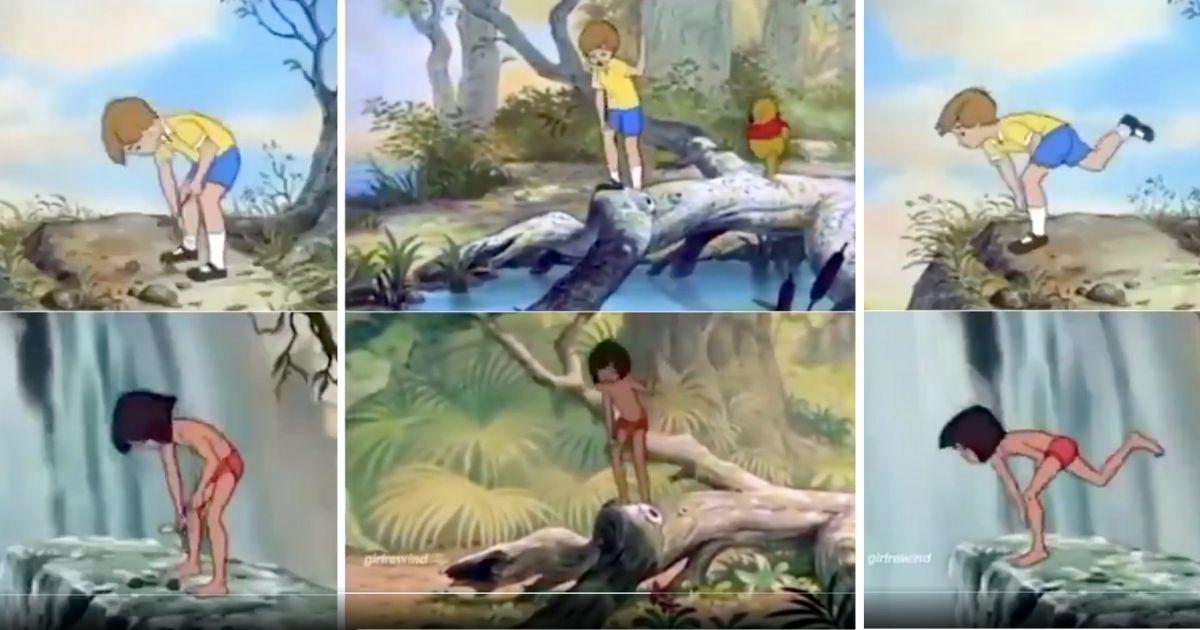
Someone realized these scenes from different Disney movies are identical and you can't unsee it

Have you ever been watching a Disney movie and had a bit of deja vu? Not just that "Oh, this movie has that familiar Disney look and feel" feeling, but more like, "I swear I've literally seen this exact scene before in another movie"?

If you've watched a lot of Disney films, you actually have seen the same scenes repeated in different movies. People have been pointing out parallel sequences on social media and it's got some folks super freaked out.

Check it out:


Watching that "Jungle Book" and "Winnie the Pooh" sequence, there's no denying it's exactly the same animation template, just with different backgrounds and characters. But how? And why?

Disney has actually been recycling its animation for various movie scenes since it created Dumbo in 1941. Floyd Norman, a veteran Disney animator who has worked on Disney films as far back as Sleeping Beauty in 1959 and as recently as Mulan and Toy Story 2, weighed in on the reason for reusing animation sequences, saying:

"It was done probably to save time, save money. Although I don't think it saved much time and I don't think it saved much money because it was much more of a hassle to go dig this old footage out of the archive. It would've been easier to just sit down and animate a new scene than to go back and try to retrofit all this old stuff to something new. We're looking back to the 1960s and 70s when people weren't thinking how films would change, how media would change, and how people would be able to look at these various films and compare one film against another."

This video by Cartoon Hangovers shares various recycled Disney scenes and explains why they were reused, showing how it all began with animators tracing over live footage of real actors to create more realistic animation in Disney's first full-length feature film, "Snow White."

Every Recycled Disney Shot & Why - Snow White, Frozen, Toy Story, Moana and More - Cartoon Hangover youtu.be

Despite the eventual mega-success of the Disney empire, the company's beginnings were not so rosy. "Snow White" was a surprise box office hit, but follow-up films "Pinocchio," "Bambi," and "Fantasia" went way over budget and were considered losses for the studio. "Dumbo" was a success, but then WWII hit. That's when Disney really got started with resuing animation.

The main reason was purportedly to save time and money. According to Floyd Norman, Walt Disney himself probably never even knew or noticed that animators were recycling scenes. He was focused more on the big picture and not so concerned with the technical processes of the animators.

The practice of reusing scenes continued, with "The Sword in the Stone" and "The Jungle Book" in particular snagging lots of scenes from previous Disney projects. But there are lots of well-known examples, including "The Aristocats" reusing scenes from "101 Dalmations," and "Robin Hood" stealing scenes—and even parallel characters—from "The Jungle Book" (Ever notice how similar Little John and Baloo are?) and other Disney films.

These Disney films from the 60s, 70s, and 80s can trace their recycled animation primarily back to one director–Woolie Reitherman. He's not the only one to utilize the reuse of animation, but he's best known for it. He basically didn't see a reason to reinvent the wheel.

However, the practice didn't necessarily save time or money. Floyd Norman has pointed out that it's a lot of work to go through old footage, find what you want, and remake it into a new animation. In some ways, it would be easier just to animate from scratch.

Even newer Disney movies have reused scenes, though more often not, those serve as an homage to the original films that made the newer films possible. Such is the case with the dancing scene at the end of "Beauty and the Beast," which mirrors the one at the end of "Sleeping Beauty."

So no, it's not your imagination—there is no shortage of Disney scenes that are repeated in different Disney films. No one is complaining, of course, with Disney having made dozens of beloved productions enjoyed by billions of people. Perhaps recycling scenes is even part of what gives us a sense of familiarity when we watch a Disney movie.

At the end of the day, animators are magicians. Whatever tools they use to make the magic happen, so be it.

Images courtesy of John Scully, Walden University, Ingrid Scully
True

Since March of 2020, over 29 million Americans have been diagnosed with COVID-19, according to the CDC. Over 540,000 have died in the United States as this unprecedented pandemic has swept the globe. And yet, by the end of 2020, it looked like science was winning: vaccines had been developed.

In celebration of the power of science we spoke to three people: an individual, a medical provider, and a vaccine scientist about how vaccines have impacted them throughout their lives. Here are their answers:

John Scully, 79, resident of Florida

Photo courtesy of John Scully

When John Scully was born, America was in the midst of an epidemic: tens of thousands of children in the United States were falling ill with paralytic poliomyelitis — otherwise known as polio, a disease that attacks the central nervous system and often leaves its victims partially or fully paralyzed.

"As kids, we were all afraid of getting polio," he says, "because if you got polio, you could end up in the dreaded iron lung and we were all terrified of those." Iron lungs were respirators that enclosed most of a person's body; people with severe cases often would end up in these respirators as they fought for their lives.

John remembers going to see matinee showings of cowboy movies on Saturdays and, before the movie, shorts would run. "Usually they showed the news," he says, "but I just remember seeing this one clip warning us about polio and it just showed all these kids in iron lungs." If kids survived the iron lung, they'd often come back to school on crutches, in leg braces, or in wheelchairs.

"We all tried to be really careful in the summer — or, as we called it back then, 'polio season,''" John says. This was because every year around Memorial Day, major outbreaks would begin to emerge and they'd spike sometime around August. People weren't really sure how the disease spread at the time, but many believed it traveled through the water. There was no cure — and every child was susceptible to getting sick with it.

"We couldn't swim in hot weather," he remembers, "and the municipal outdoor pool would close down in August."

Then, in 1954 clinical trials began for Dr. Jonas Salk's vaccine against polio and within a year, his vaccine was announced safe. "I got that vaccine at school," John says. Within two years, U.S. polio cases had dropped 85-95 percent — even before a second vaccine was developed by Dr. Albert Sabin in the 1960s. "I remember how much better things got after the vaccines came out. They changed everything," John says.

Keep Reading Show less
Image by 5540867 from Pixabay

Figuring out what to do for a mom on Mother's Day can be a tricky thing. There's the standard flowers or candy, of course, and taking her out to a nice brunch is a fairly universal winner. But what do moms really want?

Speaking from experience—my kids range from age 12 to 20—a lot depends on the stage of motherhood. What I wanted when my kids were little is different than what I want now, and I'm sure when my kids are grown and gone I'll want something different again.

We asked our readers to share what they want for Mother's Day, and while the answers were varied, there were some common themes that emerged.

Moms of young kids want a break.

When your kids are little, motherhood is relentless. Precious and adorable, yes. Wonderful and rewarding, absolutely. But it's a LOT. And it's a lot all the fricking time.

Most moms I know would love the gift of alone time, either away at a hotel or Airbnb or in their own home with no one else around. Time alone is a priceless commodity at this stage, especially if it comes with someone else taking care of cleaning, making sure the kids are fed and safe and occupied, doing the laundry, etc.

This is especially true after more than a year of pandemic living, where we moms have spent more time than usual at home with our offspring. While in some ways that's been great, again, it's a lot.

Keep Reading Show less
Courtesy of CeraVe
True

"I love being a nurse because I have the honor of connecting with my patients during some of their best and some of their worst days and making a difference in their lives is among the most rewarding things that I can do in my own life" - Tenesia Richards, RN

From ushering new life into the world to holding the hand of a patient as they take their last breath, nurses are everyday heroes that deserve our respect and appreciation.

To give back to this community that is always giving so selflessly to others, CeraVe® put out a call to nurses to share their stories for a chance to be featured in Heroes Behind the Masks, a digital content series shining a light on nurses who go above and beyond to provide safe and quality care to patients and their communities.

First up: Tenesia Richards, a labor and delivery nurse working in New York City who, in addition to her regular job, started a community outreach program in a homeless shelter that houses expectant mothers for up to one year postpartum.

Tenesia | Heroes Behind the Masks presented by CeraVe www.youtube.com

Upon learning at a conference that black mothers in the U.S. die at three to four times the rate of white mothers, one of the widest of all racial disparities in women's health, Richards decided to take further action to help her community. She, along with a handful of fellow nurses, volunteered to provide antepartum, childbirth and postpartum education to the women living at the shelter. Additionally, they looked for other ways to boost the spirits of the residents, like throwing baby showers and bringing in guest speakers. When COVID-19 hit and in-person gatherings were no longer possible, Richards and her team found creative workarounds and created holiday care packages for the mothers instead.

Keep Reading Show less