How the unscripted hand flex in ‘Pride and Prejudice’ became an iconic romantic moment

This subtle, two-second scene has had women swooning for 20 years.

pride & prejudice, mr. darcy, hand flex scene, matthew macfadyen, film
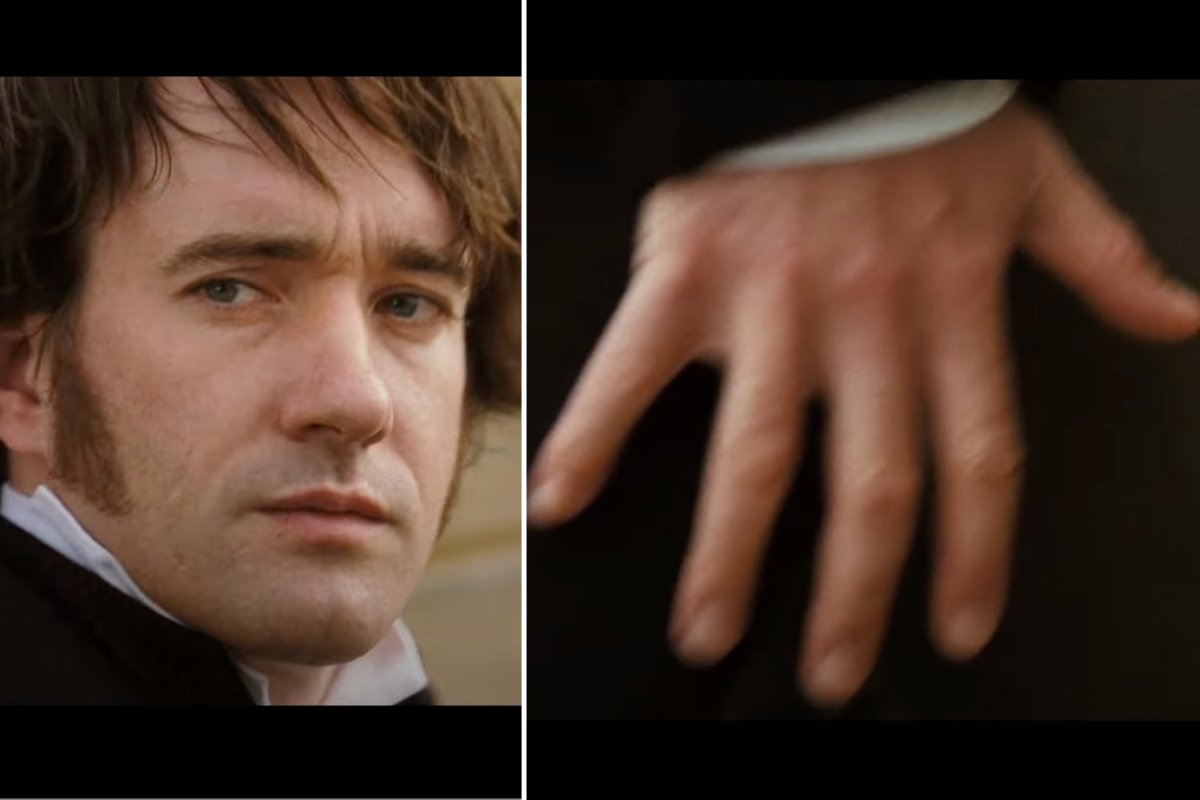
Mr. Darcy's hand flex packs a huge romantic wallop.Photo credit: Focus Features/YouTube

When we think of romantic moments in film, some classic scenes come to mind. Billy Crystal yelling his love at Meg Ryan on New Year’s Eve in When Harry Met Sally. The much-spoofed “I’m flying” scene in Titanic. The cheesy-but-effective “You had me at hello” line in Jerry Maguire. We watch romantic movies for precisely these interactions that allow us to live vicariously through the characters and feel the chemical rush of falling in love.

Romantic scenes generally include a declaration of love, a passionate embrace or kiss, or some other overt expression of affection and desire. But one romantic scene that involves none of those things has become an iconic fan favorite despite it just being a brief close-up shot of a hand.

The “hand flex” from Joe Wright’s 2005 adaptation of Jane Austen’s Pride & Prejudice says more in two seconds than many entire scenes do, which is what makes it so powerful. Some people even call it the sexiest non-sex scene in cinema.

In the scene, Mr. Darcy (played by Matthew MacFadyen) briefly takes Elizabeth Bennett’s (played by Keira Knightley) hand to help her into a carriage. At this point in the story, the two characters have been prickly toward one another after getting off on the wrong foot, though their attraction is becoming palpable. For the quickest of moments, their hands touch and their eyes meet, and there’s an unspoken flash of recognition. Then, as Darcy walks away from the carriage, he flexes his hand—literally for two seconds—and despite it being the slightest gesture that no one would even notice in real life, it speaks volumes about what he’s feeling.

Chemistry. Electricity. Longing. Tension. It’s all right there in his outstretched fingertips.

Director Joe Wright shared with PEOPLE how the scene came about.

“It wasn’t in the script, but that was an important moment in the book,” Wright said. “This sudden realization, as they were parting, of what they meant to each other or the kind of disturbance they caused in each other.”

Wright said the hand stretch was an improvised move by MacFadyen’s, though MacFadyen has said that Wright was the one who initially noticed him doing it.

“”Our bodies are so much smarter than our minds often,” Wright told PEOPLE. “Although their conscious minds are fighting against each other, their bodies are two magnets drawn to each other. As they touch, even that little hand lifting helping her, which is pure etiquette of the period, somehow creates this kind of electronic shock wave through them both, and he has to shake it away.”
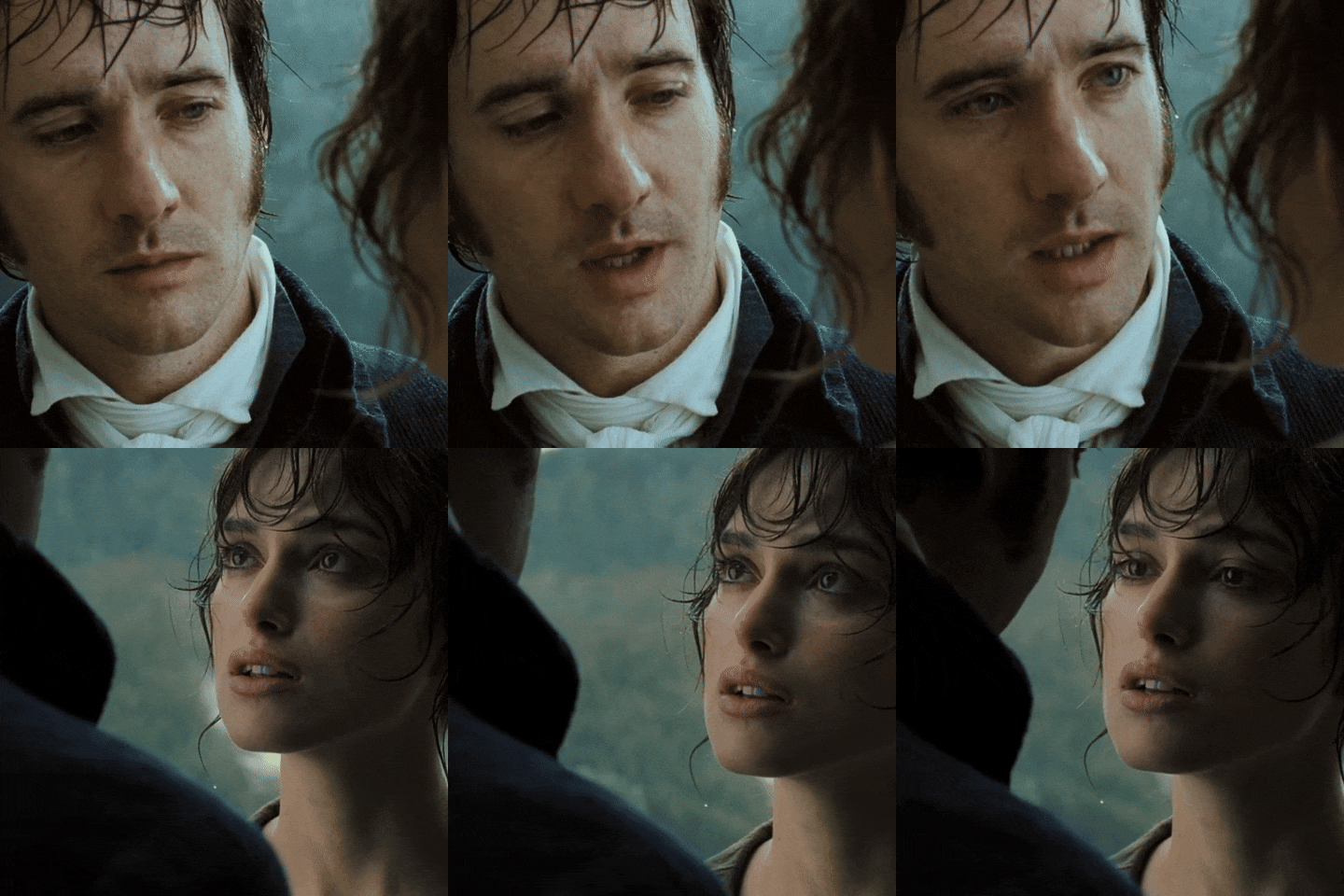
pride and prejudice, mr. darcy, elizabeth bennett, film, love scene
Pride And Prejudice GIF by Working Title Giphy

Those electrical pulses of sheer chemistry are visceral when they happen in real life, and in that simple stretching of his fingers we can all feel it. Ironically, however, Wright had been disappointed with that day’s filming, feeling like he hadn’t captured what he hoped to in the scene.

“It had been a gloomy day when we shot it,” Wright told PEOPLE. “I felt like I hadn’t conveyed what I wanted to, and it’s odd and gratifying to find that we told our story, and people have responded. Because on the day, I thought, ‘Oh no, we didn’t get it. It was rubbish. It didn’t work.’ Now, people are still posting it. It’s odd and really nice.”
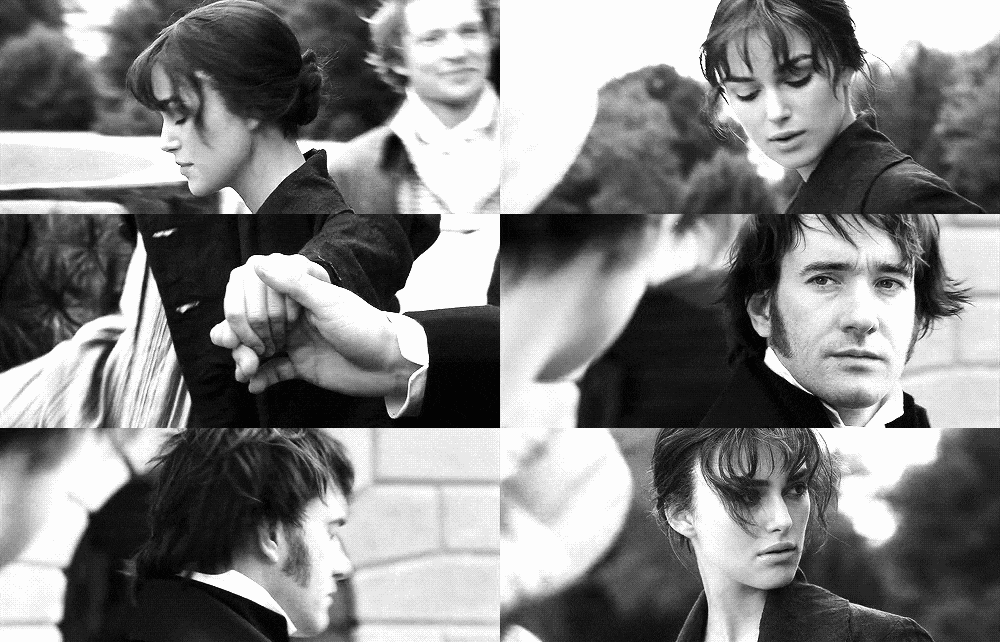
hands, scene, pride and prejudice, hand scene, mr. darcy, film
Pride & Prejudice Giphy

Imagine thinking that scene hadn’t worked. So many people really do doubt themselves more than they should, eh? As people’s commentary makes clear, the scene is perfection.

“This is my favourite minute of acting from all the films I’ve seen over my 57 years.”

“That’s it. This is more intimate than other scenes from romance movies.”

“I’m watching this movie for the first time (shocker i know), and this scene is so intensely romantic it’s crazy—more intimate than full body contact. I think it’s because of how they filmed it, all close-up shots.”

“Like an electric current ran from her to him and the only way he could express what teaching her means is that hand-flex. That’s how you tell a whole story with one gesture. Swoooonniing.”

“Tell me you want me without saying a word. This IS most women’s dreams.”

“I always come back to this scene IT SHOOOK ME.”

“This scene has its own separate fan base.”

Fans can see the hand flex on the big screen for the film’s 20th anniversary as it will be re-released in select theaters on April 20, 2025. It’s worth a trip to the movie theater, as the 2005 Pride & Prejudice has a gorgeous aesthetic that is enhanced on a larger screen. Joe Wright really did know what he was doing with this film from start to finish, hand flex and all.


  • Hugh Grant finally tells ‘Bridget Jones’ co-star Renée Zellweger what he always thought of her

    Hugh Grant and Renée Zellweger have made movie magic with their roles in the Bridget Jones film series. The two first co-starred in the original Bridget Jones’s Diary back in 2001. Since then, there have been three additional Bridget Jones movies: Bridget Jones: The Edge of Reason (2004), Bridget Jones’s Baby (2016), and Bridget Jones: Mad About the Boy (2025)—although Grant did not appear in 2016’s Bridget Jones’s Baby.

    The result has been a long-standing friendship between the actors off-screen, with Grant developing a soft spot for Zellweger. During an appearance on The Graham Norton Show in 2016, Hugh agreed with his original assessment that she’s “delightful. Also far from sane. Very good kisser.”

    When pressed, Hugh jokingly said, “She is genuinely lovely, but her emails are 48 pages long. Can’t understand a word of them.”

    Now, ten years later, Renée is returning to her Bridget Jones character, and the two reunite for a piece called “Bridget Jones: Mad About the Boy” for British Vogue. Apparently in their OG Bridget Jones days, had tons of questions between on-set shots for Renée. Examples include: “If you had to marry one of today’s extras, who would it be?” and “Who is a better kisser, me or Colin Firth?”

    This time, there was a new slew of questions for each actor. Here are a few key things we find out:

    What did Hugh always think of Renée?

    He says candidly (of course), “With a lot of other actors, you think they’re really great, and then suddenly you see a little glint of steely, scary ambition, and you realize this person would trample their grandmother to get what they want in this business. But I’ve never seen that glint coming off you. So either it’s very well disguised, or you are quite nice.”

    What does Renée really think of Hugh?

    “You’re hilariously brilliant at everything you hate. And, though you hate humans, you’re a very good and loyal friend. I like you very much. And I love working with you.”

    And during a February 2025 interview on TODAY while promoting Bridget Jones: Mad About the Boy, Jones shared about Grant, “He’s mastered cute-grouchy for sure…I mean, 25 years of coming together and catching up through this experience, I’ve come to know him in a really lovely way… I just adore him.”

    What did Hugh really think of her English accent?

    After discussing Renée’s dialect coach, Hugh tells her that her attempt at an English accent is…”perfect.”

    Why does the Bridget Jones franchise remain so appealing?

    Hugh says, “In a nutshell, I say it’s an antidote to Instagram. Instagram is telling people, especially women, ‘Your life’s not good enough.’ It’s not as good as this woman’s or that woman’s, making you insecure. Whereas what Helen (the writer) did with Bridget is celebrate failures, while making it funny and joyful.”

    Renée makes some jokes and then says, “I think maybe folks recognize themselves in her and relate to her feelings of self-doubt. Bridget is authentically herself and doesn’t always get it right, but whatever her imperfections, she remains joyful and optimistic, carries on, and triumphs in her own way.”

    @thisisheart

    Renee Zellweger on what goes down in her email thread with Hugh Grant! #bridgetjones #reneezellweger #hughgrant #Fyp #foryou #celeb #movies

    ♬ original sound – Heart

    What does Hugh think of Renée’s fashion?

    After asking if people in general should be a “bit more stylish,” Hugh tells Renée she’s “very chic.” Renée pushes back with, “I’m wearing a tracksuit.” To which Hugh retorts, “Yeah, but a sort of PRICEY one.”

    And finally, those emails:

    “You have sent me the longest emails I’ve ever received. I can’t understand a single word of them. They’re written in some curious language that I can’t really understand.”

    “No!” Renée exclaims. “If you reference something in your emails that makes me laugh…I will circle back to that. And if you’ve forgotten that you wrote it, I don’t think I should be held accountable for that!”

    This article originally appeared last year. It has been updated.

  • Gen Zers try, and hilariously fail, to guess Gen X movies after hearing one famous line
    Well this was painful to watch.Photo credit: via @larrylexicon/Instagram used iwth permission

    It’s no secret Gen Zers aren’t necessarily the biggest fans of Gen X movies. Many parents eagerly await the day to finally blow the dust off that Dead Poets Society or Sixteen Candles VHS, only to find that their kids doesn’t hold quite the same shine to it. And, let’s be honest, neither do we a lot of the time once we rewatch through a more modern lens.

    But it’s another thing entirely for them to have no earthly idea what some of the biggest, most quotable movies of the ’80s and ’90s are, period.

    Recently, a teacher who goes by Larry Lexicon on Instagram asked his class to guess the name of a classic Gen X movie using only one iconic quote from it. Here were some of the quotes:

    “Nobody puts baby in a corner.”

    “I feel the need. The need for speed.“

    “Life moves pretty fast. If you don’t stop and look around once in a while, you could miss it.”

    “Yipee ki yay”

    “I want my two dollars.”

    “If you build it, they will come.”

    Now, you and I both know that these lines are from Dirty Dancing, Top Gun, Ferris Bueller’s Day Off, Die Hard, Better Off Dead, and Field of Dreams. But these kiddos had no idea. They couldn’t even begin to guess where these quotes came from. Nothing but blank stares.

    But what’s even funnier were the, ahem, creative reaches some other students had.

    For instance, one kid guessed that the line “Hello. My name is Inigo Montoya. You killed my father. Prepare to die,” was from Zorro (the answer is, of course, The Princess Bride).

    Another said “Come with me if you want to live” was from Impractical Jokers (it’s from Terminator), while a third guessed that, rather than Karate Kid, “Sweep the leg!” is from Legally Blonde. (Although, that student admitted it’s because she thought of “bend and snap.”)

    One kid even had the audacity to say that “It’s the car, right? Chicks dig the car,” was from Stranger Things, which is both hilarious and also kind of makes sense when you think about it.

    There was actually only one correct guess in the entire bunch: “What are you looking at, butthead?” is from Back to the Future, but that’s only because this kiddo got help from an offscreen classmate. So really, it was one big goose egg.

    While many in the comments joked that this was a result of “parental failure,” another content creator by the name of “The Treehouse Detective” surmised that the real reason Gen Zers generally aren’t as knowledgeable about the pop culture that happened before they were born as their predecessors is that they grew up with streaming services instead of cable.

    @treehousedetective The real reason millennials know more about movies and tv before they were born than Gen Z #movies #television #millennials #genz #filmtok ♬ original sound – Treehouse Detective

    Treehouse Detective explained: “In the ’80s and ’90s, when cable programming really exploded, many networks began creating singular channels meant to focus only on certain genres. Cartoon Network played only cartoons, Comedy Central played only comedy, and so on. But networks still had to fill 24 hours worth of content, and thus would buy old libraries of movies and TV shows, otherwise known as “reruns,” and fill their slots that way. So, millennial kids were passively being educated about older forms of entertainment.

    The same can certainly not be said about Gen Z or Gen Alpha kids, who have access to exponentially more content, not to mention more mediums in which to receive that content. So it’s understandable that they might not feel motivated to watch a “B movie from the ’70s,” argued Treehouse Detective.

    So, what does this mean? Will we never be able to connect through movie quotes again? Is it only memes now? Is cinema dead? Perhaps. But while we might not have the same monoculture of yesteryear, maybe we’ll find solace in throwing around quotes from our favorite modern-day shows with our close group of friends. We’ll bond with the youngsters some other way.

  • Matthew McConaughey says an iconic memory of his brother inspired one of his most beloved characters
    Matthew McConaughey in Dazed and Confused (1993)Photo credit: IMDB

    One might not call David Wooderson from Dazed and Confused a wholesome character. Iconic? Timelessly quotable and effortlessly cool? Sure. But wholesome? That’s a stretch. And yet, the childhood memory that helped Matthew McConaughey create that star-making role is just that: wholesome.

    While appearing on the Jan. 7 episode of the Where Everybody Knows Your Name podcast hosted by Ted Danson and Woody Harrelson, McConaughey shared how he actually landed the role, and it’s about as classic a Hollywood story as you can get.

    Apparently, one of McConaughey’s film school classmates worked as a bartender for the rooftop bar at the Hyatt. One night, McConaughey went to visit this friend, who informed him that casting director Don Phillips was sitting close by.

    McConaughey went over to talk to Phillips, and the two hit it off. Perhaps a little too well, because, McConaughey recalls, “Three and half hours later, we get kicked out” after a conversation about golf led to Phillips hopping onto a table to demonstrate his swing.

    While sharing a cab home, Phillips asked McConaughey, “Hey, you ever done any acting?” to which he answered honestly: “I said, ‘Yeah, I was in a Miller Light commercial. I don’t know if you consider that acting. Maybe it was more of a modeling job.’ ”

    Still, Phillips thought he “might be right” for the role of Wooderson in a Richard Linklater coming-of-age film titled Dazed and Confused. Knowing only that the character was someone “out of high school, but he still likes the high school girls,” McConaughey showed up at 9:30 a.m. the next morning to a script and a handwritten note that read, “Hey, Matthew, great night last night. I read this part. You might be right for it.”

    Skimming the script, McConaughey found that now-immortal words, “That’s what I love about them high school girls, man. I get older, but they stay the same age.” He instantly knew that was a “launchpad line.”

    During the two weeks leading up to the audition while McConaughey was “trying to figure” the true spirit of his character, he was struck by a memory of picking up his older brother Pat from school with his mom while his car was at the shop.

    “We’re driving through the campus and I’m looking out the back end of that wood-paneled station wagon. I’m looking for Pat. . . . And as we’re going by, about 200 yards away, I see this shadowed figure leaning against the shady wall in the smoking section,” McConaughey recalled.

    He continued, “I can see the ember of this lazy finger cigarette hanging on these two hands. This guy’s leaning against the wall with his left leg, boot heel up against the wall, smoking. And I went, it’s my brother.” Not wanting his big brother to get in trouble for smoking, little McConaughey let his mother keep driving. Somehow, Pat got home on his own.

    “In my 10-year-old eyes, my 17-year-old brother, who was my hero, in that shot from 200 yards away, he was cooler than James Dean. He was 9 feet tall. He was the coolest man. Now, that’s who I based Wooderson on,” McConaughey gushed. “That wasn’t who my brother was, but that, in my 10-year-old eyes, that’s who it was.”

    Matthew McConaughey, Dazed and Confused, 90s movies, ted danson, ted danson podcast, woody harrelson, movies, pop culture
    Matthew McConaughey and Shawn Andrews inu00a0Dazed and Confused (1993) Facebook

    From that point, McConaughey had a solid anchor. When he showed up for the audition, he was ready. He even improvised everyone’s favorite “Alright, alright, alright” line. When Harrelson and Danson asked if McConaughey ever tires of people saying it to him, he replied with an adamant, “Hell no.”

    It’s always amazing to hear what tiny spark sets off someone’s creativity, isn’t it? What a great reminder that life provides an endless supply of inspiration.

    Watch the full episode of Where Everybody Knows Your Name below:

  • In 1986, Bill Murray dished on Looney Tunes characters as if they were real people for 2 mesmerizing minutes
    Bugs Bunny asks "What's up doc?" Bill Murray poses. Photo credit: Photo Credit: Canva, Mark Anderson, Flickr, Wikipedia Commons

    In 1986 Saturday Night Live creator Lorne Michaels and his production company released a mockumentary, but it wasn’t just any spoof. Set to look like it was honoring the 50th anniversary of the Looney Tunes cartoon universe, the mockumentary showcased the characters as if they were very much real Hollywood stars. The idea was to have famous people discussing the beloved animated characters as if they were colleagues. The cast was incredibly star-studded. A barrel-full of impressive celebrities, such as George Burns, Kirk Douglas, Candace Bergen, Jeff Goldblum, Jeremy Irons, Molly Ringwald, and Billy Dee Williams showed up to do their part.

    In an Instagram Reel from the account Toons, Tunes, and Trash (@toonstunesandtrash), they add, “From the music world, you had Cher, Quincy Jones, and David freaking Bowie. From the Lorne-verse, you had Chevy Chase, Steve Martin, and Bill Murray. For a bit of realism, Mel Blanc, Friz Freleng, and Chuck Jones are also interviewed in non-bits.”

    But it’s Bill Murray who steals the show. While most of the others seem to be working off a script, Murray riffs for nearly two full minutes on infamous Looney Tunes characters as though he knew them in real life. And his observations are laugh-out-loud brilliant.

    In the clip, Murray is casually shooting pool while he pretends to answer interview questions. “Bugs never did anything for anybody that didn’t serve Bugs Bunny,” he quips. “That’s why he’s a star.”

    He also suggests that Yosemite Sam was “afraid of the supernatural.” He states, “Yosemite would come onto the set and start giving Friz a little trouble. And Friz would reach in for a little voodoo thing and just wave it in front of Sam.” (Murray is referring to Friz Freleng, a Warner Bros. animator, director, and composer.)

    Now it’s time for Porky. “Porky Pig could have any dame he wanted in Hollywood. You know, with a (snaps his fingers) phone call. He goes out with this girl and he’s like, ‘She’s a pig. I don’t want to date a pig.’ You know, it’s one of those things where you always want what… you know, sort of rejecting his past and wanting more.”

    Back to the bunny. “But Bugs selling war bonds was a joke. Because Bugs was not interested in fighting, you know what I mean? He couldn’t get arrested. After Knighty Knight Bugs’, because all of a sudden Bugs was the superstar. He was the artist. And Pepe was just a little skunk.”

    And speaking of that skunk, Murrary shares, “So Pepe left. He bailed out. He went over to Europe. He worked in France. He did art films over there. He was loved by a lot of people, and whenever we’d go over, everybody would look him up. But he never came back. He never visited.” Murray then attempts a French accent. “It was always ‘If you are here, please stop by.’ And you’d go by and he was so gracious and so lovely and he would always say, ‘Oh, how is Bugs?’ And you knew it was breaking his heart.”

    Time for the duck. “Everyone knew it was Daffy’s picture all the way. Daff was unique. He was a maverick. He was a rebel. And he’s a lot more intelligent than people give him credit for. I mean, I have no respect, intellectually, for Fudd. It’s not that I don’t like Fudd, I just don’t have any respect for him intellectually. And Daffy… I do have respect for.”

    The Instagram handle also explains that the whole concept seemed to have little to do with any kind of actual anniversary. “It was tied into a Looney Tunes exhibit opening up at the MoMA entitled ‘That’s Not All, Folks!: Warner Bros. Cartoons Golden Jubilee.’ (The Cartoon Golden Jubilee was also a hugely successful video series of this stuff. This wabbit hole goes deep.)”

    In a 2012 Vulture article entitled, “Bill Murray, Steve Martin and the Bugs Bunny; The Looney Tunes 50th Anniversary Special,” author Matthew Callan writes, “The fact that the 50th anniversary special was produced by Lorne Michaels’ Broadway Video should give your first clue as to the tone. Near its close, legendary animator Chuck Jones confesses, ‘Our pictures were never made for children. Our pictures were never made for adults. They were made for us.’ The same could have been said of this special. It was clearly done primarily for the enjoyment of the people involved.”

    If you watch it, it’s clear the whole cast had a great time dishing on Hollywood scandals. Callan shares, “This ‘gossip’ was punctuated by a perfectly selected array of classic cartoons, edited together for maximum comic effect.”

    In a 1986 “review” of the film, New York Times writer John O’Connor writes, “With tongues nailed firmly to cheek, in time-honored cartoon style, the guests very seriously reveal their innermost thoughts about these peculiarly American heroes.” Mentioning Murray as “bitter,” O’Connor goes on to say that some of the stars, like Cher, are “wistful.”

    O’Connor makes it clear that there are real insights into the people and messages behind the scenes at Warner Bros. “Some of the studio’s top animators are on hand to offer insights into their creations. Chuck Jones sees Bugs Bunny as an aspiration, ‘what you’d like to be like,’ as opposed to Daffy Duck, ‘what you are afraid you’re really like.’”

    Highlights aside from Bill Murray, include Chevy Chase who, just before the opening credits, states, “Bugs just kind of plays himself. I’ve never really seen him stretch as an actor.”

    David Bowie, always down for a good joke, changes his tune on Bugs. “Look,” he says. “I don’t know Bugs Bunny. Alright, I’ve met him. In fact, I know him pretty well, but I’d never work with him… except I might be doing an album with him.”

    Jeff Goldblum hilariously defends Porky, saying, “Porky is not washed up, if that’s what they’ve been saying. He’s, as a matter of fact, for your information, the greatest and most versatile actor to ever work in the business.”

    And Steve Martin goes the extra absurdist route, insisting that movie stars simply copy Bugs, such as the time Paul Newman was spotted eating carrots.

    Upworthy had a chance to chat with the Toons, Tunes, and Trash Instagram handle creator Mike Hadge, who adds his point of view as to why the Bill Murray bit was so special.

    “Bill Murray’s wiring is just so perfectly installed to endlessly riff on Yosemite Sam’s presence on set and things like that. When people refer to ‘yes and-ing‘ something in regards to improvisation, this is what they mean. It helps that Murray trained in comedy under Del Close, the godfather of the ‘yes and…’ philosophy of improv, at Second City. That said, this is just how Bill Murray lives and breathes. Lucky us!”

    Additionally, he tells us that having had Lorne Michaels at the helm of the whole thing totally tracks. “The odd approach taken in the special makes sense when you realize this whole thing was produced by Lorne Michaels, who, aside from SNL, produced another faux-documentary eight years earlier in The Rutles’ ‘All You Need Is Cash,‘ an iconic Beatles riff that, by the way, ALSO featured some tasty Bill Murray riffing.”

    Hadge also shares how his account came about. “As for Toons, Tunes, and Trash, the account started six months ago as support for my online shop, which specializes in affordable vintage animation and music collectibles. The account has become an overall celebration of old animation, music, comedy—basically stuff I love made by humans. In the process, I’ve learned just how much people enjoy revisiting—or being introduced to—classic animation and the like. It’s been nice to share stuff that amuses me and see who else it amuses. Community is key, people.”

  • A mom showed ‘Ferris Bueller’ to her Gen Z kids and was surprised by who they think is the hero
    A photo collage from the movie Ferris Bueller's Day Off.Photo credit: acommons.wikimedia.org

    When my friend invited me to join her family for their once-a-month movie night, she asked which John Hughes movie she should show her 14-year-old twins. The answer was obvious. It had to be something fun, school-related, and iconic. Ferris Bueller’s Day Off seemed like the perfect choice, since we Gen X-ers loved it when we were exactly their age in 1986.

    The fraternal twins (one boy, one girl) sat down on a rare early Saturday evening when neither had dance practice or a sleepover. We gathered in our comfy clothes, popped some popcorn, and hit “rent now.”

    They were excited by the opening scene, where an adorable Matthew Broderick (doesn’t matter what generation one is, he transcends them all) is pretending to be sick in bed with worrying parents. His sister Jeanie is suspicious and exhausted by his antics, but Ferris prevails. He then delivers a brilliant monologue about eating life up and living in the moment. His now-famous line, Life moves pretty fast. If you don’t stop and look around once in a while, you could miss it,” is still plastered in quote books and on Bumble profiles.

    The twins seemed inspired, and one of them actually teared up in the first five minutes.


    Spoilers ahead: the movie is pretty simple. Ferris is a super cool high school kid with a beautiful girlfriend, Sloane, played by Mia Sara. His best friend is a depressed hypochondriac named Cameron, who is played to perfection by Alan Ruck. Ferris skips school a lot (nine times!) and grabs each day by the neck. There are themes of hedonism, nihilism, and Taoism, but neither twin mentioned them.

    The first thing both kids did bring up was how privileged the characters were. Affluent Chicago suburbs, after all, was the setting John Hughes knew best. They also noted, as many have over the years, that Ferris seemed rather selfish and insensitive to what others in his life wanted and needed.

    Who is the true hero of ‘Ferris Bueller’s Day Off’?

    There have been many conversations over the years about Cameron being the true hero of the film. He has an unwavering story arc, unlike Ferris’s. He’s sad, but pushes through it and even gets the guts up to stand up to his father after accidentally totaling the old man’s prized Ferrari.

    In fact, there was a theory that Ferris was a figment of Cameron’s imagination—a Fight Club scenario, if you will. Robert Vaux writes on CBR, “The theory holds that the entire day is a fantasy taking place in Cameron’s head while he lies sick in bed. His sickness actually supports the theory: once Ferris comes over, it vanishes, and Cameron plunges energetically, if reluctantly, into the events of the day. According to the theory, it’s because there are no events of the day. He’s still sick at home, and the whole thing is a daydream.”


    I fully expected the twins to have similar thoughts. If not the Fight Club part, at least the idea that Cameron was the true protagonist. But what they (both of them) said instead was shocking. “No,” the daughter told me. “I mean, I liked Ferris, and I loved Cameron. But it’s Jeanie who’s the hero here.”

    Jeanie, the sister mentioned earlier, was played with pure rage by Jennifer Grey. She spends most of the movie attempting to narc on Ferris rather than enjoying her own beautiful day. She is angry and determined until…she meets a “bad boy” at the county jail, played complete with bloodshot eyes by Charlie Sheen.

    (Sheen stayed up super late the night before the shoot so that he looked weary. “I just figure if I show up looking tired, that’s going to be an asset. I need to look tired, so I’m gonna be tired. There was no booze, no dope, there was nothing involved in that night preparing for this,” he said.)

    Taken aback, their mom pushed back. “Jeanie, the sister? Why?”

    The son answers, “She just changes the most. She starts out, like, having it in for Ferris. Really, having it in for EVERYONE. And then she just like figures it out.” The daughter adds, “Yeah, in the end she was rooting for Ferris. She came the farthest from where she started and she’s the one who kinda saved him.”

    Gobsmacked, I turned to Reddit for more answers. In the subreddit r/movies, someone recently posted, “Something I noticed about Ferris Bueller’s Day Off.” They then proceed to drive the Cameron theory forward. “At the start of the film, Cameron is in bed sickly and not really confident in himself, but as the movie progresses, he starts to get more confidence, and by the end, he gains the courage to stand up to his father.”

    What is a flat or static character?

    A Redditor replies with this thoughtful answer: “I’ve heard it called a flat character arc when the protagonist doesn’t change but is instead the catalyst for those around them to change. It’s hard to pull off but is often the most satisfying kind of character. Ted Lasso (especially in season one) is a good example.”

    Others echo that idea, offering up characters like Forrest Gump and The Dude from The Big Lebowski. Chauncey Gardiner in Being There is another great example; he remains the same while the world projects its own personality onto him. So is Mary Poppins; she blows into town, has a big effect on everyone around her, and then flies off.

    These characters stayed exactly the same while the world or others in their lives changed around them. It’s described on a YouTube clip as The moment you realize the main character is not actually the main character.”

    This would give credence to the twins’ opinion. But I’d never heard anyone choose Jeanie before (and they weren’t swayed by Grey’s performance in Dirty Dancing because they hadn’t seen it yet). When pressed one more time, their answer didn’t change. “No doubt, it’s the sister. She should have a spinoff.” Their mom was so proud, and we all totally agree.

    This article originally appeared last year. It has since been updated.

  • Ethan Hawke playfully roasts Rose Byrne over her 16-year-old brutal review of his first novel
    Rose Byrne and Ethan Hawke had a hilarious exchange over her past book reviewPhoto credit: Rose Byrne (Greg Hernandez/Wikicommons), Ethan Hawke (Wikicommons)

    The New York Film Critics Circle Awards 2025 was a time of celebration of great movies and performances from the previous year that also included a great ribbing. As part of the awards presentation, actor Ethan Hawke had the honor of introducing the winner of Best Actress, Rose Byrne, to the stage at the Film Critics Dinner, but not without a rebuttal that was 16 years in the making.

    Hawke revealed at the podium that he discovered that Byrne had left a Goodreads review of his 1996 book The Hottest State back in 2010. In her review, given under her first name only, Byrne gave the book two out of five stars, saying that she read it because the book was “lazing around on set.” She ended her review with, “It’s kind of like a Ryan Adams song but not as good.”

    The audience laughed as the gobsmacked Byrne took the stage and approached the microphone. Hawke laughed as well, greeting Byrne with a smile, a peck on the cheek, and a hug as she accepted her award for her performance in the film If I Had Legs I’d Kick You.

    “I never thought you would read that review. Ever! Ever! Goodreads is so daggy, like, no one reads it,” Byrne declared with the crowd, and Hawke, laughing.

    While she didn’t care for his book at the time, Byrne was certainly a fan of Hawke’s overall, saying, “You are the most magical person and artist whose career I put on a pedestal. I had a poster of Dead Poet’s Society on my wall.”

    Byrne was referring to Hawke’s breakthrough film role in Dead Poets Society back in 1989 which led to him becoming a movie star and household name.

    Byrne then proceeded to continue her acceptance speech. In If Had Legs I’d Kick You, Byrne portrays a woman trying to hold it together as she deals with her child’s illness, a missing person, her absent husband, and a contentious relationship with her therapist while being a therapist herself.

    Film buffs quickly pointed out that this book review call-out reflected a past film the two had starred in together. In 2018, eight years after Byrne posted that Goodreads review, she co-starred with Hawke in the rom-com Juliet, Naked. In the film, Byrne’s character meets Hawke’s rock star character after leaving an anonymous negative review of his latest album.

    Everything was all in good nature, fun, with a sweet ending with Byrne saying this to Hawke before accepting her award:

    “Whether I see you on the street corner in Brooklyn or at a black tie event, your spirit is infectious, insightful, inspiring. I walk away having a better day.”

  • ‘Wicked’ author shares the one ‘Wizard of Oz’ line that inspired Elphaba and Glinda’s story
    The two witches in "The Wizard of Oz" clearly had a history together.Photo credit: Public domain, Tenor
    , ,

    ‘Wicked’ author shares the one ‘Wizard of Oz’ line that inspired Elphaba and Glinda’s story

    Wicked author Gregory Maguire says he “fell down to the ground” laughing when the idea hit him.

    Have you ever watched a movie or read a book or listened to a piece of music and wondered, “How did they come up with that idea?” The creative process is so enigmatic even artists themselves don’t always know where their ideas come from, so It’s a treat when we get to hear the genesis of a brilliant idea straight from the horse’s mouth. If you’ve watched Wicked and Wicked: For Good, and wondered where the idea for the friendship between Elphaba (the Wicked Witch) and Glinda (the Good Witch) came from, the author of the book has shared the precise moment it came to him.

    The hit two-part movie Wicked is based on the 20-year-old hit stage musical, which is based on the novel “Wicked: The Life and Times of the Wicked Witch of the West” written by Gregory Maguire. While the musical is a simplified version of the 1995 book, the basic storyline—the origin story of the two witches from “The Wizard of Oz”—lies at the heart of both. In an interview with BBC, Maguire explained how Elphaba and Glinda’s friendship popped into his head.

    Maguire was visiting Beatrix Potter’s farm in Cumbria, England, and thinking about “The Wizard of Oz,” which he had loved as a child and thought could be an interesting basis for a story about evil.

    “I thought ‘alright, what do we know about ‘The Wizard of Oz’ from our memories,’” he said. “We have the house falling on the witch. What do we know about that witch? All we know about that witch is that she has feet. So I began to think about Glinda and the Wicked Witch of the West…

    “There is one scene in the 1939 film where Billie Burke [Glinda the Good Witch] comes down looking all pink and fluffy, and Margaret Hamilton [the Wicked Witch of the West] is all crawed and crabbed and she says something like, ‘I might have known you’d be behind this, Glinda!’ “

    “This was my memory, and I thought, now why is she using Glinda’s first name? They have known each other. Maybe they’ve known each other for a long time. Maybe they went to college together. And I fell down onto the ground in the Lake District laughing at the thought that they had gone to college together.”

    In Wicked: Part One, Glinda and the soon-to-be Wicked Witch, Elphaba, meet as students at Shiz University, a school of wizardry. They get placed as roommates, loathe each other at first, but eventually become best friends. The story grows a lot more complicated from there (and the novel goes darker than the stage play), but it’s the character development of the two witches and their relationship with one another that force us to examine our ideas about good and evil.

    Maguire also shared with the Denver Center for Performing Arts what had inspired him to use the “Wizard of Oz” characters in the first place.

    “I was living in London in the early 1990’s during the start of the Gulf War. I was interested to see how my own blood temperature chilled at reading a headline in the usually cautious British newspaper, the Times of London: ‘Sadaam Hussein: The New Hitler?’ I caught myself ready to have a fully formed political opinion about the Gulf War and the necessity of action against Sadaam Hussein on the basis of how that headline made me feel. The use of the word Hitler – what a word! What it evokes! When a few months later several young schoolboys kidnapped and killed a toddler, the British press paid much attention to the nature of the crime. I became interested in the nature of evil, and whether one really could be born bad. I considered briefly writing a novel about Hitler but discarded the notion due to my general discomfort with the reality of those times. But when I realized that nobody had ever written about the second most evil character in our collective American subconscious, the Wicked Witch of the West, I thought I had experienced a small moment of inspiration. Everybody in America knows who the Wicked Witch of the West is, but nobody really knows anything about her. There is more to her than meets the eye.”

    And to think, that little inspiration would turn into a critically acclaimed pop culture juggernaut. Arguably not just because of the dazzling costumes, choreography, and vocal prowess of both grande and Erivo…but because of the very real human elements interwoven throughout the story.

    Authors and artists—and their ideas—help hold a mirror up to humanity for us to see and reflect on who we are, and Wicked is one of those stories that makes us take a hard look at what we’re seeing in that mirror. Thanks, Gregory Maguire, for launching us on a collective journey that not only entertains but has the potential to change how we see one another.

    This story originally appeared last year.

Generations

Seniors ranting about their friend Barbara cheating at Mahjong is the Internet’s best new reality show

Education

It’s not brains or talent. Expert says high achievers have two traits anyone can learn.

Pop Culture

Gen Xers share 17 nostalgic dishes they ate growing up—and still make for dinner

Wholesome

Teacher shares her surprisingly wholesome story of learning what ‘Netflix and chill’ means