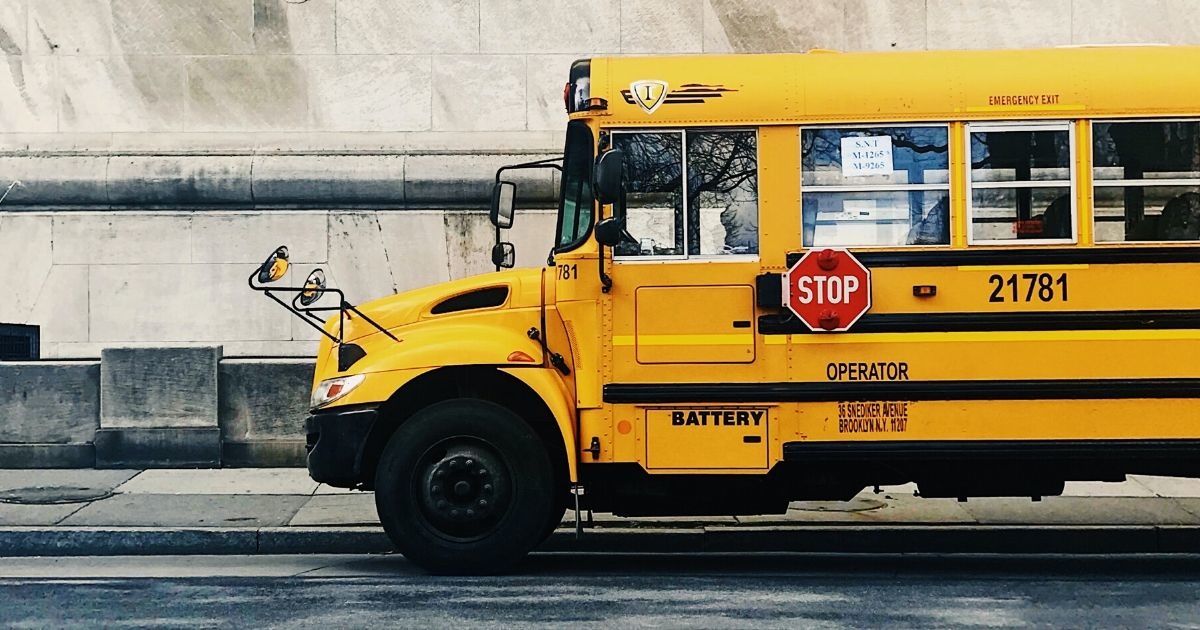
School districts are transforming buses into wifi hotspots for students without internet

If you see school buses parked around your city and get confused because schools are closed, no worries. It's likely that those buses are pumping out wifi for students who otherwise struggle for internet access.
With schools shut down across the country, school districts have had to scramble to figure out how to provide online schooling quickly. That's no simple task, and the transition has been a rocky one for administrators, teachers, parents, and kids. For families without the technology that enables that transition, it's been even harder.
Since online learning is the only way students can stay connected to schools and teachers, internet is a vital service. But despite the ubiquity of internet providers, not all families can afford internet. Even in places where internet providers are offering free wifi to families who can't afford it, some still can't afford the hardware—modems, routers—that enable them to take advantage of it.
School districts across the nation are addressing part of this issue by transforming their now-empty school buses into mobile wifi hotspots to bring online access to students. School bus hotspots fill a gap for families that aren't able to get wifi in their homes, for whatever reason. And though the idea isn't new—some districts have been using wifi-enabled buses as hotspots for years—it is becoming widespread during the pandemic.
In Montgomery, Alabama, 11 wifi-enabled buses already have rolled out, six more will go out today, and more will come next week. Montgomery Mayor Steven Reed told WSFA News why the buses are important.
"Because we understand there's a digital divide," he said. "And the coronavirus pandemic that we're into right now has only heightened the chasm that exists between those who can access high-speed internet service and those who can't."
"The idea is that any parent, any child in any neighborhood where they see that yellow school bus, they can access the WiFi hotspot," said MPS Superintendent Dr. Ann Roy Moore. "They don't have to be right down the street from their home. If they're at home, it's fine, but if they're at their grandma's house and there's a bus down the road, they can also access from that location."
The largest school district in Austin, Texas has deployed more than 100 wifi buses around the city through a $600,000 grant from Kajeet, an education technology provider.
"As we prepare for the possibility of extended school closures, we know that an Internet connection is a lifeline and a learning link for our students," Kevin Schwartz, chief technology officer for Austin ISD, said in a news release.
"Austin ISD will be deploying many of our 500+ Kajeet Wi-Fi/Internet enabled school buses to locations around our school district so that students can connect using our district Chromebooks."
The buses do have some limitations, however. The buses in Austin broadcast about 300 feet, so some students may have to go outside of their homes to catch a signal. They are not allowed to board the bus, so inclement weather can make accessing the wifi tricky for some, but it's definitely better than nothing.
One thing the COVID-19 pandemic has succeeded in doing is shining a spotlight on existing inequities in our country. School districts in low-income areas that already struggle with funding suddenly have to figure out how to provide computers and internet to students, while many wealthier districts already had laptops or tablets for every student. Thankfully, donors and organizations are stepping up to assist, but addressing the economic inequality underlying the problem will need longer-lasting institutional solutions.
In the meantime, wifi buses are an innovative temporary stopgap for families who can't access the internet otherwise.

- Some free advice for freaked out parents from a homeschooling ... ›
- A 'mother's desperate prayer' speaks to millions of parents during ... ›
- How to prepare for extended school closings—and not lose your mind ›
- Georgia 2nd grader tests positive on first day of school—whole class quarantined for two weeks - Upworthy ›
- Former FBI agent now works as a bus driver and loves it - Upworthy ›
- A teacher in China describes what post-lockdown school reopening looks like - Upworthy ›
- Woman wants to outdo her neighbor with 'funny' Wi-Fi name and the suggestions are outrageous - Upworthy ›
- Every December, a school in Ireland ditches homework and does 'kindness' assignments instead - Upworthy ›
- Another school district just shifted to a 4-day week and parents are making themselves heard - Upworthy ›


A Generation Jones teenager poses in her room.Image via Wikmedia Commons
An office kitchen.via
An angry man eating spaghetti.via 


An Irish woman went to the doctor for a routine eye exam. She left with bright neon green eyes.
It's not easy seeing green.
Did she get superpowers?
Going to the eye doctor can be a hassle and a pain. It's not just the routine issues and inconveniences that come along when making a doctor appointment, but sometimes the various devices being used to check your eyes' health feel invasive and uncomfortable. But at least at the end of the appointment, most of us don't look like we're turning into The Incredible Hulk. That wasn't the case for one Irish woman.
Photographer Margerita B. Wargola was just going in for a routine eye exam at the hospital but ended up leaving with her eyes a shocking, bright neon green.
At the doctor's office, the nurse practitioner was prepping Wargola for a test with a machine that Wargola had experienced before. Before the test started, Wargola presumed the nurse had dropped some saline into her eyes, as they were feeling dry. After she blinked, everything went yellow.
Wargola and the nurse initially panicked. Neither knew what was going on as Wargola suddenly had yellow vision and radioactive-looking green eyes. After the initial shock, both realized the issue: the nurse forgot to ask Wargola to remove her contact lenses before putting contrast drops in her eyes for the exam. Wargola and the nurse quickly removed the lenses from her eyes and washed them thoroughly with saline. Fortunately, Wargola's eyes were unharmed. Unfortunately, her contacts were permanently stained and she didn't bring a spare pair.
- YouTube youtube.com
Since she has poor vision, Wargola was forced to drive herself home after the eye exam wearing the neon-green contact lenses that make her look like a member of the Green Lantern Corps. She couldn't help but laugh at her predicament and recorded a video explaining it all on social media. Since then, her video has sparked a couple Reddit threads and collected a bunch of comments on Instagram:
“But the REAL question is: do you now have X-Ray vision?”
“You can just say you're a superhero.”
“I would make a few stops on the way home just to freak some people out!”
“I would have lived it up! Grab a coffee, do grocery shopping, walk around a shopping center.”
“This one would pair well with that girl who ate something with turmeric with her invisalign on and walked around Paris smiling at people with seemingly BRIGHT YELLOW TEETH.”
“I would save those for fancy special occasions! WOW!”
“Every time I'd stop I'd turn slowly and stare at the person in the car next to me.”
“Keep them. Tell people what to do. They’ll do your bidding.”
In a follow-up Instagram video, Wargola showed her followers that she was safe at home with normal eyes, showing that the damaged contact lenses were so stained that they turned the saline solution in her contacts case into a bright Gatorade yellow. She wasn't mad at the nurse and, in fact, plans on keeping the lenses to wear on St. Patrick's Day or some other special occasion.
While no harm was done and a good laugh was had, it's still best for doctors, nurses, and patients alike to double-check and ask or tell if contact lenses are being worn before each eye test. If not, there might be more than ultra-green eyes to worry about.