Death remains a very difficult topic for scientists to study. While there are some reports of near death experiences (NDEs) or people being revived after being declared dead, we’ve never been able to definitively confirm what happens beyond the grave. Further complicating things, death is often either sudden and unexpected, or a slow and drawn-out process. It’s hard to get accurate readings and measurements at the exact moment someone passes away.
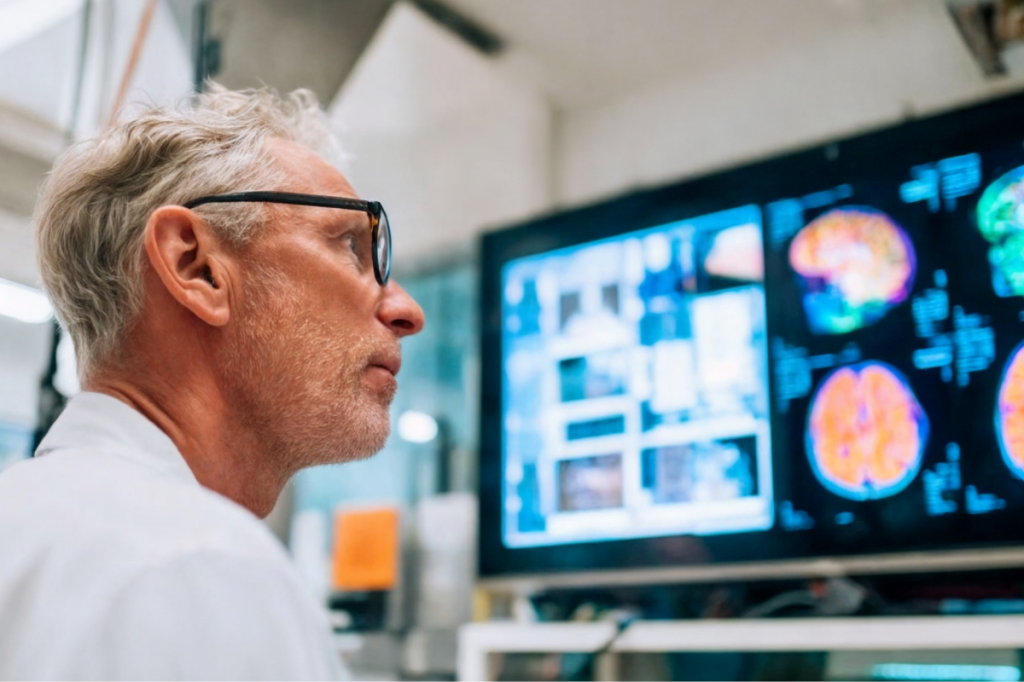
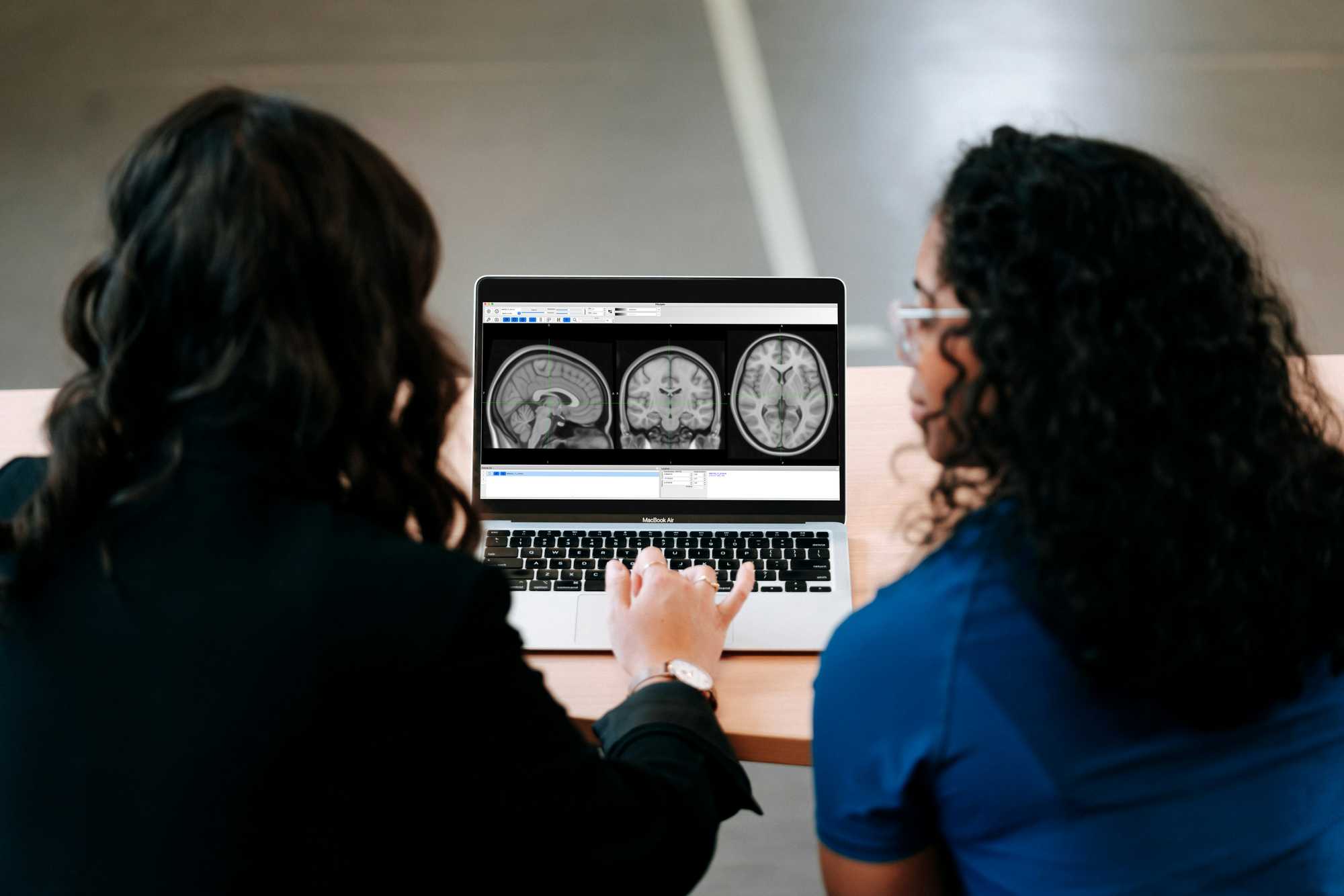
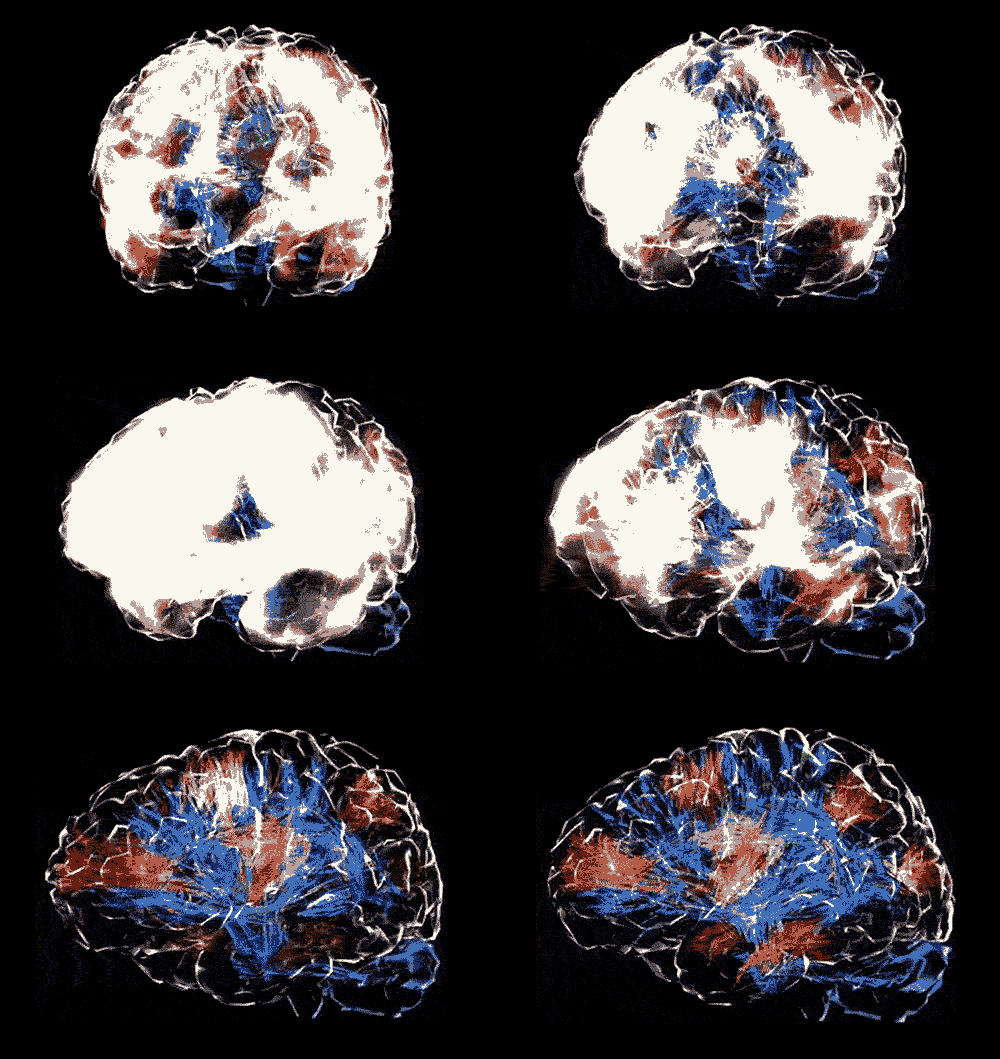
However, in 2021, researcher Dr. Raul Vicente and his colleagues at the University of Tartu, Estonia, became the first people ever to record the brainwaves of someone in the process of dying, and what they’ve come to realize should be very comforting to everyone.
“We measured 900 seconds of brain activity around the time of death and set a specific focus to investigate what happened in the 30 seconds before and after the heart stopped beating,” Dr. Ajmal Zemmar, a neurosurgeon at the University of Louisville, US, who organized the study, told Frontiers.
Fascinatingly, the discovery was a complete accident.
The patient who died while having his brain waves measured was 87 years old and had epilepsy. While researchers were studying his brain to learn more about the condition, the man had a heart attack and passed away. “Just before and after the heart stopped working, we saw changes in a specific band of neural oscillations, so-called gamma oscillations, but also in others such as delta, theta, alpha, and beta oscillations,” Zemmar said.
The findings were so special and rare because the man just happened to be hooked up to machines that could measure his brain waves; a miraculous coincidence.
The different types of brain oscillations that occurred in the patient before and after the heart attack were associated with high cognitive functions, including dreaming, concentrating, memory retrieval, and memory flashbacks.
Therefore, it’s possible that as the patient was dying, they had their life flash before their eyes. What an amazing and comforting experience right before leaving this mortal coil.
“Through generating oscillations involved in memory retrieval, the brain may be playing a last recall of important life events just before we die, similar to the ones reported in near-death experiences,” Zemmar speculated. “These findings challenge our understanding of when exactly life ends and generate important subsequent questions, such as those related to the timing of organ donation.”
The positive findings line up with reports of NDEs and first-hand observations from hospice workers. Medical workers who work with dying folks report they often have visions of visitations and conversations with deceased loved ones, almost as if those relatives and friends are preparing to guide them over to the other side. Many people who have been declared dead and lived to tell the tale, or suffered an extreme NDE, report feelings of calm and peace rather than fear and pain.
How long are people conscious after they are technically dead?
Science has found that people can remain conscious up to 20 seconds after they are declared dead. Even after the heart and breathing have stopped, the cerebral cortex can hang on for a little while without oxygen. So, some people may experience the moment when they hear themselves declared dead, but they aren’t able to move or react to the news. In cases where someone performs CPR on the deceased person, the blood pumped by the compressions can temporarily keep the brain alive as well.
Although the experience of death will probably always remain a mystery, we should take solace in the idea that, in many cases, it may not necessarily be a miserable experience but an ecstatic final burst of consciousness that welcomes us into the great beyond. “Something we may learn from this research is: although our loved ones have their eyes closed and are ready to leave us to rest, their brains may be replaying some of the nicest moments they experienced in their lives,” Zemmar concludes.
This article originally appeared in February. It has been updated.
From Pakistan to Tanzania, the most effective education solutions are community-led. Here’s how local leaders, in partnership with Malala Fund and supported by Pura, are mobilizing entire communities.
When asked to describe what Tanzania smells like, Grace Isekore closes her eyes and breathes in deep. For a moment, she’s somewhere else entirely. Tanzania is a rich tapestry of sights and scents, from the smell of sea mist that permeates the coastline to the earthy cardamom and cloves she cooks with in her kitchen. But when Grace emerges from her reverie, her answer is unexpected.
“Tanzania smells like peace,” she says, her eyes still closed. “I see a beautiful country where we are free to move, free to speak. And there is peace within the community.”
For Grace, that sense of peace isn’t just something she smells; it’s something she works toward every day. As a project coordinator with Pastoral Women’s Council (PWC), a women-led organization that empowers pastoralist communities in northern Tanzania, she has seen firsthand how girls flourish when they have the opportunity to attend school. Like scent, education not only connects girls to their own culture, but also helps broaden their horizons, realizing new possibilities for themselves and others. That transformation reshapes entire communities and ripples outward, with the potential to change countries and transform the world for the better.
Different scents, different approaches, and communities driving change
Spices in Tanzania. Captured by James Roh for Pura
For Grace and others around the world, education is freedom, as well as a pathway to a stronger community. Rooted in that shared belief, Pura, a home fragrance company, was inspired to build on their four-year partnership with Malala Fund to create something truly unique: a fragrance collection that connects people through scent to communities in Tanzania, Nigeria, Pakistan, and Brazil, where barriers to girls’ education are among the highest.
Using ingredients from each region, the new Pura x Malala Fund Collection uses scent to transport people to these regions directly. “Future in Bloom,” for example, invokes Pakistan’s lush valleys through notes of jasmine, cedarwood, and mango; while Tanzania’s fragrance, “Heart on Fire,” evokes the spirit and joyfulness of the girls who live there through cardamom, lemon, and green tea.
The new Collection honors the work Malala Fund does every day, partnering with locally-led organizations in these four countries to ensure every girl can access and complete 12 years of education. Each scent celebrates the joy, tenacity, and courage of the women and girls driving change on the ground, while also augmenting Pura’s annual grant to Malala Fund by donating eight percent of net revenue from the Pura x Malala Fund Collection to Malala Fund directly.
Just as each country’s scent is unique, so too are their needs related to education. But with support from Malala Fund and Pura, local leaders are coming up with creative ways to mobilize entire communities (parents, teachers, elders, and the students themselves, in their pursuit of solutions, understanding that educating girls helps everyone thrive. Here’s how their efforts are creating real, durable impact in Tanzania and Pakistan, and creating a ripple effect that changes the world for the better.
Parent-teacher associations help Maasai girls and their communities in Tanzania problem-solve
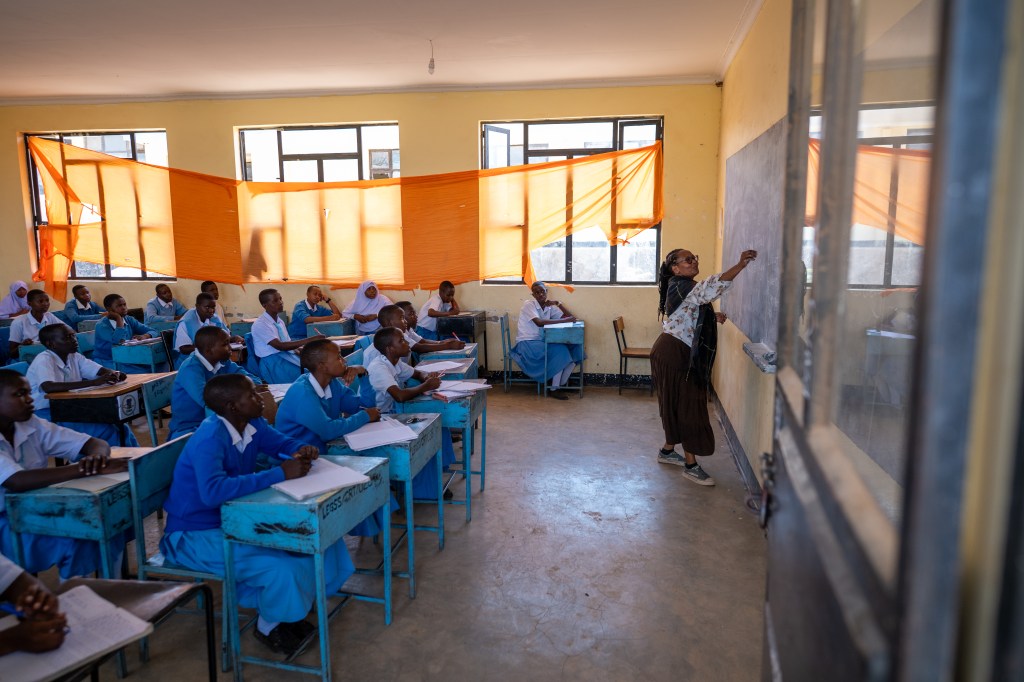
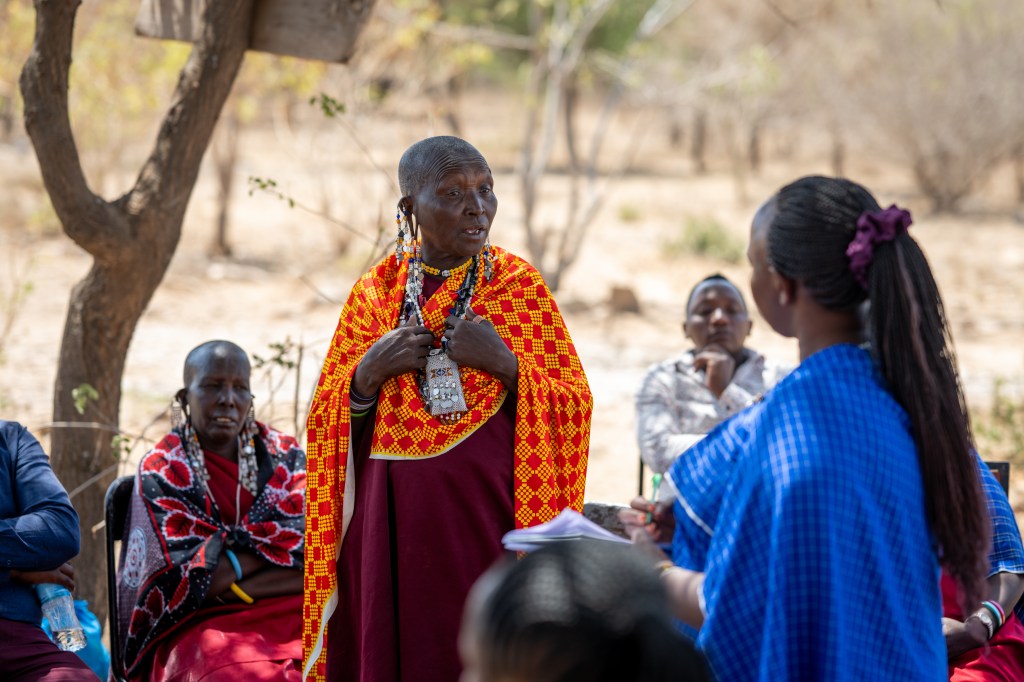
A girl’s school in Tanzania. Captured by James Roh for Pura
Northern Tanzania, Grace’s home, is home to pastoralist communities like the Maasai, a nomadic people who have moved with the seasons to nurture the land and care for their livestock for centuries. The nomadic nature of this lifestyle creates significant and unique barriers to girls’ education. Longstanding gender roles have enabled Maasai to survive in the harsh environment and have placed great value on both women and men. Over time, as nomadic life has been threatened by the privatization of land and stationary education models have been implemented, the reality of pastoralist livelihood has shifted and introduced new complexities. Now, the sheer distance to schools is both a practical challenge and one that often comes with danger from the landscape, predators, and potential exposure to assault along the journey. Girls shoulder the responsibility of household chores and there is often cultural pressure around early marriage – both leading to boys’ education being prioritized over girls’.
“There are very, very good [pastoralist] cultural practices, which are passed from generation to generation,” says Janet Kimori, an English teacher at Lekule Girls Secondary School in Longido, Tanzania. But when cultural practices act as educational barriers, “you have to sit down and look for where you are going to assist. As a school, as an individual, the school administration—all of us will chip in and know how we are going to deal with this problem.”
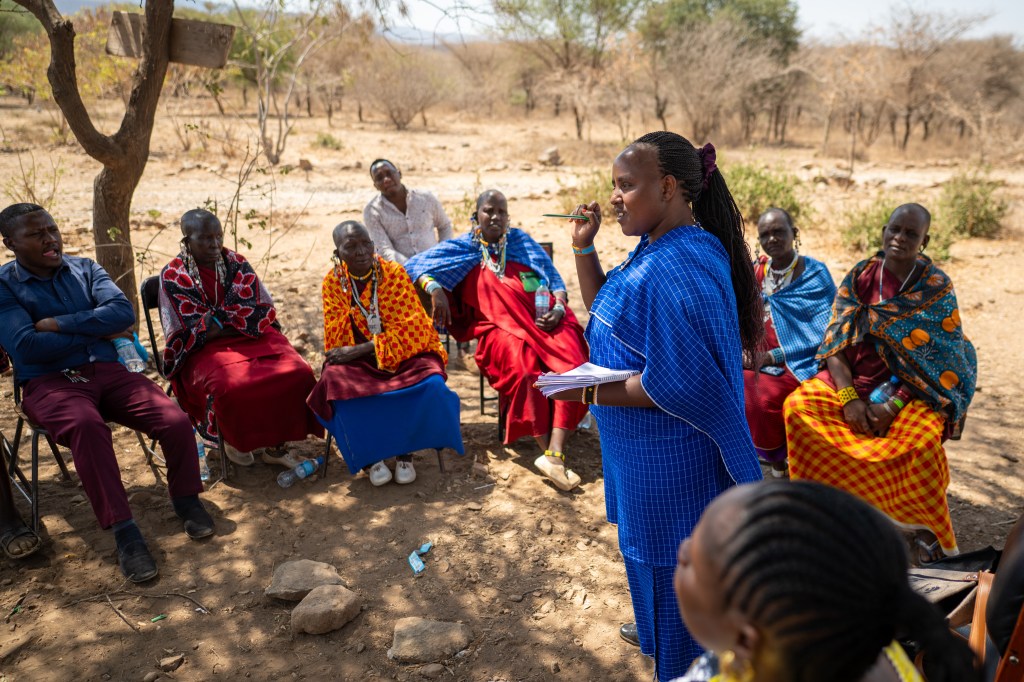
PWC works to ensure girls are able to exercise their right to an education while also preserving pastoralist culture. One successful approach, the organization found, has been the formation of Parent Teacher Associations (PTAs), created with help from Malala Fund. In PTA meetings, students, parents, teachers, elders, and government officials meet, discuss educational barriers, and come up with community-led solutions that preserve and honor their culture while advancing educational outcomes.
PTA meeting in Tanzania. Captured by James Roh for Pura
One recent PTA meeting highlights how these community-led solutions are often the most effective. At Lekule Girls Secondary School, the lack of fresh water forces girls to walk long distances to collect water for the school’s kitchen during the school day, and these long journeys not only disrupt class time but can leave girls vulnerable to sexual assault in isolated areas. Through facilitated discussion, PTA members landed on a solution: installing a borehole to pipe in fresh water to the school. Reliable access to water creates a better learning environment for the girls, but it also benefits the community at large, as local governments are then more likely to invest in health clinics and other community resources nearby.
With a solution in place, the PTA was then able to discuss ideas and map out a course of action. The women would raise money for the cost of the borehole, while the men would recruit workers to dig the hole and lay the pipe. Together, they would ask government officials to match their investment.
The benefits of PTA meetings within the pastoralist communities are undeniable. “The girls are talking and addressing issues in a confident way, and parents feel they are part of the resource team to solve challenges happening at school,” Grace says. One unexpected benefit: The larger cultural impact these PTA meetings have created. Thanks to the success of PTAs within pastoralist communities, the models are now being endorsed on a national level, and schools across Tanzania are starting to use them to solve problems in their own communities. When a community creates opportunities for girls to learn, everyone benefits.
Safe spaces in rural Pakistan help students and their parents connect, then drive change
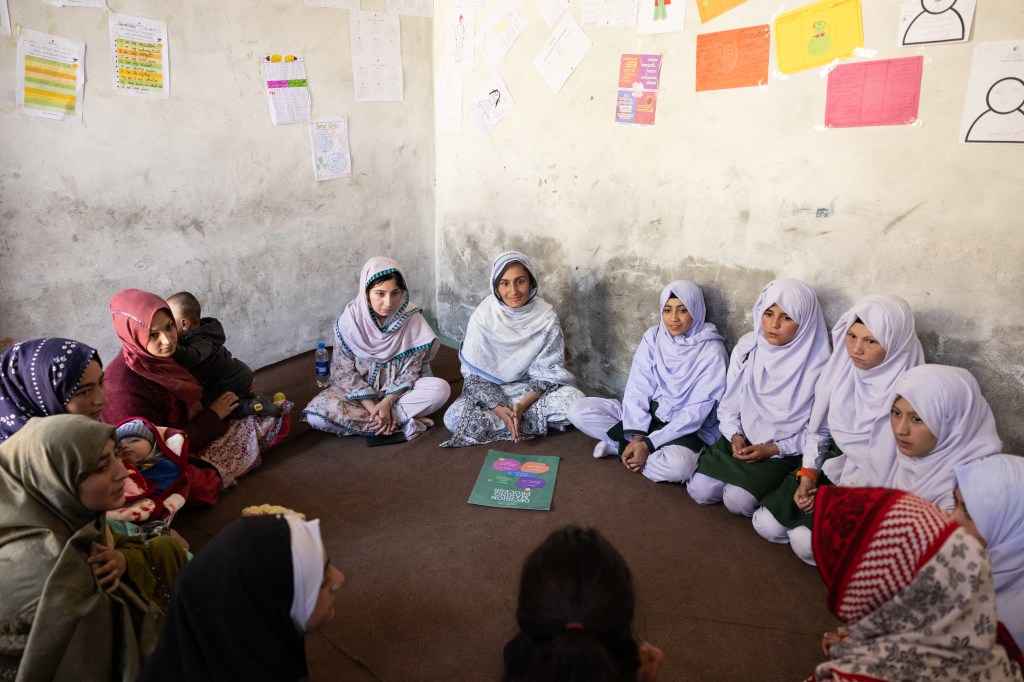
Safe space for girls meeting in Pakistan. Captured by Insiya Syed.
A continent away in Pakistan, the country’s northernmost region of Gilgit-Baltistan seems like a land untouched by time. The region’s looming mountains, snow-capped peaks, lush valleys and crystalline lakes draw nature lovers and landscape photographers from around the world, but living among this kind of breathtaking scenery has its drawbacks. Schools in the region are few and far between, and the area’s harsh climate often makes roads inaccessible for travel. Poverty and gender-based discrimination are additional obstacles, making school even further out of reach, and girls are affected disproportionately. Going up against these barriers requires a persistent, quiet strength that’s found in the women who live there and reflected in Pakistan’s signature scent.
Saheli Circles are how local leaders in Gilgit-Baltistan are bridging the gap between girls and education. An Urdu term for “female friend,” Saheli Circles are after-school safe spaces where girls explore subjects like art and climate change, while also developing skills that help them manage emotions, set goals, and build positive relationships. Girls study in groups, visit the library, play sports, and tackle filmmaking and photography projects, all designed to develop self confidence and teach the girls how to advocate for issues that matter to them. But the work doesn’t stop there.
“What we’re trying to achieve here will only be impactful if it trickles down to the home environment and the school environment,” says Marvi Sumro, founder and program director of Innovate, Educate, and Inspire Pakistan (IEI), the local organization that developed the Saheli Circles model and partnered with Malala Fund in 2021 to make it a reality. Ever since, Saheli Circles have grown to involve teachers, elders, and parents to encourage relationship building that’s essential for young girls and adolescents. “Our spaces can give mothers and daughters an opportunity to interact a little differently—do an art activity, or have a cup of tea together, or some good conversation,” Marvi says.
The relationship building is what makes the biggest positive impact throughout the community. Recently, one Saheli Circle was able to bring together parents, teachers, and administrators to advocate for better education at their local school, and together they convinced the department of education to hire a science teacher. Another Saheli Circle organized a fund where members of the community can contribute monthly to pay for uniforms, books, and other school expenses for the girls in their village, eliminating those small, hidden costs that are often a barrier to education for many. A third Saheli Circle was able to produce a short film about how gender-based household chores can take away valuable study time from girls, leaving them at a disadvantage. “The girls put the film together and showed it to the mothers, and the response from the mothers was just beautiful,” Marvi says.
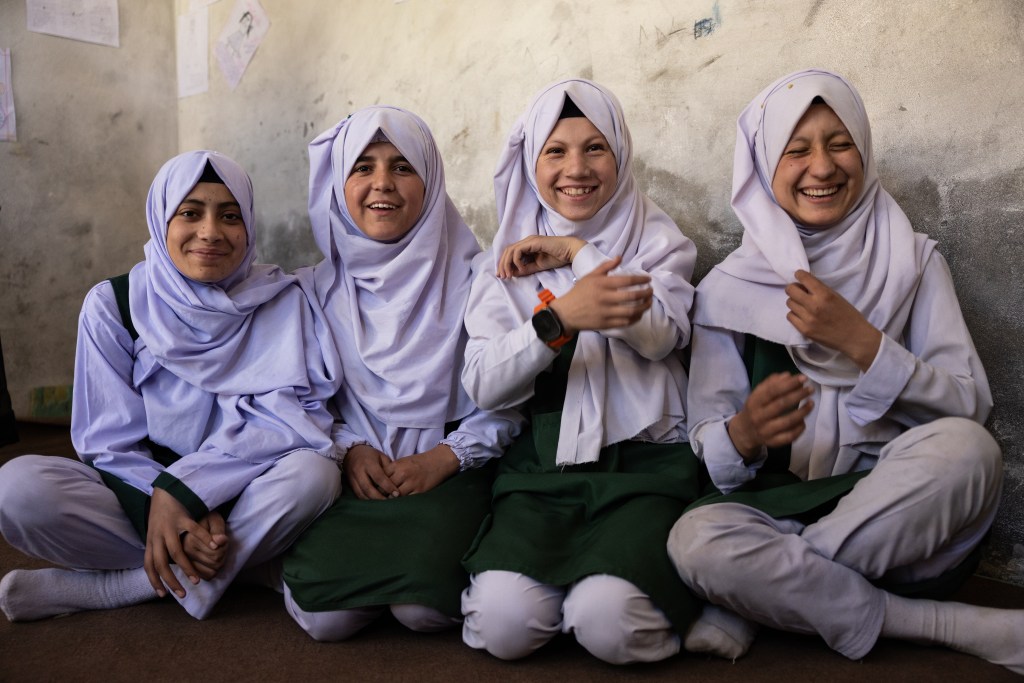
Girls smiling in Pakistan. Captured by Insiya Syed.
The education and relationship building that the girls receive in Saheli Circles connects them to larger opportunities and economic freedom that are not possible in their hometown. “For girls in Gilgit-Baltistan, education is extremely important because of the fact that we’re so far away from where the economy is, where the opportunity is. Education becomes this bridge for us, for our girls, to access all the opportunity and economy that exists in [larger cities].”
From rural Tanzania to remote Pakistan, local organizations prove every day that prioritizing girls’ education benefits everyone. Communities that lift up girls are able to secure resources like clean water and well-staffed schools, as well as build stronger relationships.
These outcomes are only possible because of the women and girls who work tirelessly in these regions to overcome barriers and drive progress. The Pura x Malala Fund Collection is a way to honor them, celebrate their achievements, and unite people the world over around a shared belief that education is freedom. Like scent, that belief can build, travel, and has the possibility to transform the world.
Experience the Pura x Malala Fund Collection here, and connect with the stories of real girls leading change across the globe.
Look, let’s just get it out there: It’s uncomfortable any time you have to get fully or partially naked for a medical exam or cosmetic procedure. Right? It’s natural and part of the process, but while you know that the person on the other end is a professional who’s just there to do their job, they’re also a human being. Getting naked in front of them in any other context would be extremely weird, and it’s hard to completely shut that part of your brain off no matter the setting.
It’s amazing how body dysmorphia really knows no bounds. We tend to think of insecurities as focusing on things like the flatness of our stomachs or the size of our noses. But perhaps the thing that people are most self-conscious about is the thing we actually talk about the least.
According to one study, about 30% of men are “dissatisfied” with the size, shape, or appearance of their penis. That number is even higher when it comes to how women feel about their vaginas. A survey done by Refinery29 showed that almost half of women had “concerns” about the appearance of their vulva.
The numbers say anywhere from a third to a half or more of all people think there’s something wrong with the way our private parts look. Which begs the question: If we all think we’re weird, is anybody really weird at all?
A fascinating Reddit thread recently polled experts on this very topic—people who tend to see an awful lot of genitals in their line of work: Waxing technicians or estheticians. The responses were oddly inspiring.
The prompt asked, “Waxers, how often are you surprised by how a clients genitals look?”
Professional waxers chimed in with their stories and observations. As did doctors, nurses, pelvic floor therapists, urologists, and lots of other pros who work closely with people’s unmentionables.
“Gonna chime in as a doctor – and I would imagine it’s the same for professional waxers. WE. DONT. CARE. And in my case I would be surprised if you’d show me something I’ve never seen before.” – feelgoodx
“I use to be very self conscious and insecure about my genitals. I honestly thought I had a weird vagina. But working in this industry has taught me that every one is a snowflake. I’ve seen it all and nothing surprises me. Just clean yourself before coming in.” – Wild-Clementine
Not a waxer but I am a labor and delivery nurse. I see a vulva every single day I work, often multiple, and frequently about 3 feet from my face with a spotlight on it lol. Not much surprises me. Most are out of my memory by the time they’re clothed or covered up. When it comes to genitals you want to be unremarkable.” – tlotd
“Very, very rarely. Shaved, not shaved, lots o’ labia, no labia, etc—it’s all the same to me. I’m just here to work.” – Important-Tackle
“never. i have seen it all. scars, hyperpigmentation, unevenness; none of it surprises me. just please wash yourself before coming to me.” – pastelmorning
“Nothing surprises me, I’m mostly just focusing on the hair, but i do have a client who has a tuft of hair on the underside of his shaft near the tip of his penis we call his downstairs soul patch.” – noorisms
Two big takeaways:
First, outside of obvious mutilations or pathologies, nothing stands out to people who are extremely knowledgeable about genitals. Differences in size, shape, and structure are totally normal and barely even register on the radar!
Second, no matter what you look like down there, good hygiene is always appreciated. A solid tip that extends far beyond the borders of the esthetician’s office!
Being embarrassed, self-conscious, or even ashamed of the way your parts look doesn’t seem like a big deal, but it can be.
It’s bizarre and tragic that unrealistic beauty standards actually affect the way we perceive our own nether regions. Pornography, media, and inconsiderate past partners all play a role in people developing anxiety about the way their genitals look.
Both men and women can have their sex lives negatively impacted by bad self-image and anxiety over the way they look naked. When the shame is really bad, it can hold them back in relationships, or even stop them from seeking them in the first place.
This shame or embarrassment unfortunately extends into the medical arena, as well.
Fear of being judged or humiliated can stop women in particular from not just going in for a wax, but from going to the gynecologist, getting breast exams, or asking potentially-embarrassing but critical and life-saving health questions. For their part, men are prone to skipping prostate exams, testicular exams, or conversations about potentially embarrassing topics like erectile dysfunction or bladder problems. None of these things are fun or comfortable, but they’re critical for our health!
Experts say sharing your vulnerability with your doctor or cosmetic professional can help. Letting them know you’re nervous or embarrassment can signal them to offer you comfort measures. It also helps to be really direct and detailed with what you want or what you want to discuss.
According to Cedars Sinai, “Does sex hurt? Tell your doctor exactly where you feel the pain. Notice that your poop stinks? Try to describe the odor in detail.” If you’re too embarrassed to talk about it, try writing it down. At some point though, you’ll have to get the exam. Just get through it, it gets easier once you build a relationship with your doctor (or waxer!) over time.
If you’ve ever been a little self-conscious, take it from the experts, from the people who have seen hundreds if not thousands of genitals up close and personal, in the most unflattering lighting and from the worst angles possible: You’re totally normal!
This article originally appeared two years ago. It has been updated.
Millions of Americans seek the help of therapists for mental health struggles, and many more could use some psychological care but aren’t getting it due to affordability, lack of access, or other barriers. One of the positives to come out of the social media era is professionals sharing thoughts, opinions, approaches, and tools that the public might find helpful. While “TikTok therapy” is certainly not a replacement for actual therapy, you can sometimes find some useful nuggets.
For instance, clinical therapist Hattie Awe, LPC, shared a video laying out three things she tells her patients all the time, and judging by the four million views and 124,000+ saves of the video, people are finding it helpful.
“I am a therapist in higher level of care, and these are the three quotes that I use almost daily with the patients that I work with,” Awe begins. “It’s more of a fact, the first one, but your brain has never existed and will never exist to be happy. Your brain has no rationale of what that means, and your brain strictly operates off of safety and knowing. which doesn’t always align with what we want out of life.”
Neuroscience backs this up. Evolutionary psychologists say our brain’s primary goal is survival, not happiness. That doesn’t mean we don’t want to be happy—of course we do. It means our brain isn’t hardwired for that. It’s wired to keep us safe and secure, which means it’s naturally prone to focus more on the negative than the positive.
Awe says that idea connects to the second quote that she probably uses more than any other: “Your nervous system will choose a familiar hell over an unfamiliar heaven every day of the week,” she says. “Your nervous system will gravitate towards the things that we know, the things that we see, the things that we’ve done over and over and over again because to the brain that’s safety. It doesn’t matter if the outcome is something that we don’t want, as long as our brain knows what’s coming, as long as we know what this is, as long as this is familiar, there’s a safety in that, which is why we might find ourselves doing the same shit, engaging in the same toxic relationships, engaging in the same behaviors over and over and over again, not knowing why we keep doing it, because it’s safe to the brain.”
Somatic therapist Sarah Alpern used a similar phrase, “Your nervous system will always choose a familiar hell over an unfamiliar heaven” to explain why we might resist change even when it’s good for us and why we tend to gravitate toward the same patterns, behaviors, and situations even though they may be harming us. Predictability feels safer than change.
“Change for the better represents uncertainty, and our brains perceive uncertainty as a potential threat,” Alpern writes. “It disrupts the familiar patterns and forces our nervous system to adapt to new circumstances, which can be scary and uncomfortable.”
Understanding this can help us recognize when our instinctual brain functions are fighting us and why.
“That leaves me to my third favorite little tidbit, little quote, which is you literally cannot hate yourself in the loving yourself,” says Awe. “There is no criticizing your way to confidence. There’s no shitting on yourself into a version of yourself that you enjoy. It doesn’t exist. and you’ve probably learned all of the lessons of life that you need by hating yourself. You might as well get to the fun part of life where you learn all the lessons of life by loving yourself.”
“So validate the past versions of yourself,” she continues. “Validate the functions of the brain and the fact that it’s never really cared if you were happy. Validate how easy it is to fall in the habits of cyclical behavior, given the fact that our nervous system and brain is drawn to it. Have acceptance for that and be able to move forward. But we can’t act like the person before us doesn’t exist. And we can’t hate her for existing.”
Therapy can help people better understand how their brain works. Photo credit: Canva
People in the comments of her video shared how helpful they found Awe’s concise breakdown of these concepts.
“There is no criticizing yourself into confidence HITS.”
“u just linked up like 12 different concepts in my brain thank u.”
“This was gold! How much do I owe you?”
“I just listened to this three times through to let it sink in. I’m in a transition phase and finding it hard and I needed to hear this. Thanks!”
“I love that by being happy, you’re basically being a rebel against your own brain and nervous system.”
Other therapists weighed in on her video as well, some with quotes they frequently share with their clients:
“As a fellow staff with youth in higher level of care, I can confirm that this way of thinking is their only way to get through everyday . It’s so black and white and everyday is such a struggle trying to get them back to baseline.”
“Along with your third quote, something I’ve said to clients is something to the effect of ‘if talking to yourself that way/thinking that way worked, it would’ve worked by now.’”
“I’m a therapist, and a quote I use frequently is ‘you can be comfortable or you can grow, but you can’t do both.’”
“Psychiatrist here…. ‘Acceptance does not require approval’ is one of my favorites. I feel like acceptance is such a huge part of life but it’s such a struggle for so many people.”
A two-minute video definitely won’t cure anyone’s mental health issues, but even short tidbits like this can sometimes help shift our perspective and allow us to see the workings of our brains in a new and helpful light.
Most of us have a self-improvement checklist. Exercise more. Stress less. Sleep better. Be more present. It’s a lovely list. But it can also be quite mean and vague. And it tends to sit there, quietly judging us, while we scroll our phones in bed at 11 p.m.
However, you don’t need an elaborate morning routine or a 45-minute meditation practice to shift how you feel. Science keeps arriving at the same surprising conclusion: tiny actions, repeated consistently, change lives. Not because of magic. Because of biology.
Instead of a grand, sweeping declaration like, “Stress less” (what does that even mean?), start small. These 15 micro-habits take two minutes or less. Some take ten seconds. All of them have real research behind them. Begin with one. See what happens.
Morning habits for a strong start
Photo credit: Canva – Jot down the messy, unfiltered stuff.
1. Write it out
Before you pick up your phone—before the news, the texts, the notifications—grab a notebook and spend two minutes writing down whatever is on your mind. Not a diary entry. Not a to-do list. Just the messy, unfiltered stuff, like the dream you just woke up from or an event later you’re nervous about. Psychologist James Pennebaker spent decades studying what happens when people do this, and the results are striking: expressive writing reduces anxiety, improves emotional processing, and even strengthens immune function. Think of it as taking out the mental trash before the day fills back up.
2. Get moving, even a little
To change your day (on a micro level, at least), you don’t need a gym. You need two minutes and an open space. Go nuts! Jump. Sprint up your stairs. Do jumping jacks in the kitchen. Anything to warm up those muscles. Researchers at Victoria University found that just two minutes of all-out effort triggers the same cellular adaptations in your muscles as a 30-minute workout. Surprisingly, your body genuinely cannot tell the difference.
3. Anchor your identity
Spend 60 seconds stating—out loud or on paper—one true thing about who you are. Not a wish. A fact. Think along the lines of, “I am someone who shows up.” Or, “I take care of the people I love.” Neuroscientists have confirmed that self-affirmation activates brain reward pathways and buffers against stress. So, this is more than a pep-talk: it’s a reminder of who you are.
4. Savor that first sip
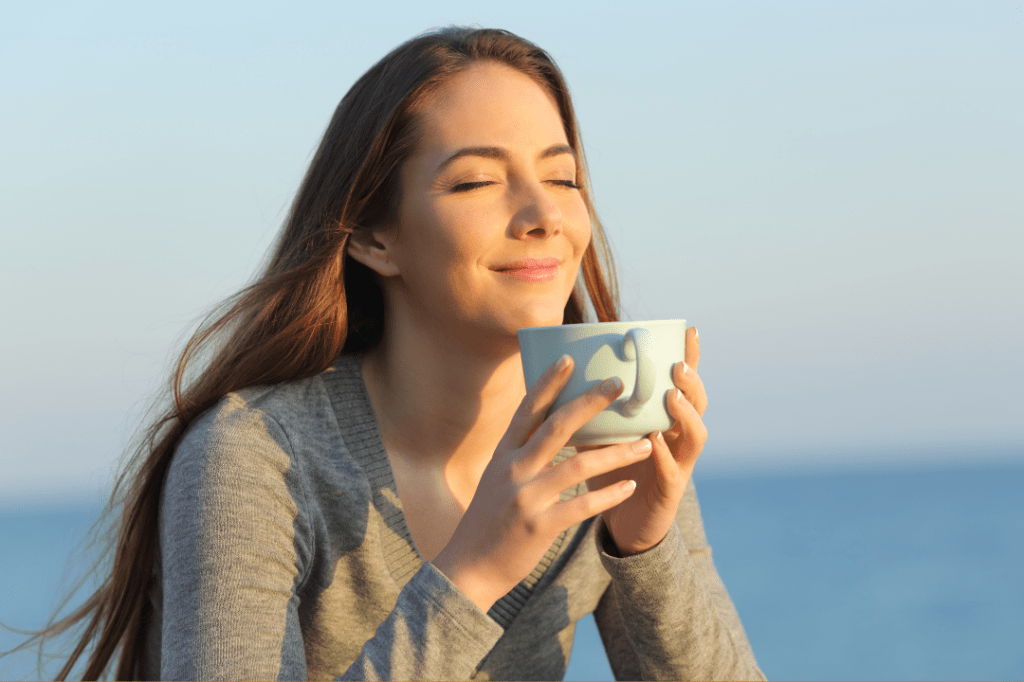
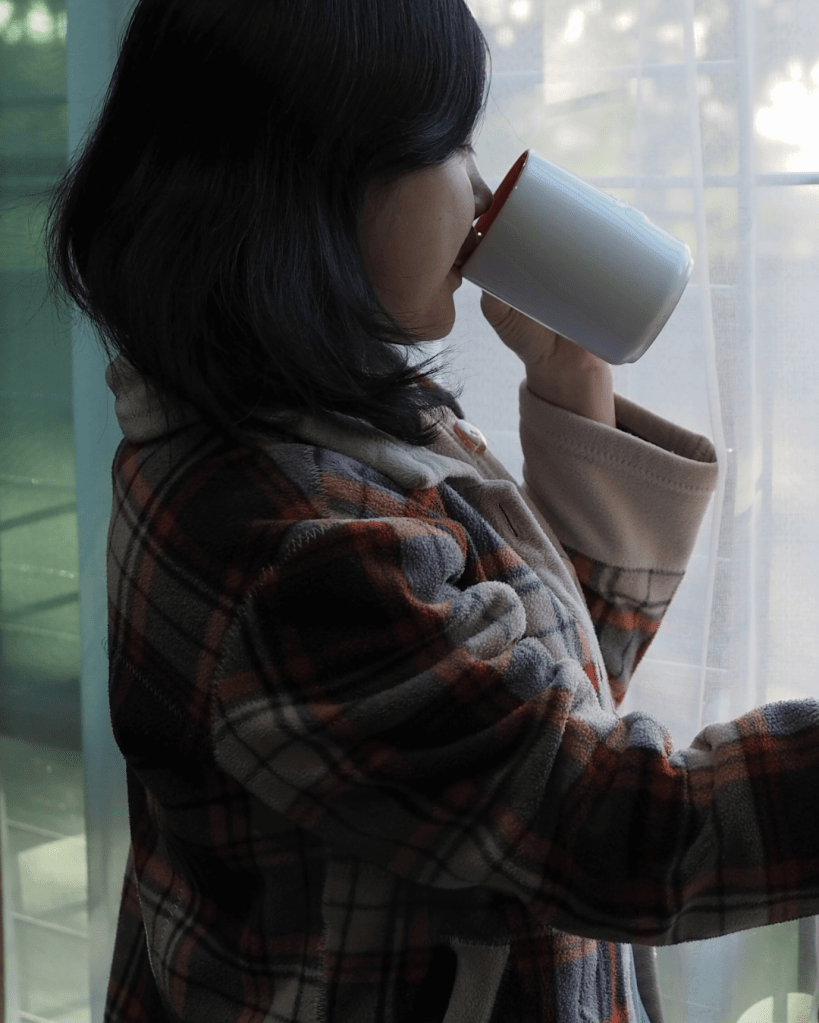
Before you gulp your coffee or tea, pause. Wrap both hands around the mug. Notice the warmth radiating from its contents. Breathe in the smell. Then, take one slow sip and actually taste it. Woohoo, that’s it! Research shows that even brief moments of sensory awareness lower cortisol and reduce anxiety. Who knew? Your morning drink has been waiting to do this for you the whole time.
5. Catch ten seconds of sunlight
Step outside, or at least to a window, within the first hour of waking, and let natural light reach your eyes for ten seconds. Andrew Huberman has spent years explaining why this matters: morning sunlight triggers a healthy cortisol spike that wakes up your immune system, sets your circadian clock, and produces serotonin. Skip it regularly, and your body’s internal timing slowly drifts. Ten seconds. That’s all it takes.
6. Visualize a good day
Close your eyes for one minute and picture one thing going well today. Not perfectly and not the entire day. Just one thing, well. The research here comes from the sports world, where mental rehearsal has been studied extensively. Studies show that imagining yourself performing an action fires the same neural pathways as actually doing it.
Mid-day habits to ease stress
Photo credit: Canva – The antidote is choosing, for once, not to hurry.
7. Slow down on purpose
Once a day, pick one task that doesn’t actually need to be rushed, and deliberately don’t rush it. Walk a little slower. Eat a few bites without looking at a screen. Wash those dishes at a snail’s pace. Researchers who study “hurry sickness” (yes, it’s a real clinical term) have found that chronic time urgency keeps your amygdala on high alert, flooding your system with cortisol for hours. The antidote is choosing, for once, not to hurry. Your nervous system will slowly get the message that not everything is an emergency.
8. Leave your phone out of the bathroom
This one isn’t glamorous, but it matters. Studies have found that phones carry roughly ten times more bacteria than toilet seats. Besides, neurologists note that bathroom scrolling creates dependency, fragments attention, and eliminates one of the last quiet spaces in the day. The bathroom used to be a sanctuary. Reclaim it.
9. Sigh or hum out loud
A Stanford study published in 2023 found that the “physiological sigh”—a double inhale through the nose followed by a long exhale through the mouth—reduced stress hormones more effectively than mindfulness meditation in head-to-head trials. Alternatively, try humming. Humming for 60 seconds stimulates the vagus nerve through vibration, effectively shifting your body from fight-or-flight to rest-and-digest.
10. Run cold water over your hands
When anxiety peaks, hold your hands under cold running water for 30 seconds. Cold water on the skin activates what physiologists call the “diving reflex,” triggering the vagus nerve to slow your heart rate and engage the parasympathetic nervous system. It’s an ancient mammalian stress response that still works remarkably well.
11. Unclench that jaw
Right now, check: are your teeth touching? Is your tongue pressed against the roof of your mouth? Most of us spend hours a day with our jaws subtly clenched, and researchers now recognize this as a nervous system pattern, not just a dental one. The simple act of letting the jaw go slack, teeth apart, sends a signal to your brain that the perceived threat has passed.
Around sunset, switch off your overhead lights and use softer lamps instead. The reverse can be catastrophic: a 2021 study in PNAS found that just a few weeks of bright evening lighting can delay your circadian rhythm by two to three hours, disrupting sleep, memory, and mood.
13. Hold a smile for five seconds
Yes, even a fake one. A landmark 2022 study involving nearly 4,000 people across 19 countries found that deliberately holding a smile—even without genuine emotion—makes people feel measurably happier. The science behind that? Facial muscles feed information back to the brain, meaning your mind will get the message. So, hold that grin for five seconds.
14. Give one genuine compliment
Before the day ends, tell someone something specific you admire about them. Not a generic compliment, like “great job.” Dig for something real. Maybe they handled a tricky moment with poise, or put in some extra effort while crafting that company-wide email. It could be as simple as, “Hey, your sandwich looked incredible during lunch.” Cornell researchers discovered that we consistently underestimate how much our words mean to others, and that compliment recipients feel far better than givers ever predict. The kicker? The givers feel better, too.
15. Finish your shower with 30 seconds of cold
A Dutch randomized controlled trial of over 3,000 people found that ending a shower with just 30 seconds of cold water reduced sick days by 29%. Going even further, there was no difference between 30, 60, or 90 seconds: the benefit kicks in almost immediately. This little dose of freezing also produces a lasting surge of dopamine and norepinephrine. So, while it’s unpleasant for about five seconds. Then it isn’t, and you feel great.
Don’t go overboard, okay?
Despite the headline of this article, you don’t have to do all 15. How about you just pick two? Try them for a week and notice what shifts. The point here isn’t perfection; it’s incorporating the smallest acts into your daily routine and watching them compound into tangible benefits. Remember, your nervous system is paying attention, even when you think nothing is happening. Feed it something good to work with.
Aging is weird. You’re trucking along, enjoying your middle-aged life, finally feeling like a real adult, when you look in the mirror one day and gasp. “Where did those wrinkles come from?” “Is that skin on my arm…crepey?!?” “Why am I aching like that?”
Somewhere in your mid-40s, you start noticing obvious signs of aging that seem to arrive overnight. You assumed it was a gradual process that you just hadn’t noticed, but it sure as heck felt like it happened really fast.
The science behind the ‘overnight’ changes
New research indicates that may very well be the case. A 2024 study from researchers at Stanford tracked thousands of different molecules in people age 25 to 75 and found that people tend to make two big leaps in aging—one around age 44 and another around age 60. These findings indicate that aging can actually happen in bursts.
“We’re not just changing gradually over time. There are some really dramatic changes,” said senior study author Michael Snyder, Ph.D., a geneticist and director of the Center for Genomics and Personalized Medicine at Stanford University. “It turns out the mid-40s is a time of dramatic change, as is the early 60s. And that’s true no matter what class of molecules you look at.” The researchers assumed the mid-40s changes would be attributed to menopausal or perimenopausal changes in women influencing the overall numbers, but when they separated the results by sex they saw similar changes in men in their 40s.
“This suggests that while menopause or perimenopause may contribute to the changes observed in women in their mid-40s, there are likely other, more significant factors influencing these changes in both men and women. Identifying and studying these factors should be a priority for future research,” said study author Xiaotao Shen, PhD, a former Stanford Medicine postdoctoral scholar who now teaches at Nanyang Technological University in Singapore.
Aging happens in bursts, scientists find. Canva Photos
What’s behind these ‘bursts?’
The study included 108 participants who submitted blood and other samples every few months for several years. The scientists tracked age-related changes in 135,000 different molecules—nearly 250 billion distinct data points—to see how aging occurs.
The study may shed light on the reasons for jumps in certain diseases and maladies at certain ages. For the 40-somethings, scientists found significant changes in molecules related to alcohol, caffeine, and lipid metabolism, cardiovascular disease, and skin and muscle. For those in their 60s, changes related to carbohydrate and caffeine metabolism, immune regulation, kidney function, cardiovascular disease, and skin and muscle were found.
Lifestyle is a factor
The study authors did note that lifestyle might play a role in some of these changes. For instance, alcohol metabolism may be influenced by people drinking more heavily in their 40s, which tends to be a period of higher stress for many people. However, the researchers added that these bursts of aging in the mid-40s and early 60s indicate that people may want to pay closer attention to their health around those ages and make lifestyle changes that support greater overall health, such as increasing exercise or limiting alcohol.
The research team plans to study the drivers of these aging bursts to find out why they happen at these ages, but whatever the reasons, it’s nice to know that the seemingly sudden onset of age-related woes isn’t just in our imaginations.
It’s understandable that we worry about aging, as physical signs of aging remind us of our own mortality. We also have all kinds of social messaging that tells us youth is ideal and beautiful and old is bad and ugly, so of course we give aging the side-eye. But none of us can avoid aging altogether, so the more positive and healthy we are in our approach to aging, the better off we’ll be, no matter when and to what degree aging hits us.
This story originally appeared two years ago. It has been updated.
It may sound like a scene from a sci-fi film, but it’s not. In 1979, eight men arrived at a week-long retreat in a converted monastery in New Hampshire. As soon as they stepped foot in the door, they traveled 20 years into the past. The newspapers and magazines lying around were from 1959. Fifties music played on the radio. Old episodes of The Ed Sullivan Showaired on the black-and-white television. The entire environment was set up to feel like a 20-year time jump.
The men, who were in their late 70s and early 80s, were instructed to live for the week as if it really were 1959. They were to speak in the present tense, as if what they were seeing, reading, and living was the present day. Events in the newspapers were to be regarded as happening in real time, not as part of the past.
Living as if it were 20 years earlier seemed to make the men age backwards
What was the point of all of this? Dr. Ellen Langer, a Harvard University psychologist, wanted to see how the mind affected the body when it came to aging. To study this question, she created an environment that took participants back to a time when they were younger.
“We were going to take old men, put their minds back in time, and see the effects on the body,” Langer said in a 2024 interview. “What we found in a week: Their vision improved, their hearing improved, their memory improved, their strength, and they looked noticeably younger. Now, I don’t know about you, but I don’t think I had ever heard of an elderly person’s hearing improved without any medical intervention.”
Another study group, with a tweak to the instructions, also showed improvements
After that week-long experiment, another group of old men stayed a week in the same environment. This time, however, they didn’t live as if it were 1959, but rather reminisced about that time in their lives. They used past tense language instead of present tense. That group also showed improvement in aging symptoms at the end of the week, but to a lesser degree than the group that had fully immersed themselves in the past.
“The study had a problem in that I didn’t have the funding to do several relevant control groups — a vacationing group and so on — but the results were startling,” Langer said in 2018. “Most people did not think that older people were going to have improved vision, improved hearing, and look younger.”
It may have been a small study, but Langer’s research has continued in the decades since. She has become known to many as the “mother of mindfulness” for her ongoing work on the mind-body connection. She has published several books focused on mindful health, mindful learning, mindful creativity, and more.
“We have no idea what our limits are”
Much of Langer’s research focus comes down to how we think about what is and isn’t possible. She shared on the Mighty Pursuit podcast that the attitude of “It’s all downhill from here” as we get older “can easily become a self-fulfilling prophecy.”
“We have no idea what our limits are, and we’re severely limiting ourselves across the board,” she shared. “Fifty years of data show that many of the things we think we can’t do any longer actually can be reversed…Most of our abilities, we don’t know how far we can actually push things.”
“Most of what people believe, what they’ve been taught and read about, they’ve learned mindlessly, they’ve learned as absolute fact,” she said in another interview. “And, as I said before, because everything is always changing and the context is changing, absolutes need to be questioned. And I question them. You say something ‘has to be’ and my first — almost mindless — knee-jerk reaction is, well, ‘Why?’ And, ‘How might it be other?’”
What if we all asked ourselves those questions when we start having limiting thoughts? How much could we improve our lives by being mindful of the stories we tell ourselves and adopting a mindset of possibility?
You can learn more about Langer’s research on her website.
No one wants to be unhappy or unhealthy at any age. But as we get older, health and happiness arguably play an outsized role in our quality of life. Sketchy health habits we may have gotten away with when we were younger catch up to us later in life. And what once made us feel happy may no longer be an option as we age.
So how do we stay both happy and healthy throughout our lives?
Dr. Arthur C. Brooks, a social scientist at Harvard University and a leading researcher on happiness, has studied this question. Thanks largely to the 85-year-long Harvard Study of Adult Development, the longest-running study on happiness, we can better understand which qualities and habits are associated with being both happy and healthy as people age.
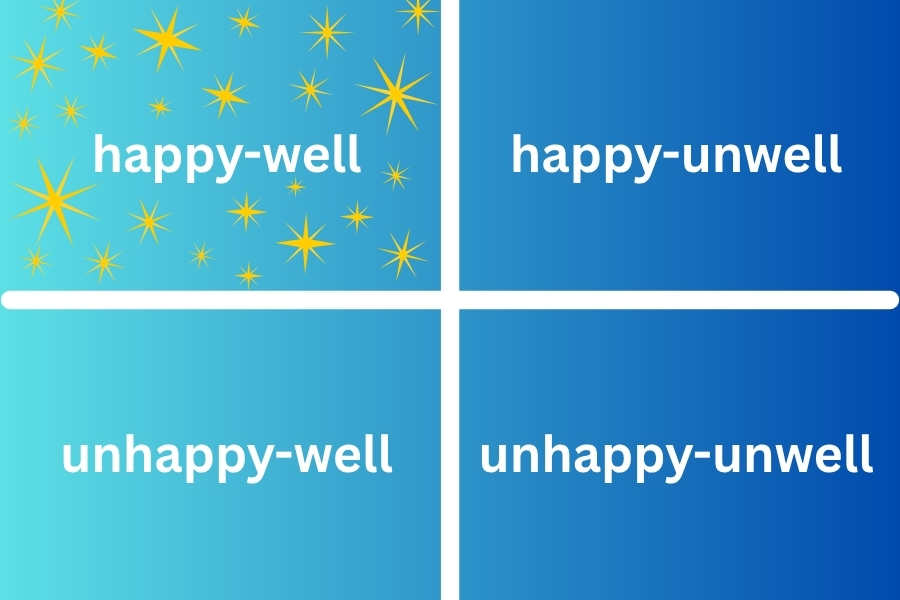
Four quadrants. Photo credit: Canva
Measuring health and happiness basically separates people into four quadrants. In an interview with Dr. Rhonda Patrick, Brooks shared that people who fall into the happy-healthy (or happy-well) quadrant tend to share seven habits in common.
The four physical habits associated with happiness and health
The first four have to do with our physical health and are ones that most of us might guess.
“Diet, exercise, smoking, and drinking,” Brooks said, adding that happy-well people are “very moderate” when it comes to substance use. “None of them were addicts, or if they had trouble with it, they quit,” he said.
Brooks shared that he smoked into his 20s and, even then, knew it was stupid. “But I still think about it every day,” he said. “I do. I love nicotine. I got addicted to it when I was 13 and quit when I was 26. And it was a relationship for me, right? But the whole point is no, because lifelong smokers have a 7 in 10 chance of dying from a smoking-related illness, and that is an unhappy way to go. You’re not going to be healthy and you’re not going to be happy dying of emphysema.”
People who age happier and healthier tend to do 7 things:
They don’t smoke, exercise regularly (but not excessively), maintain a healthy weight, and are mindful with alcohol or other substances.
As far as diet goes, Brooks said the happy-healthy people eat a “normal, healthy” diet. And for exercise, it’s really about moderation and the obvious things like walking and staying active.
“If you don’t exercise at all, you’re not happy and well,” he said. “And if you’re an exercise maniac, you actually will do some mechanical ill to your body, but actually you’re probably not happy and some compensation is going on.”
Three psychological and emotional habits associated with health and happiness
The other three habits aren’t quite as obvious.
“No. 1 is continuing to learn,” Brooks said. “And people who are life-long learners, they are healthier and they are happier. That’s usually a lot of reading, but curiosity is how that comes about. It’s just really really important.”
The next is having a technique for dealing with setbacks.
“You’ve got to get good at it,” he said. “You need skill at dealing with life’s problems. And if you don’t get good at it, you’re going to be bad when things actually crop up. And so maybe you’re good at therapy. Maybe you’re good at prayer, maybe you’re good at meditation. Maybe you’re really good at journaling. But all the happy and well people have their way to deal with it and they’re highly skilled in doing it.”
And the seventh habit, which Brooks calls “the biggie,” is simply love. “People who have the best lives, who are happy and well when they’re older, they have a strong marriage and/or close friendships,” he said. “That’s it. There’s no substitute for love. Happiness is love, full stop.”
Brooks shared other thoughts about the value in boredom and the pitfalls of social comparison in this segment, but the whole interview is filled with fascinating insights into what makes people happy and healthy.
Long-acting, reversible contraception methods like IUDs have become extremely popular in the United States and beyond. Just a few decades ago, only about 2% of women relied on them. In recent years, that figure has risen to around 17%, accounting for millions of women.
The rising popularity makes sense. IUDs can be convenient, highly effective, and can even make a woman’s period far less painful or stop it altogether. There’s just one problem: getting an IUD inserted hurts. For some people, it hurts a lot.
The pain from getting an IUD can range from mild discomfort for some people to excruciating pain for others. What’s frustrating is that medical providers haven’t historically listened to patients who say the procedure is severely painful. A 2013 study found that the average patient rated the pain of insertion at 64.8 out of 100, while providers estimated it at just 35.3—a big disconnect.
For years, women struggling in the aftermath of the procedure have been told the same infuriating refrain: “Just take ibuprofen.”
Artist brings women’s frustration to life
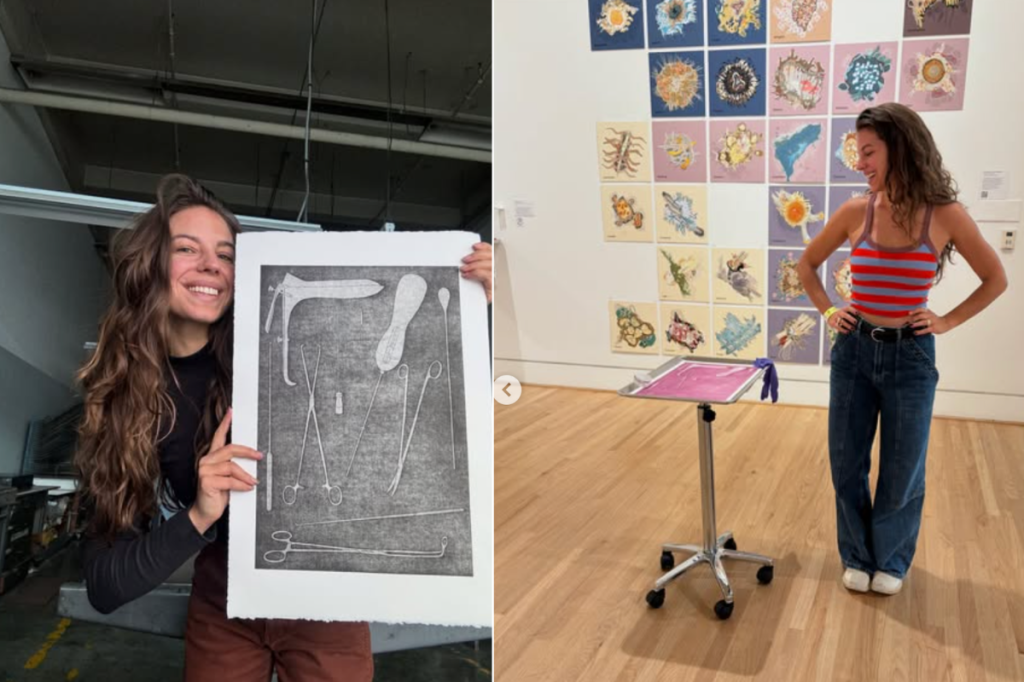
Emily Kampa recently debuted a striking piece of artwork built around this common source of dismissed pain among women.
The display, aptly titled “Just Take Ibuprofen,” boldly shows the actual medical instruments used in an IUD insertion in all of their horrific glory. Kampa listed them on her Instagram:
Speculum: 6.95” nose length
Single toothed tenaculum: 10”
Paracervical block (& needle): 6”
IUD insertion tube: 11”
MT cervix-holding clamp: 11”
OS finder: 8”
Cotton swab: 8”
IUD string scissors: 9.8”
Hook for IUD removal: 10”
IUD: 1.25”
After hours of research and planning, Kampa etched the instruments onto a copper plate, each one rendered life-size.
For the in-person installation at the Triton Museum of Art, Kampa placed the display on a real medical cart, with a surgical glove loosely dangling off the corner.
She wrote that she wanted viewers to experience the tools the same way she did when she first saw them at her OB-GYN’s office.
“‘Wait why are there scissors? Why is that q-tip SO large?!’” she recalled thinking. “That image stuck with me long after my own IUD experience and was the spark for this project.”
The art evokes a visceral reaction in viewers. It’s hard not to feel that taking a few Advil is a woefully inadequate response to the pain caused by these long, sharp instruments.
Photos of the display have been posted and reposted across social media, racking up thousands of likes and comments wherever they appear. Many women flocked directly to Kampa’s Instagram account to thank her for speaking out through her art:
“Thank you for this because I thought I was over reacting when I got physically sick. I [was] literally on the verge of vomiting and passing out. Cramps for days.”
“I never connected to an image so much in my life. … For the first two years (and still for a few days every month), felt like I had barbed wire inside me. I went to the doc after the first two weeks of pain and the nurses there said … the pain was normal for the first year.”
“Ibuprofen my a**! Too many of us have been gaslit, dismissed, ignored, traumatized, and even killed by medical professionals. Thank you for capturing this all-too-true experience and sharing your process”
“My cervix is shuddering. This is ART from experience”
Art has the power to elevate messages in unique and memorable ways. Thanks to women and artists like Kampa who have spoken out over the years, the culture of IUD pain management is steadily changing for the better.
“Systemic racism and bias as to how pain is experienced and who experiences it also has, unfortunately, influenced pain management considerations,” said Dr. Christopher M. Zahn, chief of clinical practice and health equity and quality at ACOG.
The new guidance recommends local anesthetics for the procedure, as well as “comprehensive pain management counseling” for patients, including offering the option of sedation or general anesthesia when possible.
These are big and necessary steps forward. Perhaps the most powerful part of this shifting conversation and culture, however, is that more women are being heard and their pain is finally being taken seriously.
Many women have a hard time doing traditional push-ups. Instead, they opt for “girl push-ups,” where the knees are placed on the ground to accommodate less upper body strength.
But what if this exercise actually took female anatomy into consideration?
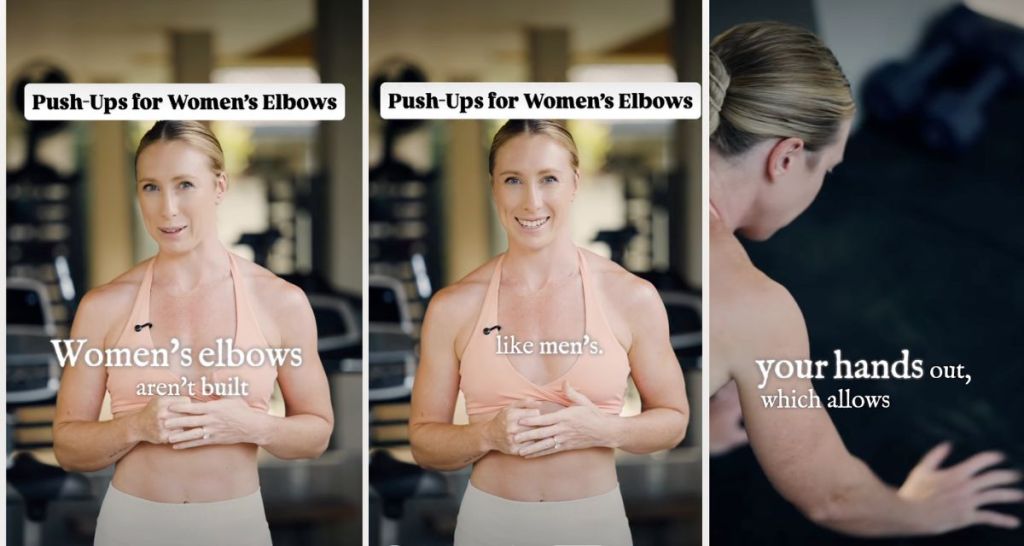
That’s the question behind a viral fitness trend on TikTok where women are making one small shift to their arm placement and suddenly realizing they could do full push-ups all along.
What is a “women’s anatomy” push-up?
As explained by Kayla Lee, a women’s anatomy and biomechanics educator, women tend to have a naturally greater “carrying angle” than men, meaning their elbows angle more outward when the arm is straightened. Traditional push-ups, where the elbows are tucked in and the wrists are stacked under the shoulders, don’t always accommodate this, which can lead to difficulty with the exercise, or even joint pain.
However, turning the hands outward at about 45 degrees and placing them slightly wider than shoulder-width accommodates this anatomical difference, making the exercise more doable while also reducing wrist and elbow strain and improving stability.
The reaction
So far, the reaction has been overwhelmingly positive, with many women hailing it as a game changer.
But, regardless, the real takeaway is that there’s no one-size-fits-all approach. We should aim for good form, but it has to be a form that works with your body.
Historically speaking
It’s also worth noting that, historically, women haven’t always been taken into account in the fitness industry, or the health industry overall.
Fitness programs either drew a stark divide between men’s and women’s fitness—remember when it was unheard of for women to lift weights at all?—or neglected women’s structural differences, hormonal fluctuations, and need for pelvic floor health.
So it wouldn’t be surprising if push-ups, an exercise believed to have originated with ancient Indian warriors and later popularized by the military, were also shaped through a male-centric lens.
Thankfully, this is changing. For example, equipment manufacturers are redesigning machines with narrower grip spacing and more comfortable chest pad designs. Women are increasingly prioritizing muscle gain to help stave off osteoporosis and age-related muscle loss. There’s also greater awareness of hormonal health and pelvic floor strength, especially postpartum.
And trainers like Kayla Lee offer more female anatomy-friendly exercise alternatives—from bicep curls to dumbbell rows to lateral raises, just to name a few.
In other words, sometimes it’s not about “getting stronger” in the way we’ve been told, but about finally having the tools that work with our bodies instead of against them. If a small shift in hand placement can unlock that kind of confidence, imagine what else becomes possible when fitness truly starts including everyone.