
upworthy
Add Upworthy to your Google News feed.
Google News Button
Pop Culture

Millennials nearing 40 are sharing their biggest mistakes so everyone can learn from them

Here are 21 of the most powerful responses.

millennials, regrets, millennial life lessons
via Pexels

Millennials are now old enough to seriously reflect on life.

It seems like only yesterday a millennial was a college kid that baby boomers chided for being entitled and Gen Xers thought were way too sincere and needed to learn how to take a joke. Today, the oldest millennials, those born around 1980, have hit their 40s and have lived long enough to have some serious regrets.

They also have enough experience to take some pride in decisions that, in hindsight, were the right moves. The good news is that at 40 there is still plenty of time to learn from our successes and failures to set ourselves up for a great second half of life. These lessons are also valuable to the Gen Zers coming up who can avoid the pitfalls of the older generation.

A Reddit user who has since deleted their profile asked millennials nearing 40 “what were your biggest mistakes at this point in life?” and they received more than 2,200 responses. The biggest regrets these millennials have are being flippant about their health and not saving enough money when they were younger.

They also realized that the carefree days of youth are fleeting and impossible to get back. So they should have spent less time working and more time enjoying themselves. Many also lamented that they should have taken their education more seriously in their 20s so they have more opportunities now.

The responses to this thread are bittersweet. It's tough hearing people come to grips with their regrets but the realizations are also opportunities to grow. Hopefully, some younger people will read this thread and take the advice to heart.

Here are 21 of the most powerful responses to the question: “Millennials of Reddit now nearing your 40s, what were your biggest mistakes at this point in life?”

1.

"Not taking care of my hearing, not even 35 and going deaf." — Kusanagi8811

2.

"Not getting healthy earlier." — zombiearchivist

3.

"Staying too long at a job in my 20s, just because it was safe and easy. When I finally got the motivation to leave, ended up with an almost 50% pay boost." — Hrekires

4. 

"Thinking that I could and should put myself on the back burner for anything and anyone else." — lenalilly227

5.

"Smoking and not dealing with my shit the right way." — Allenrw3

6.

"Pining after the wrong person." — runikepisteme

7.

"I turned 40 this year and just started liking who I am. Why the fuck did it take 40 years for self acceptance?" — guscallee

8.


"Take care of your fucking back. Lift with your knees. Sure it's rad when you grab a fridge by yourself and lift it in the back of a moving truck unaided, but one day that shit is going to have consequences that won't just magically go away by resting and "taking it easy" for a week." — GuyTallman

9.

"I wish I spent more time with my dad while I had the chance." — CharlieChooper

10.

"I'm 37. I absolutely could have taken better care of my body, but I'm in relatively good health. I'm starting to realize how important it is to maintain my health. I do also think I drank far too much in my 20 and early 30's. I'm trying to rectify that now, but it's hard. So that I guess." — dartastic

11.


"I'm not sure if people have experienced the same but when I entered my 30s I became convinced I was rapidly running out of time. Rather than using that as motivation I let it paralyze me with indecision because I "couldn't afford to make the wrong choice." Consequently, I'm now 39 and, though I've had great things happen in my 30s, I regret spending so much time worrying and so little time committing to a course of action." — tomwaste

12.

"Work to live, don’t live to work. You have half your working life after you turn 40 but only 20-25 years to really live it up before the responsibilities become heavy and your joints start to ache. Live life. Really LIVE it. Experience as much you can. Every sensation, sight, sound, touch. Be open. Be brave. Live your first few decades in the fast lane. You have the rest of your life to take it easy, when you have no choice." — MrDundee666

13.

"I should have paid more attention to my parents telling me to save money and less attention when they were teaching me about purity culture." — Arkie_MTB

14.

"If I could tell my 18 year old self one thing, it would be to save 10% of every paycheck I ever got." — PutAForkInHim

15.

"Thinking that I have time to do everything I want only to find myself loosing time, and the endless energy I used to have in order to purse them." — ezZiioFTW

16.

"Not wearing sunscreen." — blueboxreddress

17.

"Not recognizing the importance of work/life balance earlier in life. My late teens, all 20's, and early 30's were spent pulling 60-100+hr weeks because I thought it was what was required to succeed. How wrong I was. Others stabbed me in the back and reaped the reward.

1.) Putting work first for too long. Work is my #1 priority during work hours now. After quitting time, I don't think about it (much) anymore. I don't vent to my wife or friends about it anymore either.

2.) Investing more into fast cars than solid long-term investments. Sure, it was fun, but I could have made bookoos more had I put that towards less-fun investments.

3.) Not using PTO and just waiting for the payout. All those years, missed. I'm in my mid 30's and I didn't actually have a real vacation until 3 years ago.

4.) Not realizing that "the good guy" often loses. Just because you're morally justified doesn't mean you're going to win. Just because there's a number to call doesn't mean anyone will actually help you. Just because "law" exists, doesn't mean people follow it, enforce it, or create justice. The world is dog eat dog and cynicism can be healthy in moderate doses." — [Deleted]

18.

"When you get out of college, keep your friends. No matter how hard it is. Hold on to them." — mpssss22

19.

"I imagine these are kinda universal:

  • Not getting fit and healthy
  • Assuming I'd be offered proper guidance on how to achieve my goals
  • Assuming higher education would help me achieve my goals
  • Spending far too long caring what people think
  • Not taking risks that might better my life when I was younger and had nothing to lose
  • Staying in relationships too long after they were clearly done." — katapultperson

20.

"Always ask for more pay. Starting, yearly, before leaving, whatever. Get that money." — SensibleReply

21.

"Spending too much time in front of a screen and not enough enjoying life." — BellaPadella


This article originally appeared two years ago.

kids, school, school days, school week, schedule, 4 day week
Unsplash

Many school districts are moving to a 4-day week, but there are pros and cons to the approach.

American kids have fewer school days than most other major countries as it is, which poses a big challenge for families with two working parents. In a system designed for the "classic" stay-at-home mom model, it's difficult for many modern families to cover childcare and fulfill their work obligations during the many, many holidays and extra days off American children receive in school.

Some school districts, in fact, are ready to take things one step further with even fewer instructional days: for better or for worse.


Whitney Independent School District in Texas recently made news when it decided to enact a four-day week heading into the 2025 school year. That makes it one of dozens of school districts in Texas to make the change and over 900 nationally.

The thought of having the kids home from school EVERY Friday or Monday makes many parents break out in stress hives, but this four-day school week movement isn't designed to give parents a headache. It's meant to lure teachers back to work.

Yes, teachers are leaving the profession in droves and young graduates don't seem eager to replace them. Why? For starters, the pay is bad—but that's just the beginning. Teachers are burnt out, undermined and criticized relentlessly, held hostage by standardized testing, and more. It can be a grueling, demoralizing, and thankless job. The love and passion they have for shaping the youth of tomorrow can only take you so far when you feel like you're constantly getting the short end of the stick.

School districts want to pay their teachers more, in theory, but their hands are often tied. So, they're getting creative to recruit the next generation of teachers into their schools—starting with an extra day off for planning, catch-up, or family time every week.

Teachers in four-day districts often love the new schedule. Kids love it (obviously). It's the parents who, as a whole, aren't super thrilled.

- YouTube www.youtube.com

So far, the data shows that the truncated schedule perk is working. In these districts, job applications for teachers are up, retirements are down, and teachers are reporting better mental well-being. That's great news!

But these positive developments may be coming at the price of the working parents in the communities. Most early adopters of the four-day week have been rural communities with a high prevalence of stay-at-home parents. As the idea starts to take hold in other parts of the country, it's getting more pushback. Discussions on Reddit, Facebook, and other social media platforms are overrun with debate on how this is all going to shake up. Some parents, to be fair, like the idea! If they stay-at-home or have a lot of flexibility, they see it as an opportunity for more family time. But many are feeling anxious. Here's what's got those parents worried:

The effect on students' achievement is still unclear.

The execution of the four-day week varies from district to district. Some schools extend the length of each of the four days, making the total instructional time the same. That makes for a really long day, and some teachers say the students are tired and more unruly by the late afternoon. Some districts are just going with less instruction time overall, which has parents concerned that their kids might fall behind.

A study of schools in Iowa that had reduced instructional days found that five-days-a-week students performed better, on average.

Four-day school weeks put parents in a childcare bind.

Having two working parents is becoming more common and necessary with the high cost of living. Of course—"school isn't daycare!" But it is the safe, reliable, and educational place we send our kids while we we work.

Families with money and resources may be able to enroll their kids in more academics, extracurriculars, sports, or childcare, but a lot of normal families won't be able to afford that cost. Some schools running a four-day week offer a paid childcare option for the day off, but that's an added expense and for families with multiple kids in the school system, it's just not possible.

kids, school, school days, school week, schedule, 4 day week In a 4-day model, kids often (but not always) receive less instructional time. Photo by Ivan Aleksic on Unsplash
This will inevitably end with some kids getting way more screentime.

With most parents still working five-day weeks, and the cost of extra activities or childcare too high, a lot of kids are going to end up sitting around on the couch with their iPad on those days off. Adding another several hours of it to a child's week seems less than ideal according to expert recommendations.

Of course there are other options other than paid childcare and iPads. There are play dates, there's getting help from family and friends. All of these options are an enormous amount of work to arrange for parents who are already at capacity.

Working four days is definitely a win for teachers that makes the job more appealing. But it doesn't address the systemic issues that are driving them to quit, retire early, or give up their dreams of teaching all together.

@5th_with_ms.y

Replying to @emory here are my thoughts on my 4day work week as a teacher✨ #foryou #fyp #fypシ #foryoupage #foryoupageofficiall #teachersoftiktokfyp #teachersoftiktok #teachertok #teachersbelike #teachertiktok #tik #tiktok #viralllllll #teachertoks #teaching #teacher #tok #viralvideo #teacherlife #viral #trendy #teacher #teaching #worklifebalance #worklife #publicschool #publiceducation #school #student

A Commissioner of Education from Missouri calls truncated schedules a "band-aid solution with diminishing returns." Having an extra planning day won't stop teachers from getting scapegoated by politicians or held to impossible curriculum standards, it won't keep them from having to buy their own supplies or deal with ever-worsening student behavior.

Some teachers and other experts have suggested having a modified five-day school week, where one of the days gets set aside as a teacher planning day while students are still on-site participating in clubs, music, art—you know, all the stuff that's been getting cut in recent years. Something like that could work in some places.

In any case, the debate over a shortened school week is not going away any time soon. More districts across the country are doing their research in preparation for potentially making the switch.

Many parents don't theoretically mind the idea of their busy kids having an extra day off to unwind, pursue hobbies, see friends, catch up on projects, or spend time as a family. They're also usually in favor of anything that takes pressure off of overworked teachers. But until we adopt a four-day work week as the standard, the four-day school week is always going to feel a little out of place.

This article originally appeared in February. It has been updated.

gentle parenting, parenting, parenting tips, mommy blogger, instagram moms, emotional regulation, teaching kids discipline
via @kelsewhatelse/Instagram, used with permission

A mom shared a simple mantra she uses to teach her kids that they can do hard things.

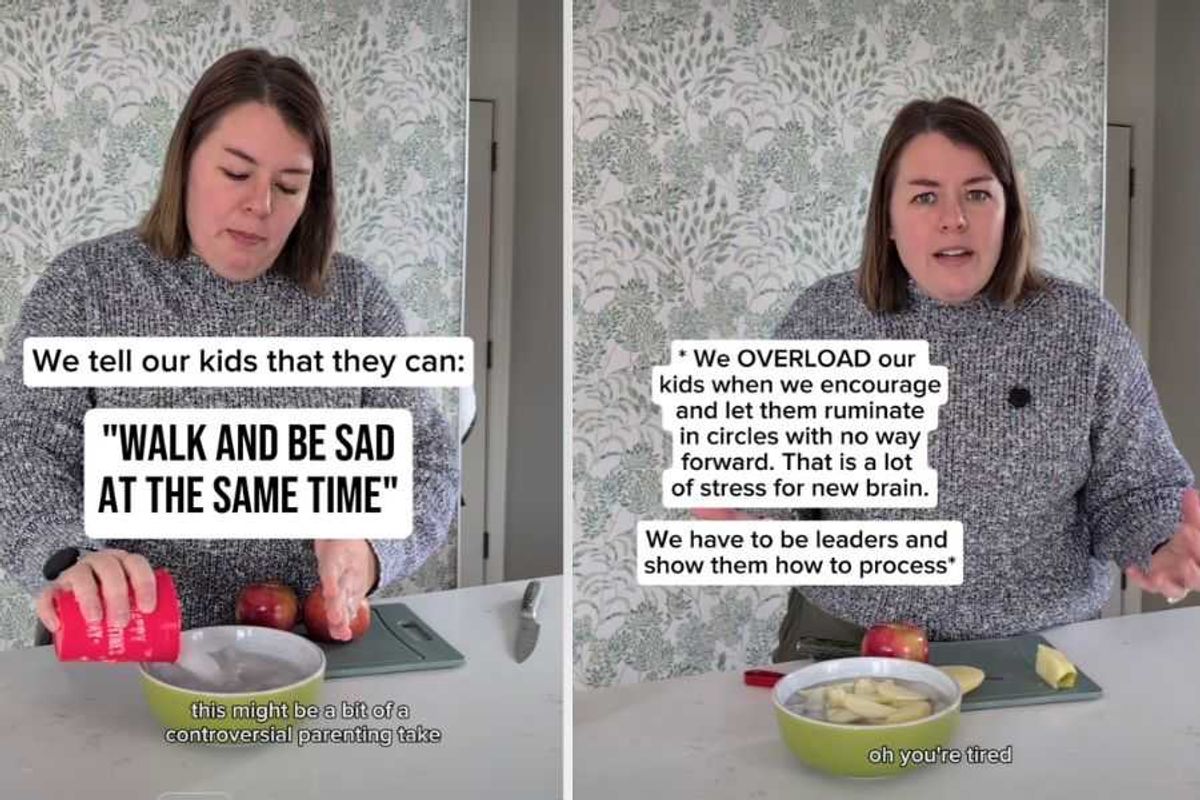
Recently, a mom named Kelsey Pomeroy shared what she called a "bit of a controversial parenting take." While it might sound prickly at first, it can be a powerful way to teach kids emotional regulation.

It all comes down to this simple mantra: "You can walk and be sad at the same time."


In a video posted to Instagram, Pomeroy used the example of her son, who had recently said he was "too tired" to go to school. Pomeroy knew he'd gotten enough rest the night before and wasn't sick; it was simply more comfortable to stay in bed. So while she acknowledged and validated her son's feelings, she reiterated that important responsibilities, like school, can still get done, even when emotions aren't optimal.

In her caption, Pomeroy argued that a lot of moms and dads who are Team Gentle Parenting get stuck on validating the feeling part. All that rumination can result in "overload" with no real way forward, especially because kids, and even some teens, have "bummer blindness," meaning that every setback feels like a "BIG important crisis."

"We have to actively TEACH and CALIBRATE their new brains to differentiate between BIG bummers and LITTLE bummers," Pomeroy wrote. The "you can feel x and still y" idea helps with that by teaching kids the difference between genuinely needing to push through and knowing when to pull back, something many Millennials and those who came before them never quite learned.

"Many of us never learned where our actual limits were," Pomeroy said in the comments. "Then we became parents and focused hard on emotional intelligence. But in the process, we sometimes robbed our kids of the opportunity to see their potential by unintentionally robbing them of resilience. That is why teaching both emotional intelligence and advocacy, as well as grit, is so important."

Pomeroy also astutely noted that tone means everything. Rather than dismissing, chastising, or being sarcastic, she explained that "it is a loving and motivating 'you can do it, you can do this' tone."

gentle parenting, parenting, parenting tips, mommy blogger, instagram moms, emotional regulation, teaching kids discipline Therapist applying tape to a boy's leg on a treatment table.Photo credit: Canva

"The key is: We are NOT 'moving on.' We ARE 'moving forward.'"

Adults do things while tired and frustrated all the time, Pomeroy argues, making it a "crucial skill that we have to build up in our children."

In the comments, people seemed to wholeheartedly agree.

"Learning how properly to carry every emotion while still function in society is a huge advantage."

"Wise words. Our job is to model and encourage resilience so our kids can be ready for their adult lives. It's the 'and.' We love them, we see them AND they can do hard things."

gentle parenting, parenting, parenting tips, mommy blogger, instagram moms, emotional regulation, teaching kids discipline Smiling child in a striped shirt, flexing arms in a playful muscle pose.Photo credit: Canva

"As a parent who's been stuck in the validating and wallowing with no forward momentum, this is the most common sense parenting advice on the internet. Thank you for providing us with something actionable!!"

"We absolutely must teach them these skills so that they can grow up to function and thrive in the adult world. 👏"

Parenting is about preparing kids for healthy adulthood. Sometimes that means teaching them that they are, in fact, safe to show up even when the good feelings aren't there.

Follow Pomeroy on Instagram for more helpful (and fun) parenting content.

Culture

American shares his 9 realizations about the U.S. after 13 years abroad and it's eye-opening

“If you’ve never left, you can never understand what it’s really like…”

united states, american, europe, living abroad, U.K.
Image credit: Evan Edinger/YouTube

You learn a lot about your country when you leave it for a while.

Evan Edinger moved to London over 13 years ago to study abroad but never planned on staying overseas permanently. His goal was to get his degree, return to the United States, start his career, and make a life for himself. He thought of his time in London as a "temporary adventure."

But when he finished his degree, he found himself in an unexpected situation: He didn't want to go back. "The longer I stayed in London," Edinger shares on his YouTube channel, "the more I began to notice all of the assumptions that I'd grown up believing in America, the things I was brought up to believe were undeniably true and just the way the world worked—it turns out they weren't true at all."


One of the benefits of living in another country is seeing your country of origin through different eyes. That perspective can cause you to appreciate some things and question other things. Edinger shares nine realizations he's had about the U.S. since he left, starting with one of the most quintessentially American realities he found himself questioning.

- YouTube www.youtube.com

1. Guns

Edinger grew up in New Jersey and describes it as "quite a blue state," but he was still immersed in the gun culture that views gun ownership as a fundamental part of being an American.

"I was raised in a very pro-gun household," Edinger says. "In my family home in America, we had a 12-gauge shotgun, a 10-gauge, a black powder rifle, and a .410 shotgun for the children. My dad would take us out some days to shoot empty cans of beer or play pigeons or sometimes go hunting for pheasants or deer."

He says the notion of not owning a gun was unthinkable in his upbringing. "The idea that other countries do not allow guns is viewed more like these other countries are missing a fundamental right," he says.

His ideas about guns have changed dramatically since moving to London and living in a society without ubiquitous access to guns. "Visiting Philadelphia when I was younger was always scary to me because I never knew who had a gun, who wanted to rob me," Edinger shares. "Visiting New Orleans a couple years ago, I was told by my hotel staff that a few days prior, a tourist was shot and died in the local Popeye's Chicken because he caught a stray bullet of two people having an argument in the restaurant. So, that's just something that people just have to deal with. This constant fear of I could just die being caught in a crossfire and there's nothing I can really do about it because freedom. I've pretty much never felt that level of fear in London at all. And that alone was enough to sway my opinion on guns."

guns, gun culture, gun violence, united states, second amendment The U.S. has a unique gun culture.Photo credit: Canva

2. Government

"One thing that's really drilled into you pretty much every year of American school is that American democracy is the end-all be-all of government and that it is the beacon of freedom other countries look to emulate. Then, once you become an adult and you see how dysfunctional the U.S. government is, you search for anything to feel better about it and usually settle on 'Well, at least it's not a third world dictatorship.'"

But those aren't the only two options. Edinger explains how the parliamentary system in the U.K. is far from perfect, but it tends to be more effective at actually getting things done because lawmakers aren't constantly stymied by the inherently destructive two-party gridlock we have in the U.S.

"It's messy, yes, but after 13 years away, I've come to the belief that no system of government is perfect," he says. "But most systems in Western Europe are far more effective than what I grew up believing was the 'best in the world.'"

3. Walkability and Public Transport

In the U.S., having a car is practically a symbol of freedom, but Edinger says he's never felt the need to have a car in his 13 years living in London. He says it's been incredibly freeing to be able to walk and take public transit everywhere, and not just in the city. He's been able to travel all over Europe, in larger cities and small towns, and the focus on walkable neighborhoods and public transportation is everywhere.

walkable cities, public transportation, car dependency, london underground, subway It's much easier to get around without a car in Europe. Photo credit: Canva

"After having spent some time living in walkable neighborhoods, I would never ever choose to live in a car dependent place ever again," Edinger says. "It is truly one of the most life-changing parts of living over here. And because I'm always walking everywhere, because I'm always cycling everywhere, it's so much easier to be healthy and physically fit without even trying."

4. Food Quality and Price

Europe has different regulations than the U.S., Edinger explains, with an approach that leads to a lot less additives and chemicals being added to foods.

"Europe's food agency focuses on possibilities and the U.S.'s focuses on probabilities. Is it possible an unnecessary additive could be harmful? Europe prohibits it just to be safe. The US agency, the FDA, they only step in if the probability of it being harmful is high. So, that risk is passed on to the average American consumer."

Edinger also points out that the ability to walk down to the store to get fresh ingredients regularly makes it a lot easier to eat well. "It's one of those things where once you experience both, there is no contest. No contest. So, it's much easier to be healthy in Europe than in America."

5. Healthcare in the U.S. vs. Europe

"If my health does have issues, I am glad it's not something that would ever bankrupt me or cause me to ever think about how much it would have to cost me just to be sick," says Edinger.

Americans often hear horror stories about socialized medicine, but Edinger's experience with going to the doctor and even going to the hospital have been positive, and barely cost him anything.

health, healthcare, universal healthcare, health insurance, cost of healthcare The U.S. is an outlier in the world when it comes to healthcare costs. Photo credit: Canva

"There are only two types of people that are against the freeing social safety net that is universal healthcare," says Edinger. "People that have never experienced socialized healthcare and people that profit from the broken system. That's it." Most Americans want it, but "most Americans" is not where the money is.

6. Consumer Protections in the U.S. vs Europe

Edinger shares that he bought a MacBook Pro in 2019 that didn't work right, and he hadn't purchased AppleCare because he knew he didn't have to.

"If you buy a tech product in Europe, you have a reasonable expectation that it should last you at least two years free of defects," says Edinger. "And if it's not up to your expectations or breaks down before then, you can demand a return or replacement. This law protects consumers from shady business practices."

He ended up getting his full money back on the computer due to those consumer protections.

"It's laws like this where you really begin to notice a pattern that life in Europe is one that gives more rights to the everyday person over giant corporations and shared benefit over private," says Edinger.

7. Worker Rights

"A quick summary would be 28 days minimum paid holiday, one year paid maternity leave, two weeks paid paternity leave, sick leave, even the right against unlawful termination," said Edinger. "When working part-time at Urban Outfitters in London, even though I worked less than 20 hours a week, I still got two days paid holiday per month. That's insane, right? No, that's just life over here. Meanwhile, I worked five years at a Pizza Hut in New Jersey for over 30 hours per week. Never got a single day of paid vacation."

Indeed, there's more than a handful of European countries that guarantee at least a month of paid days off, with some countries actually requiring a certain number of days or weeks off.

vacation, holiday, paid vacation days, paid time off, work life balance Europeans get far more generous paid leave than Americans do.Photo credit: Canva

Edinger points out the irony that he was always taught that the U.S. was for the individual, for individual freedoms. But in his experience, in Europe individuals have more rights than those with money or power, while it's the opposite in the U.S.

8. Money (Live to work or work to live?)

Edinger says that most things are more affordable in Europe, from groceries to data plans, but Americans do earn higher salaries.

"So if you earn a lot of money and money is your sole defining metric of success, then you can feel a lot more successful in the U.S.," he says. "But because the culture in Europe is work to live and not live to work, you might find that the stress and cost tradeoffs and quality of life erode the value of that higher salary quite quickly."

9. On Romanticizing Europe

People often wonder if Americans romanticize Europe too much, and Edinger says the same question used to be asked of Europeans romanticizing America. But now that we have YouTube and social media and a better ability to see the realities of both places, he says what Americans "romanticize" about Europe is really just the things we want and don't have.

work-life balance, united states, working, european culture, worker rights Work-life balance is something a lot of Americans struggle with.Photo credit: Canva

"I think most Americans who are eyeing up Europe are doing so because of the things that America is lacking. Nearly two in three Americans want universal healthcare. Well, America doesn't offer that. Again, two in three Americans want European style vacation policies. America doesn't offer that. And 53% of Americans would prefer to live in a walkable neighborhood, but sorry, America doesn't offer that. The list goes on. If America were an actual democracy, I don't think many of these people would be having romanticized views of Europe at all because they wouldn't need to. They could have everything they wanted in the country they were born and raised."

Of course, every country has its problems and there are certainly downsides to moving abroad. Edinger acknowledges that but says it really boils down to what you value in life. Americans are taught to romanticize the U.S., and leaving it helps you see the reality, what's good about your country and where it has room for improvement.

"I think the main thing though out of everything that I miss about the U.S. that I can't really get here is not rights, not freedoms, not anything that's big on quality of life improvements," says Edinger. "It's just Mexican food and good ice cream."

You can follow Evan Edinger on YouTube for more on his experiences as an American living abroad.

Learning

15 English words that instantly change from nouns to verbs with a simple shift in our voice

English isn't a tonal language, but in this case, it kind of feels like one.

present, presentation, linguistics, words, nouns, verbs

The different stresses on "present" and "present" determine whether it's a noun or a verb.

When native English speakers try to learn tonal languages like Chinese, Thai, or Navajo, it can take a while to get the hang of it. The idea that the same syllables spoken in a different tone can change the meaning of a word is a foreign concept in English, where we shift our tone and pitch in all kinds of ways without any change in actual word definitions.

But that doesn't mean tone or pitch plays no role in English word meanings. Changing our tone and pitch to stress different syllables does change the meaning of a surprising number of words. Interestingly, there's a whole bunch of two-syllable words that follow a rule of sorts, where stressing the first syllable makes the word a noun and stressing the second makes it a verb.


For example, the word "conduct." Stress the first syllable, using a higher tone or pitch at the start, and you get CON-duct, a noun meaning "behavior." Emphasize the second syllable instead, and it becomes con-DUCT, a verb meaning "to carry out" or "to lead."

And there are so many more:

  • PERmit vs. perMIT
  • PREsent vs. preSENT
  • INsult vs. inSULT
  • OBject vs. obJECT
  • REject vs. reJECT
  • SUSpect vs. susPECT
  • CONflict vs. conFLICT
  • CONvict vs. conVICT
  • CONvert vs. conVERT
  • IMport vs. imPORT
  • RECord vs. reCORD
  • PROtest vs. proTEST
  • PROduce vs. proDUCE
  • ADDress vs. addRESS

What kind of rule is this? Why do all of these words change from a noun to a verb simply by changing which syllable we stress?

- YouTube youtu.be

Interestingly, these words function as both nouns and verbs, but there's a bigger picture when it comes to syllable stress and its relationship to word meaning. As Coffee Break Languages shares:

"Research into English word stress has shown that around 90% of two-syllable nouns are stressed on the first syllable. So when we see a two-syllable noun, we can be quite confident the word will be stressed on the first syllable."

We see that pattern in words like APple, LIon, ORange, PERson, TEAcher, and WINdow.

"Research also shows that around 70% of two-syllable verbs are stressed on the second syllable," they add. "We need to be more careful with verbs, but still most of them are stressed on the second syllable so we can make an educated guess here if necessary. For example, the words agREE, colLECT, deFEND, enJOY imPROVE, and perFORM follow that pattern."

These are the kinds of patterns most native English speakers aren't specifically taught, but people learning English as a second language have to learn. And because English doesn't use stress punctuation like accent marks, vocal stress has to be figured out entirely from context.

Again, English isn't a tonal language, but is this really an example of the way tonal languages function?

- YouTube www.youtube.com

Not exactly. Tone, pitch, and stress are distinct linguistic elements, and they overlap in ways that aren't always easy to explain. You can get into the weeds pretty quickly when diving into the role each element plays in different languages. (If you really want to dig in, there's an excellent description of how different categories of languages utilize tone, pitch, and stress on Linguistic Stack Exchange. It's pretty interesting.)

It's not exactly a secret that English has a lot of odd rules, exceptions to rules, and one-off cases that many of us don't even know are rules. Every language has its inconsistencies, but English is famous for them. All the more reason to always be gracious with those who are learning.

Music

The magical 1982 Genesis reunion with Peter Gabriel was actually to save him from crushing debt

Gabriel found himself in an alarming situation, receiving “horrible phone calls and death threats” from his creditors.

Phil Collins, Peter Gabriel, genesis, reunion concert, genesis reunion, musicians, live performances

Genesis reunited with Gabriel in 1982 to help save their former singer from his debt.

On March 26, 2022, as the final seconds ticked away from Genesis’ farewell tour, the crowd at London’s O2 Arena was clearly emotional. The prog-pop band’s most famous lineup—front man Phil Collins, guitarist/bassist Mike Rutherford, and keyboardist Tony Banks—had finally reunited after a 13-year hiatus (and a temporary pandemic delay), and no one wanted this improbable run to end. But there may have been another reason for the sadness: a glaring absence onstage.

Peter Gabriel had co-founded the band in 1967, helping catapult them to rock glory with his golden rasp and surreal stage antics, before leaving in 1975 to launch a solo career. Collins, previously the drummer, got the promotion to lead singer, leading the group through the commercial heights of “Mama” and “Invisible Touch.” Hardcore prog fans pined to hear Gabriel sing Genesis again, but outside of a few powerful one-offs—a tease of their epic “Dancing With the Moonlit Knight” during a 2016 solo tour, a 1999 re-recording of their starry-eyed ballad “The Carpet Crawlers”—that door remained shut.


- YouTube www.youtube.com

Now here he was at the O2, seated among the commoners, with an opportunity to help bring the Genesis story full-circle. Instead, he took the unselfish (if, let’s face it, slightly unsatisfying) route: avoiding the spotlight and letting his former bandmates enjoy the curtain call they’d rightly earned. (“Me going was a rite of passage, really,” the singer told Mojo in 2023. “I’d been part of the creation of Genesis, so I wanted to be there at the end.”)

Here’s the thing, though: A lot of casual fans forget that Gabriel had already reunited with Genesis for an entire show—it just happened 20 years earlier. Oh, and it occurred not because of rosy nostalgia but due to mounting debt and death threats.

The reunion stemmed from the financial disaster of the first WOMAD

Gabriel staged the inaugural WOMAD (World of Music, Arts, and Dance) in July 1982, with the noble vision of sparking genuine cultural fusion. The three-day event featured British post-punk (Echo and the Bunnymen, Pigbag) and art-rock (Peter Hammill, Robert Fripp), traditional Irish folk (The Chieftains), Indian sitar players (Imrat Khan), Afro-Caribbean dance companies (Ekomé)—a legit anything-goes atmosphere that remains novel at music festivals decades later, let alone in the early days of MTV. "I [wanted] to celebrate all these fantastic musicians, art, dance, film from around the world that weren't getting exposure,” Gabriel told filmmaker John Edginton in a raw-footage clip filmed for his 2014 documentary, Genesis: Together and Apart. He had big dreams for WOMAD, and, as he noted in the 2007 book Genesis: Chapter and Verse, the first fest was “magnificent.”

- YouTube www.youtube.com

"We put it on during school time, so there were a lot of schools working on projects about world music; it was very exciting, fresh, passionate,” he said. “But the people just didn’t come. There was a rail strike that weekend, and even though we thought we had enough names to pull in an audience, we were hopelessly under each day, and suddenly realized the financial consequences.”

Gabriel found himself in an alarming situation, receiving “horrible phone calls and death threats” from his creditors. “It was a very oppressive nightmare,” he said. Luckily, his old band stepped in—not that anyone involved would have chosen the reunion without this dire prompt.

By 1982, Gabriel had been enjoying a successful solo career, crafting artful pop songs and studio experiments while tinkering with new recording technology (the Fairlight CMI sampling synthesizer, for one). He had little interest in looking backward—outside of a couple early solo tours where he was forced to play a Genesis song or two due to a lack of material, he’d more or less distanced himself from his old band. (His debut single, “Solsbury Hill,” is about his desire to leave Genesis—and the music business entirely. “I felt like I was just in the machinery,” he told Rolling Stone, citing a lyric. “We knew what we were going to be doing in 18 months or two years ahead. I just did not enjoy that.”) The band, meanwhile, had soldiered on just fine without their original front man, growing into a stadium act with Collins behind the mic.

- YouTube www.youtube.com

"It made sense to us"

When manager Tony Smith reached out to Genesis, seeing if they could help Gabriel escape his dark spiral with a one-off benefit reunion, everyone felt it was the right thing to do. “Whether or not he felt he needed our help to get himself out of trouble, it made sense to us,” Collins wrote in Chapter and Verse, “and it certainly was not a condescending gesture.” Banks added that, beyond the kind act of helping their friend, it made sense as an act of fan service: “People had been asking us to organize some sort of get-together for years and years, and this seemed a very good reason to do it, at the same time as helping Peter pay off this particular debt. We did need a reason because it wasn’t something we were itching to do."

It’s not like they hated each other: Collins had even played on Gabriel’s self-titled 1980 solo album, helping create the distinctive “gated” drum sound that became ubiquitous throughout the decade. But it was a somewhat awkward fit musically, given how far their respective sounds had diverged. "Having tried for seven years to get away from the image of being ex-Genesis, there's obviously a certain amount of stepping back," Gabriel reportedly told NME ahead of the show. "I don't think they would choose at this point to work with me … [but] I’m very grateful and I'm intending to enjoy myself."

- YouTube www.youtube.com

The problem was how to solve their logistical puzzle—Genesis was only still playing a few of their Gabriel-era songs, and their old front man wasn’t up to speed on any of them. They managed to arrange two or three rehearsals at London’s Hammersmith Odeon, where Genesis played a triple-header on September 28th, 29th, and 30th. The quirky set drew from Gabriel’s time in the lineup, sprinkling in one solo cut (“Solsbury Hill,” ironically) and a single '80s-era track (“Turn It on Again,” with Gabriel on second drums). Understandably, the performances were rather loose—not up to anyone’s respective standards—and the massive downpour of rain probably didn’t improve anyone’s mood.

But in the widely shared bootlegs of that show, fans were just happy to see everyone on stage again. They even saw a brief reunion of the full ‘70s quintet lineup: Former guitarist Steve Hackett, who learned about the event while on vacation in Brazil, flew back to the U.K. to play on “I Know What I Like (In Your Wardrobe)” and “The Knife.” "As they’d already rehearsed up their stuff, I was only able to join the encores,” he wrote in his 2020 book, A Genesis in My Bed, “but I was thrilled to be involved with the team once more."

- YouTube www.youtube.com

“It felt like a bit of a dream”

It’s easy to look back on the gig with a what-if feeling. Could they have somehow figured out more rehearsal time? (Probably not.) Should they have professionally recorded the event, no matter how sloppy they expected it to be? (Definitely.) “I regret it now, but I was keen not to record the show,” Rutherford wrote in his 2015 memoir, The Living Years. “I thought it would be a bit rough and ready and that it was better to be there and in the moment.”

Ultimately, what matters is that with Six of the Best, Genesis accomplished their primary goal: rescuing their old friend from a terrifying plight.

“It felt like a bit of a dream,” Banks wrote in Chapter and Verse. “I was very glad when it was over, because I hadn’t particularly enjoyed playing that stuff at the time. I always tended to be into what we were doing either at the time or whatever the next thing was. I was pretty glad to have left some of those old songs behind. But the audience reaction was very good, and I believe that show did go some way to sorting out Peter’s financial problem; now WOMAD is a monster thing.”

Indeed. The festival re-emerged stronger in the mid-’80s and has continued annually—without death threats—ever since.

Gabriel might have been watching the final Genesis show, but he was on stage in spirit. Collins gave him a shout-out during the set, and the band wrapped this historic occasion with their swirling ballad “The Carpet Crawlers,” a track Gabriel helped craft for his Genesis swan song, 1974’s The Lamb Lies Down on Broadway.

Few major rock bands have replaced one iconic singer with another. Even fewer have done it by promoting from within. And while Genesis achieved such longevity because of their songwriting—the imagination, the color, the dynamics—perhaps that familial spirit had something to do with it. They weren’t always on the same page, musically or otherwise—but as Six of the Best proved, they came through for each other when it mattered most.

- YouTube www.youtube.com