Comedian's 'English lessons' highlight the absurdity of English spelling and pronunciation
Nothing but sympathy for anyone trying to learn English as a second language.

English makes no sense.
If you've ever tried to learn another language, you know what a daunting task it is to grasp different grammar, syntax, pronunciation and spelling rules, in addition to the exceptions to those rules. Other than something like Esperanto, the thousands of languages humans speak weren't purposefully invented, but evolved over millennia, which means the structures of them don't always make perfect, logical sense.
The English language is a perfect example.
English spelling and pronunciation are just utterly chaotic.
Despite being one of the most taught languages in the world, English is notoriously difficult to learn. So much of it is simply nonsensical, and there are so many exceptions to the rules it sometimes feels like there's no point to even having the rules. This is especially true when it comes to the way combinations of letters are pronounced differently in different words.
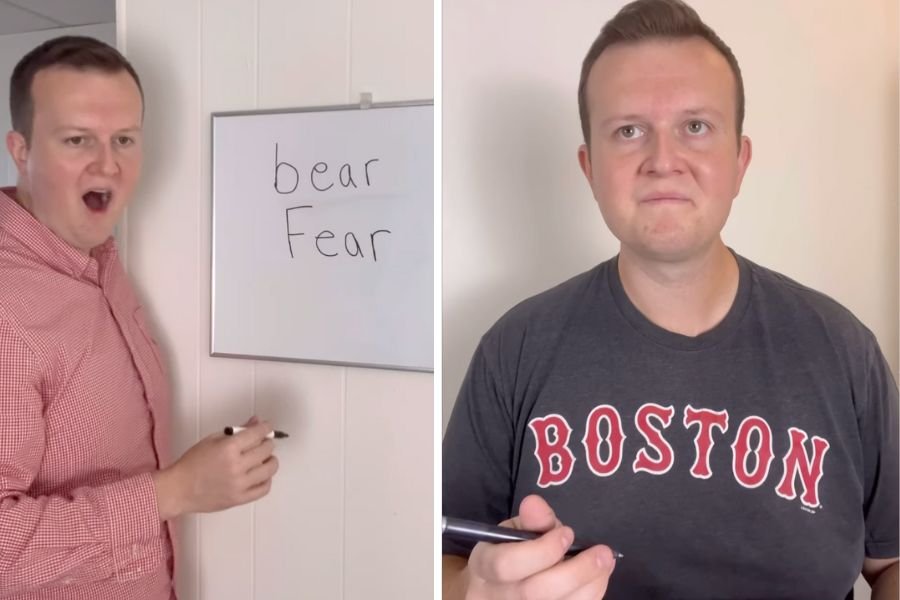
Comedian Bobby Finn highlights the absurdity of English spelling and pronunciation in his "English Class" videos, which showcase how futile it is to try to logic your way through learning the language.
For instance:
Finn's "You don't see how?" and "Why would you think?" are the perfect tongue-in-cheek responses to the confusion on the student's face when none of the logical conclusions he lays out add up.
And it just keeps going…
And he didn't even get to how "read and "read" and "tear" and "tear" and "lead" and "lead" are different pairs of words spelled the same but pronounced differently and with a different meaning.
Clearly the "ea" diphthong is an issue, but it's certainly not the only one. There is a seemingly endless list of English letter combos that combine in head-scratching ways as if they were purposefully designed to confuse and confound.
We've all been down the dreaded "ough" road, right? Imagine trying to learn this stuff as a second-language learner.
Teaching English requires either major gaslighting or admitting it's non-sensical
"Nooooo. Why would you think?" and "Remember what I said earlier." Hoo boy, you really can't teach English without either gaslighting the dickens out of students or just admitting that there's no rhyme or reason to anything. People who teach English and those who have had to learn it shared their delight at him nailing the assault on the brain that is English language learning.
"As an English major, former English instructor, and current supervisor of English, I vehemently agree that English makes no sense! 😂"
"The more of these videos i see, the more amazed i am that i actually learned English 😂."
"Oh man I’m reliving the trauma of my younger self learning English as a second language. 😆"
"OMG flashbacks of being in that seat having to answer the ESL teacher’s questions and all variations playing in my head knowing that there is no way I am going to guess the right one. Lol 🤣"
"I feel so awful for anyone that has to learn English as a second language. It’s chaotic."
"As a native English speaker, I apologise to everyone learning English for the chaos that it is. 🤣"
"As a teacher with lots of ESL students, when they ask 'how,' I just apologize. 😂"
"I love that there is no REAL explanation from teacher about why he is getting it wrong. Just the wonderful “NO” coupled with the wonderfully condescending repetition of the proper sounds. 😂💀👌🏼"
Why do so many people learn English if it's so hard?
English may be somewhat ridiculous, but it has become an increasingly important one to learn. It's an official language in 75 countries (39% of countries in the world) and is one of the six official languages of the United Nations. More than half of the world's scientific and technical periodicals are published in English and English has long been the language of international business.
In the absence of a truly universal language, English is arguably becoming a default common language. It's not unusual to travel to different countries and see signs in the country's language and in English. Even within the European Union, people from countries that speak different languages natively often find common ground in their basic command of English, which the most widely understood language in the EU.
As of now, somewhere between 15% and 20% of people on Earth speak English either as a primary or secondary language. Unless we get moving on choosing a more appropriate auxiliary language for everyone to learn in addition to their native language, it looks like English is a wise–even if frustrating—language to learn.
You can follow Bobby Finn on Instagram for more comedy.

- People are shocked to learn that 200 years ago we lost the 27th letter in the alphabet ›
- German is an oddly charming language. Here's what English sounds like with German grammar. ›
- Language expert shares what English sounds like to people who don't speak it ›
- People rally around woman learning English after man criticizes her - Upworthy ›
- English uses one of the rarest sounds of any language - Upworthy ›
- What did the Lord's Prayer sound like in medieval English? - Upworthy ›
- Comedian raps and sings to nursing home residents in heartwarming videos - Upworthy ›
- The American Island where residents speak a fascinating blend of Southern and Old English - Upworthy ›
- Parisians laugh trying to pronounce tricky English words - Upworthy ›
- How soldiers and sports helped shape the cringey corporate jargon we all despise - Upworthy ›
- People are sharing quotes from their favorite comedians. These 23 are pure gold. - Upworthy ›
- 9 things that make English weird among world languages - Upworthy ›
- Language nerd explains why so many negative words seem to start with the letter 'n' - Upworthy ›
- Experts explain why the word 'literally' confuses non-English speakers - Upworthy ›
- What English would sound like if we pronounced silent letters - Upworthy ›
- A tmesis is abso-freakin-lutely the coolest feature of the English language you don't know exists - Upworthy ›
- Comedian Paul F. Tompkins ends the debate over cake vs. pie with one deliciously pure insight - Upworthy ›
- In 1972, the number 1 song in Italy used only English-sounding gibberish and it's so trippy - Upworthy ›
- Which European country speaks English as a second language best? - Upworthy ›
- 19 nearly-extinct "fossil words" that only survive hidden inside these specific idioms - Upworthy ›
- English words that change from nouns to verbs with a vocal shift - Upworthy ›
- The weird history of Spoonerisms: English's silliest slips-of-the-tongue - Upworthy ›


A woman is getting angry at her coworker.via
A man with tape over his mouth.via
A husband is angry with his wife. via 
a man sitting at a desk with his head on his arms Photo by
Can a warm cup of tea help you sleep better? If you believe it, then yes. Photo by 
Three women sit on a blanket in the park. 
Two women engaging in a pleasant conversation inside a coffee shop
Two men engaging in a peaceful disagreement.
Resurfaced video of French skier's groin incident has people giving the announcer a gold medal
"The boys took a beating on that one."
Downhill skiing is a sport rife with injuries, but not usually this kind.
A good commentator can make all the difference when watching sports, even when an event goes smoothly. But it's when something goes wrong that great announcers rise to the top. There's no better example of a great announcer in a surprise moment than when French skier Yannick Bertrand took a gate to the groin in a 2007 super-G race.
Competitive skiers fly down runs at incredible speeds, often exceeding 60 mph. Hitting something hard at that speed would definitely hurt, but hitting something hard with a particularly sensitive part of your body would be excruciating. So when Bertrand slammed right into a gate family-jewels-first, his high-pitched scream was unsurprising. What was surprising was the perfect commentary that immediately followed.
This is a clip you really just have to see and hear to fully appreciate:
- YouTube youtu.be
It's unclear who the announcer is, even after multiple Google inquiries, which is unfortunate because that gentleman deserves a medal. The commentary gets better with each repeated viewing, with highlights like:
"The gate the groin for Yannick Bertrand, and you could hear it. And if you're a man, you could feel it."
"Oh, the Frenchman. Oh-ho, monsieurrrrrr."
"The boys took a beating on that one."
"That guy needs a hug."
"Those are the moments that change your life if you're a man, I tell you what."
"When you crash through a gate, when you do it at high rate of speed, it's gonna hurt and it's going to leave a mark in most cases. And in this particular case, not the area where you want to leave a mark."
Imagine watching a man take a hit to the privates at 60 mph and having to make impromptu commentary straddling the line between professionalism and acknowledging the universal reality of what just happened. There are certain things you can't say on network television that you might feel compelled to say. There's a visceral element to this scenario that could easily be taken too far in the commentary, and the inherent humor element could be seen as insensitive and offensive if not handled just right.
The announcer nailed it. 10/10. No notes.
The clip frequently resurfaces during the Winter Olympic Games, though the incident didn't happen during an Olympic event. Yannick Bertrand was competing at the FIS World Cup super-G race in Kvitfjell, Norway in 2007, when the unfortunate accident occurred. Bertrand had competed at the Turin Olympics the year before, however, coming in 24th in the downhill and super-G events.
As painful as the gate to the groin clearly as, Bertrand did not appear to suffer any damage that kept him from the sport. In fact, he continued competing in international downhill and super-G races until 2014.
According to a 2018 study, Alpine skiing is a notoriously dangerous sport with a reported injury rate of 36.7 per 100 World Cup athletes per season. Of course, it's the knees and not the coin purse that are the most common casualty of ski racing, which we saw clearly in U.S. skier Lindsey Vonn's harrowing experiences at the 2026 Olympics. Vonn was competing with a torn ACL and ended up being helicoptered off of the mountain after an ugly crash that did additional damage to her legs, requiring multiple surgeries (though what caused the crash was reportedly unrelated to her ACL tear). Still, she says she has no regrets.
As Bertrand's return to the slopes shows, the risk of injury doesn't stop those who live for the thrill of victory, even when the agony of defeat hits them right in the rocks.