
upworthy
Add Upworthy to your Google News feed.
Google News Button
Joy

10 awkward friendships you probably have—we all have a #9.

Not all friendships are meant to last forever.

Comic with stick figures
via Wait But Why and used with permission

The ten types of friends

When you're a kid, or in high school or college, you usually don't have to work too hard on your friendships. Friends just kind of happen.

For a bunch of years, you're in a certain life your parents chose for you, and so are other people, and none of you have that much on your plates, so friendships inevitably form. Then in college, you're in the perfect friend-making environment, one that hits all three ingredients sociologists consider necessary for close friendships to develop: “proximity; repeated, unplanned interactions; and a setting that encourages people to let their guard down and confide in each other." More friendships happen.

Maybe they're the right friends, maybe they're not really. But you don't put that much thought into any of it — you're still more of a passive observer.

But once student life ends, the people in your life start to shake themselves into more distinct tiers.

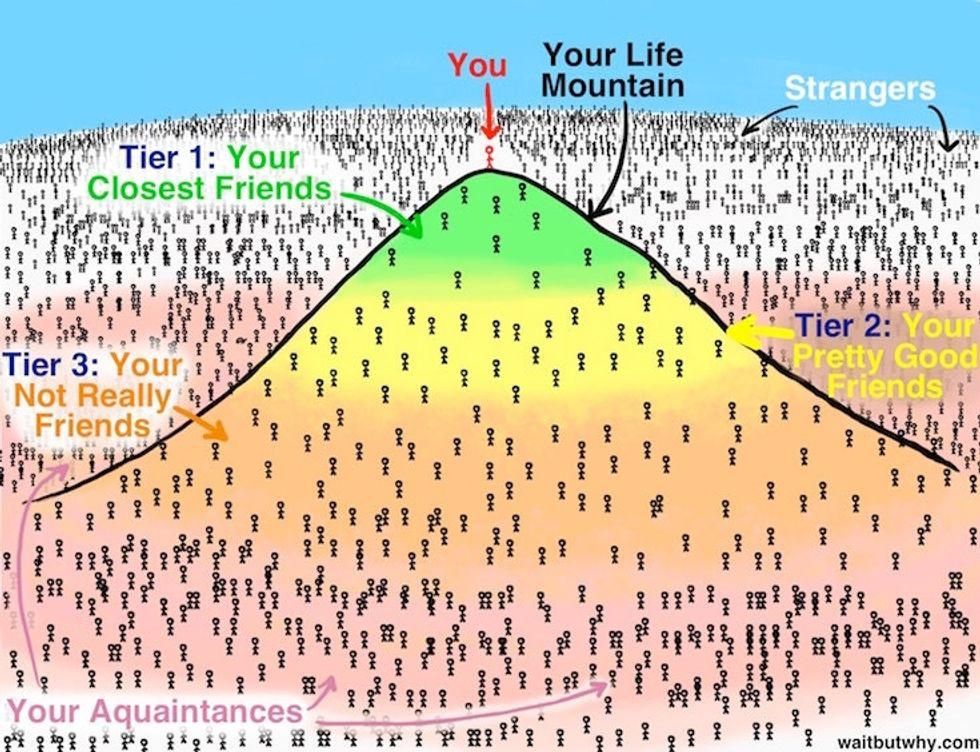
It looks something like this mountain:
Infographic of a mountain

Visual interpretation of where friends fall on the mountain of “You."

via Wait But Why post and used with permission.

At the top of your life mountain, in the green zone, you have your Tier 1 friends—the people who feel like brothers and sisters.

These are the people closest to you, the ones you call first when something important happens, the ones you love even when they suck, who make speeches at your wedding, whose best and worst sides you know through and through, and whose relationship with you is eternal; even if you go months or years without hanging out, nothing has changed when you find yourself together again.

Unfortunately, depending on how things went down in your youth, Tier 1 can also contain your worst enemies, the people who can ruin your day with one subtle jab that only they could word so brilliantly hurtfully, the people you feel a burning resentment for, or jealousy of, or competition with. Tier 1 is high stakes.

Below, in the yellow zone, are your Tier 2 friends: your Pretty Good friends.

Pretty Good friends are a much calmer situation than your brothers and sisters on Tier 1. You might be invited to their wedding, but you won't have any responsibilities once you're there. If you live in the same city, you might see them every month or two for dinner and have a great time when you do, but if one of you moves, you might not speak for the next year or two. And if something huge happens in their life, there's a good chance you'll hear it first from someone else.

Toward the bottom of the mountain in the orange zone, you have your Tier 3 friends: your Not Really friends.

You might grab a one-on-one drink with one of them when you move to their city, but then it surprises neither of you when five years pass and drink #2 is still yet to happen. Your relationship tends to exist mostly as part of a bigger group or through the occasional Facebook Like, and it doesn't even really stress you out when you hear that one of them made $5 million last year. You may also try to sleep with one of these people at any given time.

The lowest part of Tier 3 begins to blend indistinguishably into your large group of acquaintances (the pink zone): those people you'd stop and talk to if you saw them on the street or would maybe email for professional purposes but whom you'd never hang out with one-on-one. When you hear that something bad happens to one of these people, you might be sad but not too affected.

Finally, acquaintances gradually blend into the endless world of strangers.

And depending on who you are and how things shook out in those first 25 years, the way your particular mountain looks will vary.

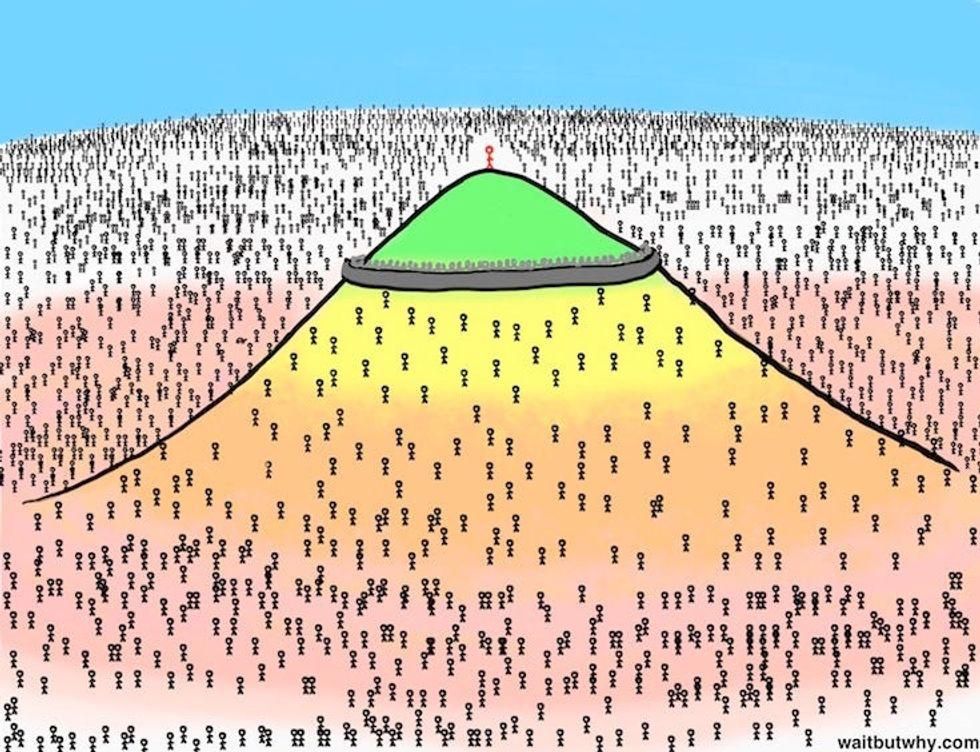
For example, there's Walled-Off Wally:
Comic of a lone person on top of a mountain

Some people keep a barrier up between acquaintances.

via Wait But Why post and used with permission.

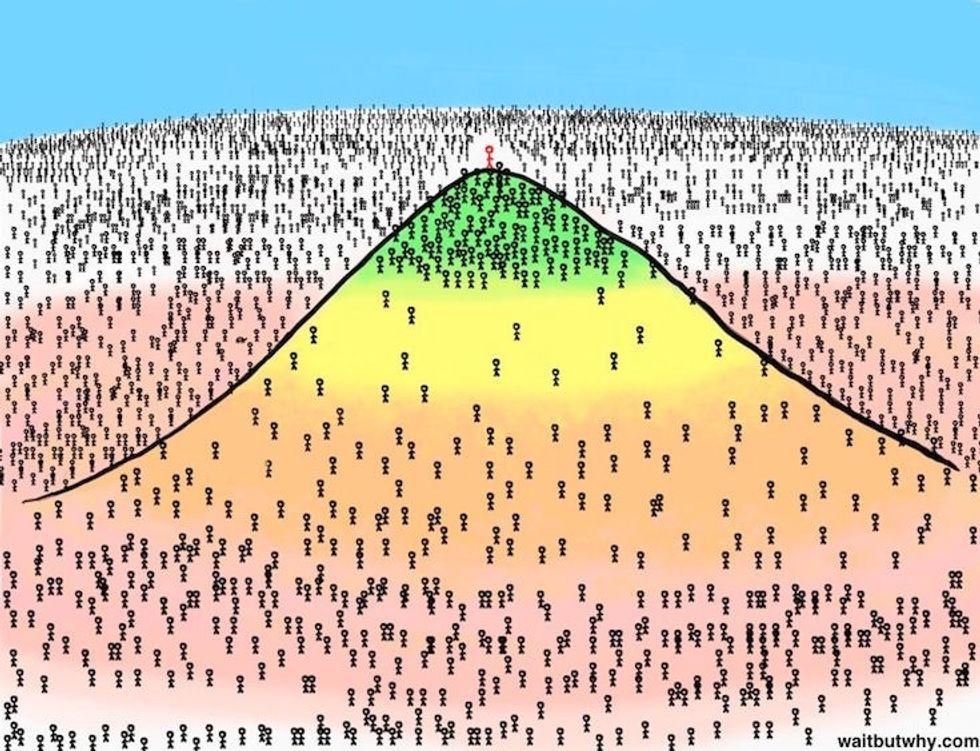
And Phony Phoebe, who tries to be everyone's best friend and ends up with a lot of people mad at her:
Comic of a mountain with a lot of people at the top

The life of the party.

via Wait But Why post and used with permission.

Even Unabomber Ulysses has a mountain:

Comic of a mostly empty mountain with one person at the top

Hermits exist.

via Wait But Why post and used with permission.

Whatever your particular mountain looks like, eventually the blur of your youth is behind you, the dust has settled, and there you are living your life.

Then one day, usually around your mid or late 20s, it hits you: It's not that easy to make friends anymore.

Sure, you'll make new friends in the future—at work, through your spouse, through your kids—but you won't get to that Tier 1 brothers level, or even to Tier 2, with very many of them because people who meet as adults don't tend to get through the 100+ long, lazy hangouts needed to reach a bond of that strength. As time goes on, you start to realize that the 20-year frenzy of not-especially-thought-through haphazard friend-making you just did was the critical process of you making most of your lifelong friends.

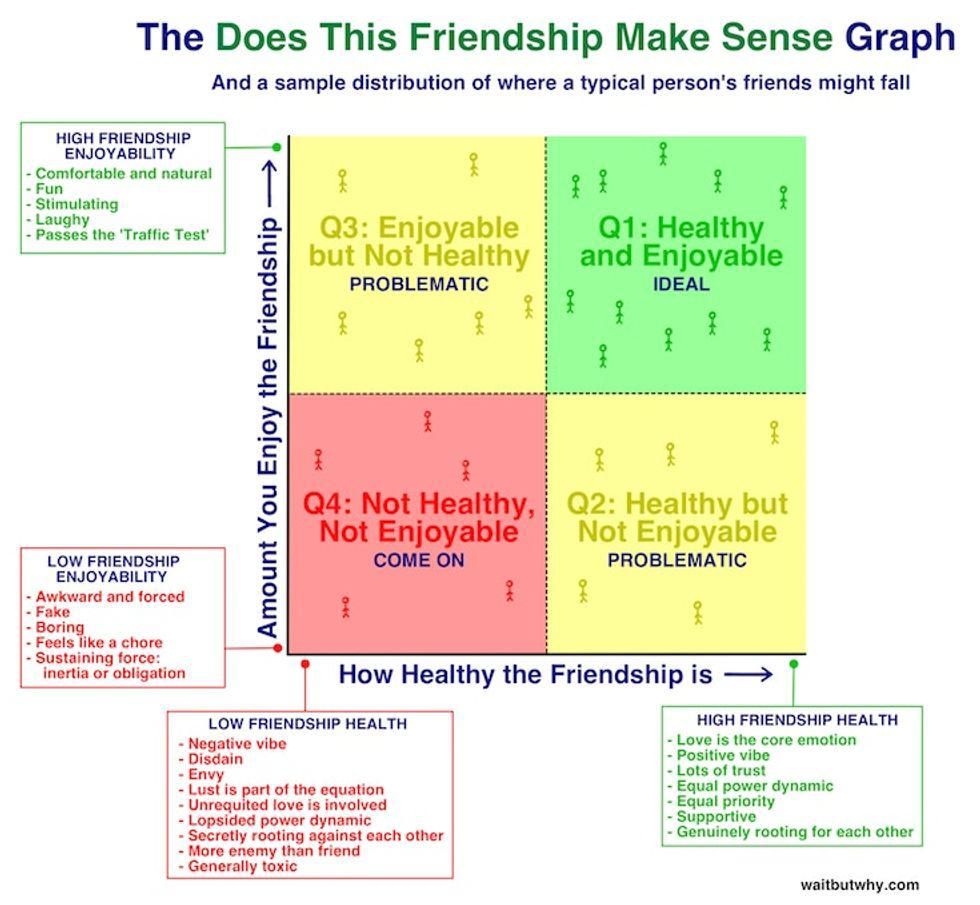
And since you matched up with most of them A) by circumstance, and B) before you really knew yourself yet, the result is that your Tier 1 and Tier 2 friends—those closest to you—fall in a very scattered way on what I'll call the Does This Friendship Make Sense? Graph:
Graph

The friendship graph.

via Wait But Why post and used with permission.

So, who are all those close friends in the three non-ideal quadrants?

As time goes on, most of us tend to have fewer friends in Quadrants 2 through 4 because A) people mature, and B) people have more self-respect and higher standards for what they'll deal with as they get older. But the fact is, friendships made in the formative years often stick, whether they're ideal or not, leaving most of us with a portion of our Tier 1 and Tier 2 friendships that just don't make that much sense. We'll get to the great, Quadrant 1 friendships later in the post, but in order to treat those relationships properly, we need to take a thorough look at the odd ones first.

Here are 10 common ones:

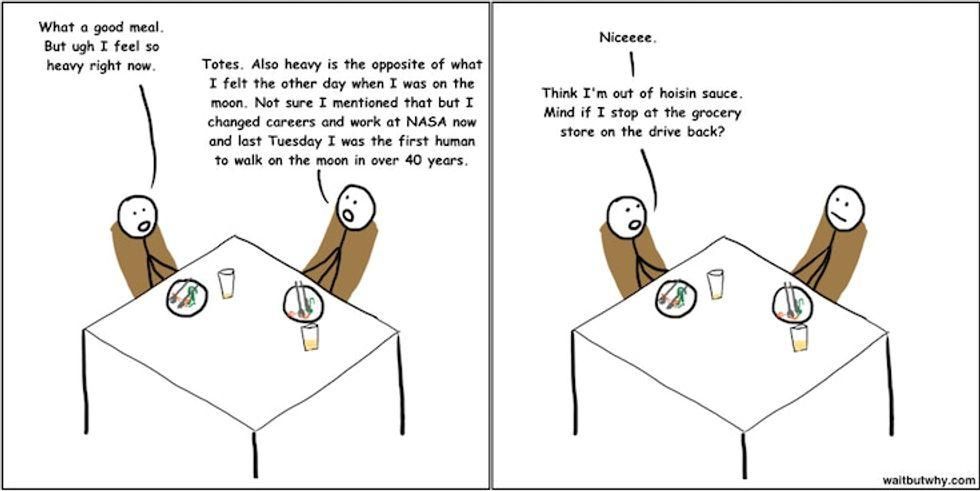
1. The non-question-asking friend
Comic of two people at dinner

Odd moments that happen between friends.

via Wait But Why post and used with permission.

You'll be having a good day. You'll be having a bad day. You'll be happy at work. You'll quit your job. You'll fall in love. You'll catch your new love cheating on you and murder them both in an act of incredible passion. And it doesn't matter, because none of it will be discussed with The Non-Question-Asking Friend, who never, ever, ever asks you anything about your life. This friend can be explained in one of three ways:

  1. He's extremely self-absorbed and only wants to talk about himself.
  2. He avoids getting close to people and doesn't want to talk about either you or himself or anything personal, just third-party topics.
  3. He thinks you're insufferably self-absorbed and knows if he asks you about your life, you'll talk his ear off about it.

Giving you the benefit of the doubt here, we're left with two possibilities. Possibility #1 isn't fun at all and this person should not be allowed space on Tier 1. The green part of the mountain is sacred territory, and super self-absorbed people shouldn't be permitted to set foot up there. Put him on Tier 2 and just be happy you're not dating him.

Possibility #2 is a pretty dark situation for your friend, but it can actually be fun for you. I have a friend who I've hung out with one-on-one about four times in the last year, and he has no idea Wait But Why exists. I've known him for 14 years and I'm not sure he knows if I have siblings or not. But I actually enjoy the shit out of this friend—sure, there's a limit on how close we'll ever be, but without ever spending time talking about our lives, we actually end up in a lot of fun, interesting conversations.

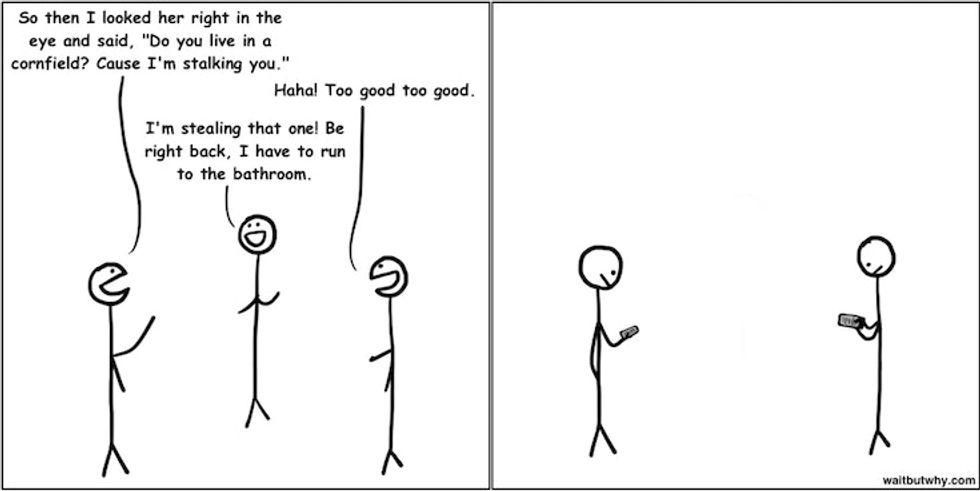
2. The friend in the group you can't be alone with under any circumstances
Comic of three stick people having a conversation

Why have relationships when there is a phone around?

via Wait But Why post and used with permission.

In almost every group of friends, there's one pair who can't ever be alone together. It's not that they dislike each other—they might get along great—it's just that they have no individual friendship with each other whatsoever. This leaves both of them petrified of the lumbering elephant that appears in the room anytime they're alone together. They're way too on top of shit to ever end up in the car alone together if a group is going somewhere in multiple cars, but there are smaller dangers afoot—like being the first two to arrive at a restaurant or being in a group of three when the third member goes to the bathroom.

The thing is, sometimes it's not even that these people couldn't have an individual friendship—it's just that they don't, and neither one has the guts to try to make that leap when things have gone on for so long as is.

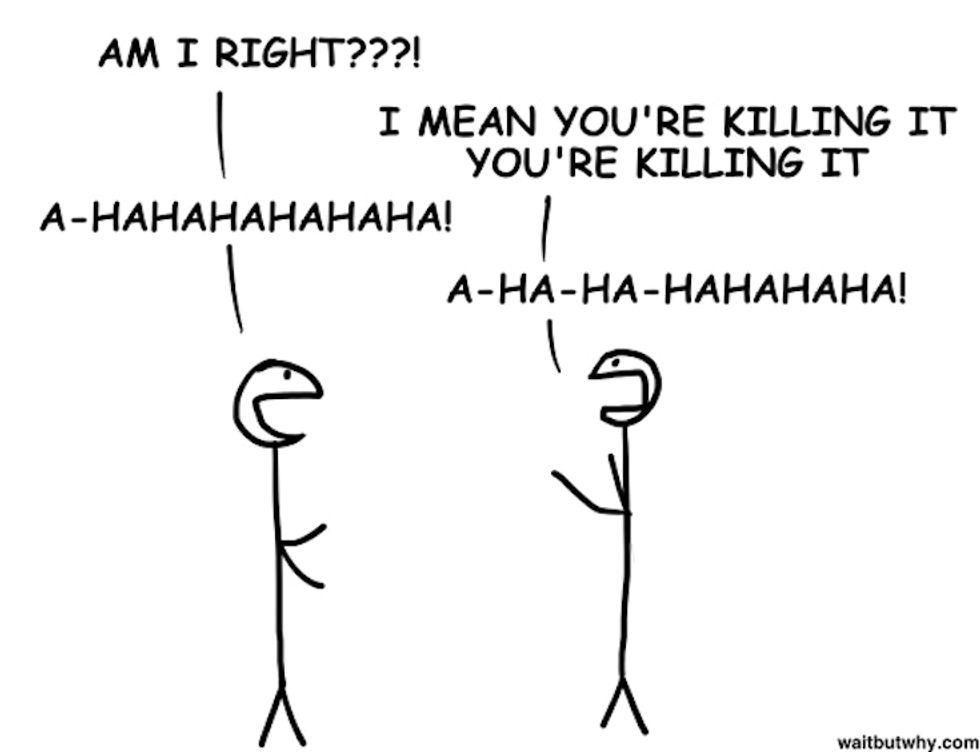
3. The non-character-breaking friend you have to be “on" with
Comic of stick people laughing together

Controlled intimacy and distancing through language.

via Wait But Why post and used with permission.

This is a friend who's terrified of having an earnest interaction, and as such, your friendship with him is always in some kind of skityou always have to be on when you're interacting.

Sometimes the skit is that you both burst out laughing at everything constantly. He can only exist with you in “This is so fucking hilarious, it's too much!" mode, so you have to be in some kind of joke-telling or sarcastic mode yourself at all times or he'll become socially horrified.

Another version of this is the “always and only ironic" friend, who you really bum out if you ever break that social shell and say something earnest. This type of person hates earnest people because someone being earnest dares him to come out from under his ironic safety blanket and let the sun touch his face, and no fucking thanks.

A third example is the “You're great, I'm great, ugh why is everyone else so terrible and not great like us" friend. Of course, she doesn't really think you're perfectly great at all—if she were with someone else, you'd be one of the voodoo dolls on the table to be dissected and scoffed at. The key here is that the two of you must be on a team at all times while interacting. The only comfortable mode for this person is bonding with you by building a little pedestal for you both to stand on while you criticize everyone else. You can either play along and everything will go smoothly, even though you'll both despise yourselves and each other the whole time, or you can commit the ultimate sin and have the integrity to disagree with the friend or defend a non-present party the friend criticizes. Doing this will shatter the fragile team vibe and make the friend recoil and say something quietly like, “Hm ... yeah ... I guess." The friend now respects you for the first time and will also criticize you extra hard next time she's playing her pedestal game with a different friend.

What these all have in common is the friend has tall walls up, at least toward you, and so she builds a little skit for you two to hang out in to make sure any authentic connection can be avoided. Sometimes that person only does this out of her own social anxiety and can become a great, authentic friend if you can just stomp through the ice. Other times, the person is just hopelessly scared and closed off and there's no hope and you have to get out.

In any case, I can't stand these interactions and am in a full panic the entire time they're happening.

4. The double-obligated friendship
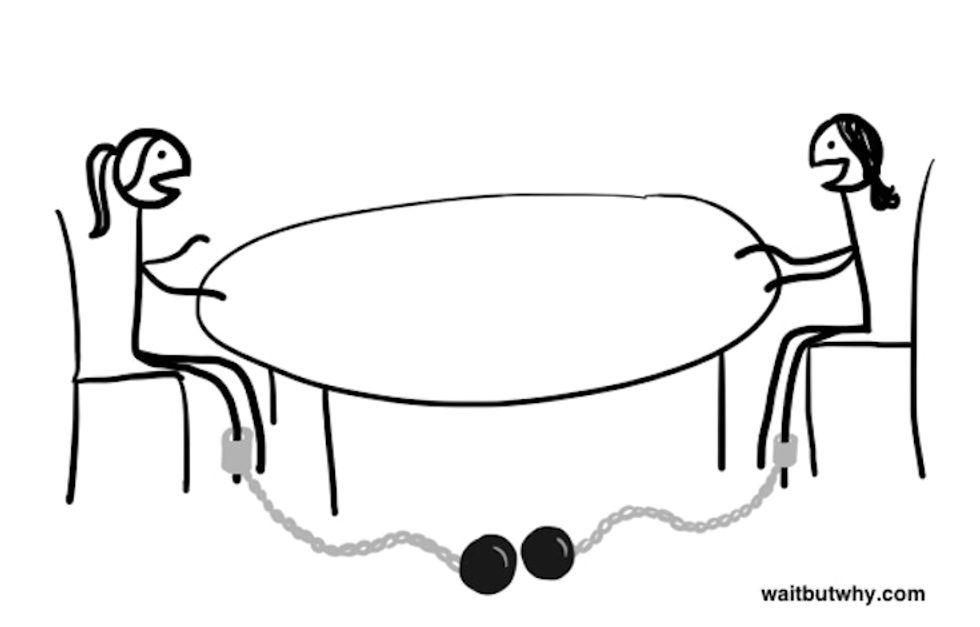
Comic of two men chatting a table with balls and chains around their legs

I think we need a bigger table.

via Wait But Why post and used with permission.

Think of a friend you get together with from time to time, which usually happens after a long and lackluster email or text exchange during which you just can't find a time that works for both of you — and you're never really happy when these plans are being made and not really psyched when you wake up and it's finally on your schedule for that day.

Maybe you're aware that you don't want to be friends with that person, or maybe you're delusional about it — but what you're most likely not aware of is that they probably don't want to see you either.

There are lopsided situations where one person is far more interested in hanging out than the other (we'll get to those later), but in the case we're talking about here, both parties often think it's a lopsided situation without realizing that the other person actually feels the same way — that's why it takes so long to schedule a time. When someone's excited about something, they figure out how to get it into their schedule; when they're not, they figure out ways to push it farther into the future.

Sometimes you don't think hard enough about it to even realize you don't like being friends with the person, and other times you really like the idea or the aesthetic of being friends with that particular person — being friends with them is part of your Story. But even in cases where you're perfectly lucid about your feelings, since neither of you knows the other feels the same way and neither has the guts to just cut things off or move it down a tier, this friendship usually just continues along for eternity.

5. The half-marriage

Two stick people each holding a half of a heart

An ego boost through controlling the relationship.

via Wait But Why post and used with permission.

Somewhere in your life, you're probably part of a friendship that would be a marriage if only the other person weren't very, very, extremely not interested in that happening. 1 for 2 on yes votes — just one vote away — so close.

You might be on either side of this — and either way, it's one of the least healthy parts of your life. Fun!

If you're on the if only side of things, probably the right move is to get your fucking shit together? Ya know? This friendship is one long, continuous rejection of you as a human being, and you're just wallowing there in your yearning like a sobbing little seal. Plus, duh, if you gather your self-respect and move on with your life, it'll raise their perception of your value and they might actually become interested in you.

If you're on the Oh yeah, definitely not side of the situation, here's what's happening: There's this suffering human in the world, and you know they're suffering, and you fucking love it, because it gives your little ego a succulent sponge bath every time you hang out with them. You enjoy it so much you probably even lead them on intentionally, don't you — you make sure to keep just enough ambiguity in the situation that their bleeding heart continues to lather your ego from head to toe at your whim.

Both of you — go do something else.

6. The historical friend
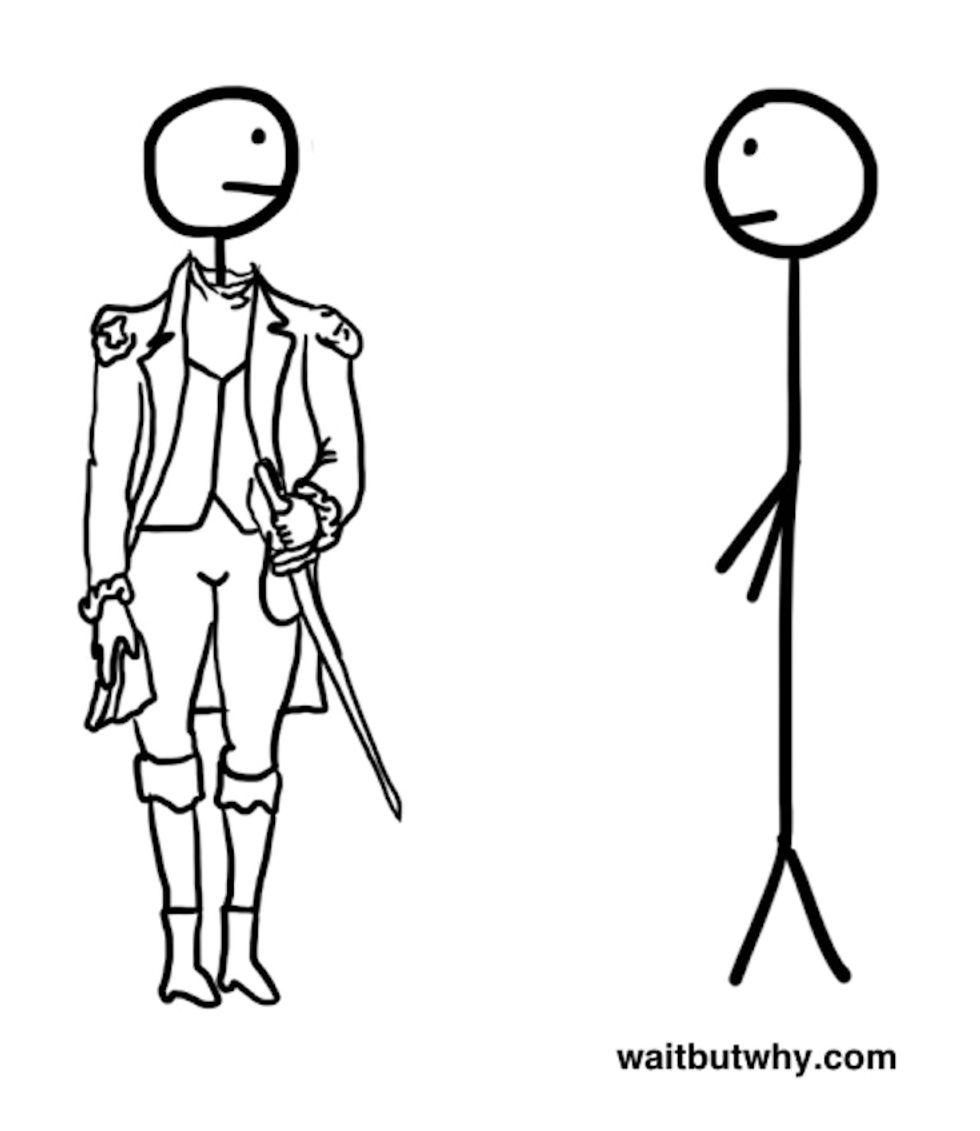
Stick person in historical garb beside a regular stick person

We met in kindergarten.

via Wait But Why post and used with permission.

A Historical Friend is someone you became friends with in the first place because you met when you were little and stayed friends through the years, even though you're a very weird match. Most old friends fall somewhat into this category, but a true Historical Friend is someone you absolutely would not be friends with if you met them today.

You're not especially pleased with who they are, and they feel the same way about you. You're not each other's type one bit. Unfortunately, you're also extremely close friends from when you were four, and you're both just a part of each other's situation forever, sorry.

7. The non-parallel life paths friendship
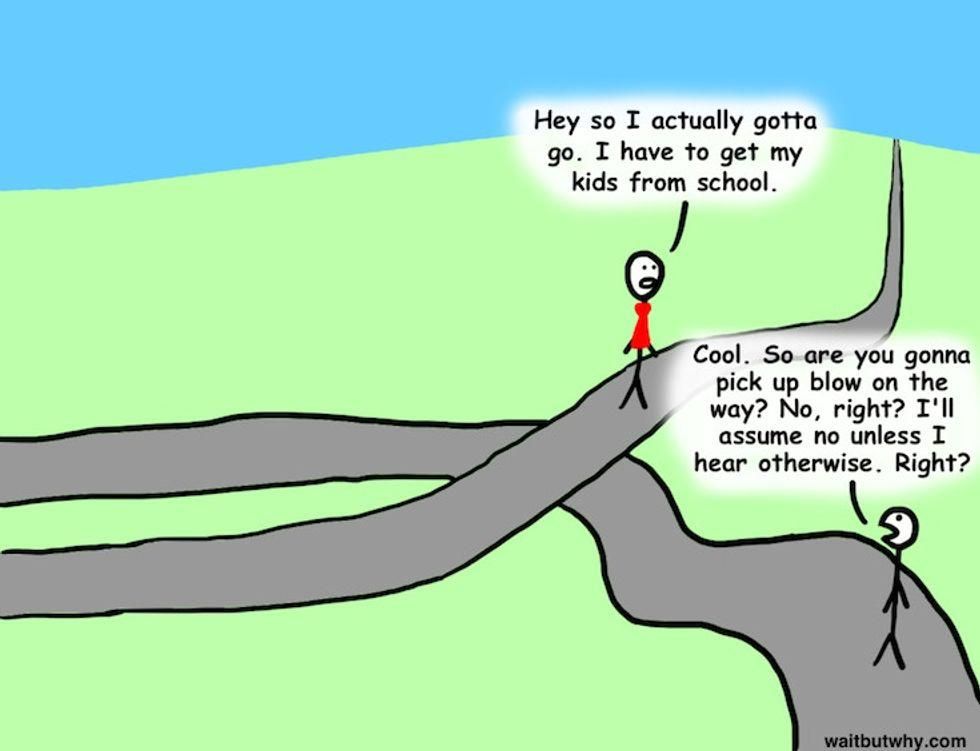
Two stick people on opposite paths

Looking for love in all the wrong places.

via Wait But Why post and used with permission.

Throughout childhood and much of young adulthood, most people your age are in the same life stage as you are. But when it comes to advancing into full adulthood, people do so at widely varying paces, which leads to certain friends suddenly having totally different existences from one another.

Anyone within three years of 30 has a bunch of these going on. It's just a weird time for everyone. Some people have become Future 52-year-olds, while others are super into being Previous 21-year-olds. At some point, things will start to meld together again, but being 30-ish is the friendship equivalent of a kid going through an awkward pubescent stage.

There are darker, more permanent Non-Parallel Life Path situations. Like when Person A starts to become a person who rejects material wealth, partially because she genuinely feels that pursuing an artistic path matters more and partially because she needs a defense mechanism against feeling envious of richer people, and Person B's path makes her scoff at people who pursue creative paths, partially because she genuinely thinks expressing yourself is an inherently narcissistic venture and partially because she needs a defense mechanism against feeling regretful that she never pursued her creative dreams — these two will have problems.

They may still like each other, but they can't be as close as they used to be — each of their lives is a bit of a middle finger at the other's choices, and that's jst awkward for everyone. It's not always that bad — but to survive an Off-Line Life Situation, friends need to be really different people who don't at all want the same things out of life.

8. The frenemy
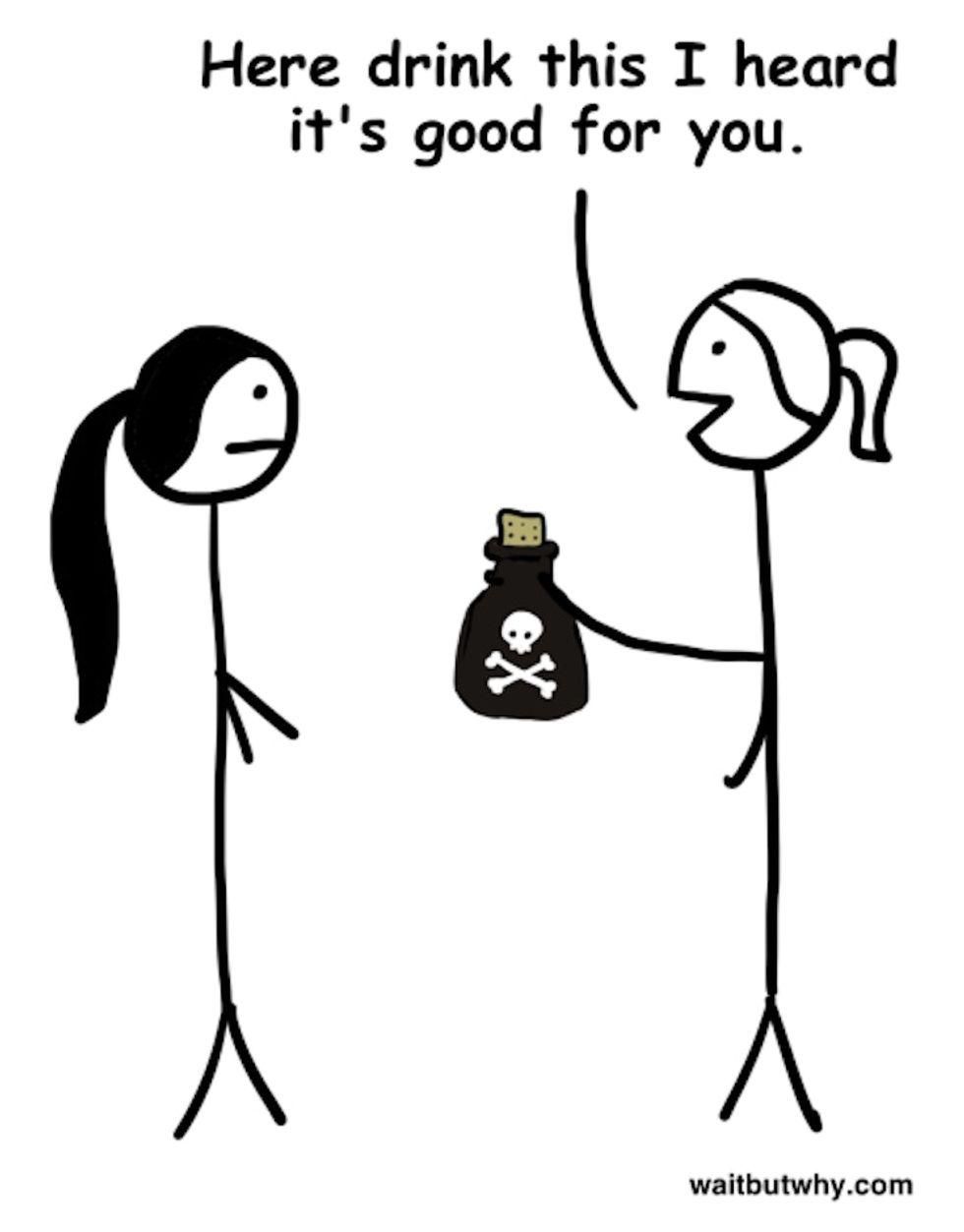
One stick person offers another stick person poison pretending it's safe

This is awful. Taste it.

via Wait But Why post and used with permission.

The Frenemy roots very hard against you. And I'm not talking about the friends that will feel a little twinge of pleasure when they hear your big break didn't pan out after all or that your relationship is in bad shape. I'm not even talking about someone who secretly roots against you when they're not doing so well at some area of life and it hurts them to see you do better. Those are bad emotions, but they can exist in people who are still good friends.

I'm talking about a real Frenemy — someone who really wants bad things for you. Because you're you.

You and the Frenemy usually go way back, have a very deep friendship, and the trouble probably started a long time ago. There's a lot of complex psychology going on in these situations that I don't fully understand, but my hunch is that a Frenemy's resentment is rooted in his own pain, or his own shortcomings, or his own regret — and for some reason, your existence stings them in these places hard.

A little less dark but no less harmful is a bully situation where a friend sees some weakness or vulnerability in you and she enjoys prodding you there either for sadistic reasons or to prop herself up.

A Frenemy knows how to hurt you better than anyone because you're deeply similar in some way and she knows how you're wired. She'll do whatever she can to bring you down any chance she gets, often in such a subtle way it's hard to see that it's happening.

Whatever the reason, if you have a Frenemy in your life, kick her toxic ass off your mountain, or at least kick her down the mountain — just get her off of Tier 1. A Frenemy has about a 10th of the power to hurt you from Tier 2 as she does from Tier 1.

9. The Facebook celebrity friend
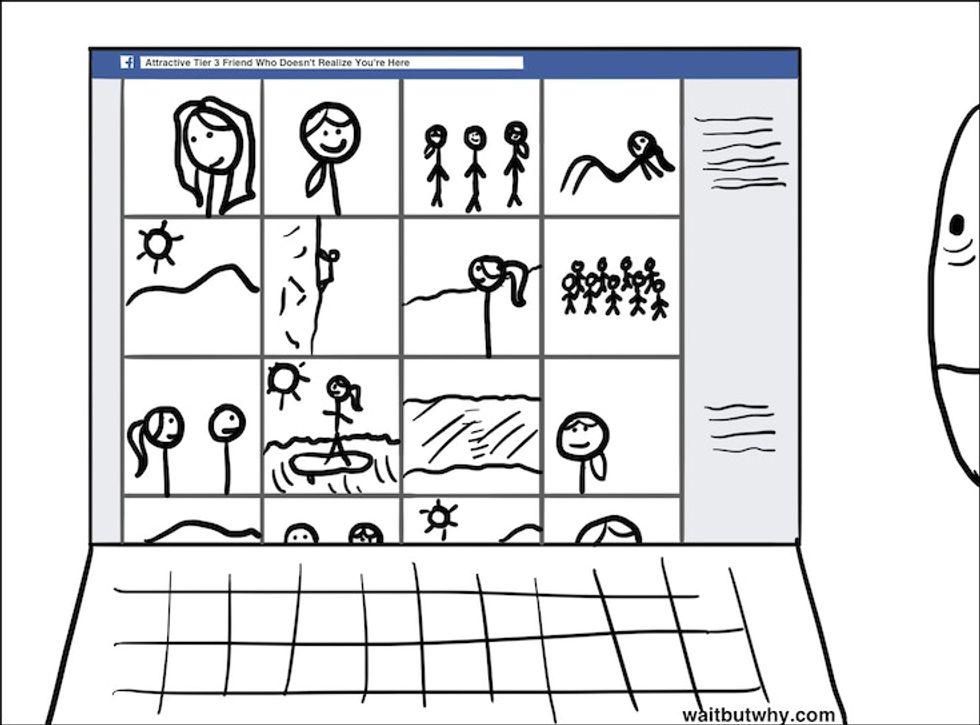
Comic of a computer with photo grid

What’s happening on social media?

via Wait But Why post and used with permission.

This person isn't a celebrity to anyone other than you, you creep. You know exactly who I'm talking about — there are a small handful of people whose Facebook page you're uncomfortably well-acquainted with, and those people have no idea that this is happening. On the plus side, there are people out there you haven't spoken to in seven years who know all about the new thing you're trying with your hair, since it goes both ways.

This is a rare Tier 3 friend, or even an acquaintance, who qualifies as an odd friendship because you found a way to make it unhealthy even though you're not actually friends. Well done.

10. The lopsided friendship
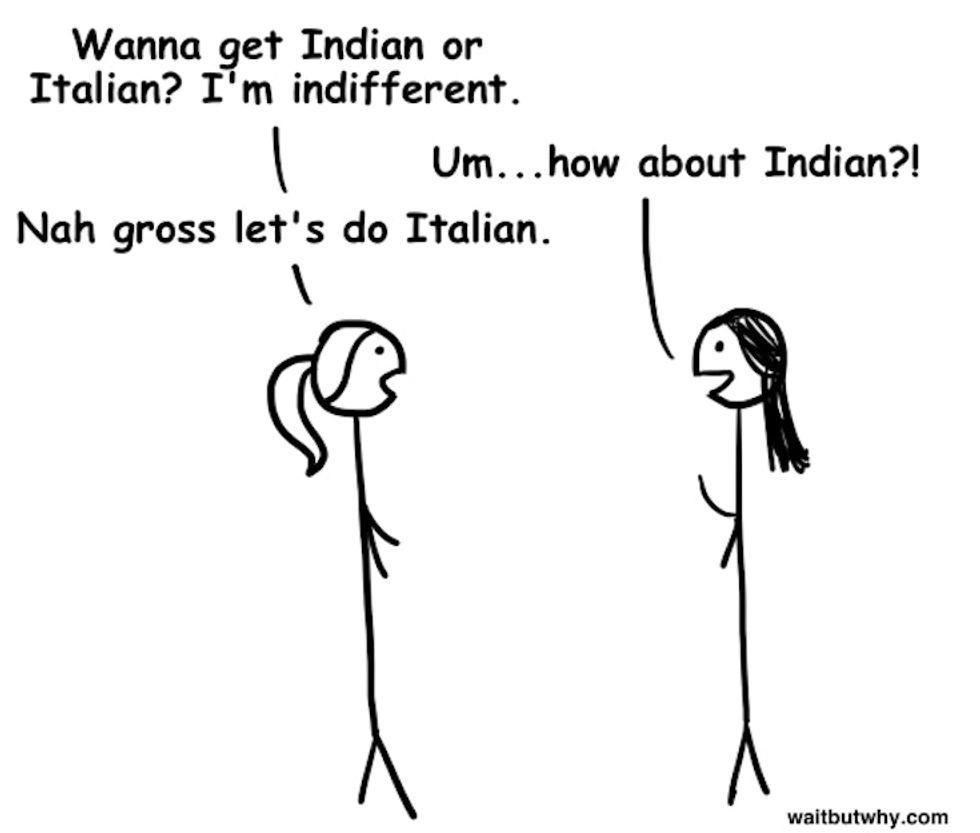
Two stick women discussing dinner

Can I make all the decisions... that was rhetorical.

via Wait But Why post and used with permission.

There are a lot of ways a friendship can be lopsided: Someone can be higher on their friend's mountain than vice versa. Someone can want to spend more time with a friend than vice versa. One member can consistently do 90% of the listening and only 10% of the talking, and in situations where most of the talking is about life problems, what's happening is a one-sided therapy situation, with a badly off-balance give-and-take ratio, and that's not much of a friendship—it's someone using someone else.

And then there's the lopsided power friendship. Of course, this is a hideous quality in many not-great couples, but it's also a prominent feature of plenty of friendships.

A near 50/50 friendship is ideal, but anything out to 65/35 is fine and can often be attributed to two different styles of personality. It's when the number gap gets even wider that something less healthy is going on—something that doesn't reflect very well on either party.

There are some obvious ways to assess the nature of a friendship's power dynamic: Does one person cut in and interrupt the other person while they're talking far more than the other way around? Is one person's opinion or preference just kind of understood to carry more weight than the other's? Is one person allowed to be more of a dick to the other than vice versa?

Another interesting litmus test is what I call the “mood determiner test." This comes into play when two friends get together but they're in very different moods — the idea is, whose mood “wins" and determines the mood of the hangout. If Person A is in a bad mood, Person B is in a good mood, and Person B reacts by being timid and respectful of Person A's mood, leaving the vibe down there until Person A snaps out of it on her own — but when the moods are reversed, Person B quickly disregards her own bad mood and acts more cheerful to match Person A's happy mood — and this is how it always goes — then Person A is in a serious power position.

But hey, not all friendships are grim.

In the Does This Friendship Make Sense graph above, the friendships we just discussed are all in Quadrants 2, 3, or 4 — i.e., they're all a bit unenjoyable, unhealthy, or both. That's why this has been depressing. On the bright side, there's also Quadrant 1—all the friendships that do make sense.

No friendship is perfect, but those in Quadrant 1 are doing what friendships are supposed to do: They're making the lives of both parties better. And when a friendship is both in Quadrant 1 of the graph and on Tier 1 of your mountain, that friendship is a rock in your life.

Rock friendships don't just make us happy — they're the thing (along with rock family and romantic relationships) that makes us happy.

Investing serious time and energy into those is a no-brainer long-term life strategy. But in the case of most people over 25—at least in New York— I think A) not enough time is carved out as dedicated friend time, and B) the time that is carved out is spread too thin, and too evenly, among the Tier 1 and Tier 2 friendships in all four quadrants. I'm definitely guilty of this myself.

There's something I call the Perpetual Catch-Up Trap. When you haven't seen a good friend in a long time, the first order of business is a big catch-up — you want to know what's going on in their career, with their girlfriend, with their family, etc., and they want to catch up on your life. In theory, once this happens, you can go back to just hanging out, shooting the shit, and actually being in the friendship. The problem is, when you don't make enough time for good friends, seeing them only for a meal and not that often — you end up spending each get-together catching up, and you never actually get to just enjoy the friendship or get far past the surface. That's the Perpetual Catch-Up Trap, and I find myself falling into it with way too many of the rocks in my life.

There are two orders of business right now:

First, think about your friendships, figure out which ones aren't in Quadrant 1, and demote them down the mountain. I'm not suggesting you stop being friends with those people—you still love them and feel loyal to them, and old friends are critical to hold onto—but if the friendships aren't that healthy or enjoyable, they don't really deserve to be in your Tier 1, and you probably shouldn't be in theirs. Most importantly, doing this clears up time to...

Second, dedicate even more time to the Quadrant 1, Tier 1 rocks in your life. If you're in your mid-20s or older, your current rocks are probably the only ones you'll ever have. Your rock friendships don't warrant two times the time you give to your other friends—they warrant five or 10 times!

Your rocks deserve serious, dedicated time so you can stay close. So go make plans with them.


This article was written by Tim Urban and originally published on Wait But Why. It originally appeared here nine years ago.

time off requests, pto, sick leave, gen z manager, manager positions, asking for time off

This Manager thinks PTO is for vacation, not "life changing events."

What does it take to be a good boss? You can answer this a million different ways—by being a clear communicator, earning employee trust, providing constructive feedback, and fostering a positive and supportive work environment while also being open to feedback and recognizing your team's contributions—but really, it all seems to stem from respecting your employees as fellow human beings.

Part of that means acknowledging that these employees have lives that are, frankly, more important to them than the job, and not penalizing them for it. One manager, and Gen Zer no less, seems to fully understand this basic principle, and folks are applauding her for it.


Elizabeth Beggs, who manages a five-person team for a packaging distribution company in Virginia, recently made a TikTok sharing which time-off requests she “rejects. ”You’ll see why “rejects” is in quotes shortly.

One example: when a female rep notified Beggs that she was likely having a miscarriage. After the team member asked how she can file for time off to see to the issue, Beggs immediately responded, “Girl, go to the doctor! We’re not submitting time off for that!”

In Beggs’ mind, PTO is for “vacation,” not medical emergencies. What a concept.

@bunchesofbeggs

Edited to clarify- 1. My team is all salary. 2. These examples are not all recent or from my current position. 3. My team works hard and hits thier KPIs above and beyond. Time off is meant to recharge and be used how you need it, not to handle life changing events #mangers #corporate #genzmanagers #sales #vetstocorporate #veterans

Beggs went on to explain a couple more situations, like when one employee—a parent—was “up all night” with their sick kid. And her last one wasn’t even negative—she had an employee who wanted to work a half-day to do something nice for their anniversary.

“Seriously, if any of these triggered anyone, then you need to evaluate how you run your team as a manager,” she concluded.

By and large, the response to Beggs’ management style has been overwhelmingly positive, and people seem to find it completely refreshing.

“You are not a manager, you’re a LEADER,” one person wrote.

@bunchesofbeggs

Everything you do should be to better your team, not to make your life easier #leadership #ownership #corporatelife #veteran #military

Another said, “The better you treat your employees, the more loyal they will be and the better work they will put out. Most people do not understand how management works.”

A few noted how this attitude seems to be more present among younger leaders. One person commented, "millennial manager here. My team members are human first, employees second. Like just go do what you want but get the work done too.”

Another joked that “Boomer managers could NEVER.”

Beggs would later clarify this doesn’t mean she doesn't have clear productivity expectations for her team (who work on salary). Perhaps if she had a team member not making their KPIs (key performance indicators), there would be an additional conversation surrounding time off, but there is still an inherent respect as a fellow human being. Which, to her, means treating bona fide time off as a way to “recharge and be used how you need it, not to handle life changing events.”

@bunchesofbeggs

If you’re planning does not account for people being human- it’s bad planning #genzleaders #armyvet #militaryvet #genz #corporatelife #corporate #manager #timeoff

Younger generations might get labeled “lazy” or “entitled,” but they are also the ones fighting to change the status quo so that we all may be treated less like cogs in the machine, and more like actual human beings. Its leaders like Beggs who show that operating in new ways doesn't compromise productivity—it, in fact, enhances it. We might not be able to change the global standard overnight, but we certainly aren’t going to get to a better place without leaders who choose to serve their community rather than a bottom line.

This article originally appeared in March.

Education & Information

This surprising map reveals the real value of $100 in each state

Your purchasing power can swing by nearly 25 percent from state to state.

cheapest states, cost of living, finances, cost of living, $100

Map represents the value of 100 dollars across America.

As the cost of living in large cities continues to rise due to inflation, tariffs, and other economic factors, more and more people are realizing that the value of a dollar in the United States is a very relative concept. For decades, cost of living indices have sought to address and benchmark the inconsistencies in what money will buy, but they are often so specific they prevent a holistic picture or the ability to "browse" the data based on geographic location.

Each year, the Tax Foundation addresses many of these shortcomings using the most recent Bureau of Economic Analysis data to provide a familiar map of the United States overlaid with the relative value of what $100 is "worth" in each state. In recent years, they've further updated their data so that you can break down the value of your money across every single metro area in the United States. It's an incredibly valuable tool for the many people considering (or who have already acted and migrated from states like California to Florida), Texas and other states with friendly state taxes rates and more affordable housing options.


The map quantifies and presents the cost of living by geography in a brilliantly simple way. For instance, if you're looking for a beach lifestyle but don't want to pay California prices, try Florida, which is about as close to "average"—in terms of purchasing power, anyway—as any state in the Union. If you happen to earn (or luck) your way into Silicon Valley tax brackets, head to Hawaii, D.C., or New York. You'll burn through your money in no time. And in some of those places like Hawaii, there are quality of life measurements that often exceed raw purchasing power.

So, where does your dollar go the furthest in 2025? The financial planning site GoBankingRates.com compiled its own list of cash purchasing power across each state and found that in California, you get the least bang for your buck: only $87.42 in real purchasing power for every $100 of cash. The average person in California makes $96,344 annually, one of the higher income levels in the country. However, just living in California on average costs residents a staggering $86,408, leaving the average person with little flexibility for long-term financial planning projects like retirement, saving for a new home, or even buying a new car.

At the other end of the spectrum is Arkansas, where your dollar goes the furthest. In fact, that $100 bill burning a hole in your proverbial wallet is in fact worth more than its technical value, with a real value of $113.49. On top of that, the cost of living is only $37,067, less than half of that in California. Further, the average cost of a new home in Arkansas is $208,743, less than one-third of a new home in California. Not coincidentally, in 2023, Arkansas was the top destination for people moving to another state within the United States, followed by Texas.

family, moving, income, finances, $100 Family moving into a new home. Canva Photos.

How about Florida, which has received outsized attention in recent years for its overt efforts to draw residents from California and other states with higher costs of living? According to the most recent data, Florida is in fact much closer to California than Arkansas, coming in only in 40th place on the GoBankingRates rankings, with $100 in cash only being worth $96.55. However, the annual cost of living is still only slightly more than half of that in California, coming in at $53,505. And if you're looking to buy some real estate, the average home is valued at $404,924. That's still well outside the purchasing power of many Americans, but with built-in advantages such as warm weather and one of the top-ranked state education system in America, it's obvious why so many people, especially those with families, are choosing Florida over California in recent years.

florida, cost of living, finances, $100, education Driving Road Trip GIF by Rosen Hotels & Resorts Giphy

According to U.S. News and World Report's data analysis, California only has the nation's 23rd best education system and is ranked a paltry 37th overall in their state rankings. It's quite a contrast for a state that bills itself on the promise of opportunity, natural wonder, and positive lifestyle options. And with 2025's wildfires (as well as an annually-worsening wildfire season), the constant threat of earthquakes, and other factors, California clearly has challenges beyond economics if it wants to remain one of the more attractive states in the nation.

Of course, those numbers are always in flux, and political leaders in California have promised concrete reforms in order to address the state's high cost of living compared with the value of its social and emergency services. If you want proof of how quickly things can change, look at a similar analysis of the value of $100 in each state from 2015:

- YouTube youtu.be

However, those negative statistical trends aside, California continues to have an incredible pull on our collective imagination. Four hundred twenty-three thousand, one hundred ninety-four Americans left their state for California according to the most recent data in 2023, placing it in third behind our previously mentioned top two states, Arkansas and Texas.

So, it's clear there are a number of factors that determine the best place to live in America. When it comes to raw purchasing power, you cannot beat Arkansas. But there's so much else to consider: public resources like education and healthcare, job opportunities (you probably won't make nearly as much in Arkansas as you might in California) and other factors such as proximity to family, friends, and personal interests.

There's no doubt America is rapidly changing and that includes what people value the most when they decide where to live. In uncertain economic times, the face of America will likely change radically in the coming years with the political, economic, and social landscape shifting in meaningful ways.

This article originally appeared in August.

boomers, millennials, generations, grandparents, boomer grandparents, millennial parents, 90s, 2000s, technology, humor
via Canva/Photos

Boomer parents and grandparents sure do have some interesting habits.

When it comes to intergenerational conflict, you never hear too much about Gen Z having a hard time with Generation X or the silent generation having beef with the baby boomers. However, there seems to be some problem where baby boomers and millennials just can’t get on the same page.

Maybe it’s because millennials were raised during the technological revolution and have to help their boomer parents log into Netflix, while the grandparents get frustrated when their adult children don't know how to do basic homemaking and maintenance tasks. There’s also a political divide: Millennials are a reliable liberal voting bloc, whereas boomers are the target demographic for Fox News. Both generations also have differing views on parenting, with boomers favoring an authoritative style over the millennials' gentler approach, which leads to a ton of conflict within families.


A Redditor recently asked Xennials, older millennials, and younger Gen Xers born between 1977 and 1983 to share some quirks of their boomer parents, and they created a fun list of habits that can be both endearing and frustrating.

The users shared that millennials are frustrated with their parents' abilities to use technology but are touched when they send them a greeting card.

boomers, millennials, generations, grandparents, boomer grandparents, millennial parents, 90s, 2000s, technology, humor Baby boomers are a fascinating and endearing group. Giphy

Of course, it is reductive to reduce generations into a series of stereotypes, whether it’s millennials or baby boomers. But, for many, hearing that they aren’t the only person who gets frustrated with their boomer parents can be pretty cathartic and make them feel less alone.

Here are 15 boomer parent quirks that Millennials just don’t understand.

1. They save everything

"They save EVERYTHING (containers, jars, boxes, etc.) just in case they might be able to use it for something later. I feel like this habit was handed down from our grandparents' Great Depression upbringing."

"Absolutely! Shopping bags, empty yogurt containers, boxes that some product came in…..although I love me a 'good box!' I have all my iPhone boxes for no reason."

You know the old saying: Is she really a grandma if she doesn't rinse out used plastic baggies to save for later?


boomers, millennials, generations, grandparents, boomer grandparents, millennial parents, 90s, 2000s, technology, humor An average boomer's basement. Photo by Tania Melnyczuk on Unsplash

2. Scary texts

"Will text something foreboding like 'we need to talk;' then turns out she forgot a recipe."

"My dad will text me 'You need to call me right now' when it’s nothing. And not tell me major life events until well after the fact. Like my aunt had a heart attack and I found out a week later from her son. (And my dad did know.)"

It's true, generations have been battling over tone and punctuation in texts for years.


boomers, millennials, generations, grandparents, boomer grandparents, millennial parents, 90s, 2000s, technology, humor They love to scare their adult children with dramatic texts. Giphy

3. Stranger death toll

"My mom is ALWAYS telling me about dead people I’ve never met. I really do not care. I know that sounds awful, but I don’t have it in me to be sad for everyone on the planet when they pass."

“You remember my friend Carol? Her aunt had that above-ground swimming pool in her backyard. We swam in it a couple times one summer when you were about 9. Anyway, Carol’s mom just lost her brother-in-law. They were very close. Thought you’d want to know.”


boomers, millennials, generations, grandparents, boomer grandparents, millennial parents, 90s, 2000s, technology, humor Boomers love to talk about random people who have died, and large-scale tragedies. Giphy

4. They don't travel

"They act jealous of us traveling but refuse to go anywhere."

"Ooh good one. Mine act jealous of anything we do/buy that they can't solely because they can't get out of their own way and actually make things happen."

And, in general, they have more money and time to make it happen! But they often insist on being homebodies, to their own chagrin.


boomers, millennials, generations, grandparents, boomer grandparents, millennial parents, 90s, 2000s, technology, humor Boomers love staying at home for no good reason. Giphy

5. They print everything

"My Boomer FIL prints out EVERYTHING from his computer. I understand printing out instructions or recipes to help remember but do you really need a file cabinet full of forwarded emails from friends and sale adverts from 5 years ago? Oh well, at least he keeps it organized. Also, both TVs in the house run 24/7 playing reruns of 'CSI: Who Gives a Sh*t Anymore?'"

"I'm not on Facebook, but my dad is. Last year, he made a celebratory post on my birthday and all his church friends liked and commented on it. He printed up the post and all of the comments, stapled it into a little book, and MAILED me the printed Facebook comments..."


boomers, millennials, generations, grandparents, boomer grandparents, millennial parents, 90s, 2000s, technology, humor If it can't be held in their hand, they don't trust it. Giphy

6. 'From, dad' texts

"My dad sends text messages with, 'From, Dad' at the end of them. It cracks me up every time. He also states who he is every time he calls me."

This has to be one of the more endearing things the boomers do. Please never stop.

7. Irrational fears

"One quirk my dad had was that he was deathly afraid of the house burning down. Not from the standpoint of the danger of fire but when he was growing up, if your house burnt down, you were basically homeless and destitute. My mom is much more level headed about it. She always told my dad, that is why we have homeowners insurance."

8. Expired food

"My mother-in-law doesn't throw out expired food. She has food in her pantry that is several years past their expiration dates. Same with condiments in her fridge. You just can't trust any of the food she has on hand because more than likely than not it's way expired. When we have brought this up, that she needs to throw some stuff out, she insists it's absolutely fine. It's not. "

"My grandmother is the same way. Once, she opened her refrigerator, and there was a jar of pickles with mold floating on the surface of the liquid. I pointed it out, and she said it was still good. She would just scoop the mold out at a later time. She has an incredibly strong stomach and immune system."

They also love to stock up on and freeze certain staples, even milk.


boomers, millennials, generations, grandparents, boomer grandparents, millennial parents, 90s, 2000s, technology, humor They'll keep food for way, way too long. Giphy

9. Smartphone addiction

"You always hear a kids 'these kids always on their damn phones.' But when it comes to phone addiction, boomers are far worse."

"My mom drives five hours to see us, then spends the whole time texting people from her church or looking at Facebook."

"I once sat in their living room for over an hour before they decided to put their phones down and speak to me, only to phub me and pick them right back up."

It's not the Gen Alpha kids keeping Bejewled in business!

10. Rigid gender roles

"My dad still clings to the traditional division of 'men's/women's work.' He'll fix a car, do any outside work, clean out a clogged drain. Cooking? If it's any more complicated than making coffee or calling in a pizza, he can't/won't. I don't think he even grills anymore. Laundry? Hell no. Taking care of small children? He'll play with them but that's it."


boomers, millennials, generations, grandparents, boomer grandparents, millennial parents, 90s, 2000s, technology, humor They still hold onto outdated gender stereotypes. Photo by Frankie Cordoba on Unsplash

11. The TV is constantly on

"In-laws leave the TV on for all waking hours. And FIL gets irritated if someone talks over the episode of MASH or Walker, Texas Ranger, that he's already seen 50 times. Like clenching his teeth and stomping the floor."

"TV on 24/7. Constantly flipping between some version of Law and Order, HGTV, and Guy Fieri. Asking me 'did you see that commercial where…' No mom. I don’t have cable. I don’t see commercials. All of the time."


boomers, millennials, generations, grandparents, boomer grandparents, millennial parents, 90s, 2000s, technology, humor This is the generation that invented TV as background noise. Giphy

12. They are always right

"My dad...he's has to be right about everything and doesn't know what to do if you beat him to the point on something. He once was giving me a recipe that required cinnamon, cardamon, and clove and told me just to use Pumpkin Pie Spice! It's the greatest thing! 'Dad, I don't need to. I have all those spices on hand (I bake)' But...no! You have to use this. 'No, I don't. I don't need to buy something that I already have" It happens all the time."

"My parents are always right and they are not impressed about anything."

13. Obsessed with the weather

"Yes, my dad should have been a meteorologist. He used to have a weather alert radio that would sound off in the middle of the night and he would watch the weather channel constantly. We all had to quiet down when your local weather forecast on the 8's came on. He gets really excited about severe weather like when we might get thunderstorms or a tornado."

There's nothing quite like the thrill a boomer gets from relentlessly tracking every movement of an oncoming storm that will probably amount to some rain and little else.

boomers, millennials, generations, grandparents, boomer grandparents, millennial parents, 90s, 2000s, technology, humor They love intensely tracking a thunderstorm via The Weather Channel Giphy

14. One more thing

"Without fail, every time I'm leaving my mother's house and backing down the driveway, she comes back out of her house and stops me to say something else, even though we'd just spoken."

15. Mail stress

"My mom has an anxiety attack during the entire journey of a package or piece of mail she dispatched to me. No, she doesn’t know how to track. She will not rest until she knows that a package has arrived or a nominal check has been cashed. She calls when she is thinking about sending something, when she sent it, when it’s en route, and when it’s expected to arrive. God forbid it’s late. And if I don’t issue a prompt thank you, she will guilt me."

It all makes you wonder what new conflicts will pop up when the millennials become grandparents, and the Gen Z and Gen Alpha kids are the ones doing the griping. Probably that millennials will continue to insist on Googling things when traditional search engines have long been replaced, or that the 90s and 2000s kids will never stop listening to Lil Jon-era hip hop, no matter how old they get and how inappropriate it becomes.

Guess we'll see. Stay tuned!

This story originally appeared in January. It has been updated.

Education

A fourth-grade teacher asked for 3 'good reasons' for slavery. There was only right answer.

The school assignment was intended to spark debate and discussion—but isn't that part of the problem?

history, Black Americans, school, homework assignment, outrage

A school assignment asked for 3 "good" reasons for slavery.

Back in 2018, a fourth-grader's school assignment was so shocking that it went viral. Every news outlet from ABC7 to HuffPost to CNN reported on the incident, in which a homework assignment asked students to list three "good" reasons for slavery. Yeah, you read that right.

The assignment was given to fourth graders at Our Redeemer Lutheran School in Milwaukee, Wisconsin, and also asked for three "good" and three "bad" reasons for slavery. The absurd and offensive assignment was brought to the public's attention when one fourth grader's mom shared a photo of the homework sheet on Facebook, asking, 'Does anyone else find my 4th grader's homework offensive? 😡"


Now, it's not uncommon for parents to have questions about their kids' homework. Sometimes, it's just been too long since they've done long division for them to be of any help. Or teaching methods have just changed too dramatically since they were in school. And other times, kids bring home something truly inexplicable.

For mom Trameka Brown-Berry, looking over her 4th-grade son Jerome's homework made her jaw hit the floor.

The school assignment was intended to spark debate and discussion—but isn't that part of the problem? The shockingly offensive assignment deserved to be thrown in the trash. But young Jerome dutifully filled it out anyway, and his response was pretty much perfect:

In the section reserved for "good reasons," Jerome wrote, "I feel there is no good reason for slavery that's why I did not write."

We're a country founded on freedom of speech and the debate of ideas, which often leads us into situations where "both sides" are represented. In most cases, looking at both sides of a debate can help people come to a clear conclusion about what's right and what's wrong. But in this scenario, there is no reason that a child should ponder the positive benefits of slavery. There's no meaningful dialogue to be had about the perceived merits of stripping human beings of their basic living rights. No one is required to make an effort to "understand the other side" when the other side is bigoted, hateful, and violent.

The principal apologized to the students for the assignment

In a follow-up post, Brown-Berry writes that the school has since apologized for the assignment and committed to offering better diversity and sensitivity training for its teachers.


But what's done is done, and the incident illuminates the remarkable racial inequalities that still exist in our country. After all, Brown-Berry said to WCTI ABC News12, "You wouldn't ask someone to list three good reasons for rape or three good reasons for the Holocaust."

At the very end of the assignment, Jerome brought it home with a bang: "I am proud to be black because we are strong and brave..."


Even though the assignment was offensive, Brown-Berry found a silver lining in the experience for her son. "The moral of the story is, the only way to teach our kids to stand up for their rights and respect is to model it. With all of your support, I was able to give my child a personal life lesson about how change starts with you," she wrote in a Facebook post.

Good for Jerome for shutting down the thoughtless assignment with strength and amazing eloquence, and for being brave enough tell the truth: there are no good reasons for history's most heinous acts. The sooner the world acknowledges that, the sooner we can heal and restore.

This article originally appeared seven years ago. It has been updated.

moms, motherhood, parenting, family, teens, teenagers, letters, tough love, parenting styles
via Heidi Johnson/Facebook
A letter written from mother to son.

Parents are people, too. Whether they subscribe to "gentle parenting" ideas or a more old-school approach, the truth is that they're just doing their best. Sometimes they get it right, sometimes they make mistakes, and quite often, it's hard for anyone to tell whether they're doing a good job until years later.

Heidi Johnson's son was 13, deeply in adolescence, and in that stage where he'd frequently lash out and defy her at every turn. In one such instance, he stubbornly told her he shouldn't have to deal with her rules and should be independent. So she wrote a strict but loving "Mom's not a fool" letter. In the letter, she wrote that because he bragged about making money, he can buy back all of the things that she had purchased for him in the past and that he would also have to pay rent.


moms, motherhood, parenting, family, teens, teenagers, letters, tough love, parenting styles Teaching teenagers about real-life consequences isn't easy. Photo by Norbert Kundrak on Unsplash

"Dear Aaron,

Since you seem to have forgotten you are only 13, and I’m the parent, and that you won’t be controlled, I guess you will need a lesson in independence. Also, as you threw in my face that you are making money now, it will be easier to buy back all the items I bought for you in the past. If you would like your lamp/lightbulbs or access to the internet, you will need to pay your own share of costs.

Rent – $430

Electricity – $116

Internet – $21

Food – $150"

She also added some additional chores that, if not accomplished, she would fine him $30.

"He came home, saw the note, crumpled it on the floor, and stormed out of the apartment. I have always encouraged him to take a walk when he is upset so that he can collect his thoughts, so when we try to talk, we are able to talk, and not just yell at each other. I do the same thing — sometimes, I just need to walk away and collect myself. I am not above admitting that. He was still livid when he got home. He decided to stage a 'sit in' in my room, where he did laugh at me and repeat, 'Really? What are you going to do? You can't take my stuff,' etc.

He was asked to leave my room, and when he could be respectful, and I was more calm, we would discuss it further. He went to his room, and after about an hour, he had removed some electronics and items I missed that he felt he should have to earn back for his behavior. He apologized, and asked what could he do to make things better and start earning items back. He earned his comforter and some clothes right back. I did leave him some clothes to begin with, just not the ones he would want to wear every day. He also had some pillows and sheets, just not his favorite ones.”

Johnson decided to post the letter in its entirety on Facebook, the way one does to friends for a laugh and connection. After all, the strategy had been a success!

However, she neglected to make it "private," and soon, comments and shares proliferated, including admonishments from strangers who thought she was a bad parent. Now she had to deal with a bigger teenager: the internet and its commentariat.

But Johnson remained level-headed and wrote another Facebook post, clarifying.

"It's out there; and I am not ashamed of what I wrote... I am not going to put my 13-year-old on the street if he can't pay his half of the rent. I am not wanting him to pay anything. I want him to take pride in his home, his space, and appreciate the gifts and blessings we have.”

She explains that he is more grateful because of it, and also that he has slowly earned back things and dealt with sacrificing others. Then she lists her very organized and succinct rules of the house:


moms, motherhood, parenting, family, teens, teenagers, letters, tough love, parenting styles Kids need to be reminded, sometimes, of how much they still depend on mom. Photo by Spencer Plouzek on Unsplash

1 – Do your best in school! I don't expect a perfect 100%, but I do expect that you do your best and ask for help when you don't understand something.

2 – Homework and jobs need to be done before you can have screen time.

3 – Jobs are emptying the trash, unloading the dishwasher, throwing away trash you make in the kitchen, rinsing dirty dishes, making your bed daily, pick up bedroom nightly, and cleaning your bathroom once a week.

4 – You must complete two chores a day. Each day of the week with the exception of Sunday has a room that we work on cleaning. He has to pick two chores for that room. For example, if it is the living room he can choose two of the following options: dust, vacuum, polish furniture, clean windows, mop the floor.

5 – Be respectful and kind with your words — no back talking, no cussing at me.

6 – Keep good hygiene.

7 – Make eye contact when being spoken to, and be an active listener.

8 – Use proper manners.

It seems that after a long conversation about what being independent truly means, the mother and son came to a deeper understanding and patched things up.

"You know what.. this hasn't hurt our relationship. He and I still talk as openly as ever. He has apologized multiple times... And… he is trying harder," Johnson said.

Tough love is a controversial topic in parenting circles. Some say it makes kids anxious and unsafe while others insist that it's the only way to truly instill an understanding of consequences in young people. Experts say the best "tough love" enforces boundaries and consequences in order to teach tough life lessons, but is done with love and understanding rather than yelling — and it's certainly never violent. That's why it's so powerful how Johnson took the time to cool herself down and write a firm but level-headed letter.

It's also important to remember that teens who rebel aren't bad or ungrateful. The rebellion is a part of how they begin to establish their much-needed independence.

- YouTube www.youtube.com

After the initial negative reaction to her post, Johnson's story continued to spread and drew praise from other exasperated parents of teens:

"Tough love is real love, he has a chance because of you," one commenter wrote.

"Good for you! He needs to appreciate everything you do! You are doing him a favor teaching him what it is to take care of himself and learn some respect," wrote another.

"Best parent I have read about in a very long time. Kids do not rule the house, adults rule the house. Thank you very much for being a great mom," another said.

As for Johnson, her son is earning things back little by little, and "appreciating it more than he did before," she wrote.

"This came down to a 13-year-old telling his mother she had no right to enforce certain rules, and had no place to 'control' him. I made the point to show what life would look like if I was not his 'parent,' but rather a 'roommate.' It was a lesson about gratitude and respect from the very beginning. Sometimes, you have to lose it all to realize how well you really had it."

This article originally appeared four years ago. It has been updated.