

upworthy
Add Upworthy to your Google News feed.
Google News Button
Joy

10 awkward friendships you probably have—we all have a #9.

Not all friendships are meant to last forever.

Comic with stick figures
via Wait But Why and used with permission

The ten types of friends

When you're a kid, or in high school or college, you usually don't have to work too hard on your friendships. Friends just kind of happen.

For a bunch of years, you're in a certain life your parents chose for you, and so are other people, and none of you have that much on your plates, so friendships inevitably form. Then in college, you're in the perfect friend-making environment, one that hits all three ingredients sociologists consider necessary for close friendships to develop: “proximity; repeated, unplanned interactions; and a setting that encourages people to let their guard down and confide in each other." More friendships happen.

Maybe they're the right friends, maybe they're not really. But you don't put that much thought into any of it — you're still more of a passive observer.

But once student life ends, the people in your life start to shake themselves into more distinct tiers.

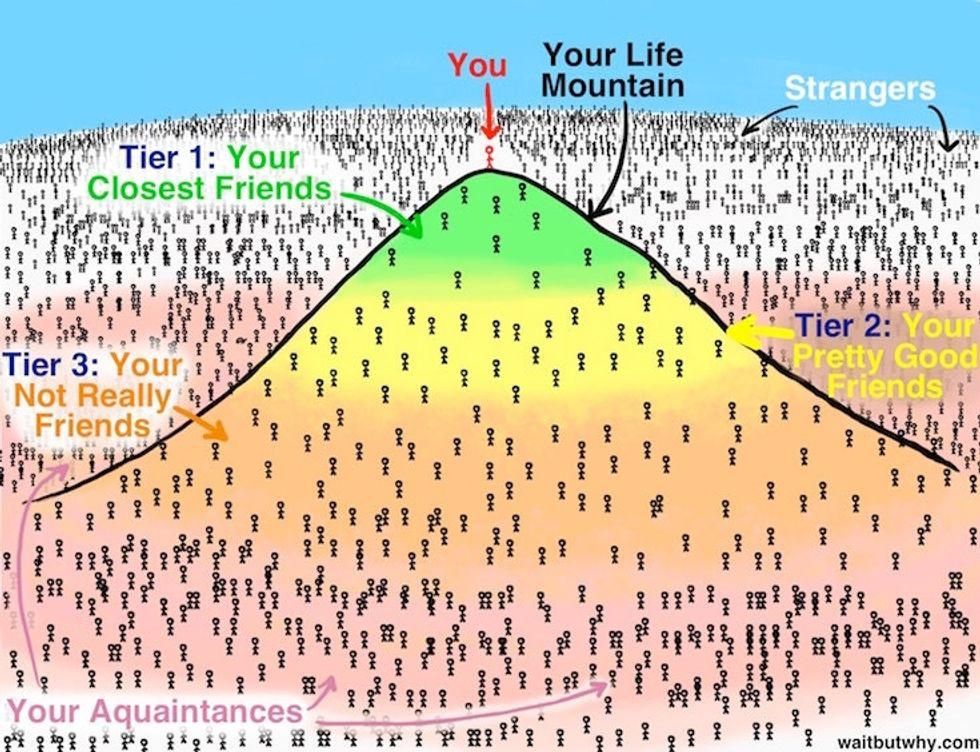
It looks something like this mountain:
Infographic of a mountain

Visual interpretation of where friends fall on the mountain of “You."

via Wait But Why post and used with permission.

At the top of your life mountain, in the green zone, you have your Tier 1 friends—the people who feel like brothers and sisters.

These are the people closest to you, the ones you call first when something important happens, the ones you love even when they suck, who make speeches at your wedding, whose best and worst sides you know through and through, and whose relationship with you is eternal; even if you go months or years without hanging out, nothing has changed when you find yourself together again.

Unfortunately, depending on how things went down in your youth, Tier 1 can also contain your worst enemies, the people who can ruin your day with one subtle jab that only they could word so brilliantly hurtfully, the people you feel a burning resentment for, or jealousy of, or competition with. Tier 1 is high stakes.

Below, in the yellow zone, are your Tier 2 friends: your Pretty Good friends.

Pretty Good friends are a much calmer situation than your brothers and sisters on Tier 1. You might be invited to their wedding, but you won't have any responsibilities once you're there. If you live in the same city, you might see them every month or two for dinner and have a great time when you do, but if one of you moves, you might not speak for the next year or two. And if something huge happens in their life, there's a good chance you'll hear it first from someone else.

Toward the bottom of the mountain in the orange zone, you have your Tier 3 friends: your Not Really friends.

You might grab a one-on-one drink with one of them when you move to their city, but then it surprises neither of you when five years pass and drink #2 is still yet to happen. Your relationship tends to exist mostly as part of a bigger group or through the occasional Facebook Like, and it doesn't even really stress you out when you hear that one of them made $5 million last year. You may also try to sleep with one of these people at any given time.

The lowest part of Tier 3 begins to blend indistinguishably into your large group of acquaintances (the pink zone): those people you'd stop and talk to if you saw them on the street or would maybe email for professional purposes but whom you'd never hang out with one-on-one. When you hear that something bad happens to one of these people, you might be sad but not too affected.

Finally, acquaintances gradually blend into the endless world of strangers.

And depending on who you are and how things shook out in those first 25 years, the way your particular mountain looks will vary.

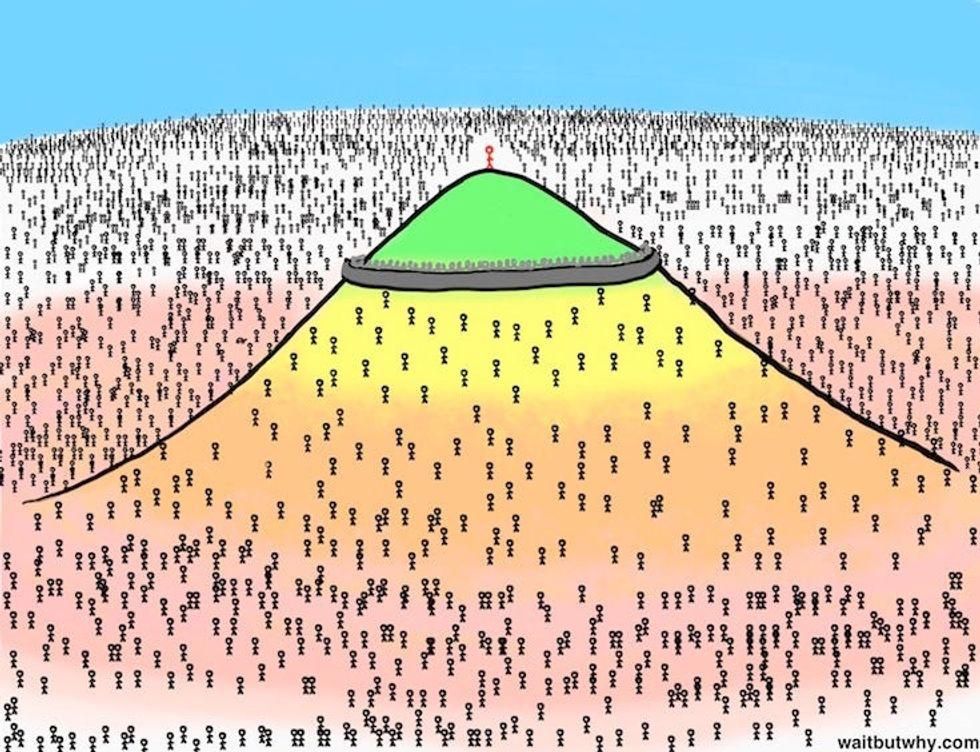
For example, there's Walled-Off Wally:
Comic of a lone person on top of a mountain

Some people keep a barrier up between acquaintances.

via Wait But Why post and used with permission.

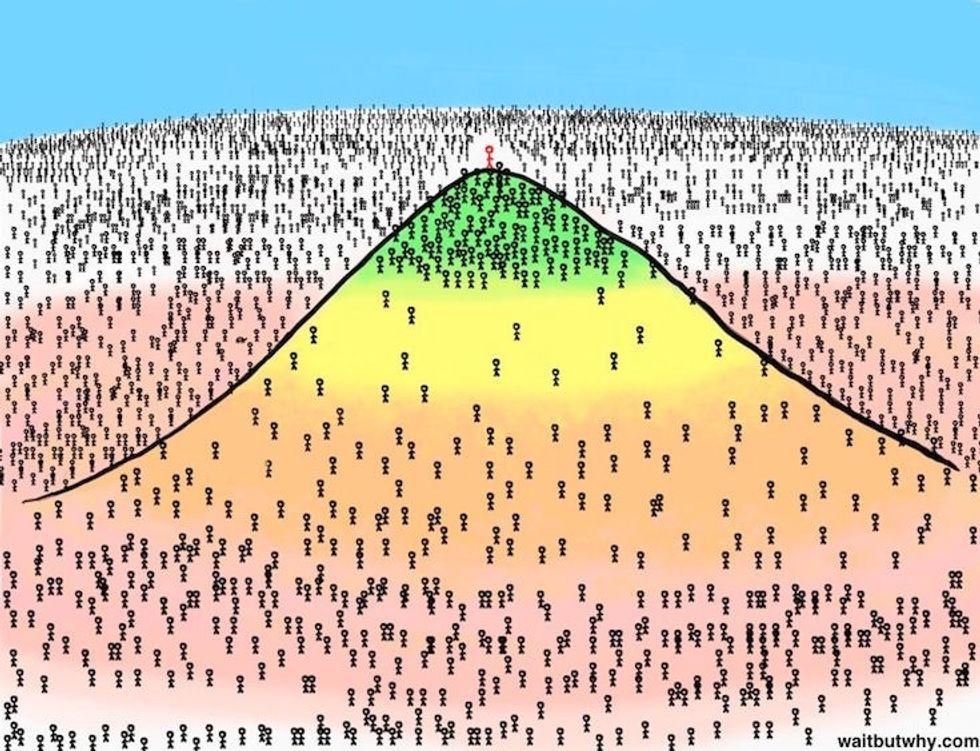
And Phony Phoebe, who tries to be everyone's best friend and ends up with a lot of people mad at her:
Comic of a mountain with a lot of people at the top

The life of the party.

via Wait But Why post and used with permission.

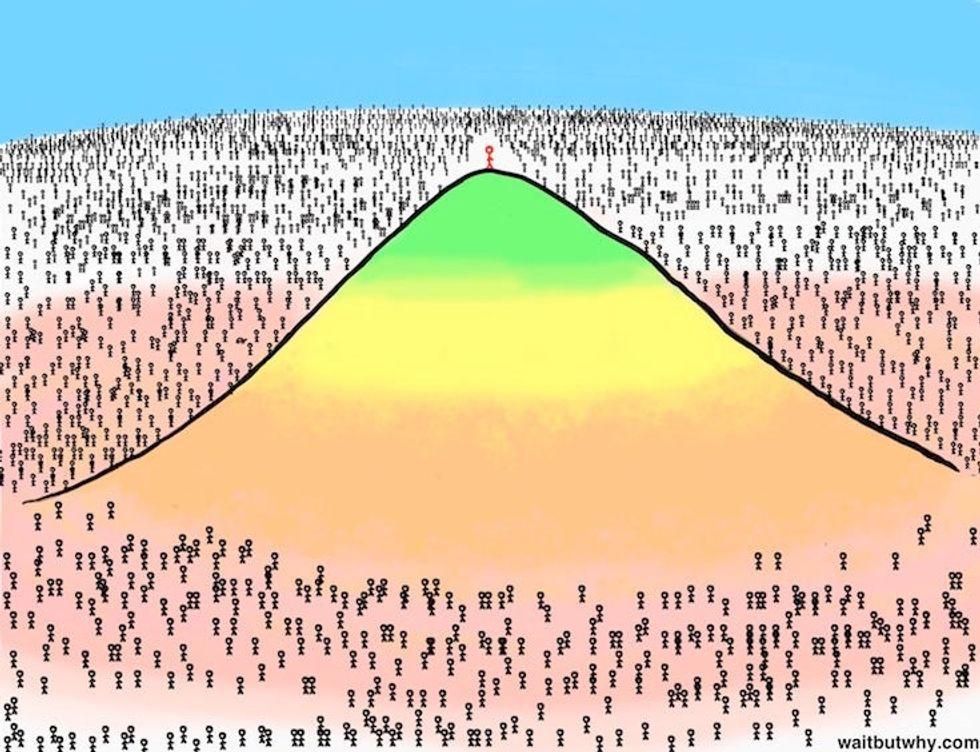
Even Unabomber Ulysses has a mountain:
Comic of a mostly empty mountain with one person at the top

Hermits exist.

via Wait But Why post and used with permission.

Whatever your particular mountain looks like, eventually the blur of your youth is behind you, the dust has settled, and there you are living your life.

Then one day, usually around your mid or late 20s, it hits you: It's not that easy to make friends anymore.

Sure, you'll make new friends in the future—at work, through your spouse, through your kids—but you won't get to that Tier 1 brothers level, or even to Tier 2, with very many of them because people who meet as adults don't tend to get through the 100+ long, lazy hangouts needed to reach a bond of that strength. As time goes on, you start to realize that the 20-year frenzy of not-especially-thought-through haphazard friend-making you just did was the critical process of you making most of your lifelong friends.

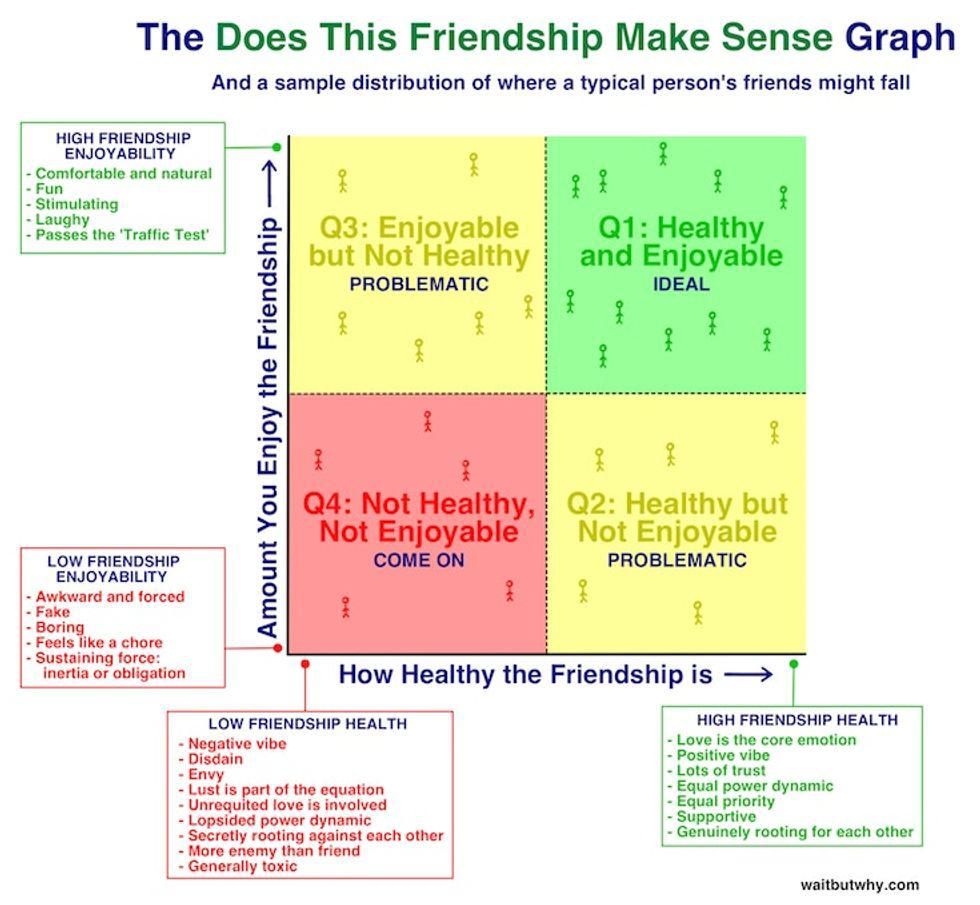
And since you matched up with most of them A) by circumstance, and B) before you really knew yourself yet, the result is that your Tier 1 and Tier 2 friends—those closest to you—fall in a very scattered way on what I'll call the Does This Friendship Make Sense? Graph:
Graph

The friendship graph.

via Wait But Why post and used with permission.

So, who are all those close friends in the three non-ideal quadrants?

As time goes on, most of us tend to have fewer friends in Quadrants 2 through 4 because A) people mature, and B) people have more self-respect and higher standards for what they'll deal with as they get older. But the fact is, friendships made in the formative years often stick, whether they're ideal or not, leaving most of us with a portion of our Tier 1 and Tier 2 friendships that just don't make that much sense. We'll get to the great, Quadrant 1 friendships later in the post, but in order to treat those relationships properly, we need to take a thorough look at the odd ones first.

Here are 10 common ones:

1. The non-question-asking friend
Comic of two people at dinner

Odd moments that happen between friends.

via Wait But Why post and used with permission.

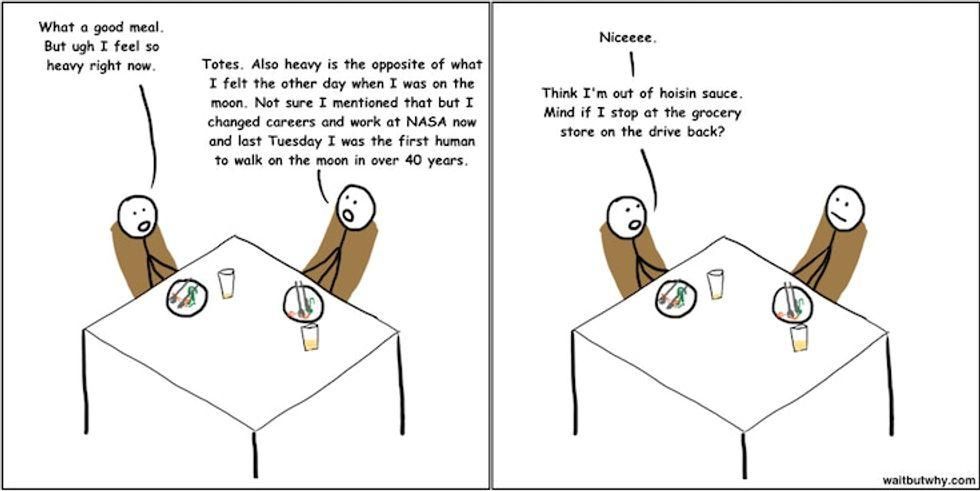
You'll be having a good day. You'll be having a bad day. You'll be happy at work. You'll quit your job. You'll fall in love. You'll catch your new love cheating on you and murder them both in an act of incredible passion. And it doesn't matter, because none of it will be discussed with The Non-Question-Asking Friend, who never, ever, ever asks you anything about your life. This friend can be explained in one of three ways:

  1. He's extremely self-absorbed and only wants to talk about himself.
  2. He avoids getting close to people and doesn't want to talk about either you or himself or anything personal, just third-party topics.
  3. He thinks you're insufferably self-absorbed and knows if he asks you about your life, you'll talk his ear off about it.

Giving you the benefit of the doubt here, we're left with two possibilities. Possibility #1 isn't fun at all and this person should not be allowed space on Tier 1. The green part of the mountain is sacred territory, and super self-absorbed people shouldn't be permitted to set foot up there. Put him on Tier 2 and just be happy you're not dating him.

Possibility #2 is a pretty dark situation for your friend, but it can actually be fun for you. I have a friend who I've hung out with one-on-one about four times in the last year, and he has no idea Wait But Why exists. I've known him for 14 years and I'm not sure he knows if I have siblings or not. But I actually enjoy the shit out of this friend—sure, there's a limit on how close we'll ever be, but without ever spending time talking about our lives, we actually end up in a lot of fun, interesting conversations.

2. The friend in the group you can't be alone with under any circumstances

Comic of three stick people having a conversation

Why have relationships when there is a phone around?

via Wait But Why post and used with permission.

In almost every group of friends, there's one pair who can't ever be alone together. It's not that they dislike each other—they might get along great—it's just that they have no individual friendship with each other whatsoever. This leaves both of them petrified of the lumbering elephant that appears in the room anytime they're alone together. They're way too on top of shit to ever end up in the car alone together if a group is going somewhere in multiple cars, but there are smaller dangers afoot—like being the first two to arrive at a restaurant or being in a group of three when the third member goes to the bathroom.

The thing is, sometimes it's not even that these people couldn't have an individual friendship—it's just that they don't, and neither one has the guts to try to make that leap when things have gone on for so long as is.

3. The non-character-breaking friend you have to be “on" with

Comic of stick people laughing together

Controlled intimacy and distancing through language.

via Wait But Why post and used with permission.

This is a friend who's terrified of having an earnest interaction, and as such, your friendship with him is always in some kind of skityou always have to be on when you're interacting.

Sometimes the skit is that you both burst out laughing at everything constantly. He can only exist with you in “This is so fucking hilarious, it's too much!" mode, so you have to be in some kind of joke-telling or sarcastic mode yourself at all times or he'll become socially horrified.

Another version of this is the “always and only ironic" friend, who you really bum out if you ever break that social shell and say something earnest. This type of person hates earnest people because someone being earnest dares him to come out from under his ironic safety blanket and let the sun touch his face, and no fucking thanks.

A third example is the “You're great, I'm great, ugh why is everyone else so terrible and not great like us" friend. Of course, she doesn't really think you're perfectly great at all—if she were with someone else, you'd be one of the voodoo dolls on the table to be dissected and scoffed at. The key here is that the two of you must be on a team at all times while interacting. The only comfortable mode for this person is bonding with you by building a little pedestal for you both to stand on while you criticize everyone else. You can either play along and everything will go smoothly, even though you'll both despise yourselves and each other the whole time, or you can commit the ultimate sin and have the integrity to disagree with the friend or defend a non-present party the friend criticizes. Doing this will shatter the fragile team vibe and make the friend recoil and say something quietly like, “Hm ... yeah ... I guess." The friend now respects you for the first time and will also criticize you extra hard next time she's playing her pedestal game with a different friend.

What these all have in common is the friend has tall walls up, at least toward you, and so she builds a little skit for you two to hang out in to make sure any authentic connection can be avoided. Sometimes that person only does this out of her own social anxiety and can become a great, authentic friend if you can just stomp through the ice. Other times, the person is just hopelessly scared and closed off and there's no hope and you have to get out.

In any case, I can't stand these interactions and am in a full panic the entire time they're happening.

4. The double-obligated friendship
Comic of two men chatting a table with balls and chains around their legs

I think we need a bigger table.

via Wait But Why post and used with permission.

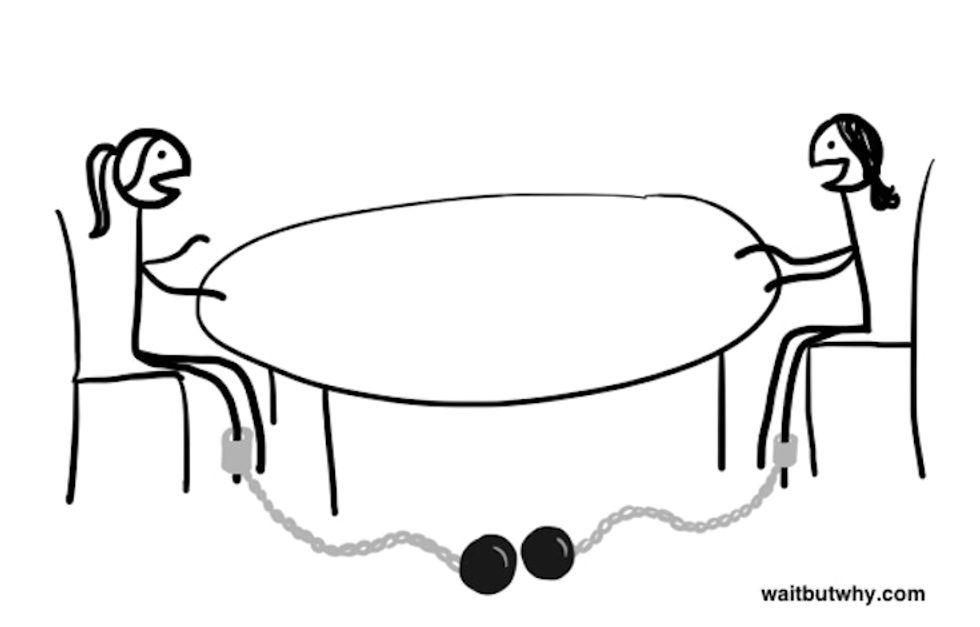
Think of a friend you get together with from time to time, which usually happens after a long and lackluster email or text exchange during which you just can't find a time that works for both of you — and you're never really happy when these plans are being made and not really psyched when you wake up and it's finally on your schedule for that day.

Maybe you're aware that you don't want to be friends with that person, or maybe you're delusional about it — but what you're most likely not aware of is that they probably don't want to see you either.

There are lopsided situations where one person is far more interested in hanging out than the other (we'll get to those later), but in the case we're talking about here, both parties often think it's a lopsided situation without realizing that the other person actually feels the same way — that's why it takes so long to schedule a time. When someone's excited about something, they figure out how to get it into their schedule; when they're not, they figure out ways to push it farther into the future.

Sometimes you don't think hard enough about it to even realize you don't like being friends with the person, and other times you really like the idea or the aesthetic of being friends with that particular person — being friends with them is part of your Story. But even in cases where you're perfectly lucid about your feelings, since neither of you knows the other feels the same way and neither has the guts to just cut things off or move it down a tier, this friendship usually just continues along for eternity.

5. The half-marriage

Two stick people each holding a half of a heart

An ego boost through controlling the relationship.

via Wait But Why post and used with permission.

Somewhere in your life, you're probably part of a friendship that would be a marriage if only the other person weren't very, very, extremely not interested in that happening. 1 for 2 on yes votes — just one vote away — so close.

You might be on either side of this — and either way, it's one of the least healthy parts of your life. Fun!

If you're on the if only side of things, probably the right move is to get your fucking shit together? Ya know? This friendship is one long, continuous rejection of you as a human being, and you're just wallowing there in your yearning like a sobbing little seal. Plus, duh, if you gather your self-respect and move on with your life, it'll raise their perception of your value and they might actually become interested in you.

If you're on the Oh yeah, definitely not side of the situation, here's what's happening: There's this suffering human in the world, and you know they're suffering, and you fucking love it, because it gives your little ego a succulent sponge bath every time you hang out with them. You enjoy it so much you probably even lead them on intentionally, don't you — you make sure to keep just enough ambiguity in the situation that their bleeding heart continues to lather your ego from head to toe at your whim.

Both of you — go do something else.

6. The historical friend
Stick person in historical garb beside a regular stick person

We met in kindergarten.

via Wait But Why post and used with permission.

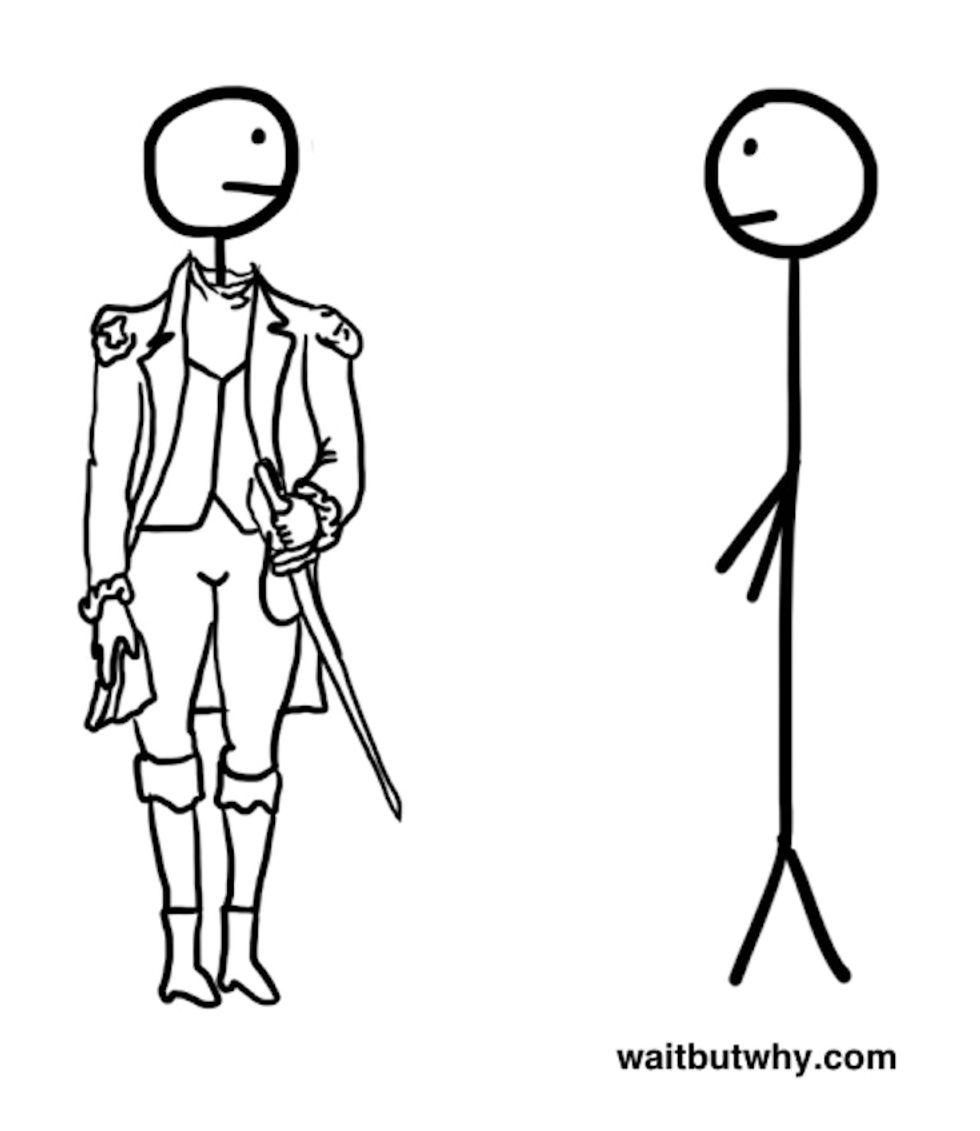
A Historical Friend is someone you became friends with in the first place because you met when you were little and stayed friends through the years, even though you're a very weird match. Most old friends fall somewhat into this category, but a true Historical Friend is someone you absolutely would not be friends with if you met them today.

You're not especially pleased with who they are, and they feel the same way about you. You're not each other's type one bit. Unfortunately, you're also extremely close friends from when you were four, and you're both just a part of each other's situation forever, sorry.

7. The non-parallel life paths friendship
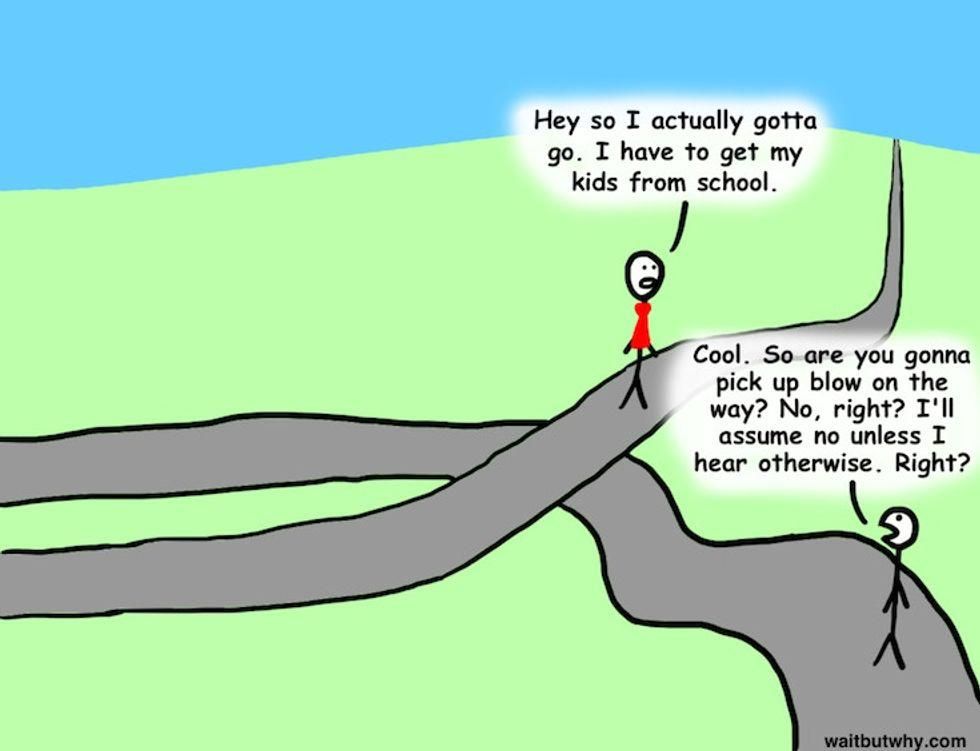
Two stick people on opposite paths

Looking for love in all the wrong places.

via Wait But Why post and used with permission.

Throughout childhood and much of young adulthood, most people your age are in the same life stage as you are. But when it comes to advancing into full adulthood, people do so at widely varying paces, which leads to certain friends suddenly having totally different existences from one another.

Anyone within three years of 30 has a bunch of these going on. It's just a weird time for everyone. Some people have become Future 52-year-olds, while others are super into being Previous 21-year-olds. At some point, things will start to meld together again, but being 30-ish is the friendship equivalent of a kid going through an awkward pubescent stage.

There are darker, more permanent Non-Parallel Life Path situations. Like when Person A starts to become a person who rejects material wealth, partially because she genuinely feels that pursuing an artistic path matters more and partially because she needs a defense mechanism against feeling envious of richer people, and Person B's path makes her scoff at people who pursue creative paths, partially because she genuinely thinks expressing yourself is an inherently narcissistic venture and partially because she needs a defense mechanism against feeling regretful that she never pursued her creative dreams — these two will have problems.

They may still like each other, but they can't be as close as they used to be — each of their lives is a bit of a middle finger at the other's choices, and that's jst awkward for everyone. It's not always that bad — but to survive an Off-Line Life Situation, friends need to be really different people who don't at all want the same things out of life.

8. The frenemy
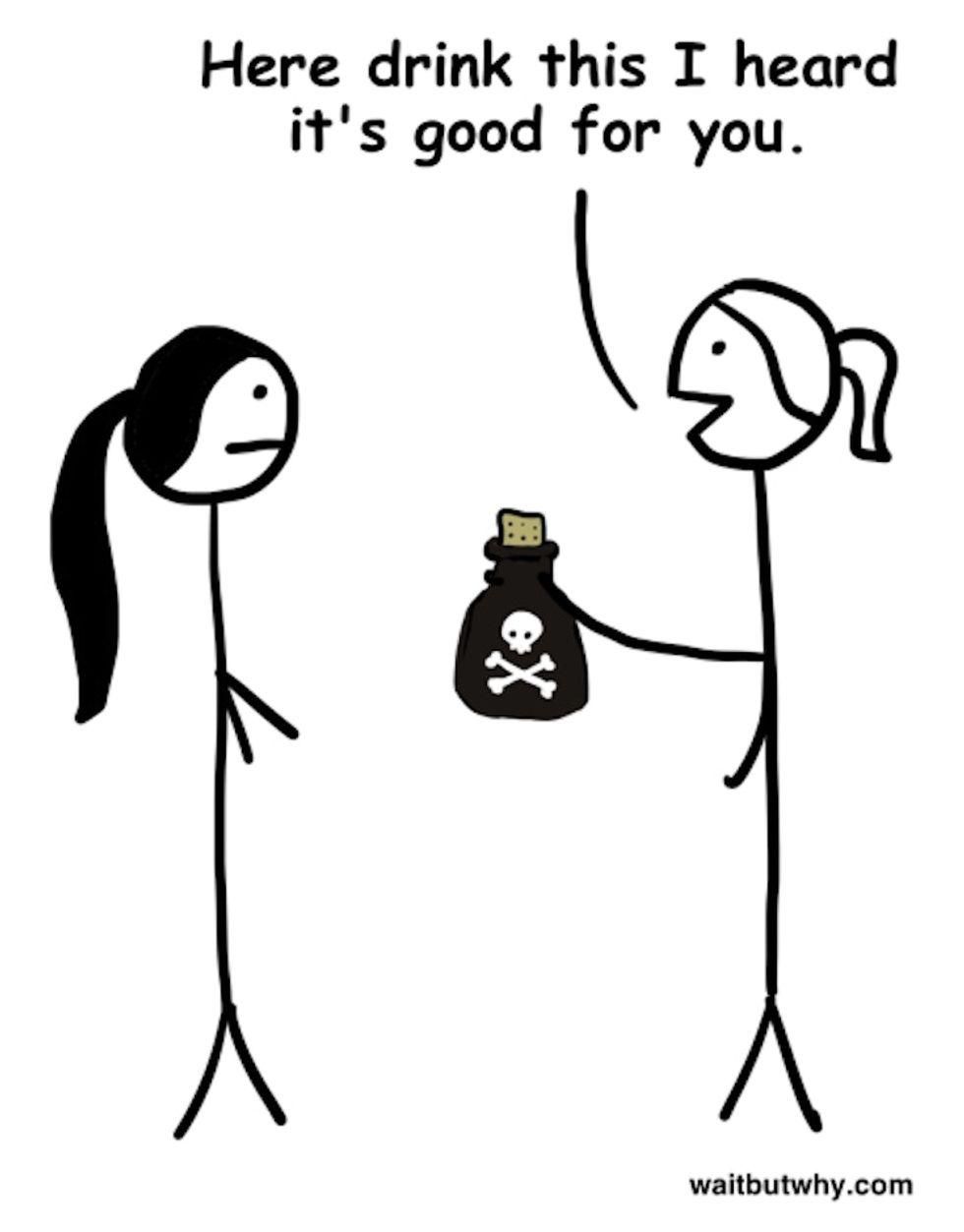
One stick person offers another stick person poison pretending it's safe

This is awful. Taste it.

via Wait But Why post and used with permission.

The Frenemy roots very hard against you. And I'm not talking about the friends that will feel a little twinge of pleasure when they hear your big break didn't pan out after all or that your relationship is in bad shape. I'm not even talking about someone who secretly roots against you when they're not doing so well at some area of life and it hurts them to see you do better. Those are bad emotions, but they can exist in people who are still good friends.

I'm talking about a real Frenemy — someone who really wants bad things for you. Because you're you.

You and the Frenemy usually go way back, have a very deep friendship, and the trouble probably started a long time ago. There's a lot of complex psychology going on in these situations that I don't fully understand, but my hunch is that a Frenemy's resentment is rooted in his own pain, or his own shortcomings, or his own regret — and for some reason, your existence stings them in these places hard.

A little less dark but no less harmful is a bully situation where a friend sees some weakness or vulnerability in you and she enjoys prodding you there either for sadistic reasons or to prop herself up.

A Frenemy knows how to hurt you better than anyone because you're deeply similar in some way and she knows how you're wired. She'll do whatever she can to bring you down any chance she gets, often in such a subtle way it's hard to see that it's happening.

Whatever the reason, if you have a Frenemy in your life, kick her toxic ass off your mountain, or at least kick her down the mountain — just get her off of Tier 1. A Frenemy has about a 10th of the power to hurt you from Tier 2 as she does from Tier 1.

9. The Facebook celebrity friend
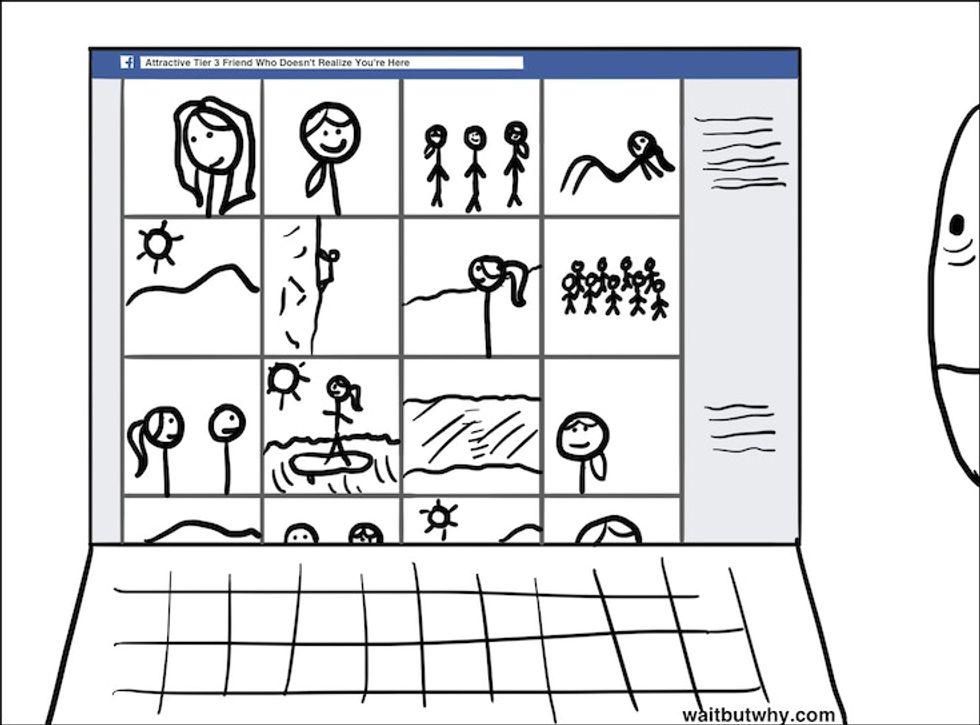
Comic of a computer with photo grid

What’s happening on social media?

via Wait But Why post and used with permission.

This person isn't a celebrity to anyone other than you, you creep. You know exactly who I'm talking about — there are a small handful of people whose Facebook page you're uncomfortably well-acquainted with, and those people have no idea that this is happening. On the plus side, there are people out there you haven't spoken to in seven years who know all about the new thing you're trying with your hair, since it goes both ways.

This is a rare Tier 3 friend, or even an acquaintance, who qualifies as an odd friendship because you found a way to make it unhealthy even though you're not actually friends. Well done.

10. The lopsided friendship
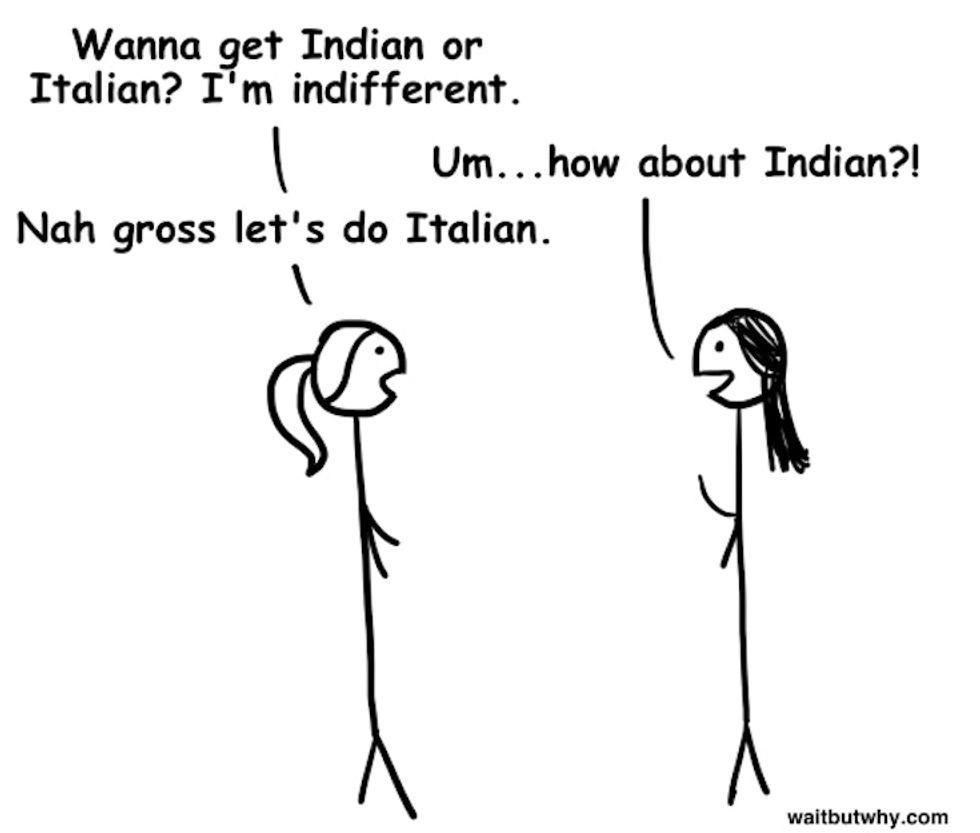
Two stick women discussing dinner

Can I make all the decisions... that was rhetorical.

via Wait But Why post and used with permission.

There are a lot of ways a friendship can be lopsided: Someone can be higher on their friend's mountain than vice versa. Someone can want to spend more time with a friend than vice versa. One member can consistently do 90% of the listening and only 10% of the talking, and in situations where most of the talking is about life problems, what's happening is a one-sided therapy situation, with a badly off-balance give-and-take ratio, and that's not much of a friendship—it's someone using someone else.

And then there's the lopsided power friendship. Of course, this is a hideous quality in many not-great couples, but it's also a prominent feature of plenty of friendships.

A near 50/50 friendship is ideal, but anything out to 65/35 is fine and can often be attributed to two different styles of personality. It's when the number gap gets even wider that something less healthy is going on—something that doesn't reflect very well on either party.

There are some obvious ways to assess the nature of a friendship's power dynamic: Does one person cut in and interrupt the other person while they're talking far more than the other way around? Is one person's opinion or preference just kind of understood to carry more weight than the other's? Is one person allowed to be more of a dick to the other than vice versa?

Another interesting litmus test is what I call the “mood determiner test." This comes into play when two friends get together but they're in very different moods — the idea is, whose mood “wins" and determines the mood of the hangout. If Person A is in a bad mood, Person B is in a good mood, and Person B reacts by being timid and respectful of Person A's mood, leaving the vibe down there until Person A snaps out of it on her own — but when the moods are reversed, Person B quickly disregards her own bad mood and acts more cheerful to match Person A's happy mood — and this is how it always goes — then Person A is in a serious power position.

But hey, not all friendships are grim.

In the Does This Friendship Make Sense graph above, the friendships we just discussed are all in Quadrants 2, 3, or 4 — i.e., they're all a bit unenjoyable, unhealthy, or both. That's why this has been depressing. On the bright side, there's also Quadrant 1—all the friendships that do make sense.

No friendship is perfect, but those in Quadrant 1 are doing what friendships are supposed to do: They're making the lives of both parties better. And when a friendship is both in Quadrant 1 of the graph and on Tier 1 of your mountain, that friendship is a rock in your life.

Rock friendships don't just make us happy — they're the thing (along with rock family and romantic relationships) that makes us happy.

Investing serious time and energy into those is a no-brainer long-term life strategy. But in the case of most people over 25—at least in New York— I think A) not enough time is carved out as dedicated friend time, and B) the time that is carved out is spread too thin, and too evenly, among the Tier 1 and Tier 2 friendships in all four quadrants. I'm definitely guilty of this myself.

There's something I call the Perpetual Catch-Up Trap. When you haven't seen a good friend in a long time, the first order of business is a big catch-up — you want to know what's going on in their career, with their girlfriend, with their family, etc., and they want to catch up on your life. In theory, once this happens, you can go back to just hanging out, shooting the shit, and actually being in the friendship. The problem is, when you don't make enough time for good friends, seeing them only for a meal and not that often — you end up spending each get-together catching up, and you never actually get to just enjoy the friendship or get far past the surface. That's the Perpetual Catch-Up Trap, and I find myself falling into it with way too many of the rocks in my life.

There are two orders of business right now:

First, think about your friendships, figure out which ones aren't in Quadrant 1, and demote them down the mountain. I'm not suggesting you stop being friends with those people—you still love them and feel loyal to them, and old friends are critical to hold onto—but if the friendships aren't that healthy or enjoyable, they don't really deserve to be in your Tier 1, and you probably shouldn't be in theirs. Most importantly, doing this clears up time to...

Second, dedicate even more time to the Quadrant 1, Tier 1 rocks in your life. If you're in your mid-20s or older, your current rocks are probably the only ones you'll ever have. Your rock friendships don't warrant two times the time you give to your other friends—they warrant five or 10 times!

Your rocks deserve serious, dedicated time so you can stay close. So go make plans with them.


This article was written by Tim Urban and originally published on Wait But Why. It originally appeared here nine years ago.

kids, school, school days, school week, schedule, 4 day week
Unsplash

Many school districts are moving to a 4-day week, but there are pros and cons to the approach.

American kids have fewer school days than most other major countries as it is, which poses a big challenge for families with two working parents. In a system designed for the "classic" stay-at-home mom model, it's difficult for many modern families to cover childcare and fulfill their work obligations during the many, many holidays and extra days off American children receive in school.

Some school districts, in fact, are ready to take things one step further with even fewer instructional days: for better or for worse.


Whitney Independent School District in Texas recently made news when it decided to enact a four-day week heading into the 2025 school year. That makes it one of dozens of school districts in Texas to make the change and over 900 nationally.

The thought of having the kids home from school EVERY Friday or Monday makes many parents break out in stress hives, but this four-day school week movement isn't designed to give parents a headache. It's meant to lure teachers back to work.

Yes, teachers are leaving the profession in droves and young graduates don't seem eager to replace them. Why? For starters, the pay is bad—but that's just the beginning. Teachers are burnt out, undermined and criticized relentlessly, held hostage by standardized testing, and more. It can be a grueling, demoralizing, and thankless job. The love and passion they have for shaping the youth of tomorrow can only take you so far when you feel like you're constantly getting the short end of the stick.

School districts want to pay their teachers more, in theory, but their hands are often tied. So, they're getting creative to recruit the next generation of teachers into their schools—starting with an extra day off for planning, catch-up, or family time every week.

Teachers in four-day districts often love the new schedule. Kids love it (obviously). It's the parents who, as a whole, aren't super thrilled.

- YouTube www.youtube.com

So far, the data shows that the truncated schedule perk is working. In these districts, job applications for teachers are up, retirements are down, and teachers are reporting better mental well-being. That's great news!

But these positive developments may be coming at the price of the working parents in the communities. Most early adopters of the four-day week have been rural communities with a high prevalence of stay-at-home parents. As the idea starts to take hold in other parts of the country, it's getting more pushback. Discussions on Reddit, Facebook, and other social media platforms are overrun with debate on how this is all going to shake up. Some parents, to be fair, like the idea! If they stay-at-home or have a lot of flexibility, they see it as an opportunity for more family time. But many are feeling anxious. Here's what's got those parents worried:

The effect on students' achievement is still unclear.

The execution of the four-day week varies from district to district. Some schools extend the length of each of the four days, making the total instructional time the same. That makes for a really long day, and some teachers say the students are tired and more unruly by the late afternoon. Some districts are just going with less instruction time overall, which has parents concerned that their kids might fall behind.

A study of schools in Iowa that had reduced instructional days found that five-days-a-week students performed better, on average.

Four-day school weeks put parents in a childcare bind.

Having two working parents is becoming more common and necessary with the high cost of living. Of course—"school isn't daycare!" But it is the safe, reliable, and educational place we send our kids while we we work.

Families with money and resources may be able to enroll their kids in more academics, extracurriculars, sports, or childcare, but a lot of normal families won't be able to afford that cost. Some schools running a four-day week offer a paid childcare option for the day off, but that's an added expense and for families with multiple kids in the school system, it's just not possible.

kids, school, school days, school week, schedule, 4 day week In a 4-day model, kids often (but not always) receive less instructional time. Photo by Ivan Aleksic on Unsplash

This will inevitably end with some kids getting way more screentime.

With most parents still working five-day weeks, and the cost of extra activities or childcare too high, a lot of kids are going to end up sitting around on the couch with their iPad on those days off. Adding another several hours of it to a child's week seems less than ideal according to expert recommendations.

Of course there are other options other than paid childcare and iPads. There are play dates, there's getting help from family and friends. All of these options are an enormous amount of work to arrange for parents who are already at capacity.

Working four days is definitely a win for teachers that makes the job more appealing. But it doesn't address the systemic issues that are driving them to quit, retire early, or give up their dreams of teaching all together.

@5th_with_ms.y

Replying to @emory here are my thoughts on my 4day work week as a teacher✨ #foryou #fyp #fypシ #foryoupage #foryoupageofficiall #teachersoftiktokfyp #teachersoftiktok #teachertok #teachersbelike #teachertiktok #tik #tiktok #viralllllll #teachertoks #teaching #teacher #tok #viralvideo #teacherlife #viral #trendy #teacher #teaching #worklifebalance #worklife #publicschool #publiceducation #school #student

A Commissioner of Education from Missouri calls truncated schedules a "band-aid solution with diminishing returns." Having an extra planning day won't stop teachers from getting scapegoated by politicians or held to impossible curriculum standards, it won't keep them from having to buy their own supplies or deal with ever-worsening student behavior.

Some teachers and other experts have suggested having a modified five-day school week, where one of the days gets set aside as a teacher planning day while students are still on-site participating in clubs, music, art—you know, all the stuff that's been getting cut in recent years. Something like that could work in some places.

In any case, the debate over a shortened school week is not going away any time soon. More districts across the country are doing their research in preparation for potentially making the switch.

Many parents don't theoretically mind the idea of their busy kids having an extra day off to unwind, pursue hobbies, see friends, catch up on projects, or spend time as a family. They're also usually in favor of anything that takes pressure off of overworked teachers. But until we adopt a four-day work week as the standard, the four-day school week is always going to feel a little out of place.

This article originally appeared in February. It has been updated.

Joy

Man ordering steak for dog's last meal is stunned by restaurant staff’s kind response

The staff knew something was wrong when he said he didn't need any sides with the steak.

cheddar's scratch kitchen. black labrador, dogs, rainbow bridge, steak, steak house

A Cheddar's Scratch Kitchen and a black Labrador (representative image).

There are a few things that are harder than saying goodbye to a pet; it can be as difficult as losing a close friend or family member. But for some reason, many people feel that they are not supposed to grieve as deeply for the loss of a pet as they do for a human. That’s why the kindness shown by the staff at Cheddar’s Scratch Kitchen in Saint Joseph, Missouri, is so extraordinary.

CousinHomer, a country musician in Missouri, was faced with the terrible decision to put down his 13-year-old dog, Bella, so he wanted her last meal to be something truly special: a “big, juicy steak.” The staff at the restaurant asked him what he wanted for sides, and CousinHomer said he just wanted the steak. “They told me it would be the same price with or without them, so I might as well get them. I explained to them that I was having my dog, Bella, put to sleep later that day, and I wanted her last meal to be a nice, juicy steak,” CousinHomer said in his video.


@clevelandclinic

Five-finger breathing is a simple but powerful breathing technique that induces deep relaxation — and you can do just about anywhere! 🖐️ Unlike other types of breathwork, five-finger breathing is a multisensory experience where you concentrate on more than just your breath. You also focus on the movement and sensation of one hand touching another, slowly and with intentionality. This helps your brain enter a state of deep relaxation, which causes it to release endorphins.

An incredible act of kindness

“When I showed up at the restaurant about 30 minutes later to pick up her food, the manager handed me the bag of food and said, ‘We are so sorry about your dog. This meal is on us.’ I really couldn't believe it. It was so nice of them,” CousinHomer said. However, when he got home, he saw that they had done something even more special: the entire staff had signed a card that read: "Our deepest sympathy in the loss of your best friend. She'll be waiting for you over the Rainbow Bridge."


“So I just want to publicly say, thank you, Cheddar's, for being so kind and thoughtful. It really meant the world to me,” CousinHomer concluded his video. But that wasn’t the end of the story. CousinHomer asked people to tag Cheddar’s in the post, so they know how many saw their act of kindness. Cheddar’s followed up with another act of kindness, which CousinHomer documented in a follow-up video.

@cousinhomer

CHEDDAR’S Restaurant Did It AGAIN. Wow!! (A Must See). #cheddars #cheddarsscratchkitchen #rainbowbridge #steakdinner #compassion @Cheddar’s

After Cheddar’s was flooded with people tagging them in the story, they sent CousinHomer a branded fleece that he can wear like a snuggie. “May comfort wrap around you like a warm Honey Butter Croissant. Your Cheddar’s family is here for you, Cousin,” the company wrote in the comments.

Why the loss of a pet hurts so much

Losing a pet can be just as hard as losing a human loved one, but there is one thing that's uniquely painful about putting down a pet. No matter how much we know we made the right decision, it still won’t stop us from ruminating over it.

“You do that because emotional pain hurts just like physical pain. And we are hard-wired to recognize pain as a teacher,” Sarah Hoggan, a pet loss grief advocate, said in a TED Talk. “Our body has reflexes that will pull our hand off a hot stove. We have pulled ourselves to safety even before we know the burn has occurred. Unfortunately, no such instant rescue mechanism exists for emotional pain. That means we need to study the events that led to the pain, to try to learn something from it and avoid it in the future.”

Ultimately, CousinHomer is going to be in a period of grief for quite a while, but it’s nice to know that there are a whole lot of people who recognized his pain and let him know that it was completely warranted to need some love after the death of a pet. At a moment when you have to make an incredibly difficult decision, having people understand your pain can make all the difference.

- YouTubeyoutu.be

This article originally appeared last year
Culture

American shares his 9 realizations about the U.S. after 13 years abroad and it's eye-opening

“If you’ve never left, you can never understand what it’s really like…”

united states, american, europe, living abroad, U.K.
Image credit: Evan Edinger/YouTube

You learn a lot about your country when you leave it for a while.

Evan Edinger moved to London over 13 years ago to study abroad but never planned on staying overseas permanently. His goal was to get his degree, return to the United States, start his career, and make a life for himself. He thought of his time in London as a "temporary adventure."

But when he finished his degree, he found himself in an unexpected situation: He didn't want to go back. "The longer I stayed in London," Edinger shares on his YouTube channel, "the more I began to notice all of the assumptions that I'd grown up believing in America, the things I was brought up to believe were undeniably true and just the way the world worked—it turns out they weren't true at all."


One of the benefits of living in another country is seeing your country of origin through different eyes. That perspective can cause you to appreciate some things and question other things. Edinger shares nine realizations he's had about the U.S. since he left, starting with one of the most quintessentially American realities he found himself questioning.

- YouTube www.youtube.com

1. Guns

Edinger grew up in New Jersey and describes it as "quite a blue state," but he was still immersed in the gun culture that views gun ownership as a fundamental part of being an American.

"I was raised in a very pro-gun household," Edinger says. "In my family home in America, we had a 12-gauge shotgun, a 10-gauge, a black powder rifle, and a .410 shotgun for the children. My dad would take us out some days to shoot empty cans of beer or play pigeons or sometimes go hunting for pheasants or deer."

He says the notion of not owning a gun was unthinkable in his upbringing. "The idea that other countries do not allow guns is viewed more like these other countries are missing a fundamental right," he says.

His ideas about guns have changed dramatically since moving to London and living in a society without ubiquitous access to guns. "Visiting Philadelphia when I was younger was always scary to me because I never knew who had a gun, who wanted to rob me," Edinger shares. "Visiting New Orleans a couple years ago, I was told by my hotel staff that a few days prior, a tourist was shot and died in the local Popeye's Chicken because he caught a stray bullet of two people having an argument in the restaurant. So, that's just something that people just have to deal with. This constant fear of I could just die being caught in a crossfire and there's nothing I can really do about it because freedom. I've pretty much never felt that level of fear in London at all. And that alone was enough to sway my opinion on guns."

guns, gun culture, gun violence, united states, second amendment The U.S. has a unique gun culture.Photo credit: Canva

2. Government

"One thing that's really drilled into you pretty much every year of American school is that American democracy is the end-all be-all of government and that it is the beacon of freedom other countries look to emulate. Then, once you become an adult and you see how dysfunctional the U.S. government is, you search for anything to feel better about it and usually settle on 'Well, at least it's not a third world dictatorship.'"

But those aren't the only two options. Edinger explains how the parliamentary system in the U.K. is far from perfect, but it tends to be more effective at actually getting things done because lawmakers aren't constantly stymied by the inherently destructive two-party gridlock we have in the U.S.

"It's messy, yes, but after 13 years away, I've come to the belief that no system of government is perfect," he says. "But most systems in Western Europe are far more effective than what I grew up believing was the 'best in the world.'"

3. Walkability and Public Transport

In the U.S., having a car is practically a symbol of freedom, but Edinger says he's never felt the need to have a car in his 13 years living in London. He says it's been incredibly freeing to be able to walk and take public transit everywhere, and not just in the city. He's been able to travel all over Europe, in larger cities and small towns, and the focus on walkable neighborhoods and public transportation is everywhere.

walkable cities, public transportation, car dependency, london underground, subway It's much easier to get around without a car in Europe. Photo credit: Canva

"After having spent some time living in walkable neighborhoods, I would never ever choose to live in a car dependent place ever again," Edinger says. "It is truly one of the most life-changing parts of living over here. And because I'm always walking everywhere, because I'm always cycling everywhere, it's so much easier to be healthy and physically fit without even trying."

4. Food Quality and Price

Europe has different regulations than the U.S., Edinger explains, with an approach that leads to a lot less additives and chemicals being added to foods.

"Europe's food agency focuses on possibilities and the U.S.'s focuses on probabilities. Is it possible an unnecessary additive could be harmful? Europe prohibits it just to be safe. The US agency, the FDA, they only step in if the probability of it being harmful is high. So, that risk is passed on to the average American consumer."

Edinger also points out that the ability to walk down to the store to get fresh ingredients regularly makes it a lot easier to eat well. "It's one of those things where once you experience both, there is no contest. No contest. So, it's much easier to be healthy in Europe than in America."

5. Healthcare in the U.S. vs. Europe

"If my health does have issues, I am glad it's not something that would ever bankrupt me or cause me to ever think about how much it would have to cost me just to be sick," says Edinger.

Americans often hear horror stories about socialized medicine, but Edinger's experience with going to the doctor and even going to the hospital have been positive, and barely cost him anything.

health, healthcare, universal healthcare, health insurance, cost of healthcare The U.S. is an outlier in the world when it comes to healthcare costs. Photo credit: Canva

"There are only two types of people that are against the freeing social safety net that is universal healthcare," says Edinger. "People that have never experienced socialized healthcare and people that profit from the broken system. That's it." Most Americans want it, but "most Americans" is not where the money is.

6. Consumer Protections in the U.S. vs Europe

Edinger shares that he bought a MacBook Pro in 2019 that didn't work right, and he hadn't purchased AppleCare because he knew he didn't have to.

"If you buy a tech product in Europe, you have a reasonable expectation that it should last you at least two years free of defects," says Edinger. "And if it's not up to your expectations or breaks down before then, you can demand a return or replacement. This law protects consumers from shady business practices."

He ended up getting his full money back on the computer due to those consumer protections.

"It's laws like this where you really begin to notice a pattern that life in Europe is one that gives more rights to the everyday person over giant corporations and shared benefit over private," says Edinger.

7. Worker Rights

"A quick summary would be 28 days minimum paid holiday, one year paid maternity leave, two weeks paid paternity leave, sick leave, even the right against unlawful termination," said Edinger. "When working part-time at Urban Outfitters in London, even though I worked less than 20 hours a week, I still got two days paid holiday per month. That's insane, right? No, that's just life over here. Meanwhile, I worked five years at a Pizza Hut in New Jersey for over 30 hours per week. Never got a single day of paid vacation."

Indeed, there's more than a handful of European countries that guarantee at least a month of paid days off, with some countries actually requiring a certain number of days or weeks off.

vacation, holiday, paid vacation days, paid time off, work life balance Europeans get far more generous paid leave than Americans do.Photo credit: Canva

Edinger points out the irony that he was always taught that the U.S. was for the individual, for individual freedoms. But in his experience, in Europe individuals have more rights than those with money or power, while it's the opposite in the U.S.

8. Money (Live to work or work to live?)

Edinger says that most things are more affordable in Europe, from groceries to data plans, but Americans do earn higher salaries.

"So if you earn a lot of money and money is your sole defining metric of success, then you can feel a lot more successful in the U.S.," he says. "But because the culture in Europe is work to live and not live to work, you might find that the stress and cost tradeoffs and quality of life erode the value of that higher salary quite quickly."

9. On Romanticizing Europe

People often wonder if Americans romanticize Europe too much, and Edinger says the same question used to be asked of Europeans romanticizing America. But now that we have YouTube and social media and a better ability to see the realities of both places, he says what Americans "romanticize" about Europe is really just the things we want and don't have.

work-life balance, united states, working, european culture, worker rights Work-life balance is something a lot of Americans struggle with.Photo credit: Canva

"I think most Americans who are eyeing up Europe are doing so because of the things that America is lacking. Nearly two in three Americans want universal healthcare. Well, America doesn't offer that. Again, two in three Americans want European style vacation policies. America doesn't offer that. And 53% of Americans would prefer to live in a walkable neighborhood, but sorry, America doesn't offer that. The list goes on. If America were an actual democracy, I don't think many of these people would be having romanticized views of Europe at all because they wouldn't need to. They could have everything they wanted in the country they were born and raised."

Of course, every country has its problems and there are certainly downsides to moving abroad. Edinger acknowledges that but says it really boils down to what you value in life. Americans are taught to romanticize the U.S., and leaving it helps you see the reality, what's good about your country and where it has room for improvement.

"I think the main thing though out of everything that I miss about the U.S. that I can't really get here is not rights, not freedoms, not anything that's big on quality of life improvements," says Edinger. "It's just Mexican food and good ice cream."

You can follow Evan Edinger on YouTube for more on his experiences as an American living abroad.

flags, countries, world, patriotism, nationalism

What's the difference between patriotism and nationalism?

Patriotism can feel like a loaded term sometimes, as the meaning can range in people's minds from a basic love of country to a fierce loyalty one is willing to die for. What constitutes "country" can also impact how we perceive of patriotism, as there's a difference between the land, the people, the ideals, and the current government.

And then there's nationalism, which may sound like the same thing but isn't. So what's the difference? Episcopal priest Joseph Yoo shared his thoughts on what separates patriotism from nationalism, and people are appreciating having the key differences laid out so clearly.


@joseph.yoo

Nationalism vs. Patriotism #yourEpiscoPal #YourKoreanFather #nationalism #patriotism #LanguageLearning

"Patriotism is love," Yoo begins. "It's gratitude. It's saying, 'I care about my country enough to tell the truth about it, to celebrate what's good and work to fix what's broken."

"Nationalism, that's idolatry," he continues. "It says my nation is the nation above critique, above others, God's favorite. And once you slap God's seal of approval on your own flag, congratulations, you've just made your country a 'golden calf.'"

He explained the patriotism results in activism like that of John Lewis crossing the Edmund Pettus Bridge to demand that the country live up to its professed ideals. Nationalism results in tragedies like the January 6th invasion of the Capitol, where Confederate flags and crosses were seen in the same mob.

"Patriotism says, 'I love my family enough to admit when we've messed up, and I will help us grow," Yoo says." Nationalism says, 'My family is perfect, everyone else is trash, and if you disagree you are out."

"One is honest love. The other is toxic possession," he says. "One builds. One bullies."

Yoo concluded with a biblical point: "Jesus never called us to worship a flag, only to love our neighbor."

It's important to differentiate between patriotism and nationalism because the latter has become a bit of a lightning rod in the political discourse. Some use it as a pejorative term, while others have embraced it as something totally acceptable or even positive. When the definitions are muddied, it causes confusion.

American flags, united states, america, patriotism, nationalism Flags can be a symbol of both patriotism and nationalism.Photo credit: Canva

Of course, Yoo is not the sole authority on what these words mean, but his thoughts are aligned with what the neutral arbiters of definitions say they mean.

Dictionary.com has an entire page discussing the terms, defining patriotism as "devoted love, support, and defense of one’s country; national loyalty,” and nationalism as "the policy or doctrine of asserting the interests of one’s own nation viewed as separate from the interests of other nations or the common interests of all nations," ultimately leading to how the two words are used:

"Patriotism generally has a positive connotation. It’s used for various positive sentiments, attitudes, and actions involving loving one’s country and serving the great good of all its people.

Nationalism generally has a negative connotation. It’s used for political ideologies and movements that a more extreme and exclusionary love of one’s country—at the expense of foreigners, immigrants, and even people in a country who aren’t believed to belong in some way, often racial and religious grounds."

flags, countries, world, patriotism, nationalism Love of one's country is nice. But there's a difference between patriotism and nationalism. Photo credit: Canva

Britannica also has a whole page about the two words, with this basic synopsis of the differences:

"Patriotism is a feeling of attachment and commitment to a country, nation, or political community, and its conception has roots tracing back to Greek and Roman antiquity. It is associated with the love of law and common liberty, the search for the common good, and the duty to behave justly toward one’s country. Nationalism, on the other hand, is a more modern ideology that emerged in the 18th century, focusing on the individual’s loyalty and devotion to the nation-state, often surpassing other individual or group interests."

And then there are some famous takes on patriotism:

“I love America more than any other country in the world and, exactly for this reason, I insist on the right to criticize her perpetually.”
― James Baldwin

“Patriotism is supporting your country all the time and your government when it deserves it.”
― Mark Twain

mark twain, author, patriotism, nationalism, democracy Mark Twain had quite a bit to say about patriotism. Giphy

“Patriotism means to stand by the country. It does not mean to stand by the president or any other public official, save exactly to the degree in which he himself stands by the country. It is patriotic to support him insofar as he efficiently serves the country. It is unpatriotic not to oppose him to the exact extent that by inefficiency or otherwise he fails in his duty to stand by the country. In either event, it is unpatriotic not to tell the truth, whether about the president or anyone else.”
― Theodore Roosevelt

“The difference between patriotism and nationalism is that the patriot is proud of his country for what it does, and the nationalist is proud of his country no matter what it does; the first attitude creates a feeling of responsibility, but the second a feeling of blind arrogance that leads to war.”

― Sydney J. Harris

There's nothing wrong with loving your country, but anything taken to excess and exclusion isn't healthy. Nationalism is excessive and exclusive in its very nature, and while patriotism can be weaponized, when kept in check it's what keeps people striving to make their homelands the best that they can be for everyone who lives there.

This article originally appeared last year

Gen Alpha; Gen Z; millennials; life in 80s; 80s life; 1980s; Oregon trail generation

Teacher asks 7th graders about the 80s. Their answers have us howling.

Gen Zers joke that their parents were born in the 1900s as a way to teasingly make it seem like their parents are much older than they actually are. But the kids coming up behind them are either really good at sarcasm or they actually believe the 80s were more like the 1780s. A 7th grade teacher asked her class full of Gen Alphas what they thought the worst part of the 80s was, and no one was prepared for their answers.

When most people think about the 80s, they think of big hair teased and sprayed to the gods. Bright colors, roller skates, and people walking around with giant boomboxes on their shoulders (as if everyone wanted to hear their music choices) are also at the top of the list for things that represent the 80s. But when thinking of the worst part of that decade, the lack of things like GPS, cell phones, and search engines would probably be at the top of that list.


Gen Alpha; Gen Z; millennials; life in 80s; 80s life; 1980s; Oregon trail generation Retro vibes with bold colors and music! 🎶✨ #80sFashionPhoto credit: Canva

Gen Alpha has other ideas about the worst part of the 80s. If you lived through that decade, you may want to remove your hat so you can scratch your head. The teacher who goes by Meliciousmo on social media recently uploaded the prompt and her students' answers on TikTok, giving viewers a chuckle.

One kid answers the prompt with, "No electricity. No good food." It's starting out pretty questionably, but let's give him the benefit of the doubt by assuming his family watches a lot of Little House on the Prairie and his centuries are mixed up. The next kid's response will probably nail it.

Well, maybe not. Through a few spelling errors, the response explains that the worst part about the 80s is that they didn't have cars. Yes, this sweet summer child surmised that life was tough because cars didn't exist, so walking everywhere or riding a horse and buggy was imperative. Obviously, this is false, because there were cars in the 80s. They had seatbelts in them for decoration, and kids would slide across the backseat when their dad turned a corner too fast as their mom reflexively extended a stiff arm to stop them from flying out of the car.

Gen Alpha; Gen Z; millennials; life in 80s; 80s life; 1980s; Oregon trail generation Confused expression with a questioning gesture.Photo credit: Canva

Clearly, some of the students were exposed to either 80s movies or TV shows because a couple of answers were spot on. One student wrote that running out of hairspray was the worst thing about the 80s, while another said, "People listening to other people's phone calls." Yikes. They're right. There were no cell phones, so there were no Bluetooth devices, so everyone was privy to your private conversation. Another child said nothing was bad about the 80s because "they had cool clothes, music, people, and hair." Those are big facts, kid.

But other suggestions included having to walk through rivers because of the lack of buses, or the worst part of the 80s: the Cold War.

@meliciousmo Every Friday I ask my students a fun question. This was today’s with some of their responses. 🤦🏼♀️#teachersoftiktok #funnyanswers #genx #middleschool ♬ Don't Stop Believin' (2024 Remaster) - Journey

One person writes, "There’s[sic] like 3 kids who know the 1980s are not the same as the 1780s. LOL."

Another laughs, "Gosh I’m still tired from walking through all the rivers to school."

Someone else thinks the generational gap between parents has something to do with it, "Some of these are spot on…some think we’re over 100 years old! You can tell who has Gen X parents and who has Millennial parents!"

Gen Alpha; Gen Z; millennials; life in 80s; 80s life; 1980s; Oregon trail generation Students eagerly participate in a classroom discussion.Photo credit: Canva

Book It pizza party anyone? (Or was that the 90s?) Either way, someone is proposing that iconic classic, writing, "Ok so some good ones, shoulder pads, people listening in to phone calls and hair spary[sic] are all legit. Give those kids a classic 80s pizza paety[sic]!! As for WW2, no tv, cars, and the great depression. Well those kids need a new history book lol."

Another person adds a pressure that only those who were adults in the 80s could appreciate, saying, "I didn't even grow up in the 80s and I KNOW it was writing a check at the grocery store with four people behind you and the person behind you had a full belt. The pressure must have been CRIPPLING."

This article originally appeared last year