upworthy
Add Upworthy to your Google News feed.
Google News Button
Joy

7 things Black people want their well-meaning white friends to know

"You, white friend, need to speak up and say something when I can't."

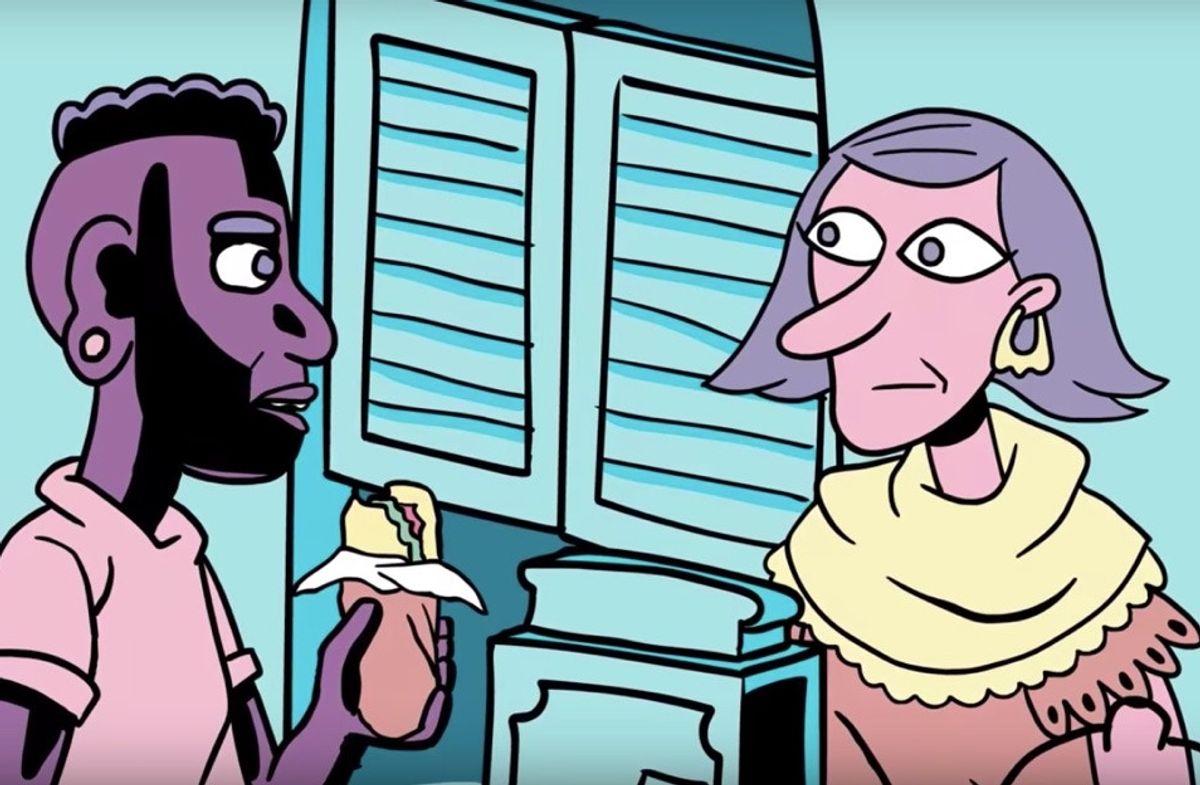
comic of a Black man holding a sandwich speaking to a white woman

Growing up black in a white neighborhood.

I grew up Black in a very white neighborhood in a very white city in a very white state.

As such, I am a lot of people's only Black friend.

Being the only Black friend is a gift and a curse. I am Black and I love having friends. But I am also, at any given moment, expected to be a translator, an ambassador, a history teacher, and/or a walking, talking invitation into "I am not racist" territory. It's a lot to handle. See what I mean about that curse?

So when I saw the animated short-film "Your Black Friend," I felt so seen. Clearly, I am not alone.
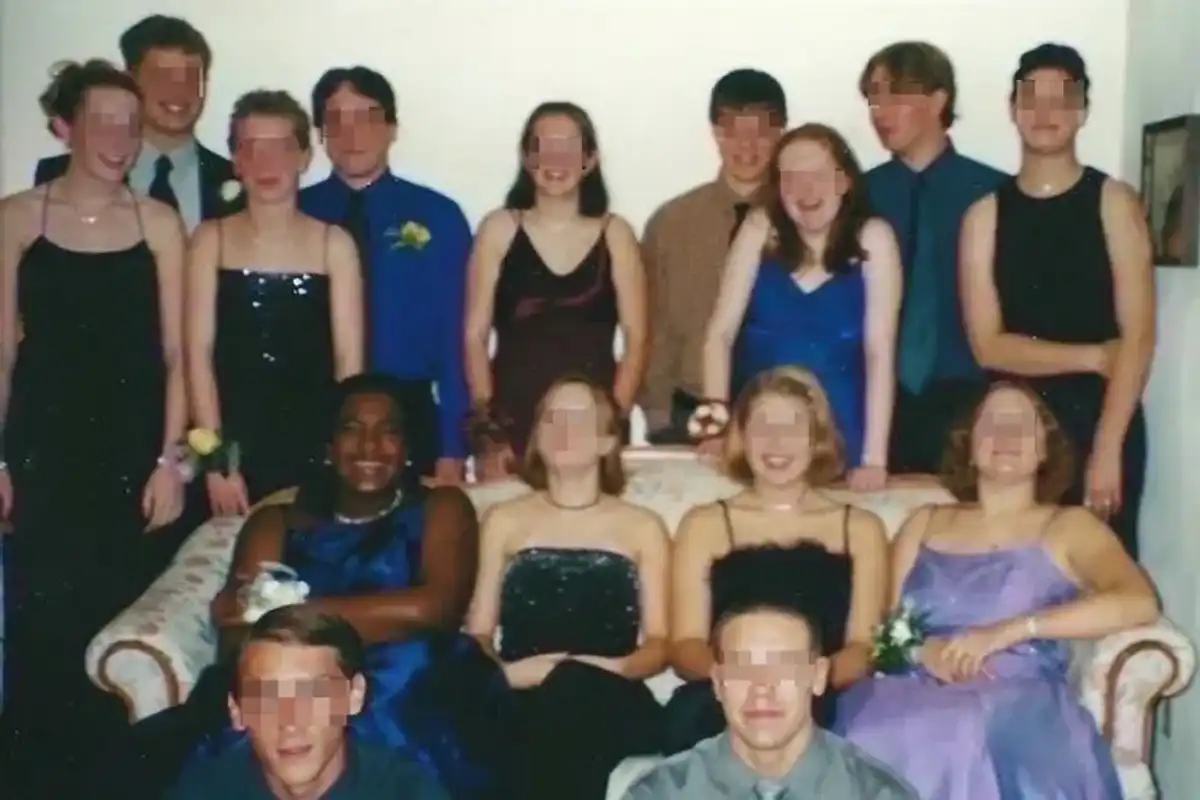
group of teens taking a photo before a dance. all eyes are pixelated except the author's

Don't get me wrong, my friends are awesome, just very white. Here are me and a few of my pixelated pals before a high school dance in the early 2000s.

Photo courtesy of the author.

The film, which was written, designed, and narrated by Ben Passmore and is based on his mini-comic of the same name, is a brilliant, refreshing way to examine whiteness and racism. The comic and animated short are an open-letter from "your Black friend" to you, their well-meaning white friend, about bias, alienation, and what it means to be a good ally and friend.

It's funny, honest, and heartbreaking in equal measure. And speaking from personal experience, it captures the experience of being a Black friend to white people pretty much perfectly.

So if you're a "woke" friend and ally, here are some things your Black friend wants you to know.

1. You're going to have to get uncomfortable.
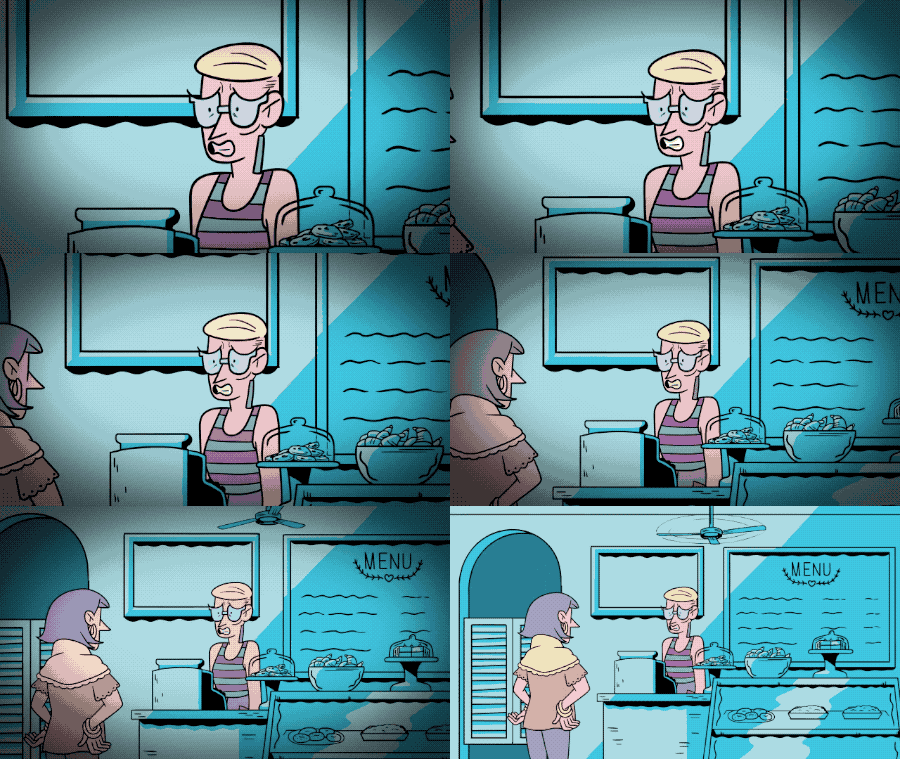
illustration of a white barista looking uncomfortable in front of a customer

Animation depicting a racist joke that creates an awkward and upsetting space.

Silver Sprocket/YouTube

It could be something as obvious and upsetting as a racist joke. Or something as "benign" as your aunt suggesting you cross the street when she sees a group of Black kids walking by. But either way, if you want to be a good friend and a real ally, you're going to have to speak up. You're going to have to have those tough conversations with people you care about.

It's not easy to confront strangers or people you love, but if you don't do it, you are part of the problem. Sitting out isn't an option. No one said being an ally is easy.

2. "Your Black friend would like to say something to the racist lady, but doesn't want to appear to be that 'angry Black man.'"
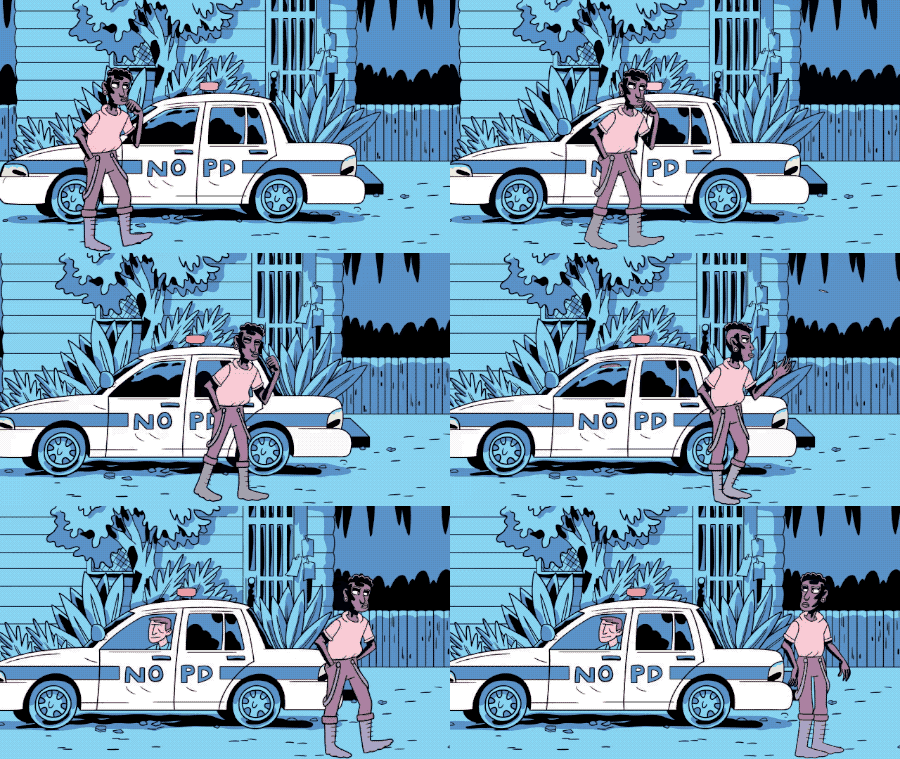
illustration of Black man walking by police car, littering, and the sirens going off

Biased situations that play out uncomfortably true.

Silver Sprocket/YouTube

"He knows this type of person expects that from him, and he will lose before he begins," Passmore says.

Black people can't always react or respond the way we want to. When I am followed in a department store, pulled over for no reason, or stared at while picking up dinner at the fancy grocery store, I can't stop what I'm doing and yell, "YES, I AM BLACK. NO, I AM NOT A CRIMINAL YOU SMALL-MINDED, BIASED ASSHOLES." Trust me, I want to. But especially when police are involved, I have to be calm, respectful, and obedient.

That's where you come in. You, white friend, need to speak up and say something when I can't. If you are not at risk, nor considered a threat, you have a certain amount of privilege in these situations. Use it to demand answers, speak to supervisors, or if things really get dicey, pull out your phone and hit record.

3. We are constantly monitoring our surroundings and adjusting our clothes, hair, speed, and speech to maintain white comfort.
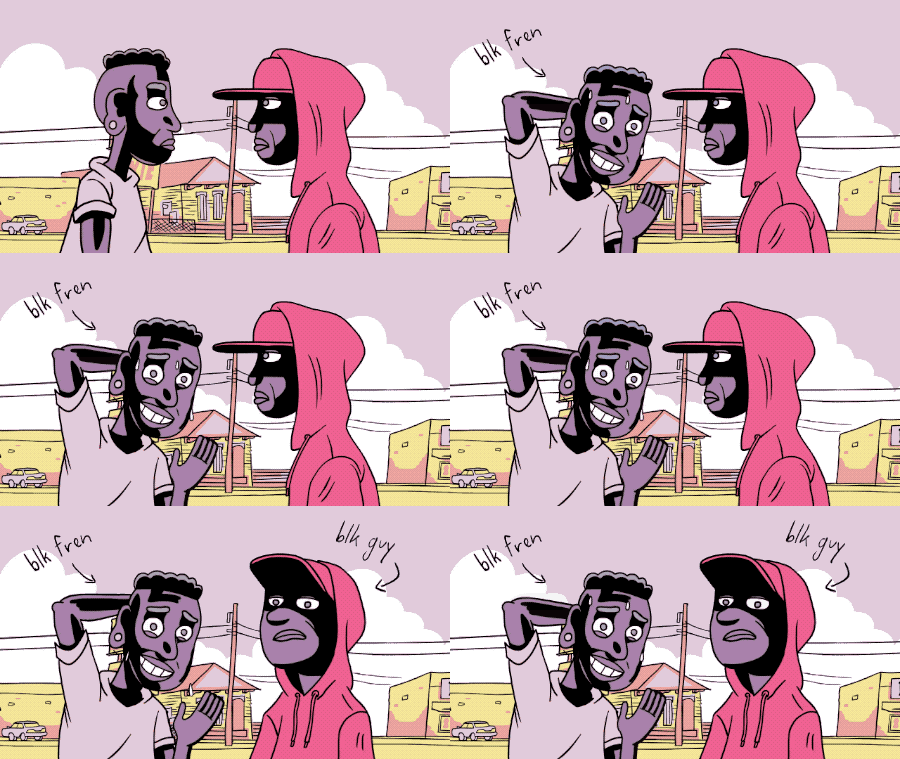
illustration of two Black men talking; one looks anxious and one looks nonplussed

Friends may not realize the challenges in avoiding unwarranted confrontation.

Silver Sprocket/YouTube

We don't like it, but one small choice—like deciding whether or not to wear a hood, or the speed at which we reach into our glove box—can be the difference between life and death.

When I am in a parking garage and walking behind a white woman, I intentionally cough or walk a little louder so she turns and notices me.

Why? Because when I don't, that same white woman will often clutch her purse and occasionally let out an audible gasp as I pass her. This is something my white friends likely don't realize I have to do. Some of them may even be the pearl-clutchers in the parking lot.

But to maintain white comfort and to avoid having the cops called on us, we often have to tamp down clothes, modify our speech and volume, even do our hair differently. We have to have "the talk" with our kids about how the world sees them, and how to act in order to make sure they come home alive.

No, it's not fair. No, we don't like it. But so long as this country and its institutions are built on a solid foundation of white supremacy, it's a grim reality. You need to know that, and take it up with your fellow white people about how to dismantle it.

4. "Your Black friend wishes you'd play more than Beyoncé. There are more Black performers than Beyoncé."
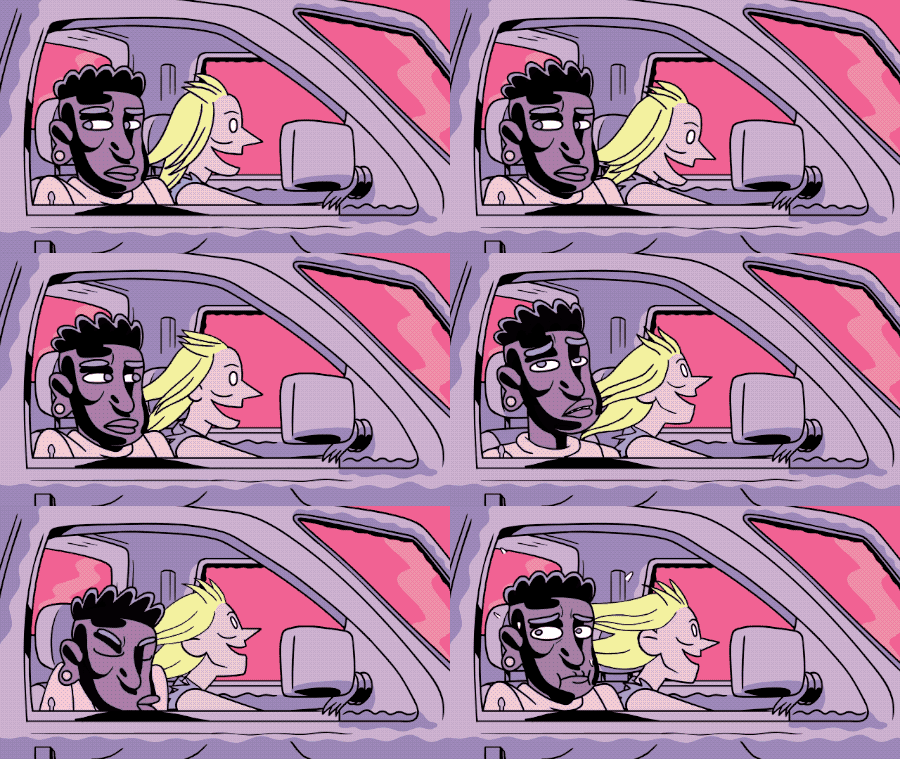
comig gif of a Black man looking uncomfortable in the car with a white friend

Taste isn't only derived from race and culture.

Silver Sprocket/YouTube

Lemonade was awesome. There is no denying it. And yes, I love seeing her iconic looks on Instagram too. But there is more to Black music and Black art than Beyoncé. Dip a toe outside your comfort zone and try new new artists and genres you may not be familiar with. Go listen, see it, and experience it for yourself.

And while we're here, you can't say the n-word when you sing along. Nope. You just can't.

5. Speaking of which, performative Blackness is really uncomfortable.
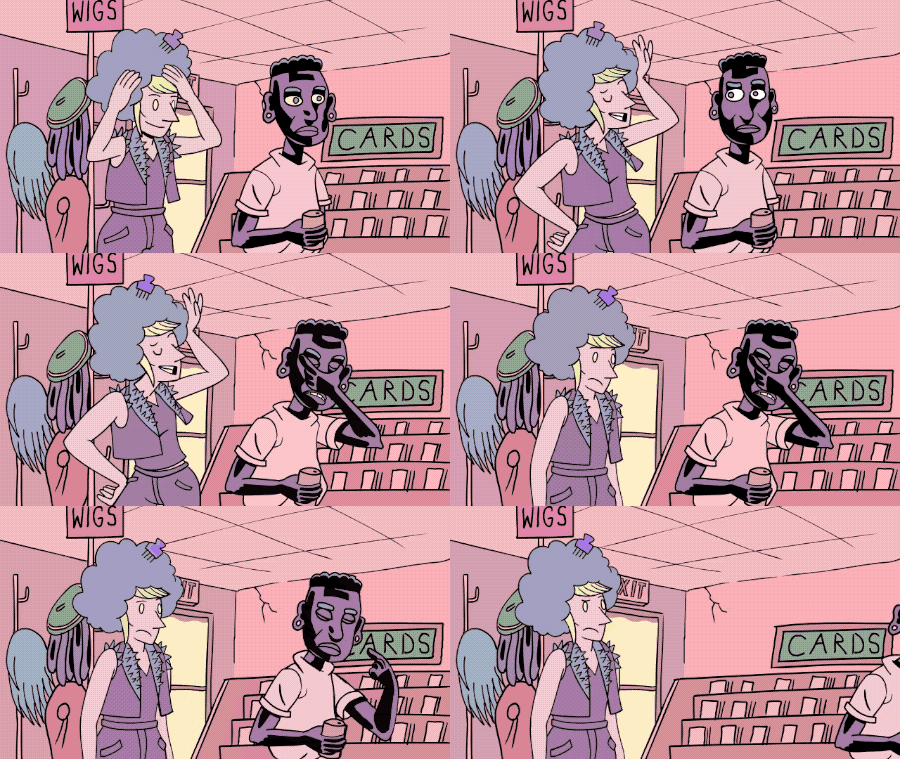
comic of a white woman wearing an afro wig to the chagrin of their Black friend

Sometimes jokes and misguided appreciation is hurtful.

Silver Sprocket/YouTube

When you wear that braided wig on Halloween, or use your "blaccent" when you're around me or other Black people, it hurts. It's not cute or charming, and it definitely doesn't make you seem cool.

Our culture and heritage are not costumes you can slide on and off at your convenience. We don't get to be Black only when it suits us. Neither do you.

6. "Your Black friend feels like a man without a country."
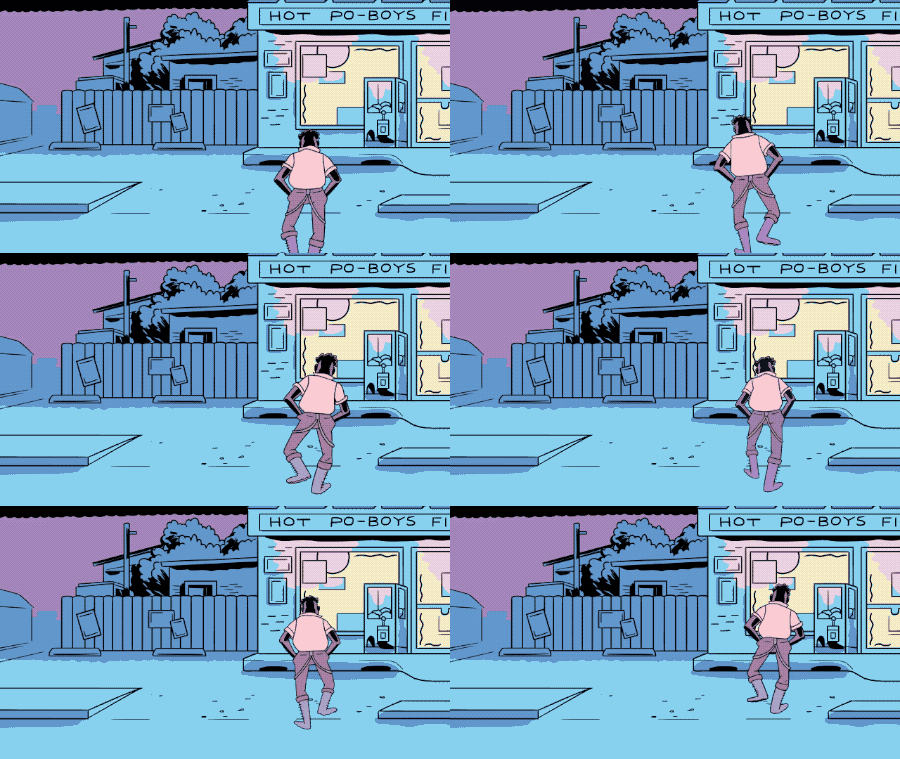
illustration of man walking up to a storefront that says "Hot Po-Boys"

Can we enjoy each others company without pointing out our differences?

Silver Sprocket/YouTube

Having white friends and seeming to "fit in" with the majority can feel really alienating. You can feel too "white" for Black people, and too "Black" for white people when all you want to do is find people to eat pizza with. As Passmore wrote, "He is lost in this contradiction, and held responsible for it."

7. We would love it if we could stop talking about our anxiety and frustrations regarding racism. But right now, that's impossible.

Our concerns are urgent and real. We're getting subpar health care. We're disenfranchised. We're over-policed. We're thrown in jail. We're killed by people sworn to protect us. It's exhausting, but we have to keep talking about it. So do you.

We can't be expected to dismantle white supremacy on our own.

Our white friends and allies need to step up and gather their people. Have the tough conversations. Speak up when you see racism, discrimination, and microaggressions. The time to talk about it is done. Be about it, or find yourself a new Black friend.

Watch "Your Black Friend" in full and check out Passmore's book, Your Black Friend And Other Strangers.


This article was written by Erin Canty and originally published on seven years ago.

snl, christmas, holidays, satire, comedy, kristen wiig, saturday night live, humor, youtube, christmas presents, moms
SNL/YouTube

Classic SNL Christmas sketch has people rethinking the holiday dynamics in their family.

Five years ago, one of the most iconic Christmas sketches ever aired on Saturday Night Live. It's called simply, "Christmas Robe," and it depicts an average American family excitedly waking up on Christmas morning, running to the tree, and opening their presents. In song form, each member of the family takes turns rapping about their own gift haul: A hat, a drone, a pinball machine...

Except for poor mom, played perfectly by Kristen Wiig, who only got a robe—that was 40% off. Things only get worse for Mom as she discovers that her stocking is also empty and she must now go make the family breakfast while everyone plays with their new gifts.


If you haven't seen it, here it is. It's well worth watching in its entirety:


- YouTube www.youtube.com

The sketch got a lot of laughs and resonated deeply with people—especially moms—who watched it.

It's no big secret that moms are the primary makers of Christmas magic in most Western families. While they get joy out of making the holidays special for their families, it's a lot of exhausting work, made worse when it goes unnoticed and unappreciated. It's implied, of course, that Kristen Wiig's character bought everyone their presents while no one in the family bothered to think of her at all.

Jessica Cushman Johnston writes for Motherly: "[Making Christmas magic] is not something my husband or my kids put on me, it’s my own deal. It’s also a tinsel-covered baton handed down from generation to generation of women. As a kid, I just thought the warm fuzzy feelings I felt on Christmas morning 'happened.' Now I know that the magic happens because someone is working hard, and now that someone is me."

Kristin Wiig's character beautifully says it all with the dead-inside expression as she feigns excitement over her lonely robe. In just two and a half minutes, the cast and writers managed to capture a frustrating feeling that millions of women relate to.

The sketch spawned discussions, think pieces, and even parodies when it aired in 2020. Real moms took to social media to "show off" their own robes in an act of solidarity. The sketch had, one could say, a moment. And then, quietly, it retired and took its place in the SNL holiday hall of fame, destined to be re-watched for years to come.

And then something funny happened. People kept tuning in. The skit continued to reach new viewers, and somewhere along the line, a few people actually learned something from the extremely silly sketch.

Saturday Night Live's YouTube and social media are full of comments from viewers who say the sketch opened their eyes in a very real way. And even better, that they're changing their behavior because of it:

"As a retail worker, I actually heard multiple people reference this sketch while buying presents for their wife/mom this year. Thanks SNL!"

"This skit changed Christmas in our house. The year it aired my husband made sure I didn’t get a robe and since this aired (okay, two Christmases have gone by) it’s a joy to see boxes under the tree and a full stocking- now in our house when I’m forgotten my husband says, “you got a robe” and adjusts the situation. Never thought a skit could change my life."

"I just saw this first time. I'm definitely going to buy better present next Christmas to my mom."

"A few years ago, I got a robe. This year, I got a new iPad plus all the accessories. SNL doing all the moms a solid."

"As a grown man, this skit is the first time I've realized how true this is. And now I feel so damn awful :( Gonna bombard moms with the presents this year"

"Seriously! I got a bunch more stuff for my mom after seeing this! It's so accurate. No more robes for mom!"

"I was laughing at this, then realized my mom's stocking was empty and ran out and bought her a truckload of stuff. Love you Mom!"

"Thanks, SNL. After watching this with the family, I had the most bountiful Christmas ever!! And the gifts were wrapped instead of left in the bags the came in."

"This video did more to stimulate spending on Moms this year than almost anything else, guaranteed. Look at SNL actually making a difference with their humor"

The comments go on and on, with the video now reaching over 12 million views. Some moms changed their behavior, too, after seeing the sketch:

"This is spot on, and exactly why I now buy myself Christmas presents, without feeling guilty about it."

The trouble of moms unfairly shouldering too much labor around the holidays (and, well, most other times of the year) is not a new problem. Not by a long shot. So why has this skit reached people when other forms of messaging has failed to sway them?

Marie Nicola, a pop culture historian and cultural analyst, says that no amount of deeply serious essays or shrugged off "mom is complaining again" can fix what satire easily addresses. That's the power of comedy at its best:

"It allows the audience see what was historically unseen or ignored, and it validates the labour as visible and concrete, without being accusatory because it wraps the whole thing up in camp comedy and exaggeration. The skit makes it safe to laugh. This is what psychologists call benign violation," she says. "SNL is showing viewers that something is wrong but they have made it safe enough that people can laugh at it instead of feeling attacked. Once the defenses drop, then recognition can flow through that opening."

The Humor Research Lab writes that humor occurs when an accepted "norm" is violated in a benign way—that's the benign violation Nicola's referring to. "Jokes ... fail to be funny when either they are too tame or too risqué."

The best pieces of satire—the ones that reach the highest levels of cultural relevance—thread that needle perfectly. The norm, in this case, according to Nicola, is that it is "a privilege to curate the perfect holiday experience for the family, the gift is the joy in the moment and their memories for years to come." We're not allowed to talk about the dejection and exhaustion that come from all that hard work. This sketch gave a lot of people permission for the first time to do so.

It’s not the first time that SNL’s comedy and satire have had a palpable effect on how we view the world.


- YouTube www.youtube.com

Once SNL performed the "More Cowbell" sketch, none of us could look at the bizarrely overproduced "Don't Fear the Reaper" the same way again. An old Eddie Murphy sketch got a lot of laughs out of the idea of "white privilege" long before it became a commonly known concept. And people had a hard time taking Sarah Palin seriously after Tina Fey's spot-on yet over-the-top impersonation, with studies later investigating the "Tina Fey Effect's" impact on the election.

And now, the more than 12 million people who have seen "Christmas Robe" are going to have a hard time looking at Mom’s empty stocking without being reminded of Kristen Wiig’s pitch-perfect performance.

Of course, "Christmas Robe" continues to land and connect with viewers today in part because it has not solved the problem of household inequities. The phenomenon continues to exist in spades. But the fact that it’s made even a small dent is pretty remarkable for a two-and-a-half-minute parody rap song.

mansplaining, golf, swing change golf, humor, golfing, sports, athletes, female athletes, womens sports, sexism
Representative Image from Canva
A man tried to tell a pro golfer she was swing too slow.

We’re all probably familiar with the term “mansplaining,” when a man explains something to a woman in a condescending or patronizing way. Often, this comes in the form of a man explaining a subject to a woman that she already knows on an expert level. The female neuroscientist who was told by a man that she should read a research paper she actually wrote comes to mind.

Often, mansplaining can show up in small interactions that minimize or infantilize a woman's knowledge and expertise. It can be a man spouting off facts because he thinks it makes him seem interesting, or giving unsolicited fitness advice at the gym in a poorly disguised flirting attempt. But sometimes the irony at play is just too much to bear. Frankly, it's often delicious.


Recently some next-level mansplaining was caught in the wild. Well, at a golf driving range anyway. Georgia Ball, a professional golfer and coach who’s racked up over 3 million likes on TikTok for all her tips and tricks of the sport, was minding her own business while practicing a swing change.

It takes all of two seconds on Google to see that when it comes to incorporating a swing change, golfers need to swing slower, at 50-75% their normal speed…which is what Ball was doing.

And this is what prompted some man to insert his “advice.”

In the clip, we hear the man say “What you are doing there … you shouldn’t be doing that.”

Exhibiting the patience of a nun, Ball simply tells him that she’s going through a swing change.

But her attempts at reason are unfortunately interrupted, multiple times, when the man repeatedly assures her that since he’s been playing golf for 20 years, he knows what he’s talking about.

He then insists, repeatedly cutting her off, that she’s going too slow on her swing and should be following through.

Cue Ball’s incredulous look to the camera.

Watch the whole, cringe-inducing interaction here:

@georgiagolfcoach

Can you believe he said this? 😳⛳️👀 #golf #golfswing #golflife #golftok #golftiktok #golfer #golfing #golfgirl #golfpro #golftips #golfclub #drivingrange

Hoping to appease him, Ball finally gives a hearty swing, writing “I knew I had to make this a good one” on the onscreen text.

As the ball sails through the air, the man says “see how much better that was?", completely taking credit for her swing.

Yes. Really. He really said that.

Poor Ball then tries to tell him that even the “best players in the world” slow down their swing when going through a swing change. And she'd know. Not only is she a golf coach, she's a certified PGA professional.

“No, I understand what you’re saying, but I’ve been playing golf for 20 years,” the man repeats. At this point Ball is just “trying to keep it together.”

mansplaining, golf, swing change golf, humor, golfing, sports, athletes, female athletes, womens sports, sexism Women don't need unsolicited male advice, not on the golf course, not at the gym, not anywhere. Photo by Benny Hassum on Unsplash

Sure, this guy might have not known who Ball was, but it’s pretty evident that the last thing she needed was this guy’s “advice.” And thus, the “mansplaining” jokes commend in the comments section.

Here’s a small sampling:

“As a guy, this is the first time I’ve ever seen ‘mansplaining’ happen.”

“The way he took credit for your next swing.”

“But did you consider that he’s been playing golf for 20 years?”

“*implement nothing he says* ‘See how much better that was’ HAHAHAHAH.”

“My hope is that he comes across this video and it keeps him up at night."

Others couldn’t help but praise Ball for keeping her cool.

“He doesn’t even give you a chance to explain, just forces his opinion and advice onto you. Goon on you for staying calm and polite,” one person wrote.

Of course, others felt Ball was being “too nice” to the man. One even exclaimed, “there’s no reason to be so polite!”

Ball told BBC that it wouldn't be in her nature to shut the man down harshly, even if that's what he deserved. ""I wouldn't interrupt and say that," she says. "I suppose it's just the humble side of me."


@georgiagolfcoach

Play a hole with me ⛳️🏌🏽‍♂️25mph wind 🤯🤣 #golf #golftiktok #golftok #golfer #golfswing #golfing #golflife #golftips #golfcourse #golfclub #golfgirl #golfdrills #playaholewithme #golfpro

Perhaps worst of all, this kind of behavior is pretty common, especially for female athletes. A fellow female golfer even commented “So glad you posted this because it is my BIGGEST frustration when I’m at the driving range. Unfortunately, men always feel the need to comment on my swing or want to coach me. Guys take note: Please don’t.”

On the bright side: as annoying as it is that Ball had to endure that (not to mention what it says about the very real b.s. that women in general have to put up with on the regular) she laughed it off and just went on about her life being awesome at what she does. Just like the other smart, capable women of the world. It’s almost like…maybe women don’t need advice, so much as they need respect? Now there’s a concept.

But for her part, Ball isn't holding onto any grudges over the incident.

"I have a lot of interaction with males and females every single day [on the course]. And I'd say it's mostly always positive," she says. "I'm just glad I can look back at it now and laugh about it because the majority of people and golfers are all just out to help each other."

This article originally appeared last year. It has been updated.

batteries, energy, sustainability, power, breakthroughs

UCI doctoral candidate Mya Le Thai has developed a nanowire-based technology that allows lithium-ion batteries to be recharged hundreds of thousands of times.

A quote widely attributed to the Roman philosopher Seneca says, "Luck happens when preparation meets opportunity." In 2016, a doctoral candidate at the University of California Irvine proved that this is indeed the truth.

Nine years ago, Mya Le Thai, PhD was playing around in the lab when she made a colossal discovery that could lead to a rechargeable battery—that could last up to 400 years. That means longer-lasting appliances, laptops, smartphones, cars and so much more, plus fewer lithium ion batteries piling up in landfills.


A team of researchers at UCI had been experimenting with nanowires for potential use in batteries, but found that, over time, the thin fragile wires would break down and crack after too many charging cycles. A charge cycle is when a battery goes from completely full to completely empty and back to full again.

charging station, battery, charging battery, charge, batteries Phone charging.Canva Photos.

But one day on a whim, Thai coated a set of gold nanowires in manganese dioxide and a Plexiglas-like electrolyte gel.

"She started to cycle these gel capacitors, and that's when we got the surprise," said Reginald Penner, chair of the university's chemistry department. "She said, 'this thing has been cycling 10,000 cycles and it's still going.' She came back a few days later and said 'it's been cycling for 30,000 cycles.' That kept going on for a month."

This discovery is mind-blowing because the average laptop battery lasts 300 to 500 charge cycles. The nanobattery developed at UCI made it though 200,000 cycles in three months. That would extend the life of the average laptop battery by about 400 years. The rest of the device would have probably gone kaput decades before the battery, but the implications for a battery that lasts hundreds of years are pretty startling.

- YouTube www.youtube.com

“Mya was playing around, and she coated this whole thing with a very thin gel layer and started to cycle it,” Penner added. “She discovered that just by using this gel, she could cycle it hundreds of thousands of times without losing any capacity.”

“That was crazy,” he added, “because these things typically die in dramatic fashion after 5,000 or 6,000 or 7,000 cycles at most. ”"The big picture is that there may be a very simple way to stabilize nanowires of the type that we studied. If this turns out to be generally true, it would be a great advance for the community."

Not bad for just fooling around in the laboratory!

science, discovery, lab, batteries, Bill Nye, gif bill nye chemistry GIF by NETFLIX Giphy

Since her discovery, Mya Le Thai earned her PhD and has gone on to a successful career as the Principal Scientist with the Enevate Corporation, a company set "to develop innovative battery technologies that accelerate adoption of electrified mobility," according to their website.

She has also filed patents for her various inventions, the most recent of which being "Cells with blocking devices for delayed heat propagation" in July 2025. Her full list of patents can be found on Justia.

This article originally appeared eight years ago. It has been updated.

Pop Culture

All In: 5 Ways This Week

From the silly to the sentimental, there are so many ways people like to go “all in” on something. Here are our five favorite examples we found this week across the internet.

5 ways people are going "All In" this week
True

When you hear the words “all in,” what do you think? You might picture a Dancing with the Stars trend gone viral or maybe bridesmaids who fully supportive of the bride's favorite movie (and recreates an iconic scene). Whatever you picture, the idea is the same: Someone who does something with 100 percent total commitment. Going “all in” means giving your all—going completely over the top, no second guessing, no holding back. Just full-throttle enthusiasm, with some flair and creativity thrown in. And when people go “all in,” something truly special usually happens as a result.


The internet abounds with examples of people giving it their all—whatever it is. In this roundup, we’ve found the very best examples of people going “all in”—moments where passion, creativity, and commitment take center stage. Some are sentimental, some are silly, but all of them are a reminder that giving 100 percent is truly the only way to leave a mark on this world. Get ready: These folks didn’t just show up, they went all in.


1. An Iconic "snow-coaster"

One thing about going all in - it can be crazy and childish at times. That’s something that makes going all in special, connecting with that side of you that takes things less seriously in order to have some fun. Shira Goldstone and her husband took to that mindset when it started snowing in their backyard. Shira’s husband picked up planks of wood (and whatever other tools are required) and within the same night, in the falling snow, built a “snow-coaster” for the two of them to play on.

2. A Truck That's Feeding It's Community

You already know our friends at All In—they’ve got some seriously tasty snacks that are not only healthy and affordable (scroll to the bottom of this article to see how you can snag a free bar), they help fund food banks, gardens, community fridges, meal programs, and other amazing things

For Giving Tuesday, All In teamed up with Fresh Truck, a weekly mobile market that brings fresh and affordable produce to neighborhoods in the Boston area. Fresh truck hosts weekly markets, pop-up events, and an online storefront, all to help strengthen communities who need it the most. They’re going all in on local nutrition and food access, and we’re here for it.


3. All In on Madam Morrible

I’m always all in on a good TikTok trend. This week, I’m going to share with you a classic that has come out of the Wicked franchise and Michelle Yeoh.

Michelle, who plays Madame Morrible in the Wicked movies, is an outstanding actress. She’s known for iconic films like Everything, Everywhere All At Once, Crazy Rich Asians and Star Trek. But her legacy might be this one quote, which she’s said in interviews countless times, and now people can’t stop making videos with the phrase “Madame Morrible, M.M…flip it around, W.W. Wicked Witch!”

You might have to take a look at how people are going all in yourself, the sound has taken off with already 14.3K videos, and the variations are unstoppable...defying all odds and maybe even...defying gravity?

4. Spotify Wrapped: All in on "Coconut Mall"

TikTok · Ale

www.tiktok.com

There’s nothing better than finding a song that hits just right and gets you feeling productive. For some people, it’s lofi beats. For others, it’s orchestra music. For TikTok user @aleinmotion, it was the “coconut mall” song from the Mario Kart racing soundtrack. Ale never realized how much she listened to the song until it became #1 on her Spotify Wrapped. Sometimes you’ll be surprised by what you love most, and I’m thinking this is one of those moments for Ale.

5. A Family Prank Everyone Enjoys

This girl said her boyfriend had an ugly hat, so her family decided to go all in on supporting him instead. This is when love and humor come together, a perfect prank that actually made the boyfriends day…and taught his girlfriend that nothing is really that serious! They even got the daughter her very own hat as well, and she looked happy to wear it!

As someone who grew up with a dad who always wore floppy hats to protect him from the sun, I understand the embarrassment. Maybe it’s time I go all in and show my support with a matching hat and white long sleeve sun shirt!

Snag your free (!!) snack bar here while this deal lasts. Simply sign up with your phone number, pick up your favorite flavor of an All In bar at Sprouts, and then text a picture of your receipt through Aisle. They’ll Venmo or PayPal you back for the cost of one bar. Enjoy!

parents, parenting, moms, motherhood, dads, fatherhood, family, kids, teens, anxiety, anxious generation, gen alpha, mental health
Breakingcycles.co/Instagram & Canva

Is your child always trying to cheer you up? It's sweet and shows empathy, but one expert says it could be a warning sign.

Parents are people, too. Despite shouldering the immense and constant responsibility of raising kids, we have bad days like anyone else. We get sad, frustrated, dejected, and angry. And yet, we can't disappear to go process our emotions, not when the kids need breakfast, and help getting dressed, and dinner, and bedtime.

Kids are self-centered by nature, but they're smart enough to know when we're struggling. And often, they want to help us feel better. Sometimes it's with a hug, an "I love you," or by drawing us a picture to cheer us up. These are moments most parents cherish. Adorable, right?


One expert says that this sweet "cheering-up" behavior may be cute in little kids, but it's not something parents should encourage.

Jaclyn Williams is clinical mental health counseling grad student specializing in children and adolescents and posts on social media under Breakingcycles.co. She recently posted a gut-punch of a reel to Instagram that had a lot of parents rethinking how they view their children's displays of empathy.

"Your kiddo tries to comfort you when you're upset..." the caption reads. "It feels sweet but here's what you need to do."

"Your kid sees you're stressed and says: 'Don't be sad, Mom!'" the post continues. "Your instinct: Let them comfort you. It's sweet. It shows they care. But here's what's happening in their nervous system... They're learning that YOUR emotional state is their responsibility to manage."

It's a topic Williams discusses often on social media. In another Facebook post, she elaborates on what's really happening and how that adorable, innocent behavior might evolve as your kids grow into teenagers and young adults. She says that what feels like love when your child is five can feel like a huge burden on them when they're 15:

Age 5: "Don't be sad, Mommy! Look, I drew you a picture!"
Age 15: Panic attacks when anyone's upset because they feel responsible for everyone's emotions
Age 5: Never complains when you seem stressed
Age 15: Can't advocate for their needs without crushing guilt about being "selfish"
Age 5: "So mature" and "emotionally wise beyond their years"
Age 15: Chronic anxiety from carrying emotional weight that was never theirs

It's not just Williams' opinion or her experience with her own teenage children. It's what she sees in her practice day in and day out:

"I started seeing... kids coming in with anxiety, people-pleasing, perfectionism. And when I'd trace it back—it started with them trying to make their parents feel better when they were little. We all think... 'They're so sweet. So empathetic.' Actually? They're working. Trying to regulate US."

Parents have strong, visceral reactions to Williams' advice whenever she posts about the topic. One instance even had over a million views on Facebook:

"Wish more parents knew this," one commenter wrote. "My parents didn’t and [now] I’m so hyper aware of the emotions of everyone around me. My poor fiancé can’t be in any type of mood without me immediately picking up on it and asking him what’s wrong."

"I'm literally healing from this EXACT thing, down to the letter," said another. "Learning how to regulate, to know my worth doesn't have to be earned, to find my identity, to set boundaries. Its been a WILD ride"

But that doesn't mean the posts haven't generated their share of debate. Not everyone agrees with Williams' words, with many commenters arguing that it's a good thing when kids show empathy and kindness to others, and that it's not something we should squash.

"Some modeling of comforting is natural and healthy bc they are learning from you how to respond when someone is upset. By stopping their comfort I worry that you're teaching them that mom has to be strong and always make it about other people," one commenter suggested.

Williams agrees that empathy and compassion are important skills to nurture, but clarifies that children should never feel like it's their "job" to make sure adults feel better. She says you can gently redirect them in a way that doesn't dismiss their kindness by saying something like:

"Hey I really love that you're checking in and helping me feel better, thank you so much! I'm gonna go call [your aunt] or go for a walk with dad about it cause it's some grown up stuff that you don't need to worry about."

In fact, she offers slightly different scripts parents can use depending on how old their kids are:

Ages 4-7: "Mom's having some big feelings, but I'm taking care of them. This isn't your job. Want to go play while I take some deep breaths?"

Ages 8-12: "I'm stressed about some grown-up stuff, but I'm handling it with Dad/my friend. You don't need to worry about me. This isn't yours to carry."

Ages 13-18: "I appreciate you noticing I'm stressed. I'm working through it. You don't need to fix it or manage it. That's not your responsibility."

It's not about hiding negative feelings or pretending everything's fine. It's about drawing the correct boundaries between child and adult, teaching them how to recognize and label emotions, and most importantly, modeling how to deal with them. Today's Parent writes, for example, that it's OK to cry in front of your kids—as long as you describe what you're going to do about feeling sad, like taking some quiet time, or going for a walk.

"Emotional parentification" is a concept that refers to children taking care of their parents emotionally, often far before they're ready to do so.

parents, parenting, moms, motherhood, dads, fatherhood, family, kids, teens, anxiety, anxious generation, gen alpha, mental health It's sweet when they make you a "cheer up" card, but it shouldn't be happening all the time. Photo by Kelly Sikkema on Unsplash

Psychology Today writes, "Emotionally parentified kids learn that it is their job to grow up fast and swallow their own emotional and developmental needs to keep the peace at home and manage their parents. These kids may get 'so mature for their age' or 'so low maintenance.' While meant as a compliment, these phrases simply describe children who were asked to bypass their own developmentally appropriate role of child to become a little grown-up. And those roles take a toll."

The toll being far higher instances of anxiety and depression as they grow up, among other adverse effects. If you've ever wondered how people-pleasers are born, this is one way.

"Boundaries are what sets empathy/compassion apart from people-pleasing," Williams says. "Which is what can happen to these littles when they get older, they get really validated and praised for taking such good care of everyone, they might feel like it's their job/responsibility and instead of being able to advocate and take care of their own needs, they're stuck people-pleasing everyone else."

A sweet gesture from your kid every now and then is just that—sweet. But Williams and other parenting experts warn not to let it become a pattern.