upworthy
Add Upworthy to your Google News feed.
Google News Button
Pop Culture

People share the 18 things that are a 'subtle sign' someone is really smart

"They effortlessly communicate complex concepts in a simple way."
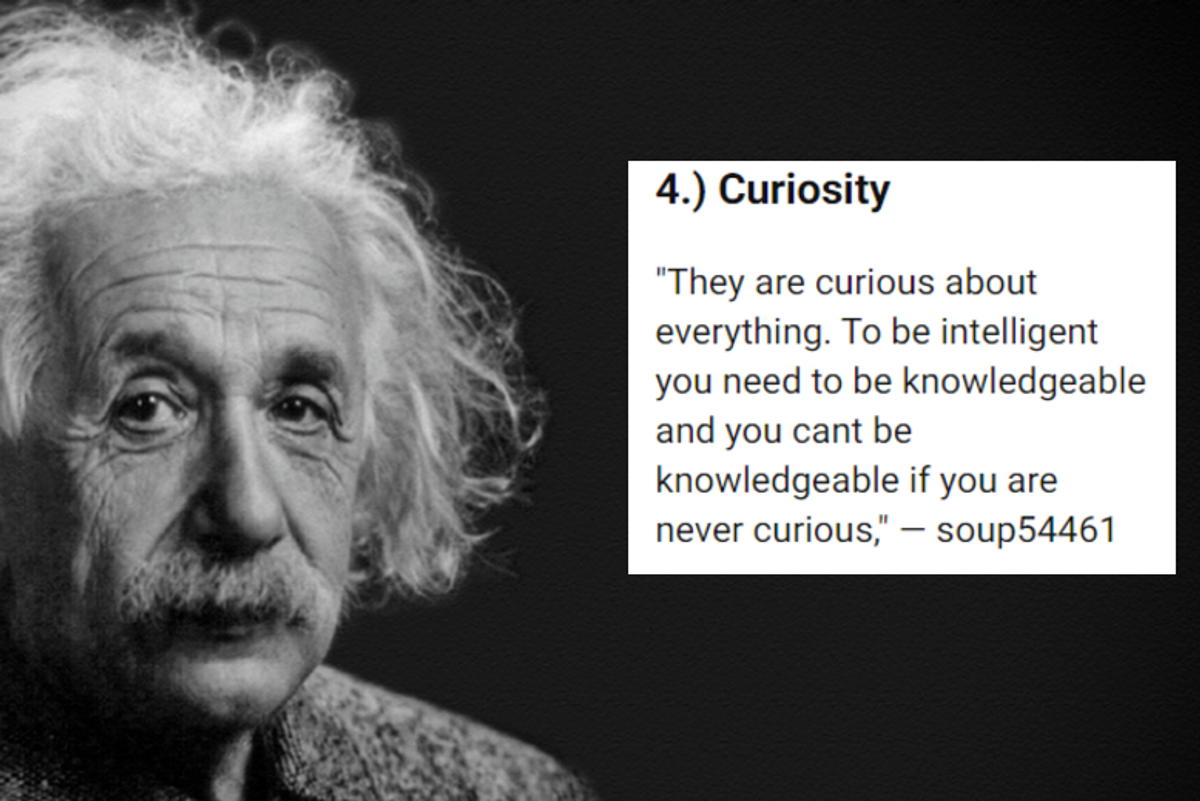
Albert Einstein beside a comment

Albert Einstein

One of the strangest things about being human is that people of lesser intelligence tend to overestimate how smart they are and people who are highly intelligent tend to underestimate how smart they are.

This is called the Dunning-Kruger effect and it’s proven every time you log onto Facebook and see someone from high school who thinks they know more about vaccines than a doctor.

The interesting thing is that even though people are poor judges of their own smarts, we’ve evolved to be pretty good at judging the intelligence of others.


“Such findings imply that, in order to be adaptive, first impressions of personality or social characteristics should be accurate,” a study published in the journal Intelligence says. “There is accumulating evidence that this is indeed the case—at least to some extent—for traits such as intelligence extraversion, conscientiousness, openness, and narcissism, and even for characteristics such as sexual orientation, political ideology, or antigay prejudice.”

Reddit user Gisgiii posed a question to the AskReddit subforum: “What is a subtle sign that someone is really intelligent?”

The answers painted a clear picture of how smart people behave: They tend to be great communicators who understand their audience and are more concerned with getting things right than being right.

Here are 18 of the best answers.

1. They draw wisdom from multiple sources.

"They draw wisdom from multiple sources. Wait but that might be more wise than intelligent... But I guess those two tend to be seen together a lot," — Puzzlehead-Engineer

2. They know their audience.

"They can switch up the way they talk to match the person they're talking to without sounding condescending. They listen to how others learn and explain it in that person's language of understanding," — Wynonna99

3. They develop a keen sense for their job.

"I used to work with a doctor - Tom Howard - and the day I realized he was a genius was the time he guessed every single condition a patient of mine had based on minute pieces of information about him," — Yodei_Mon

4. Curiosity.

"They are curious about everything. To be intelligent you need to be knowledgeable and you can't be knowledgeable if you are never curious," — soup54461

5. They're great at conveying ideas.

"When they explain something they make you feel intelligent," — gwoshmi

6. Considerate questions.

"They spend time thinking before asking a question," — ParkMan73

7. They make hard ideas simple.

"They effortlessly communicate complex concepts in a simple way," — joculator

8. They know what they don't know.

"They know when their knowledge ends and say something to the extent of 'i don't know and anything else i say on this topic is ignorant speculation,'" — blutoboy

9. They ask great questions.

"They can ask really good questions."

"Edit: to anyone not understanding what mean, I’m talking about people who ask “really good questions”, not just any questions, really good ones. I don’t know how one would achieve this skill(I know I haven’t)," — milkmanbran

10. They don't pretend to know everything.

"They aren’t afraid to say they don’t know the answer to a question," — xchernx

11. They change their minds with new information.

"They admit to changing their mind about something," — FarAwayAdventure

12. They pivot well.

"They apply knowledge from one realm into a new and relevant situation," — soubestitch

13. They are open-minded.

"They can genuinely consider an idea which opposes their worldview without necessarily accepting it," — paidshill29

14. They use analogies.

"People who use analogies to explain concepts to others. It’s a form of code-switching and integrating concepts on the fly and is a clear indicator someone is both socially and conceptually intelligent," — SwimmerAutomatic2488

15. They don't argue.

"I think intelligent people are more willing to calmly debate/discuss, rather than argue. Like, you explain to them why you disagree, and they listen to you and ask further questions about your viewpoint before offering a different perspective; as opposed to an unintelligent person, who would just resort to insults when other people disagree with them," — AngelicCinnamonBun

16. They learn from mistakes.

"Admitting when they're wrong and being willing to learn from mistakes," — siyl1979

17. A sense of humor.

"Humor. I think that truly funny people are often very smart and cognizant of the different ways an idea can be humorous on several levels. They also know their audience. I think the difference between say a Jeff Foxworthy and a Dave Chappelle and a Bo Burnham is their audience and their interests," — biscuitboi967

18. A love of learning.

"They say they love learning and they learn something new every day. Then they listen more than talk," — throwingplaydough


This article originally appeared three years ago.

old letter, 1959, tony trapani, letter, secret letters, love letter, love stories, dads, fatherhood, father and son, parents, parenting
via SHVETS production/Pexels and Suzy Hazelwood/Pexels
Tony Trapani discovers a letter his wife hid from him since 1959.

Writing a letter is truly a lost art form, and many young people will never know the joy of it. You had to choose your words carefully and say everything you wanted to say. Once you sent it off, there was no way to be sure it was delivered. No way to know if it had been opened or read. You couldn't take it back or send it again. You just put it in the mailbox and hoped for the best. It was excruciating and magical all at the same time.

One story of a letter never delivered has captured the hearts of readers everywhere. A heart-warming local news story gone viral for the best reasons.


Tony Trapani and his wife were married for 50 years despite the heartache of being unable to have children. "She wanted children,” Trapani told Fox 17. "She couldn't have any. She tried and tried." Even though they endured the pain of infertility, Tony's love for his wife never wavered and he cherished every moment they spent together.

letter, secret letters, love letter, love stories, dads, fatherhood, father and son, parents, parenting Tony Trapani received the most important letter of his life, but he didn't see it for 50 years Photo by Álvaro Serrano on Unsplash

After his wife passed away when Tony was 81 years old, he undertook the heartbreaking task of sorting out all of her belongings. In particular was a mountain of papers stuffed into filing cabinets. Trapani diligently went through every single one.

That’s when he stumbled upon a carefully concealed letter in a filing cabinet hidden for over half a century.

The letter was addressed to Tony and dated March 1959, but this was the first time he had seen it. His wife must have opened it, read it and hid it from him. The letter came from Shirley Childress, a woman Tony had once been close with before his marriage. She reached out, reminiscing about their past and revealing a secret that would change Tony's world forever.

"Dear Tony, I bet you are surprised to hear from me after so many years. I was just thinking about you tonight like so many other nights. But I thought I would write you and find out how you are," the letter reads. "Tony, please don't be angry or surprised to hear this. I have a little boy. He is five-years- old now - grey eyes and beautiful black hair. What I am trying to say Tony is he is your son."


"Please, Tony if you can find it in your heart to forgive me, please come and see him," Shirley wrote in the letter. "Every day he asks me where is his daddy and believe me Tony I can't even answer him anymore. I would be forever grateful to you if you would just see him. ... I'll close now hoping and praying you will answer. P.S. His name is Samuel Duane."

Now, Tony faced the fact that he had a son that would be around 60 years old and he set out to find him.

For over a year, Trapani’s sister tried to track down the mysterious Samuel Duane Childress, until she finally contacted his wife, Donna.

Tony and Samuel met in January 2015 and he felt like a new dad. After meeting his father, Samuel said his mother told him she sent the letter, but Tony never responded. "Why my wife didn't tell me," said Trapani, "I don't know. She wanted children. She couldn't have any. She tried and tried."

It's easy to understand why it may have been hard for Trapani's late wife, Dolly, to pass along that sort of news. Though we'll never know what exactly must have been in her heart and mind when she hid the letter all those years ago.

"I always asked my mom, I said, 'Well what does he look like?'' Samuel said. "She said, 'Well, go look in the mirror."

The two met and caught up on a lifetime of memories with the understanding that they could never change the past. "Just to know him now is so important to me. It's going to fill that void," Samuel said.

But just to be sure, Tony took a paternity test to ensure they were father and son. Stunning everyone involved, the test came back negative. Tony was not the father.


letter, secret letters, love letter, love stories, dads, fatherhood, father and son, parents, parenting Tony and Samuel didn't waste time thinking about what might have been if he'd seen the letter earlier. Photo by Ire Photocreative on Unsplash

The news upset Tony and Samuel, but they still had a unique bond. They shared a relationship with Samuel’s mother and both have been on an incredibly wild ride after Tony found the mysterious letter.

“They're keeping that bond,” Donna said. “That paper doesn't mean anything to him. That bond has been made—and we're going to move on from here.”

Tony Trapani passed away in 2017, leaving him just two short years to connect with the man he once believed to be his son. If he'd seen the letter earlier, maybe they would have had more time. But that's all in the past, and by all accounts the men treasured the time they got together, and the relationship that they did have — not the one they wished for.

This article originally appeared earlier this year. It has been updated.

Education

4 gestures that can make you instantly more likeable, according to a communication coach

Draw people in with these facial expressions and body language tips.

likeability, likeable, how to be more likeable, facial expressions, body language

Communication expert shares facial expressions and body language tips to become more likeable.

Being a likeable person can help you build strong, healthy personal and professional relationships. How you carry yourself and the gestures you make can impact if people perceive you to be likeable.

"Based on various research in neuroscience and communication, the brain processes nonverbal cues up to half a second before it processes words," Tatiana Teppoeva, a certified communication coach specializing in nonverbal communication and founder of One Nonverbal Ecosystem, tells Upworthy. "Facial expressions, tone, and body signals are decoded almost instantly, long before we consciously register verbal meaning."


Your nonverbal communication and body language can speak volumes to others.

- YouTube www.youtube.com

"These rapid cues shape whether someone seems warm, safe, confident, or emotionally attuned," she adds. "When your body language communicates presence and ease, people intuitively perceive you as more likeable and trustworthy."

These are four gestures that make you instantly more likeable:

Gesture #1: The softened eye look

"A slight narrowing of the lower eyelids that signals warm, focused attention," says Teppoeva. "This type of eye expression makes people feel truly seen, which increases warmth and connection."

She offers a few examples of celebrities as great examples. "Dwayne 'The Rock' Johnson uses this micro-gesture often when someone shares something meaningful with him. It shows genuine focus without intensity," she shares. "Zendaya uses a softer, empathetic version of the same look in interviews, especially when she is listening closely or responding with care."

zendaya, zendaya gif, zendaya body language, soft eyes, empathy Public Media Actors On Actors GIF by PBS SoCal Giphy

Gesture #2: The sincere, welcoming smile

A slow, natural smile that appears as you take in the moment, not a quick or automatic grin," explains Teppoeva. "The brain interprets these kinds of smiles as sincerity and emotional presence, which boost likeability almost instantly."

Two celebrities who model this well are Tom Cruise and Julia Roberts.

"Tom Cruise is known for his delayed, spontaneous smile that reads as genuine rather than posed," Teppoeva says. "Julia Roberts has a warm, gradually unfolding smile that consistently feels authentic and inviting."

@steven

Behavioural expert Vanessa Van Edwards teaching you how to become more likeable with these simple tips 👀 Full conversation on The Diary Of A CEO #podcast #podcastclips #clip #expert #bodylanguage #vanessavanedwards #tips #advice #didyouknow #trythis #relatable #teamwork #interview

Gesture #3: The encouraging nod

Nodding communicates empathy and understanding.

"A gentle, supportive nod while someone speaks," Teppoeva shares. "This gesture validates the speaker and increases likeability because it shows true engagement."

"Idris Elba nods subtly during conversations, especially when someone shares something personal or uncertain, signaling 'I’m with you'," adds Teppoeva. "Oprah Winfrey uses the same encouraging nod to create psychological safety and help guests feel understood."

- YouTube www.youtube.com

Gesture #4: Open-hand visibility

Your hands also play a big part in your likeability.

"Showing your hands briefly when you begin speaking or respond to someone’s point signals openness and cooperation," explains Teppoeva. "Many widely liked actors and presenters naturally incorporate relaxed open-palm gestures because humans instinctively associate visible palms with honesty and sincerity. This makes you appear more approachable and trustworthy within seconds."

time, neil degrasse tyson, time flies, perception of time. clock, science,

A clock and Neil deGrasse Tyson.

When you’re a kid, time passes a lot more slowly than when you’re an adult. At the age of seven, summer seems to go on forever, and the wait from New Year’s Day to Christmas feels like a decade. As an adult, time seems to go faster and faster until one weekend you’re putting up your Christmas lights though you swear you just took ‘em down a month ago.

Why does time seem to speed up as we get older? Astrophysicist Neil deGrasse Tyson recently explained the phenomenon in a video posted to Instagram. He also offered tips on how to slow the passage of time as you age. DeGrasse Tyson is one of the most popular science communicators in the world and the host of 2014's Cosmos: A Spacetime Odyssey and 2020’s Cosmos: Possible Worlds.


Why does time appear to speed up as we get older?


“When you're young, everything is new. Your brain is constantly recording fresh memories, and the more memory your brain stores, the longer the experience feels. But then something changes. As you get older, routines take over. Your brain stops saving so much detail. It switches to autopilot because everything feels familiar and predictable,” deGrasse Tyson explains. “And when your brain stores fewer new memories, your perception of time compresses. That's why childhood feels long, and adulthood feels like a blur.”


Steve Taylor, PhD, author of many best-selling books including Time Expansion Experience, The Leap, and Spiritual ScienceThe Leap, and Spiritual Science, agrees with deGrasse Tyson.

“This is mainly because, as children, we have so many new experiences, and so process a massive amount of perceptual information,” Taylor writes at Psychology Today. “Children also have an unfiltered and intense perception of the world, which makes their surroundings appear more vivid. However, as we get older, we have progressively fewer new experiences. Equally importantly, our perception of the world becomes more automatic. We grow progressively desensitized to our surroundings. As a result, we gradually absorb less information, which means time passes more quickly. Time is less stretched with information.”

How do we make time slow down?

There’s something a little depressing about the idea that time speeds up as we age because we have fallen into predictable routines. The good news is that we can break this cycle by changing our habits and having new experiences. The more novel information we can process and the less routine our lives become, the slower time will move.

DeGrasse Tyson believes that with some change in our behaviors, we can get back to longer summers and Christmases that aren’t perpetually around the corner.

“You can actually slow time down again. Do something unfamiliar,” deGrasse Tysons says. "Travel somewhere new. Break a routine you've repeated for years. Learn a skill your brain hasn't mapped yet. Because the more new memories your brain forms, the slower time feels as it passes. So if life feels like it's accelerating, it's not your age. It's your brain, and you can reboot it.”

weird al yankovic, music fans, 1980s nostalgia, celebrities, emotional meetings
Photo credit: courtesy of 1980s.nostalgia Instagram

A fan's emotional meeting with "Weird Al" has prompted people to share their

"Weird Al" Yankovic: Grammy-winning parody-song master, multi-platinum singer-accordionist, genuinely nice dude. For decades, devoted fans have marveled at his warmth and approachability—rare qualities for an artist and celebrity of his stature. And now hundreds of them have gathered to swap stories in a particularly heartwarming Instagram comment section.

Their meeting spot is a post by Katelyn Sue, who runs the social media account 1980s.nostalgia. Starting in September 2025, the influencer posted a series of photos and videos showing an emotional pre-concert meet-and-greet with one of her lifelong inspirations. The clips are beautiful, showing the pair chatting casually, sharing a tender hug, and Yankovic signing some merch. "'Never meet your heroes' doesn’t apply to this man," she wrote.


"I started listening to Weird Al when I was 8," Katelyn Sue tells Upworthy. "There’s a joke with my generation that we have to go through the obligatory Michael Jackson phase in second grade because so many of us did. In the midst of my Michael Jackson phase, I would watch his videos over and over on my mom and dad’s computer in their room. One day while I was watching Michael Jackson videos, my dad showed me [Yankovic’s] 'Eat It' video…and then 'Fat.' I think being in the wheelchair and also just being a really quirky kid, I was hyper aware that I was different from other kids my age. Not many eight-year-olds then shared the same quirky interests that I did, and I think I felt like kind of a loner. Not only did I think the videos and songs were hilarious, it was comforting as the weird kid to watch his videos and feel like I wasn’t alone in being different and that it was okay. He definitely was one of the first people to make me feel like being weird isn’t bad."

How "Weird Al" helped one diehard fan persevere through a dark time

Katelyn Sue started her public social-media accounts at age 14, frequently posting about her love of the '80s and childhood heroes Yankovic and Paul "Pee-wee Herman" Reubens. But at first, she wound up getting "severely bullied" for it. "I was called 'a freak,' 'mentally ill,' all kinds of things," she says. "I shut that part of myself completely out."

At age 20, her mental health reached a breaking point, and in an attempt to escape her "dark thoughts," she clicked on her YouTube app and randomly found Yankovic’s video for childhood favorite "Like a Surgeon." "Long story short," she says, "that video is the reason I came back to myself. I wanted to meet him in 2022 when he was in my area, but it was too fresh. I decided to buy the tickets this tour and tell him what he had gotten me through."

Katelyn Sue was so "starstruck" during the meet-and-greet that she could barely remember everything she wanted to say. But she did manage to remark "You’re my childhood hero" and "Can I give you a hug?" She also requested that he doodle his own image so she could get it tattooed. "I almost chickened out, but I finally decided to tell him that he’s the reason I was able to start being my authentic self again and how much his music had gotten me through," she adds. "It was truly the most magical thing I’ve ever experienced."

The video of their meeting went viral—Katelyn Sue says it’s been "seen by" John Mayer, David and Patricia Arquette, and Cheri Oteri—and that reaction has been overwhelming in a good way.

"There are an insane number of comments talking about their interactions with him and how it made their day, even if it was a short interaction," she says.

Indeed, you can’t scroll for more than two seconds without spotting another sweet reply—from ordinary fans, celebrities, even former Yankovic collaborators. "He is really this guy," wrote actor Steven Weber. "Genuinely decent. Everything you’d want him to be." Stand-up comedian Matt Braunger chimed in, "I met him backstage when I opened for Aziz Ansari in like 2007(?) and he sends me a bday card every year (amongst other cool things he’s done as a friend). An absolute prince of a performer and person ❤️"

Here are some other wonderful comments:

"I’ve met Al several times and even have his autograph tattooed where he signed my arm. He is exactly what you’d hope he’d be like!"

"Awww 💕 I got to work with @alfredyankovic when he performed in the Nightmare Before Xmas live with Danny Elfman and Paul Reubens and can confirm that he was totally kind, warm and gracious the whole time. He even made a video greeting for the son of my boyfriend (at the time) who was a huge fan. He was gushing about it for ages! He’s a lovely human being ☺️"

"I've met weird Al several times. He is the kindest most giving person I've ever met. When you're talking to him he actually pays attention to you and doesn't just scribble his name and then have you walk away"

"Weird Al was a semi regular for a bit at a coffee shop i worked at. This is genuinely how he is. He always took pictures, always looked people in the eye and took time to actually speak with them."

"He’s a delightful man!"

"Waited 3 hours to *possibly* meet him and he wanted to meet EVERYONE in line. He was so nice."

"My kid got to interview him in 2016 (he was nine at the time.) Then, at the concert he (son, not Weird Al,) had a diabetic episode and got sick. We were leaving and security insisted we meet him before going. He let us go ahead of everybody else waiting to meet, and treated my son with total respect and warmth. 10/10 celebrity meeting. Could have hoped for more."

I actually met him for an interview after we filmed his live performance. So exceptionally sweet. He looked at me with a smile and said: 'Oh yeah, I saw you with the camera!'"

"I met Al back in 2011 and of the 100’s and 100’s of celebs I met or interacted with living out in California, he was by far one of the most genuine and memorable. Truly a person who seems so grateful to be appreciated by his fans. He made a very personal moment out of our meeting and it solidified why I’ve been a life long fan"

For Katelyn Sue, the story didn’t even end with that emotional meet-and-greet—she was able to meet Yankovic again in October at the GalaxyCon event. "[H]e told me he had seen the post, and that definitely made me extremely emotional," she says. "I had hoped he saw it for no other reason than I wanted him to see the comments talking about how much he has helped people through and how many people he truly inspires to just be their weird selves."

Disability

Clip of two nonverbal autistic friends reuniting has people moved to their core

"She spoke two million and 42 words her own way. He listened to and heard each one."

profound autism, thomas, sofia, shannon lowe, autism awareness, love on the spectrum
Photo Credit: Shannon Lowe, used with permission

Thomas and Sofia, both nonverbal, communicate differently.

Sometimes love, whether it's platonic or romantic, cannot be heard—only experienced. Such is the case for Thomas, a non-verbal 20-year-old young man, and his dear friend Sofia, who is 23.

In a beautiful clip posted by t4autism on behalf of Thomas AKA Cubby, we see these two souls reunite at a bowling alley after having not seen one another for two weeks. Sofia and Thomas sit next to each other—one knee touching. They lean in, still keeping a dash of personal space. Their eyes gaze into one another's in a way that no words could truly capture. They each briefly smile when she looks up at his baseball cap. She gently touches it and then pushes it off. She smiles, and his gaze never wavers.


The camera briefly turns around to Thomas's proud mother, who simply gives the "I know, right?" look. The chyron reads, "After two weeks without seeing each other. Nonverbal. Profound Autism," while the song "A Thousand Years" by Christina Perri underscores the moment. Hashtags on the post include: "Happy, love, autism, parents, joy, mom, papa, girl, boy, adulting, T4Autism" and perhaps best of all…"telepathy."

At nearly half a million likes, over 20,000 people took the time to comment on this video alone, many from people who claim to be neurodivergent themselves. One commenter writes, "This is literally the most beautiful thing I witnessed all year. She looks like a Disney princess, he's handsome. Her presence is soothing his overstimulation." Another notes, "They're not nonverbal, we just can't hear them."

This Instagrammer was downright poetic: "She spoke two million and 42 words her own way. He listened to and heard each one."

Upworthy had the honor of speaking with Thomas's mother, Shannon Lowe. She shared that Thomas was diagnosed with profound autism at the age of two. "Our journey has been a roller coaster of highs and lows," she said. "As a family, we've worked hard to find a tribe that truly understands our dynamic."

Of Thomas and Sofia, she notes, they "share a beautiful bond and great affection for one another."

She also opens up about what profound autism is and the impact it can have on families: "I wish the world understood that profound autism is a very different level of autism. It requires one-on-one care and often comes with self-injury behaviors. Unfortunately, we do not have many champions for this particular diagnosis. We lack legislation, resources, and support. Here in Fort Worth, we currently have a 17-year waitlist, and most of these families are led by single mothers—because only 18% of fathers stay, which adds even more trauma to an already stressful situation."

But she doesn't give up. She uses her social media platforms, including her YouTube channel T4Autism, to educate, vent, and exemplify that love knows no bounds. She even wrote a children's book entitled "Profound Love: Profound Autism," which she describes as an "invitation to see beyond diagnosis, beyond silence, and into the extraordinary ways love reveals itself—wordless, boundless, and profoundly real."

Mother talks about constant pivots made for autistic child. www.youtube.com, T4Autism

On the book's Amazon page, the description reads in part: "Though Thomas does not speak, he expresses joy, affection, and connection in ways that transcend language. His leaps of excitement, radiant smiles, and warm presence remind everyone around him of the purest form of love.

As Thomas, his family, and their three beloved dogs navigate daily life, their world expands when they meet Sasha and Sofia—two extraordinary young people also living with profound autism. Through shared walks, laughter, and simple moments, an unexpected and beautiful bond blossoms between Thomas and Sofia. Step by step, hand in hand, they discover a connection deeper than words—a love that speaks through smiles, gestures, and presence."