upworthy
Add Upworthy to your Google News feed.
Google News Button
Joy

Jennifer Garner shows how a random act of kindness begins with a simple Ziploc bag

Now, you're prepared to help at any time.

jennifer garner, help the homeless, homeless care package

Jennifer Garner's Ziploc care package.

Homelessness has been on the increase in America since 2016 and the numbers exploded in 2020. On a single night in January 2020, there were more than 580,000 individuals who were without a home.

There are many reasons for the increase in homelessness and one of the leading causes is a lack of affordable housing across the country. Housing prices have been on a steady increase and, according to PBS, we are about 7 million units short of affordable housing in the country.

So what can the average person do about this human tragedy taking place in America’s streets? Some people who would like to help don’t feel comfortable giving money to homeless people, although experts in the field say that most of the time it is OK.

“If you don’t have money or time, or capacity to donate, I still think it’s nice to be respectful and say hello,” Diane O’Connell, a community lawyer for the Chicago Coalition for the Homeless, told the Chicago Tribune.

Actress Jennifer Garner, 49, shared a great idea on Instagram for those who would like to help homeless people but aren’t sure how to do so.

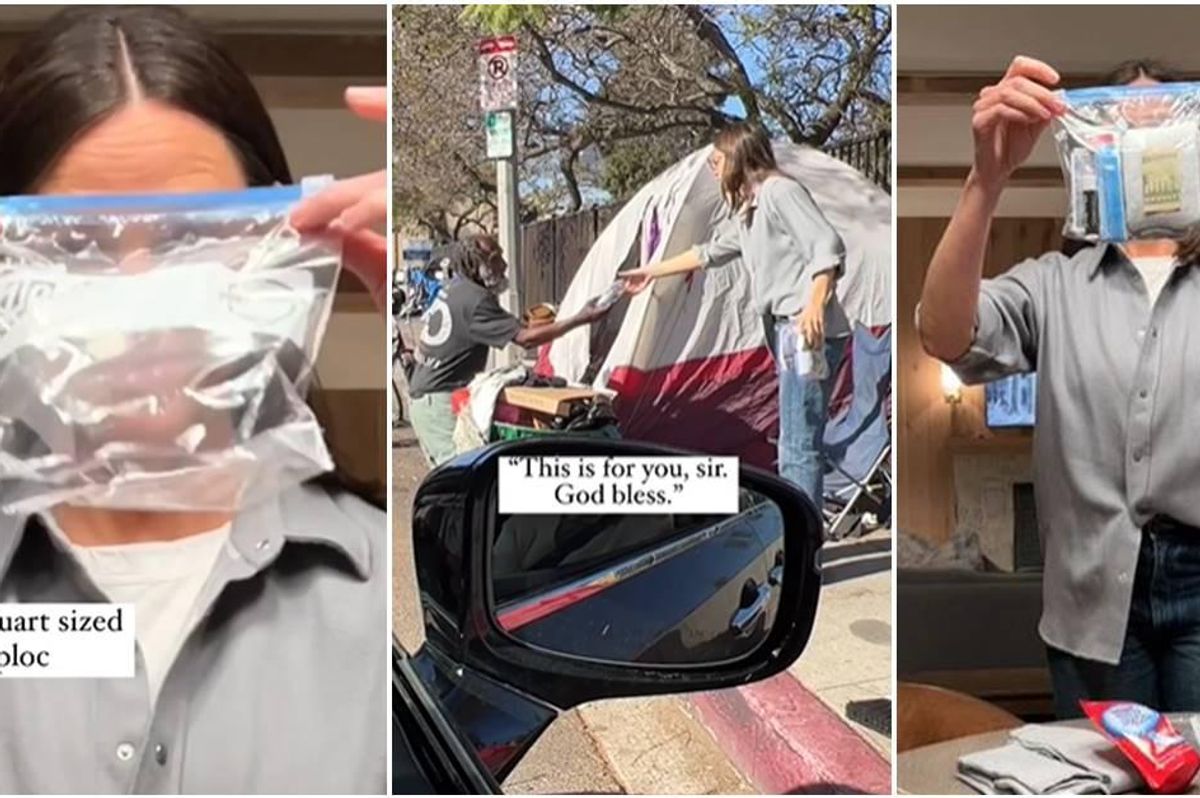
The actress posted a video where she filled zip-up plastic bags with everyday items that homeless people need.

"Random act of kindness: gather these essentials in a quart sized ziploc bag and keep them in your car to give away when you see someone in need,” she captioned the post. “A pair of thick socks. Kleenex. Hand wipes. Disposable toothbrushes. Chapstick. A couple of granola bars. I forgot this time, but like to add feminine hygiene products, too. Add $5, $10, $20 and a smile.”

For those not comfortable giving money, they can put a gift card in the bag for a local restaurant. O’Connell says that one thing most homeless people desperately need is a hot meal.

“Simple, cheap foods like bagels and doughnuts aren't that helpful,” O’Connell said. “People who are homeless can usually buy things like that for themselves." Often what people experiencing homelessness need is a hot meal, she said, because that’s more difficult for them to buy.

Greendrop says that the items most commonly requested by homeless people are socks and undergarments. Homeless people are always walking and have a hard time accessing laundry facilities so their socks and undergarments are often dirty or falling apart.

Here are some other items that will help make homeless people more comfortable:

Shampoo and conditioner

Toothpaste

Hair brushes and toothbrushes

Soap

Lotions

Nail clippers

Feminine hygiene products

Reusable containers

Garner’s Ziploc bag tip is a great idea because it’s a simple way for people to lend a hand when they encounter someone on the streets. How many times have you been driving around, saw someone in need, but didn’t have any way to help? This way you can easily brighten someone’s day when you see them at a freeway on-ramp or in a parking lot without having to ask yourself whether you feel comfortable giving them money.


This article originally appeared two years ago.

Gen Z; Millennials; technology; cell phones; social media; teens and technology; teens social media

Gen Z is the first generation less cognitively capable than their parents. Denmark has the solution.

Nearly every parent hopes their child will be better off than they are: smarter, more secure, and more well-adjusted. Many parents see this as a stamp of successful parenting, but something has changed for children growing up today. While younger generations are known for their empathy, their cognitive capabilities seem to be lagging behind those of previous generations for the first time in history.

Dr. Jared Cooney Horvath, a teacher turned cognitive neuroscientist who focuses on human learning, appeared before Congress to discuss concerns about cognitive development in children. In his address to the members of Congress, he says, "A sad fact that our generation has to face is this: our kids are less cognitively capable than we were at their age. Since we've been standardizing and measuring cognitive development since the late 1800s, every generation has outperformed their parents, and that's exactly what we want. We want sharper kids."


kids, intelligence, sharp kids, generations, education, cognitive abilities Student smiling in a classroom, working on a laptop.Photo credit: Canva

Horvath explains that the reason this happens is that each generation has gone to school longer than the previous generation. Gen Z is no exception to the longer duration of time spent in school, but they're the first ones who aren't meeting this normal increase in cognitive development. According to the cognitive neuroscientist, the decline is due to the introduction of screens in the classroom, which started around 2010.

"Across 80 countries, as Jean was just saying, if you look at the data, once countries adopt digital technology widely in schools, performance goes down significantly. To the point where kids who use computers about five hours per day in school for learning purposes will score over two-thirds of a standard deviation less than kids who rarely or never touch tech at school," Horvath reveals.

In most cases, the decline in performance doesn't result in better strategies. The neuroscientist shares that the standardized testing has been adjusted to accommodate lower expectations and shorter attention spans. This is an approach that educators, scientists, and researchers went to Capitol Hill to express wasn't working. But not every country is taking the approach of lowering standards to meet lowered cognitive ability. Denmark went in the opposite direction when it realized their students were slipping behind.

France24 recently interviewed educators in Denmark following their seemingly novel approach to students struggling with cognitive development. Since the beginning of the 2025/2026 school year, Denmark has not only been having students turn in their cellphones, but they've also taken tablets, laptops, and computers out of the classroom. No more digital learning for the majority of the school day. Danes went old school by bringing back physical textbooks, workbooks, and writing assignments. The results have been undeniable. Even the students can't seem to deny the success of the countrywide shift in educational approach.

"I think the biggest issue has been that, because we kind of got rid of the books and started using screens instead, that we've noticed that a lot of the kids have trouble concentrating, so it's pretty easy to swipe with three fingers over to a different screen and have a video game going, for example, in class," Copenhagen English teacher, Islam Dijab tells France24.

Now, instead of computers being part of every lesson, Denmark uses computers very sparingly and with strict supervision. One student says that it has been nice not having screen time at school because she loves to read and write. But it wasn't just the lack of attention span children were developing, they were also developing low self-esteem and poor mental health due to the amount of time spent on devices.

kids, intelligence, sharp kids, generations, education, cognitive abilities Students focused and ready to learn in the classroom.Photo credit: Canva

The data showing the negative impact of screens on teens' brains has prompted a nationwide change in Denmark that extends outside of the classroom. Afterschool activities are eliminating or extremely limiting electronic use. There is also a national No Phone Day that encourages everyone to put away their devices for the day, and Imran Rashid, a physician and digital health expert, is petitioning parliament to ban social media use for children under the age of 15. The no phone movement in Denmark is a nationwide effort that hopes to right the ship before another generation feels the effects.

women, silence, achievements, goals, move in silence
TikTok: @wemiopakunle, @_alliechen, @mandanazarfhami,

Science confirms ‘Move in Silence’ trend might be the smartest way to achieve your goals.

Don't roll your eyes: TikTok's latest viral wisdom is backed by hard data—and it's making people rethink their communication habits. We live in a world of chronic oversharing. We post everything, from the routes we run (including screenshots as proof of all that hard work), to the pale-green iced matcha latte sitting at our desks or a present from a boyfriend (who will be tagged prominently, not secretly off screen). Who knows when, but our brains became wired for sharing: to record, to curate, and to post every second of our lives, then consume that of others to a disturbing degree.

So, here's a radical idea: when it comes to goals and plans, try keeping them to yourself. It could be the key to making them a reality.


Why you should move in silence

That's the message behind TikTok's massively popular "Move in Silence" trend, where creators like @noemoneyyy have cracked the contradictory code to success: Instead of broadcasting every big idea or project that runs through your head, if you actually want it to come to fruition, keep your plans to yourself until they're executed. And it's not just a trend; surprisingly, science also supports this muted approach.

@noellemartiinez

Work in private and let the results speak! #privatelife #privatelifehappylife #workinprivate #creatorsearchinsights

"As a former oversharer who used to tell every single friend, every single family member, or a partner everything I was doing, I promise you things always work out better when you keep them to yourself," explains creator @noemoneyyy in a video that's garnered millions of views.

On a different video by @mandanazarfhami, she says, “I don’t care what you’ve got going on in your life: that dream job, that city that you want to move to, that dream person, that dream life, that dream anything. Literally keep it to yourself until it’s done.”

Commentors were quick to agree, with one person writing: “From a young age, I never told anyone my next steps. I also taught my husband and son to keep our private matters to themselves and just do things 💯Not many people like it, but who cares🌝🙌🏼🫶🏼”

Another chimed in, “This concept has changed my life for the better.” Others replied, “100 agree 💕” and “100%🙌🏼people can’t ruin what is silent, show results.”

Lil Wayne, famously, agreed when he wrote "Real G's move in silence like lasagna."

@mandanazarghami

monitoring spirits are a real thing - move in silence and watch how much your life changes #fypシ

The science to moving in silence

In a study done by New York University, researchers found that people who kept their goals private worked on tasks for an average of 45 minutes, compared to the 33 minutes of work completed by those who announced their plans in advance. The twist? The people who shared their goals expressed feeling closer to finishing, despite doing approximately 25% less work.

NYU psychologist Peter Gollwitzer, who led the research, concluded that "once you've told other people your intentions, it gives you a 'premature sense of completeness.'" He also found that the brain is made up of "identity symbols," which create one's self-image. Interestingly, both action and talking about action create symbols in your brain, so simply speaking about a future plan or something you want to do satisfies that part of your brain. When we make our goals public, especially ones that matter to us and deal with our identity, our ability to achieve said goal is significantly reduced. As the old adage goes, "actions speak louder than words."

Stranger still, in his paper "Does Social Reality Widen the Intention-Behavior Gap," Gollwitzer notes that for this phenomenon to happen, one must truly care about their goals. "Ironically, this effect was only found for participants who are very committed to their goal!" PsychologyToday notes. "The lesson learned is that the more passionate you are about your goals, the more secretive you should be about them."

shhh, quiet, finger on lips, lipstick, mouth shut, A woman telling you to be quiet.via Canva/Photos

Another reason to keep quiet: If you're a beginner trying something new, sharing your plans could potentially open you up to criticism and negative feedback, which could deter you from even starting. At the University of Chicago, professor Ayelet Fishbach conducted studies to determine how positive and negative feedback affects the pursuit of one's goal. According to Atlassian, she and her team found:

  • When positive feedback signals commitment to a goal, it increases motivation.
  • When positive feedback signals progress, it actually decreases motivation.

"One example the researchers give is a math student who gets a good grade on a test. If she perceives it to mean she likes math, she will study harder. If, however, she sees the high score as a sign she is making progress in the class, she may ease up and study less," they write.

We've all been there: excitedly telling everyone about your grand plans to backpack through Europe, the year you'll finally learn Spanish, or joining the group lesson at the tennis courts you always pass by… only to mysteriously lose all motivation a week later. Turns out, those lovely dopamine bursts that accompany every enthusiastic "That sounds great!" or "You should totally do it!" response might be precisely what's holding you back.

You can tell a few people

The good news? You don't need to become closed-off and secretive, a hermit on the top of a mountain who's afraid to share any part of themselves with the world. Research suggests that sharing your goals with one or two selected friends who can be trusted to provide meaningful support is still a good idea. Just hold off on the Instagram Live announcement until you've actually accomplished something substantial.

The key is to share them with friends who support your goals and aren't secretly harboring resentment toward you, because it can negative feedback can seriously hinder your plans. "Furthermore, your emotional responses to the feedback you get about your goal progress affect how you behave in the future. The really oversimplified version suggests that positive feedback is motivating, and negative feedback is demotivating," Elliot T. Berkman writes at Psychology Today.

shhh, quiet, finger on lips, lipstick, mouth shut, A woman telling you to be quiet.via Canva/Photos

So, the next time you sit down to write your goals, whether they be a new year's resolution, the day's to-do list, or a five-year plan, think twice about sharing it with others. Give it time and you might have something better to share soon: the results.

Nolwazi Sangweni writes for The Orange Journal: "Moving in silence is staying lowkey and only popping out when the main questions you’ll be asked will start with ‘since when…?’"

This article originally appeared last year. It has been updated.

parenting, teens, raising teens, teen hangout, high school, game night for teens, activities for teens, parenthood

Amy White explains how her house became "the house" for her teens.

I grew up in "the house." In high school, my home was the designated place where my friends gathered, sometimes in big groups, sometimes just my small core squad. My three best friends spent the night there almost every Friday and/or Saturday night for four years straight. We devoured Totino's frozen pizzas by the dozen, inhaled soda, and laid waste to any snacks or leftovers that were brave enough to survive in the kitchen. Not only that, but my house was pretty small — four teenage boys took up a lot of space in the living room (the whole thing) and made a lot of noise playing video games deep into the night. It must have driven my parents and older brothers crazy. It's a wonder anyone put up with it.

Or so I thought when I was younger. When I became a parent myself, I started to understand a little more why my mom and dad were so willing to host and feed all my friends and me every single weekend. Why the outrageous grocery bill and constant chaos in the house were probably a small price to pay.


Mom explains how to make your house 'the house' where teenagers hang

One mom has perfectly encapsulated the value of turning your home into "the house" for your kids and their friends, and exactly how she did it for her family.

teens, teen house, teens hanging out, teens having fun, teenagers Teens hanging out in a living room.via Canva/Photos

Amy White shared a reel on Instagram showing her college-aged son hanging in her dining room with a group of friends playing cards. The text overlay reads "What makes your kids' high school friends want to come over, play cards & spend the night on their College Christmas Break." I think most parents can agree that we want our kids to keep coming home as long as possible! So how exactly did White pull this off?

Her explanation in the caption was spot-on.

First, White says that you have to start early. Become "the hang out house" in high school or even earlier. Then you have a better chance of holding onto the mantle into your kid's college years.


Next, be ready to stock the house with snacks and drinks, and don't make a fuss when your kid's friends have at it. "The kids knew we had food," she writes, "BUT they also knew I didn't care what they had. They knew they could eat anything in my pantry and fridge."

Third, and this is a big one, don't mistake being the "cool house" for being "the house." Some parents choose to allow their underage kids and friends to drink alcohol under their supervision, but you don't have to bend your morals and the law to lure the squad over to your place. Pizza and Coke is plenty to keep most teens happy. "We were not the house that served alcohol or even allowed the kids to bring alcohol to our house. And Guess What?? The kids still came and wanted to hang at our house!"

teens, teen house, teens hanging out, teens having fun, teenagers Teenagers eating pizza.via Canva/Photos

Fourth, always say Yes (as often as possible, anyway) when your kids want to have friends over. "They know my answer is 99% of the time YES," White writes. "You have to have your kids take the leadership of offering your home and if your home was 'open' to their friends in high school, they know it will be 'open' to their friends in college."

As a bonus tip, White pleas with parents not to worry about the mess having friends over makes. "I love a clean house and organization, BUT I would much rather have a crazy messy house for the kids where memories are made than a quiet house with nothing going on just to keep my house 'clean.'"

Should parents allow teens to drink at home?

There's an age-old debate over whether parents should allow teens to drink at home because it's better than if they do is unsupervised or keep their home dry as a bone. A recent study out of the University of Buffalo found that kids who grew up drinking at home had a greater chance of having addiction problems when they got older. "A robust relationship was found between parental permission to use alcohol during adolescence and increased alcohol use frequency and quantity, alcohol use disorder symptoms, and alcohol-related harms in young adulthood," the study says.

White writes, "It's worth being 'the house', so let go of control & get to know your kids friends." Commenters agreed.

White's video went viral to the tune of 8.5 million views and hundreds of comments. Parents shared their own experiences of what it's like being the default hang out house.

"Our house was the high school hangout for my son and friends... every weekend... I loved it!! Miss it now that they are all college graduates and have moved away. I love seeing them when they do come home for the holidays"

"A wise man once said don't be the house with the alcohol. Be the house with the food."

"Amy 1000% agree!!! My house is full of teenagers on the weekends and I love every bit of it. Even though I wake up to a kitchen that looked much different from when I left it"


teens, teen house, teens hanging out, teens having fun, teenagers Teenagers eating pizza.via Canva/Photos

"We never allowed alcohol, drugs, bad language, always respectful, and guess what, our house was always the house where the kids hung out. First my daughter, then my son. Through grade school, high school, then when my kids went out of state for college their college friends would come spend a couple weeks during the summer. I always thought of it this way, I loved knowing my kids friends and, who knows, maybe some of those kids, especially during the younger years, just maybe those kids just needed an adult to care. Anyway, it was always fun to have them here!"

"It used to crack me up when my daughter would bring over a bunch of her friends (girls and boys) in high school and instead of hanging out in the family room they all wanted to crowd into either the kitchen with me or our tiny office and happily share all the gossip with me."

Experts say that knowing your kids' friends, and their parents, can have huge benefits. Not only will it bring you the peace of mind of knowing where your kid is and who they're with when they get to those crucial high school years, it has been shown to tangibly improve kids ability to create positive relationships and problem-solve collaboratively. Plus, it can actually be really fun! Kids and teens are the funniest, silliest, most interesting people on the planet. Having a house full of them is messy and loud, but it's always a good time.

One caveat: "don’t feel bad if your house isn’t the chosen house," one commenter reminds us. "Just be happy your kid has a good group of friends and be thankful they have somewhere safe to hang out."

This article originally appeared last year.

flight etiquette, viral video, United Airlines, good news, compassion, hospice nurse, paying it forward, grief

There are still good people in the world.

No matter where you are, even when your life feels like it's falling apart, other people's lives are still going on as normal. Unfortunately, the world doesn't stop because tragedy strikes someone's family, but recently, on a United Airlines flight, one woman had a pretty close equivalent. Hailey Ann Sand recently took an unexpected trip after finding out her grandfather was being placed on comfort care as he was nearing the end of his life.

Sand knew she wanted to be there for his final moments, so she booked a last-minute flight and headed out. What was supposed to be a smooth trip wound up being stress-inducing due to the flight landing behind schedule. The airline was aware that some passengers had connecting flights taking off in a few minutes, so they made the announcement asking for passengers to extend courtesy to those with tight connections.


One kind act changed everything.

Sand was one of those with an extremely tight connection when the flight landed in Denver, but as airline passengers often do, many stood up, not allowing others to get off the plane first. It was then that the grieving granddaughter was reminded that there are still good people in the world.

A man standing up inside a planePhoto credit: Canva

The woman shared in a video that she was in seat 31A when another woman, whom she didn't know in seat 31B, noticed the urgency on Sand's face. This prompted the woman to inquire if something was wrong. After Sand explained that she was in a hurry to catch her next flight so she could be there with her grandfather in his last moments, the stranger sprang into action.

Sand's connecting flight was scheduled to depart in 25 minutes but the aisle was completely blocked. That is, until her seatmate got everyone to clear it.

"You didn't owe me anything but you stepped out in the aisle and you announced very loudly to everybody to please step aside so that I can get off the plane in a timely manner," Sand said, hoping her words reach the woman who helped her. "We landed 25 minutes before my next flight was supposed to depart, and it was a 22-minute walk across the Denver airport. We flew into gate 73ish, and I was flying out of 12. I had to walk all the way across. I just want you to know that I made that flight and I got to be there last night. And I got to tell my grandfather how much I loved him and he got to tell me back and he understood what I was saying."

The grieving granddaughter was able to be there along with the rest of her family until her grandfather passed. She continued the video with an emotional thank you to the stranger, saying that her act of kindness changed her life, hoping the video would reach the kind stranger. While the video didn't reach her, the video did reach United Airlines, causing several flight attendants and crew to reach out to Sand. Through some detective work, they connected her with a relative who connected her with the stranger, Katie.

Turns out Katie wasn't just an average passenger, she's a hospice nurse who deeply understands a family's need to be together during someone's final hours.

A hospice nurse with her female patient. Photo credit: Canva

Sand told Upworthy it took less than 24 hours to track Katie down and get in touch with her. While the flight they shared was from San Antonio to Denver, Katie just happened to be traveling from work and isn't from either city, and Sand lives in San Antonio but is from Washington. The chance seating assignment seemed meant to be.

Once Sand reached her family, she left her chance encounter with a hospice nurse to feel the warmth and comfort of the hospice nurses at Samaritan Hospital in Moses Lake, Washington. "They did an excellent job for my grandfather in his final moment,s but also my whole family in helping us through a difficult time."

Sand shared that her grandfather was "a husband of 62 years, a father, a grandfather, a great-grandfather, a brother, a friend, a mentor. He served in the Army and worked his whole life as a farmer. He was the most hardworking man. He loved to travel and has been all over the world. He was very involved in his community, and the world would be better with more people like him in it."

While the woman hoped the video would reach the passenger who helped her on the plane, she likely didn't expect it to reach over 9 million other people. But since it did, she hopes people leave her video with a message of kindness.

"I hope this story continues to resonate with people and inspire them to love each other more, and think twice when the flight crew asks you to stay seated so that people who have a tight connection can get off the plane. You never know why someone is traveling and it’s not always for a happy reason."

This article originally appeared last year.

school lunch, South Korea, American food, nutrition, viral photo, Reddit, food culture, kids health, parenting, food debate

A young boy reaches for food at a buffet

School lunch in the United States has a complicated history. While many of us who grew up in the '80s or '90s are nostalgic for some of the menu items we remember fondly (rectangle pizza, anyone?), some of the serving choices were bizarre. We really grew up with someone handing us a tray of pizza, French fries, chocolate milk, and soggy green beans every morning at 10:30am.

The offerings have improved somewhat over the years, but everything's still pretty...beige. The main choices are typically pizza, chicken nuggets, or some form of questionable ground beef like burgers or meatloaf. Some people are stunned when they find out that school lunches from around the world can look very different.


Last year, a photo of lunch served at a school in South Korea went viral and had everyone's mouths watering.

from pics

A user on Reddit posted the photos to r/pics where they immediately racked up over 17,000 upvotes.

The colors on the tray stick out immediately, most notably the noodles covered in creamy red sauce. But it's really the stuffed lobster tail that's the star of this particular tray; potentially lobster thermidor.

You expect to see some cultural differences in the food offerings in different countries. Korean food is inherently different than American food in a number of ways, but love for lobster is real in both countries. Yet, can you imagine American schools serving lobster tail to kids under any circumstances?

school lunch, South Korea, American food, nutrition, viral photo, Reddit, food culture, kids health, parenting, food debate Can't quite imagine this on the average American school lunch tray.Canva Photos

The response from mostly-American users was fascinating. Some were in awe while others rightly pointed out why a lunch like this would never fly in the USA.

One of the main sentiments was that school lunches in other countries often put ours to utter shame:

"I used to teach in Korea and the lunches were always amazing, the beef and quails egg stew was a constant highlight."

"I studied in Korea for 6 months on uni exchange. The food at the uni cafeteria looked just like this, and was 10/10. My private room at the uni lodge was $500USD for the WHOLE semester, and included unlimited food."

"I live in Spain and my kid's school invited the parents to taste lunch one day. It was fantastic. Also, at the end of each month they share a calendar of the meals that will be served during the next one, day by day. They're all balanced, and prepared with proximity food. They prepare specific meals for every kid with allergies/intolerances/any kind of dietary restriction, e.g. restrictions related to religion. They also share a list of dinner suggestions - again, for the whole month - so you have ideas for dinners that are healthy, easy, cheap, and tasty for kids. It's a public school."

"I am from a third world country where many public schools lack a ton of funding and even we have better more healthy lunches than the slop that’s given to US students. I know because I went to school in the US and also in my home country."

"America hates its f*cking kids. It will always mistreat them and deny them opportunities."

"Lobster as a school lunch??? I need to go back to elementary school... I'll quit work for education and a lunch like that!"

school lunch, South Korea, American food, nutrition, viral photo, Reddit, food culture A typical American school lunch.Canva Photos

Others, while impressed with the selection, had their doubts about if American schools could ever adopt something like this:

"This lunch is orders of magnitude better then US school lunches. And most American kids would utterly hate it."

"American kids have no palette! It’s all chicken nuggets and mac & cheese! ... I know some kids that would starve rather than try anything on that tray."

Some pointed out that those metal chopsticks would likely be used as a weapon almost immediately, and discontinued ASAP.

Americans, as a whole, have a dreadful diet devoid of enough nutrition and it causes catastrophic health problems in the long-term. For clues as to why, you can look at what we feed our kids—and why.

No, most American kids probably wouldn't like lobster tail, but there is a lot that goes into how our palette develops that might help explain it.

school lunch, South Korea, American food, nutrition, viral photo, Reddit, food culture Kids eating lunch.Canva Photos

For starters, fresh produce and lean proteins are extremely expensive in America, and prices are still rising. It's far more cost-effective to pump people full of cheap, empty calories and sugar. School lunch used to be cooked fresh every day in the schools before major government budget cuts forced districts to more heavily on lean on frozen or reheated options. Kids get used to chicken nuggets all day every day from a young age!

The irony is that school lunches in America, while not overly exciting, at least meet some basic nutritional guidelines. But they're not free for everyone, and even kids who qualify for free or reduced lunch may not end up participating due to stigma, red-tape, or food preferences. When parents on a shoestring budget have to buy their own lunch supplies, things can get a lot worse than meatloaf and green beans. We all knew a few kids in school who had Pop Tarts for lunch every day. To be fair, we were all jealous at the time.

- YouTube youtu.be

And finally, Americans sure love to get fired up about our "right" to eat like crap. When Michelle Obama tried to clean up the school lunch program, she ran into massive pushback. RFK Jr. wants to do his own version of it, and we'll see how that goes.

The viral photo from South Korea shows what might be possible with a few key cultural and political shifts. Treating feeding our kids more like "preventive medicine" versus a cost to manage would definitely be a start.

This article originally appeared last year. It has been updated.