$1 can lead to 1 million books for kids in need this holiday season
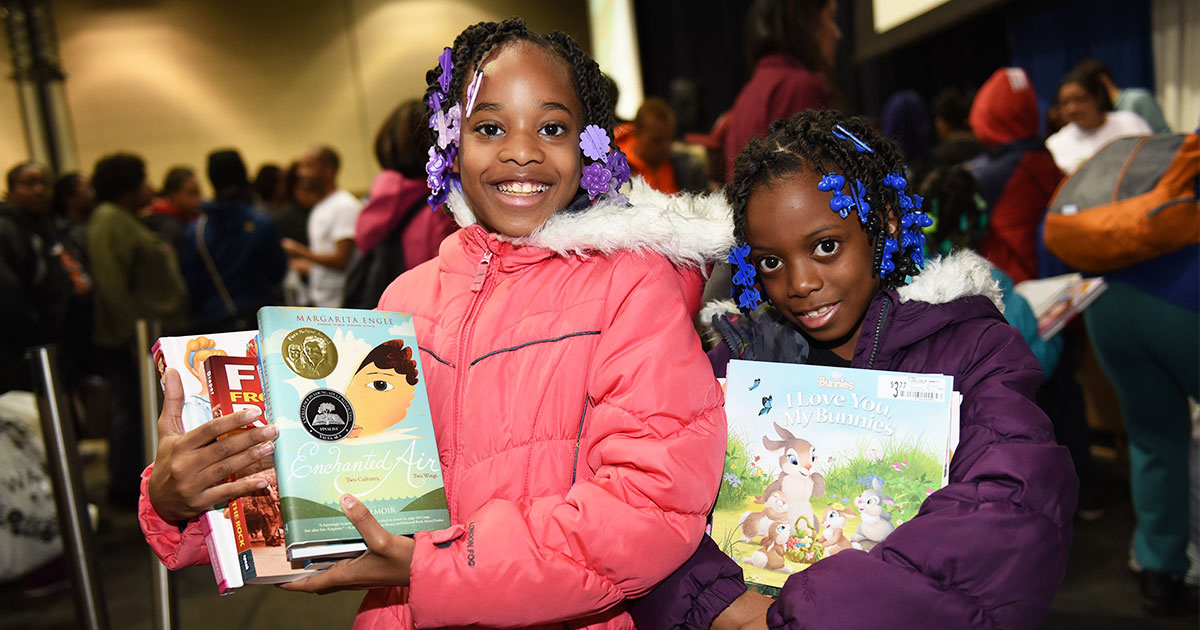
We take the ability to curl up with a good story for granted. Unfortunately, not everyone has access to books. For the 32 million American children growing up in low-income families, books are rare. In one low-income neighborhood in Washington, D.C., there is approximately one book for every 800 children. But children need books in…
We take the ability to curl up with a good story for granted. Unfortunately, not everyone has access to books. For the 32 million American children growing up in low-income families, books are rare. In one low-income neighborhood in Washington, D.C., there is approximately one book for every 800 children. But children need books in their lives in order to do well in school and in life. Half of students from low-income backgrounds start first grade up to two years behind other students. If a child is a poor reader at the end of first grade, there’s a 90% chance they’re going to be a poor reader at the end of fourth grade.
In order to help close the literacy gap, First Book launched Give a Million, a Giving Tuesday campaign to put one million new, high-quality books in the hands of children. Since 1992, the nonprofit has distributed over 185 million books and educational resources, a value of more than $1.5 billion. Many educators lack the basic educational necessities in their classrooms, and First Book helps provide these basic needs items.
The aptly named Give a Million campaign aims to raise $1 million between now and December 6. So far, more than $125,000 has been raised thanks to donations from award-winning authors and their foundations, including The Mo and Cher Willems Foundation, Alane Adams and her Rise Up Foundation, and Marissa Meyer.
The gift of a book is a little that goes a long way. “Bringing new books to kids in need has an immeasurable impact, and for many kids, it will be the first book they have ever owned, or the only gift they will receive during the holidays,” said Kyle Zimmer, president, CEO, and co-founder of First Book.
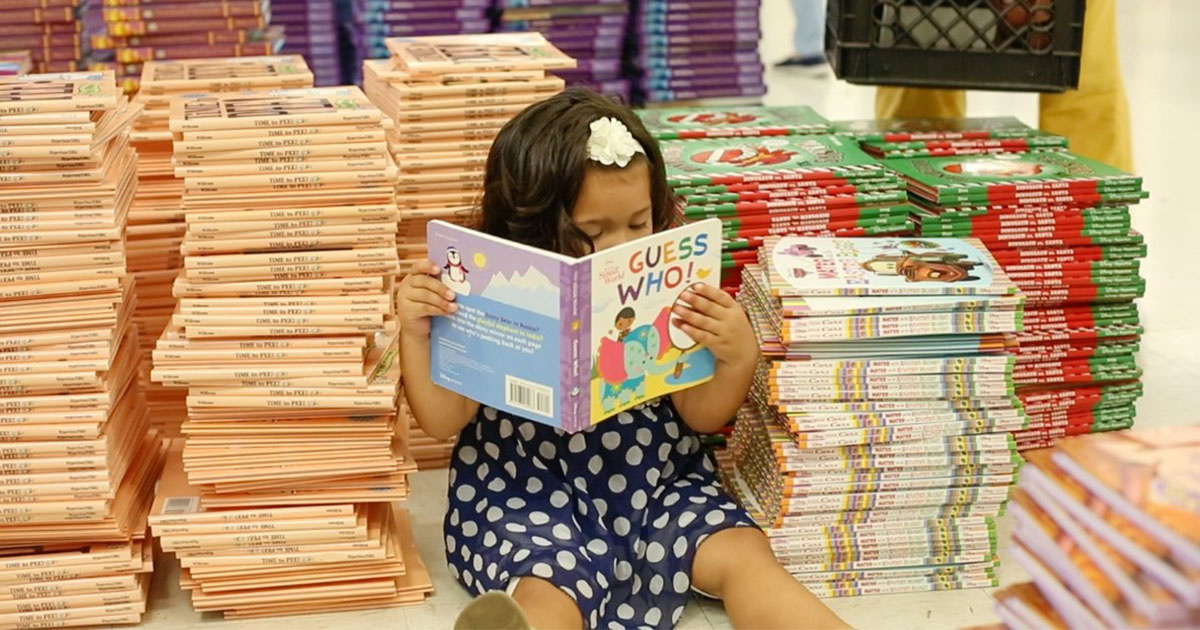
First Book believes books offer children in need the best path out of poverty. “The sense of self-esteem that comes with that is worth far more than $1 million, and the fact that it also furthers their academic possibilities makes the gift of a book invaluable. This is an easy ask — grant a wish and give a child a future of possibility,” Zimmer said.
What children read now can last a lifetime. When students have more books at home, they’re more likely to have higher reading scores at school. Not only that, children who choose what they read and are allowed to read in an informal environment have more of an appetite for reading. They also have greater literacy and language development. Allowing children to read as they please by giving them books plants a seed in their young minds, allowing them to blossom as they grow.
First Book is collecting donations for Give a Million via their website. You can click here to donate.
UPDATE: First Book’s Give a Million campaign ended a few days after Giving Tuesday, and they are proud to have raised over $200,000 with the help of generous authors and supporters like you. Though they’re shy of their ambitious goal, they’re still confident that with the support of book lovers across the nation, they can provide a million books to kids who need them. Thanks to a generous donation match by their partners, Penguin Random House, every gift made to First Book through 12/31 has double the impact. Every $3 = 2 books to kids in need! Click here to find out how to Take Action for literacy with First Book and make a matched donation today.
This article is sponsored by C&S Wholesale Grocers.
From Pakistan to Tanzania, the most effective education solutions are community-led. Here’s how local leaders, in partnership with Malala Fund and supported by Pura, are mobilizing entire communities.
When asked to describe what Tanzania smells like, Grace Isekore closes her eyes and breathes in deep. For a moment, she’s somewhere else entirely. Tanzania is a rich tapestry of sights and scents, from the smell of sea mist that permeates the coastline to the earthy cardamom and cloves she cooks with in her kitchen. But when Grace emerges from her reverie, her answer is unexpected.
“Tanzania smells like peace,” she says, her eyes still closed. “I see a beautiful country where we are free to move, free to speak. And there is peace within the community.”
For Grace, that sense of peace isn’t just something she smells; it’s something she works toward every day. As a project coordinator with Pastoral Women’s Council (PWC), a women-led organization that empowers pastoralist communities in northern Tanzania, she has seen firsthand how girls flourish when they have the opportunity to attend school. Like scent, education not only connects girls to their own culture, but also helps broaden their horizons, realizing new possibilities for themselves and others. That transformation reshapes entire communities and ripples outward, with the potential to change countries and transform the world for the better.
Different scents, different approaches, and communities driving change
Spices in Tanzania. Captured by James Roh for Pura
For Grace and others around the world, education is freedom, as well as a pathway to a stronger community. Rooted in that shared belief, Pura, a home fragrance company, was inspired to build on their four-year partnership with Malala Fund to create something truly unique: a fragrance collection that connects people through scent to communities in Tanzania, Nigeria, Pakistan, and Brazil, where barriers to girls’ education are among the highest.
Using ingredients from each region, the new Pura x Malala Fund Collection uses scent to transport people to these regions directly. “Future in Bloom,” for example, invokes Pakistan’s lush valleys through notes of jasmine, cedarwood, and mango; while Tanzania’s fragrance, “Heart on Fire,” evokes the spirit and joyfulness of the girls who live there through cardamom, lemon, and green tea.
The new Collection honors the work Malala Fund does every day, partnering with locally-led organizations in these four countries to ensure every girl can access and complete 12 years of education. Each scent celebrates the joy, tenacity, and courage of the women and girls driving change on the ground, while also augmenting Pura’s annual grant to Malala Fund by donating eight percent of net revenue from the Pura x Malala Fund Collection to Malala Fund directly.
Just as each country’s scent is unique, so too are their needs related to education. But with support from Malala Fund and Pura, local leaders are coming up with creative ways to mobilize entire communities (parents, teachers, elders, and the students themselves, in their pursuit of solutions, understanding that educating girls helps everyone thrive. Here’s how their efforts are creating real, durable impact in Tanzania and Pakistan, and creating a ripple effect that changes the world for the better.
Parent-teacher associations help Maasai girls and their communities in Tanzania problem-solve
A girl’s school in Tanzania. Captured by James Roh for Pura
Northern Tanzania, Grace’s home, is home to pastoralist communities like the Maasai, a nomadic people who have moved with the seasons to nurture the land and care for their livestock for centuries. The nomadic nature of this lifestyle creates significant and unique barriers to girls’ education. Longstanding gender roles have enabled Maasai to survive in the harsh environment and have placed great value on both women and men. Over time, as nomadic life has been threatened by the privatization of land and stationary education models have been implemented, the reality of pastoralist livelihood has shifted and introduced new complexities. Now, the sheer distance to schools is both a practical challenge and one that often comes with danger from the landscape, predators, and potential exposure to assault along the journey. Girls shoulder the responsibility of household chores and there is often cultural pressure around early marriage – both leading to boys’ education being prioritized over girls’.
“There are very, very good [pastoralist] cultural practices, which are passed from generation to generation,” says Janet Kimori, an English teacher at Lekule Girls Secondary School in Longido, Tanzania. But when cultural practices act as educational barriers, “you have to sit down and look for where you are going to assist. As a school, as an individual, the school administration—all of us will chip in and know how we are going to deal with this problem.”
PWC works to ensure girls are able to exercise their right to an education while also preserving pastoralist culture. One successful approach, the organization found, has been the formation of Parent Teacher Associations (PTAs), created with help from Malala Fund. In PTA meetings, students, parents, teachers, elders, and government officials meet, discuss educational barriers, and come up with community-led solutions that preserve and honor their culture while advancing educational outcomes.
PTA meeting in Tanzania. Captured by James Roh for Pura
One recent PTA meeting highlights how these community-led solutions are often the most effective. At Lekule Girls Secondary School, the lack of fresh water forces girls to walk long distances to collect water for the school’s kitchen during the school day, and these long journeys not only disrupt class time but can leave girls vulnerable to sexual assault in isolated areas. Through facilitated discussion, PTA members landed on a solution: installing a borehole to pipe in fresh water to the school. Reliable access to water creates a better learning environment for the girls, but it also benefits the community at large, as local governments are then more likely to invest in health clinics and other community resources nearby.
With a solution in place, the PTA was then able to discuss ideas and map out a course of action. The women would raise money for the cost of the borehole, while the men would recruit workers to dig the hole and lay the pipe. Together, they would ask government officials to match their investment.
The benefits of PTA meetings within the pastoralist communities are undeniable. “The girls are talking and addressing issues in a confident way, and parents feel they are part of the resource team to solve challenges happening at school,” Grace says. One unexpected benefit: The larger cultural impact these PTA meetings have created. Thanks to the success of PTAs within pastoralist communities, the models are now being endorsed on a national level, and schools across Tanzania are starting to use them to solve problems in their own communities. When a community creates opportunities for girls to learn, everyone benefits.
Safe spaces in rural Pakistan help students and their parents connect, then drive change
Safe space for girls meeting in Pakistan. Captured by Insiya Syed.
A continent away in Pakistan, the country’s northernmost region of Gilgit-Baltistan seems like a land untouched by time. The region’s looming mountains, snow-capped peaks, lush valleys and crystalline lakes draw nature lovers and landscape photographers from around the world, but living among this kind of breathtaking scenery has its drawbacks. Schools in the region are few and far between, and the area’s harsh climate often makes roads inaccessible for travel. Poverty and gender-based discrimination are additional obstacles, making school even further out of reach, and girls are affected disproportionately. Going up against these barriers requires a persistent, quiet strength that’s found in the women who live there and reflected in Pakistan’s signature scent.
Saheli Circles are how local leaders in Gilgit-Baltistan are bridging the gap between girls and education. An Urdu term for “female friend,” Saheli Circles are after-school safe spaces where girls explore subjects like art and climate change, while also developing skills that help them manage emotions, set goals, and build positive relationships. Girls study in groups, visit the library, play sports, and tackle filmmaking and photography projects, all designed to develop self confidence and teach the girls how to advocate for issues that matter to them. But the work doesn’t stop there.
“What we’re trying to achieve here will only be impactful if it trickles down to the home environment and the school environment,” says Marvi Sumro, founder and program director of Innovate, Educate, and Inspire Pakistan (IEI), the local organization that developed the Saheli Circles model and partnered with Malala Fund in 2021 to make it a reality. Ever since, Saheli Circles have grown to involve teachers, elders, and parents to encourage relationship building that’s essential for young girls and adolescents. “Our spaces can give mothers and daughters an opportunity to interact a little differently—do an art activity, or have a cup of tea together, or some good conversation,” Marvi says.
The relationship building is what makes the biggest positive impact throughout the community. Recently, one Saheli Circle was able to bring together parents, teachers, and administrators to advocate for better education at their local school, and together they convinced the department of education to hire a science teacher. Another Saheli Circle organized a fund where members of the community can contribute monthly to pay for uniforms, books, and other school expenses for the girls in their village, eliminating those small, hidden costs that are often a barrier to education for many. A third Saheli Circle was able to produce a short film about how gender-based household chores can take away valuable study time from girls, leaving them at a disadvantage. “The girls put the film together and showed it to the mothers, and the response from the mothers was just beautiful,” Marvi says.
Girls smiling in Pakistan. Captured by Insiya Syed.
The education and relationship building that the girls receive in Saheli Circles connects them to larger opportunities and economic freedom that are not possible in their hometown. “For girls in Gilgit-Baltistan, education is extremely important because of the fact that we’re so far away from where the economy is, where the opportunity is. Education becomes this bridge for us, for our girls, to access all the opportunity and economy that exists in [larger cities].”
From rural Tanzania to remote Pakistan, local organizations prove every day that prioritizing girls’ education benefits everyone. Communities that lift up girls are able to secure resources like clean water and well-staffed schools, as well as build stronger relationships.
These outcomes are only possible because of the women and girls who work tirelessly in these regions to overcome barriers and drive progress. The Pura x Malala Fund Collection is a way to honor them, celebrate their achievements, and unite people the world over around a shared belief that education is freedom. Like scent, that belief can build, travel, and has the possibility to transform the world.
Experience the Pura x Malala Fund Collection here, and connect with the stories of real girls leading change across the globe.
April McNary, a teacher at Sunnyslope High School in Phoenix, Arizona, has always believed in the transformative power of reading and writing. The honest conversations that are sparked by this creative work, she says, are some of the most valuable to her. “Allowing students to wrestle with their thoughts and convictions is something that happens…
April McNary, a teacher at Sunnyslope High School in Phoenix, Arizona, has always believed in the transformative power of reading and writing. The honest conversations that are sparked by this creative work, she says, are some of the most valuable to her.
“Allowing students to wrestle with their thoughts and convictions is something that happens on a regular basis, and it’s one of the parts I love most about my career choice,” says McNary.
While learning from great written works like Shakespeare is always on the agenda, McNary also makes a point of giving her students space to write and reflect on pressing issues that affect them directly — like gun violence. After the Parkland shooting happened, she gave her students time to do just that, then discuss what they wrote in small groups. Allowing the students space to express their feelings helped everyone feel better and get on with the day.
One area of creative expression McNary felt like she needed to boost in her classroom was poetry.
“Knowing that reading one’s own poetry is terrifying for some (and something I still won’t assign), I figured something less daunting was to read a poem someone else had written/published,” she explains.
But she implemented a twist — students had to choose a poem with which they had some sort of personal connection. Little did she know what incredible moments were about to transpire as a result.
One girl came out in front of the class. A boy, who was known as a jock, wept while telling everyone his mother was dying of cancer. Another girl spoke about how her parents had been deported and she had to take up a job to help support herself and her siblings. And another girl couldn’t even finish her poem about being bullied, it affected her so much.
The common thread through all of these incredibly emotional admissions was empathy; the class rallied around each person going through it, applauding, hugging, and weeping right along with them. The act of expressing oneself through another’s words seemed to be the permission they needed to open the floodgates and truly support one another.
One reading in particular, however, hit McNary at her core. A student in her class named Chris* brought in a poem from the novel, “The Perks of Being a Wallflower,” that clearly denotes suicidal ideation. But it wasn’t just the context of the poem that concerned her, “it was the way he read it. It’s hard to explain to anyone who wasn’t in the room, but it was as if he was reading like the original writer of such dark thoughts.”
She’d also noticed how he seemed more and more distant in class and in his weekly journal writing. He wouldn’t make eye contact with anyone. So, after the class where he presented the poem, McNary reached out to Chris’ mom and expressed her concerns. Sadly, she was immediately receptive because she’d noticed her son’s behavior, too. They made a plan to keep a close eye on him, and check in with the school social worker.
Chris came in the next day and told McNary his mom had spoken to him about their concerns. “I asked him if he was mad at me, and he said no (with tears in his eyes). I think, although he didn’t say it, he was relieved,” she says. He started coming in to talk with her before school about books and other things. One day, later in the year, he told her he’d joined a band. After that he started talking to her and his mom about his dreams and goals. “I think Chris needed to be seen and heard,” says McNary.
Soon enough, he headed off to college, but he didn’t forget about McNary. Eventually, he wrote her an email telling her he was doing well and hoped she was too. “I remember just crying as I read the email a few times. I was beyond relieved and grateful that he had found a place in college, and was positive about his future,” she says.
She was so moved by his message that she decided to write a poem herself about him. She often writes to process emotions, just as she instructs her students.
Since the poetry-reading assignment had done so much good in her own classroom, McNary decided to submit the idea to the nonprofit, First Book, for inclusion in a toolkit they were developing to help educators promote respect and empathy in the classroom.
First Book helps qualifying teachers like McNary get affordable books and supplies for their students, as well as free professional development tools. She heard about the call for submissions for their Respect and Empathy toolkit via an email they’d sent her. She never expected her exercise would be chosen, and was shocked and humbled when she found out.
McNary hopes the exercise will inspire many more students to really see and hear each other and “accept who their peers are at their core.” The point is for students to learn that being vulnerable is a strength, not a weakness, and should be respected as such.
And she has hopes for the teachers who utilize her exercise, too. “I hope they see the value in turning the floor over to their students completely. My hope is for other teachers to sit in the back of the room in awe of their students like I do every year. I also hope that teachers know the power they have to connect kids to one another through experience and poetry.”
*The name has been changed to protect the identity of the individual.
This article is sponsored by C&S Wholesale Grocers.