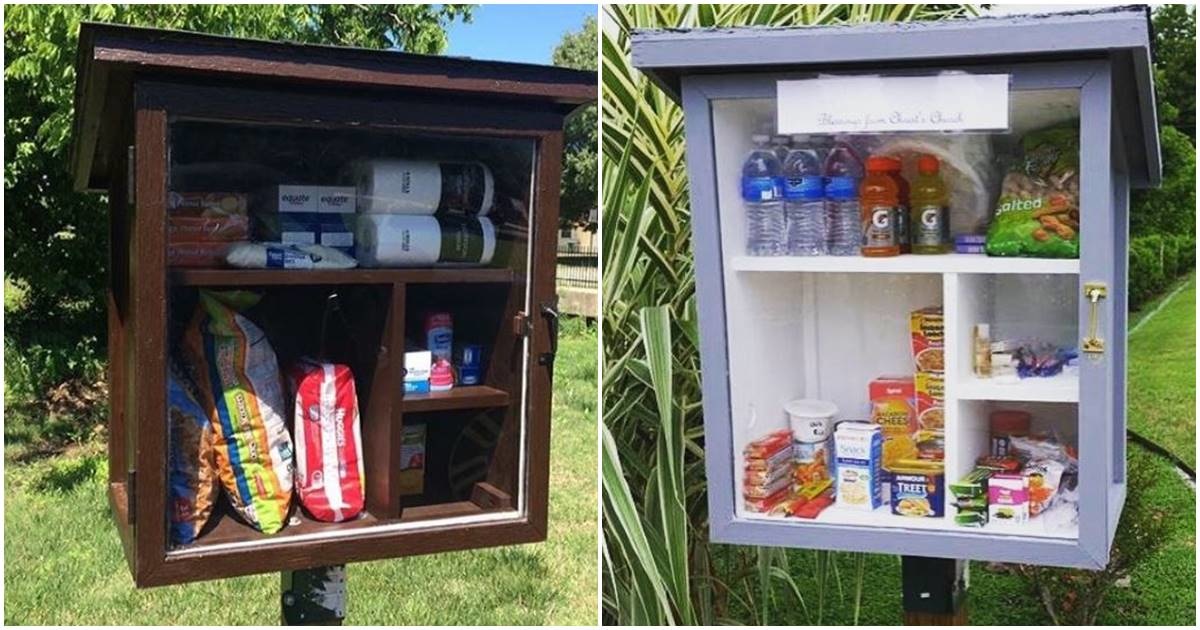
These 'public pantries' are popping up all around the world to help fight hunger
via Little Free Pantry Project / Instagram

According to Feeding America, an estimated 1 in 8 Americans are food insecure, that's roughly 40 million Americans including more than 12 million children.

And yet at the same time, 40% of the food produced in American goes uneaten, ending up in landfills.


In 2016, Jessica McClard of Fayetteville, Arkansas found a brilliant way to help the uneaten food get distributed to those who are hungry. Inspired by the Little Free Library movement, she decided to create the Little Free Pantry project based on the same premise.

RELATED: France has started forcing supermarkets to donate food instead of throwing it away

Little Free Libraries are small boxes, usually mounted on someone's front lawn, where neighbors can share books, like the "need a penny, take a penny" jar at a liquor store. The first known Little Free Library was started in 2009 by Todd Bol in Hudson, Wisconsin, as a tribute to his late mother who loved books. The movement has caught on and there are now over 90,000 public book exchanges in 91 countries across the world.
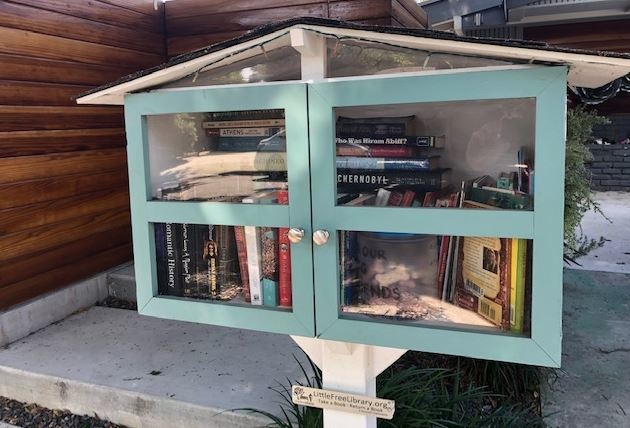
Little Free Library in Long Beach, CA.via Tod Perry

After McClard opened the first Little Free Pantry, she received an "immediate and overwhelmingly positive" response from her community and decided to spread the idea through the Little Free Pantry Project.

The Little Free Pantry concept is a win for everyone involved because it provides hungry people food on-demand while encouraging giving in communities.

RELATED: 15 delicious ways to reduce food waste

"The LFP is about feeding people, yes. But it's also about working together and about choosing reciprocity, trust, and grace over scarcity, mistrust, and judgment," McClard told World Hunger. "Less obvious but no less profound is the project's effect on stewards and communities. It changes them."

"You don't have to have a lot of time or a lot of money to give back in that way, and I think it opens up a lot of space for lots of different people to be involved," McClard told Global Citizen. "I believed it could be something that would catch."

In just three years, the idea has caught fire and over 650 pantry boxes have sprang up across the world.

"There's a real need for it in the neighborhood, and I don't like the thought of kids being hungry," Margot Baker, who has a Little Library-Little Pantry combo in her yard told, Global Citizen. "There's so much extra, and there's so much that can be done, why should anybody go hungry? For a few extra bucks a month, why can't I help?"

Looking to start a Little Food Pantry in your neighborhood? The Little Free Pantry Project has some steps to help you get started.
Images courtesy of John Scully, Walden University, Ingrid Scully
True

Since March of 2020, over 29 million Americans have been diagnosed with COVID-19, according to the CDC. Over 540,000 have died in the United States as this unprecedented pandemic has swept the globe. And yet, by the end of 2020, it looked like science was winning: vaccines had been developed.

In celebration of the power of science we spoke to three people: an individual, a medical provider, and a vaccine scientist about how vaccines have impacted them throughout their lives. Here are their answers:

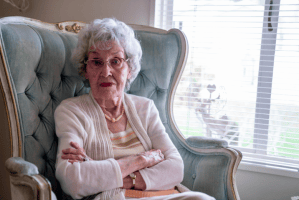
John Scully, 79, resident of Florida

Photo courtesy of John Scully

When John Scully was born, America was in the midst of an epidemic: tens of thousands of children in the United States were falling ill with paralytic poliomyelitis — otherwise known as polio, a disease that attacks the central nervous system and often leaves its victims partially or fully paralyzed.

"As kids, we were all afraid of getting polio," he says, "because if you got polio, you could end up in the dreaded iron lung and we were all terrified of those." Iron lungs were respirators that enclosed most of a person's body; people with severe cases often would end up in these respirators as they fought for their lives.

John remembers going to see matinee showings of cowboy movies on Saturdays and, before the movie, shorts would run. "Usually they showed the news," he says, "but I just remember seeing this one clip warning us about polio and it just showed all these kids in iron lungs." If kids survived the iron lung, they'd often come back to school on crutches, in leg braces, or in wheelchairs.

"We all tried to be really careful in the summer — or, as we called it back then, 'polio season,''" John says. This was because every year around Memorial Day, major outbreaks would begin to emerge and they'd spike sometime around August. People weren't really sure how the disease spread at the time, but many believed it traveled through the water. There was no cure — and every child was susceptible to getting sick with it.

"We couldn't swim in hot weather," he remembers, "and the municipal outdoor pool would close down in August."

Then, in 1954 clinical trials began for Dr. Jonas Salk's vaccine against polio and within a year, his vaccine was announced safe. "I got that vaccine at school," John says. Within two years, U.S. polio cases had dropped 85-95 percent — even before a second vaccine was developed by Dr. Albert Sabin in the 1960s. "I remember how much better things got after the vaccines came out. They changed everything," John says.

Keep Reading Show less
via Jimivr / Flickr and Gage Skidmore / Flickr

Actress Billie Lourd paid tribute to her late mother Carrie Fisher on Tuesday by sharing a photo of her son Kingston watching Fisher as Princess Leia in 1977's "Star Wars: A New Hope."

Kingston was born last September to Lourd and her fiancé, actor Austen Rydell. The infant is pictured wearing a knitted hat with buns on its side and a Leia-themed onesie.

Keep Reading Show less
Courtesy of CeraVe
True

"I love being a nurse because I have the honor of connecting with my patients during some of their best and some of their worst days and making a difference in their lives is among the most rewarding things that I can do in my own life" - Tenesia Richards, RN

From ushering new life into the world to holding the hand of a patient as they take their last breath, nurses are everyday heroes that deserve our respect and appreciation.

To give back to this community that is always giving so selflessly to others, CeraVe® put out a call to nurses to share their stories for a chance to be featured in Heroes Behind the Masks, a digital content series shining a light on nurses who go above and beyond to provide safe and quality care to patients and their communities.

First up: Tenesia Richards, a labor and delivery nurse working in New York City who, in addition to her regular job, started a community outreach program in a homeless shelter that houses expectant mothers for up to one year postpartum.

Tenesia | Heroes Behind the Masks presented by CeraVe www.youtube.com

Upon learning at a conference that black mothers in the U.S. die at three to four times the rate of white mothers, one of the widest of all racial disparities in women's health, Richards decided to take further action to help her community. She, along with a handful of fellow nurses, volunteered to provide antepartum, childbirth and postpartum education to the women living at the shelter. Additionally, they looked for other ways to boost the spirits of the residents, like throwing baby showers and bringing in guest speakers. When COVID-19 hit and in-person gatherings were no longer possible, Richards and her team found creative workarounds and created holiday care packages for the mothers instead.

Keep Reading Show less