An American on lockdown in China shares some tips for staying sane while social distancing
The COVID-19 virus is a serious threat to the world’s health. But there are also many issues facing those that remain healthy during the crisis, mainly the psychological effects of social distancing. Humans are social beings. That’s why we punish people through imprisonment and the reason that socially-isolated people have a higher mortality rate. So…
The COVID-19 virus is a serious threat to the world’s health. But there are also many issues facing those that remain healthy during the crisis, mainly the psychological effects of social distancing.
Humans are social beings. That’s why we punish people through imprisonment and the reason that socially-isolated people have a higher mortality rate.
So if you’re feeling depressed or distressed during lockdown it’s important to know that it’s normal and there are ways to improve your sense of well-being.
“Isolation, physical distancing, the closure of schools and workplaces are challenges that affect us, and it is natural to feel stress, anxiety, fear and loneliness at this time,” Hans Kulge, the director of the European branch of the World Health Organization said.
“It is essential to address the public mental health of people during the following weeks,” Kluge added.
The stress of isolation can be so debilitating it can be difficult to cope.
Bloomberg journalist Peter Martin has been socially isolated in China without a housemate for two months and his family is overseas. So, as someone who has more than a few weeks of experience being on lockdown, he took to Twitter to share some helpful tips to stay sane.
So you're going crazy under lockdown?
I know the feeling. I've been in Beijing for the last two months. My housemate is away and I'm thousands of miles from my family.
I have some thoughts on how to make lockdown better. These won't apply to everyone, but they ring true for me:— Peter Martin (@PeterMartin_PCM) March 26, 2020
1) Know things will get better.
The first few weeks felt pretty oppressive, but now I'm kind of used to it.
Even if the lockdown goes on longer than expected, you'll get used to your new environment and likely grow more comfortable with your own company.— Peter Martin (@PeterMartin_PCM) March 26, 2020
2) Have a routine. Fill it with stuff that makes you feel good.
It might be home workouts, cooking, or learning something new. It might be a TV show that calms you (I've rewatched The Office and Parks and Rec). You'll get your work done, but don't let that become your only focus— Peter Martin (@PeterMartin_PCM) March 26, 2020
3) Be careful with technology.
Seeing pictures of and doing video calls with loved ones has made this whole experience much easier to deal with. Don’t underestimate the difference between hearing someone say they're doing ok and seeing it with your own eyes. On the other hand…— Peter Martin (@PeterMartin_PCM) March 26, 2020
… my social media feeds are full of anxiety-inducing outrage and doom-mongering.
I need social media for my work, but I've started logging out of Twitter when I'm done with my workday and I'm limiting my time on Facebook. It helps.— Peter Martin (@PeterMartin_PCM) March 26, 2020
4) Appreciate little changes that improve your life.
In my part of Beijing, so few people have been on the streets that strangers now nod as they pass each other. It’s a small thing, but it's kind of beautiful and it reminds me of the small town in England where I grew up.— Peter Martin (@PeterMartin_PCM) March 26, 2020
5) Don't hate yourself for not being constantly productive
We trick ourselves into thinking all time at the office is well-spent. It’s not. Your day at home will include idle moments and that's ok. Even if it takes you to parts of YouTube that make you question your self-respect— Peter Martin (@PeterMartin_PCM) March 26, 2020
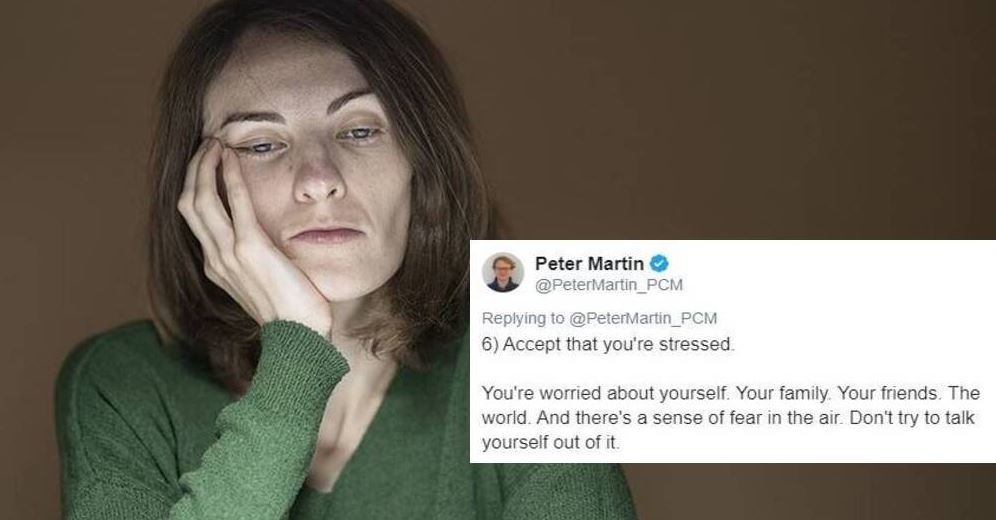
6) Accept that you're stressed.
You're worried about yourself. Your family. Your friends. The world. And there's a sense of fear in the air. Don't try to talk yourself out of it.
Tell your friends. Write it down. Meditate. Exercise. Do whatever you need to do to deal with it.— Peter Martin (@PeterMartin_PCM) March 26, 2020
7) Talking of stress, don't feel guilty that you're consumed with your own feelings when others (doctors, the elderly, the socially isolated) have it harder.
Your stress is real too. And unless you deal with it properly, you won't be able to support others.— Peter Martin (@PeterMartin_PCM) March 26, 2020
8) You're going to have off-days when you just feel really crappy and sorry for yourself.
That's ok. It would be kind of strange if you didn't. Take some time off. Do nothing. Relax.
Write a line under the bad day when you're done and start a new one tomorrow.— Peter Martin (@PeterMartin_PCM) March 26, 2020
9) Write to people you don't contact often enough and ask how they're doing.
I was really touched when people did this for me. Others will appreciate it when you reach out. The social contact and sense of solidarity will probably make you feel good too.— Peter Martin (@PeterMartin_PCM) March 26, 2020
10) Above all, be forgiving.
We’re all stressed. We all have different ways of coping. And we all experience moments when it's too much.
If you or others don't live up to your usual standards, try to move on and get back to binge-watching your favorite crappy show. ENDS.— Peter Martin (@PeterMartin_PCM) March 26, 2020
Rebecca Dolgin of Psycom says there are a few groups that are more likely to have a hard time social distancing, young adults (16 to 24), women, people with a history of psychological illness, healthcare workers, and those who have one child.
Dolgin also says that fear, anxiety, depression, boredom, anger, frustration, and irritability are all common reactions to social isolation. “The further you are from engaging with others and feeling a connection, the more of an impact it will have,” Dr. Adam Kaplin, a neuroscientist at Johns Hopkins University School of Medicine, writes.
Dolgin says that we can maintain our psychological well-being by acknowledging what’s happening and that it is stressful. She also says it’s important to stay in contact with loved ones, even if it’s just through social media and real-time video chat programs such as Facetime.
Like Martin, Dolgin also agrees that we should all manage our news consumption.
“Being informed doesn’t require you to act like you’re a newsroom producer,” Dolgin writes. “It’s okay to set a few times a day where you’ll check in for updates.”
In March 2023, after months of preparation and paperwork, Anita Omary arrived in the United States from her native Afghanistan to build a better life. Once she arrived in Connecticut, however, the experience was anything but easy.
“When I first arrived, everything felt so strange—the weather, the environment, the people,” Omary recalled. Omary had not only left behind her extended family and friends in Afghanistan, she left her career managing child protective cases and supporting refugee communities behind as well. Even more challenging, Anita was five months pregnant at the time, and because her husband was unable to obtain a travel visa, she found herself having to navigate a new language, a different culture, and an unfamiliar country entirely on her own.
“I went through a period of deep disappointment and depression, where I wasn’t able to do much for myself,” Omary said.
Then something incredible happened: Omary met a woman who would become her close friend, offering support that would change her experience as a refugee—and ultimately the trajectory of her entire life.
Understanding the journey
Like Anita Omary, tens of thousands of people come to the United States each year seeking safety from war, political violence, religious persecution, and other threats. Yet escaping danger, unfortunately, is only the first challenge. Once here, immigrant and refugee families must deal with the loss of displacement, while at the same time facing language barriers, adapting to a new culture, and sometimes even facing social stigma and anti-immigrant biases.
Welcoming immigrant and refugee neighbors strengthens the nation and benefits everyone—and according to Anita Omary, small, simple acts of human kindness can make the greatest difference in helping them feel safe, valued, and truly at home.
A warm welcome
Dee and Omary's son, Osman
Anita Omary was receiving prenatal checkups at a woman’s health center in West Haven when she met Dee, a nurse.
“She immediately recognized that I was new, and that I was struggling,” Omary said. “From that moment on, she became my support system.”
Dee started checking in on Omary throughout her pregnancy, both inside the clinic and out.
“She would call me and ask am I okay, am I eating, am I healthy,” Omary said. “She helped me with things I didn’t even realize I needed, like getting an air conditioner for my small, hot room.”
Soon, Dee was helping Omary apply for jobs and taking her on driving lessons every weekend. With her help, Omary landed a job, passed her road test on the first attempt, and even enrolled at the University of New Haven to pursue her master’s degree. Dee and Omary became like family. After Omary’s son, Osman, was born, Dee spent five days in the hospital at her side, bringing her halal food and brushing her hair in the same way Omary’s mother used to. When Omary’s postpartum pain became too great for her to lift Osman’s car seat, Dee accompanied her to his doctor’s appointments and carried the baby for her.
“Her support truly changed my life,” Omary said. “Her motivation, compassion, and support gave me hope. It gave me a sense of stability and confidence. I didn’t feel alone, because of her.”
More than that, the experience gave Omary a new resolve to help other people.
“That experience has deeply shaped the way I give back,” she said. “I want to be that source of encouragement and support for others that my friend was for me.”
Extending the welcome
Omary and Dee at the Martin Luther King, Jr. Vision Awards ceremony at the University of New Haven.
Omary is now flourishing. She currently works as a career development specialist as she continues her Master’s degree. She also, as a member of the Refugee Storytellers Collective, helps advocate for refugee and immigrant families by connecting them with resources—and teaches local communities how to best welcome newcomers.
“Welcoming new families today has many challenges,” Omary said. “One major barrier is access to English classes. Many newcomers, especially those who have just arrived, often put their names on long wait lists and for months there are no available spots.” For women with children, the lack of available childcare makes attending English classes, or working outside the home, especially difficult.
Omary stresses that sometimes small, everyday acts of kindness can make the biggest difference to immigrant and refugee families.
“Welcome is not about big gestures, but about small, consistent acts of care that remind you that you belong,” Omary said. Receiving a compliment on her dress or her son from a stranger in the grocery store was incredibly uplifting during her early days as a newcomer, and Omary remembers how even the smallest gestures of kindness gave her hope that she could thrive and build a new life here.
“I built my new life, but I didn’t do it alone,” Omary said. “Community and kindness were my greatest strengths.”
Are you in? Click here to join the Refugee Advocacy Lab and sign the #WeWillWelcome pledge and complete one small act of welcome in your community. Together, with small, meaningful steps, we can build communities where everyone feels safe.
This article is part of Upworthy’s “The Threads Between U.S.” series that highlights what we have in common thanks to the generous support from the Levi Strauss Foundation, whose grantmaking is committed to creating a culture of belonging.
By 1973, the Bee Gees’ career had hit a low. After a series of hits in the late 1960s and early 1970s, including “To Love Somebody,” “How Can You Mend a Broken Heart,” and “I Started a Joke,” the band was in a rut. Their latest album, Life in a Tin Can, and single “Saw a New Morning” sold poorly, and the band’s popularity declined.
On April 6, 1973, the Gibb brothers (Barry, Robin, and Maurice) appeared on The Midnight Special, a late-night TV show that aired on Saturday mornings at 1 a.m. after The Tonight Show with Johnny Carson. Given the lukewarm reception to their recent releases, the Bee Gees decided to change things up and play a medley of hits from their idols, The Beatles, who had broken up three years before.
The Beatles were the biggest band on Earth in their heyday. Giphy
The performance, which featured five of the Fab Four’s early hits, including “If I Fell,” “I Need You,” “I’ll Be Back,” “This Boy,” and “She Loves You,” was a stripped-down, acoustic performance that highlighted the Bee Gees’ trademark harmonies.
“When you got brothers singing, it’s like an instrument that no one else can buy. You can’t go buy that sound in a shop. You can’t sing like The Bee Gees because when you got family members singing together, it’s unique,” Noel Gallagher, who sang with his brother Liam in Oasis, said according to Far Out.
A year later, the Bee Gees performed in small clubs, and it looked like their career had hit a dead end. Then, at the urging of their management, the band began to move in a new direction, incorporating soul, rhythm and blues, and a new, underground musical style called disco into their repertoire. Barry also adopted a falsetto singing style popularized by Black singers such as Curtis Mayfield and Marvin Gaye.
This unlikely change for the folksy vocal group catapulted them into the stratosphere and they became the white-satin-clad kings of disco.
In the late ‘70s, the band had massive hits, including songs featured on the 40-million-selling Saturday Night Fever soundtrack: “Stayin’ Alive,” How Deep is Your Love,” More Than a Woman,” Jive Talkin’,” and “Night Fever.”
In 1978, the band made a significant misstep, starring in a musical based on The Beatles’ music called Sgt. Pepper’s Lonely Hearts Club Band, produced by Robert Stigwood, the man behind Saturday Night Fever and Grease. The film was a colossal bomb, although the soundtrack sold well.
The Beatles’ George Harrison thought the Bee Gees film was about what happens when you become successful and greedy.
“I just feel sorry for Robert Stigwood, the Bee Gees, and Pete Frampton for doing it because they had established themselves in their own right as decent artists,” Harrison said. “And suddenly… it’s like the classic thing of greed. The more you make the more you want to make, until you become so greedy that ultimately you put a foot wrong.”
Even though the Bee Gees’ Beatle-themed musical was a flop, former Beatle John Lennon remained a fan of the group. He sang their praises after the public’s growing distaste of disco resulted in a significant backlash.
“Try to tell the kids in the seventies who were screaming to the Bee Gees that their music was just the Beatles redone,” he told Playboy magazine in 1980. “There is nothing wrong with the Bee Gees. They do a damn good job. There was nothing else going on then.”
The Bee Gees historic career ended when Maurice passed away in 2003 at 53. Robin would follow in 2009 at 62. Barry is the final surviving member of the band.
There’s a popular trend where parents often share they are creating “core memories” for their children on social media posts, whether it’s planning an elaborate vacation or creating an extra-special holiday moment. While it’s important for parents to want their kids to have happy childhoods, sometimes it feels presumptuous when they believe they can manufacture a core memory. Especially when a child’s inner world is so different than an adult’s.
The concept of “core memories” was made mainstream in 2015 thanks to Disney’s Inside Out. In it, “core memories” are born from moments and experiences that majorly shape a part of the main character, Riley’s, personality. The experience(s) can be grand or benign; the point is these moments are ultimately forming Riley into the person she is. Seems pretty hard to manufacture such a moment, but parents are certainly trying.
Carol Kim, a mother of three and licensed Marriage and family Therapist, known as Parenting.Resilience on Instagram, recently shared the “5 Things Kids Will Remember from Their Childhood” on her page. The fascinating insight is that none of the entries had to do with extravagant vacations, over-the-top birthday parties, or Christmas gifts that kids could only dream about.
According to Kim, the five things that kids will remember all revolve around their parents’ presence and support. “Notice how creating good memories doesn’t require expensive toys or lavish family trips. Your presence is the most valuable present you can give to your child,” Kim wrote in the post’s caption.
“Taking some time to focus only on your child is very special. Playing games, reading books, or just talking can create strong, happy memories. These moments show your child that you are present with them.”
2. Words of encouragement
“Encouraging words can greatly impact your child during both good times and tough times. Kids often seek approval from their parents and your positive words can be a strong motivator and source of comfort…. It can help kids believe in themselves, giving them the confidence to take on new challenges and keep going when things get tough.”
3. Family traditions
“It creates a feeling of stability and togetherness … Family traditions make children feel like they belong and are part of a larger story, deepening their sense of security and understanding of family identity and values.”
“Seeing and doing kind things leaves a strong impression on children. It shows them the importance of being kind and caring. They remember how good it feels to help others and to see their parents helping too.”
5. Comfort during tough times
“Knowing they can rely on you during tough times makes them feel secure and build trust. … Comforting them when they’re struggling shows them they are loved no matter what, helping them feel emotionally secure and strong.”
Kim’s strategies are all beautiful ways to be present in our children’s lives and to communicate our support. However, these seemingly simple behaviors can be challenging for some parents who are dealing with issues stemming from their pasts.
“If you find barriers to providing these things, it’s important to reflect on why,” Kim writes in the post. “There could be several reasons, such as parenting in isolation (we’re not meant to parent alone), feeling overstimulated, dealing with past trauma, or struggling with mental health. Recognizing these challenges is the first step to addressing them and finding support.”
Alright, that’s it. We’ve finally had enough in this country. In a move that’s long overdue, we’re finally cracking down on… *checks notes*…basic human kindness?
The orders have come straight from the top. Being nice to people who are different than you is now bad. Creating environments that are welcoming and inclusive of everyone? Also bad. What’s most disturbing is just how far these mandates are trickling down—all the way into our schools.
A 6th grade teacher in Idaho was recently told by school administrators to remove a controversial sign from her classroom. She refused.
An angry elementary school teacher sits in class Canva
Earlier this spring, world civilization teacher Sarah Inama at Lewis and Clark Middle School was told that one of the posters in her class was inappropriate. The school asked her to remove it.
Initially, she complied, but upon reflection and discussion with her husband, decided that it didn’t feel right. She needed to take a stand. So Inama put the poster back up and left it visible for all to see, even after administrators warned her she could lose her job over the noncompliance.
Finally, among growing outcry and threats of termination, Inama decided to resign rather than remove the poster. She bravely decided to stick up for her controversial beliefs, even though she knew her personal opinion may not be popular.
Just wait until you see the outrageous sign. Here it is:
Seriously, that’s it. The sign reads “Everyone Is Welcome Here” and shows hands of different colors. This is the poster that was deemed not appropriate for the public school environment.
The district’s chief academic officer Marcus Myers clarified that, “The political environment ebbs and flows, and what might be controversial now might not have been controversial three, six, nine months ago.”
Inama’s sign was said to have violated the school’s “content neutral” policy, which prohibits any speech or messaging that might reflect personal opinions, religious beliefs, or political ideologies.
What’s hard to believe is that a sign meant to show kids that they are welcome in Inama’s classroom somehow reflects a “personal belief” that the school won’t tolerate. The sign made no mention of religion or LGBTQ+ identities or political ideologies; and it was still deemed too woke. That’s extremely frightening.
Inama received an outpouring of support from the community, but it wasn’t enough to change the district’s mind. After her resignation, she didn’t hold back, sharing her resignation letter with local news.
“This will be my last year teaching in the West Ada School District, and it saddens me to leave under these circumstances,” Inama’s letter begins.
“I cannot align myself nor be complicit with the exclusionary views and decisions of the administration. It is deeply troubling that the people running this district and school have allowed a welcoming and inclusive message for my students to be considered controversial, political, and, worst of all, an opinion.”
“I hope for the sake of the students in your district that you can remember the core values of public education,” she concludes. “To serve all citizens, foster an inclusive and safe learning environment, and protect your staff and students from discriminatory behavior.”
And now, the education system has lost a talented and passionate teacher because of it. But at least Inama hasn’t gone quietly, and with millions of outraged supporters all over the country and now world, we probably haven’t heard the last of this case.
This article originally appeared last year. It has been updated.
Some people are just naturally good at reading others. They pick up on subtle cues, body language, tone of voice, and facial expressions that go over other people’s heads. They are adept at seeing past other people’s words and cuing into the energy or emotions behind them.
People who are great at reading others have a significant advantage in being creative, building relationships, and building teams. But where does it come from? Why does it seem like some people have an extra social muscle that others just don’t?
Some posit that people who are adept at reading others often come from backgrounds where they grew up with chaotic parents or family members. To preserve themselves, they become keen observers of subtle clues to protect themselves against abusive outbursts.
This makes them excellent students of tone of voice, body language, and emotional states so that they can defend themselves.
To those who aren’t brilliant at reading others, these people’s skills seem mysterious at best. So, a Reddit user posed a question to the AskReddit forum to see what other people have noticed about people who are great at reading others. “What’s a sign that someone is dangerously good at reading people?” they asked. They received over 1,300 replies, and we compiled the best.
Here are 13 signs that someone is “dangerously good” at reading people.
1. You immediately overshare
“You feel comfortable talking to them and you find yourself sharing things with them you don’t typically share.”
2. They’re hard to read
“They themselves are typically hard to read.”
“Or better yet people think they are reading you and know you but all they know is what you want them to think they know.”
“Observe the person. It helps if you’re naturally empathetic. You can tell when they’re being sincere or when there’s motivation. You can hear it in their voice when they’re nervous, jealous, or uncomfortable. You can see it in their face. You can feel when their energy pauses, dips, or spikes. The key is to be neutral yourself. If you’re not invested in the outcome of the interaction at all, you can read others better.”
“My mom is the one who tipped me off to this. She said it was the key to learning about our lives when we were preteens and teens. She said she was careful not to ever react in big ways to anything we said, especially if it was negative, because if she did we would be more likely to stop providing info. If she acted neutral, we’d keep talking.”
4. They had unpredictable parents
“Some people who grew up with unpredictable parents become hyper-observant of micro-expressions. When coupled with empathy and a good memory, they can ask good questions at the right time, or pick up on unspoken emotions (or intentions/danger). This can be a blessing and a curse.”
“This is exactly how I got good at reading people. If I found myself unable to predict what my father was going to do next, there’s a good chance bad things happen to me. It’s born out of necessity.”
5. They know you before you open your mouth
“They clock your mood or thoughts before you’ve even said anything. They would ask really specific questions. Not nosy, just oddly on point. Also, watch how fast they adjust. You’re all fired up, and they’re calm and grounding.”
6. They’re accurate
“When they say something about you that you’ve never told anyone, but it’s scarily accurate… like ?? How do you know that, that’s when you know they’re built different.”
“People who are highly intuitive, very observant and understands people dynamics usually at the expense of knowing themselves well at times.”
“OH MY GOD. This. This this this. This is exactly my wife who is by far the best people person I’ve ever seen…and she’s terrible at understanding herself or solving her own problems.”
8. They understand receptivity
“Children and animals like and trust them. They are constantly aware of the receptivity levels of others.”
“When they ask lots of questions to people, especially when they’re based off observations.
You usually don’t ___ and i see now you’re ___, is everything alright?
Since you’ve been dating your partner, I’ve noticed _____. What’s up?
I’ve noticed when you feel like ____ you usually do _____, and you’ve been doing ____ lots recently, how come?
NEVER in a way which sounds or is judgemental, is always evidence based, and as a result people are often willing to open up and elaborate more without fear of being judged. My friends do this and I try so hard to learn from them.”
10. They don’t show it
“One of the biggest signs that someone is exceptionally skilled at reading people is that they don’t show it. People who are truly skilled observers mask their awareness and let others underestimate them while they quietly collect insight. They downplay their intuition and pretend to guess poorly. Also, they ask or say things that are psychologically strategic.”
11. You don’t know them, but they know you
“You feel super close to them, very comfortable sharing anything with them and consider them a close friend. In retrospect, you realize you know next to nothing about them beyond the surface.”
12. They can make friends with anyone
“I had a friend who was insanely good at reading people. He once told me ‘if I want you to be my friend, you will.’ I believed it too. He could be friends with anyone.”
“That’s kinda creepy ngl, smacks of the Machiavellian type more than the empathetic type.”
What makes a ‘good person’ is hard to quantify, but sometimes, you just know it when you see it. But that’s the problem, you can’t always see it. Have you ever met somebody new and wondered if they were a good person with a mischievous streak or a bad person who can turn on the charm and behave occasionally? Determining someone’s true moral character is important, especially if you start dating them or have a business relationship. It is crucial to get to the core of who they are and know whether they can be trusted.
Popular TikTok philosopher and Substack writer Juan de Medeiros recently shared a great way to determine whether someone is good or bad. His rubric for judging someone’s moral character comes from a quote commonly attributed to Johann Wolfgang von Goethe, a German poet, playwright, novelist, and intellectual known for works like Faust and The Sorrows of Young Werther.
How can you tell if someone is a good or a bad person?
“Here’s a pretty good indicator that somebody is a bad person and vice versa, how you can spot a good one. And this goes back to a simple rule, a moral aphorism by Goethe in which he writes, ‘Never trust someone who is unkind to those who can do nothing for him,’” de Medeiros shared in a TikTok video with over 45,000 views.
“Never trust someone who is unkind to those who can do nothing for him.” —Johann Wolfgang von Goethe
De Medeiros then provided real-world ways to determine whether the person you have questions about is good or bad. “A bad person is unfriendly to strangers, to the elderly, to children, to service staff, to anybody they’re not trying to impress,” he said. At the same time, the good person treats people equally, no matter what they can do for him. They’re good for goodness sake, not to get anything out of it.
“A good person carries grace within them and shares it freely with abundance. A good person treats other people as they would like to be treated as well. And it doesn’t matter who you are, it doesn’t matter what your status is, they will treat you and see you as their equal,” de Medeiros said.
an instant green flag was when my current bf took me to a restaurant n the waiter brought us our food but had clearly forgotten about his drink and bc he didn't want her to feel bad he went "hey sorry I forgot earlier but could I also have a glass of water with my *drink name*?"
Goethe’s quote echoes the common red/green flag test that many people have on dates. Sure, it’s important if your date is courteous and treats you well on the date, but you really want to watch how they interact with the server. The rule is often called “The Waiter Rule,” outlined by William Swanson. Swanson, the former chairman and CEO of Raytheon Company, wrote in his book, 33 Unwritten Rules of Management, “A person who is nice to you but rude to the waiter—or to others—is not a nice person.” Boxer Muhammad Ali is also known for saying something similar: “I don’t trust anyone who’s nice to me but rude to the waiter. Because they would treat me the same way if I were in that position.”
'I don't trust anyone who's nice to me but rude to the waiter. Because they would treat me the same way if I were in that position.'
— The Loneliest Sport (@LoneliestSport) April 5, 2023
Rudeness toward the waitstaff also indicates that the person isn’t very smart. It’s not wise to be rude to someone who is in charge of your meal for the night.
Conversely, a good person is kind to others without looking for anything in return because they want to spread joy and believe that others deserve respect. You are what you do, not what you think or believe, and when someone treats others with goodness, it’s a clear indicator of the type of person they are.
In the end, we are all a mixed bag of behaviors and attitudes, and even the most perfect of us has a devil on their shoulder telling them that it’s okay to occasionally get into a bit of mischief. However, when it comes down to determining someone’s core character, how they treat those who can do nothing for them says everything.
This article originally appeared last year. It has been updated.
Why is it that some people are high achievers who have a track record of success and some people never come close to accomplishing their dreams? Is it talent, luck, or how you were raised? Is it that some people are just gifted and have exceptional talents that others don’t?
The good news is, according to psychologist Angela Duckworth, the most critical factor in being a high achiever has nothing to do with talent or intelligence. It’s how long you can keep getting back up after getting hit. She calls it “grit” and, according to Duckworth’s research, it’s the common denominator in high achievers across the board, whether it’s cadets at West Point or kids in a spelling bee. Duckworth goes into depth on the topic in her book Grit: The Power of Passion and Perseverance.
What personal traits make someone successful?
“The common denominator of high achievers, no matter what they’re achieving, is this special combination of passion and perseverance for really long-term goals,” Duckworth revealed on The Mel Robbins Podcast. “And in a word, it’s grit.”
“Partly, it’s hard work, right? Partly it’s practicing what you can’t yet do, and partly it’s resilience,” she continued. “So part of perseverance is, on the really bad days, do you get up again? So, if you marry passion for long-term goals with perseverance for long-term goals well then you have this quality that I find to be the common denominator of elite achievers in every field that I’ve studied.”
When pressed to define the specific meaning of grit, Duckworth responded: “It’s these two parts, right? Passion for long-term goals, like loving something and staying in love with it. Not kind of wandering off and doing something else, and then something else again, and then something else again, but having a kind of North Star.”
For anyone who wants to achieve great things in life, grit is an attitude that one can develop for themselves that isn’t based on natural abilities or how well one was educated. Those things matter, of course, but having a gritty attitude is something someone can learn.
“I am not saying that there aren’t genes at play because every psychologist will tell you that’s also part of the story for everything and grit included,” Duckworth said. “But absolutely, how gritty we are is a function of what we know, who were around, and the places we go.”
Why grit is so important
Grit is critical for people to become highly successful because it means that you stick with the task even when confronted with barriers. In every journey of taking an idea that you love and turning it into reality there is going to be what’s known as the dark swamp of despair—a place that you must wade through to get to the other side. It takes grit and determination to make it through the times when you fear that you might fail. If it were easy, then everyone could be high achievers.
The emotional journey of creating anything great goes through the dark swap of despair. pic.twitter.com/GlwozyARIM
Grit is what keeps people practicing in their room every night as teenagers and makes them an accomplished guitar player. Grit is what makes a basketball player the first one in the gym and the last to leave so that they make the starting lineup. Grit is knocking on the next door after 12 people have just slammed their doors in your face.
The wonderful thing about Duckworth’s work is that it presents an opportunity for everyone willing to do the work. You can no longer use the fact that you may not have specialized intelligence or a God-given talent as an excuse. All you need is perseverance and passion and you have as good a shot as anyone at achieving your dreams.
This article originally appeared last year. It has been updated.
Generation X (those born between 1965-1980) grew up eating classic Americana meals. During the 1970s, comfort meals like tuna casserole and salmon roquettes were popular meals.
Gen X also grew up eating some pretty unhinged (but all the more yummy) sandwiches. These meals are steeped in childhood nostalgia.
And to this day, Gen Xers are still fond of their favorite dishes they grew up eating. Together, they discussed on Reddit their most-loved home-cooked dishes that they still whip up, starting with sloppy joes.
Here are 17 iconic Gen X comfort meals to keep in mind the next time you make dinner:
“Breakfast. We will have a ‘breakfast for dinner’ at least a couple times a month. Yum!” – fadeanddecayed, KddKc
“Pizza bread! My mom would cut Italian bread into pieces, put butter and garlic salt on them, then pour some spaghetti sauce on them, cover with mozzarella cheese, and broil for like ten or fifteen minutes. Super easy and quick to make and so tasty. I’m sure my mom loved that I was so into something that took roughly zero effort for her to make.” – hornybutired
“Grilled cheese and soup.” – reincarnateme
“Meat loaf. I use 2 pounds ground beef, replace bread crumbs with minute rice, add 1 pkg beef soup flavoring, chop an entire onion for it, and mix BBQ sauce into mixture. Oh, important: do not overmix! Place all ingredients into bowl, then mix quickly 10 or 12 swirls of a large spoon. Grease loaf pan, carefully place mixture in, pat down & bake about an hour. (Extra info: for even better flavor, mix the night before, pat into loaf pan, cover with plastic, put into fridge overnight. Remove from fridge about an hour before baking. BE SURE TO REMOVE PLASTIC WRAP! [Esp. If in Pyrex glass loaf pan])” – jehardt, AbbyM1968
“White guy tacos.” – najing_ftw
“Skillet dinner. Kielbasa, bell pepper, onion, spuds in a cast iron pan. One dish. Easy peasy.” – UnimportantOutcome67
“Chicken pot pie or chicken ala king.” – sattersnaps
“Fried catfish, greens, and red beans and rice.” – User Unknown
“Shepherds pie, technically cottage pie if it’s ground beef. Homemade enchiladas, usually made as a layered casserole instead because I don’t have time to roll them. Pork chops with mashed potatoes and veggies.” – XerTrekker
“Fried rice with chicken or pork leftovers.” – AlternativeResort181
“Hot hamburgers: hamburger patty open face on Texas toast thickness bread, cover with fries then cover that with brown gravy. Wife’s variation is hamburger patty over rice with brown gravy.” – EnricoMatassaEsq
“Stuffed peppers. I make it much more easily by cooking it all in one large frying pan ‘deconstructed’. Sauté onions garlic and ground beef, add cut up peppers, tomatoes or tomato sauce, sometimes a little spinach, then add separately cooked rice, salt and pepper and serve. It comes together pretty quickly and tastes just as good as stuffing and baking peppers in the oven.” – Affectionate-Map2583
“Macaroni and cheese with cut up hot dogs. Seriously, that’s what I ate tonight.” – Dazzling-Walrus9673
“Homemade Stroganoff casserole. Ridiculously easy to make. Ingredients:
1.25-1.5 lbs. Ground Beef 1 each of large white onion, green pepper, and red pepper 1 can mushroom pieces, drained and rinsed 12 oz. Bag of wide egg noodles 1 can cream of mushroom soup 16 oz. Sour cream Worcestershire Sauce Louisiana Hot Sauce White or Black Pepper Panko bread crumbs
To Make: Preheat oven to 360 degrees. Worcestershire, hot sauce, garlic powder, and pepper are all to taste, depending on how much flavor and punch you want it to have. Cook noodles per instructions. Drain. Peel and slice onion (not diced), core and cut peppers into strips Brown meat, onions and peppers along with liberal amount of Worcestershire; garlic, pepper, and hot sauce. Add mushrooms. Cook until meat is fully brown, onions are translucent and peppers are tender. Drain. Combine drained meat, etc. with whole can of soup, half of the sour cream. Gradually add noodles into the mix. Add sour cream as needed to maintain consistency. Add Worcestershire, hot sauce, and pepper to taste. Dump into large, deep Corning dish or whatever. Cover too with bread crumbs. Cover and bake for forty minutes.” – CynfullyDelicious
This article originally appeared last year. It has been updated.
Visiting different states within America can sometimes feel like traveling to a completely different country, given the significant cultural differences and accents. Visiting parts of Louisiana may make you feel like you require a translator to navigate your vacation, as people often speak Creole or Cajun—both of which have very thick, unique accents. Southern Mississippi also has a mishmash of accents that range from Cajun to a non-distinct regional accent.
But one thing North Carolina has in common with states like Texas, Mississippi, and Louisiana is that they all have a range of southern colloquialisms that translate fine between southern states. It’s when those creative southern phrases make their way above the Mason-Dixon Line that causes some confusion. Many southerners who travel north for work, pleasure, or relocation adapt quickly to not using uniquely southern phrases after experiencing looks of bewildered confusion.
Oftentimes, southerners don’t even know where their beloved and well-used phrases originated or why. As far as a Google search pulls up, there’s never been a child born in the world who has ever been small enough to be “knee high to a grasshopper,” but that’s not going to stop PawPaw from saying it. People who are used to hearing the sometimes outrageous phrases simply interpret them themselves and add them to their own lexicon for future use.
General Southern expressions to keep in your pocket
1. “You don’t believe fat meat is greasy.”
This is an expression often used when someone is intent on not listening to advice. It essentially means they won’t believe it until they see or experience it themselves. We all know someone who has to learn lessons the hard way, and this is the saying that conveys that message without sounding harsh.
A phrase like this is used a lot by elders. It just adds a little dramatic flair when they’re making plans. In a conversation, it would go like this: “So, I’ll see you next Sunday at the potluck, right?” There may be a pause for emphasis along with a fist perched on their hip before responding, “The Lord willing and the creek don’t rise.” Just know they’ll be there as long as they wake up in the morning and there’s no natural disaster preventing them from getting there.
3. “There’s more than one way to skin a cat.”
This particular one is a phrase my husband uses often. It is often said by men doing manual labor, whether it’s at work or around the house. If someone is trying something that isn’t working, they have to come up with a better idea of how to make it work. If the original person pushes back on trying it a different way, that’s when you’ll hear, “There’s more than one way to skin a cat.” To date, no one has skinned a cat to prove a point, that I’m aware of, but there’s debate on its origin. It’s believed to come from a phrase used in the mid-1600s in England, “There’s more than one way to kill a dog than hanging.”
Eventually, it got changed to the cat idiom southerners say today, though some suggest the phrase came from when women’s coats were made from cat fur…(that’s information you can’t unlearn). Either way, as someone who has lived in the south for more than 20 years, you can rest assured that the only people skinning cats down here are taxidermists with the pet owner’s permission. Just know they’re saying there’s more than one way to get the job done.
4. “Don’t pee on my leg and tell me it’s raining.”
This is just a fancy way of telling someone not to lie to you.
5. “Well, you look rode hard and put up wet.”
Honestly, if someone says this to you, you’re looking mighty bad. This means not only do you look exhausted, but you also look disheveled, and maybe even ill. When people say this, it’s not meant to be rude. They’re typically genuinely concerned about your well-being, whether it be that you appear to need a break or you need to rest and get some soup in your belly.
6. “P*ss or get off the pot” and “Fish or cut bait.”
These two phrases mean the exact same thing. They’re calling out someone’s lack of progress and can be applied to all sorts of situations. It means to do what you’re supposed to be doing or get out of the way so someone else can do the job you won’t. By the time someone says this, they’re a little annoyed, so it’s best to go ahead and “pee or get off the pot” before they move you over and do it themselves.
7. “Well, butter my butt and call me a biscuit.”
You can stick this in the same category as, “Well, I’ll be a monkey’s uncle.” It’s meant to convey genuine surprise and delight in information they’ve just received or upon seeing someone they haven’t seen in a while and weren’t expecting. It’s a fun one to say, even outside of the South, due to the humorous element.
8. “I’ve got a hitch in my giddy-up”
You’ve got a limp due to hurting yourself somehow, or you’re feeling under the weather in some way that’s slowing you down.
9. “Why, bless your little pea-pickin’ heart.”
Ouch! You’ve just been insulted, and they wanted to make sure you knew. “Bless your heart” on its own can be said in a condescending way or a genuine, “I’m so sorry you’re going through this” way. Using tone and context clues can help you decipher the difference. But when they add “little pea-pickin” right in the middle of the phrase, go grab some ointment because that was meant to sting.
10. “I’m going to snatch her baldheaded.”
Whoever is the target of that comment should probably avoid being around the person making it. See also, “I’m going to jerk a knot in her tail.” When it’s an adult directing the comment at another adult, it could simply mean they’re going to have a verbal confrontation. But, depending on the person, it could also mean physical confrontation because that is not off the table in Southern culture. If it’s a parent directing the expression towards their child, then it usually means that the child is going to get into trouble.
11. “Pull your dress down, everyone can see Christmas.”
This feels self-explanatory, but it’s something you might hear a friend say to another friend to address a wardrobe malfunction. You may also hear a parent telling their young daughter a version of this as they’re learning how to properly sit in a dress. Also see, “Pull down that skirt! We can see clear to the promised land.”
12. “They fell out of the ugly tree and hit every branch on the way down.”
Also in the vein of calling someone unattractive, one might say, “He’s so ugly he could make paint peel.”
13. “Pants are so tight you can see his thoughts.”
Those are some really tight pants.
14. “She’s just as loony as a Betsy Bug.”
Until today, I had no idea what a Betsy Bug was, but apparently it’s a type of beetle that eats decomposing wood. There doesn’t seem to be an explanation for what makes the beetle loony, though.
15. “Well, aren’t you as bright as a box of black crayons.”
Have you ever seen a bright black crayon? If southerners are good at one thing, it’s insults.
16. “That boy’s so dumb he’d throw himself on the ground and miss.”
See also: “He ain’t got the good sense God gave a mule,” and, “If he had an idea, it would die of loneliness.”
Bonus sayings you don’t want to miss
Clearly, southerners have a way with words, but there are a few more that can be fun to pull out for a party trick. A favorite is, “That really burns my biscuits,” but a close second is, “I’m fuller than a tick on a dog’s behind.” If you want to get around the ears of nosey children while having a chat about an adult encounter, some people in the south will say, “He took me to church,” “I was singing opera,” or “We stayed in and played the piano.”
Whenever you decide to pull out any of these phrases, just make sure it’s not one that’ll make someone “madder than a wet hen,” and you’ll be golden.