upworthy
Add Upworthy to your Google News feed.
Google News Button
Pop Culture

'Adults' are honestly confused by these 15 things the younger generations are into

Why do they love to record themselves crying?
gen z, gen alpha, generations

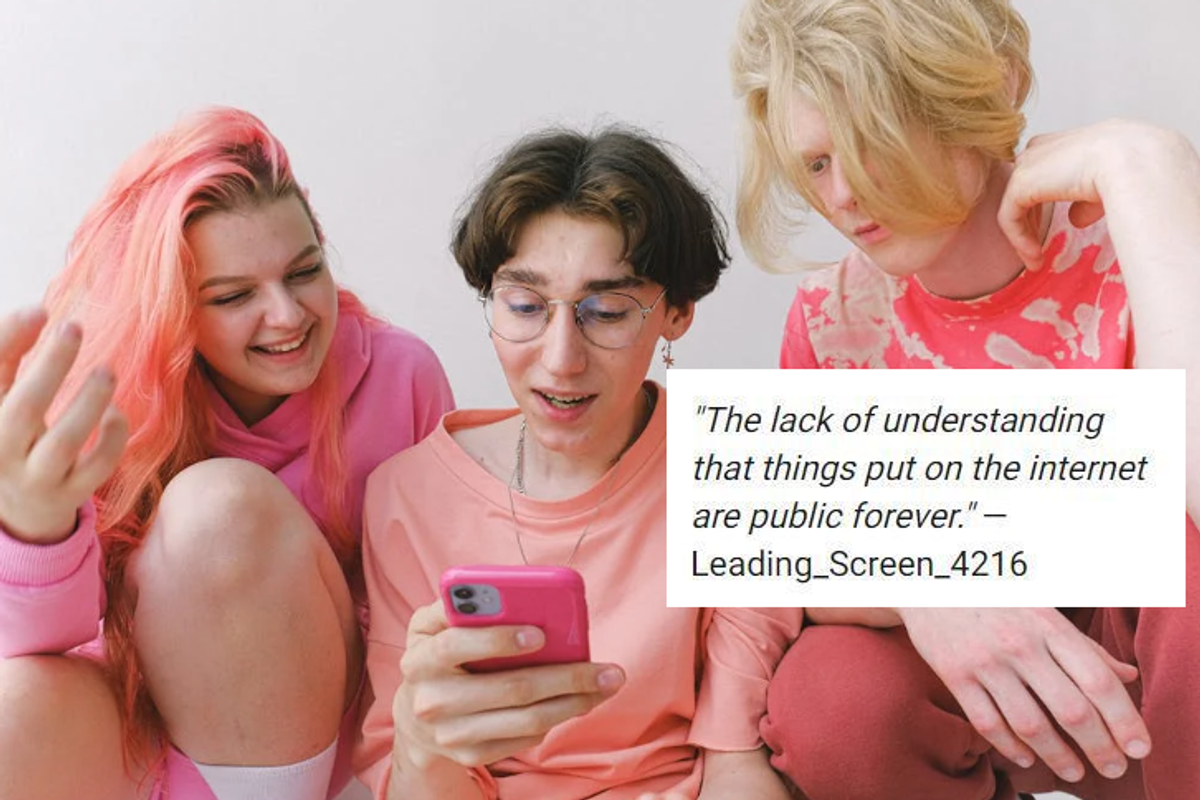
Teens staring at a pink phone.

Every generation is different from the one that came before. It makes sense. Every group grows up in different economic, cultural, and technological circumstances, so of course they’re going to have different tastes and values. It’s also natural for younger generations to rebel against their parents and create their own unique identities.

However, these days, with the rapid changes in technology and culture spurned on by the internet, for some older people (Baby Boomers, Gen X), the younger generations (Millenials, Gen Z, Gen Alpha) are downright confusing. Further, Gen Z and Gen Alpha were raised during the pandemic, the #MeToo movement, and the murder of George Floyd, which have had an enormous impact on how they see the world.

To help the older folks who may be confused by “kids these days” feel less alone, a Redditor named 5h0gKur4C4ndl posed a question to the AskReddit subforum, “What is something about the newer generations that you can't seem to understand?” A lot of the responses were centered around the younger generations’ relationship to technology.

The older generations also seem concerned that younger kids are a lot more prudish than their parents and should learn how to lighten up and have some fun — a big role reversal from previous generational wars.

Here are 15 things about the younger generations that older people don’t understand.

​1. Recording yourself crying

"THIS IS THE ONE. I do not know how intense your desire for external validation has to be for you to be in the midst of crying and think 'Lights, camera, action baby let's make sure as many people see this as possible.'" — Thrillmouse

"People who record themselves crying are already weird but posting it on the internet is weirder. imagine clicking 'post' to every social media they have. do they seriously not look at what they're posting online?" — TryContent4093


2. Poor grammar

"The emails I get from my students aged 18-25 are such a mess of incoherent garbage, I can't tell if they are lazy or if it's an actual literacy issue. And I'm barely older than they are so if this is a generational gap, it happened quickly!" — NefariousSalmander

"It's a block of text with no capitalization or punctuation. Imagine receiving 6 consecutive one-line texts at once. If you can figure out where the periods should go then you can make sense of it, but it's all texting abbreviations and slang. Something like, 'yo mr y u slow fixin my grade I trned in the lab last class my dad gonna take my phone lmk.'" — Ceesa


3. Learned helplessness

"I'm a middle school teacher. My kids will routinely claim they can't do anything and then shut down and do nothing. And then... It's easy and they do it. So basically it's the degree of learned helplessness. They know to ask when I go over, but if there are twenty kids and I get to them last, they will do nothing (no phones, nothing!) for twenty minutes and act surprised I'm irritated they didn't grab a damn pencil from the freeeee pencils on my desk. And then act surprised they're behind on the assignment!" — Scarletuba


4. The internet is forever

"The lack of understanding that things put on the internet are public forever." — Leading_Screen_4216


5. No self-confidence

"37-year-old attending college for the first time here. They have negative confidence. They barely speak above a mumble, especially when answering a question from the teacher. Most of them would rather die than talk to someone they're interested in. It's like 90% of them are cripplingly introverted." — Intelligent-Mud1437

6. They need attention

"We were saying what we would do if we won the big lottery jackpot. The new 22-year-old hire said he’d become an influencer. Can you imagine winning a billion at 22 and that’s what you would do? Not start a business, travel the world, charity, sports, property… Learn something… but become an influencer… with a billion dollars. I mean, like, he’s gonna hire a marketing company to fabricate interest in his social media? He’s gonna spend money on stupid things to make people cringe or rage comment? With a billion dollars." — Covercall


7. Put your phone down

"Why do you want to watch 100% of a concert, that you paid good money for, through your phone lens?" — LeluWater

"I was yesterday in a Linkin Park cover band concert, a fuckin blast. There was that one guy, that spent every song recording HIS FACE 'singing' along. Not the band, his face. Please wake me up in 1995." — pls_tell_me

8. Phone at the movies

"Why do they go to the movies only to scroll through their phone the entire time?" — IAmASurgeonDoctorHan

"My wife does this. Not at the theater, but we'll be watching a movie or TV show, and she'll be glued to her phone. Then when she looks up she doesn't get what's going on and we have to pause while I explain what just happened and why." — Project2R

9. Paranoia

"I’m in my forties and I manage a small group of people who are in their 20s to early thirties. What I notice most is how anxious and fearful they seem to be. Everyone is out to get them. I often get approached by subordinates who want me to do something about a colleague who is doing them wrong in some way. After I gather more information, it almost always is a case of poor assumption about someone else’s intentions, coupled with a desire to jump to the worst-case scenario. If I ask them a series of probing questions about other possible interpretations they often admit they didn’t consider those possibilities." — Reasonable_Human55

10. Putting on heirs

"I don't understand why most of them want to look rich with expensive s**t and most of them act like they run businesses or something.They take pictures with cars that are not theirs for example. Dude chill, you're 16." — Honest_Math7760

"Because they are indoctrinated by social media that tells them they are a failed human if they don’t become a multi-millionaire entrepreneur." — Outrageous_Glove_467

11. The new Puritans

"This weird new Puritan wave they are riding on. We struggled for generations to free ourselves from oppressive dogmas, and now they are all-in on the whole: 'if you like anything even remotely non-wholesome, you should be arrested and burn in hell.' ... Constantly calling for bans on anything that upsets them, instead of learning how to avoid the things that upset them." — SleepyCera

"The prudishness is so weird to me. Hearing young people talk about body counts' and how you should be married with kids by the age of 25, or you’re past your prime is absolutely insane. Even my Christian grandparents weren’t as sexually conservative as this generation. The complete demonization of partying, drinking, and going out is weird too—like I can see being traumatized by fentanyl and the general lack of safety around drugs, but I did most of my socializing as a young person by going to concerts and nightlife events and meeting people, and they seem to just…not do anything social?" — Counterboudd

12. Can't handle stress

"The absolute lack of capacity to deal with any emotional stress or upheaval without turning into a gibbering mess. ...I had someone messing around in a lecture, playing with their phone and being disruptive. I stopped the lecture and told them to put it away and pay attention or leave. They looked SHOCKED to have been called out and sat there quietly for the next 10-15 minutes until suddenly going all 'deer in the headlights' when asked a question in relation to the topic and then running the full length of the lecture hall and out the room. I was informed the following day that the student had went to counseling services to complain that I had 'put unreasonable pressure on him by asking him questions in class, and set off his anxiety.'" — Indiana_Harris

13. White socks with sneakers

"How pulling up white socks with sneakers was the most unfashionable middle-aged American dad clothing in the entire world. To being fashionable." — Awkward_Moments

"Socks with sandals too. And mustaches. Kids today think dressing like a dorky dad thirty years ago is cool. I laugh at them all the time." — IDigRollingRockBeer

14. Watching video games

"Why they'd rather watch someone else play a video game than play it themselves. That was a punishment when I was a kid, not entertainment." — DeadDevilMonkey

15. External stimulation

"Will never understand the constant need for external stimulation. I’m quite happy just to ponder my own thoughts. I love flying, because it gives me several hours to think on shit without distraction. Ask young people to put down their phone? It’s as if you asked them to chop off their left hand." — Midnight_Poet


This article originally appeared last year.

bee gees, how deep is your love, bee gees live

The Bee Gees singing "How Deep is Your Love" in 1998.

Not all live performances are created equal, but when the circumstances and the talent are just right, they can far surpass studio recordings. In 1998, the Bee Gees, brothers Barry, Robin and Maurice Gibb, stopped by ITV’s “Des O'Connor Tonight” with acoustic guitars in hand to promote their recent release, “One Night Only,” an album and live concert DVD featuring many of the band’s biggest hits.

The highlight of the performance was when Barry got ready to strum his guitar for a performance of “How Deep Is Your Love,” the 1977 megahit from the “Saturday Night Fever Soundtrack,” but instead chose to sing the song a cappella.


Barry starts the song solo in his beautiful falsetto, but then, when his brothers join him, they create a wonderful harmony that only brothers can make. The show’s host, Des O’Connor, a notable singer himself, even joins in for a few bars.

- YouTube youtu.be

Earlier in the performance, the brothers played their version of “Islands in the Stream,” a song made famous by Dolly Parton and Kenny Rogers in 1983 that was written by the Bee Gees. In 1998, the song was enjoying a resurgence as its melody was used in the song “Ghetto Supastar” by Pras of The Fugees.

Robin Gibb later admitted that the song was initially written for Marvin Gaye to sing, but he was tragically murdered in 1984 by his father. The band also had Diana Ross in mind while composing the tune.

During the appearance, the band also sang “Guilty,” a song that the Bee Gees wrote for Barbara Streisand and Barry produced in 1980.

You can watch the entire performance here:

- YouTube youtu.be

The Gibb brothers started making music together when they were children, and after their first public appearance together at a local movie theater in 1956, they were hooked on performing.

“It was the feeling of standing in front of an audience that was so amazing," said Barry. "We’d never seen anything like it. We were very young, but it made an enormous impression. We didn’t want to do anything else but make music.”

After the family moved to Australia in 1958, Barry, Maurice, and Robin were "discovered" at the Redcliffe Speedway, where they had asked to perform between races. Even over the tinny PA system, their harmonies made an impression. Speedway manager Bill Goode introduced the trio to DJ Bill Gates, who set them up with a recording session.

the bee gees, gibb brothers, maurice, barry, robin gibb Stayin Alive GIF by Bee Gees Giphy

If you've ever wondered how the Bee Gees got their name, that was it: Bill Goode, Bill Gates, Barry Gibb, and the brothers' mother Barbara Gibb all had the initials B.G. After a strong reception on the airwaves in Brisbane, Gates forwarded the brothers' recordings to a Sydney radio station. They got a lot of airtime there as well, and the band had a run of success performing in Australia, but it wasn't until their return to England in 1967 that they became the international sensation we all know today.

Manager Robert Stigwood had received tapes from the Gibbs brothers and called them up within weeks of their arrival in the U.K.

“I loved their composing,” Stigwood told Rolling Stone in 1977. “I also loved their harmony singing. It was unique, the sound they made; I suppose it was a sound only brothers could make.”

- YouTube www.youtube.com

And, as they say, the rest is history. The award-winning 2020 HBO documentary, "The Bee Gees: How Can You Mend a Broken Heart" tells the story of the band with loads of footage from throughout their 40-year career, which includes not only their disco-era fame, but the various phases of their musical journey and the countless songs they wrote for other artists.

As one commenter wrote, "People that call the Bee Gees a 'disco group' don't have a clue. They had 10 albums out before they ventured into 'disco.' Their song catalogue is amazing and some of their very best songs were written long before Saturday Night Fever. Those 'disco' songs are classics as well. It is nice to see they are finally getting the recognition they deserve."

This article originally appeared last year. It has been updated.

living the the us, living in europe, europe vs usa, travel, europe, road trip, driving

Road trip adventure through stunning mountain landscapes.

Sometimes it takes an outsider’s eyes to remind us what makes our home special.

Eva zu Beck, a traveler on YouTube, was born in Poland, grew up in England, and lived in a variety of European countries throughout her life. Hence why she says she’s “as European as it gets.”


So when she spent six months traveling in the United States, it was definitely a different experience. In a recent video, she shared what some of those “cultural shocks” were. Sure, there were some expected things in there (our car-centric culture, outrageous tipping practices, the neverending-ness of Texas, etc.) but also some lovely unexpected things as well.

Most surprisingly of all, it was anything but a "dump on America"-fest. Instead, it was chock full of lighthearted, positive realizations.

- YouTube www.youtube.com

Here are some of the most interesting ones:

1. Everybody smiles

“And gives you random compliments!” said zu Beck, recalling the random strangers that would yell “nice tattoo!” from across the street.

2. Bonkers date formats

“That makes no sense, surely you should go from smallest, to biggest, right? Day, month, year.”

3. Being able to turn right on a red light

“I can't tell you how many cars have…honked at me…before I realized I could do it.”

4. All way crossroads

“It’s super confusing, like a big mental workout. In Europe, the person that’s on the right always has priority, that’s it.”

5. Guns aren’t quite as prevalent as they seem

“I thought I would see guns everywhere. Every Walmart would sell guns. However, they are more common than in Europe.”

6. Politics is in the American psyche, but it's not being talked about 24/7

Zu Beck noted that while she was surprised that she was constantly hearing conversations about politics, “the way you have regular conversations in the US heavily indicated one’s political leanings. Or, ya know, what giant sign they put on their fence."

7. Good American food exists…if you’re willing to pay a little extra

According to zu Beck, America has both the best and the worst food. Quality food could certainly be found, at a higher price point, at places like Whole Foods. However, it's worth noting that zu Beck also follows a “mostly vegan diet.” The odds of finding quality vegan food is probably even harder than for most of us omnivores.

8. Montana, Wyoming, and Central Nevada are awesome

“So much nature, space and beauty,” recalls zu Beck, noting that these were her favorite places to see.

9. Yellowstone National Park, on the other hand…not so much

Zu beck likened it to a “massive glorified parking lot” and “nature Disney-fied,” though she also recognized she went during a peak tourist time.

10. It makes sense now why so many Americans don’t travel

According to zu Beck, many Europeans make fun of Americans for not being cultured and well-traveled. But after seeing the “sheer diversity of the country” she gets it now. There’s already so much to see here in our own backyard.

11. She would “1000%” live here

“Some people love it. Some people hate it, [but] to me the United States is the most beautiful country in the world. It really is.”

Down in the comments, Americans shared how touching it was to hear zu Beck’s overall positive assessment.

“It’s so refreshing to hear foreigners say they love my home.”

“I just want to say thank you for such kind words. We have issues in our country for sure and we often times only hear the negative from other countries but what you said was absolutely a breathe of fresh air. Thank you.”

“As an American, sometimes we can get so focused on all of the negatives that we see in the country...it is so refreshing to have an outsider's view. I have been fortunate enough to have lived, traveled and worked in many other countries, and when I come back to the States I am re-astonished by its sheer beauty and amazing cultural diversity. Thanks for the reminder,.”

“As an American, it was refreshing to hear an unbiased view from an open-minded European about your experiences without just being the usual slam of the negatives. America definitely has a unique culture (outside of the big cities) and there's plenty of beauty if you actually travel through our beautiful nation without just looking for the usual negatives pushed through mainstream news and the ‘haters.’ Thank you!”

Zu Beck's takeaway isn't that America is perfect—far from it. But in her eyes, it’s still one of the most beautiful, surprising, and welcoming places she’s ever been. That alone feels like something many of us need to hear right now.

empty nester, empty nesters, declutter, decluttering, decluttering tips

Mom and empty nester shares her tips for decluttering her home.

Deep cleaning and decluttering a home is a daunting task—especially for empty nesters. After spending a lifetime creating memories and living together under one roof, doing a big declutter can take an emotional toll.

It's a milestone that many empty nesters know the sting of. And in a cleaning community on Reddit, a 51-year-old mom and recent empty nester shared her experience cleaning and decluttering her home after entering this new phase of life.


"In my entire life, my house has always been messy. I mean, I didn’t have a disaster-level situation going on, but if someone dropped by unannounced, it would’ve been super embarrassing," she shared. "When my kids were younger, we had a housekeeper because I just couldn’t keep up. Now that we’re empty nesters, I realized I never really learned how to keep house."

- YouTube www.youtube.com

She explained that the book Unf*ck Your Habitat: You're Better Than Your Mess played an integral part in helping her declutter—and offered eight helpful tips to fellow empty nesters looking to organize their new lives.

1. Put stuff away, not down.

Her first tip is the key to decluttering.

"Whatever you have goes right back where it’s supposed to go when I’m done with it," she notes.

2. Do laundry every day.

And she doesn't just wash and dry her laundry when doing it.

"Just one load, start to finish. Wash, dry, fold, and put away," she shares. "Also, no chair or floor laundry. It gets put in the hamper or hung back up. No clothes are ever out."

3. I make the bed every day.

The benefits keep on giving by doing this, she notes.

"It just makes my bedroom look cleaner and I smile every time I come in my room," she writes. "Plus we aren’t fighting over the covers when we get in because the bed is straightened out."

- YouTube www.youtube.com

4. Do a quick daily clean-up of commonly used spaces.

She cleans the places that she and her husband use frequently.

"I keep a stack of cleaning rags in my master bath because it’s the only bathroom that’s used every single day. Every night, I spray the counter, wipe everything down, put everything back (that my husband leaves out), and wipe the mirror," she explains. "I also wipe down the toilet. I find that I don’t need a huge, big cleaning of this space because I’m keeping it up daily. Same goes for the kitchen."

5. Dishes are always put away, cabinet or dishwasher.

No dishes in the sink or stuck in the dishwasher.

"Dishes are finished in the dishwasher? It’s emptied and dirty ones are placed inside while waiting for the dishwasher to get full," she notes.

@brunchwithbabs

Life Changing Dishwasher Hack #tutorials #kitchenhacks #parentsoftiktok #dishwasherhack

6. Don't neglect your shoes.

When she takes them off, they get put away.

"Shoes are put away immediately upon walking in the house," she shares.

7. Knock out small tasks.

There is no time to waste.

"If it takes less than 5 minutes clean it while you’re waiting for something else to get done," she writes.

8. Take no days off.

Rather than assign certain days for cleaning, she is constantly doing it throughout the week.

"Lastly, I do not have scheduled cleaning days. I just do something all the time," she explains. "My life is kind of unpredictable, we love traveling or going out for the day so my so called cleaning schedule would be shot to hell every time. It’s better this way, because now I never feel behind."

Culture

Rainn Wilson's new creative tool for exploring spirituality is refreshingly inclusive

It takes you on a deeply comprehensive and delightfully creative spiritual journey, no matter your faith background or belief.

soul boom, rainn wilson, spirituality, spiritual workbook, faith and religion
Courtesy of Soul Boom/Instagram

The Soul Boom Workbook is deeply comprehensive and delightfully creative.

Sometimes the best things come from the most unexpected of places. Like, who would imagine a comedic actor who played the iconic beet-farming paper salesman Dwight Schrute on The Office would come up with a creative tool to help people explore their own spirituality?

Rainn Wilson isn't exactly new to talking about the soul. He co-founded the Soul Pancake media company in 2009, spent years having philosophical discussions in his Metaphysical Milkshake series, wrote a whole book during the pandemic about the need for a global "spiritual revolution," and created his current Soul Boom Podcast out of that book in which he interviews all kinds of people from all faiths and spiritual paths to have meaningful conversations.


But his newest offering feels different. Instead of giving us something to consume and then reflect on, his Soul Boom Workbook: Spiritual Tools for Modern Living is a hands-on, interactive, deeply comprehensive, delightfully creative tool to help us personally explore our own spirituality and figure out how our own spiritual transformation can also transform the world.

Wilson tells Upworthy that the idea for the workbook was born out of the response to the Soul Boom book. "When I, a former sitcom actor, decided to write a book about spirituality, there were a lot of question marks," he says. "Would people respond? Would they like it? Would they laugh me out of Hollywood?"

However, the response to the New York Times bestseller was "overwhelmingly positive."

"People seem to be hungry for spiritual paths and wisdom more and more as various systems start to unravel," Wilson says. "The response was so strong. And part of it was like, 'Well, what do we do if we want a spiritual revolution? If we want to find a spiritual path, and truth, and harness the kind of ancient wisdom traditions from the world's great faith traditions on our journey forward?' And that's when the idea of a Soul Boom workbook was born."

soul boom, rainn wilson, spirituality, spiritual workbook, faith and religion Soul Boom Workbook: Spiritual Tools for Modern LivingScreenshots courtesy of Rainn Wilson

Wilson and his co-creator, Shabnam Mogharabi, wanted to create an interactive place for a person to take a spiritual journey, either by themselves or with others in their lives who are interested in connecting on a deeper level. They also wanted it to connect spirituality and creativity.

"We wanted to give people an experience that I had years ago when I did The Artist's Way," Wilson explains. "That was a really important book for me, and it has been for dozens of people that I know. This classic workbook about creativity, which also has spiritual elements in it, has been revolutionary. It has sold millions of copies and allowed people to kind of undertake a creative journey that they didn't know was possible."

soul boom, rainn wilson, spirituality, spiritual workbook, faith and religion The workbook includes all kinds of activities designed to get you reflecting on all aspects of spirituality.Screenshots courtesy of Rainn Wilson

The workbook includes drawings, essays, reflective writing exercises, doodles, games—there's even section where you create a stand-up comedy act. Whatever you imagine a "spiritual workbook" might be, this is likely more. Tackling concepts like God ("The Notorious G.O.D."), faith and religion, meditation and prayer, values and morals, tests and difficulties, death and dying, creating community and a better world, and more, the Soul Boom Workbook is incredibly comprehensive. And it feels unique in that anyone from any background or belief, no matter how devout or skeptical, can utilize it to explore what they find divine or sacred, what parts of their beliefs might need to be challenged or "excavated," and how they can contribute to building a better world.

The "guy who played Dwight" may seem like an unlikely source of spiritual wisdom, but thankfully, Wilson doesn't claim to be that at all. He is not a guru offering enlightenment or an academic pontificating on the meaning of existence; he's simply someone who has run the spiritual seeker gauntlet himself, who has a deep and abiding interest in exploring this stuff, and who offers a refreshingly down-to-earth, accessible, and inclusive way of talking about it all.

Wilson says his favorite thing about the workbook is how it starts off intensely personally but then takes you on a journey that expands and expands into exploring how you can apply your spiritual "superpowers" to create a more just, kind, and loving world. Ultimately, it's all about exploring spiritual tools for personal and social transformation.

"I would love it if someone started the workbook in a certain place and finished it at a very different place, and that it actually affected their lives in a transformational way," Wilson says. "Could you do a book, and by the end of it be a different person? Or at least see the world in a slightly different way at the end of this process?"

You can find Soul Boom Workbook: Spiritual Tools for Modern Living here.


As a participant in the Amazon Associates affiliate program, Upworthy may earn proceeds from items purchased that are linked to this article, at no additional cost to you.

Joy

Here's why the world's strangest traffic light in Japan only turns green one day a year

Everyone waits until a special day in May, when it finally turns green.

himakajima stoplight, traffic light, street corner, octopus, japan, japanese island
via Flickr

The Himakajima traffic light.

The island of Himakajima, a few dozen kilometers south of Nagoya in between Ise Bay and Mikawa Bay, Japan, is home to around 2,000 residents. It’s best known for its picturesque beaches and local delicacy, octopus. The dish is so famous in the town that it even has cute pictures of it emblazoned on its manhole covers. Himakajima is also known for its one stoplight that blinks yellow for 364.25 days of the year.

Himakajima doesn’t really need any stoplights because the tiny island sees very little foot or car traffic. However, the children who grow up on the island may not live there forever; many will grow up to attend schools or find jobs on the mainland. So it’s important that they know how to cross a street with a traffic light, or they could get seriously injured.


The Himakajima traffic light

In 1994, at the request of the local Himaka Traffic Safety Association, stoplights were installed on the east side of the island so the town’s children could practice crossing the street like they would in a big city. The light blinks yellow most of the time, so when it becomes fully operational, it’s a real event in the city.

- YouTube youtu.be

Every year in May, the town’s teachers, children, parents, and officials gather near its East Port and the stoplight becomes fully operational, cycling through red, yellow, and green lights.

Last year, on May 21, the kids congregated at the light and practiced looking left, right, and left again before crossing the street. To be extra sure that other pedestrians and motorists know they are crossing, they hold their hands high in the air so they’re sure to be seen.

According to SoraNews24, one girl told reporters that things got “tricky” when she was walking her bike across the zebra strips and the light turned red. It goes to show that kids need to know not only when to walk but also how quickly to do so.

The annual children’s crossing has become so popular that people planning to visit the island often hunt online to catch wind of when the stoplight will be fully operational. After the special day, the light reverts to its blinking yellow state, encouraging everyone to proceed with caution until sometime the next May.

himakajima stoplight, traffic light, street corner, octopus, japan, japanese island The Himakajima traffic light.via Google Maps

The official Green Light Day in Himakajima is a beautiful example of how, even in the smallest of communities, parents and teachers find a way to help their children prepare for the real world. It’s a testament to the community's importance of safety and learning through real-life experience. A lesson in class where the teacher holds up a red or green light sign may give kids a vague notion of how to cross the street in a big city, but getting to travel to see the real light and trying to judge how quickly to move across the street is a lesson the kids will never forget.

Further, for the vast majority of us who live in towns where streetlights are commonplace, it’s refreshing to see a community gather around something that we take for granted.