upworthy
Add Upworthy to your Google News feed.
Google News Button
Joy

10 awkward friendships you probably have—we all have a #9.

Not all friendships are meant to last forever.

Comic with stick figures
via Wait But Why and used with permission

The ten types of friends

When you're a kid, or in high school or college, you usually don't have to work too hard on your friendships. Friends just kind of happen.

For a bunch of years, you're in a certain life your parents chose for you, and so are other people, and none of you have that much on your plates, so friendships inevitably form. Then in college, you're in the perfect friend-making environment, one that hits all three ingredients sociologists consider necessary for close friendships to develop: “proximity; repeated, unplanned interactions; and a setting that encourages people to let their guard down and confide in each other." More friendships happen.

Maybe they're the right friends, maybe they're not really. But you don't put that much thought into any of it — you're still more of a passive observer.

But once student life ends, the people in your life start to shake themselves into more distinct tiers.

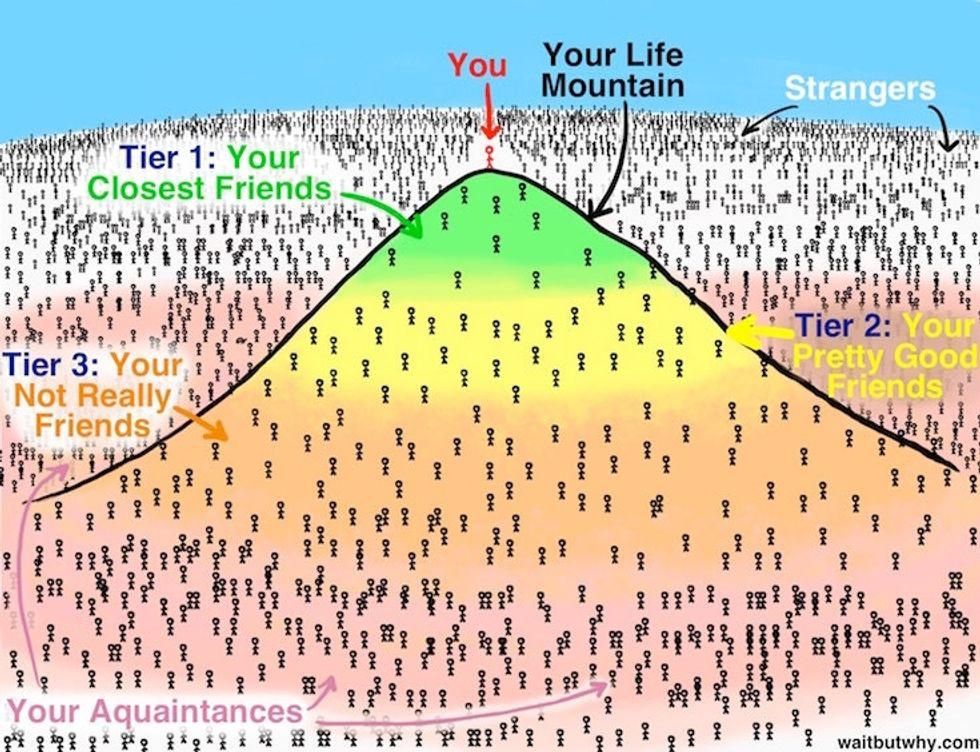
It looks something like this mountain:
Infographic of a mountain

Visual interpretation of where friends fall on the mountain of “You."

via Wait But Why post and used with permission.

At the top of your life mountain, in the green zone, you have your Tier 1 friends—the people who feel like brothers and sisters.

These are the people closest to you, the ones you call first when something important happens, the ones you love even when they suck, who make speeches at your wedding, whose best and worst sides you know through and through, and whose relationship with you is eternal; even if you go months or years without hanging out, nothing has changed when you find yourself together again.

Unfortunately, depending on how things went down in your youth, Tier 1 can also contain your worst enemies, the people who can ruin your day with one subtle jab that only they could word so brilliantly hurtfully, the people you feel a burning resentment for, or jealousy of, or competition with. Tier 1 is high stakes.

Below, in the yellow zone, are your Tier 2 friends: your Pretty Good friends.

Pretty Good friends are a much calmer situation than your brothers and sisters on Tier 1. You might be invited to their wedding, but you won't have any responsibilities once you're there. If you live in the same city, you might see them every month or two for dinner and have a great time when you do, but if one of you moves, you might not speak for the next year or two. And if something huge happens in their life, there's a good chance you'll hear it first from someone else.

Toward the bottom of the mountain in the orange zone, you have your Tier 3 friends: your Not Really friends.

You might grab a one-on-one drink with one of them when you move to their city, but then it surprises neither of you when five years pass and drink #2 is still yet to happen. Your relationship tends to exist mostly as part of a bigger group or through the occasional Facebook Like, and it doesn't even really stress you out when you hear that one of them made $5 million last year. You may also try to sleep with one of these people at any given time.

The lowest part of Tier 3 begins to blend indistinguishably into your large group of acquaintances (the pink zone): those people you'd stop and talk to if you saw them on the street or would maybe email for professional purposes but whom you'd never hang out with one-on-one. When you hear that something bad happens to one of these people, you might be sad but not too affected.

Finally, acquaintances gradually blend into the endless world of strangers.

And depending on who you are and how things shook out in those first 25 years, the way your particular mountain looks will vary.

For example, there's Walled-Off Wally:

Comic of a lone person on top of a mountain

Some people keep a barrier up between acquaintances.

via Wait But Why post and used with permission.

And Phony Phoebe, who tries to be everyone's best friend and ends up with a lot of people mad at her:

Comic of a mountain with a lot of people at the top

The life of the party.

via Wait But Why post and used with permission.

Even Unabomber Ulysses has a mountain:

Comic of a mostly empty mountain with one person at the top

Hermits exist.

via Wait But Why post and used with permission.

Whatever your particular mountain looks like, eventually the blur of your youth is behind you, the dust has settled, and there you are living your life.

Then one day, usually around your mid or late 20s, it hits you: It's not that easy to make friends anymore.

Sure, you'll make new friends in the future—at work, through your spouse, through your kids—but you won't get to that Tier 1 brothers level, or even to Tier 2, with very many of them because people who meet as adults don't tend to get through the 100+ long, lazy hangouts needed to reach a bond of that strength. As time goes on, you start to realize that the 20-year frenzy of not-especially-thought-through haphazard friend-making you just did was the critical process of you making most of your lifelong friends.

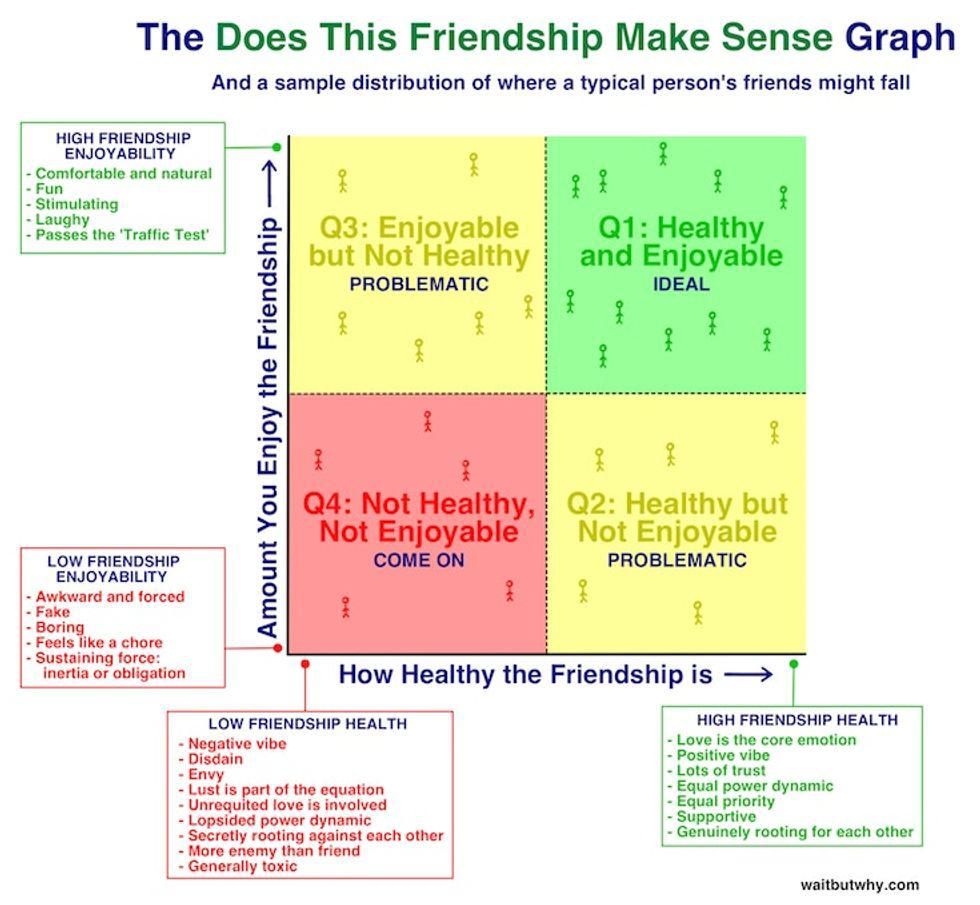
And since you matched up with most of them A) by circumstance, and B) before you really knew yourself yet, the result is that your Tier 1 and Tier 2 friends—those closest to you—fall in a very scattered way on what I'll call the Does This Friendship Make Sense? Graph:
Graph

The friendship graph.

via Wait But Why post and used with permission.

So, who are all those close friends in the three non-ideal quadrants?

As time goes on, most of us tend to have fewer friends in Quadrants 2 through 4 because A) people mature, and B) people have more self-respect and higher standards for what they'll deal with as they get older. But the fact is, friendships made in the formative years often stick, whether they're ideal or not, leaving most of us with a portion of our Tier 1 and Tier 2 friendships that just don't make that much sense. We'll get to the great, Quadrant 1 friendships later in the post, but in order to treat those relationships properly, we need to take a thorough look at the odd ones first.

Here are 10 common ones:

1. The non-question-asking friend
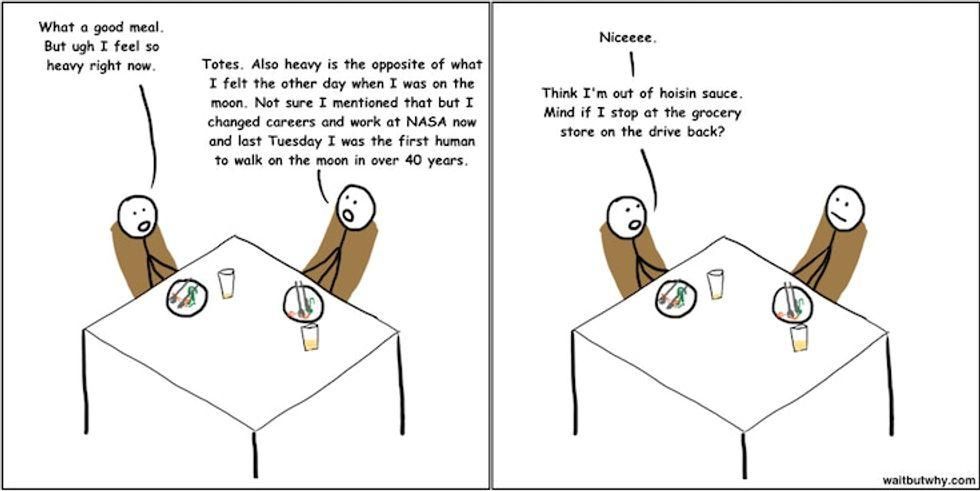
Comic of two people at dinner

Odd moments that happen between friends.

via Wait But Why post and used with permission.

You'll be having a good day. You'll be having a bad day. You'll be happy at work. You'll quit your job. You'll fall in love. You'll catch your new love cheating on you and murder them both in an act of incredible passion. And it doesn't matter, because none of it will be discussed with The Non-Question-Asking Friend, who never, ever, ever asks you anything about your life. This friend can be explained in one of three ways:

  1. He's extremely self-absorbed and only wants to talk about himself.
  2. He avoids getting close to people and doesn't want to talk about either you or himself or anything personal, just third-party topics.
  3. He thinks you're insufferably self-absorbed and knows if he asks you about your life, you'll talk his ear off about it.

Giving you the benefit of the doubt here, we're left with two possibilities. Possibility #1 isn't fun at all and this person should not be allowed space on Tier 1. The green part of the mountain is sacred territory, and super self-absorbed people shouldn't be permitted to set foot up there. Put him on Tier 2 and just be happy you're not dating him.

Possibility #2 is a pretty dark situation for your friend, but it can actually be fun for you. I have a friend who I've hung out with one-on-one about four times in the last year, and he has no idea Wait But Why exists. I've known him for 14 years and I'm not sure he knows if I have siblings or not. But I actually enjoy the shit out of this friend—sure, there's a limit on how close we'll ever be, but without ever spending time talking about our lives, we actually end up in a lot of fun, interesting conversations.

2. The friend in the group you can't be alone with under any circumstances
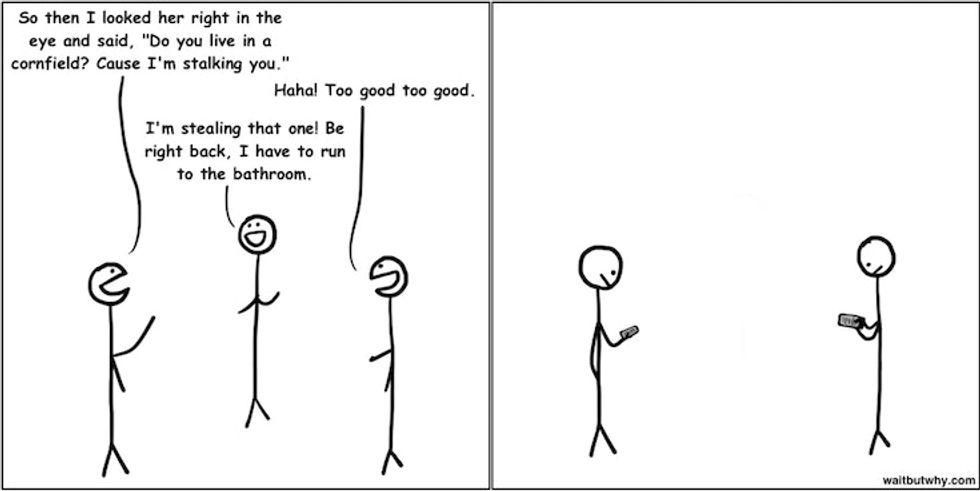
Comic of three stick people having a conversation

Why have relationships when there is a phone around?

via Wait But Why post and used with permission.

In almost every group of friends, there's one pair who can't ever be alone together. It's not that they dislike each other—they might get along great—it's just that they have no individual friendship with each other whatsoever. This leaves both of them petrified of the lumbering elephant that appears in the room anytime they're alone together. They're way too on top of shit to ever end up in the car alone together if a group is going somewhere in multiple cars, but there are smaller dangers afoot—like being the first two to arrive at a restaurant or being in a group of three when the third member goes to the bathroom.

The thing is, sometimes it's not even that these people couldn't have an individual friendship—it's just that they don't, and neither one has the guts to try to make that leap when things have gone on for so long as is.

3. The non-character-breaking friend you have to be “on" with
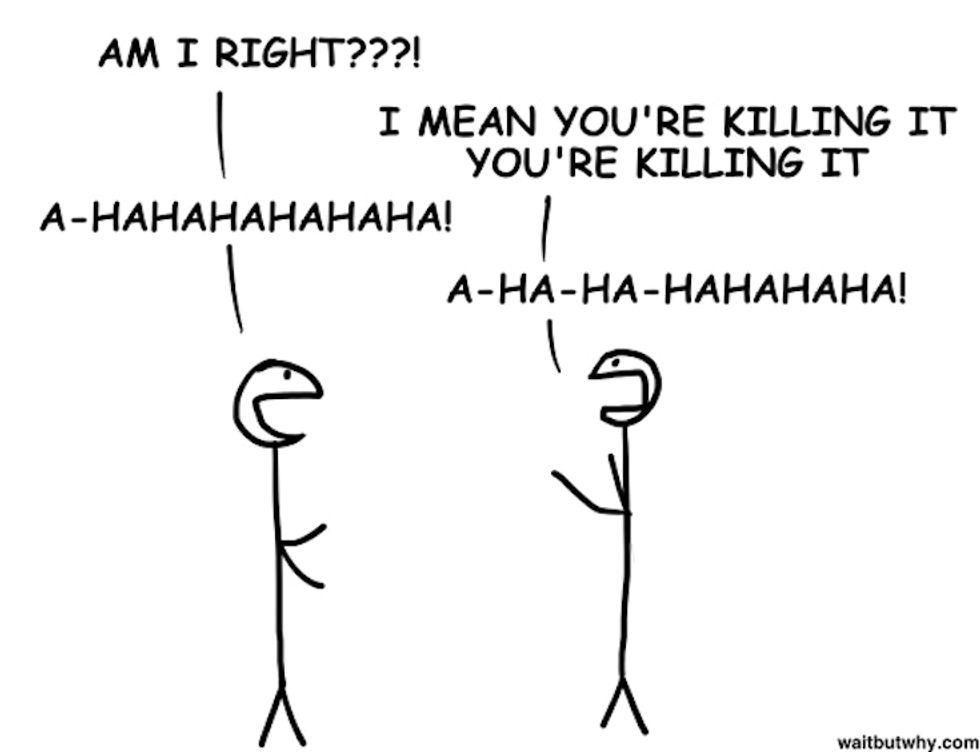
Comic of stick people laughing together

Controlled intimacy and distancing through language.

via Wait But Why post and used with permission.

This is a friend who's terrified of having an earnest interaction, and as such, your friendship with him is always in some kind of skityou always have to be on when you're interacting.

Sometimes the skit is that you both burst out laughing at everything constantly. He can only exist with you in “This is so fucking hilarious, it's too much!" mode, so you have to be in some kind of joke-telling or sarcastic mode yourself at all times or he'll become socially horrified.

Another version of this is the “always and only ironic" friend, who you really bum out if you ever break that social shell and say something earnest. This type of person hates earnest people because someone being earnest dares him to come out from under his ironic safety blanket and let the sun touch his face, and no fucking thanks.

A third example is the “You're great, I'm great, ugh why is everyone else so terrible and not great like us" friend. Of course, she doesn't really think you're perfectly great at all—if she were with someone else, you'd be one of the voodoo dolls on the table to be dissected and scoffed at. The key here is that the two of you must be on a team at all times while interacting. The only comfortable mode for this person is bonding with you by building a little pedestal for you both to stand on while you criticize everyone else. You can either play along and everything will go smoothly, even though you'll both despise yourselves and each other the whole time, or you can commit the ultimate sin and have the integrity to disagree with the friend or defend a non-present party the friend criticizes. Doing this will shatter the fragile team vibe and make the friend recoil and say something quietly like, “Hm ... yeah ... I guess." The friend now respects you for the first time and will also criticize you extra hard next time she's playing her pedestal game with a different friend.

What these all have in common is the friend has tall walls up, at least toward you, and so she builds a little skit for you two to hang out in to make sure any authentic connection can be avoided. Sometimes that person only does this out of her own social anxiety and can become a great, authentic friend if you can just stomp through the ice. Other times, the person is just hopelessly scared and closed off and there's no hope and you have to get out.

In any case, I can't stand these interactions and am in a full panic the entire time they're happening.

4. The double-obligated friendship
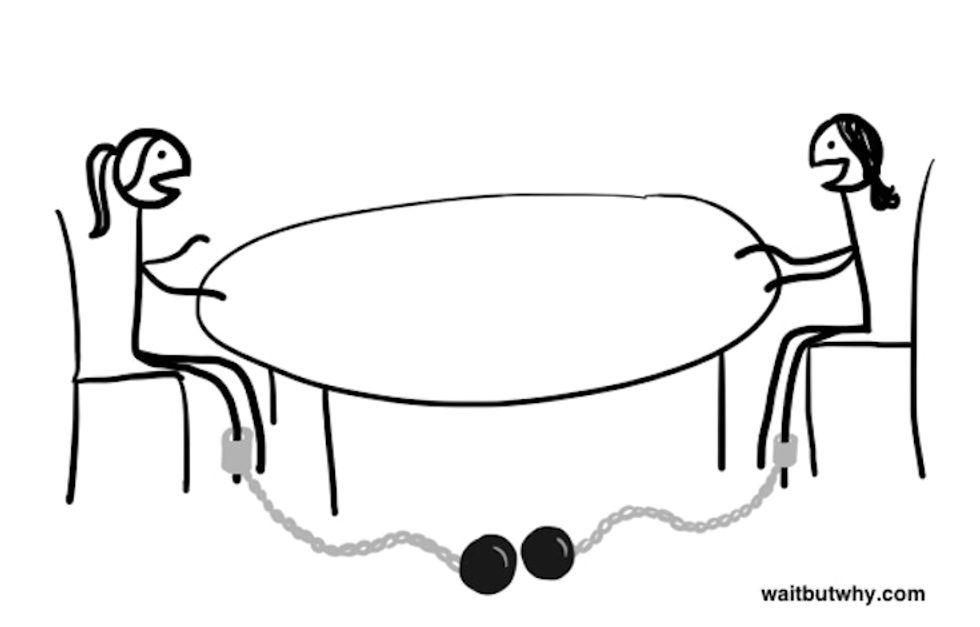
Comic of two men chatting a table with balls and chains around their legs

I think we need a bigger table.

via Wait But Why post and used with permission.

Think of a friend you get together with from time to time, which usually happens after a long and lackluster email or text exchange during which you just can't find a time that works for both of you — and you're never really happy when these plans are being made and not really psyched when you wake up and it's finally on your schedule for that day.

Maybe you're aware that you don't want to be friends with that person, or maybe you're delusional about it — but what you're most likely not aware of is that they probably don't want to see you either.

There are lopsided situations where one person is far more interested in hanging out than the other (we'll get to those later), but in the case we're talking about here, both parties often think it's a lopsided situation without realizing that the other person actually feels the same way — that's why it takes so long to schedule a time. When someone's excited about something, they figure out how to get it into their schedule; when they're not, they figure out ways to push it farther into the future.

Sometimes you don't think hard enough about it to even realize you don't like being friends with the person, and other times you really like the idea or the aesthetic of being friends with that particular person — being friends with them is part of your Story. But even in cases where you're perfectly lucid about your feelings, since neither of you knows the other feels the same way and neither has the guts to just cut things off or move it down a tier, this friendship usually just continues along for eternity.

5. The half-marriage

Two stick people each holding a half of a heart

An ego boost through controlling the relationship.

via Wait But Why post and used with permission.

Somewhere in your life, you're probably part of a friendship that would be a marriage if only the other person weren't very, very, extremely not interested in that happening. 1 for 2 on yes votes — just one vote away — so close.

You might be on either side of this — and either way, it's one of the least healthy parts of your life. Fun!

If you're on the if only side of things, probably the right move is to get your fucking shit together? Ya know? This friendship is one long, continuous rejection of you as a human being, and you're just wallowing there in your yearning like a sobbing little seal. Plus, duh, if you gather your self-respect and move on with your life, it'll raise their perception of your value and they might actually become interested in you.

If you're on the Oh yeah, definitely not side of the situation, here's what's happening: There's this suffering human in the world, and you know they're suffering, and you fucking love it, because it gives your little ego a succulent sponge bath every time you hang out with them. You enjoy it so much you probably even lead them on intentionally, don't you — you make sure to keep just enough ambiguity in the situation that their bleeding heart continues to lather your ego from head to toe at your whim.

Both of you — go do something else.

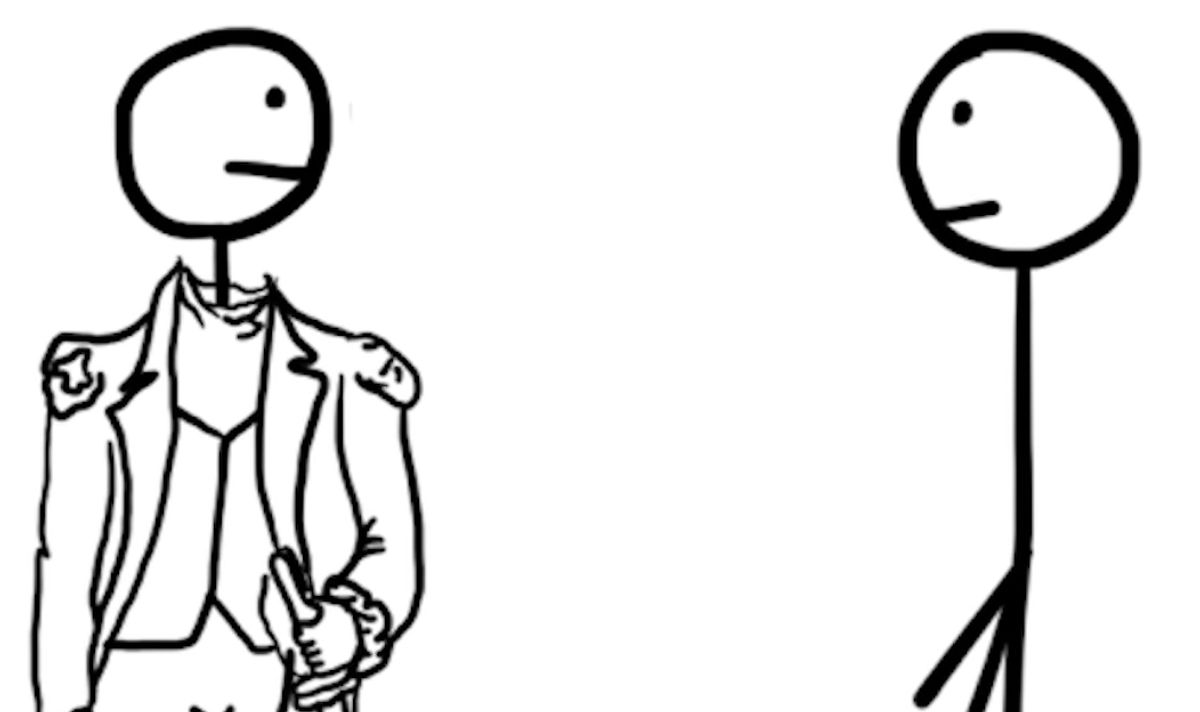
6. The historical friend
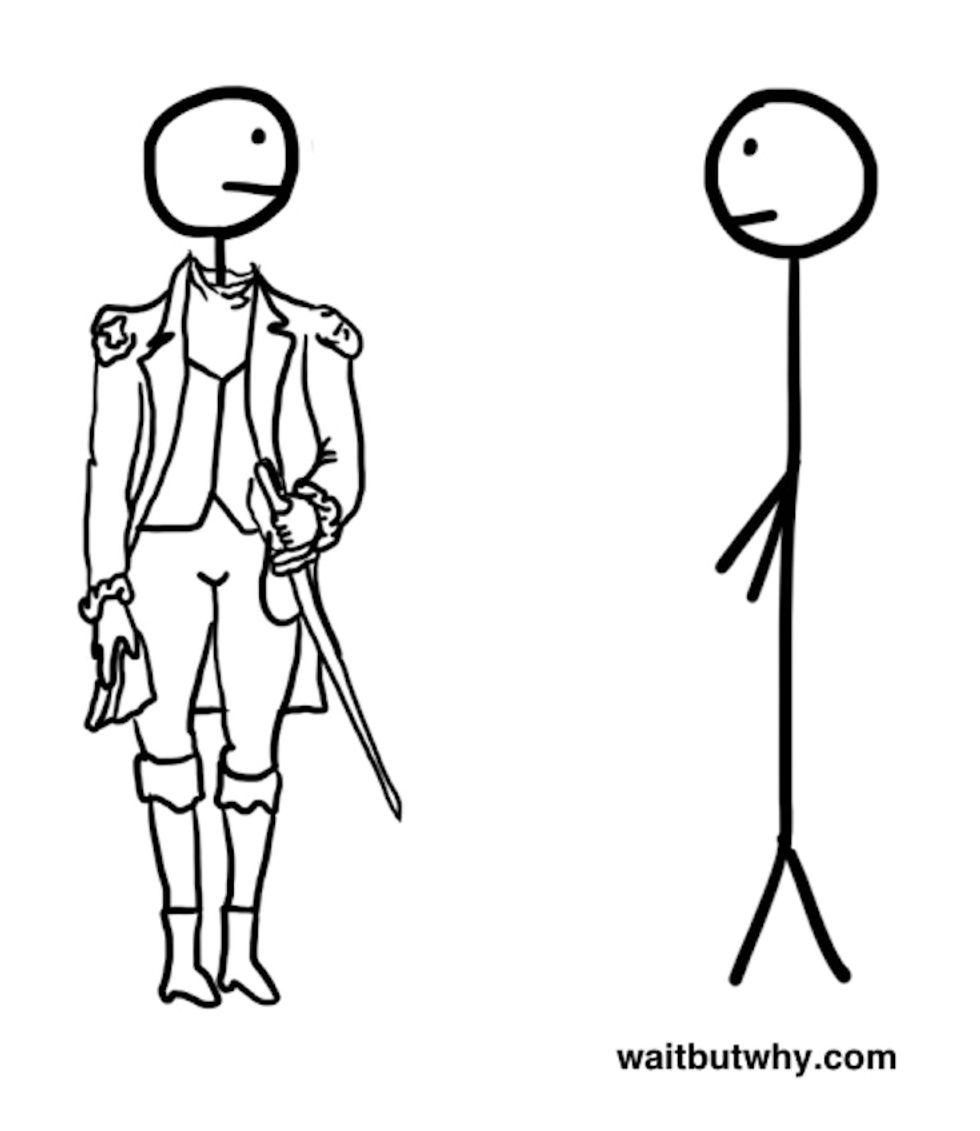
Stick person in historical garb beside a regular stick person

We met in kindergarten.

via Wait But Why post and used with permission.

A Historical Friend is someone you became friends with in the first place because you met when you were little and stayed friends through the years, even though you're a very weird match. Most old friends fall somewhat into this category, but a true Historical Friend is someone you absolutely would not be friends with if you met them today.

You're not especially pleased with who they are, and they feel the same way about you. You're not each other's type one bit. Unfortunately, you're also extremely close friends from when you were four, and you're both just a part of each other's situation forever, sorry.

7. The non-parallel life paths friendship
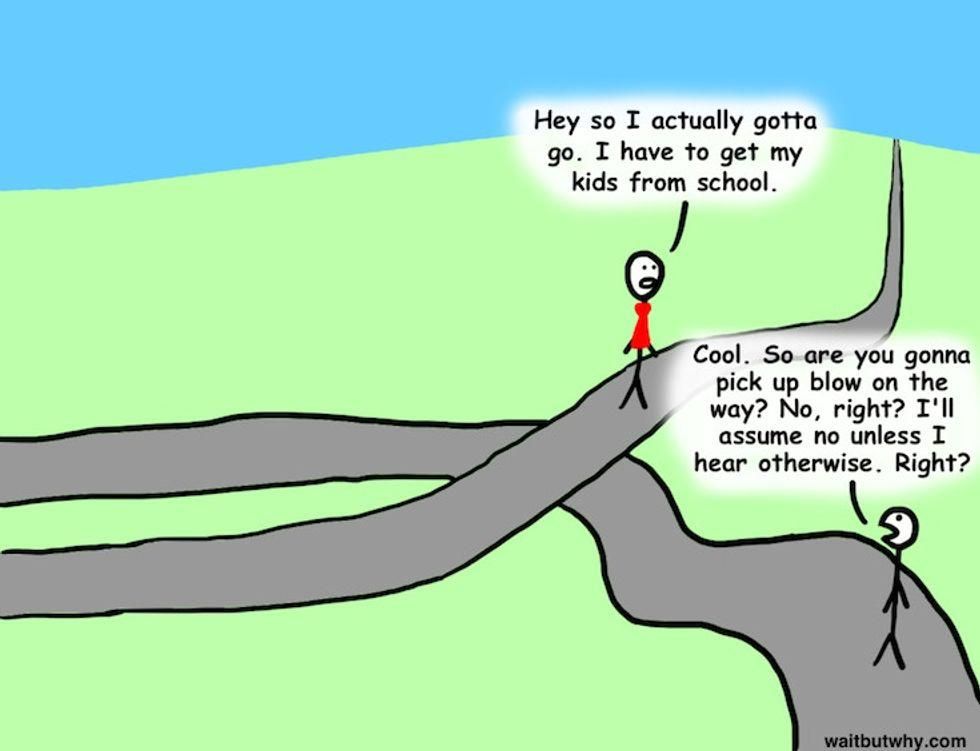
Two stick people on opposite paths

Looking for love in all the wrong places.

via Wait But Why post and used with permission.

Throughout childhood and much of young adulthood, most people your age are in the same life stage as you are. But when it comes to advancing into full adulthood, people do so at widely varying paces, which leads to certain friends suddenly having totally different existences from one another.

Anyone within three years of 30 has a bunch of these going on. It's just a weird time for everyone. Some people have become Future 52-year-olds, while others are super into being Previous 21-year-olds. At some point, things will start to meld together again, but being 30-ish is the friendship equivalent of a kid going through an awkward pubescent stage.

There are darker, more permanent Non-Parallel Life Path situations. Like when Person A starts to become a person who rejects material wealth, partially because she genuinely feels that pursuing an artistic path matters more and partially because she needs a defense mechanism against feeling envious of richer people, and Person B's path makes her scoff at people who pursue creative paths, partially because she genuinely thinks expressing yourself is an inherently narcissistic venture and partially because she needs a defense mechanism against feeling regretful that she never pursued her creative dreams — these two will have problems.

They may still like each other, but they can't be as close as they used to be — each of their lives is a bit of a middle finger at the other's choices, and that's jst awkward for everyone. It's not always that bad — but to survive an Off-Line Life Situation, friends need to be really different people who don't at all want the same things out of life.

8. The frenemy
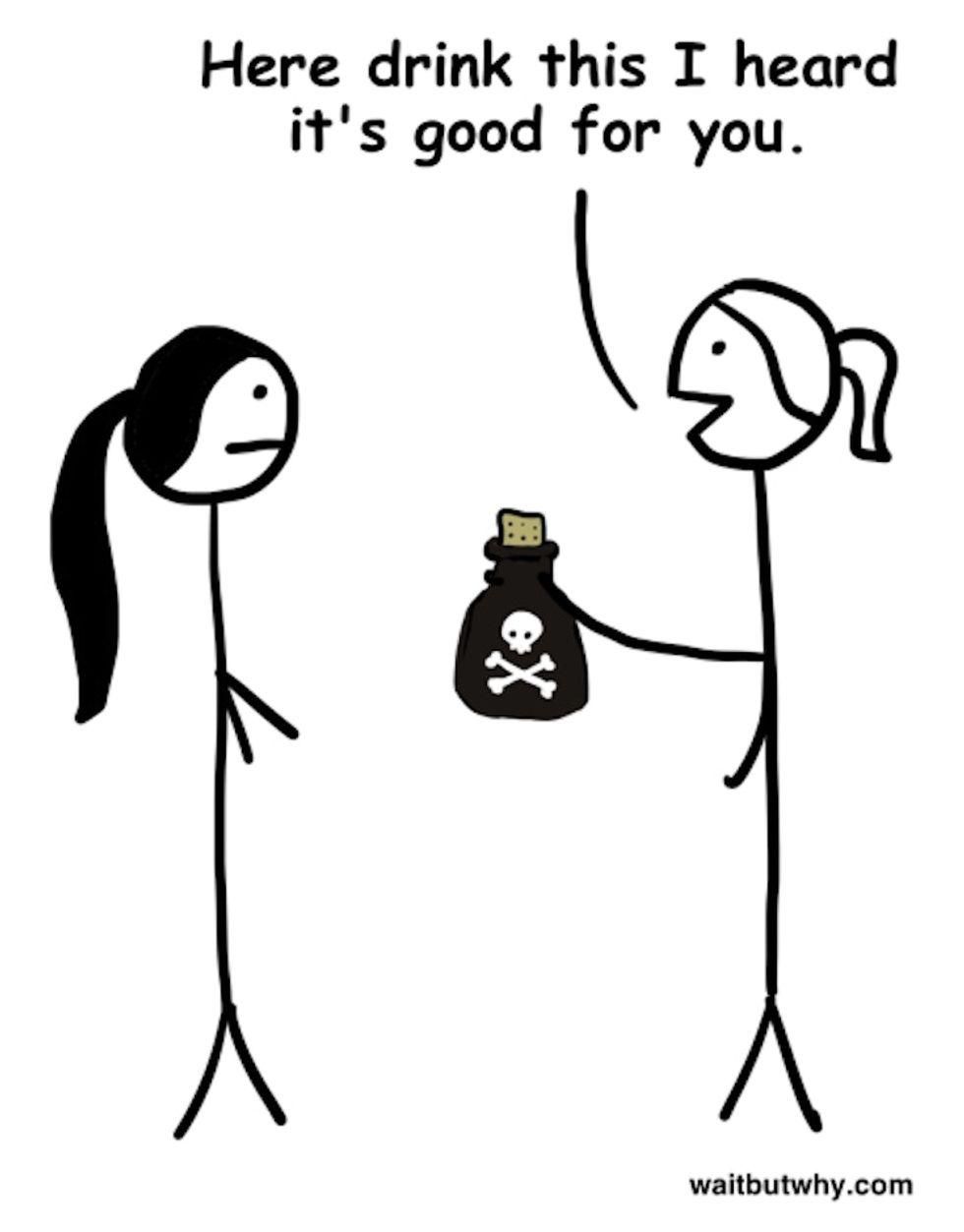
One stick person offers another stick person poison pretending it's safe

This is awful. Taste it.

via Wait But Why post and used with permission.

The Frenemy roots very hard against you. And I'm not talking about the friends that will feel a little twinge of pleasure when they hear your big break didn't pan out after all or that your relationship is in bad shape. I'm not even talking about someone who secretly roots against you when they're not doing so well at some area of life and it hurts them to see you do better. Those are bad emotions, but they can exist in people who are still good friends.

I'm talking about a real Frenemy — someone who really wants bad things for you. Because you're you.

You and the Frenemy usually go way back, have a very deep friendship, and the trouble probably started a long time ago. There's a lot of complex psychology going on in these situations that I don't fully understand, but my hunch is that a Frenemy's resentment is rooted in his own pain, or his own shortcomings, or his own regret — and for some reason, your existence stings them in these places hard.

A little less dark but no less harmful is a bully situation where a friend sees some weakness or vulnerability in you and she enjoys prodding you there either for sadistic reasons or to prop herself up.

A Frenemy knows how to hurt you better than anyone because you're deeply similar in some way and she knows how you're wired. She'll do whatever she can to bring you down any chance she gets, often in such a subtle way it's hard to see that it's happening.

Whatever the reason, if you have a Frenemy in your life, kick her toxic ass off your mountain, or at least kick her down the mountain — just get her off of Tier 1. A Frenemy has about a 10th of the power to hurt you from Tier 2 as she does from Tier 1.

9. The Facebook celebrity friend
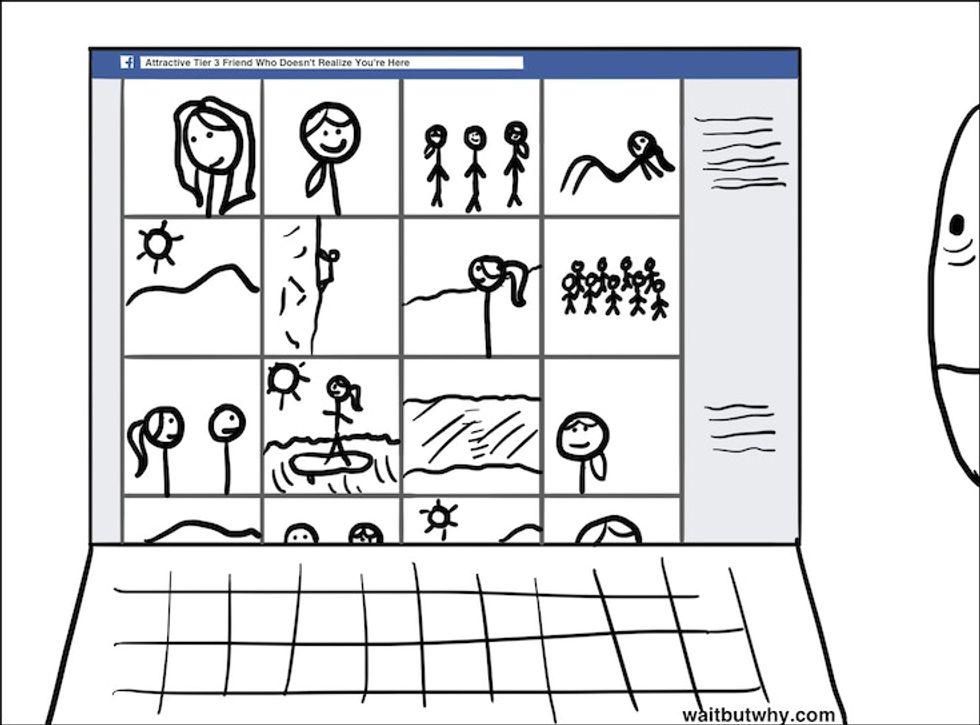
Comic of a computer with photo grid

What’s happening on social media?

via Wait But Why post and used with permission.

This person isn't a celebrity to anyone other than you, you creep. You know exactly who I'm talking about — there are a small handful of people whose Facebook page you're uncomfortably well-acquainted with, and those people have no idea that this is happening. On the plus side, there are people out there you haven't spoken to in seven years who know all about the new thing you're trying with your hair, since it goes both ways.

This is a rare Tier 3 friend, or even an acquaintance, who qualifies as an odd friendship because you found a way to make it unhealthy even though you're not actually friends. Well done.

10. The lopsided friendship
Two stick women discussing dinner

Can I make all the decisions... that was rhetorical.

via Wait But Why post and used with permission.

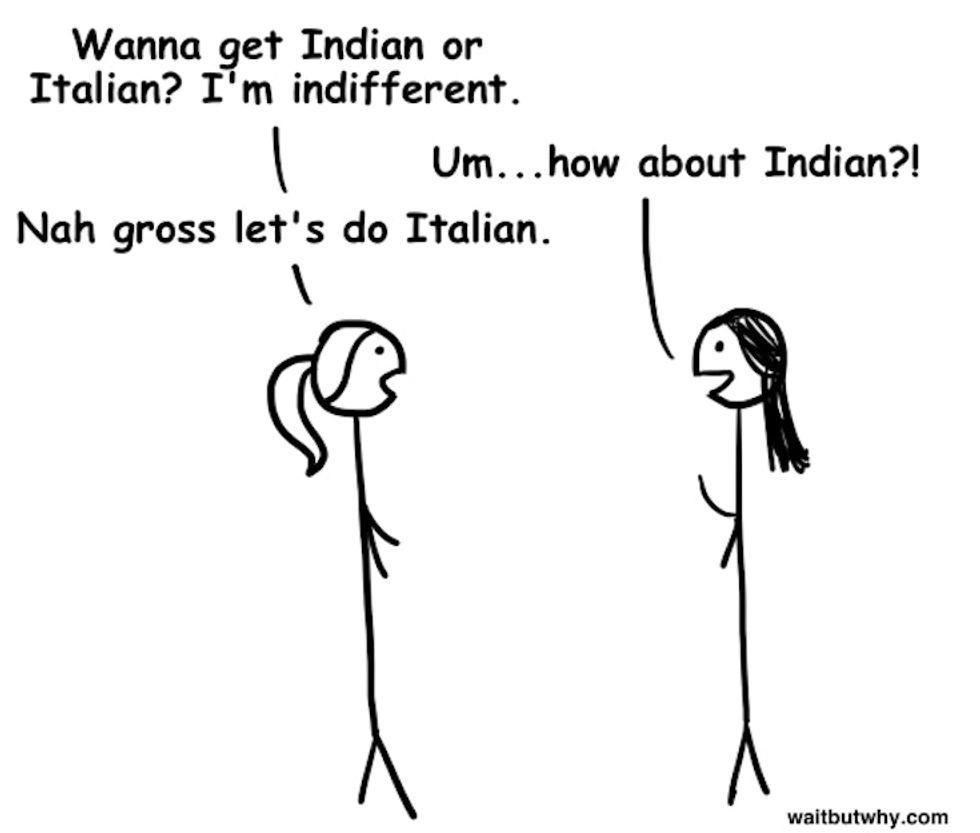
There are a lot of ways a friendship can be lopsided: Someone can be higher on their friend's mountain than vice versa. Someone can want to spend more time with a friend than vice versa. One member can consistently do 90% of the listening and only 10% of the talking, and in situations where most of the talking is about life problems, what's happening is a one-sided therapy situation, with a badly off-balance give-and-take ratio, and that's not much of a friendship—it's someone using someone else.

And then there's the lopsided power friendship. Of course, this is a hideous quality in many not-great couples, but it's also a prominent feature of plenty of friendships.

A near 50/50 friendship is ideal, but anything out to 65/35 is fine and can often be attributed to two different styles of personality. It's when the number gap gets even wider that something less healthy is going on—something that doesn't reflect very well on either party.

There are some obvious ways to assess the nature of a friendship's power dynamic: Does one person cut in and interrupt the other person while they're talking far more than the other way around? Is one person's opinion or preference just kind of understood to carry more weight than the other's? Is one person allowed to be more of a dick to the other than vice versa?

Another interesting litmus test is what I call the “mood determiner test." This comes into play when two friends get together but they're in very different moods — the idea is, whose mood “wins" and determines the mood of the hangout. If Person A is in a bad mood, Person B is in a good mood, and Person B reacts by being timid and respectful of Person A's mood, leaving the vibe down there until Person A snaps out of it on her own — but when the moods are reversed, Person B quickly disregards her own bad mood and acts more cheerful to match Person A's happy mood — and this is how it always goes — then Person A is in a serious power position.

But hey, not all friendships are grim.

In the Does This Friendship Make Sense graph above, the friendships we just discussed are all in Quadrants 2, 3, or 4 — i.e., they're all a bit unenjoyable, unhealthy, or both. That's why this has been depressing. On the bright side, there's also Quadrant 1—all the friendships that do make sense.

No friendship is perfect, but those in Quadrant 1 are doing what friendships are supposed to do: They're making the lives of both parties better. And when a friendship is both in Quadrant 1 of the graph and on Tier 1 of your mountain, that friendship is a rock in your life.

Rock friendships don't just make us happy — they're the thing (along with rock family and romantic relationships) that makes us happy.

Investing serious time and energy into those is a no-brainer long-term life strategy. But in the case of most people over 25—at least in New York— I think A) not enough time is carved out as dedicated friend time, and B) the time that is carved out is spread too thin, and too evenly, among the Tier 1 and Tier 2 friendships in all four quadrants. I'm definitely guilty of this myself.

There's something I call the Perpetual Catch-Up Trap. When you haven't seen a good friend in a long time, the first order of business is a big catch-up — you want to know what's going on in their career, with their girlfriend, with their family, etc., and they want to catch up on your life. In theory, once this happens, you can go back to just hanging out, shooting the shit, and actually being in the friendship. The problem is, when you don't make enough time for good friends, seeing them only for a meal and not that often — you end up spending each get-together catching up, and you never actually get to just enjoy the friendship or get far past the surface. That's the Perpetual Catch-Up Trap, and I find myself falling into it with way too many of the rocks in my life.

There are two orders of business right now:

First, think about your friendships, figure out which ones aren't in Quadrant 1, and demote them down the mountain. I'm not suggesting you stop being friends with those people—you still love them and feel loyal to them, and old friends are critical to hold onto—but if the friendships aren't that healthy or enjoyable, they don't really deserve to be in your Tier 1, and you probably shouldn't be in theirs. Most importantly, doing this clears up time to...

Second, dedicate even more time to the Quadrant 1, Tier 1 rocks in your life. If you're in your mid-20s or older, your current rocks are probably the only ones you'll ever have. Your rock friendships don't warrant two times the time you give to your other friends—they warrant five or 10 times!

Your rocks deserve serious, dedicated time so you can stay close. So go make plans with them.


This article was written by Tim Urban and originally published on Wait But Why. It originally appeared here nine years ago.

Pop Culture

All In: 5 Ways This Week

From the silly to the sentimental, there are so many ways people like to go “all in” on something. Here are our five favorite examples we found this week across the internet.

5 ways people are going "All In" this week
True

When you hear the words “all in,” what do you think? You might picture a Dancing with the Stars trend gone viral or maybe bridesmaids who fully supportive of the bride's favorite movie (and recreates an iconic scene). Whatever you picture, the idea is the same: Someone who does something with 100 percent total commitment. Going “all in” means giving your all—going completely over the top, no second guessing, no holding back. Just full-throttle enthusiasm, with some flair and creativity thrown in. And when people go “all in,” something truly special usually happens as a result.


The internet abounds with examples of people giving it their all—whatever it is. In this roundup, we’ve found the very best examples of people going “all in”—moments where passion, creativity, and commitment take center stage. Some are sentimental, some are silly, but all of them are a reminder that giving 100 percent is truly the only way to leave a mark on this world. Get ready: These folks didn’t just show up, they went all in.


1. An Iconic "snow-coaster"

One thing about going all in - it can be crazy and childish at times. That’s something that makes going all in special, connecting with that side of you that takes things less seriously in order to have some fun. Shira Goldstone and her husband took to that mindset when it started snowing in their backyard. Shira’s husband picked up planks of wood (and whatever other tools are required) and within the same night, in the falling snow, built a “snow-coaster” for the two of them to play on.

2. A Truck That's Feeding It's Community

You already know our friends at All In—they’ve got some seriously tasty snacks that are not only healthy and affordable (scroll to the bottom of this article to see how you can snag a free bar), they help fund food banks, gardens, community fridges, meal programs, and other amazing things

For Giving Tuesday, All In teamed up with Fresh Truck, a weekly mobile market that brings fresh and affordable produce to neighborhoods in the Boston area. Fresh truck hosts weekly markets, pop-up events, and an online storefront, all to help strengthen communities who need it the most. They’re going all in on local nutrition and food access, and we’re here for it.


3. All In on Madam Morrible

I’m always all in on a good TikTok trend. This week, I’m going to share with you a classic that has come out of the Wicked franchise and the incredible actress Michelle Yeoh.

Michelle, who plays Madame Morrible in the Wicked movies, is an outstanding actress. She’s known for iconic films like Everything, Everywhere, All At Once, as well as Crazy Rich Asians and Star Trek. But her legacy might be this one quote, which she’s said in interviews countless times, and now people can’t stop making videos with the phrase “Madame Morrible, M.M…flip it around, W.W. Wicked Witch!”

You might have to take a look at how people are going all in yourself, the sound has taken off with already 14.3K videos, and the variations are unstoppable...defying all odds and maybe even...defying gravity?

4. Spotify Wrapped: All in on "Coconut Mall"

TikTok · Ale

www.tiktok.com

There’s nothing better than finding a song that hits just right and gets you feeling productive. For some people, it’s lofi beats. For others, it’s orchestra music. For TikTok user @aleinmotion, it was the “coconut mall” song from the Mario Kart racing soundtrack. Ale never realized how much she listened to the song until it became #1 on her Spotify Wrapped. Sometimes you’ll be surprised by what you love most, and I’m thinking this is one of those moments for Ale.

5. A Family Prank Everyone Enjoys

This girl said her boyfriend had an ugly hat, so her family decided to go all in on supporting him instead. This is when love and humor come together, a perfect prank that actually made the boyfriends day…and taught his girlfriend that nothing is really that serious! They even got the daughter her very own hat as well, and she looked happy to wear it!

As someone who grew up with a dad who always wore floppy hats to protect him from the sun, I understand the embarrassment. Maybe it’s time I go all in and show my support with a matching hat and white long sleeve sun shirt!

Snag your free (!!) snack bar here while this deal lasts. Simply sign up with your phone number, pick up your favorite flavor of an All In bar at Sprouts, and then text a picture of your receipt through Aisle. They’ll Venmo or PayPal you back for the cost of one bar. Enjoy!

batteries, energy, sustainability, power, breakthroughs

UCI doctoral candidate Mya Le Thai has developed a nanowire-based technology that allows lithium-ion batteries to be recharged hundreds of thousands of times.

A quote widely attributed to the Roman philosopher Seneca says, "Luck happens when preparation meets opportunity." In 2016, a doctoral candidate at the University of California Irvine proved that this is indeed the truth.

Nine years ago, Mya Le Thai, PhD was playing around in the lab when she made a colossal discovery that could lead to a rechargeable battery—that could last up to 400 years. That means longer-lasting appliances, laptops, smartphones, cars and so much more, plus fewer lithium ion batteries piling up in landfills.


A team of researchers at UCI had been experimenting with nanowires for potential use in batteries, but found that, over time, the thin fragile wires would break down and crack after too many charging cycles. A charge cycle is when a battery goes from completely full to completely empty and back to full again.

charging station, battery, charging battery, charge, batteries Phone charging.Canva Photos.

But one day on a whim, Thai coated a set of gold nanowires in manganese dioxide and a Plexiglas-like electrolyte gel.

"She started to cycle these gel capacitors, and that's when we got the surprise," said Reginald Penner, chair of the university's chemistry department. "She said, 'this thing has been cycling 10,000 cycles and it's still going.' She came back a few days later and said 'it's been cycling for 30,000 cycles.' That kept going on for a month."

This discovery is mind-blowing because the average laptop battery lasts 300 to 500 charge cycles. The nanobattery developed at UCI made it though 200,000 cycles in three months. That would extend the life of the average laptop battery by about 400 years. The rest of the device would have probably gone kaput decades before the battery, but the implications for a battery that lasts hundreds of years are pretty startling.

- YouTube www.youtube.com

“Mya was playing around, and she coated this whole thing with a very thin gel layer and started to cycle it,” Penner added. “She discovered that just by using this gel, she could cycle it hundreds of thousands of times without losing any capacity.”

“That was crazy,” he added, “because these things typically die in dramatic fashion after 5,000 or 6,000 or 7,000 cycles at most. ”"The big picture is that there may be a very simple way to stabilize nanowires of the type that we studied. If this turns out to be generally true, it would be a great advance for the community."

Not bad for just fooling around in the laboratory!

science, discovery, lab, batteries, Bill Nye, gif bill nye chemistry GIF by NETFLIX Giphy

Since her discovery, Mya Le Thai earned her PhD and has gone on to a successful career as the Principal Scientist with the Enevate Corporation, a company set "to develop innovative battery technologies that accelerate adoption of electrified mobility," according to their website.

She has also filed patents for her various inventions, the most recent of which being "Cells with blocking devices for delayed heat propagation" in July 2025. Her full list of patents can be found on Justia.

This article originally appeared eight years ago. It has been updated.

social awkwardness, resilience, talent, evolution, growth

If you're socially awkward, you may be more resilient than others think.

Many people experience social awkwardness from time to time, but for some, it happens much more often.

They accidentally say the wrong thing, miss social cues, or are simply overly shy at parties, in meetings, or around people in general. It can make you wonder how social awkwardness still exists as a trait in humans, given that we’ve evolved into such a highly social species—starting with small tribes built for survival and eventually growing into the thriving societies we have today.


Well, one psychologist has a theory about how socially awkward people not only survived evolution but actually thrived.

"There’s this curious and strong correlation between social awkwardness and what researchers call 'extraordinary achievement' or 'striking talent,'" said psychologist Ty Tashiro on the A Bit of Optimism podcast. "People who achieve amazing things in this world, things that are kind of the tail end of the bell curve, they're actually more likely to be more awkward."

@simonsinek

What if being socially awkward is actually a superpower? Ty Tashiro, an incredible psychologist and author, joined me on A Bit of Optimism this week for a deep dive on why awkward is awesome. It's an episode filled with laughs, 'aha' moments, and maybe a bit of self-recognition. 🤓 Check it out wherever you listen to podcasts and find out why your next awkward moment could be the start of something amazing.

Tashiro explained that socially awkward individuals often have an "obsessive interest in things," zeroing in on details and minutiae, sometimes at the cost of engaging with others or following social norms. However, he argues that this obsessiveness can translate into persistence during hard times and resilience in the face of challenges, ultimately helping them achieve great things.

This could explain why many people perceive brilliant scientists as smart but poor communicators, and why so many highly successful people who are often considered geniuses or leaders in their fields are also introverts.

"Socially awkward individuals often spend a lot of time alone," therapist Lesley Lesker told Upworthy. "This provides the opportunity for them to process information thoroughly, look at all different angles and analyze situations in a more depth manner than non-socially awkward individuals."

- YouTube youtu.be

Support systems are necessary for success

But can being socially awkward or neurodivergent really lead to greater resilience in the face of struggles and more persistence when confronting challenges? The experts who spoke to Upworthy believe it's possible, especially when socially awkward individuals have a strong support system around them.

"Resilience is built when we go through difficult situations and come out on the other side, realizing that we are okay," said Lesker. "For socially awkward people, these challenging situations often happen several times a day, every day of the week. The difference between someone who is able to build resilience and someone who is not often comes down to whether or not they live within a supportive environment."

"The key factor in whether these 'super powers' lead to resilience really depends on support systems—family, education, social, and psychological support make all the difference," said therapist Karissa Provost.

"Social awkwardness is a blessing and a curse. The reason that many people are socially awkward is because their brain is so unique and sees the world in such different ways that they naturally don't conform to social norms," said Tyana Tavakol, a licensed trauma therapist in California and Florida, and virtual private practice owner of Uncovering You. "This uniqueness can build resilience when their awkwardness is more consistently than not taken as quirky, funny, or some other type of endearing way. This can happen when they grew up in a very attuned and accepting home or family, or happened to find friends or community that also have their own unique brains and can really appreciate that in others."

"For those who struggle to build resilience, it is likely they experienced the exact opposite: being bullied, shamed, criticized, or going through other types of negative responses to their social awkwardness more often than they got support for it," Tavakol added.

"There's also a biological component," said Provost. "Resilience is linked to brain structure, particularly how the frontal cortex regulates emotional responses from the amygdala. People with better-regulated fear responses recover more quickly from social stress, and the good news is this can be developed through coping skills and emotional regulation strategies over time."

What if social awkwardness still hurts?

Lesker told Upworthy that social awkwardness can still feel emotionally overwhelming, and that breathing techniques, grounding exercises, and other strategies can help regulate that stress. She also recommends that socially awkward people "create scripts" for common social situations to rely on in order to make them more comfortable and confident. This can include small talk like, "Hi, how was your day?" or "How do you know the host?"

Overall, self-compassion is the key to working through socially awkward feelings and building resilience.

@kolourmemisfit_24

Be my friend 🥹 #sociallyawkward #awkward #awkwardmoments #momsoftiktok #momfriends #locs #girlswithtattoos

"Developing self compassion can help a socially awkward person to build resilience," Lesker concluded. "It is common for a socially awkward individual to blame themselves excessively, but when you speak to yourself compassionately in the same way that you would speak to a friend, resilience will grow."

snl, christmas, holidays, satire, comedy, kristen wiig, saturday night live, humor, youtube, christmas presents, moms
SNL/YouTube

Classic SNL Christmas sketch has people rethinking the holiday dynamics in their family.

Five years ago, one of the most iconic Christmas sketches ever aired on Saturday Night Live. It's called simply, "Christmas Robe," and it depicts an average American family excitedly waking up on Christmas morning, running to the tree, and opening their presents. In song form, each member of the family takes turns rapping about their own gift haul: A hat, a drone, a pinball machine...

Except for poor mom, played perfectly by Kristen Wiig, who only got a robe—that was 40% off. Things only get worse for Mom as she discovers that her stocking is also empty and she must now go make the family breakfast while everyone plays with their new gifts.


If you haven't seen it, here it is. It's well worth watching in its entirety:


- YouTube www.youtube.com

The sketch got a lot of laughs and resonated deeply with people—especially moms—who watched it.

It's no big secret that moms are the primary makers of Christmas magic in most Western families. While they get joy out of making the holidays special for their families, it's a lot of exhausting work, made worse when it goes unnoticed and unappreciated. It's implied, of course, that Kristen Wiig's character bought everyone their presents while no one in the family bothered to think of her at all.

Jessica Cushman Johnston writes for Motherly: "[Making Christmas magic] is not something my husband or my kids put on me, it’s my own deal. It’s also a tinsel-covered baton handed down from generation to generation of women. As a kid, I just thought the warm fuzzy feelings I felt on Christmas morning 'happened.' Now I know that the magic happens because someone is working hard, and now that someone is me."

Kristin Wiig's character beautifully says it all with the dead-inside expression as she feigns excitement over her lonely robe. In just two and a half minutes, the cast and writers managed to capture a frustrating feeling that millions of women relate to.

The sketch spawned discussions, think pieces, and even parodies when it aired in 2020. Real moms took to social media to "show off" their own robes in an act of solidarity. The sketch had, one could say, a moment. And then, quietly, it retired and took its place in the SNL holiday hall of fame, destined to be re-watched for years to come.

And then something funny happened. People kept tuning in. The skit continued to reach new viewers, and somewhere along the line, a few people actually learned something from the extremely silly sketch.

Saturday Night Live's YouTube and social media are full of comments from viewers who say the sketch opened their eyes in a very real way. And even better, that they're changing their behavior because of it:

"As a retail worker, I actually heard multiple people reference this sketch while buying presents for their wife/mom this year. Thanks SNL!"

"This skit changed Christmas in our house. The year it aired my husband made sure I didn’t get a robe and since this aired (okay, two Christmases have gone by) it’s a joy to see boxes under the tree and a full stocking- now in our house when I’m forgotten my husband says, “you got a robe” and adjusts the situation. Never thought a skit could change my life."

"I just saw this first time. I'm definitely going to buy better present next Christmas to my mom."

"A few years ago, I got a robe. This year, I got a new iPad plus all the accessories. SNL doing all the moms a solid."

"As a grown man, this skit is the first time I've realized how true this is. And now I feel so damn awful :( Gonna bombard moms with the presents this year"

"Seriously! I got a bunch more stuff for my mom after seeing this! It's so accurate. No more robes for mom!"

"I was laughing at this, then realized my mom's stocking was empty and ran out and bought her a truckload of stuff. Love you Mom!"

"Thanks, SNL. After watching this with the family, I had the most bountiful Christmas ever!! And the gifts were wrapped instead of left in the bags the came in."

"This video did more to stimulate spending on Moms this year than almost anything else, guaranteed. Look at SNL actually making a difference with their humor"

The comments go on and on, with the video now reaching over 12 million views. Some moms changed their behavior, too, after seeing the sketch:

"This is spot on, and exactly why I now buy myself Christmas presents, without feeling guilty about it."

The trouble of moms unfairly shouldering too much labor around the holidays (and, well, most other times of the year) is not a new problem. Not by a long shot. So why has this skit reached people when other forms of messaging has failed to sway them?

Marie Nicola, a pop culture historian and cultural analyst, says that no amount of deeply serious essays or shrugged off "mom is complaining again" can fix what satire easily addresses. That's the power of comedy at its best:

"It allows the audience see what was historically unseen or ignored, and it validates the labour as visible and concrete, without being accusatory because it wraps the whole thing up in camp comedy and exaggeration. The skit makes it safe to laugh. This is what psychologists call benign violation," she says. "SNL is showing viewers that something is wrong but they have made it safe enough that people can laugh at it instead of feeling attacked. Once the defenses drop, then recognition can flow through that opening."

The Humor Research Lab writes that humor occurs when an accepted "norm" is violated in a benign way—that's the benign violation Nicola's referring to. "Jokes ... fail to be funny when either they are too tame or too risqué."

The best pieces of satire—the ones that reach the highest levels of cultural relevance—thread that needle perfectly. The norm, in this case, according to Nicola, is that it is "a privilege to curate the perfect holiday experience for the family, the gift is the joy in the moment and their memories for years to come." We're not allowed to talk about the dejection and exhaustion that come from all that hard work. This sketch gave a lot of people permission for the first time to do so.

It’s not the first time that SNL’s comedy and satire have had a palpable effect on how we view the world.


- YouTube www.youtube.com

Once SNL performed the "More Cowbell" sketch, none of us could look at the bizarrely overproduced "Don't Fear the Reaper" the same way again. An old Eddie Murphy sketch got a lot of laughs out of the idea of "white privilege" long before it became a commonly known concept. And people had a hard time taking Sarah Palin seriously after Tina Fey's spot-on yet over-the-top impersonation, with studies later investigating the "Tina Fey Effect's" impact on the election.

And now, the more than 12 million people who have seen "Christmas Robe" are going to have a hard time looking at Mom’s empty stocking without being reminded of Kristen Wiig’s pitch-perfect performance.

Of course, "Christmas Robe" continues to land and connect with viewers today in part because it has not solved the problem of household inequities. The phenomenon continues to exist in spades. But the fact that it’s made even a small dent is pretty remarkable for a two-and-a-half-minute parody rap song.

france, germany, netherlands, english, european people, eu

A French woman, German man, and Dutch woman.

Even though the United Kingdom isn’t in the European Union, English is the lingua franca throughout the region because it's the standard language for international commerce. A lingua franca is a common language that two people who don’t speak the same language use to communicate. When one person speaks French and the other German, they can use English to communicate.

There are 27 countries in the European Union and 24 native tongues, but a whopping 43% of the nearly 450 million people who live there speak English, and German is a far second with 16% of people in the EU fluent in the language.


According to the EF English Proficiency Index, if you travelled to Europe and wanted to go somewhere where people are best at speaking English,, the best country is the Netherlands. Croatia and Austria finish 2nd and 3rd, respectively.

dutch woman, netherlands, dutch people, dutch street, happy woman A happy woman in the Netherlands.via Canva/Photos

The top 10 countries in English proficiency as a second language are all in Europe:

1. Netherlands

2. Croatia

3. Austria

4. Germany

5. Norway

6. Portugal

7. Denmark

8. Sweden

9. Belgium

10. Slovakia

Ranking countries in English proficiency isn’t just about finding places where Americans, British people, or Australians can go on vacation; it has to do with the number of opportunities that people, especially those who are economically disadvantaged, can have.


“Working adults who speak English in addition to their other languages have access to a wider range of information and more diverse professional opportunities. For individuals in marginalized groups or geographically disadvantaged locations, a professional level of English may represent a pathway to financial independence they could not otherwise attain,” the EF English Proficiency Index writes in their 2025 report.

Having a large number of English speakers also bodes well for a country’s economic development. “English proficiency reflects a workforce's capacity to engage with the global economy beyond national boundaries. In economies transitioning toward knowledge-based sectors, comfort with English often signals adaptability to international standards and practices,” the report continues.

- YouTube youtu.be

Why do the Dutch speak English so well?

This study raises an important question: Why are the Dutch so good at speaking English? The first reason is that in the Netherlands, television shows aren’t dubbed. So, if you are watching an episode of Happy Days, you hear it in the original English, but it is subtitled in Dutch. In countries such as Germany, Spain, or France, TV shows are dubbed into the local language, so viewers hear less English.

Second, the Dutch economy is predicated on international trade. It’s a small country with just 17 million inhabitants; however, it has the 18th-largest economy in the world. This means that people in the Netherlands have to be great at speaking the international language of business if they are going to get by. The Dutch tradition of international business dates back to 1602, when the Dutch East India Company became the world's first multinational corporation.

Their culture's openness to hearing other languages and dependence on global trade have made it so that up to 93% of Dutch people can carry on a conversation in English.

Ultimately, the EU’s embrace of English isn’t just historical happenstance—it’s closely tied to the region's growing economic, social, and cultural interconnectedness. For many, speaking English is a gateway to opportunity and participation in the global economy. The Netherlands is an excellent example of how learning a second language can lead to incredible prosperity.

farts, fart research, farting all the time, flatulence, gas causing foods, science, study, research

What's bad for the nose is good for the brain.

Everybody farts. Upwards of 23 times a day, in fact. It’s one of the most universal human experiences, cutting (the cheese) across age, culture, and personality. Yet for something so common, it somehow feels very different coming from a woman than it does from a man.

But according to research highlighted in a now-legendary study, there indeed is a difference between man farts and lady farts. This unexpected fact about the battle of the sexes carries an even more unexpected health benefit.


Yes, this is a story about farts. But stay with us.

The doctor who wanted to know what makes flatulence smell

farts, fart research, farting all the time, flatulence, gas causing foods, science, study, research Thumbs up media3.giphy.com

Back in 1998, Dr. Michael Levitt, a gastroenterologist known among colleagues as the “King of Farts,” set out to understand where that unmistakable scent of human flatulence comes from. To answer the question, he recruited 16 healthy adults with no gastrointestinal issues. Each participant wore a “flatus collection system,” described as a rectal tube connected to a bag.

After eating pinto beans and taking a laxative, the volunteers provided samples that were then analyzed using gas chromatographic mass spectroscopic techniques. Levitt and his team broke down the chemical components inside each bag and invited two judges to help evaluate the results. The judges did not know they were sniffing human gas (which in retrospect sounds diabolical). They rated each sample on an odor scale from zero to eight, with eight meaning “very offensive.”

Their assessments pointed clearly to one culprit. Sulfur-containing compounds were responsible for the strongest and most memorable odors, especially hydrogen sulfide, which produces that classic “rotten egg” smell.

So where does the gender difference come in?

Here is the twist researchers did not expect: although men tended to produce larger volumes of gas, women’s flatulence contained a “significantly higher concentration” of egg smelling hydrogen sulfide. When the judges rated the odor of each sample, they consistently marked women’s gas as having a “greater odor intensity” than men’s.

farts, fart research, farting all the time, flatulence, gas causing foods, science, study, research Woman in chair. media0.giphy.com

The unexpected health connection

Hydrogen sulfide may smell intense and unpleasant, but inside the body, at low levels, it plays a key role in helping brain cells communicate. It works by chemically adjusting proteins through a process called sulfhydration. This process tends to decline as people age, and it declines even more sharply in patients with Alzheimer’s disease.

That singular fact sparked a new wave of research.

In 2021, scientists at Johns Hopkins Medicine conducted experiments on mice genetically engineered to mimic human Alzheimer’s. The mice received injections of a hydrogen sulfide carrying compound called NaGYY for 12 weeks. The results were remarkable. Behavioral tests revealed that treated mice saw a 50 percent improvement in cognitive and motor function compared with untreated mice.

In conclusion: women's farts are worse for the nose, but better for the brain.

A reframing of an everyday experience

The science suggests that the very compound behind a silent but deadly toot may also be a quiet guardian of brain health. Something that has historically been a source of embarrassment, especially for women, might actually reflect a built in biological benefit.

Sometimes the world offers good news in the most unexpected places.