upworthy
Add Upworthy to your Google News feed.
Google News Button
Popular

Adults who actually lived through the '80s share 15 things pop culture still gets wrong about that time

"Pop culture acts like the '80s were just a sea of nothing but neon for 10 years."

80s, 1980s, pop culture, myths, Reddit, retro, 80s fashion, neon, smoking, homophobia
Canva

A woman decked out in a 1980s outfit

YouTubeJudging by Gen Z’s Y2K-inspired fashion trends, you’d think the 2000s were nothing but people walking around the mall in pleated miniskirts and bucket hats. We can mostly chalk this up to the depiction of the era in movies like “Clueless” and “13 Going on 30.” Anyone born before the 90s can tell you that life was definitely not like that. But hey, sometimes fantasy is more fun.

Same goes for other time periods as well. For those of us without a degree in history, much of how we picture other eras is influenced by pop culture. Like how we think of Victorian women being obsessed with waist cinching thanks to almost every Hollywood movie showing a woman getting bound by an excruciating tight corset. Yep, that was previously debunked.

And sure, some movies and TV series, like “Mad Men” or “Schindler’s List,” make painstaking efforts to achieve historical accuracy. But often, they are works of fiction, and creative liberties are taken. And those liberties create the world for those who did not live in it.

80s, 1980s, pop culture, myths, Reddit, retro, 80s fashion, neon, smoking, homophobia Stereotypical man from the 1980sCanva

That can even be said of the 80s, rife with Cold War threats and colorful leggings. Or…was it? Recently, user Jerswar asked Reddit: "People who were adults in the 1980s: What does pop culture tend to leave out?" Here are the raddest, gnarliest, most tubular response people gave.

1."The insane amounts of smoking inside. Especially in restaurants."

"When I worked in a restaurant, the smokers (backroom dishwashers/cooks) got more chances to sit around and take breaks to smoke. Then, when I got an office job, people had ashtrays at their desks. Often, the ashtrays were hand-made by a young relative in an elementary school class."

80s, 1980s, pop culture, myths, Reddit, retro, 80s fashion, neon, smoking, homophobia YouTube

2." Anything we wore that wasn't neon. Pop culture acts like the '80s were just a sea of nothing but neon for 10 years."

“And as if every girl and woman was dressed up in tulle tutus with off-the-shoulder lace shirts and a giant bow tied atop our heads.Not all of us were lucky enough to have our parents buy us new outfits like that. My wardrobe was full of old hand-me-downs. No neon, lace or tulle in the bunch."

"I graduated high school in 1984, and never dressed like Madonna or wore neon anything. We were poor, so it was crappy jeans that never got soft and T-shirts until I got a job. Even after that, I wore cords and overalls and sweaters from Chess King."

80s, 1980s, pop culture, myths, Reddit, retro, 80s fashion, neon, smoking, homophobia YouTube

3. "How much decor from the '70s and '60s were still in houses and offices throughout the decade."

"This is something that I thought 'Stranger Things' REALLY got right. All the kids' houses look like they were built and decorated in the 1960s–'70s, which is how it really was. Nobody was living in fancy candy-colored Memphis-style apartments except California yuppies."

4. "I was born in the early '80s. I've been totally blind since birth. In the '80s, accessibility was virtually non-existent.That new Nintendo that the kids had? Good luck. Scholastic Book Club? Not in braille or audio. Everything is in print. Nothing to see here for me or mine. Then computers finally got accessible and Windows came out and they had to start all over again. I wouldn't want to go back to the '80s. I now have my phone that I can use to access the world, read what is on my grocery labels, have pictures described to me, and basically know what's going on in the world. In the '80s, so much went by without any context, and that was in the formative years of my childhood."

5. "Reading everything — literally everything — I could get my hands on. Cereal boxes, newspapers, magazines. Luckily, my library was a bike ride away but carrying those back on my bike was fun."

"OMG, you are so right. That reminds me of things I hadn't thought about in ages.I used to feel so very bored that I'd read anything that had text on it, from cans of food to cereal boxes to whatever books (however insipid) I could lay my hands on. Even the obituary notices in the newspaper were worth a read. The internet really did away with the boredom, didn't it?!"

Speaking of reading…

80s, 1980s, pop culture, myths, Reddit, retro, 80s fashion, neon, smoking, homophobia A frustrated man sits on the toiletCanva

6. "Trying to find something to read in the bathroom to pass the time. I remember shampoo bottles and the contents of my wallet were my go-to's when a magazine or book was unavailable." "Yes! Shampoo bottles for desperate moments of boredom."

7. "Might be my own bias but being a kid in the '80s there was a lot of casual bullying and conformism. Not that bullying and conformism ever went away, but the '90s was more about counter-culture a bit."

8. "I was a child in the '80s, but something that I don't think I've ever seen in modern pop culture retellings of '80s life, which I recall witnessing, is this: people think of the weird, wacky, fun colors and hair, etc., of the 1980s — like Madonna, Cyndi Lauper, Boy George styles. BUT for many people and mainstream communities, that was considered a 'weird' or 'rock and roll character' kind of presentation. People would often openly stare, laugh at, or disparage people who looked openly unique. It took a lot of courage to go out styled like that. It was acceptable to have a more 'subtle' take on the fun color trends."

"I believe the best real-time representation/evidence of this is in Cyndi Lauper's 'Time After Time' music video, there’s a scene where she sits down in a diner with her boyfriend and his friends. She pulls off her cap to reveal her new hairstyle - half-shaved and dyed bright colors. Her boyfriend's friends start hysterically laughing, the boyfriend is quietly embarrassed, and she runs out of the diner in tears."

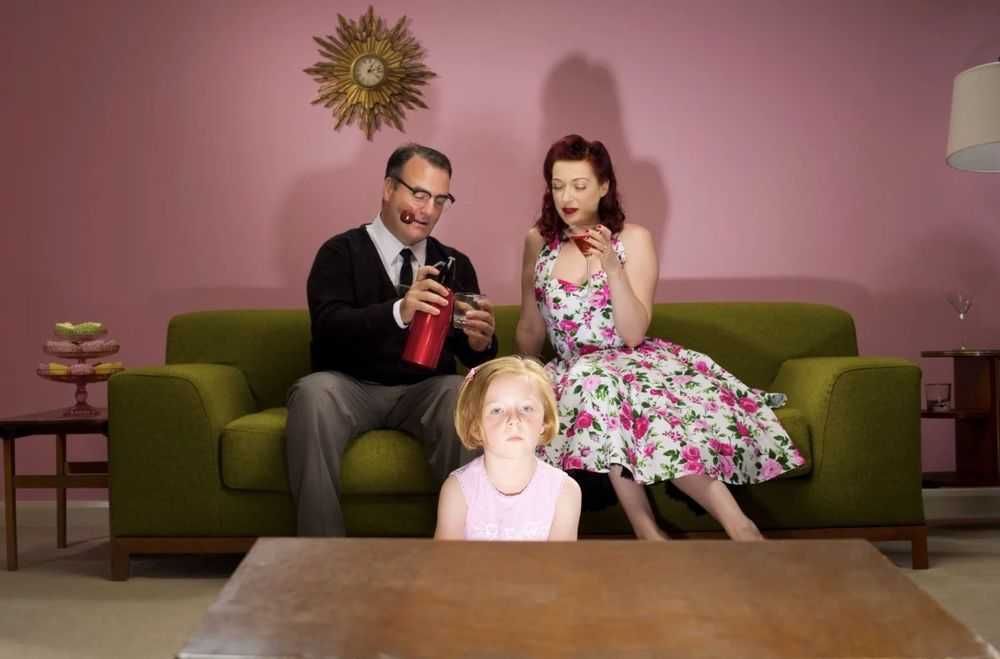
80s, 1980s, pop culture, myths, Reddit, retro, 80s fashion, neon, smoking, homophobia A retro family watches TV in their living roomCanva

9. "TV was just adult shows for most of the week, especially during summer break. Just soap operas and other boring things." "Staying home sick from school and all there was to watch were game shows and soap operas until the Gilligan's Island reruns came on."


80s, 1980s, pop culture, myths, Reddit, retro, 80s fashion, neon, smoking, homophobia savage reagan GIFGiphy

10. "The sheer sense of doom and pervasive low-key terror of nuclear war. The Soviets' nuclear arsenal pointing at us, and their nihilistic posturing in some ways remind me of the climate change dread we now have. Living with an existential threat is not something new."

"This is so completely underestimated or misunderstood. All through high school, I was convinced that the world would just end one day, and I'd have to figure out how to survive in a post-apocalyptic world afterwards. Yeah, we thought that people would survive an all-out nuclear war."


80s, 1980s, pop culture, myths, Reddit, retro, 80s fashion, neon, smoking, homophobia YouTube

11. "The homophobia."

"It was casual, rampant, and virtually unquestioned. If you were gay or lesbian, and not living in a major city like New York or San Francisco, you were probably in the closet, at least to everyone but some close friends and (maybe) family. If you were trans, forget about it. Enjoy your life of dysphoria and misery. You don't really see that depicted so much in pop culture now."

"AIDS and '80s homophobia went hand in hand, and it's hard to overstate how much AIDS destroyed the gay community and how the dominant culture thought that was a good thing."

12. "Being a latchkey kid it was no frequent communication with your parents. I can't tell you how many times I stayed out all night as an 18-year-old and no one but who I was with knew where I was or what I was doing. My parents didn't know what I was doing all day as a 12–17-year-old, either! You only called your parents at work only if it was an emergency."

"Yes. It's almost like a 'parents didn't care' attitude that would be ascribed to that behavior now (but that wasn't right). Ma needed to work and that she didn't get home until 7 p.m. was just a reality. Oftentimes, she was gone when I got up and we had zero communication until she got home. I was just responsible for the whole shpiel of keeping myself alive."

13.The obsession people/media had about the '50s and '60s.”

“Part of it was stuff like 'Back to the Future,' '50s-themed diners and baseball jackets being popular, then there was the 20th anniversary of things, like various Beatles albums. I think the boomers at that point were in positions of influence and were looking back on their teens and twenties with rose-tinted glasses, so the rest of us had to suffer these cultural echoes from the generation before."

14."Cruising. Before social media, we would drive up and down the street, see and be seen. Stop at different businesses, the cool kids hung out at the Walgreens parking lot, the jocks at the McDonald's. But it was a small town so we would stop at all of them during the evening. That was our social world along with keggers in the desert all through high school and for folks that stayed in town for years after high school.

"It was like a social network but with your car."

And lastly…

15. "What a mess it was to get cleaned up!”

“That sparkle-blue eye shadow didn't come off easily and if it got in your eyes it was torture! That red lip gloss ran all over. And shampooing your hair three times to get out all the hairspray and the mousse. I loved the '80s and I had a marvelous time. But it was messy... but way worth it!"

This article originally appeared last year.

discussion, debate, disagreement, conversation, communication, curiosity

How do you get someone to open their minds to another perspective?

The diversity of humanity means people won't always see eye to eye, and psychology tells us that people tend to double down when their views are challenged. When people are so deeply entrenched in their own perspectives they're refusing to entertain other viewpoints, what do we do?

Frequently, what we do falls into the "understandable but ineffective" category. When we disagree with someone because their opinion is based on falsehoods or inaccurate information, we may try to pound them with facts and statistics. Unfortunately, research shows that generally doesn't work. We might try to find different ways to explain our stance using logic and reasoning, but that rarely makes a dent, either. So often, we're left wondering how on Earth this person arrived at their perspective, especially if they reject facts and logic.


According to Stanford researchers, turning that wondering into an actual question might be the key.

discussion, debate, disagreement, conversation, communication, curiosity Questions are more effective than facts when it comes to disagreements.Photo credit: Canva

The power of "Tell me more."

Two studies examined how expressing interest in someone's view and asking them to elaborate on why they hold their opinion affected both parties engaged in a debate. They found that asking questions like, "Could you tell me more about that?” and ‘‘Why do you think that?" made the other person "view their debate counterpart more positively, behave more open-mindedly, and form more favorable inferences about other proponents of the counterpart’s views." Additionally, adding an expression of interest, such as, ‘‘But I was interested in what you’re saying. Can you tell me more about how come you think that?” not only made the counterpart more open to other viewpoints, but the questioner themselves developed more favorable attitudes toward the opposing viewpoint.

In other words, genuinely striving to understand another person's perspective by being curious and asking them to say more about how they came to their conclusions may help bridge seemingly insurmountable divides.

discussion, debate, disagreement, conversation, communication, curiosity Asking people to elaborate leads to more open-mindedness.Photo credit: Canva

Stanford isn't alone in these findings. A series of studies at the University of Haifa also found that high-quality listening helped lower people's prejudices, and that when people perceive a listener to be responsive, they tend to be more open-minded. Additionally, the perception that their attitude is the correct and valid one is reduced.

Why curiosity works

In some sense, these results may seem counterintuitive. We may assume that asking someone to elaborate on what they believe and why they believe it might just further entrench them in their views and opinions. But that's not what the research shows.

Dartmouth cognitive scientist Thalia Wheatley studies the role of curiosity in relationships and has found that being curious can help create consensus where there wasn't any before.

“[Curiosity] really creates common ground across brains, just by virtue of having the intellectual humility to say, ‘OK, I thought it was like this, but what do you think?’ And being willing to change your mind,” she said, according to the John Templeton Foundation.

discussion, debate, disagreement, conversation, communication, curiosity Curiosity can help people get closer to consensus. Photo credit: Canva

Of course, there may be certain opinions and perspectives that are too abhorrent or inhumane to entertain with curious questions, so it's not like "tell me more" is always the solution to an intractable divide. But even those with whom we vehemently disagree or those whose views we find offensive may respond to curiosity with more open-mindedness and willingness to change their view than if we simply argue with them. And isn't that the whole point?

Sometimes what's effective doesn't always line up with our emotional reactions to a disagreement, so engaging with curiosity might take some practice. It may also require us to rethink what formats for public discourse are the most impactful. Is ranting in a TikTok video or a tweet conducive to this shift in how we engage others? Is one-on-one or small group, in-person discussion a better forum for curious engagement? These are important things to consider if our goal is not to merely state our case and make our voice heard but to actually help open people's minds and remain open-minded in our own lives as well.

Shitsuke, Japanese parenting, parenting, Japan, discipline. learning
Photo credit: Canva

Parents watch as their child uses a toothbrush.

When it comes to parenting, sometimes the simplest reframing of how you discipline can make all the difference. In a YouTube video, pediatric occupational therapist Emma Hubbard shares a tip she describes as the "Japanese rule that changes everything."

It's a method called "Shitsuke," which she explains literally translates to "discipline." She claims it's the "one simple rule that Japanese parents follow that helps create calm, respectful, and obedient children."


Hubbard makes it clear from the jump that although the word translates to "discipline," it doesn't carry the same meaning it does in Western culture. Instead, it's about getting ahead of behavioral issues rather than responding to them.

"It's really easy to fall into a cycle that looks something like this," she says. "We wait for our kids to act out, then we punish, lecture, or bargain with them. Shitsuke flips this completely."

- YouTube www.youtube.com

She goes on to explain that Shitsuke strongly urges parents to nurture their children by modeling good behavior and giving clear, consistent instruction.

"It's based on the belief that children develop good manners and courtesy through instruction and practice, not through punishment or hoping they'll just figure it out," she says. "Instead of constantly putting out fires, Japanese parents prevent them by actively teaching the exact behaviors they want to see."

Hubbard shares three main principles of this method:

1. Model the behavior you want to see

It's actually quite simple. Hubbard explains, "Japanese parents understand that kids are observational learners. If you want a calm child, you must be calm. If you want a respectful child, you must be respectful, especially when you're frustrated. And if you don't want your child to scream when they're angry, then you should also try not to scream when you're angry."

2. Be consistent with clear rules

Studies show that children are less anxious when given clear instructions and predictable routines.

"The truth is, rules don't make children unhappy," Hubbard says. "In fact, having no clear rules is what makes them anxious and stressed. Think about it like this. Imagine if you went to work and your boss never told you what time to arrive, what your job was, or even when team meetings started. You'd be anxious, stressed, and confused all day. And that's exactly how your child feels without clear rules."

In an article for Psychology Today, Jenalee Doom, PhD, points out that "both children's and adults' brains love predictability. We can still get pleasure from unpredictable things like surprises, but in general, we feel safe and secure when we have predictable routines, and we find unpredictability to be highly stressful." She goes on to offer suggestions for helping children feel safe, such as keeping regular bedtimes and having meals together.

3. Learn to reframe "naughty" behavior into a learning experience

This is the game changer for many parents, and what Hubbard calls the most important part of the concept.

"This is the most important part of Shitsuke that completely changes everything," she says. "Instead of just saying 'Don't do that' or 'Stop being naughty,' Shitsuke teaches parents to ask one crucial question: 'What skill does my child need to learn here?'"

The clear genius behind this principle is that it takes mistakes (which are going to happen) and turns them into lessons.

"This shift in thinking changes everything because instead of punishing the behavior you don't want, you start actively teaching the skill that they're missing," she adds. "And that's when you see real, lasting obedience because your child actually knows how to behave well."

children, discipline, shitsuke, Japanese method of learning, lessons A young girl has a tantrum. Photo credit: Vinh Thang on Unsplash

Hubbard's YouTube video has nearly one million views and over one thousand comments, many of which add insightful thoughts to the conversation.

One commenter stressed the importance of being respectful:

"Something I will add: growing up in Japan, polite behavior was acknowledged and positively reinforced by nearly every adult I interacted with. Not just my teachers, but my pediatrician, my neighbors, the old lady who ran the corner tobacco store, my barber, etc. Saying 'good morning!' or 'thank you!' felt fantastic, because here you are a tiny child being respectfully greeted by big adults. As an adult, I now acknowledge kind American children I encounter with comments like 'thank you, that was very considerate' to pass it on, and I see them smile. I do not have children of my own, but I encourage everyone to notice the children who are trying their best and to thank them for it."

Another commenter backs up the claim that children often thrive when they have set rules:

"Rules don't make children unhappy. 100%. As a teacher, they're the ones who expect me to follow the rules and enforce the consequences all the time. Predictability makes kids happy."

This commenter discusses the value of the words parents use:

"Framing of messages are so important. For example, instead of saying, 'Don't forget…,' rather say, 'please remember.' Or, 'Don't pull the kitty's tail,' instead say, 'Please pet it gently.' Reframe the message from communicating with negatively charged words to positively charged words by telling them what you want them to do, not what you don't want them to do."

Science

Her groundbreaking theory on the origin of life was rejected 15 times. Then biology proved her right.

Lynn Margulis had the audacity to challenge Darwin. And we're lucky she did.

lynn margulis, lynn margulis symbiosis, biology, scientific breakthroughs, darwin, darwinism, women in science
Facts That Will Blow Your Mind/Facebook

A photo of Lynn Margulis.

Throughout her prolific and distinguished career, biologist Lynn Margulis made several groundbreaking contributions to science that we take for granted as common knowledge today. For example, she championed James E. Lovelock’s “Gaia concept,” which posited that the Earth self-regulates to maintain conditions for life.

But by far, her most notable theory was symbiogenesis. While it was first written off as “strange” and “aesthetically pleasing” but “not compelling,” it would ultimately prevail, and completely rewrite how we viewed the origin of life itself.


In the late 1960s, Margulis wrote a paper titled "On the Origin of Mitosing Cells," that was quite avant-garde. In it, she proposed a theory: that life evolved through organisms merging together to become inseparable.

In essence, cooperation is the driver of life, not competition and domination. This directly went against Darwin’s “survival of the fittest” principle that was considered gospel in scientific circles. Margulis’ paper was rejected by fifteen journals before getting accepted into the Journal of Theoretical Biology.

- YouTube www.youtube.com

Time would be on Margulis’ side, however. By the late ‘70s and early ‘80s, research proved that the two major building blocks of plants and animals, chloroplasts and mitochondria were at one time independent bacteria. This solidified the fact that on a biological level, connection trumps autonomy for longevity. And now that fact is written in textbooks, with no real story of the adversity it overcame to get there.

While it is customary for most new scientific theories to be met with criticism, especially those that completely shift the current narrative, many have noted that sexism played a key part in Margulis’ initial lack of acceptance. On more than one occasion, she herself had hinted that women were seen as mothers and wives first, and scientists second. She recalled that while married to fellow scientist Carl Sagan that “Carl would finish his sentence, unperturbed” while she was expected to “handle all the duties of a 1950s housewife, from washing dishes to paying the household bills.”

And yet, Margulis would have other ideas that were controversial that had nothing to do with her gender. Most famously, she did not believe that AIDS was caused by HIV, and instead believed it was cause by a syphilis-causing type of bacteria, despite there already being decades of research proving otherwise. That view was seen as an endorsement of AIDS denialism, which undermined prevention and treatment effort. Then later in life, Margulis became a vocal proponent of 9/11 conspiracy theories suggesting government involvement the in Twin Towers attacks.

And yet, perhaps this is one of those “you gotta take the good with the bad” situations. Margulis’ inherent contrarian nature gave us both these unfounded, even harmful stances, in addition to entirely new paradigms that altered our understanding of life itself.

And if nothing else, it illuminated the need for science to include multiple points of view in order to unlock the truth. It seems life is, after all, about coming together.

comedian, comedy, jimmy carr, standup, philosophy, parenting, dads, fatherhood, family, kids

Comedian Jimmy Carr put the jokes aside and delivered a brilliant nugget of parenting advice mid-show.

Jimmy Carr is best known as a comedian, but he also has dyslexia and had extreme trouble reading and writing into his early teen years. Years later, he'd go on to graduate from Gonville and Caius College, Cambridge with degrees in social and political science and first class honors.

It's safe to say that, jokes aside, he's a pretty smart guy. And in Carr's standup routines, he's not afraid to set aside the gags for a few minutes and get serious about topics that he feels deserve proper attention.


At a recent show, Carr was performing crowd work—asking questions and bantering with the audience—when an audience member called out a poignant question.

"What's your advice for parents with toddlers?" a woman yelled out.

"Well, I mean, practical advice? You can half-ass it. Get an iPad, a Netflix subscription, and you're off to the...races. They'll be very... happy," he said. The crowd roared with laughter. But Carr wasn't done. "You want serious advice?" he asked the woman.

Seamlessly, he launched into his philosophy on parenting.

"Hard choices now, easy life later," he said to a round of applause from the crowd. "I bet you fucking love your kids, but you've also got to love who they could be. So it's kindness, isn't it? You want to be really kind to your children, but not just kind in the moment. In the moment, what do kids want? They want to watch TV, not read books. They want to eat junk food, not vegetables. If you give in to that, if you're kind in the moment, you've got fat, stupid kids. That's no good. You've got to be a little bit mean in the moment."

He then joked that this clip would become his own "famous last words," so to speak when his own kids get older and reveal what a terrible father he turned out to be.

- YouTube www.youtube.com

Carr taps into a common debate in his performance here: When does gentle parenting become so gentle that it does kids a disservice?

Millennial and even Gen Z parents are "breaking generational cycles of harshness and emotional distance," writes Motherly. Baby Boomers were notoriously distant, often as a result of their own upbringing, and some experts say Millennials have perhaps overcorrected.

Gentle parenting preaches connection over correction and validating a child's feelings frequently. Research generally suggests this is a good approach, but it's a high-wire act that requires careful calibration. Otherwise, as Carr points out, you wind up letting kids do whatever they want in an effort to be kind and avoid hurting their feelings—an approach called permissive parenting. That ultimately doesn't serve them in the long-run.

He doesn't shy away from the fact that being "meaner" is hard, and far easier said than done. It's a good thing to care about your kid's happiness, which is why Carr's reframe of the approach is so brilliant. You're being kind to the person your child will one day be, by being a little bit "meaner" right now.

comedian, comedy, jimmy carr, standup, philosophy, parenting, dads, fatherhood, family, kids Jimmy Carr became a dad in 2019.Albin Olsson/Wikimedia Commons

Carr is often all jokes, but he's been known to get serious when it comes to parenting. Reports say that Carr has one son, Rockefeller, who was born in 2019.

At another recent show, a woman called out wondering how she should deal with the kids who were bullying her 11-year-old son. After several minutes of non-stop, chaotic, ridiculously silly jokes, Carr turned on a dime.

"Speaking as a parent... you cannot helicopter parent. You cannot pave the jungle. You can just teach him to get through it. It's a very tough thing. On the upside, your kid is being bullied. That's terrible, I imagine heartbreaking for you...But at least he's not the bully. Tell him from me, you can't have an easy life and a great character. You can't have both. It'll make him stronger and better and more compassionate in the future," Carr said.

- YouTube www.youtube.com

Carr's parenting advice videos have gone mega viral across social media and commenters can't believe how skillfully he can transition from jokes to solid gold words of wisdom.

"Jimmy can turn things on a sixpence from humour to compassion. He is a remarkable person."

"Just a brilliant intelligent empathetic chap."

"I do like how Jimmy can flip from the most savage come backs possible into full on philosopher in the most natural way."

"I love how this applies to essentially everything in life. Hard choices now. Easy life later. So simple, so true"

It shouldn't be a surprise that a comedian like Carr has such thoughtful takes on everything from mortality to parenting to life itself and happiness. Comedy is ultimately rooted in fundamental truths about the world. What's special about Carr is how he can turn off the funny filter and deliver that truth in its purest, most potent form when needed.

Parenting

Instead of a 'Sweet 16,' mom hosts 'Coming of Age Brunch' with adult mentors for her teen daughter

She calls it a "birthday tradition that will change your teenager's life."

sweet sixteen, birthday, birthday brunch, coming of age, young adulthood, parenting, parenting tip, parenting teens

A group of women raising glasses (left) A happy teen girl (right)

Turning sixteen is considered a milestone. It symbolizes the beginning of the transition from childhood to young adulthood, and the start of new privileges, responsibilities, and identities.

Many families celebrate this new chapter with some kind of “Sweet 16” ritual. Depending on one’s culture, it might go by a different name, such as a bar/bat mitzvah (when a boy/girl turns 13 in Jewish culture) or a quinceañera,, (when a girl turns 15 in Latin American culture). Each celebration involves slightly different traditions, but generally have the same intention of commemorating a child’s newfound maturity.


A mom who posts parenting tips under the handle of @simplyonpurpose recently shared her unique take on a “Sweet 16,” which she hails as “a birthday tradition that will change your teenager’s life.”

She calls it the “Coming of Age Brunch.”

Rather than having a birthday party with friends, this mom has her child choose a select group of adult mentors who have played a “special part” in the child’s life. These guests are asked to bring letters conveying, in their own words, “what it means to be a strong woman” and sharing special praise for the teen.

The reason is simple: “Children need a village during their adolescent years more than at any other time in their lives,” @simlyonpurpose wrote in her caption. This was a tradition that began with her eldest daughter, who is now 22. Doing it for now the third time, @simplyonpurpose feels confident that “every teenager needs this- a room full of adults that you admire praising you.”

It sounds lovely. Imagine if every girl had this kind of support as they entered an undeniably turbulent stage of life. Sure, maybe the hormonal fluctuations, body image issues, changing friend groups, relationship dramas, and social media challenges would still be there, but perhaps they wouldn’t be quite so all-consuming.

sweet sixteen, birthday, birthday brunch, coming of age, young adulthood, parenting, parenting tip, parenting teens A teen girl getting a hug.Photo credit: Canva

And to be clear, the OP clarified that this was not strictly a girls-only ritual, though she would tweak it slightly for a boy, featuring a “fire pit with roasted hotdogs and marshmallows” and male mentors to share words of wisdom and love.

This is great to hear as well, considering there have been a lot of conversations centered around how a lack of healthy mentors has led many young men to getting “red pilled,” or influenced by misogynistic and radicalized online forums that target lonely or vulnerable boys by offering a sense of belonging.

sweet sixteen, birthday, birthday brunch, coming of age, young adulthood, parenting, parenting tip, parenting teens A teen boy wearing headphones while looking at his phone. Photo credit: Canva

By and large, other parents were totally on board with a “Coming of Age Brunch.” Quite a few were excited to try it out for their own teens.

“This really resonates. 💗 I want to do something similar for my daughter as she turns 17," one person wrote.

"Teens don’t need more preaching. Instead they need trusted adults who model strong values, healthy boundaries, and long-term thinking. That kind of guidance sticks,” added another.

Another added, “I cannot even think of anything that could possibly be a better gift - you just cemented her village. How incredible!”

The proverb “It takes a village” is an extremely popular saying found in many cultures across the world, but it's lately accompanied with the lament that villages are not so easy to come by in the modern world. Maybe by creating new traditions like this, we are able to reclaim that sense of much-needed community. At the very least, young folks don’t have to feel so alone, and that in itself is a great thing.