The controversial HPV vaccine has nearly eliminated the cervical disease in Scotland.

There’s been a lot of controversy around the safety and effectiveness of vaccines over the last decade, but a new study just put a big check mark in the plus column for the HPV vaccine.
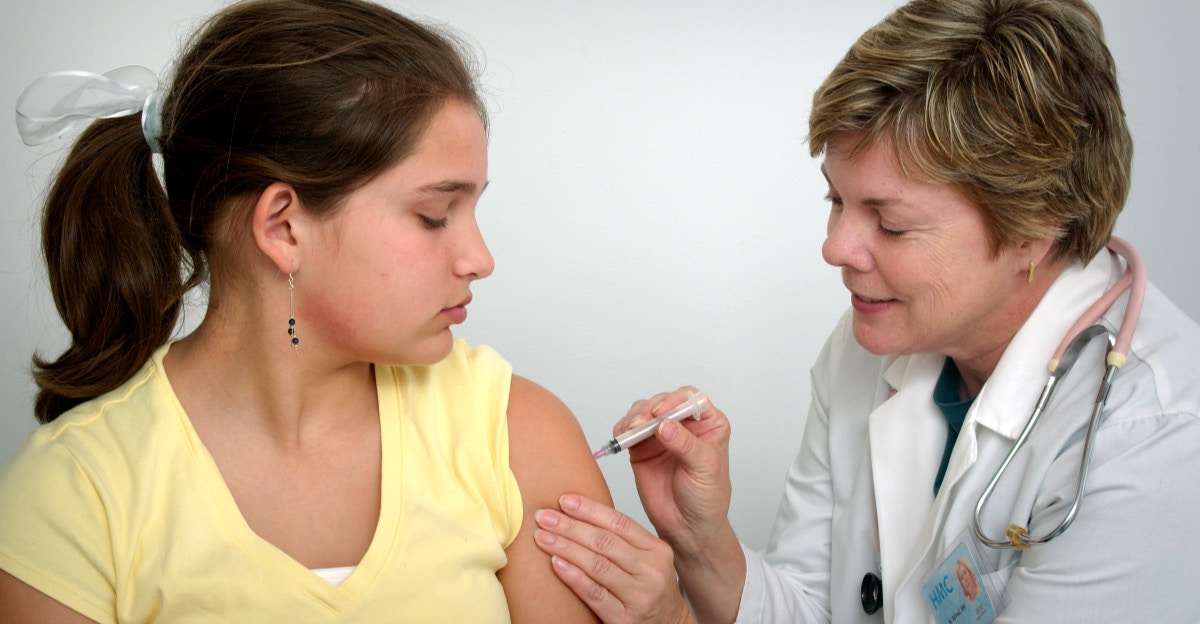
The study involved 140,000 women and shows the vaccine that protects against the human papillomavirus has been effective in dramatically decreasing cases of the cervical disease later in life. Researchers claim the vaccine, recommended to girls when they are in their early teens, has cut the pre-cancerous cells by 90 percent, nearly eliminating cases of pre-cancer since they implemented the new vaccination program in 2008.
But that’s not the most interesting factor. This new research also found that being vaccinated at a younger age was associated with increased effectiveness.
And there’s good news for parents who’ve chosen not to vaccinate their kids as well.
Unvaccinated women also showed a reduction of cervical cancer, likely due to the fewer HPV cases in general thanks to the increase in those who had been vaccinated.
Researchers hope these findings will help ramp up cervical cancer prevention programs around the world, and inspire more families to get their young women vaccinated so that cervical cancer can be eliminated once and for all.
"The main message is that the vaccine works,” Dr Kevin Pollock, of Glasgow Caledonian University, explained to the BBC. “As long as the high uptake continues, the virus has got nowhere to go and it is being eliminated.”
Unfortunately, many parents are still morally against the vaccine, fearing it encourages sex at a young age.
It might seem like a no-brainer to get your child an HPV vaccine, however, historically there has been some controversy around it, especially with regard to administering it to younger women.
Some worry that it encourages their children to be prematurely sexually active. Others simply don’t believe in vaccinations in general. What's more, if parents refuse to allow their child to be vaccinated, and that child then waits until they’re legally old enough to get it themselves, it likely won’t be nearly as effective. An individual needs to receive the vaccine before they become sexually active — not after — in order for it to do its job. If they wait until they’re 18, there’s a much higher chance that they’ll already be sexually active, thereby negativing the vaccine’s effectiveness.
Just because teens have access to things like condoms, birth control pills and vaccines that have to do with their reproductive health doesn’t mean they are going to have sex. However, as this study shows, such vaccines could save them from contracting a life-altering and potentially deadly disease. At the end of all the arguments, isn’t protecting your child’s long-term health the most important thing?




A Generation Jones teenager poses in her room.Image via Wikmedia Commons
An office kitchen.via
An angry man eating spaghetti.via 
Gif of baby being baptized
Woman gives toddler a bath Canva


An Irish woman went to the doctor for a routine eye exam. She left with bright neon green eyes.
It's not easy seeing green.
Did she get superpowers?
Going to the eye doctor can be a hassle and a pain. It's not just the routine issues and inconveniences that come along when making a doctor appointment, but sometimes the various devices being used to check your eyes' health feel invasive and uncomfortable. But at least at the end of the appointment, most of us don't look like we're turning into The Incredible Hulk. That wasn't the case for one Irish woman.
Photographer Margerita B. Wargola was just going in for a routine eye exam at the hospital but ended up leaving with her eyes a shocking, bright neon green.
At the doctor's office, the nurse practitioner was prepping Wargola for a test with a machine that Wargola had experienced before. Before the test started, Wargola presumed the nurse had dropped some saline into her eyes, as they were feeling dry. After she blinked, everything went yellow.
Wargola and the nurse initially panicked. Neither knew what was going on as Wargola suddenly had yellow vision and radioactive-looking green eyes. After the initial shock, both realized the issue: the nurse forgot to ask Wargola to remove her contact lenses before putting contrast drops in her eyes for the exam. Wargola and the nurse quickly removed the lenses from her eyes and washed them thoroughly with saline. Fortunately, Wargola's eyes were unharmed. Unfortunately, her contacts were permanently stained and she didn't bring a spare pair.
- YouTube youtube.com
Since she has poor vision, Wargola was forced to drive herself home after the eye exam wearing the neon-green contact lenses that make her look like a member of the Green Lantern Corps. She couldn't help but laugh at her predicament and recorded a video explaining it all on social media. Since then, her video has sparked a couple Reddit threads and collected a bunch of comments on Instagram:
“But the REAL question is: do you now have X-Ray vision?”
“You can just say you're a superhero.”
“I would make a few stops on the way home just to freak some people out!”
“I would have lived it up! Grab a coffee, do grocery shopping, walk around a shopping center.”
“This one would pair well with that girl who ate something with turmeric with her invisalign on and walked around Paris smiling at people with seemingly BRIGHT YELLOW TEETH.”
“I would save those for fancy special occasions! WOW!”
“Every time I'd stop I'd turn slowly and stare at the person in the car next to me.”
“Keep them. Tell people what to do. They’ll do your bidding.”
In a follow-up Instagram video, Wargola showed her followers that she was safe at home with normal eyes, showing that the damaged contact lenses were so stained that they turned the saline solution in her contacts case into a bright Gatorade yellow. She wasn't mad at the nurse and, in fact, plans on keeping the lenses to wear on St. Patrick's Day or some other special occasion.
While no harm was done and a good laugh was had, it's still best for doctors, nurses, and patients alike to double-check and ask or tell if contact lenses are being worn before each eye test. If not, there might be more than ultra-green eyes to worry about.