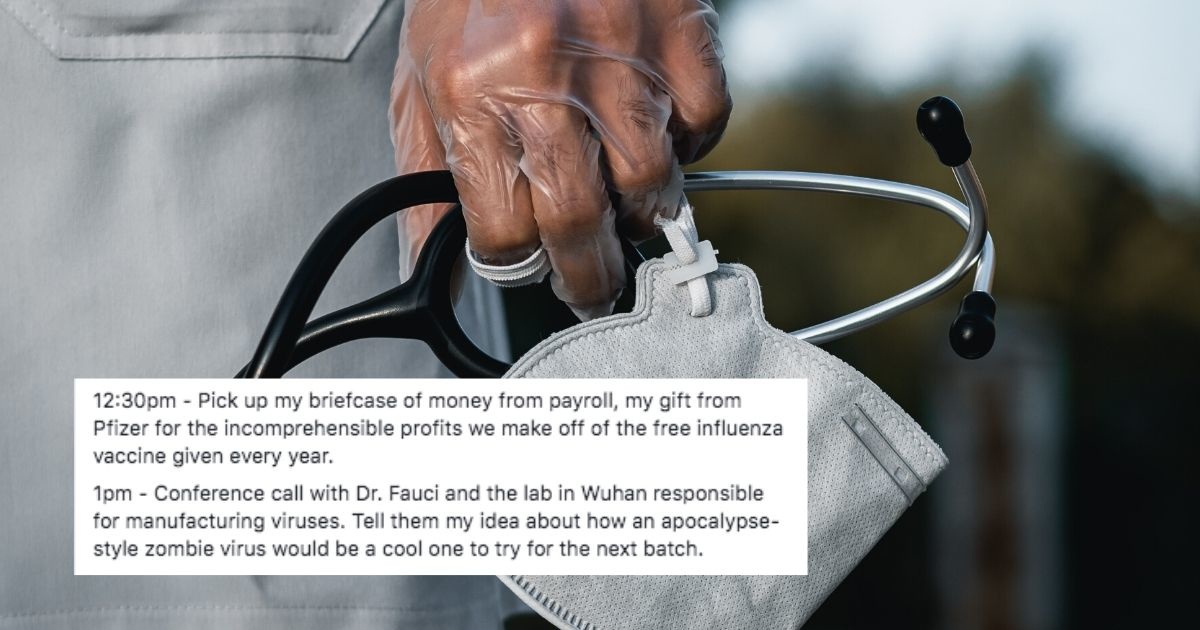
Doctor shares his ‘typical day’ in a COVID ward, taking a jab at medical conspiracy theories

By now, we’ve all seen the many conspiracy theories about the coronavirus pandemic floating around (Plandemic, anyone?), but medical conspiracy theories are nothing new. In fact, most of the anti-vaccine movement is predicated on a couple of them, which are getting a lot of attention right now: 1) Pharmaceutical companies are big, money-grabbing corporations (which…

Array
Photo credit: Photo by Ashkan Forouzani on Unsplash, David Young/FacebookArray

By now, we’ve all seen the many conspiracy theories about the coronavirus pandemic floating around (Plandemic, anyone?), but medical conspiracy theories are nothing new. In fact, most of the anti-vaccine movement is predicated on a couple of them, which are getting a lot of attention right now:

1) Pharmaceutical companies are big, money-grabbing corporations (which is arguably true) and therefore doctors and medical associations recommend people get vaccinated are all part of the Big Pharma conspiracy to fool the masses into paying them big money (arguably not true).


2) There’s a bigger, more nefarious plot organized by some evil player (ahem, Bill Gates) to vaccinate people in an attempt to depopulate the world or control the masses somehow, and the pandemic is just a planned rouse to give the medical “establishment” an excuse to carry out the dastardly plan.

I’m sure there are other somewhat related ones, but one thing they all seem to have in common is an underlying assumption that most doctors are willing to go against their “do no harm” oath in order to stash some cash. That seems like a terribly negative view of doctors and humanity in general, but that’s how conspiracy theories work—they play on people’s fears and amplify skepticism to outrageous proportions.

Dr. David Young, a hospital care specialist in the Chicago area, shared a breakdown of his daily schedule in a COVID ward to illustrate what these conspiracy theories sound like when you take them out of the chatroom/YouTube information bubble in which they fester. And you have to admit, the absurdity really does come through.

Young wrote:

A lot of people have been asking me what it’s like being on the COVID wards in the hospital, so I figured I’d share what a typical day looks like for me:

6 a.m. Wake up. Roll off of my pile of money that Big Pharma gave me. Softly weep as it doesn’t put a dent in my medical school loans

6:30 a.m. Make breakfast, using only foods from the diet that gives me everlasting life by avoiding all fats, sugars, carbs, and proteins. For details buy my book and check out my shop.

7 a.m. Get to work, load up my syringes with coronavirus before rounds.

8 a.m. See my patients for the day. Administer the medications that the government tells me to. Covertly rub essential oils on the ones I want to get better.

9:30 a.m. Call Bill Gates to check how 5G tower construction is going, hoping for more coronavirus soon. He tells me they’re delayed due to repairs on the towers used to spread the Black Plague. Curse the fact that this is the most efficient way to spread infectious diseases.

10 a.m. One patient tells me he knows “the truth” about coronavirus. I give him a Tdap booster. He becomes autistic in front of my eyes. He’ll never conspire against me again.

11 a.m. Tend to the secret hospital garden of St. John’s wort and ginkgo leaves that we save for rich patients and donors.

12:30 p.m. Pick up my briefcase of money from payroll, my gift from Pfizer for the incomprehensible profits we make off of the free influenza vaccine given every year.

1 p.m. Conference call with Dr. Fauci and the lab in Wuhan responsible for manufacturing viruses. Tell them my idea about how an apocalypse-style zombie virus would be a cool one to try for the next batch.

2 p.m. A patient starts asking me about getting rid of toxins. I ask her if she has a liver and kidneys. She tells me she knows “the truth” about Big Anatomy and that the only way to detoxify herself is to eat nothing but lemon wedges and mayonnaise for weeks. I give her a Tdap booster.

2:45 p.m. Help the FBI, CIA, and CDC silence the masses. Lament the fact that I can only infringe on one or two of their rights. Oh well, there’s always tomorrow.

4pm – One of my rich patients begins to crash. Laugh as I realize I’ve mismatched her spirit animal and zodiac moon sign. I switch out the Purple Amethyst above her bed for a Tiger’s Eye geode. She stabilizes. I throw some ginkgo leaves on her for good measure

6pm – Go onto YouTube and see coronavirus conspiracy videos everywhere. Curse my all powerful government for how inept they are at keeping people from spreading “the truth”

6:10pm – Go onto Amazon and see that a book about “the truth” is the #1 seller this week. Question the power of my all powerful government. Make a reminder to myself to get more Tdap boosters from the Surgeon General next time we talk.

7pm – Time to go home. Before I leave, sacrifice a goat to Dr. Fauci and say three Hippocratic Oaths.

9pm – Take a contented sigh as I snuggle under the covers made of the tinfoil hats of my enemies, realizing that my 4 years of medical school and 3 years of residency training have been put to good use today.

Snort. Even as someone who uses essential oils and herbal treatments for some things, I found this hilarious. That really does seem to be close to what some conspiracy-minded folks think doctors do all day.

The reality is that the vast majority of doctors really do go into medicine to help people and would not tacitly go along with any evil plots to harm even one person, much less mass numbers of people. While there are legitimate discussions and debates to be had about pharmaceutical medicine vs. alternative medicine vs. natural medicine for various ailments, as soon as we get into evil plots and conspiracy territory, those legitimate discussions lose all credibility.

Doctors on the front line are dealing with enough right now. They really shouldn’t have to be fending off absurd ideas about them lying and scheming en masse to fill their own pockets or bring the world to ruin.

  • Guy enthralls millions of viewers by singing exactly like the late Michael Jackson
    Photo credit: Constru-centro/Wikimedia CommonsBrandon Conway sounds remarkably like Michael Jackson when he sings.

    When Michael Jackson died in 2009, the pop music world lost a legend. However markedly mysterious and controversial his personal life was, his contributions to music will go down in history as some of the most influential of all time.

    Part of what made him such a beloved singer was the uniqueness of his voice. From the time he was a young child singing lead for The Jackson 5, his high-pitched vocals stood out. Hearing him sing live was impressive, his pitch-perfect performances always entertaining.

    No one could ever really be compared to MJ, or so we thought. Out of the blue, a guy showed up on TikTok with a performance that sounds so much like the King of Pop it’s blowing people away.

    A parking lot performance that broke the internet

    Brandon Conway posted his first TikTok video ever on July 24 in 2022, and in less than three weeks it racked up more than 27 million views. It’s just him standing in a parking lot snapping his fingers and singing “The Way You Make Me Feel,” but when he opens his mouth, whoa.

    As he keeps going, it gets even more whoa. Then he hits Jackson’s signature “he he” and the whoa turns into what?!?

    Take a listen:

    @brandonconway11

    First post on tiktok let me know what you guys think! More videos coming soon feom mj to country to rock so yall be sure to stay tuned!#fyp #singer #usherchallenge @usher @tpain #letsgo #firstvideo

    ♬ original sound – Brandon

    How does he compare to Jackson himself?

    Uncanny, right? If you need a reminder of how Jackson himself sounded when he sang it, here’s a live performance from Auckland during his 1996 world tour.

    Very impressive, to say the least. Especially considering Conway seems to label himself a country singer over a pop artist.

    @brandonconway11

    This one goes out to all the ones who maybe going through it right now… the messsge you ask?? The message is knowing that regardless of how bad things may be or get it’s always okay to ask for help… no matter how you do it or when the fact still remains that we all need a little help or “saving” if you will! @Jelly Roll my brother thank you and @Lainey Wilson for such a beautiful song ❤️ I hope you all enjoy my cover of this great record with my right hand man @JoshHamiltonmusic__ strumming his guitar! Happy Monday everyone hope your Christmas filled week is beautiful 🙏🏽#brandonconwaymusic #viralvideo #coversongsontiktok #thereisalwayshope

    ♬ original sound – Brandon

    Basically, he can’t go wrong with whatever genre he does. Follow him on TikTok to hear more.

    This article originally appeared four years ago. It has been updated.

  • Iceland is willing to pay good money for ‘really bad photographers.’ Their reasoning is genius.
    Photo credit: CanvaMan taking selfie/ Icelandic landscape

    Do you know someone who seems to have zero photography skills? Who somehow manages to make everyone look their worst whenever they’re behind the camera? The kind of person who can’t even frame a decent selfie?

    If so, Iceland might have a job for them. And a decently paying one at that. 

    Recently, Iceland Air made a post specifically seeking out “really bad photographers.” Virtually the only prerequisite was having  “no photography skills.” Those who knew terms like “composition, white balance, or color theory” need not apply.

    Those who did think they fit the bill could potentially score a once-in-a-lifetime opportunity. The selected candidate would receive a 10-day trip to Iceland, all expenses covered, along with a $50,000 payout. The only catch is that they will be expected to document the journey with their uniquely unimpressive photography skills.

    Why “bad” photos might be the point

    The idea behind this campaign is that Iceland is so naturally beautiful that even the least remarkable images would still manage to capture its essence. A creative marketing strategy, to be sure, but one that also reflects a broader cultural shift.

    More and more people are growing tired of highly polished, overly curated visuals dominating their feeds. The constant pressure to present a perfect life has left many craving something more grounded and authentic. In that context, a blurry snapshot or an awkwardly framed landscape can feel refreshing.

    This shift has only intensified with the rapid rise of AI-generated imagery. Yes, most of it is absurd, but much of this “AI slop” is becoming harder to distinguish from genuine photographs, which raises concerns about credibility. Several experts have pointed out that the issue goes far beyond aesthetics.

    As Dr. Manny Ahmed, CEO of OpenOrigins, told the BBC, “It causes us to lose trust in content that we should be trusting.”

    A different way of seeing beauty

    While it’s easy to find countless images of Iceland that have been heavily edited, there is something appealing about seeing the country through a less polished lens. A slightly out-of-focus Northern Lights display, a windswept black sand beach with scattered debris, or a muted volcanic landscape can still evoke a sense of wonder. Nature is an endless miracle, regardless of whether or not we Photoshop it. 

    iceland, nature photos, ai slop
    An image of the Northern Lights Photo credit: Canva

    The Internet has thoughts

    Judging by the responses to Iceland Air’s post, there is no shortage of terrible photographers ready to apply. The comment section quickly filled with nominations, many of them playful callouts of friends, partners, and relatives.

    Husbands in particular seemed to be a recurring theme.

    Regardless of who is selected for this campaign, perhaps the bigger win is the conversation it sparked and how it encourages us to rethink our relationship with the images we see or post online.

    And for anyone who has ever been accused of taking truly awful photos, this might be the rare moment where that skill, or lack thereof, finally pays off.

  • Pete Holmes makes it anything but weird in conversation with Upworthy
    Photo credit: Pete Holmes, CanvaComedian Pete Holmes on stage.
    ,

    Pete Holmes makes it anything but weird in conversation with Upworthy

    “You can just live your life and make a difference where you can.”

    Comedian Pete Holmes isn’t just funny. He’s a deep thinker who digs so far beneath the crust of your average every day “observational” comic that he might just touch the lava. He takes an aerial view on everything from parenting to science to sex to faith, and all of the tiny minutia that comes with them. His rise as a beloved writer and stand-up has barreled through the atmosphere from tiny gigs to podcasts to TV shows.

    Holmes and I have a mutual friend who put us in touch for this Upworthy interview. And although we had never met, I immediately felt like we were long lost friends upon answering his call. He was ready to break down not only the rules (or lack thereof) of comedy, but to deconstruct human thought and how the most sensitive people might navigate the world.

    What especially stood out in this half hour chat beyond his quick wit, was his deep commitment to supporting other talented people. He seemingly laughs as easily as he makes others laugh, and that alone is a gift.

    Pete Holmes, Stoicism, philosophy
    Photo credit: Neal Brennan/YouTubeComedian Pete Holmes.

    Upworthy: I must tell you there’s a podcast interview you did on You Made it Weird with Gareth Reynolds about Doritos where he did a Jay Leno impression. Do you remember this?

    Holmes: “Of course!”

    Upworthy: I legit look at this once a week when I’m having a bad day and need to laugh. Is there something that you come back to often when you’re in a bad mood and need to laugh?

    Holmes: “Oh my God, first of all, I love Gareth so much. What a funny person! In fact, people come up and say, ‘I love your Doritos thing!’ Which is funny because I have a lot of jokes about Doritos, so I’m never sure what they mean.

    To answer your question, what do I watch when I’m in a bad mood? I watch Nirvana the Band the Show. They just had their movie come out, and I think the whole second season is on YouTube.

    I think Matt Johnson and Jay McCarrol are just two of the funniest people in the world, and I just watch clips from that show sort of endlessly if I’m looking to laugh. The ones that really get me are the ones that are a little bit over the line, and that’s what I like about them.

    They’re just two friends finding fun together, and it just makes me so happy. So it’s not just the content, it’s the medium. It’s how they made it, and it really captures the feeling of two just free people, two people that realize that we’re in this weird reality, we’re in this weird world, and we’re only here for a little time. And one of the things we can do is be really funny and make each other laugh, and they just go at it with this innocence that I really admire.”

    Upworthy: To that end, who would you say back in the day and now are your major influences as a comic?

    Holmes: “I love that question. When I read the book SeinLanguage—which is I’m just so sure that Jerry Seinfeld regrets calling it. I don’t know him. I’m not basing that on anything that you don’t also have access to, just his comedy and his show. I’m just so sure that he is like, “Why did I call it SeinLanguage?

    But I read it because I didn’t really have control over our TV in our house. When a comedy special came out in book form, I could get the book and I could read it privately and re-read it. And he actually talks a bit about comedy theory in it as well. Anyway, I read this book and I just couldn’t believe that the kind of thoughts I was already having were not that different from the thoughts of a professional comedian.

    I just didn’t feel like I had that tour de force, wild, loud guy Boston energy, if that makes sense. I felt way more in line with Jerry Seinfeld and Ellen and Ray Romano. These sort of like 7 p.m. show guys.

    Okay, I don’t know if you’re old enough to remember, that was the fringe. In the ’90s, comedy was sort of for pirates. And a lot of my best friends are pirates. I’m just saying they hooked up late night, you know, freewheeling lunatics. And I just didn’t see myself up there. So Jerry Seinfeld once said about Robert Klein that he was the first comedian that he saw that was like, ‘Oh, it just seemed like me.’ And when I saw Seinfeld I was like, ‘Oh, this is like me, this is like a guy I know.’ So the book SeinLanguage and the fact that it was clean was really important to me.”

    Upworthy: I read there was one point you had plans to be a youth pastor. Was that a real thing you were considering or just what your parents thought you would do?

    Holmes: “No, it was my idea. You could look at it two ways: one, my parents were sort of detached in a way that you were like, ‘Shouldn’t you be more involved?’ Or you can be like they really were letting me find my own way, and I actually look at it more the latter.

    It was as serious as when you’re in high school you want to be a teacher, you know what I mean? You just don’t know any other jobs. So I knew teachers that I admired, and I knew my youth pastor and my pastor that I admired. And this is a Steve Martin thing: he said, ‘Teachers are in show business.’ Pastors are too. And that doesn’t mean to say they’re phony or false. It just means if you’re up in front of a crowd holding their attention, you’re putting on a show. Teachers and pastors are doing something substantial, but they’re doing it in the style of a show.”

    Upworthy: I saw a clip where you were talking about the idea of saying ‘Yes, thank you’ to the universe. It seems very Stoic. Are there other elements of that that help you in your daily life?

    Holmes: “I would say that my understanding of ‘Yes, thank you’ has deepened a little bit. There’s a couple different altitudes you can look at that. One of them is just very basic—basic doesn’t mean bad—it’s just basic psychology. Meaning suffering comes from seeking and resisting. I know that’s sort of spiritual terminology, but it’s also psychological terminology. If you’re suffering, you’re by definition seeking a different experience.

    And there’s pain or there’s discomfort, but suffering really comes from building a story. And anybody that has kids knows that that’s true. My daughter won’t go to bed, let’s say. And that really is, if we can pause and just be on a planet in outer space in these finite spaces, that is just so insignificant.

    So when we’re resourced and with friends and rested and fed and all these things, we can see that. But often when your kid won’t go to bed, you’re not resourced and you start spinning out. People love talking about catastrophizing. You’re just making a story, and it’s never in your favor. You go, ‘She won’t go to sleep. Why is this happening to me?’ You start thinking about what you would be doing if she was asleep. ‘I can’t watch that show, I can’t relax. My whole life is just being a parent.’ None of that is really happening, your brain just sort of is torturing you.

    It’s important to recognize that your brain doesn’t always have your best interest in mind. So giving it another path to take, which is ‘Yes, thank you.’ So the flight delayed is a good example, and just about the right temperature of spice for this exercise. You know it can be deeply upsetting when a flight is cancelled until you realize, you know, you don’t resist it, you just go with it, and you realize all you have to do is sit in your chair.”

    Upworthy: Sometimes it just takes a little packaging, but just hearing you say that honestly reframed my thinking.

    Holmes: “Me too! But it has to be simple. It can’t be like the Buddhists or whoever would say, ‘Don’t resist,’ right? That’s a little too conceptual. I want to get right to the phrase that’s easy to remember, that when you’re stressed you can go to it. To talk about the deepening of that, you can look at yourself. You are what’s aware of your experience, right? You haven’t always been this body, you haven’t always been this age, your name, your country. All of these are concepts that you sort of reinforce by thinking them over and over: ‘My name is Cecily. I live in America.’

    All these are things. But what you really are is this space-like aware presence that encompasses your body, encompasses reality, your thoughts, your feelings, your emotions, your perceptions, right? So ‘Yes, thank you’ isn’t just a life hack. It’s actually your nature, meaning awareness or consciousness. This is almost over, by the way.”

    Upworthy: Are you kidding? This is amazing. This is therapy.

    Holmes: “Awareness is like a mirror, alright? So it’s like a mirror indiscriminately reflects what is in front of it. And you are like that. My voice is being recognized by you completely effortlessly. The feeling of your phone in your hand or your butt in your chair, all of that is just being registered completely defenseless. It just enters, it just comes in.

    So thinking ‘Yes, thank you’ isn’t just a trick. It’s actually more in line with your nature. You do say yes to everything. I’m driving down the highway right now, every nanosecond this is just being embraced by my awareness. So when I can get my mind in line with my true nature, which is just free flowing, it’s spontaneous, it’s like jazz.

    Like my daughter wouldn’t go upstairs two nights ago. She just wouldn’t even go upstairs to go to bed. And look, I can’t always do this, but in that moment I was able to go, ‘What is 10 minutes?’ And not 10 minutes where I’m trying to get her to go upstairs, 10 minutes where I just sit on the stairs with her, and now I’m looking at my stairs and I’ve never even seen them from that angle. I’m really just dropping the entire agenda. And I really think kids energetically can pick up on that. And I think grown-ups can pick up on that.

    Like a good date that you’re on is somebody that’s just awake and aware and spontaneous. Why do we love spontaneity? Why do we love humor? Because it’s so alive and so accommodating and so fresh, right? You are alive, you’re accommodating, you are fresh. Those are aspects of you. I don’t mean you, Cecily, or me, Pete. I mean the thing that’s running the whole show. It’s ‘Yes’ to the whole thing. So when we get in tune with that ‘Yes,’ even when you’re miserable, even when you’re having a bad situation, a bad experience, if you can just sort of go with it.

    You know the Stoics are like, ‘Control what you can control.’ You can get on another flight, and if you can’t, so they’re proactive, and I’m all about being proactive. But there is something about like, you know, a 40-minute delay where you don’t really need to look for another flight. You know what I mean? That’s really the right level for this practice.”

    Upworthy: Do you find when you travel that you’re freer? I find I am when I’m out of my element and just going with the flow and not making a whole lot of plans.

    Holmes: “Well, because when you’re home you have a lot more expectation for how things have gone. That’s why people like traveling, you know? And that’s an Eckhart Tolle thing. It’s like people like traveling because it forces them to be present. I would say when you’re being present, you’re actually being yourself. What you are is present, right? And everything else is mind activity.

    Why does it feel so good to not think about anything? Why does it feel so good to just be? If you can stop the anxiety or the fear or the chattering thoughts, if you can just be still, it feels really good. That’s because the present moment and your true self, the nature of awareness, those are the same thing. People are just pointing to it using different words.

    And when you travel, you are forced to go with the flow because you don’t even know what’s normal. ‘Oh, in Barcelona, they eat dinner at 10 o’clock.’ You’re completely out of control, so you surrender. And people are much more likely to say ‘Yes, thank you’ when they’re in Spain than they will at their home.”

    Upworthy: Back to comedy, would you bill yourself as a ‘clean comic?’ And what are your thoughts on the concept of punching up or punching down?

    Holmes: “I think a good entertainer should always be surprising, right? So like I think people that aren’t real fans of mine that just might come to a show, they might be surprised. There might be more swearing. There might be more sex stuff. But, to me, that’s sort of my job. I don’t want to just deliver what you’ve already seen.

    Like my new special that just came out (Silly Silly Fun Boy) people have noticed that I’m swearing a little bit more in the beginning. And I’m like, yeah, it was the late Friday show and people weren’t there yet. There were huge sections of the crowd that were empty, and I’m filming a special, so I wasn’t asking. I was going out with a knife between my teeth like Predator. I was going out to insist that I do very well and that we get somewhere that we all want to be.

    Other shows, the crowd—and by the way, the crowd was great—it was just kind of chunky up top. Other shows, you know, that’s not required. But I’m not doing a routine. It’s like what we were saying, I’m being present and fresh and alive for that crowd.

    And to answer your question more directly… the hour that I’m touring now (which isn’t the hour that I just released) also has what I would call dirtier jokes. Meaning they’re not ugly, but they’re jokes that are sort of a little bit outrageous, I guess.”

    Upworthy: So you feel like it’s not that you’re making a choice to be edgier? You’re just doing you.

    Holmes: “Oh yeah, and that’s how material shows up too. I always liken it to if you’ve ever gotten an Amazon package on your doorstep and you don’t even remember what it is. That’s how the material shows up. I’m not trying to be a flashy artist like, ‘Oh I’m just the vessel.’ I’m just saying I’m living my life and certain things come up. I write them down, I perform them, people like them, and then you have about an hour and ten minutes of that and you have a show.

    I’m not Marvel. I like Marvel, but I’m not Marvel thinking like, ‘Okay, we need a female-led 20-something that has…’ you know, like they’re trying to guess what people want and give it to them. They’re very good at that, but that’s not what I’m doing. I’m much more like a weather vane or a lightning rod. I’m just waiting to see what happens. But to finish my point: I’ll do these jokes—could be considered dirty, meaning I’m swearing, I’m talking about dicks, I’m talking about sex, whatever that might be. And then after the show, literally, this isn’t just something I’m making up, little old ladies will come up and tell me that they love how clean I am.”

    Upworthy: The bar has changed, right? The line has moved.

    Holmes: “Well, I think it’s the medium, going back to medium and message, right? I think it’s very possible that someone does what’s considered clean comedy, meaning they’re not talking about their penis, or sex, or about drugs, and they’re not swearing. They’re not saying the seven words, right? And that comedy can be toxic. It can be ugly. It can be encouraging really backwards thinking and harmful ideologies, right? By the way, I’ll defend someone’s right to be able to do that, I’m just saying what I see sometimes.

    And then I think it’s quite possible to talk about your dick, talk about drugs, acknowledge the existence of sex, and say all of the seven words and do a joke that is really beautiful. In fact, I think that’s part of the message. I talk about this in the special. I am demonstrating to myself and to them: this is what it looks like to be ‘unembarrassingly’ human. I’m not ashamed. I don’t choose my thoughts. I don’t choose my feelings. I’m here to report on them and laugh at them, and thereby take away some of their power.

    And that’s what you’re doing by laughing with me, you’re recognizing yourself in me and you’re laughing at yourself, and everybody leaves feeling a little bit lighter. Now did I say ‘f–k’? Yes, but if that’s your line in the sand, whether or not a comic says ‘f–k,’ that’s fine. That was me for the first 28 years of my life. It’s not my line anymore, and I’m happy to say that there are lots and lots of people that are nuanced, that are lovely, compassionate, generous, interesting, interested people that aren’t turned off by the full human experience.

    By the way, I love clean comedy too. It’s just like I don’t think clean necessarily means it’s not going to be mean or ugly or somehow harmful, and I don’t think ugly means you swear. I think it’s completely what are you saying and how are you saying it? And I’m proud that even the jokes that I have that are about me letting myself down or making some sort of mistake, there’s something beautiful in the message. We can still laugh at that, and we can still not take ourselves too seriously, and we can get better.”

    Upworthy: There are a lot of comics who have been punching down these days, and I’m hoping that becomes unpopular soon.

    Holmes: “It’s always a pendulum, and it always goes back and forth. I will defend my fellow comedians whom I don’t agree with, their right to share their experience. That being said, it’s kind of like you wake up one day and every movie that’s in the theater is a horror movie, and you’re like, ‘When did this happen?’ And there can be a parallel there. Like Chris Fleming’s special was probably one of the best specials I’ve ever seen in my entire life, and it couldn’t have been more beautiful, but also deeply hilarious. So it’s not—nor has it ever only been—one thing.

    Like look at pictures from 1972. It would look like everybody was a hippie. My dad was alive in 1972, he was not a hippie. These things get painted in these broad brushes, and you see certain trends in comedy, and it can start to feel like it’s been taken over by a certain perspective, but that’s not my experience. When we look at the bird’s-eye view, you’ll go, ‘Oh, every perspective was always being represented the whole time.’”

    Upworthy: It’s an algorithm thing, you know?

    Holmes: “I really feel like there’s room for everything. I don’t think there are any new groups. I don’t even think there are any really new perspectives. It’s just this constant fluctuation. But everybody was there the whole time. What it looked like, I can’t say, and nobody can. You can just live your life and make a difference where you can.”

  • Woman who crashed out after awful ‘wolf’ haircut is saved by ‘angel’ sister’s amazing styling
    Photo credit: CanvaA woman annoyed with her hair.

    There’s nothing more deflating than getting a bad haircut. You show the stylist a photo of how you want to look, sometimes inspired by a celebrity or fashion model, but when it translates to your head and face, it just doesn’t look right. Ultimately, much of the blame falls on the stylist for failing to execute the style or for not admitting it wouldn’t work.

    Run Zhang of England shared her bad-haircut journey on TikTok, and millions of people have followed her transformation from disaster to a look that is cute and matches her upbeat, quirky personality. In the first video, she said she was excited to get a “cool girl…spiky” short haircut, similar to a “wolf” style. However, after the haircut, she didn’t look cool at all.

    After the haircut, Run had to go straight to work and had no idea how to style her hair.

    “This is not right at all. And I have to go straight to work. I’m driving three hours to go straight to work to look like a small fruit,” she joked while prepping herself for a day of embarrassment.

    Maybe the haircut is…French?

    “Why don’t hair stylists just say they don’t know how to do a cut?! It’s not even close!” Masdelaselva wrote in the comments.

    Others joked that the hairstyle may be “French,” referencing an inspired scene from Fleabag in which Phoebe Waller-Bridge’s character tries to convince Sian Clifford’s Claire that her haircut isn’t terrible.

    Others joked that Run looks like comedian Jimmy O. Yang.

    jimmy o yang, hong kong comedia, comedian yang, fung bros
    Comedian Jimmy O. Yang. Photo credit: Fung Bros/Wikimedia Commons & Wikimedia Commons

    In a wonderful example of taking lemons and turning them into lemonade, Run enlisted her sister, Yun, to make her hair presentable.

    “Yun’s been fixing my hair like a magician or an angel or perhaps a saint,” she said while revealing her new ‘do, which features a semi-slicked-back look held in place by old-school metal clips. Strangely, the new haircut kind of fits Run’s fun-loving vibe.

    “Holy sh*t, your sister nailed that! I thought it was unsaveable, but I didn’t realize you had a team behind you,” Amy wrote. “Your sister is a miracle worker!” Harmony added.

    Run and Yun did a fantastic job of turning a tragedy into a style that looks great until her hair grows back. One wonders whether Run will try to find another hairdresser who can get the wolf cut right or lean into her new ’90s-girl throwback hairstyle.

    Until then, Run is still having trouble because she doesn’t know how to style her hair without Yun’s help.

    Run’s bad-haircut saga started as a sad story about a woman who was destined to feel bad about her looks for a few months. But in the end, with a little ingenuity and help from her sister, she proved that she could turn a bad haircut into something that reflected her true personality. It’s a great reminder that nothing is impossible when we have people who can lift us up when we’re down.

  • When she told her mom with Alzheimer’s she’d been married for 40 years, her reaction said everything
    Photo credit: CanvaA woman comforts her elderly mother.

    There’s a particular kind of grief that comes with watching a parent disappear into Alzheimer’s. It’s not a single moment of loss but a slow, ongoing one. And then, sometimes, something cuts right through all of it.

    Molly Bell Walls (@mollybellwallson) was sitting with her mother in a doctor’s office lobby, waiting for her dad to come out after an appointment. Her mom has stage 6 Alzheimer’s. In a video she posted on TikTok that has since been watched more than 19 million times, Molly is just trying to keep her mom engaged in conversation.

    She mentions, almost casually, that her parents have been married for 40 years.

    @mollybellwalls

    After Mom’s neurology appt today; waiting on Dad in the lobby. Trying to keep her occupied in conversation. It always turns to Dad. She looks for him constantly. Their love is so special. 🥰 #dementia #alzheimer #caregiver #alzheimersawareness

    ♬ original sound – Molly Bell Walls

    Her mom’s face changes. She pauses. Then, with the kind of genuine awe you can’t fake, she says: “Really? Yeah. Oh, my gosh. We are.”

    She’s learning it for the first time again. And she’s just as delighted as she probably was the first time.

    alzheimers, dementia, aging parents, marriage, viral
    An older couple embracing on a couch. Photo credit: Canva

    What makes the video so quietly devastating is what Molly wrote in the caption: her mom looks for her dad constantly. Conversations always turn to him. Even with so much gone, that part holds. The disease took the memories but apparently couldn’t touch whatever it is that makes her turn toward him in every room.

    Commenters noted how present and warm she seems for stage 6, which typically involves significant cognitive decline. “She seems so alert and actively interacting,” one person wrote. After the initial moment, she and Molly chat easily about makeup – a tiny ordinary exchange that somehow makes the whole thing more moving, not less.

    What stays with you isn’t the forgetting. It’s the rediscovering. Forty years of marriage, relearned in a lobby, and met with pure joy.

    You can follow Molly Bell Walls at @mollybellwalls on TikTok.

  • A hot air balloonist revealed man’s ‘secret’ forest he created as a tribute to his wife
    Photo credit: Canva and Google MapsA farmer at dusk.
    ,

    A hot air balloonist revealed man’s ‘secret’ forest he created as a tribute to his wife

    “It was a flash of inspiration.” For years, this husband’s beautiful tribute to his late wife was hidden from the world, until a hot air balloonist looked down.

    Grief often demands a physical outlet, a way to channel the weight of loss into something that lives and grows. For Winston Howes, a farmer in South Gloucestershire, England, that outlet became a six-acre labor of love. After his wife of 33 years, Janet, died suddenly from heart failure at age 50, Howes found himself looking at a blank field on his farm and seeing a way to keep her spirit alive.

    In the months following her death in 1995, Howes began planting 6,000 young oak trees. For nearly two decades, the project remained a private family sanctuary, unknown to the public. However, as The Guardian reported, the true scale of his tribute was finally revealed to the world when a hot air balloonist drifted over the property and looked down.

    The aerial perspective revealed a perfect, massive heart-shaped meadow hidden in the center of the dense oak forest. Howes had strategically left a clearing in the middle of the saplings, creating a secret “room” in the woods that is entirely invisible from the road.

    The heart-shaped meadow only viewable from above. Photo credit: Google Maps

    “I came up with the idea of creating a heart in the clearing of the field after Janet died,” Howes explained. “I thought it was a great idea, it was a flash of inspiration.” He even added a sentimental detail that can only be appreciated from the sky: the point of the heart is aimed directly toward Janet’s childhood home.

    A farmer tends to his field. Photo credit: Canva

    Inside the heart, Howes placed a seat where he could go to sit and think. It is a quiet place where the bustle of the farm fades away, replaced by the rustle of oak leaves. According to the American Psychological Association, engaging in meaningful tributes is a vital part of the grieving process, helping to transform acute sadness into a lasting legacy of love.

    When images of the heart-shaped forest went viral, they resonated with millions. Social media users across the globe were moved by the quiet, patient dedication required to plant thousands of trees by hand just to create a sanctuary for a person who was no longer there to see it.

    As the oaks continue to grow and the forest thickens, the heart remains a permanent fixture of the Gloucestershire landscape. It’s nice to remember that while life may be fleeting, the love we leave behind can take root and grow for generations. It is a lovely and lasting tribute that will remain standing long after we are gone, proving that sometimes, the most beautiful secrets are the ones grown from the heart.

  • Woman cleverly track downs the name and address of the person who stole her credit card
    Photo credit: via Absolutely Lauren/TikTok TikTok user Absolutely Lauren catches an online scammer.

    There was a massive jump in credit card fraud in America the last few years due to the pandemic. According to a 2025 report from Security.org, 62 million Americans experienced credit card fraud in a single year, with unauthorized purchases exceeding $6.2 billion annually. In a world where online transactions are part of everyday life, it’s hard to completely protect your information. But, by staying vigilant and monitoring your accounts you can report fraud before it gets out of hand.

    A TikTok user by the name of Lauren (@absolutelylauren) from San Diego, California, got a notification that there was a $135 charge on her card at Olaplex’s online store that she hadn’t made. Olaplex sells bond-building hair care products designed to repair and strengthen damaged hair. Before reporting the charge to her credit card company she asked her family members if they used her card by mistake.

    “I don’t wanna shut my card down if it’s just my mom ordering some shampoo,” Lauren said in the video. “Definitely not my two younger brothers, they’ve got good hair but they don’t color it.”

    How Lauren tracked down the person who stole her card

    After realizing the charge was fraudulent, most people would have called their credit card company and had their card canceled. But Lauren was curious and wanted to know who stole her information and used it to buy hair care products. So she concocted a plan to get their information. She called Olaplex’s customer service line asking for the name and address of the purchaser to see if it was made by a family member.

    “Hey, can you help me with something?” Lauren asked Tanya, the Olaplex customer service agent. “If I can give you the time and date, purchase amount and card number and whatever could you let me know who placed an order?”

    Tanya had no problem helping Lauren with her request.

    “At this point, I’m willingly giving Tanya enough info to steal my card as well — she could have very well taken advantage of me in that moment but she didn’t,” Lauren said. “She comes back — tell me why she gave me the little scammer their full government name and address.”

    Tanya revealed that a guy named Jason in a modest suburb in Texas used her card to buy a gift for his wife. “They also did it on Black Friday so at least they got a deal I guess, it was the gift set,” Lauren continued.

    Lauren then called her credit card company and shared the information she had on the fraudster. The card company is currently investigating the situation.

    Was the customer service agent supposed to share that information?

    One commenter thought that Olaplex wasn’t supposed to share that information with Lauren.

    “For some reason, I don’t think Olaplex was supposed to give that info,” Arae270 said.

    People should use utmost caution before deciding to track down a credit card thief. But kudos to Lauren for being clever enough to track down the person who stole her card information to help the authorities with their investigation. She didn’t put herself in harm’s way and if someone follows up on the tip, maybe they can prevent the same thing from happening to someone else.

    This article originally appeared three years ago. It has been updated.

  • Jennifer Garner worked as a restaurant hostess at 22. Her confession about how seating decisions were made is uncomfortable to read.
    Photo credit: Gage Skidmore via Wikimedia Commons and CanvaJennifer Garner and a recording studio.
    ,

    Jennifer Garner worked as a restaurant hostess at 22. Her confession about how seating decisions were made is uncomfortable to read.

    “If we put a circle next to their name, they got seated in Siberia.” Jennifer Garner just confirmed what a lot of us suspected about restaurant seating.

    Before Jennifer Garner was a household name, she was a 22-year-old hostess at a restaurant in New York City. She was seating people, managing waits, and doing something else she’d kept quiet about for a long time.

    On the Dish Podcast with broadcaster Nick Grimshaw and Michelin-starred chef Angela Hartnett, released March 4, Garner finally laid it out. “You put the beautiful people at certain tables,” she said. “You put celebrities at certain tables. And if somebody even mildly famous walked in…”

    The system had a name for the people who didn’t meet the standard. When Garner and her colleagues wrote down reservation names, some of them got a circle next to them. “If we put a circle next to them, they got seated in Siberia,” she said.

    Hartnett confirmed this wasn’t unique to Garner’s restaurant. In high-end dining establishments, she said, the word “Siberia” is industry shorthand for the section where less desirable customers are quietly deposited — away from the windows, away from the room’s natural center of gravity, and away from the diners the restaurant actually wants other people to see.

    One of Garner’s clearest memories involves Steve Martin, who was a regular and had a very specific preference: table five. If someone was already sitting at table five when Martin arrived, Garner had to move them. Mid-meal, mid-date, mid-whatever they were doing.

    “I would have to go to those people and say, ‘I am moving you to the bar, and I’m going to buy you some calamari and that’s going to be on me,’” she said, describing the awkwardness of being a 22-year-old telling a couple on a date that they were being relocated because someone more famous had shown up.

    Garner called the whole practice “merchandizing” the restaurant — treating the dining room the way a retailer treats a window display, positioning the most appealing elements where they’d be seen.

    Grimshaw’s response, on hearing the Siberia detail for the first time: “I’m going to rethink every restaurant I’ve ever been in.”

    The phenomenon isn’t just anecdotal. A 2016 Channel 4 documentary investigation called Tricks of the Restaurant Trade sent groups of models into three upscale London restaurants. In each case, the models were seated at prime front-of-house tables. When co-presenter Adam Pearson, who has neurofibromatosis, a condition that causes visible tumors on the face and skin, attempted the same exercise, he was seated in a corner at the first restaurant, initially ignored at the second, and turned away entirely at the third.

    Research has also found an appearance premium for the servers themselves. One study found that attractive servers earn roughly $1,261 more per year in tips than unattractive ones.

    Garner, for her part, said her hostess days were more psychologically taxing than almost anything that came after. “I’ve had more nightmares about my days as a hostess than I have had actor’s nightmares,” she said. “And I’ve had a lot of actor’s nightmares.”

    You can follow Nick Grimshaw (@nicholasgrimshaw) on Instagram for more celebrity content.

Culture

Iceland is willing to pay good money for ‘really bad photographers.’ Their reasoning is genius.

Health

The 4 brain chemicals that make you feel amazing, and simple ways you can trigger each one

Pop Culture

Pete Holmes makes it anything but weird in conversation with Upworthy

Culture

Woman who crashed out after awful ‘wolf’ haircut is saved by ‘angel’ sister’s amazing styling