upworthy
Add Upworthy to your Google News feed.
Google News Button
Culture

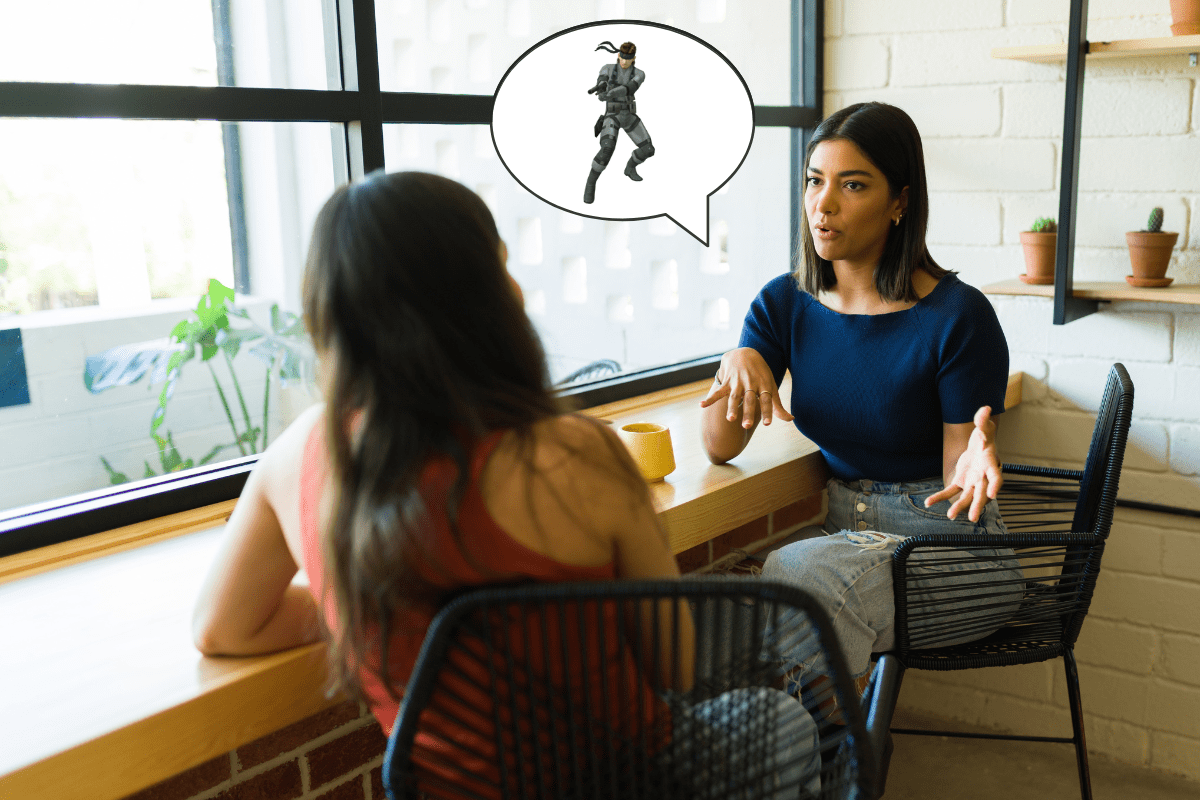
People swear by the unusual 'Solid Snake' conversation trend to conquer social anxiety

It's actually an easy Japanese active listening trick.

conversation tips, social anxiety, small talk, socializing, etiquette, politeness, introvert, video games
Canva Photos & Konami

People have found a really great active listening technique in a super strange place.

There is an art to being a good listener. Physically using your ears to hear what someone is saying, and your brain to process it, is only part of the battle. You also have to show the person you're talking to that you're listening and that you care. Asking questions is a great way to keep the conversation flowing and let your talking partner know you're engaged. But what if you're socially anxious, shy, or just can't think of anything to say? It's harder than it seems, especially when meeting new people!

The solution is easy. Just take a page out of Solid Snake's book. Who's Solid Snake? Just a former Green Beret, special ops solider, spy, assassin, and the protagonist of the popular Metal Gear Solid video games. You might wonder what the heck Solid Snake, aka David, knows about active listening. It turns out, quite a lot.

The "Solid Snake conversation method" is taking the world by storm. It's part trend, part meme, and 100% effective.

conversation tips, social anxiety, small talk, socializing, etiquette, politeness, introvert, video games Solid Snake is here to help your social anxiety! Giphy

You don't need to know anything about video games to understand where the method comes from. Suffice it to say, Metal Gear Solid is a plot-heavy game series, full of cut-scenes that feature lots of dialogue and exposition.

It's become a bit of a joke in the gaming world that Snake, a man of few words, tends to fall back on one particular conversational technique over and over: He repeats, or echoes, bits of what the other characters say. It adds emphasis to important points, creates good conversational pacing, and allows the plot and dialogue to continue on smoothly.

Here's a (made up) example:

"Snake, we've got to get the blueprints!"

"The blueprints?"

"Yes, the bad guys are constructing a devastating bomb!"

"A bomb?"

"Indeed! You'll find the prototype in that bunker over there."

"A bunker?"

You get the idea. You can watch it in action here.


- YouTube www.youtube.com

Why does this random video game character speak in this strange cadence? And why are people stealing it to use in real life?

You might think this dialogue is just a clunky tool for exposition or the result of bad writing, but you'd be wrong!

The Metal Gear Solid games are written and developed in Japan by a team led by legendary developer Hideo Kojima. Though translated into English and created in part for an American audience, the games feature a lot of bits and pieces of Japanese culture.

Frequent repetition and conversational echoes are extremely commonplace in Japanese. It's part of a polite active listening technique called "Aizuchi," which refers to frequent interjections to show interest, engagement, reassurance, and politeness.

Aizuchi includes interjecting with words or phrases (or their equivalents) like "I get it," "Yeah," "Really?" or even repeating back parts of the original speaker's words, a la Solid Snake.

According to Niko Smith at FluentU, "Perhaps you already use some of these interjections in conversation. While your friend is [telling you a story]... you might nod a few times or throw in a surprised 'No way!' or 'What happened next?' [Aizuchi] works in a similar way, but it’s more relentless. As the listener in a conversation, you might find yourself doing just as much talking as the speaker."

Smith adds that in America, young people are often taught specifically not to interrupt or speak while someone else is talking. In Japan, doing so frequently—in the right way—is a sign of respect and interest.

Better yet, Aizuchi doesn't require the listener to be particularly brilliant in conversation, charismatic, or creative. Even socially awkward people, or anyone who clams up in social situations, can muster a few polite interjections!

This technique exists outside of Japanese culture, too. In fact, it's a well-known wat to keep conversations flowing effortlessly, give you time to think about what you're going to say, and make your conversation partner feel heard and appreciated.

It's no surprise that people familiar with the game have been trying the technique in real life for years. In 2023, a viral 4chan post helped popularize the idea, and more recently a (now deleted) post on X went super viral referencing how effective the "Solid Snake conversation method" is for meeting new people.

The technique is hitting home with young people, especially gamers and the chronically-online, which makes for a really productive and much-needed discussion.

Gen Z has grown up with social media taking the place of many in-person interactions, screens everywhere, and of course, the COVID years. All of these factors affect the way they communicate with each other, especially in real life:

Maddy Mussen writes for The Standard, "Gen Z slang is all about shutting people out. It’s an inside joke, the more unintelligible the better. It’s in keeping with its etymology. When your whole modus operandi is being exclusionary, it doesn’t make for a lot of meaningful conversation."

It would be an unfair blanket generalization to say young people only speak in brainrot and have no idea how to operate in the real world. But Gen Z is racked with social anxiety to a far greater degree than previous generations. They need all the tools and practice they can get when it comes to operating in the real world and speaking to people they don't know well.

If they, or anyone else, can take a useful tip from their favorite video game character, there's nothing wrong with that at all.

ideas, homelessness, prodigy, social work, solutions
Photo credit: @ribalzebian on Instagram

Ribal Zebian is going to test a house he designed by living in it for a year.

Ribal Zebian, a student from the city of London in Ontario, Canada, already made headlines last year when he built an electric car out of wood and earned a $120,000 scholarship from it. Now, he's in the news again for something a little different. Concerned with homelessness in his hometown, Zebian got to work creating a different kind of affordable housing made from fiberglass material. In fact, he’s so confident in his idea that the 18-year-old plans on living in it for a year to test it out himself.

Currently an engineering student at Western University, Zebian was concerned by both the rising population of the unhoused in his community and the rising cost of housing overall. With that in mind, he conjured up a blueprint for a modular home that would help address both problems.


Zebian’s version of a modular home would be made of fiberglass panels and thermoplastic polyethylene terephthalate (PET) foam. He chose those materials because he believes they can make a sturdy dwelling in a short amount of time—specifically in just a single day.

“With fiberglass you can make extravagant molds, and you can replicate those,” Zebian told CTV News. “It can be duplicated. And for our roofing system, we’re not using the traditional truss method. We’re using actually an insulated core PET foam that supports the structure and structural integrity of the roof.”

Zebian also believes these homes don’t have to be purely utilitarian—they can also offer attractive design and customizable features to make them personal and appealing.

“Essentially, what I’m trying to do is bring a home to the public that could be built in one day, is affordable, and still carries some architecturally striking features,” he said to the London Free Press. “We don’t want to be bringing a house to Canadians that is just boxy and that not much thought was put into it.”

Beginning in May 2026, Zebian is putting his modular home prototype to the test by living inside of a unit for a full year with the hope of working out any and all kinks before approaching manufacturers.

“We want to see if we can make it through all four seasons- summer, winter, spring, and fall,” said Zebian. “But that’s not the only thing. When you live in something that long and use it, you can notice every single mistake and error, and you can optimize for the best experience.”

While Zebian knows that his modular homes aren't a long-term solution to either the homeless or housing crisis, he believes they could provide an inexpensive option to help people get the shelter they need until certain policies are reformed so the unhoused can find affordable permanent dwellings.

@hard.knock.gospel

What to buy for the homeless at the grocery store. 🛒 Most people get it wrong. After being there myself, these are the survival items that actually matter 💯 The 2nd to last one is about more than survival—it’s about DIGNITY. We are all one circumstance away from the same shoes 🙏 SAVE this for your next grocery run. 📌 IG@hardknockgospel Substack@ Outsiders_Anonymous #homelessness #helpingothers #kindness #payitforward #learnontiktok

Zebian’s proposal and experiment definitely inspires others to try to help, too. If you wish to lend a hand to the unhoused community in your area in the United States, but don’t know where to look, you can find a homeless shelter or charity near you through here. Whether it’s through volunteering or through a donation, you can help make a difference.

Friendship

Real people say this post-hangout question helps keep friendships alive

"It's such a simple and effective way to show love..."

friendships, hangouts, friends, organizers, adult friendships, how to stay friends,
Photo credit: Canva, alvarog1970 from alvarostock (main image) / anlomaja (text box)

People think this post-hangout question can be a friendship game-changer.

It's not always easy to maintain close friendships as an adult. Everyone's busy and to some degree exhausted, and free time is scarce. So how do we maximize our friend time? And how do we reach out without looking too pushy? A regular person offered a suggestion: asking one thoughtful post-hangout question that's made their friendships "so much stronger."

It's pretty simple: "When's the next time I'll see you?"


Here's their logic: "You're showing enthusiasm for seeing your friend again, reassuring them you had a good time, and planning the next time you'll see each other all in one go," they wrote on Reddit. "Obviously this requires the friend to reciprocate, but it's such a simple and effective way to show love that has had consistent, lasting effects on my friendships. I don't typically say this to new friends; it's for people that I'm confident I want consistently in my life."

- YouTube www.youtube.com

Their trending post earned hundreds of replies, as people weighed in with their perspectives.

One person appeared to echo the OP's sentiment, talking about the importance of having a "chooser" in friendships—someone who will take on the role of making plans. "'Be a chooser' is the best advice I ever received," they wrote. "People want to hang out, but very few want to make the decision to hang out and organize it. Be the chooser…people will follow."

In reply, someone added, "I'm the planner and the calendar friend. For a long time, I took it so personal that no one else really planned things. But actually, people appreciate this. If they didn't, they'd make excuses to not hang out or would just say no instead of enthusiastically agree."

Here are more interesting comments, including some with a different perspective:

"This works because it removes guesswork"

"I have a group of girlfriends from college that get together every month for brunch, and most of them are also in a book club with me. At the end of each hang, whether it's brunch or book club, we get our calendars out and plan the next one. Occasionally we skip a month if there's a ton of conflicts, and not every person makes every single hang, but they happen very regularly and have been happening regularly for about 2 1/2 years now. We're all late 30s-mid 40s with careers and (in their cases,) spouses and families. 10/10 everyone should do this!"

"It rules that this works for you! I have to say, if someone asks me this, unless we're super duper bestest friends I'm just gonna say, 'hopefully soon- let's talk!" and not much will change. Seeing friends is more of a time issue than a desire issue IMO. Even if we want to plan things, we're busy a lot."

friendship, happiness, adult friendships, staying close with friends, friendship dynamics Two friends hugging. Photo credit: Canva, mododeolhar from Pexels

"I see the usefulness of this, but also I think this would low-key give me a panic attack if I just got done hanging out with someone and they wanted to plan the next one. I'm fully prepared to believe this is a 'me' thing"

"Agree with you in spirit but phrasing it that way puts a lot of pressure on them to figure out a date in advance, and some people don't like to plan far in advance."

"Instead I usually go with something like 'what's our next thing?' Easier for another person to figure out what something is than when on the spot"

"I love this because it shows intention without being clingy. So many friendships fade just because no one makes the next step explicit. This feels simple, warm, and very human."

"If this isn't your speed, you can also text them the next day. This works well for anxious people because it also sends them an affirmation/aftercare if they are worried about the hangout."

"This works because it removes guesswork. Clear interest plus a next step keeps friendships from fading by accident."

- YouTube www.youtube.com

"Focus on the reception"

While some people felt the question could come off as pushy, the OP clarified their stance with a few key points: they don't ask it every time they see someone, particularly people they see often, and they always make sure to read the room. They continued, "You do NOT do this after an exhausting event, or with people who do not like planning. Sometimes it's a conversation opener; others it's a time to pull out the calendar. This works well for busy people who also like consistent quality time. If that is not you, that's okay."

While every friend dynamic is unique, it's natural to feel like you're constantly initiating hangout plans.

Friendship coach Danielle Jackson explored this idea in a 2021 YouTube video, explaining that there are three key things you can do if you feel like the "giver" in a relationship: give the other person the "opportunity to initiate," reframe how you view their contributions, and "focus on the reception" rather than the initiative. "At the end of the day," Jackson says, "it's less about who's asking and more about who's saying yes."

- YouTube www.youtube.com

washer, washing machine setting, how to use washing machine, laundry, laundry tips
Image courtesy of @granolabarpan/Instagram (with permission)

Stay-at-home mom Catrina shares shock at learning what the 'heavy' setting on her washer means.

Knocking out loads of laundry is a feeling of accomplishment that is unmatched. Depending on what needs to be washed, washing machines offer a variety of settings for the ideal clean. But even the most seasoned laundry pros can admit that they don't fully understand how to use them properly.

One stay-at-home mom shared her funny and relatable washing machine mistake. Catrina (@granolabarpan) got the shock of a lifetime when she realized that she had been using the "heavy" setting on her washer wrong for years.


"POV: today years old when it clicks why my blankets are sopping wet!!! I thought HEAVY meant heavy items being washed," she wrote in the video's overlay.

"Heavy on my machine means heavily soiled," she went on to add in the comments. "I thought it meant the stuff I was putting in the machine was heavy in weight/pounds."

Some moms are also realizing this for the first time. "Ok.. so I am 66 years old learning this???!! I always thought that heavy meant weight also😂," one person commented. Another person wrote, "Well I was today years old when I learned what heavy meant too…😂"

Others expressed confusion with so many settings, and reminiscing on simpler times. "Wait a minute. 😂. I think I need to for once go and read the manual because I have been wondering about all of the options," another user wrote. And another chimed in, "I want my old $250 3 options hot/warm/cold on/off washer back. It didn’t die it rusted out but took 25yrs to do it. I had 5 kids, plus my ex in-laws living with me."

Washing machine settings, explained

Struggling to understand the settings on your washing machine? You're not alone.

"Knowing these settings helps avoid common laundry mistakes, such as using the heavy cycle for heavy fabric weight instead of heavy soil, which can lead to ineffective cleaning or damage over time," Vanessa Ruiz, a professional organizer at Sparkly Maid San Antonio, tells Upworthy.

These are five washing machine settings and how they work:

1. Normal/Regular Cycle
Ruiz explains that this is your typical setting for day-to-day loads such as t-shirts, jeans, sheets, and underwear.

"These laundry loads are typically washed in warm water and the setting is rinsed with medium spin speeds through agitation in order to properly clean moderately soiled garments," she says. "This cycle is safe enough to wash a variety of different fabric content with a somewhat dirty load."

2. Delicate/Gentle Cycle
Ruiz notes that the delicate cycle is created specifically for delicate fabrics—lingerie, silk, lace, or embellished clothing—that may become damaged in a normal or regular wash.

"This cycle will use moderate spin speeds through gentle agitation to thoroughly dry clean and not damage clothes too easily," says Ruiz. "This is the preferred cycle when laundry items that require extra care or are labeled 'delicate' or 'hand wash' need to be washed."

3. Heavy Duty Cycle
The heavy duty cycle is specifically for heavily soiled items like work clothes, kitchen towels, and bedding.

"This setting uses higher water temperatures, longer wash times, and powerful agitation to remove stubborn dirt and grime. It’s perfect for those tough laundry jobs, but not recommended for delicate fabrics," explains Ruiz.

- YouTube www.youtube.com

4. Bulky/Bedding Cycle
This cycle is often confused with "heavy."

"This cycle accommodates larger, heavier items that absorb a lot of water, such as comforters, pillows, and sleeping bags," says Ruiz. "It uses more water, medium spin speeds, and longer wash times to thoroughly clean bulky items without causing damage or imbalance."

5. Quick Wash
In a rush? This is the perfect setting to use.

"It is an accelerated wash cycle designed for small loads of lightly soiled clothes, usually lasting 15 to 40 minutes," says Ruiz. "It’s great for when you need clean clothes fast and can save energy compared to longer cycles."

This article originally appeared last year.

neurologist; thinking is harder; critical thinking; AI; Google; AI thinking; using AI

Neurologist explains why thinking feels harder today. Reveals 10-second rule to fix it.

Many people have noticed an uptick in feeling like something is just on the tip of their tongue, but their brain is unable to grasp it. Brain fog and an increased difficulty to concentrating long enough to problem solve are also anecdotally on the rise. If you've ever felt like this, you're not alone. According to a neurologist, Dr. Arif Khan, people around the globe are experiencing more difficulty thinking than they did in the past, and he knows why.

We're constantly thinking throughout our days, but more complex thought seems to be taking a toll in more recent years. Sometimes, asking your brain to think critically feels the same as asking it to turn you into a car—just impossible. But, thankfully, Khan knows why.


neurologist; thinking is harder; critical thinking; AI; Google; AI thinking; using AI Deep in thought, trying to find the right answer.Photo credit: Canva

The neurologist starts his video by asking about the last time you had to think without using Google or AI to help with the answer. "Something subtle is happening to your brain, and most of us do not realize it until it has already changed how we think," he says. "You started a sentence, and auto-complete finished it. You had a question, and the answer appeared instantly. You needed to decide, and a tool did it for you instantly, and you probably did not even notice this. But here's a thing most people do not realize: that tiny pause, that moment where your brain used to think, is slowly disappearing."

This pause when your brain buffers to flip through the archive of information stored deep within it, is no longer being utilized. It may not occur to people that they're training their brains not to think. Khan explains that when people quickly move beyond the pause to pick up their phone to have the answer provided, the brain adapts. This adaptation is creating a reflex to bypass the thinking process, staying in line with the brain's goal of efficiency.

Khan says, "If a task gets handled for you, your brain does not resist. It relaxes. Sounds helpful, right? But here's what most people miss: the brain strengthens when it's used, and it weakens when it is not. That is not philosophy, that is neuroscience. When you struggle to remember something, memory circuits fire. When you solve something, your prefrontal cortex activates. When you sit with uncertainty, your brain builds resilience. But when answers arrive instantly, when decisions are made for you, your brain quietly steps back."

Khan goes on to say that the process isn't abrupt, so many do not feel like they're having trouble thinking—but there are signs. With the increased use of AI and search engines for quick answers, Khan shares that people may notice they become easily frustrated with not getting the answer quickly. He also explains that people start becoming increasingly uncomfortable with thinking things through, causing them to reach for information tools much faster than in previous years.

neurologist; thinking is harder; critical thinking; AI; Google; AI thinking; using AI Pensive moments during study time.Photo credit: Canva

Search engines that bring information to the fingertips of millions in seconds has made the pastime of wondering obsolete. If someone becomes curious about something, they simply ask Alexa or Siri without even having to stop the task at hand. This action has become reflexive for most people, which decreases trust in one's ability and lowers confidence, according to Khan. He advises that people should instead practice becoming comfortable with the discomfort that comes with not knowing. Sitting in that pause and thinking things through before using an information tool can help rebuild the deep thinking part of the brain.

Khan encourages people to use AI as a collaborator, not a replacement for thinking, by allowing 10 seconds to think first. This simple pause can make the difference in maintaining the brain's capacity to confidently think without the input of a search engine.

pen drill, life hack, speech tips, enunciation, pronunciation

Want to speak better? Put a pen in your mouth.

Ever been told that you mumble? Or that your way of speaking is quiet or lacking confidence? It could be affecting you in a range of situations, from asking someone out to giving a presentation at work or interviewing for a job. Well, a behavior researcher has a solution for you: put a pen in your mouth.

Behavior expert and speaker Dr. Shadé Zahrai shared a technique in a social media video that could help people who mumble, rush through speeches, or generally struggle to enunciate when speaking aloud. She recommends taking a clean pen and placing it horizontally in your mouth, like a horse biting a bridle. Then take out a book and read it aloud to yourself for one minute, even overpronouncing some words if you need to. After a minute has passed, take the pen out of your mouth and continue reading the rest of the page. Doing this "Pen Drill" once a day should help you speak more clearly and effectively overall.


@shadezahrai

I promise you - so this for 60 seconds and you’ll enunciate better.

This may sound silly, but there's solid reasoning behind it. Because you're trying to hear yourself clearly while speaking with a pen in your mouth, you naturally slow down as your mouth opens wider than usual. This makes your speech and enunciation clearer by forcing you to slow down and articulate each word. A side benefit is that speaking slowly and enunciating clearly makes you appear more calm, confident, and authoritative.

@joseczuniga

Try this pen trick to enunciate better and get a deeper more confident voice #josezuniga

There are additional benefits beyond clearer speech. Content creator Jose Zuniga claims the technique can help men deepen their voices. Zuniga says that when men speak from their chest rather than their throat during the "Pen Drill," the wider mouth opening allows them to speak at a lower pitch than usual. Singers and vocal coaches also recommend putting a pen in your mouth in order to reduce vocal strain.

@sophiesaidcoaching

A tip guarenteed to help with vocal strain!! Just grab a pen or a chopstick #vocalcoach #singing #singer

Speaking clearly is incredibly beneficial, not only because it helps you be understood and get what you want, but also because it makes you appear more eloquent and intelligent. Speaking in a clear, calm way makes you sound confident, which helps people believe your words and arguments more than if they were delivered meekly, filled with "ums" and "uhs." Combined with strong body language, it can mean the difference between being believable and being believed.

"Clear speech signals calm authority, and calm authority is magnetic," explains Zahrai in her video. "You don't sound rushed, you don't sound unsure, you sound like someone who expects to be listened to."

@gentlemens_collective

To be become a better speaker FAST… slow down.

If you want to improve your speech, whether to reduce mumbling, slow a rushed, worried pace, or sound more confident, put a pen in your mouth and swallow your pride (but not the pen!). With time and practice, it could change your speech patterns into ones people clearly understand and feel compelled to listen to.