SNL ‘kinda’ banned this 1998 ‘Schoolhouse Rock’ parody warning about corporate media control

Let’s watch “Conspiracy Theory Rock.”

snl, robert smigel, tv funhouse
Photo credit: via MetaphysicalMakaveli/YouTubeConspiracy Theory Rock, from "Saturday Night Live."

In 1996, President Bill Clinton signed the Telecommunications Act, which reduced Federal Communications Commission (FCC) regulations on cross-ownership so that major corporations could buy up smaller media outlets nationwide. This deregulation had far-reaching results, and 20 years later, 90% of the country’s major media companies were owned by just six corporations.

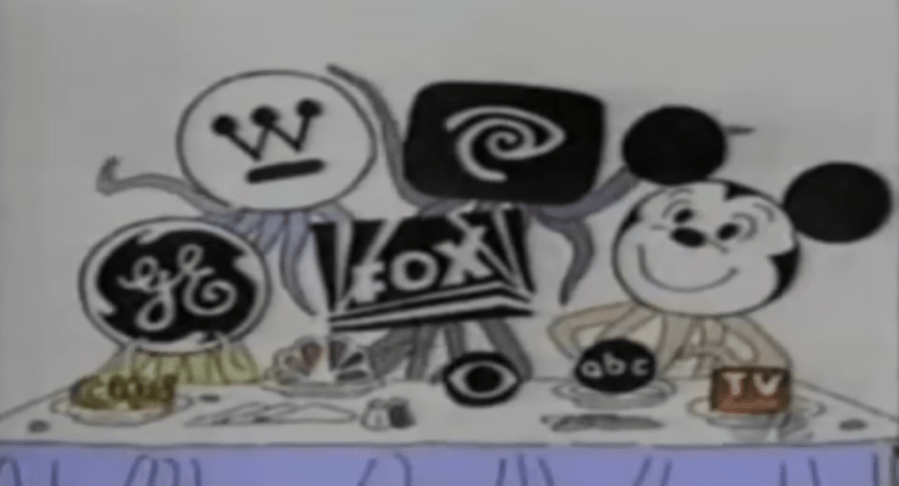
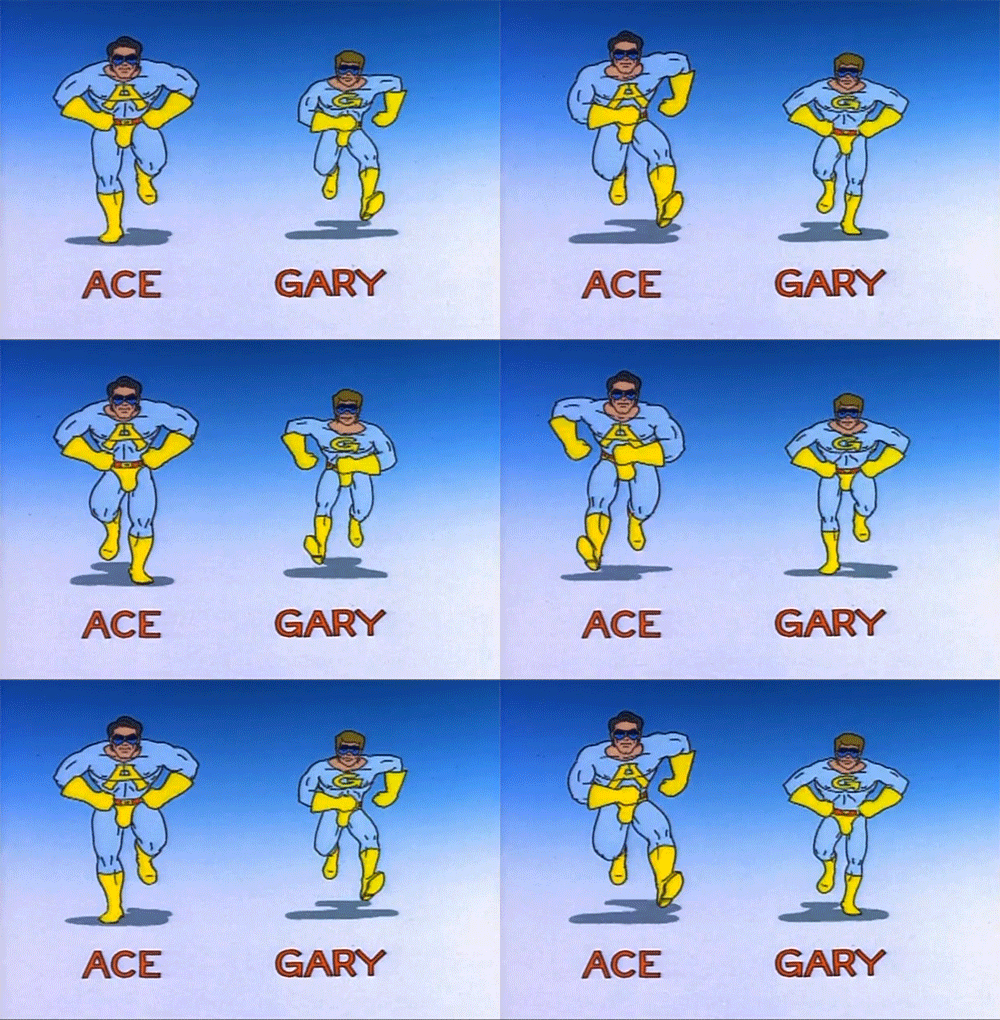
The consolidation of power over the country’s media into the hands of a few corporations rightfully disturbed many Americans who were worried a few powerful interests could shape the national narrative. “Saturday Night Live” writer Robert Smigel, who created the show’s “TV Funhouse” segment, best known for animated sketches featuring the “Ambiguously Gay Duo” and “The New Adventures of Mr. T,” took dead aim at the corporate media in a 1998 episode with a 2-minute “Schoolhouse Rock” parody called “Conspiracy Theory Rock.”


“Conspiracy Theory Rock” was a brave SNL piece because it didn’t hold back when discussing General Electric, NBC’s parent company. The sketch accuses GE of media manipulation, corporate welfare, influencing the FCC, manufacturing nuclear weapons, and producing cancer-causing pollution.

The controversial cartoon was reviewed by NBC corporate before hitting the air. “It did go through an extensive note process, beyond the Standards dept, and up the executive ladder,” Smigel recalled in an Instagram post. “I remember adding the ‘voices in my head’ line per their request to make the narrator seem crazier, not that it made a big difference.” But after a few minor notes, the network aired the sketch on the March 14 episode featuring host Julianne Moore and Backstreet Boys.

Did ‘Saturday Night Live’ ban ‘Conspiracy Theory Rock’?

Over the past 26 years, “Conspiracy Theory Rock” has earned the reputation of being a “banned” sketch, but that may be a bit of a conspiracy in and of itself. Was it cut from subsequent airings because it was controversial or because it simply wasn’t funny? SNL executive producer Lorne Michaels claims the cartoon was cut from reruns because it merely “wasn’t funny,” so they ran the second Backstreet Boys performance instead. It’s worth noting that when SNL episodes are rerun, they are often only an hour long (including commercials) instead of the usual 90-minute runtime.

However, Smigel’s recollection breathes a bit of life into the controversy.

“Months passed, and all was calm until Adam McKay approached me,” Smigel recalled. “A pissed-off crew member had let Adam know the sketch was being cut from the rerun, replaced by a second Backstreet Boys song, which had no mentions of GE polluting the environment. I wasn’t especially surprised, but Adam was fired up. He leaked the story to a few TV journalists who’d written about the cartoons. NBC claimed it wasn’t funny (not that it was), and that’s why people know and still talk about it today.”
The sketch would be included in the 2006 “Best of TV Funhouse” DVD, so Smigel believes it has only been “kinda banned.” However, the cartoon does not appear in the rerun of the March 14, 1998 episode currently streaming on Peacock. The Backstreet Boys performance is also not included due to music rights issues.

Ultimately, it’s hard to know whether the cartoon was banned or dropped from broadcasts due to its lack of humor. But we know that Smigel was brave in pointing out the problems posed by corporate media control. His willingness to criticize those in power reminds us how rare it is to see satire that questions the very system airing it. Twenty-six years later, it still makes the rounds online because the problems he pointed out are still with us today.


  • Jennifer Garner worked as a restaurant hostess at 22. Her confession about how seating decisions were made is uncomfortable to read.
    Photo credit: Gage Skidmore via Wikimedia Commons and CanvaJennifer Garner and a recording studio.
    ,

    Jennifer Garner worked as a restaurant hostess at 22. Her confession about how seating decisions were made is uncomfortable to read.

    “If we put a circle next to their name, they got seated in Siberia.” Jennifer Garner just confirmed what a lot of us suspected about restaurant seating.

    Before Jennifer Garner was a household name, she was a 22-year-old hostess at a restaurant in New York City. She was seating people, managing waits, and doing something else she’d kept quiet about for a long time.

    On the Dish Podcast with broadcaster Nick Grimshaw and Michelin-starred chef Angela Hartnett, released March 4, Garner finally laid it out. “You put the beautiful people at certain tables,” she said. “You put celebrities at certain tables. And if somebody even mildly famous walked in…”

    The system had a name for the people who didn’t meet the standard. When Garner and her colleagues wrote down reservation names, some of them got a circle next to them. “If we put a circle next to them, they got seated in Siberia,” she said.

    Hartnett confirmed this wasn’t unique to Garner’s restaurant. In high-end dining establishments, she said, the word “Siberia” is industry shorthand for the section where less desirable customers are quietly deposited — away from the windows, away from the room’s natural center of gravity, and away from the diners the restaurant actually wants other people to see.

    One of Garner’s clearest memories involves Steve Martin, who was a regular and had a very specific preference: table five. If someone was already sitting at table five when Martin arrived, Garner had to move them. Mid-meal, mid-date, mid-whatever they were doing.

    “I would have to go to those people and say, ‘I am moving you to the bar, and I’m going to buy you some calamari and that’s going to be on me,’” she said, describing the awkwardness of being a 22-year-old telling a couple on a date that they were being relocated because someone more famous had shown up.

    Garner called the whole practice “merchandizing” the restaurant — treating the dining room the way a retailer treats a window display, positioning the most appealing elements where they’d be seen.

    Grimshaw’s response, on hearing the Siberia detail for the first time: “I’m going to rethink every restaurant I’ve ever been in.”

    The phenomenon isn’t just anecdotal. A 2016 Channel 4 documentary investigation called Tricks of the Restaurant Trade sent groups of models into three upscale London restaurants. In each case, the models were seated at prime front-of-house tables. When co-presenter Adam Pearson, who has neurofibromatosis, a condition that causes visible tumors on the face and skin, attempted the same exercise, he was seated in a corner at the first restaurant, initially ignored at the second, and turned away entirely at the third.

    Research has also found an appearance premium for the servers themselves. One study found that attractive servers earn roughly $1,261 more per year in tips than unattractive ones.

    Garner, for her part, said her hostess days were more psychologically taxing than almost anything that came after. “I’ve had more nightmares about my days as a hostess than I have had actor’s nightmares,” she said. “And I’ve had a lot of actor’s nightmares.”

    You can follow Nick Grimshaw (@nicholasgrimshaw) on Instagram for more celebrity content.

  • Writer Aubrey Hirsch asked what’s a ‘universal thing men like’ and got hilarious answers
    ,

    Writer Aubrey Hirsch asked what’s a ‘universal thing men like’ and got hilarious answers

    A writer asked her followers what all men have in common and the observations in the comments were hilariously accurate.

    Writer and illustrator Aubrey Hirsch jokingly asked her followers on X (formerly Twitter) what’s a “universal thing that most men like?” because she was writing a comic and “just realized I don’t actually know any men in real life.” The tweet inspired an avalanche of funny responses.

    Hirsch is the author of “Why We Never Talk About Sugar,” a collection of short stories, and her work has appeared in The New York Times, Vox, American Short Fiction and TIME Magazine.

    The interesting thing about the responses is that they weren’t the typical stereotypes about men. She didn’t get a ton of people talking about sex, sports or toxic masculinity. Instead, there were a lot of folks that mentioned very specific male behaviors as if they were talking about a bizarre species they discovered in the wild.

    The two things that dominated the thread

    There were, undeniably, two things that got the most comments on her post. First, men enjoy watching construction sites. Evidently, the phenomenon is so popular in Italy that there is a specific word for this type of person in Italian.

    When asked why men enjoy watching construction sites so much, a poster on Reddit had the perfect response. “I just find it really satisfying and interesting to see the process behind things being built,” he wrote.

    The other beloved male activity is throwing heavy objects into bodies of water. Preferably, as large a rock as possible, and as deep a body of water as possible, and getting to throw from the highest vantage point possible.


    Gotta say, as a man, I have seen dudes do this and I have done it plenty of times myself.

    A few more that rang true

    Here are some more fun ones:

    (When we do this 99% of the time we’re pretending that the sign is 10 feet high and that we have the ability to dunk a basketball. There are two types of men, those that can dunk and mere mortals.)

    This one is near and dear to my heart. I can’t tell you the number of hours I have spent with my friends just throwing lines from “The Big Lebowski” back and forth.

    “Nice marmot.”

    “The Dude abides.”

    “Say what you want about the tenets of national socialism, Dude. At least it’s an ethos.”

    Another dude buddy pic that has cemented its place among the most quotable is “Once Upon a Time … In Hollywood.”

    “All right, that’s too hot. Anything we can do about that heat?” … “Rick, it’s a flamethrower.”

    Lastly, we’ll never pass up the opportunity to say hello to a complete stranger wearing our exact same hat, or re-live some sports-related glory days.

    Okay, everyone is an individual human. but there is certainly a lot to laugh at, and connect to, with this list.

    This story originally appeared two years ago. It has been updated.

  • Beloved airline gave all of its employees a bonus equal to 8 months salary
    Photo credit: Image credit: N509FZ Singapore Airlines employees are getting an enormous profit-sharing bonus.

    What makes an airline the “best in the world”? Stellar service, on-time departures, plentiful routes, comfortable seating, reasonable ticket prices, solid safety ratings, good loyalty benefits, etc., right? Those are all things customers look for in an airline, and many of them have given Singapore Airlines the title of “most awarded airline.” In 2023, it was named the World’s Best Airline by Skytrax World Airline Awards for the fifth time, more than any other airline in the 24-year history of the awards.

    Now, there’s another reason Singapore Airlines is being praised by both flyers and non-flyers alike. After the company announced a record net profit for 2023/2024, a source told CNN in May of 2024 that the airline was giving all of its employees a bonus equivalent to almost eight months of salary. Though details of the bonus were not shared by the company, a similar bonus was awarded to Singapore Airlines employees in 2022/2023, which was also a record-breaking year for the airline. According to an airline spokesperson who spoke to Business Insider, the bonus is due to “a long-standing annual profit-sharing bonus formula that has been agreed with our staff unions.”

    Why is Singapore Airlines giving employees an eight-month bonus?

    Profit-sharing plans provide an added incentive for employees to boost performance, which benefits both employees and employers as long as those at the top are not determined to hoard all of a company’s profits. Singapore Airlines’ profit-sharing bonus may be part of its overall compensation package as opposed to a discretionary bonus, but even so, it’s a largely unprecedented amount for any company to pay as a bonus, and people have weighed in with their thoughts.

    “Smart, this is what keeps employees happy and willing to continue going the extra mile. They are about to have even better coming year now.”

    “It’s not just that it’s a bonus….it’s the percentage. 8 months of salary is amazing leadership. Wish corporate America would not be so greedy with their record profits.”

    “Paying the staff a bonus, not just the executives, that’s good leadership.”

    “Congrats to Singapore Airlines! Setting a great example of rewarding employees for their dedication and hard work.”

    As part of the explanation for its profit of 2.68 billion Singapore dollars ($1.99 billion USD), the airline shared, “The demand for air travel remained buoyant throughout FY2023/24” with a boost by several major Asian countries fully reopening their borders after the COVID-19 pandemic. The airline shared that it carried 36.4 million passengers, a whopping 37.6% increase over the prior year.

    Clearly, a lot of people choose Singapore Airlines, but why? What actually makes it the best (currently second best after Qatar Airways in the most recent Skytrax rankings) in the world?

    What actually makes Singapore Airlines the best?

    For one, they dominate the awards for First Class travel, which is nice but doesn’t really affect the average traveler who flies economy. However, even Singapore’s economy experience is also miles above most other airlines. Singapore Airlines cabins are known for being well designed, impeccably clean and comparatively comfortable, and the crew has a reputation for being friendly, attentive, and helpful. (In fact, Singapore Airlines was honored with the World’s Best Cabin Crew award by Skytrax in 2024.) People who fly Singapore Airlines frequently tout the experience as feeling like it’s in an entirely different class than domestic airlines in the U.S., even when flying economy. The seats, the food, the service both on the ground and in the air—all of it adds up to excellence.

    When you provide customers the things they value, keep your employees satisfied and happy with fair profit-sharing incentives, and also operate in a cost-efficient way, it’s not surprising when you rank highly for awards across the board. That recognition then leads to more customers seeking you out, further increasing your revenue, and ultimately leading you to record profits, which then get shared with employees who work that much harder to ensure that this positive cycle continues.

    The cycle continues

    And it certainly has endured. According to Channel News Asia, on May 15, 2025, Singapore Airlines posted a headline profit of $2.8 billion for the current financial year (boosted by a one-off accounting gain from the merger of its Vistara subsidiary with Air India), which means their dedicated staff will be getting a nearly eight month bonus for the third year in a row.

    Amazing how when you put customers and employees first, everyone wins.

    This article originally appeared two years ago. It has been updated.

  • ‘Guys with alpaca hair’ and 14 other Gen Z fashion trends people hope disappear ASAP
    Photo credit: via The White House/Wikimedia Commons and The Earthy Jay / PexelsKansas City Chiefs quarterback Patrick Mahomes and a woman with a nose ring.

    Online culture has had an incredible effect on fashion trends. It used to take a trend about 20 years to complete a cycle: introduction, rise, peak, decline, and obsolescence. However, in recent years, this cycle has been sped up incredibly due to several factors. Trends can be quickly introduced and adopted due to social media, online shopping and quick turnaround through fast-fashion distribution. The speed of adaptation also means they can fizzle out just as fast.

    This means a fashion trends we’d usually see stick around for years can come and go in months. It’s an expensive pill to swallow for anyone trying to keep up with the latest (Gen Z, we’re looking at you), but it’s a blessing for those of us who have a problem with some of today’s polarizing looks.

    The bad news is you may not like broccoli cuts. The good news is that they will be gone and forgotten before you know it.

    A great conversation recently broke out on Reddit, where commenters weighed in on all the fashion trends they couldn’t wait to go away.

    It seems that some of the most controversial styles are the work of Gen Z. Whether it’s the nose ring that looks like it belongs on a bell cow or big pillowy eyelashes, Gen Z has championed some looks that will probably look a little silly in a few years.

    Here are 15 fashion trends currently “in” that people are already over.

    1. Suits with shorts

    “Took my cousin to prom and saw at least 30 dudes wearing a suit with shorts.”

    This one is extremely hard for millennials and Gen Xers to wrap their heads around, but it is oh-too-real. It seems to be a natural evolution of the “suit with sneakers” look.

    2. Anti-aging tweens

    Children (I’ve mostly seen around ages 9-13) going to Sephora for anti-aging serums and makeup. You all can hardly go to the park by yourselves, yet you’re plastered in expensive creams and makeup like you’re 20+.”

    “This one really bothers me. It’s pretty dark, honestly, and the parents who allow this are weird as hell.”

    The New Yorker says tweens are imitating influencers and popular “get ready with me” videos on social media.

    3. Limp Biz-kids

    “I’m a high school teacher and a surprising number of the boys dress like it’s 2000 and they’ve got Limp Bizkit’s ‘Nookie’ on repeat. There’s one kid that looks like he’s from 1977. Puka shells, feathered hair, big, open collars. I like that kid.”

    4. Botox

    “Excessive Botox in young people. I’m so tired of everyone having a frozen face. It’s not pretty. It’s just weird.”

    “I swear there was a coordinated effort by some industry to convince girls in their 20s that they need to start Botox now because it’s preventative. That’s the reason given when I ask these early 20s girls why they use it. “It prevents future wrinkles” like there was a peer-reviewed study showing it does or something.”

    Patricia Wexler, MD, of Wexler Dermatology in Manhattan, told Vogue that getting preventative Botox injections at a young age can lead to more wrinkles. “If you do too much Botox on your forehead for many, many years, the muscles will get weaker and flatter,” Wexler says. This means that surrounding muscles do more work when you make facial expressions. “If one stops using their forehead muscles, they may start squinting using their nose and have wrinkles along the side of their nose,” she continued.

    5. Teen boys with alpaca hair

    “I used to work reception at a salon and it was always fricken hilarious when these kids would come in to get a perm. They’d come sulking in behind their mommies, sit for 2 hours with curlers and stinky perm solution in their hair looking like cats being forced to take a bath, then prance out thinking they were the shit with their new poodle cuts lol.”

    “Some of them are definitely embracing their natural curls, which is awesome! But a good chunk of them, especially the preppy ones with rich parents, are getting straight up 80s style perms. It’s great.”

    Patrick Mahomes helped popularize this one, though he cut his signature curls in early 2025 — which may say something about where the trend is headed. Jake Paul, unfortunately, is still on board.

    6. Laminated brows

    “Eyebrows that are brushed upwards. That’s the only way I can think to describe it. I can’t see anything else when looking at someone who has that style brows. I just don’t know why people like it.”

    “Almost every eyebrow trend ends up looking kinda silly. Let’s just all work with the eyebrows we have. Sure, clean it up a lil bit if you feel like it.”

    In the 2000s, we had spiky hair. Now, we have spiky eyebrows. But don’t worry, it won’t last.

    Woman gets work done on her eyebrows. Photo credit Canva

    7. Over-the-top fake eyelashes

    “The ridiculous false eyelashes. I get it. I’ve got no problem with the ones that at least have a semblance of being natural. But the uber thick ones that look more like fur are just…pointless. Someone I deal with at work wears them. And it’s so weird, because most of the time she dresses down in sweatshirts, jeans, sneakers, etc. And doesn’t pay much attention to her hair. But she’s got those stupid wooly caterpillar eyelashes in. They just call attention to how un put together the rest of her is. I know that everyone should just dress for themselves, but it’s just weird.”

    8. Barrel jeans

    “The barrel jeans have got to go. They’re the ugliest effing things I’ve ever seen. And people keep lying to these women about how they’re flattering and I’m like no! You look bowlegged!”

    For years jeans got tighter and lower until they reached an inevitable breaking point. High-waisted jeans were a sign of the pendulum swinging back in the other direction, and now young peoples’ jeans look like inflated balloons.

    9. ’80s moustaches

    “Weird ’80s moustaches, I’ve seen good looking guys made to look like Ned Flanders. Ages them instantly, which I guess is the plan, but ages them past 20s to married with kids approaching teenage years.”

    The number of young men with mullets and moustaches is absolutely staggering these days.

    The ones that have been around way too long

    10. Crocs

    “I thought they were hideous when they first came out almost twenty years ago, and they’ve never gone away.”

    “We always made fun of them and then suddenly everyone was wearing them. I don’t get it!”

    How did Crocs go from the bargain bins to becoming one of the top footwear brands in the U.S.? The big reason is that comfort became more important during the pandemic than aesthetics. They were also quite a statement for people who wanted to rebel against traditional beauty standards. Add celebrity endorsements from Justin Bieber and Post Malone and Crocs came back in a big way.

    11. Long nails

    “Super long acrylic nails, they seem really impractical.”

    “Especially the pointed ones that all the Hollywood people wear like claws. You look trashy and high maintenance.”

    Woman with long ornate nails. Photo credit: Canva

    12. Grunt style

    “Patriot clothing and beards. Grunt style, nine line… all these fools dressing like they’re special forces, their entire identity tied to 1776. It’s embarrassing.”

    If I never see a t-shirt of an American flag with an assault rifle superimposed on top, it will be too soon.

    13. Hair parted in the middle

    “Middle parts. You need an almost symmetrical face to be able to pull it off, which is pretty rare. Side parts all the way.”

    “Middle parts look so harsh and unflattering on everyone. Side parts are a million times better.”

    It was cool when Shawn Hunter and Jonathan Taylor Thomas did it. Let’s leave this one in the ’90s.

    14. Nose rings

    “That nose ring in the middle. Just doesn’t look good to me. You do you. But just think it doesn’t look good very often.”

    “They always make me think of cattle.”

    15. Political clothes

    “Political attire as someone’s entire main wardrobe, no matter the side of the spectrum. You got more personality than that!”

    “I have a bro-in-law who wears American flag t-shirts almost exclusively. He must have hundreds of them. And not the tasteful kind with like a little flag on the sleeve or chest. I’m talking about the most garish kind. The kind with a gigantic waving US flag along with a menacing bald eagle flying dramatically over snow-capped peaks. We like America too, Dan, but can you try to wear at least a polo to Grandma’s funeral?”

    Fashion trends may come and go faster than ever, but some of these looks can’t go fast enough. And Reddit will always be sure to let everyone know it.

    This article originally appeared two years ago. It has been updated.

  • A two-word request on set led Jodie Foster to rethink everything about Hollywood. The request was for a cappuccino.
    Photo credit: Alan LightJodie Foster at the 61st Academy Awards March 29, 1989
    ,

    A two-word request on set led Jodie Foster to rethink everything about Hollywood. The request was for a cappuccino.

    The two-time Oscar winner opened up about the moment she realized celebrity culture was changing her…and not for the better.

    Jodie Foster has won two Oscars, been famous since she was 12, and has been working in the industry since she was barely 3. By her own account, all of that success had started to do something to her she didn’t like.

    The cappuccino that changed everything

    She described the moment of recognition in a January 2026 interview with Variety, timed to the release of her new film “A Private Life.” It came down to a cappuccino.

    “I asked someone for a cappuccino?” she recalled, with what Variety described as barely restrained horror. “I did what? I thought I knew what I was talking about and ranted on for 45 minutes? I didn’t send that person a condolence letter when their mom died? I wasn’t at their wedding? I disappeared for four months and expected everybody to be my friend when I came back?”

    Foster, now 63, said she feared she was becoming what she called “a creature of Hollywood,” a politer way of putting something less polite. Famous since her breakout in “Taxi Driver” at 12 and a two-time Best Actress winner before she was 30, for “The Accused” in 1988 and “The Silence of the Lambs” in 1991, she’d spent decades in an environment that tells you your needs come first. The cappuccino moment was when she realized she’d started to believe it.

    The science behind her self-awareness

    That discomfort is backed by research. Columbia University psychologist Adam Galinsky has studied the relationship between power and empathy, finding that people who feel powerful are demonstrably less able to read others’ emotional states accurately. In one experiment, participants who’d been primed to feel powerful made significantly more errors identifying emotions in facial expressions than those who hadn’t. Power, it turns out, reduces emotional sensitivity, not because powerful people are inherently worse, but because the environment trains them to stop paying attention.

    Foster paid attention when she noticed it happening to her, and she stepped back. She told NPR in a separate interview that she wanted to make movies she loved and give everything to her performances without getting caught up in celebrity culture, and that meant keeping her personal life tightly guarded. “I wanted to give everything of myself on screen, and I wanted to survive intact by having a life and not handing that life over to the media,” she said.

    Hollywood on her terms

    She has since returned to work, including “A Private Life,” which premiered at Cannes and opened in January 2026. She told Variety she believes it may be the best work of her career, and the secret, she said, is that she’s never worked less hard in terms of energy output. “I just do what I think, and then I drink a coffee.”

    This time around she gets the coffee herself.

  • American woman moves to Australia and discovers embarrassing double-meaning of her name
    Photo credit: via Andrea Piacquadio/Pexels and Ethan Brooke/PexelsA woman is shocked to learn that her name means something totally different in Australia.
    ,

    American woman moves to Australia and discovers embarrassing double-meaning of her name

    Devyn introduced herself to a group of people and they immediately bust out laughing.

    When people move abroad, it’s normal to experience serious culture shock. Culture shock is a feeling of being disoriented or confused by a different way of life and set of norms than you’re used to. You’d think moving from America to another English speaking country wouldn’t be so jarring, but you might actually be surprised at how different things can really be even when the bulk of the language and customs overlap nicely.

    Devyn Hales, 22, from California, recently moved to Sydney, Australia, on a one-year working visa and quickly found out that she had a lot to learn about her new home.

    The first thing that made her feel out of place? Believe it or not, her name. It wasn’t going to work Down Under. It all started when a group of men made fun of her on St. Patrick’s Day.

    Why her name became a problem the moment she landed

    After she introduced herself as Devyn, the men laughed at her. “They burst out laughing, and when I asked them why, they told me devon is processed lunch meat,” she told The Daily Mail. It’s similar to baloney, so I introduce myself as Dev now,” she said in a viral TikTok video with over 1.7 million views.

    For those who have never been to Australia, Devon is a processed meat product usually cut into slices and served on sandwiches. It is usually made up of pork, basic spices, and a binder. Devon is affordable because people buy it in bulk and it’s often fed to children. Australians also enjoy eating it fried, like spam. It is also known by other names such as fritz, circle meat, Berlina and polony, depending on where one lives on the continent. It’s like in America, where people refer to cola as pop, soda, or Coke, depending on where they live in the country.

    So, one can easily see why a young woman wouldn’t want to refer to herself as a processed meat product that can be likened to baloney or spam.

    “Wow, love that for us,” another woman named Devyn wrote in the comments. “Tell me the name thing isn’t true,” a woman called Devon added.

    For Devyn, it could have been worse, as her name was easily shortened to Dev. She could have been named Sheila, which is a slang term for women or girls that also carries slightly derogatory undertones.

    The other differences that caught her off guard

    Besides changing her name, Dev shared some other differences between living in Australia and her home country.

    “So everyone wears slides. I feel like I’m the only one with ‘thongs’—flip-flops—that have the little thing in the middle of your big toe. Everyone wears slides,” she said. “Everyone wears shorts that go down to your knees and that’s a big thing here.”

    Dev also noted that there are a lot of guys in Australia named Lachlan, Felix and Jack. (Oliver, Noah, and Henry have topped the charts in recent years, with Leo and William also consistently near the top.)

    She was also thrown off by the sound of the plentiful magpies in Australia. According to Dev, they sound a lot like crying children with throat infections. “The birds threw me off,” she said before making an impression that many people in the comments thought was close to perfect.

    “The birds is so spot on,” a user named Jess wrote. “The birds, I will truly never get used to it,” Marissa added.

    The upsides she didn’t expect

    One issue that many Americans face when moving to Australia is that it is more expensive than the United States. However, many Americans who move to Australia love the work-life balance. Brooke Laven, a brand strategist in the fitness industry who moved there from the U.S., says that Aussies have the “perfect work-life balance” and that they are “hard-working” but “know where to draw the line.”

    Despite the initial cultural shocks, Devyn is embracing her new life in Australia with a positive outlook. In a follow-up video, she mentions she hasn’t even had many run-ins with Australia’s infamous and dangerous creatures like giant spiders and man-eating sharks. There are other perks to living there, as well.

    “The coffee is a lot better in Australia, too,” she added with a smile, inspiring others to see the bright side of cultural differences.

    This article originally appeared two years ago. It has been updated.

    This article originally appeared 7 months ago. It has been updated.

  • At 19, Jewel turned down a million-dollar record deal. Decades later, she says it was the best decision she ever made.
    Photo credit: Jennifer StoddartJewel performing at The Theatre in Coquitlam, British Columbia in 2008.
    ,

    At 19, Jewel turned down a million-dollar record deal. Decades later, she says it was the best decision she ever made.

    Jewel turned down a million-dollar signing bonus while living out of her car. She went to the library first to understand why she had to.

    Before Jewel sold 30 million albums and earned four Grammy nominations, she was sleeping in her car in San Diego. She hadn’t chosen the situation romantically — she’d been fired after refusing her boss’s sexual advances, lost her paycheck, and couldn’t make rent. Then the car was stolen, leaving her fully homeless. She was 19.

    It was in the middle of all of this that the music industry came looking for her.

    Jewel had found a coffee shop that was going out of business and struck a deal with the owner: she’d bring people in, and she’d keep the door money. She started playing five-hour sets of original material on Thursday nights. Four people became twelve, became twenty, became fifty. A bootleg recording ended up on the radio. Record labels started showing up.

    A bidding war broke out. The biggest offer on the table included a $1 million signing bonus.

    She said no.

    Before making that decision, she did something practical and slightly remarkable: she went to the library and read a book about the music business. What she learned changed everything. “I learned that you owe that money back,” she explained in an interview on ABC’s No Limits with Rebecca Jarvis. “If my record wasn’t successful within a year, I would have been dropped. I would have ended up homeless again. I would have had to make a record that was guaranteed to be a hit, which I didn’t know how to do. I was a folk singer at the height of grunge.”

    In other words: the million dollars wasn’t a gift. It was a loan with conditions attached, and the conditions were essentially designed for her to fail.

    She recently revisited the decision in a conversation with entrepreneur Blake Mycoskie, posted March 30. In it she described the guiding principle she had formed for herself, even without words for it at the time. “I made myself a promise that my number one job in life would be to learn. I called it being a ‘happy whole human,’ not a human full of holes.” She wanted to be an artist more than she wanted to be famous — and she’d learned enough about the industry to know those weren’t the same thing.

    “Do I want to be famous and rich, or do I want to be an artist?” she told ABC. “I used that as my road map.”

    Instead of taking the advance, she negotiated a deal structured around the back end — one that gave her room to build a fan base slowly and stay true to her music. Her debut album, Pieces of You, came out in 1995. It eventually sold more than 12 million copies in the United States alone.

    She has since become a bestselling author, a producer, and an advocate for mental health and emotional resilience. Her motto, which she’s repeated across decades of interviews: “Hardwood grows slowly.”

    “If you can emotionally connect with a human being and cause them to emotionally invest with you, you have something,” she said. “Then you just have to go about it the old-fashioned way.”

  • Investigative journalist reveals the simple way you can protect your  phone from getting hacked
    Photo credit: Daily Show/Youtube, CanvaJournalist Ronan Farrow explains how turning off your phone each night can protect you from getting hacked
    , , ,

    Investigative journalist reveals the simple way you can protect your  phone from getting hacked

    His simple tip can offer protection in a time of less-than-stellar privacy regulations.

    There are just so many ways for important information held on your phone to be swiped—from subscription based apps that secretly send private customer data to Facebook to fake accounts that get your friends to invest in some kind of fake crypto.

    And of course—this is more than a modern day inconvenience. It poses real threats to democracy and global human rights, which is why so many are calling for more regulations and safeguards. Of course, as with most regulations, change isn’t coming fast. Which isn’t good news, considering how rapidly technology evolves.

    However, Pulitzer Prize winning investigative journalist Ronan Farrow has an incredibly simple tip for preventing our phones from being hacked: Turn them off more often.

    Why Ronan Farrow says we should all be ‘freaking out’

    While appearing on the Daily Show to promote his new documentary, Surveilled, Farrow told host Desi Lydic that we as a society should be “freaking out” more about the lack of government restraints about spyware technology, saying that it could turn the country “into an Orwellian surveillance state,” affecting anyone who uses a device, essentially—not just political dissidents.

    But, as Farrow noted, turning your phone off and on every day is an easy way to protect yourself, since most current forms of spyware “will be foiled by a reboot.” And even if you aren’t, say, a journalist or a political activist (i.e. common targets for malware), you’re thwarting apps from monitoring your activity or collecting your data. And better still, you’re making it more difficult for hackers to steal information from your phone. Privacy protection aside, it’s a great way of just keeping your device healthy. Basically, it seems like the age-old solution for virtually all tech issues still holds up.

    More easy steps you can take right now

    ronan farrow, surveilled max, documentary, privacy, journalism, daily show, spyware, malware
    Remembering to turn it off…that’s a different challenge altogether. Photo credit: Canva

    There are a few other things worth turning off now and then, such as bluetooth and location devices when you’re not using them, according to the NSA. In addition, Farrow also suggested keeping devices updated, and perhaps most important of all, actually writing to your representative about the issue.

    However, when it comes to wrapping devices in tinfoil as a makeshift Faraday cage…that might not be the best use of one’s aluminum.

    “Experts vary on exactly how effective that approach is,” Farrow told Lydic, just before quipping, “we need better policies. Not just better tinfoil.”

    The documentary that started it all

    Expanding on Farrow’s 2022 New Yorker investagative exposé on the notorious spyware Pegasus, Surveilled, which is available to stream on Max, delves into the multibillion-dollar industry of commercial spyware and its potential threats, making it evidently clear that this is not an issue for the elite few, or one to ignore until the future.

    On a (slightly) brighter note, Farrow debuted another new work in 2025, this time a true crime investigative podcast, titled Not a Very Good Murderer, which he himself narrates. Find it on Audible.

    This article originally appeared two years ago. It has been updated.

Culture

Hero principal crowned prom king after he was shot tackling school shooting suspect

Communication

‘No convincing’: Teacher praised for getting to the heart of ‘no means no’ lesson

Education

Teacher reveals the ‘really obvious’ reason teens no longer read. It’s not just the phones.

Finance

UPS driver has a blunt take on America’s economy after delivering Christmas packages