
upworthy
Add Upworthy to your Google News feed.
Google News Button
Joy

10 awkward friendships you probably have—we all have a #9.

Not all friendships are meant to last forever.

Comic with stick figures
via Wait But Why and used with permission

The ten types of friends

When you're a kid, or in high school or college, you usually don't have to work too hard on your friendships. Friends just kind of happen.

For a bunch of years, you're in a certain life your parents chose for you, and so are other people, and none of you have that much on your plates, so friendships inevitably form. Then in college, you're in the perfect friend-making environment, one that hits all three ingredients sociologists consider necessary for close friendships to develop: “proximity; repeated, unplanned interactions; and a setting that encourages people to let their guard down and confide in each other." More friendships happen.

Maybe they're the right friends, maybe they're not really. But you don't put that much thought into any of it — you're still more of a passive observer.

But once student life ends, the people in your life start to shake themselves into more distinct tiers.

It looks something like this mountain:
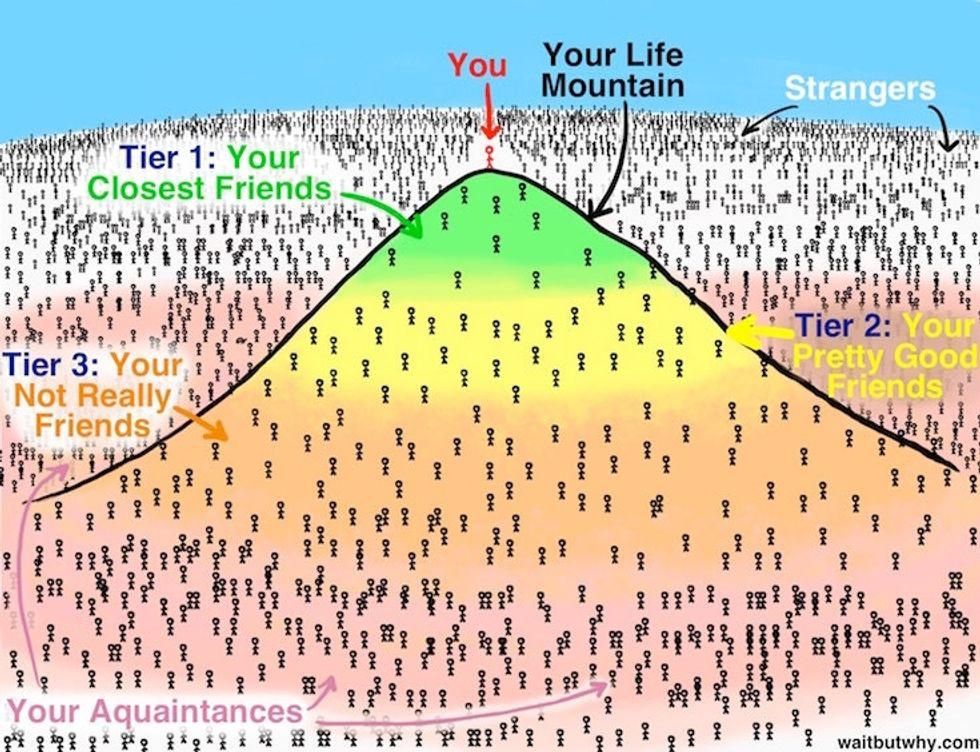
Infographic of a mountain

Visual interpretation of where friends fall on the mountain of “You."

via Wait But Why post and used with permission.

At the top of your life mountain, in the green zone, you have your Tier 1 friends—the people who feel like brothers and sisters.

These are the people closest to you, the ones you call first when something important happens, the ones you love even when they suck, who make speeches at your wedding, whose best and worst sides you know through and through, and whose relationship with you is eternal; even if you go months or years without hanging out, nothing has changed when you find yourself together again.

Unfortunately, depending on how things went down in your youth, Tier 1 can also contain your worst enemies, the people who can ruin your day with one subtle jab that only they could word so brilliantly hurtfully, the people you feel a burning resentment for, or jealousy of, or competition with. Tier 1 is high stakes.

Below, in the yellow zone, are your Tier 2 friends: your Pretty Good friends.

Pretty Good friends are a much calmer situation than your brothers and sisters on Tier 1. You might be invited to their wedding, but you won't have any responsibilities once you're there. If you live in the same city, you might see them every month or two for dinner and have a great time when you do, but if one of you moves, you might not speak for the next year or two. And if something huge happens in their life, there's a good chance you'll hear it first from someone else.

Toward the bottom of the mountain in the orange zone, you have your Tier 3 friends: your Not Really friends.

You might grab a one-on-one drink with one of them when you move to their city, but then it surprises neither of you when five years pass and drink #2 is still yet to happen. Your relationship tends to exist mostly as part of a bigger group or through the occasional Facebook Like, and it doesn't even really stress you out when you hear that one of them made $5 million last year. You may also try to sleep with one of these people at any given time.

The lowest part of Tier 3 begins to blend indistinguishably into your large group of acquaintances (the pink zone): those people you'd stop and talk to if you saw them on the street or would maybe email for professional purposes but whom you'd never hang out with one-on-one. When you hear that something bad happens to one of these people, you might be sad but not too affected.

Finally, acquaintances gradually blend into the endless world of strangers.

And depending on who you are and how things shook out in those first 25 years, the way your particular mountain looks will vary.

For example, there's Walled-Off Wally:
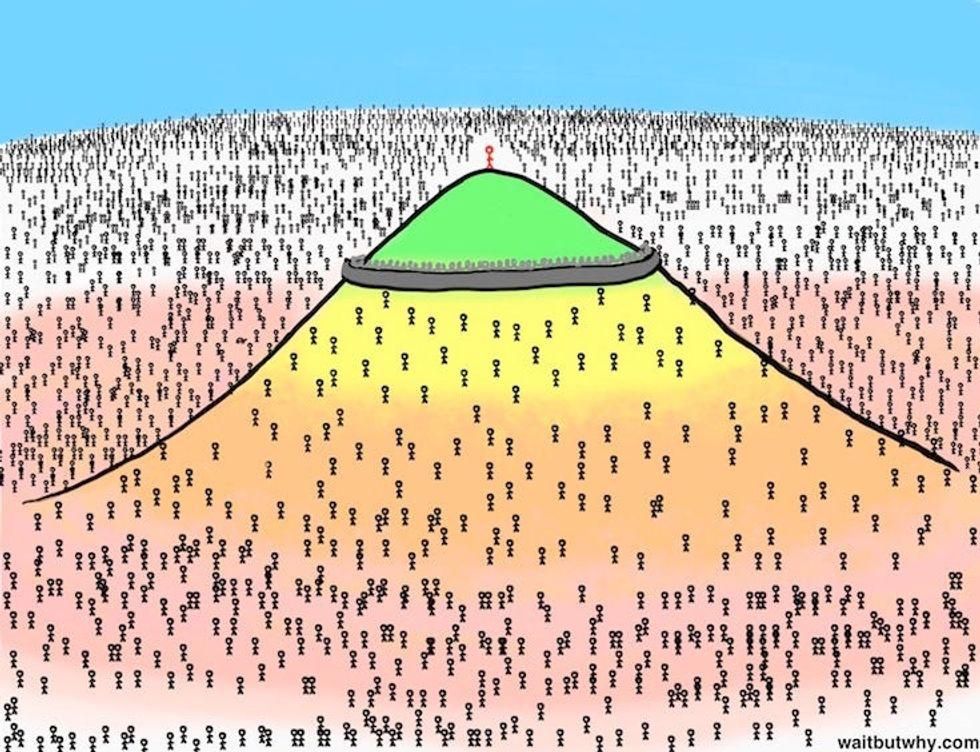
Comic of a lone person on top of a mountain

Some people keep a barrier up between acquaintances.

via Wait But Why post and used with permission.

And Phony Phoebe, who tries to be everyone's best friend and ends up with a lot of people mad at her:
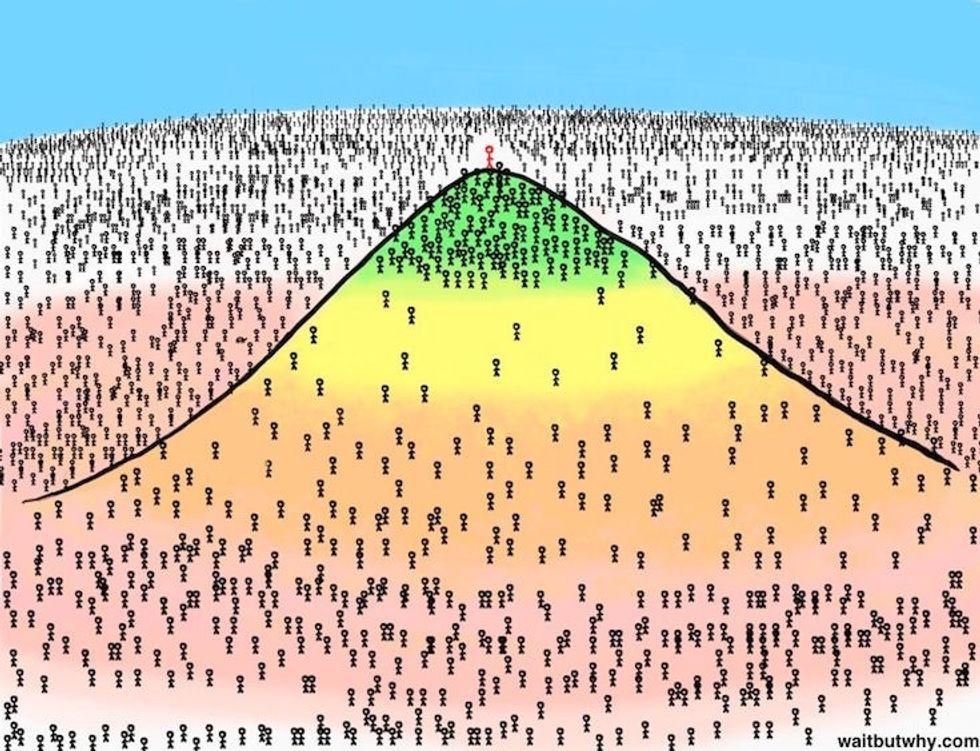
Comic of a mountain with a lot of people at the top

The life of the party.

via Wait But Why post and used with permission.

Even Unabomber Ulysses has a mountain:

Comic of a mostly empty mountain with one person at the top

Hermits exist.

via Wait But Why post and used with permission.

Whatever your particular mountain looks like, eventually the blur of your youth is behind you, the dust has settled, and there you are living your life.

Then one day, usually around your mid or late 20s, it hits you: It's not that easy to make friends anymore.

Sure, you'll make new friends in the future—at work, through your spouse, through your kids—but you won't get to that Tier 1 brothers level, or even to Tier 2, with very many of them because people who meet as adults don't tend to get through the 100+ long, lazy hangouts needed to reach a bond of that strength. As time goes on, you start to realize that the 20-year frenzy of not-especially-thought-through haphazard friend-making you just did was the critical process of you making most of your lifelong friends.

And since you matched up with most of them A) by circumstance, and B) before you really knew yourself yet, the result is that your Tier 1 and Tier 2 friends—those closest to you—fall in a very scattered way on what I'll call the Does This Friendship Make Sense? Graph:
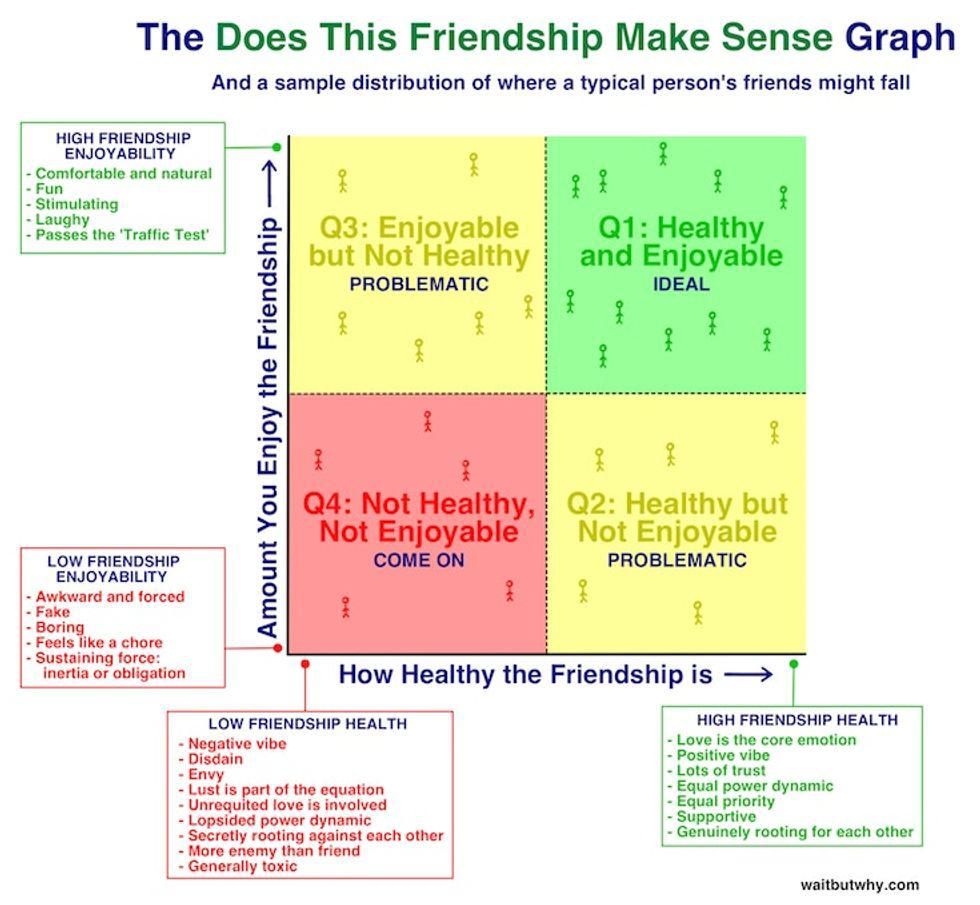
Graph

The friendship graph.

via Wait But Why post and used with permission.

So, who are all those close friends in the three non-ideal quadrants?

As time goes on, most of us tend to have fewer friends in Quadrants 2 through 4 because A) people mature, and B) people have more self-respect and higher standards for what they'll deal with as they get older. But the fact is, friendships made in the formative years often stick, whether they're ideal or not, leaving most of us with a portion of our Tier 1 and Tier 2 friendships that just don't make that much sense. We'll get to the great, Quadrant 1 friendships later in the post, but in order to treat those relationships properly, we need to take a thorough look at the odd ones first.

Here are 10 common ones:

1. The non-question-asking friend
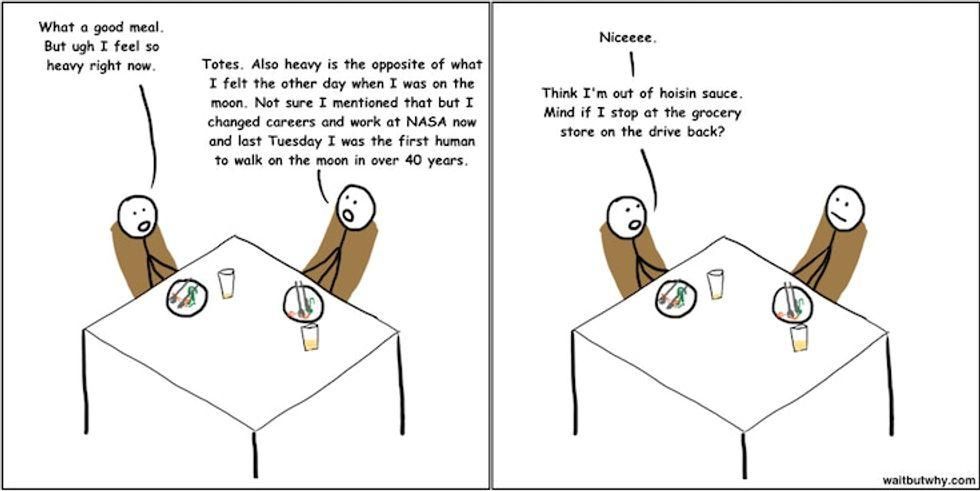
Comic of two people at dinner

Odd moments that happen between friends.

via Wait But Why post and used with permission.

You'll be having a good day. You'll be having a bad day. You'll be happy at work. You'll quit your job. You'll fall in love. You'll catch your new love cheating on you and murder them both in an act of incredible passion. And it doesn't matter, because none of it will be discussed with The Non-Question-Asking Friend, who never, ever, ever asks you anything about your life. This friend can be explained in one of three ways:

  1. He's extremely self-absorbed and only wants to talk about himself.
  2. He avoids getting close to people and doesn't want to talk about either you or himself or anything personal, just third-party topics.
  3. He thinks you're insufferably self-absorbed and knows if he asks you about your life, you'll talk his ear off about it.

Giving you the benefit of the doubt here, we're left with two possibilities. Possibility #1 isn't fun at all and this person should not be allowed space on Tier 1. The green part of the mountain is sacred territory, and super self-absorbed people shouldn't be permitted to set foot up there. Put him on Tier 2 and just be happy you're not dating him.

Possibility #2 is a pretty dark situation for your friend, but it can actually be fun for you. I have a friend who I've hung out with one-on-one about four times in the last year, and he has no idea Wait But Why exists. I've known him for 14 years and I'm not sure he knows if I have siblings or not. But I actually enjoy the shit out of this friend—sure, there's a limit on how close we'll ever be, but without ever spending time talking about our lives, we actually end up in a lot of fun, interesting conversations.

2. The friend in the group you can't be alone with under any circumstances
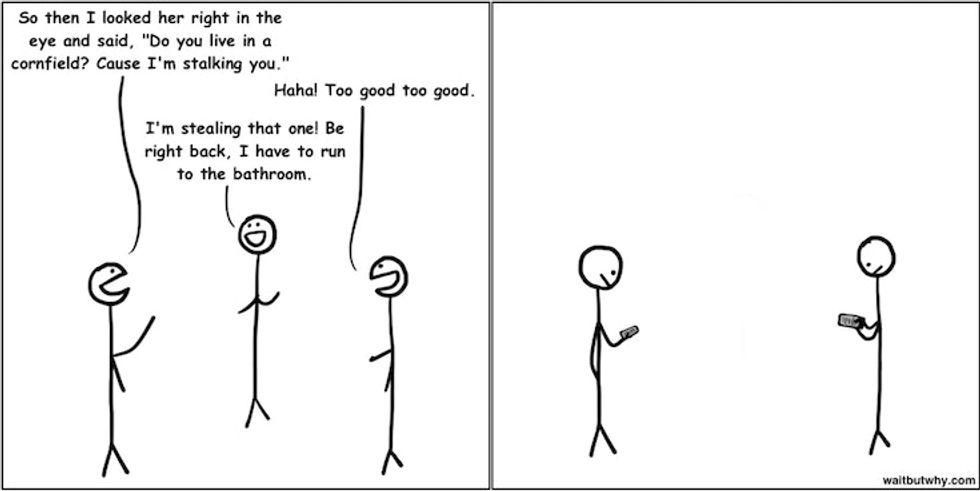
Comic of three stick people having a conversation

Why have relationships when there is a phone around?

via Wait But Why post and used with permission.

In almost every group of friends, there's one pair who can't ever be alone together. It's not that they dislike each other—they might get along great—it's just that they have no individual friendship with each other whatsoever. This leaves both of them petrified of the lumbering elephant that appears in the room anytime they're alone together. They're way too on top of shit to ever end up in the car alone together if a group is going somewhere in multiple cars, but there are smaller dangers afoot—like being the first two to arrive at a restaurant or being in a group of three when the third member goes to the bathroom.

The thing is, sometimes it's not even that these people couldn't have an individual friendship—it's just that they don't, and neither one has the guts to try to make that leap when things have gone on for so long as is.

3. The non-character-breaking friend you have to be “on" with
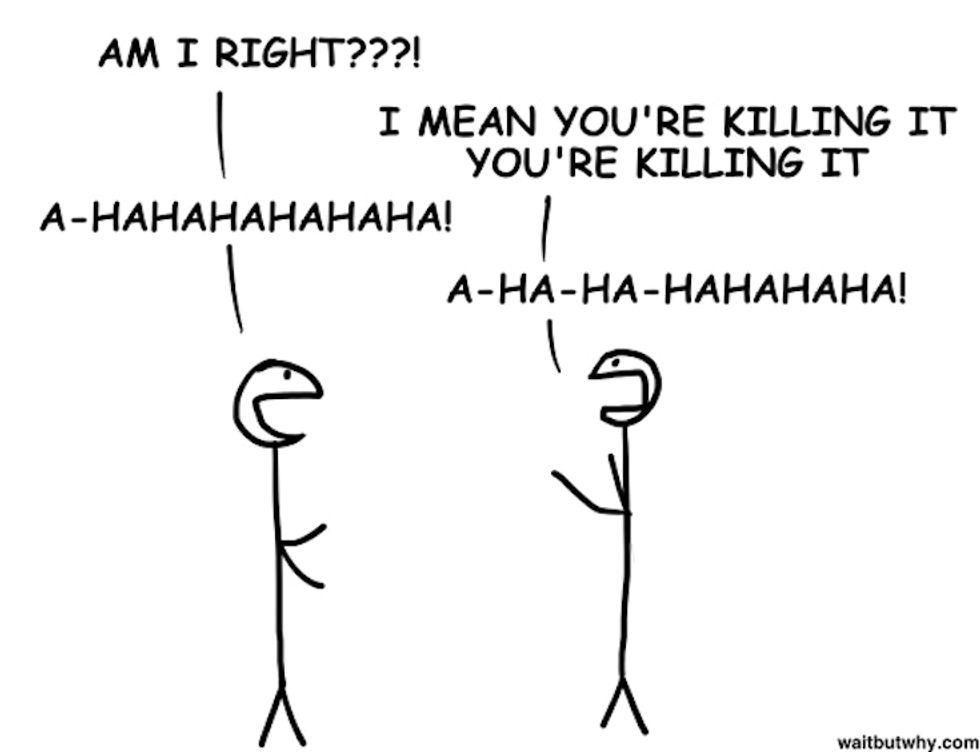
Comic of stick people laughing together

Controlled intimacy and distancing through language.

via Wait But Why post and used with permission.

This is a friend who's terrified of having an earnest interaction, and as such, your friendship with him is always in some kind of skityou always have to be on when you're interacting.

Sometimes the skit is that you both burst out laughing at everything constantly. He can only exist with you in “This is so fucking hilarious, it's too much!" mode, so you have to be in some kind of joke-telling or sarcastic mode yourself at all times or he'll become socially horrified.

Another version of this is the “always and only ironic" friend, who you really bum out if you ever break that social shell and say something earnest. This type of person hates earnest people because someone being earnest dares him to come out from under his ironic safety blanket and let the sun touch his face, and no fucking thanks.

A third example is the “You're great, I'm great, ugh why is everyone else so terrible and not great like us" friend. Of course, she doesn't really think you're perfectly great at all—if she were with someone else, you'd be one of the voodoo dolls on the table to be dissected and scoffed at. The key here is that the two of you must be on a team at all times while interacting. The only comfortable mode for this person is bonding with you by building a little pedestal for you both to stand on while you criticize everyone else. You can either play along and everything will go smoothly, even though you'll both despise yourselves and each other the whole time, or you can commit the ultimate sin and have the integrity to disagree with the friend or defend a non-present party the friend criticizes. Doing this will shatter the fragile team vibe and make the friend recoil and say something quietly like, “Hm ... yeah ... I guess." The friend now respects you for the first time and will also criticize you extra hard next time she's playing her pedestal game with a different friend.

What these all have in common is the friend has tall walls up, at least toward you, and so she builds a little skit for you two to hang out in to make sure any authentic connection can be avoided. Sometimes that person only does this out of her own social anxiety and can become a great, authentic friend if you can just stomp through the ice. Other times, the person is just hopelessly scared and closed off and there's no hope and you have to get out.

In any case, I can't stand these interactions and am in a full panic the entire time they're happening.

4. The double-obligated friendship
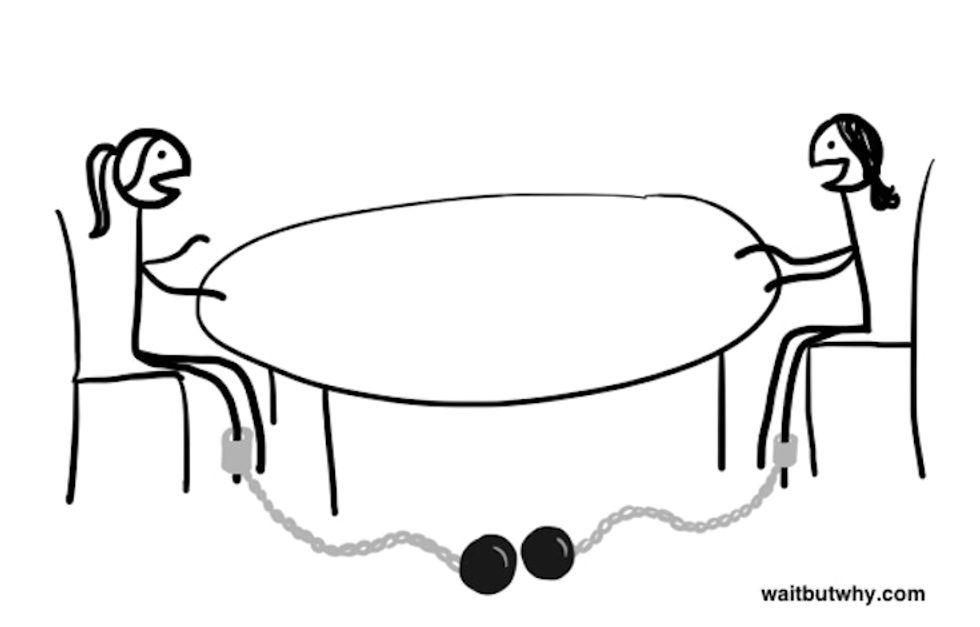
Comic of two men chatting a table with balls and chains around their legs

I think we need a bigger table.

via Wait But Why post and used with permission.

Think of a friend you get together with from time to time, which usually happens after a long and lackluster email or text exchange during which you just can't find a time that works for both of you — and you're never really happy when these plans are being made and not really psyched when you wake up and it's finally on your schedule for that day.

Maybe you're aware that you don't want to be friends with that person, or maybe you're delusional about it — but what you're most likely not aware of is that they probably don't want to see you either.

There are lopsided situations where one person is far more interested in hanging out than the other (we'll get to those later), but in the case we're talking about here, both parties often think it's a lopsided situation without realizing that the other person actually feels the same way — that's why it takes so long to schedule a time. When someone's excited about something, they figure out how to get it into their schedule; when they're not, they figure out ways to push it farther into the future.

Sometimes you don't think hard enough about it to even realize you don't like being friends with the person, and other times you really like the idea or the aesthetic of being friends with that particular person — being friends with them is part of your Story. But even in cases where you're perfectly lucid about your feelings, since neither of you knows the other feels the same way and neither has the guts to just cut things off or move it down a tier, this friendship usually just continues along for eternity.

5. The half-marriage

Two stick people each holding a half of a heart

An ego boost through controlling the relationship.

via Wait But Why post and used with permission.

Somewhere in your life, you're probably part of a friendship that would be a marriage if only the other person weren't very, very, extremely not interested in that happening. 1 for 2 on yes votes — just one vote away — so close.

You might be on either side of this — and either way, it's one of the least healthy parts of your life. Fun!

If you're on the if only side of things, probably the right move is to get your fucking shit together? Ya know? This friendship is one long, continuous rejection of you as a human being, and you're just wallowing there in your yearning like a sobbing little seal. Plus, duh, if you gather your self-respect and move on with your life, it'll raise their perception of your value and they might actually become interested in you.

If you're on the Oh yeah, definitely not side of the situation, here's what's happening: There's this suffering human in the world, and you know they're suffering, and you fucking love it, because it gives your little ego a succulent sponge bath every time you hang out with them. You enjoy it so much you probably even lead them on intentionally, don't you — you make sure to keep just enough ambiguity in the situation that their bleeding heart continues to lather your ego from head to toe at your whim.

Both of you — go do something else.

6. The historical friend
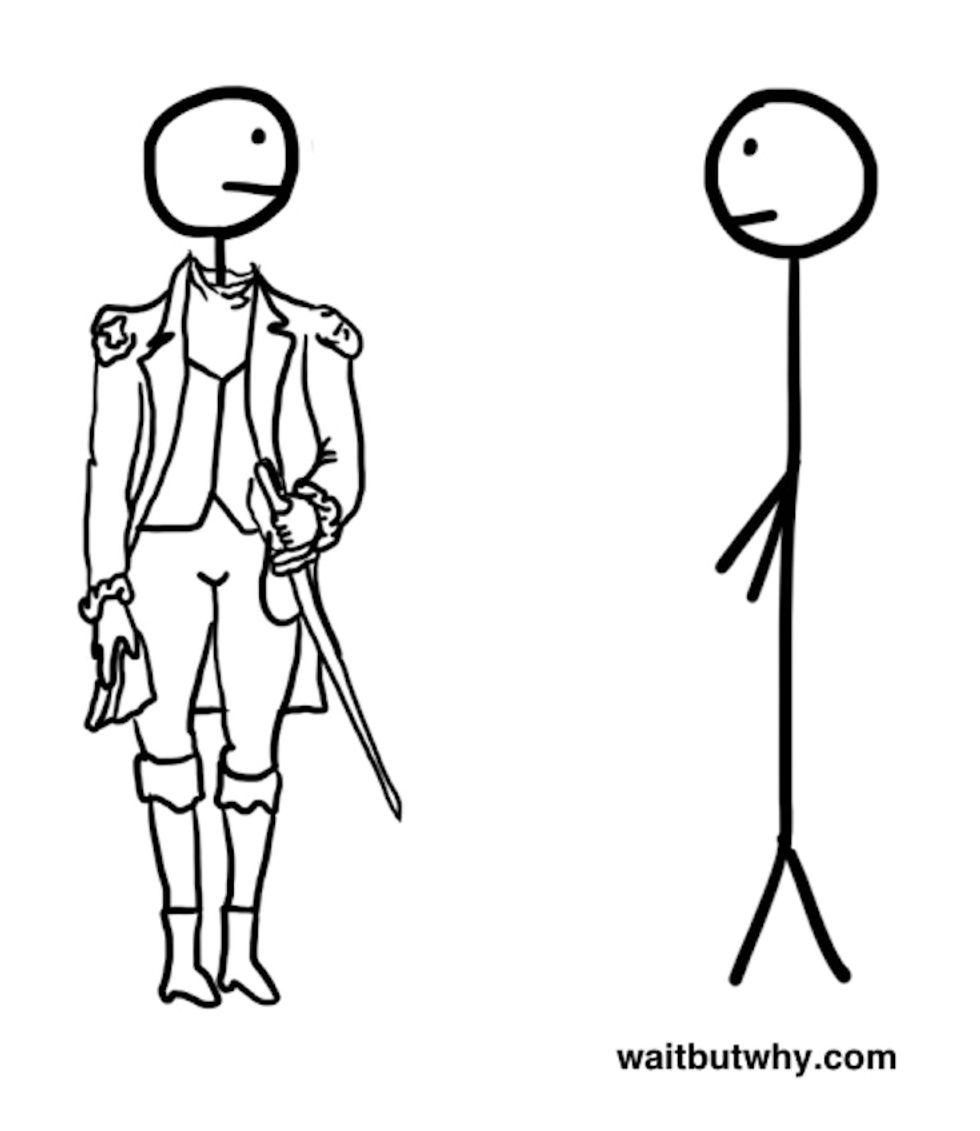
Stick person in historical garb beside a regular stick person

We met in kindergarten.

via Wait But Why post and used with permission.

A Historical Friend is someone you became friends with in the first place because you met when you were little and stayed friends through the years, even though you're a very weird match. Most old friends fall somewhat into this category, but a true Historical Friend is someone you absolutely would not be friends with if you met them today.

You're not especially pleased with who they are, and they feel the same way about you. You're not each other's type one bit. Unfortunately, you're also extremely close friends from when you were four, and you're both just a part of each other's situation forever, sorry.

7. The non-parallel life paths friendship
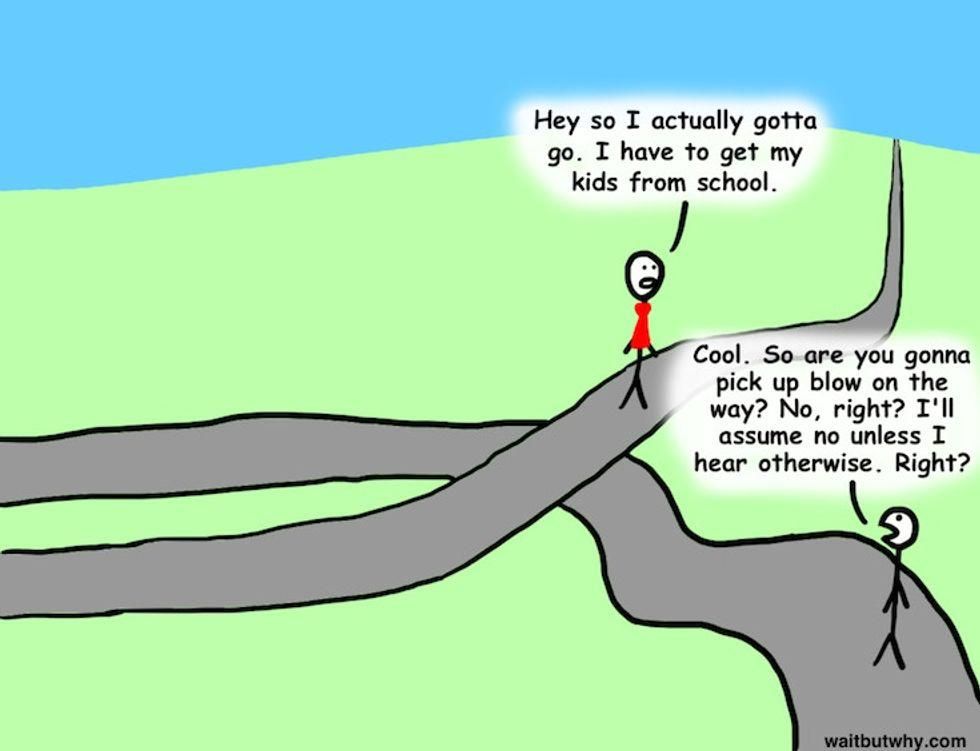
Two stick people on opposite paths

Looking for love in all the wrong places.

via Wait But Why post and used with permission.

Throughout childhood and much of young adulthood, most people your age are in the same life stage as you are. But when it comes to advancing into full adulthood, people do so at widely varying paces, which leads to certain friends suddenly having totally different existences from one another.

Anyone within three years of 30 has a bunch of these going on. It's just a weird time for everyone. Some people have become Future 52-year-olds, while others are super into being Previous 21-year-olds. At some point, things will start to meld together again, but being 30-ish is the friendship equivalent of a kid going through an awkward pubescent stage.

There are darker, more permanent Non-Parallel Life Path situations. Like when Person A starts to become a person who rejects material wealth, partially because she genuinely feels that pursuing an artistic path matters more and partially because she needs a defense mechanism against feeling envious of richer people, and Person B's path makes her scoff at people who pursue creative paths, partially because she genuinely thinks expressing yourself is an inherently narcissistic venture and partially because she needs a defense mechanism against feeling regretful that she never pursued her creative dreams — these two will have problems.

They may still like each other, but they can't be as close as they used to be — each of their lives is a bit of a middle finger at the other's choices, and that's jst awkward for everyone. It's not always that bad — but to survive an Off-Line Life Situation, friends need to be really different people who don't at all want the same things out of life.

8. The frenemy
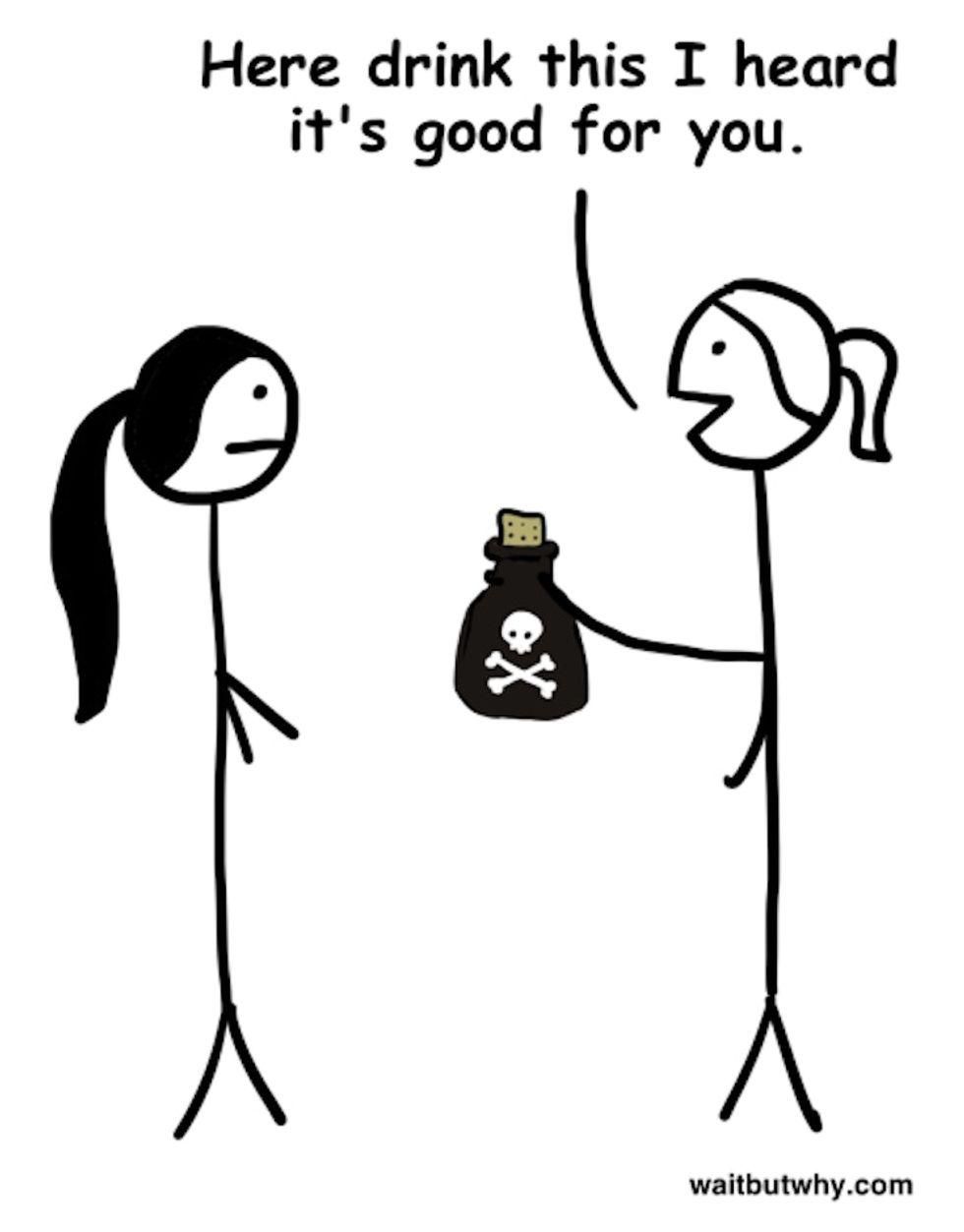
One stick person offers another stick person poison pretending it's safe

This is awful. Taste it.

via Wait But Why post and used with permission.

The Frenemy roots very hard against you. And I'm not talking about the friends that will feel a little twinge of pleasure when they hear your big break didn't pan out after all or that your relationship is in bad shape. I'm not even talking about someone who secretly roots against you when they're not doing so well at some area of life and it hurts them to see you do better. Those are bad emotions, but they can exist in people who are still good friends.

I'm talking about a real Frenemy — someone who really wants bad things for you. Because you're you.

You and the Frenemy usually go way back, have a very deep friendship, and the trouble probably started a long time ago. There's a lot of complex psychology going on in these situations that I don't fully understand, but my hunch is that a Frenemy's resentment is rooted in his own pain, or his own shortcomings, or his own regret — and for some reason, your existence stings them in these places hard.

A little less dark but no less harmful is a bully situation where a friend sees some weakness or vulnerability in you and she enjoys prodding you there either for sadistic reasons or to prop herself up.

A Frenemy knows how to hurt you better than anyone because you're deeply similar in some way and she knows how you're wired. She'll do whatever she can to bring you down any chance she gets, often in such a subtle way it's hard to see that it's happening.

Whatever the reason, if you have a Frenemy in your life, kick her toxic ass off your mountain, or at least kick her down the mountain — just get her off of Tier 1. A Frenemy has about a 10th of the power to hurt you from Tier 2 as she does from Tier 1.

9. The Facebook celebrity friend
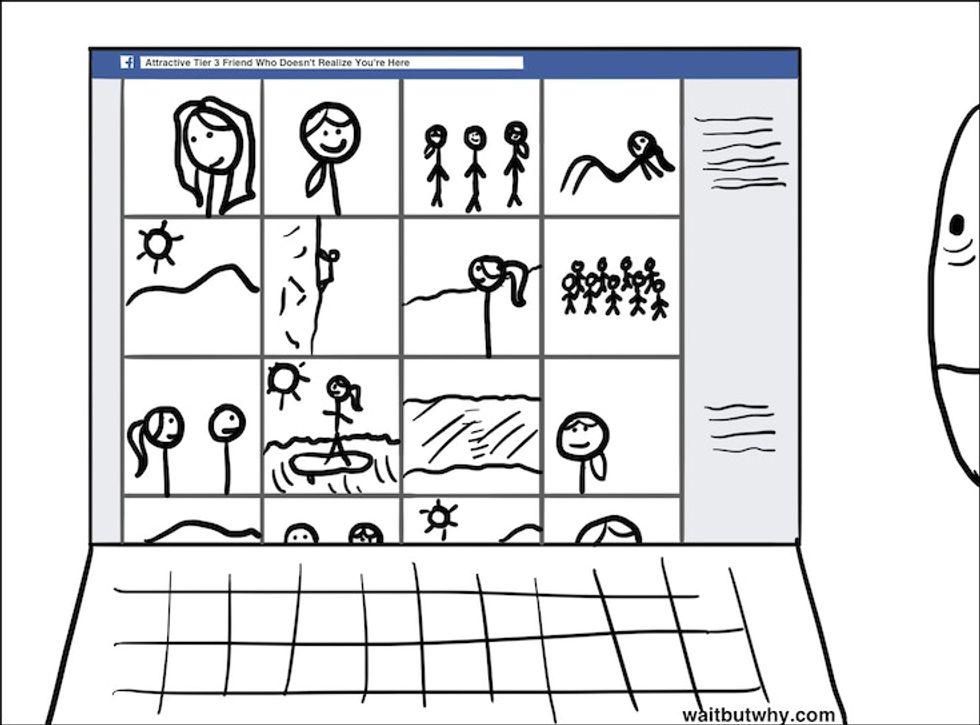
Comic of a computer with photo grid

What’s happening on social media?

via Wait But Why post and used with permission.

This person isn't a celebrity to anyone other than you, you creep. You know exactly who I'm talking about — there are a small handful of people whose Facebook page you're uncomfortably well-acquainted with, and those people have no idea that this is happening. On the plus side, there are people out there you haven't spoken to in seven years who know all about the new thing you're trying with your hair, since it goes both ways.

This is a rare Tier 3 friend, or even an acquaintance, who qualifies as an odd friendship because you found a way to make it unhealthy even though you're not actually friends. Well done.

10. The lopsided friendship
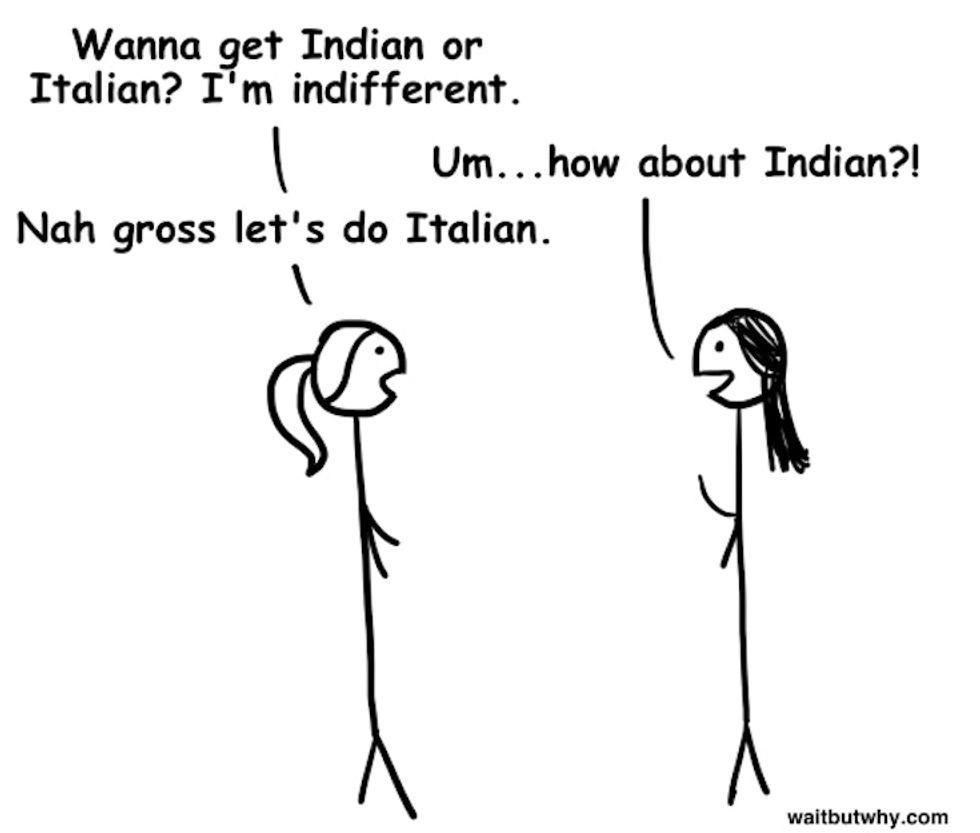
Two stick women discussing dinner

Can I make all the decisions... that was rhetorical.

via Wait But Why post and used with permission.

There are a lot of ways a friendship can be lopsided: Someone can be higher on their friend's mountain than vice versa. Someone can want to spend more time with a friend than vice versa. One member can consistently do 90% of the listening and only 10% of the talking, and in situations where most of the talking is about life problems, what's happening is a one-sided therapy situation, with a badly off-balance give-and-take ratio, and that's not much of a friendship—it's someone using someone else.

And then there's the lopsided power friendship. Of course, this is a hideous quality in many not-great couples, but it's also a prominent feature of plenty of friendships.

A near 50/50 friendship is ideal, but anything out to 65/35 is fine and can often be attributed to two different styles of personality. It's when the number gap gets even wider that something less healthy is going on—something that doesn't reflect very well on either party.

There are some obvious ways to assess the nature of a friendship's power dynamic: Does one person cut in and interrupt the other person while they're talking far more than the other way around? Is one person's opinion or preference just kind of understood to carry more weight than the other's? Is one person allowed to be more of a dick to the other than vice versa?

Another interesting litmus test is what I call the “mood determiner test." This comes into play when two friends get together but they're in very different moods — the idea is, whose mood “wins" and determines the mood of the hangout. If Person A is in a bad mood, Person B is in a good mood, and Person B reacts by being timid and respectful of Person A's mood, leaving the vibe down there until Person A snaps out of it on her own — but when the moods are reversed, Person B quickly disregards her own bad mood and acts more cheerful to match Person A's happy mood — and this is how it always goes — then Person A is in a serious power position.

But hey, not all friendships are grim.

In the Does This Friendship Make Sense graph above, the friendships we just discussed are all in Quadrants 2, 3, or 4 — i.e., they're all a bit unenjoyable, unhealthy, or both. That's why this has been depressing. On the bright side, there's also Quadrant 1—all the friendships that do make sense.

No friendship is perfect, but those in Quadrant 1 are doing what friendships are supposed to do: They're making the lives of both parties better. And when a friendship is both in Quadrant 1 of the graph and on Tier 1 of your mountain, that friendship is a rock in your life.

Rock friendships don't just make us happy — they're the thing (along with rock family and romantic relationships) that makes us happy.

Investing serious time and energy into those is a no-brainer long-term life strategy. But in the case of most people over 25—at least in New York— I think A) not enough time is carved out as dedicated friend time, and B) the time that is carved out is spread too thin, and too evenly, among the Tier 1 and Tier 2 friendships in all four quadrants. I'm definitely guilty of this myself.

There's something I call the Perpetual Catch-Up Trap. When you haven't seen a good friend in a long time, the first order of business is a big catch-up — you want to know what's going on in their career, with their girlfriend, with their family, etc., and they want to catch up on your life. In theory, once this happens, you can go back to just hanging out, shooting the shit, and actually being in the friendship. The problem is, when you don't make enough time for good friends, seeing them only for a meal and not that often — you end up spending each get-together catching up, and you never actually get to just enjoy the friendship or get far past the surface. That's the Perpetual Catch-Up Trap, and I find myself falling into it with way too many of the rocks in my life.

There are two orders of business right now:

First, think about your friendships, figure out which ones aren't in Quadrant 1, and demote them down the mountain. I'm not suggesting you stop being friends with those people—you still love them and feel loyal to them, and old friends are critical to hold onto—but if the friendships aren't that healthy or enjoyable, they don't really deserve to be in your Tier 1, and you probably shouldn't be in theirs. Most importantly, doing this clears up time to...

Second, dedicate even more time to the Quadrant 1, Tier 1 rocks in your life. If you're in your mid-20s or older, your current rocks are probably the only ones you'll ever have. Your rock friendships don't warrant two times the time you give to your other friends—they warrant five or 10 times!

Your rocks deserve serious, dedicated time so you can stay close. So go make plans with them.


This article was written by Tim Urban and originally published on Wait But Why. It originally appeared here nine years ago.

1970s, '70s, generations, food, meals

Kids in the 1970s pretending to cook

"What's for dinner?" has been asked by kids for millennia, probably, and the most common answers depend on both where and at what time in history it was asked. In ancient times, people were limited to what they could hunt or gather. Medieval recipes look different than what people ate in the 19th century. And what our grandparents ate when they were children was different from what our kids eat today.

Obviously, people couldn't DoorDash Chipotle in the '70s, but when someone on Reddit asked people born before 1970 what they ate for dinner most weeks, there were some standard meals a lot of Americans clearly ate regularly growing up. Lots of meatloaf and beef stroganoff. Pork chops and chop suey. Convenient assistance from Shake n' Bake, Hamburger Helper and TV dinners. Canned fruits and veggies. So much Jell-O.


Here are some of the most popular responses:

"Overcooked pork chop, minute rice, canned green beans, canned fruit cocktail

Spaghetti with ground beef and sauce made from a packet (Durkee?)

Pot roast (whatever cut of meat was on sale) cooked with Lipton onion soup mix. Frozen peas. Canned peaches.

Meatloaf with mashed potatoes and canned green beans. Canned pears

Shake n bake chicken and scalloped potatoes from a box. Canned fruit of some kind.

On awesome days Chef Boyardee pizza mix from a box.

I liked LaChoy chop suey.

Always with a jug of milk on the table."

1970s, '70s, generations, meals, meatloaf Meatloaf was a staple dinner.Photo credit: Canva

"So I think many of our moms went to the same home ec classes. Our house also had on rotation:

Goulash: It wasn’t what I have come to understand is Hungarian Goulash, but ground beef/spices/tomatoes.

Chicken Diane: Way overcooked chicken with rosemary, thyme and other seasonings.

Meatloaf: Yes, ketchup on top.

And the ever-present rice. Dad bought an aluminum rice cooker from his time in Japan and we had rice (he added soy sauce on top) 3x per week. The other side was baked potatoes.

The big treat!!!??? Chef Boy Ar Dee pizza from a tube on Friday once per month. Mom had a round aluminum baking pan and make dough, spread the included sauce on the dough, add the Parmesan Cheese (in the included packet). That was the biggest treat - and in all honesty I would go back to that day cause I miss my mom. Best pizza ever."

- YouTube www.youtube.com

"Hamburger patty or braised round steak, green salad, canned vegetable (peas, beans, corn, beets). Occasionally a baked potato. Sometimes my mom would toss chicken in a flour/seasoning mix and bake it and we'd have oven fried chicken--maybe once every couple of weeks. We got beef from a cousin so it was cheap, and chicken was expensive.

Mom also made spaghetti with ground beef, and beef stew with the tougher cuts of the cow. Oh--and liver--God how I hated liver night.

We always had cheap grocery store 'ice milk' in the freezer for dessert."

1970s, '70s, generations, food, meals, spaghetti Spaghetti is still a classic.Photo credit: Canva

"Sunday - Spaghetti/macaroni and homemade spaghetti sauce and a salad.

Monday - Roast chicken, a side (potatoes, Rice-a-Roni), and a veg.

Tuesday - Pork chops, a side (potatoes, Rice-a-Roni), and a veg.

Wednesday - Spaghetti/macaroni and homemade spaghetti sauce and a salad.

Thursday - Rump or sirloin steak, a side (potatoes, Rice-a-Roni), and a veg.

Friday - breaded and fried fish (ugh--haddock, halibut, or cod if the latter was on sale), a side (potatoes, Rice-a-Roni), and a veg.

Saturday - Rump or sirloin steak, a side (potatoes, Rice-a-Roni), and a veg.

Dessert would be supermarket ice cream (carton, usually Neopolitan), Jello chocolate pudding, Table Talk pie (usually apple)."

1970s, '70s, generations, food, meals, pork chops Why were pork chops so popular?Photo credit: Canva

"Typical meals: stroganoff made with ground beef and egg noodles. Pot roast. Swiss steak. Chicken cacciatore. Fried chicken. This was in California, but my parents were from the Midwest so pretty meat-and-potatoes. There was always a side vegetable and a starch. Rarely bread or rolls. Occasionally salad but not always until the 1980s. No formal/planned dessert except for special occasions like birthdays and holidays, but sometimes there was ice cream in the freezer or there were cookies (store bought; my mom wasn't a baker). In the late 70s my mom loved Julia Child and started to be more adventurous with cooking; later she took Asian cooking classes too."

"Beef stroganoff, fried bologna, weiners wrapped in bacon and then broiled, baked beans, (from scratch) liver.

Jello 1-2-3 (so space age!) Bundt cake, canned fruit salad, canned pears, canned peaches."

- YouTube www.youtube.com

"When we had some money (early in the pay period):

Spaghetti with sausages and homemade sauce

Liver and onions

Chop suey

Spare ribs and sauerkraut

Pork chops with mashed potatoes and gravy

Beef stew

Boeuf bourguignon

Beef stroganoff

When we were short on money:

Spam & scrambled eggs

Homemade macaroni & cheese

Cold cereal

That’s all I can think of right now.

We very rarely ever had dessert and almost never ate out. We never had fast food, the only fast food chain in town was Burger King, and McDonald’s was a town away and only open about six months of the year."

Here's to all the meals that nourished us in every era of our lives.

service dog, golden retriever, disney cruise, disney characters, good dog, dogs, pets, funny animals
Photo credit: Canva

A service dog named Forest lost his mind when he got to meet his hero: Pluto the Dog.

Service dogs are professionals who are trained to be attentive, helpful and extremely well-behaved for their owners who rely on them for everyday living. They aren't easily distracted and have solid control over their impulses because their job performance is vital to humans who need them. No one wants a service dog going rogue.

But underneath all of that self-control and professionalism, service dogs are still dogs, and they deserve to have a little fun every once in a while. An adorable recent encounter onboard a Disney Cruise Ship makes that abundantly clear.


service dog, golden retriever, disney cruise, disney characters, good dog, dogs, pets, funny animals Pluto and Goofy along with Chip and Dale. Photo by Taha on Unsplash

Ashton McGrady is a content creator who shares her adventures with her Golden Retriever service dog, Forest, who has an affinity for Disney characters. In one video, she shows Forest choosing his own stuffy at a Disney gift shop, even putting the money on the counter to pay for it himself.

In another video, McGrady takes Forest onto the high seas via a Disney cruise ship: The Wish. Onboard, Forest was lucky enough to be reunited with his favorite character, Pluto. People the world over are feeling his joy vicariously.

Watch:

@radiantlygolden

proof that distance won’t keep the very best of friends apart ❤️🚢✨ we love you pluto!!! #servicedog #servicedogteam #disneytiktok #disneycruiseline #disneycruise #hostedbydisney

Ashton calls Forest her "best pal and lifesaver," and it's clear from her videos that they make a great team. People loved seeing the good doggo get to let loose and enjoy a romp with Pluto and how the cast member interacted with him as well. Over two million people viewed the video on TikTok and hundreds chimed in to share how happy it made them.

"Those dogs are such good pups and work so hard to keep their owners safe, it’s nice to see them play for a bit ❤️"

"This is the most golden retriever golden I’ve ever seen 🥰🥰🥰"

"i just know the actor under the costume was having the best day ever."

"DID PLUTO WAG HIS OWN TAIL??? This is the best thing I’ve seen all day"

"It's like the Disney hug rule applies to dogs...but it's play with them until they are done."

"This truly made me smile"


service dog, golden retriever, disney cruise, disney characters, good dog, dogs, pets, funny animals Dogs aren't normally allowed onboard cruise ships unless they're service dogs, like Forest. Photo by Stephen Mease on Unsplash

The "Disney hug rule" referenced here is an apparently unofficial "rule" that Disney cast members when dressed in character don't end a child's hug until the child lets go—basically letting the child hug the character as long as they want to. It's not an actual rule, but it's a thoughtful practice some cast members use to make sure their young guests don't leave a character meet disappointed.

For Forest, the equivalent is playing until he (or his owner—he's on the job, after all) decides he's done.

This isn't the first time Forest has had a touching reunion with Pluto. Ashton shared another video with a similar interaction—it's clear that Pluto truly is Forest's bestie.

@radiantlygolden

I just want to go back to this moment 🥹 if you’re friends with pluto and you see this, you made our entire day ♥️ #waltdisneyworld #wdw50 #epcotfestivalofthearts #festivalofthearts #epcot #charactermeetandgreet #disneytiktok #distok #servicedog #servicedogteam #servicedogsatdisney

Ashton also uses social media to educate people about service dogs, as there are a lot of misunderstandings out there about what service animals are, how they work, and where they are allowed to be.

Though service dogs and their owners will often naturally form a bond, a service dog is not a pet; it's a working animal that assists a person with disabilities or health conditions. In fact, service animals are considered medical equipment, in the same category as a wheelchair or an oxygen tank, and they are allowed to go anywhere the person they are serving would normally be allowed to go—even if other animals are not allowed. As the Americans with Disabilities Act website states: "Under the ADA, State and local governments, businesses, and nonprofit organizations that serve the public generally must allow service animals to accompany people with disabilities in all areas of the facility where the public is allowed to go."

Service dogs are sometimes confused with emotional support animals, but they are not the same thing. Service animals are trained to do specific tasks related to mitigating a person's disability, which could range from recognizing when their owner is needing medical attention to reminding them to take a medication to guiding them around an obstacle or across a street.

@radiantlygolden

If a business is not pet-friendly, they may only ask these TWO questions! note: “emotional support” is NOT considered a valid answer to question 2. thank you @Disney Parks for this great example of how it should be done. #servicedog #servicedoglife #servicedogteam #disabilitytiktok #disneyparks

There are some guidelines and laws that govern how the general public as well as private businesses should interact with service animals. First, no one should pet a service animal unless their handler specifically invites them to. Second, there are only two questions a business owner or their staff members are allowed to ask a person with a service dog: 1) Is the dog a service animal who is required because of a disability? And 2) What work or task has the dog been trained to perform? They are not allowed to ask for documentation, ask what disability the person has or ask that the dog demonstrate what they can do.

For people who need them, service animals like Forest are a vital part of living a full life. They are also working professionals who deserve a break now and then, so it's fun to see this good doggo having the time of his life: like the time he met a pair of dolphins who were endlessly fascinated with him, or when he scored a great seat at the Taylor Swift Eras Tour. Rolling around with his best bud, Pluto, though, definitely takes the cake.

You can follow Ashton and Forest on TikTok and YouTube.

This article originally appeared in January. It has been updated.

Germany; German; smiling; culture; cultural norms; smiling at strangers; customer service

A German man explains why smiling at strangers in public is weird in Germany

Americans have such an interesting reputation internationally, but one that seems to give our nationality away in Germany is our habit of smiling. That's not to say that Germans don't smile because of course they do! But they don't smile while passing strangers on the street or use it as a social nicety.

Some may consider the constant smiling that many Americans do as fake or disingenuous because it's not part of their cultural norms. Dominik, a German man who runs the YouTube channel Get Germanized, explains that Americans may be taken aback by the lack of smiling by German citizens in public settings.


In America, it's considered polite to smile when greeting people or even when entering a place of business while passing another customer. It's a social norm that signals to the other person that you're acknowledging them. Sometimes this can be followed by a good morning or a thank you if the person in question held the door. There are places in the country where this is not as prevalent, but even in large cities where everyone seems to be in a rush, smiling still seems to be an understood custom.

Germany; German; smiling; culture; cultural norms; smiling at strangers; customer service Smiling girl chatting outdoors with a friend.Photo credit: Canva

Cultures vary from state to state, so it's no surprise that German social niceties are different than those in the U.S., Dominik explains, "Smiling is social lubricant everywhere else. [In] Many cultures, especially English-speaking ones, smiling is a social default. You smile at strangers. You smile to soften social interactions. You smile even when you don't mean it. It's a universal, friendly, 'I'm harmless' gesture. In Germany, that's suspicious. People will think, 'Why is this person smiling at me?'"

He goes on to share that the German smile is rare because it is only used when they're familiar with the person and are genuinely happy or amused. According to Dominik, a German offering up smiles to random people could "feel fake, intrusive, or overly familiar." It can also be seen as nervousness, insecurity, or manipulation. Germans don't smile to soothe the discomfort of themselves or others. Instead, their faces remain neutral until they experience an emotion that would elicit change.

"German communication is built on honesty. Not just in words, their body language too. If they're tired, you'll see it. If they're annoyed, you'll feel it. If they're happy, they'll show it, but only when they actually are. No forced cheerfulness. No plastic service smile. No, 'How are you? Fine,' dance. It's refreshing once you get used to it. Like taking off a mask you didn't know was there," Dominik says.

The no-smiling cultural norm extends to the service industry in Germany. Customer service employees are there to solve the customer's problems, not to be entertaining. Dominik explains that Germans trust professionals who look focused while working. Even on public transportation, no smiling is going on between commuters; people mind their own business. They're not unfriendly, they're respecting your space." Dominik shares.

Germany; German; smiling; culture; cultural norms; smiling at strangers; customer service Smiling warmly in a cozy sweater, feeling relaxed and happy.Photo credit: Canva

The German culture enthusiast assures viewers that Germans smile a lot, but it's reserved for friends, families, and cute puppies. They also smile at people they like, so it's not that Germans think Americans are strange for smiling; their cultural norms are just different.

duck egg on the ground, duck egg in incubator, duckling just hatched, humanity, kindness, ducks, animals, wildlife, conservation
Courtesy of Riyadh Khalaf/Instagram (used with permission)

When Riyadh found an egg, he had no idea how much it would change his life.

Some love stories are so out of the ordinary that they are worth sharing with the world. And few love stories are as extraordinary as the one between a man and the sweet creature that hatched from a mysterious egg he found and incubated.

The true tale of Riyadh and Spike's starts like the opening to a children's book: "One day, a man was walking along and spotted a lone egg where an egg should not have been…" And between that beginning and the story's mostly sweet ending is a beautiful journey of curiosity, care, and connection that captivated people all over the world.


Irish author, broadcaster, and activist Riyadh Khalaf was out walking in Devon, England, when he came upon an egg.

"We just found what we think is a duck egg," Riyadh says in a video showing the milky white egg sitting in a pile of dirt. "Just sitting here on its own. No nest. No other eggs."


duck egg on the ground, duck egg in incubator, duckling just hatched, humanity, kindness, ducks, animals, wildlife, conservation What do you do when you find an egg where it doesn't belong? Photo credit: Canva

Thinking there was no way it was going to survive on its own, Riyadh put the egg in a paper cup cushioned with a napkin and took it home to London, which entailed two car rides, a hotel stay, a train ride, a tube ride, and a bus ride. He said he used to breed chickens and pigeons, so he had some experience with birds. Knowing the egg could survive for a while in a dormant state, he ordered an incubator on Amazon. An incubator keeps eggs at a particular temperature and humidity range in order to allow them to continue growing. They mimic the warmth the egg receives from the mother bird sitting on it in the nest. Without that warmth, the fetus inside the egg will die.

With the egg tucked safely inside the warm incubator, the journey to see if the egg was viable began.


Even though it was "just an egg," Riyadh quickly became attached, and once it showed signs of life he took on the role of "duck dad."

Every day, the egg showed a drastic change in development. The incubator was working, and Riyadh's giddy joy at each new discovery—movement, a discernible eye, a beak outline—was palpable. He devoured information on ducks to learn as much as he could about the baby he was (hopefully) about to hatch and care for.

Finally, 28 days later, the shell of the egg began to crack. The baby was coming!


"I could see this very clear outline of the most gorgeous little round bill," Riyadh said—confirmation that it was, indeed, a duck as he had suspected. But duckling hatching is a process, and one they have to do it on their own. Ducklings instinctively know to turn the egg as it hatches so that the umbilical cord detaches, and the whole process can take up to 48 hours. Riyadh watched and monitored until he finally fell asleep, but at 4:51am, 29 hours after the egg had started to hatch, he awakened to the sound of tweets.

"There was just this little wet alien staring back at me," he said. "It was love at first sight."

Riyadh named his rescue duckling Spike. Once Spike was ready to leave the incubator, he moved into "Duckingham Palace," a setup with all of the things he would need to grow into a healthy, self-sufficient duck—including things that contribute to his mental health. (Apparently, ducklings can die from poor mental health, which can happen when they don't have other ducks to interact with—who knew?)

"My son shall not only survive, but he shall thrive!" declared the proud papa.


Riyadh knew it would be impossible for Spike not to imprint on him somewhat, but he didn't want him to see him as his mother. Riyadh set up mirrors so that Spike could see another duckling (even though it was just himself) and used a surrogate stuffed duck to teach him how to do things like eat food with his beak.

He used a duck whistle and hid his face from Spike while feeding him, and he played duck sounds on his computer to accustom Spike to the sounds of his species. He knew that Spike could not stay and live with him forever, so he'd need to learn how to become a normal, everyday duck.

"It's just such a fulfilling process to watch a small being learn," said Riyadh.

As Spike grew, Riyadh took him to the park to get him accustomed to the outdoors and gave him opportunities to swim in a small bath. He learned to forage and do all the things a duck needs to do. Throughout, Riyadh made sure that Spike was getting the proper balanced nutrition he needed as well.

In the wild, most ducks eat plants, small insects, seeds, grains, and fruits. Some species of ducks will even eat small fish. Contrary to popular belief, bread is not good for ducks. It's not inherently harmful, but it's basically candy to them — it has little to none of the nutrients their bodies need. So if they fill up on bread, they may eat less of the foods they really need. Riyadh had a lot to learn!

Check this out:


After 89 days, the day finally came for Spike to leave Riyadh's care and be integrated into a community of his kind "to learn how to properly be a duck."

A rehabilitation center welcomed him in and he joined a flock in an open-air facility where he would be able to choose whether to stay or to leave once he became accustomed to flying. Within a few weeks of being at the rehabilitation center, his signature mallard colors developed, marking his transition from adolescence. Spike has been thriving with his flock, and Riyadh was even able to share video of his first flight.

This is where "And they all lived happily ever after" would be a fitting end to the story, but unfortunately, Spike and his fowl friends are living in trying times. The rehabilitation center was notified by the U.K. government in December of 2024 that the duck flock needed to be kept indoors for the time being to protect them from a bird flu outbreak and keep it from spreading.

Building an entire building for a flock of ducks is not a simple or cheap task, so Riyadh called on his community of "daunties" and "duncles" who had been following Spike's story to help with a fundraiser to build a "Duckingham Palace" for the whole flock. Riyadh's followers quickly raised over £11,000, which made a huge difference for the center's owners to be able to protect Spike and his friends.

All in all, Riyadh and Spike's story is a testament to what can happen when people genuinely care. If Riyadh had left that egg where it was, it may not have made it. If Spike hadn't survived and been moved to the rehab center, the ducks there would be in greater danger of the bird flu due to the costs of building an indoor shelter for them. Despite the ongoing bird flu threat, the story really does have a happy ending.

In an update from June 2025, Riyadh shares that Spike is currently living with Leanne Clarke, who built a rescue shelter called "The Quack Shack" in her home. Riyadh's story and fundraising made much of the construction possible. Spike is starting to remember Riyadh less and less, which is bittersweet, but means that Spike is thriving in his new, safe, domesticated life.

Thanks to Riyadh for sharing Spike's journey with us. (You can follow Riyadh on Instagram here.)

This article originally appeared in January. It has been updated.

mil, mother in law, awesome mother in law, toxic mother in law, care package, motherhood, family

Smiling woman receives lovely care package

As many modern-day parents can attest, grandpdarents like to give a lot of...stuff. It can be overwhelming and frustrating, bringing all these things into your home that you have to find a place for, all of it adding to the clutter and mental load. Some informal surveys say 75% of parents are frustrated that grandparents give the kids too many gifts. And it's not just gifts, but food, baked goods, and groceries that noboday asked for—it's all too much!

It's a double-edged sword, though, because sometimes the stuff is great and really helpful. It's important to remember that there is a lot of generosity and love behind grandparents' (sometimes outlandish) gifting. It's a way for them to stay connected to the family when they can't always be there during the day-to-day. A little gift here and there is a way to show the grandkids they love them, and sending a batch of brownies you definitely don't want to be eating is just their little way of helping out.


To that end, a mom on TikTok recently showed off her outrageous haul from her mother-in-law, who sent a laughably generous care package when the family was sick with the flu.

mil, mother in law, awesome mother in law, toxic mother in law, care package, motherhood, family Sick woman in bed with thermometer, scarf, and hot water bottle on neck.Photo credit: Canva

Makenzie Hubbell can barely contain her laughter as she begins telling the story on camera.

"My entire family is sick and we asked our mother-in-law to shop for us, so this is everything she got."

Hubbell then holds up two eight-packs of Gatorade, or enough to hydrate a professional sports team.

"We asked for some goldfish for my son, for when he starts eating." Cue enormous, bulk-sized tub of Goldfish crackers. Then two giant bags of Tyson's chicken nuggets. "We asked for ground turkey. She got us two," Hubbell says, showing off the packs.

"Did not ask for these, but very thankful," she says, holding up a container of strawberries. "Strawberries are very expensive."

It went on and on. A huge package of chicken breast that could feed their family for a week. But the package wasn't just food and rations. There was a book for the little one, cupcakes for mom's birthday, and a gift in an adorable bag (spoiler: It was a candle and a t-shirt).

The care package was a veritable clown car of supplies and gifts. It's safe to say that mom-in-law went way overboard, in the way that grandparents do. Watch Hubbell show it all off here:

@chunkymak i fear the gatorade wont last more than 3 days😂😭 #plussize #plussizeedition #groceries #groceryhaul ♬ original sound - chunkymak

Commenters related heavily to the video, and it's got us wondering if mother-in-laws have been getting a bad rap all this time.

Turns out that mothers-in-law, despite their reputation, are coming in clutch all over the place! We might not always see eye to eye, but they're some of the most reliable and generous family members out there.

"You won the mother-in-law lottery."

"This is my MIL but she gives so much and won’t allow us to pay any portion back."

"My ex's mother, my oldest son’s grandma, drops off a care package of groceries every time she goes to Costco. Always a rotisserie chicken. Muffins, fruit, snacks for school and fresh veggies."

"Welcome to the best mother in law club. My husband had a lot of health issues before he passed and my MIL would schedule her cleaning lady to come over the day before he came home from the hospital."

"My MIL is the same way…but times 4. If I asked her to pick some things up, it would be a haul. Those of us that are blessed, APPRECIATE!"

"So happy when I hear positive MIL stories on this app. While I am not one nor do I have one it always seems like they’re getting such a bad rap."

To add to the comedy of it all, Hubbell's mother-in-law was back with more rations and an entire pharmacy's-worth of medical supplies the very next day:

@chunkymak Replying to @weetchofthewoods she also got us the sams club big pack of pampers cruisers in the wrong size so she's going to exchange them but she's got such a huge heart🩷 #plussize #plussizeedition #groceries #groceryhaul ♬ original sound - chunkymak

Conflict between women and their mothers-in-law might be a little exaggerated by sitcoms and stand-up comics, but it is a tricky relationship to manage.

- YouTube www.youtube.com

Mothers-in-law are naturally protective of their own children and have strong feelings and opinions about how their grandchildren are being raised. Communication and boundaries are key, but can be a challenge for any family to navigate with grandparents.

Case in point: Just as many commenters on Hubbell's video expressed regret that they didn't have nearly as good of a relationship with their own MIL.

It's a good exercise for any married person to look past the conflicts and disagreements and recognize how generous grandparents, and especially those pesky mothers-in-law, can be with their time and money. They just love to go overboard like in Hubbell's viral video, and seem to take pride in being more helpful than you could possibly ever ask them to be. Sure, that generosity also comes with a lot of junk and a little more spoiling of the kids than you'd like, but Hubbell's video is a good reminder to stop and be appreciative for just a moment if you're lucky enough to have an overly generous mother-in-law in your life.

This article originally appeared last year.