How do you explain the concept of a fourth dimension to humans who are only able to see in 3-D? Physical space can be measured in height, width, and depth. What is there beyond or in addition to those three dimensions? How can we understand the existence of a dimension we cannot picture?
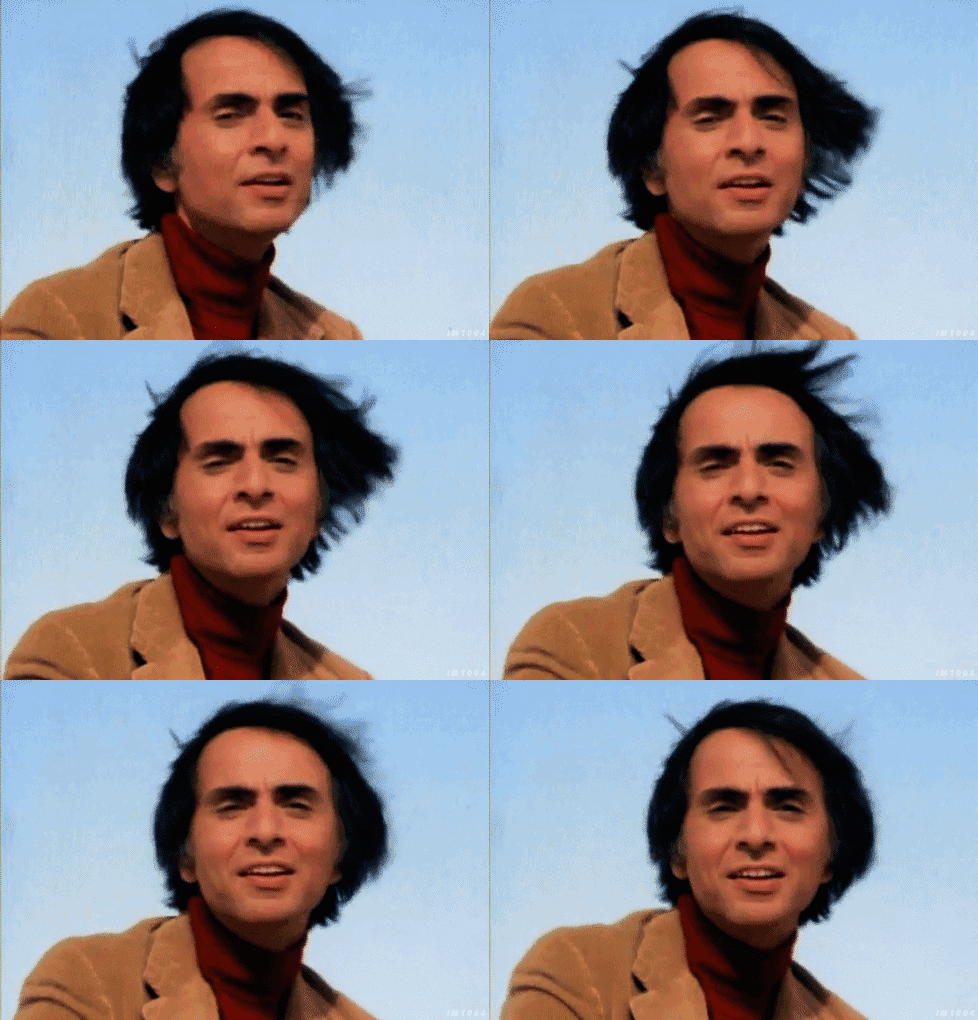
Thankfully, we had Carl Sagan, one of the greatest science communicators of his time, to help us visualize a fourth dimension. Perhaps best known for his research into extraterrestrial life, Sagan was among the first to demonstrate that life could have existed on Mars. Sagan possessed a unique gift for demystifying complex scientific concepts, making them accessible and thrilling for the general public. He could be described as a scientific Mister Rogers: friendly, a wonderful storyteller, and able to distill difficult lessons into their simplest form.
In 1980, on Episode 10 of the groundbreaking PBS show “Cosmos,” Sagan embarked on a mission to explain the seemingly impossible fourth dimension. It’s a hypnotic, entertaining, and incredibly enlightening watch:
Many of us have commonly heard of time being considered the fourth dimension. That’s not so hard to understand — in order to locate an object in the universe, you’d need to know three dimensions of its spatial location and also the time during which it exists.
But there is also a more theoretical and harder to understand place, where all four dimensions are spatial. It is nearly impossible for any of us to comprehend… without the help of a gifted teacher.
What’s excellent about Sagan’s explanation is that he uses simple and relatable objects: an apple and a Tesseract, or hypercube.
“In discussing the large-scale structure of the cosmos, astronomers sometimes say that space is curved. Or that the universe is finite but unbound,” Sagan begins. “Whatever are they talking about?”
Yeah, this guy gets it.
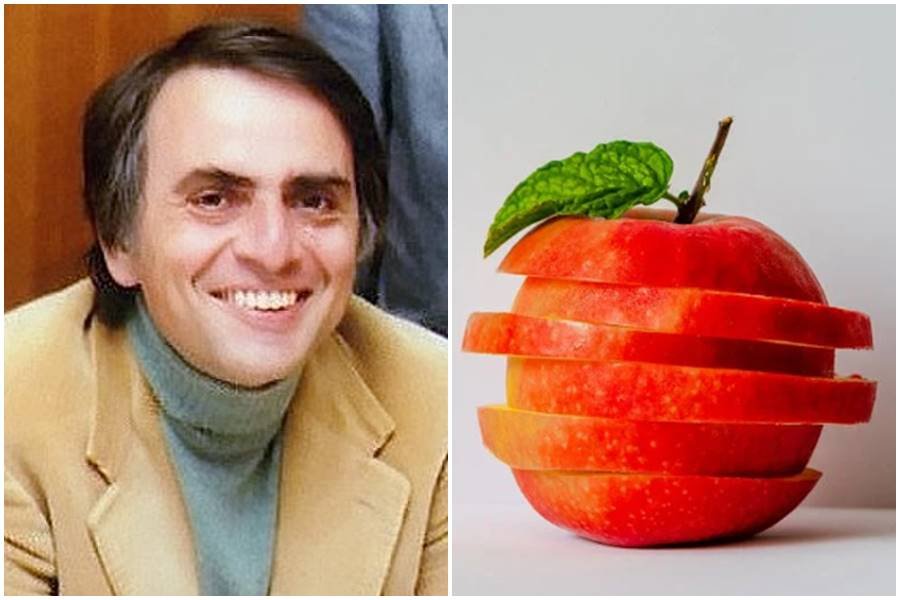
Sagan then explains how a two-dimensional being living in a flat world would perceive a three-dimensional object like an apple.

“Imagine we live in this ‘Flatland’/2-D plane with no concept of ‘up’ or ‘down.’ Then along comes a 3-D object like an apple. We do not even notice it until it crosses our plane of existence — and even then, we have no idea what the apple is,” Sagan explains. “We see only a fragment as it passes through our plane. There is no way we can comprehend the 3-D quality/dimension of the apple, because it is beyond our understanding. We only have the evidence of what has passed through our plane.”
To further demonstrate, Sagan stamps the apple into an inkpad and then onto the surface in front of him, which represents Flatland and all of its inhabitants. Inside Flatland, the apple exists only as its points of contact on the paper; or four small dots. He adds that as the apple passes through the 2-dimensional Flatland, its cross-section changes. So someone living in that plane of existence would experience the apple as an ever-shifting and rearranging set of shapes or objects. Wild!
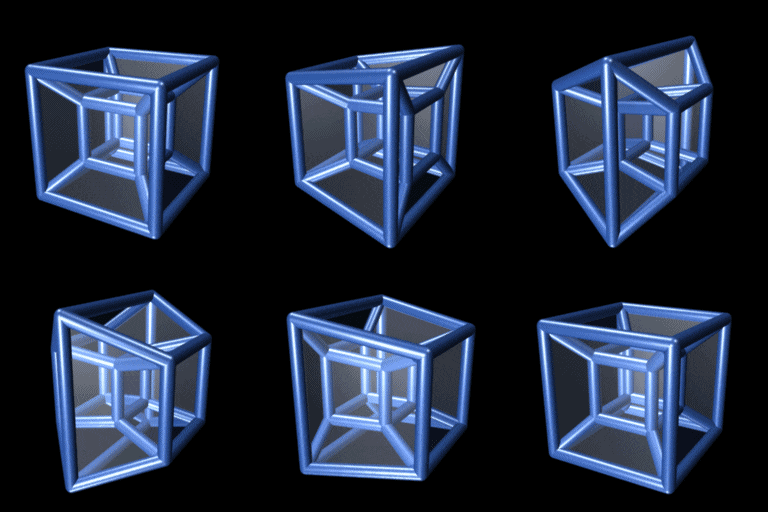
Sagan then related this two-dimensional experience of the third dimension to how we might try to understand the fourth. To do so, he used the Tesseract, a four-dimensional cube, to demonstrate how difficult it is for us to perceive or visualize dimensions beyond our own three.
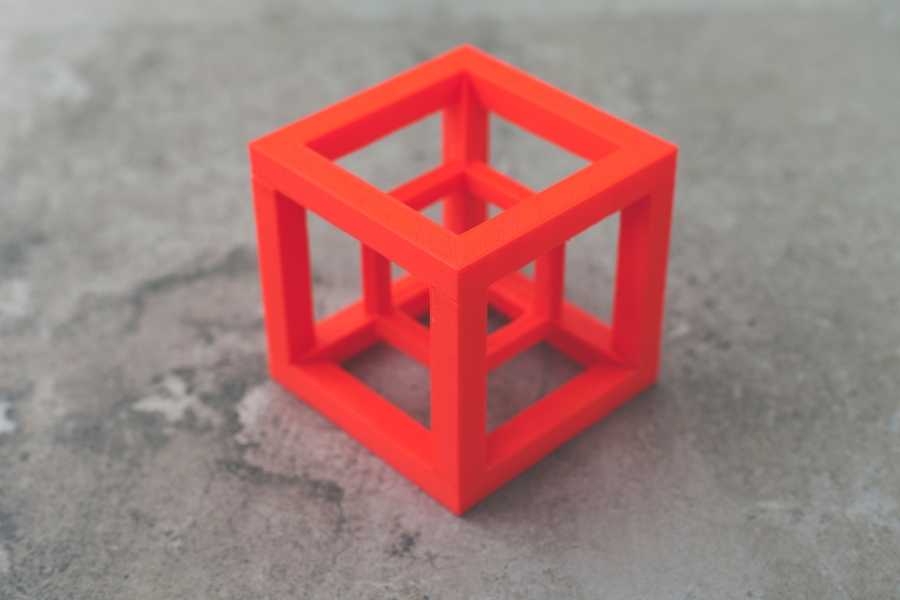
Sagan explains that the tesseract is a cube expanded into a 4th dimension, but “I cannot show you a tesseract because I, and you, are trapped in three dimensions.” But what he can do is show us a 3-dimensional rendering of one. Just like a cube can be drawn and approximated (or cast a shadow) onto a piece of paper, a 4-dimensional tesseract can be imperfectly represented in 3-dimensional space. Still following?
At this point, Sagan is asking the viewer to expand their minds to understand the fourth dimension metaphorically. Though we cannot see it or even properly visualize it, that doesn’t mean that the things we can see can’t offer clues and lessons about the fourth dimension.

Studying 4-dimensional space can help us understand the universe around us. Just because we see and experience only three dimensions doesn’t mean that’s all that exists. It’s critical for physicists and mathematicians to be able to understand and map these theoretical spaces to better comprehend things we otherwise can not explain. Remember the ever-changing, rearranging set of shapes as the apple passes through Flatland?
Sagan’s demonstration of the fourth dimension isn’t just a wonderful explanation of a scientific idea that many of us find difficult to comprehend; it’s also a great example of how to teach complex ideas by combining clear explanations, everyday concepts everyone can understand, and brilliant storytelling.
You can check out more of Carl Sagan’s brilliant scientific explanations on the carlsagan.com YouTube channel.
This article originally appeared two years ago. It has been updated.