upworthy
Add Upworthy to your Google News feed.
Google News Button
Popular

People share the most beautiful thing someone's done for them and it's a balm for the soul

From random acts of kindness to anonymous altruism to loved ones stepping up for one another, this is the best of humanity in action.

two people holding hands
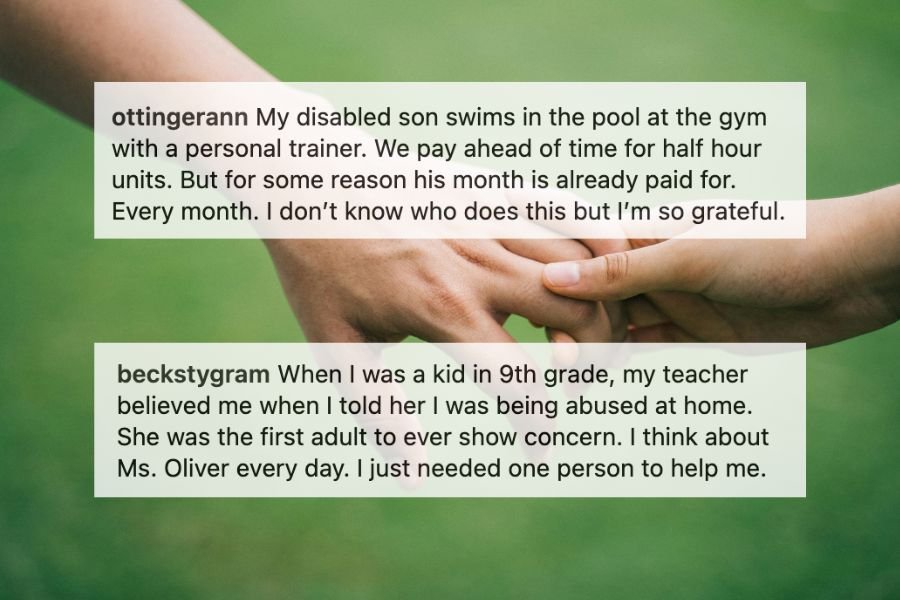
Photo by Anna Tarazevich/YouTube, Screenshot comments from Upworthy/Instagram

We all can use reminders of the good in people.

News headlines have always skewed negative—"If it bleeds, it leads" is a saying for a reason—but combine the news with a contentious election year and the polarization we so often find on social media and the world can feel rather disheartening.

What we focus on is what we see, however, and if we want to see the good in the world, that's what we have to look at. Part of our mission here at Upworthy is to demonstrate that people are a force for good, and nowhere is that clearer than in the stories our audience shares with us.

We asked our readers, "What's the most beautiful thing someone has done for you?" and the responses are a needed reminder of what's wonderful about people. From random acts of kindness to anonymous altruism to family and community stepping up in the most inspiring ways, here are some examples of humans choosing kindness, thoughtfulness and selflessness to make one another's lives a little better.


"My very attentive GYN doctor kept me much longer at an appointment than it should’ve been. She did not want me to leave the room, being I expressed the verbal and manipulative abuse I was getting from my husband. She gave me a counseling session that I have no words to describe how it helped me."

"When I was going through cancer treatment, and too sick and tired from the chemotherapy to leave the house or be on my feet for very long, my boyfriend (now husband) would take me out and drive all day through various scenic places just so I could see things, feel the wind and smell the air with the windows down. It pulled me out of a very dark hole a few times and gave me the will to keep going!"

"My best friend took me in when my life was falling apart and encouraged me every day that I would survive. She fed me when I was too depressed to eat, she let me bring my cat ( and she was not a cat person) because she knew I needed him for comfort. My husband had cheated on me , my mom was dying and I made it through several months with her until I finally found the courage to stand up on my own again because of her constant faith in me . Her acts of kindness , compassion and love were gestures of beauty from her heart to mine ❤️"

"As a poor college student majoring in music, I sold my piano to pay tuition. My brother bought it back and gave it to me for Christmas that year. My daughter has that piano now."

"My 12 step sponsor. We had never met the day I asked her to sponsor me. We met at her house every Monday for 15 months. She brought me through the 12 steps and helped me learn to love myself, to forgive others, to make amends for my harms done and to be in service. I'm 7 yrs sober and happier than I ever imagined I could be. ❤️" "I once saw a man who looked exactly like my ex partner who’d passed away. It was shocking but also felt so surreal like he was standing in front of me again. I was crying so much but I asked that random stranger for a hug after explaining why. We stood hugging for a long time. It felt like the hug I never got to have. It was so kind of him. 💔 "

"When I had cancer, a lot of friends got together, unbeknownst to me, and folded 1,000 paper cranes. They signed and put kind words side them. Then they gave them to me at a party. I was blown away. They are now hanging in my house as art."

"Mentor me! I grew up in poverty in an unsavory environment. Throughout my life I was presented with wonderful mentors, in addition to the wonderful mother I have present in my life , who pushed me be the best version of myself in the world so that I didn’t have to be a statistic of my environment. Here I am, a happy and thriving man in life because of that attention."

"Probably the elderly couple who took me in as a grandkid adoptee when I was experiencing a lot of chaos and neglect in my family. I spent weeks at their house during the Summer for years and years, starting around age 4. They cooked me good food and sewed me clothes. They had professional photos taken of me for their mantelpiece. I thought they were my actual Grandparents."

"After deciding to leave an abusive marriage with my two small children in tow (ages 2 and 5), my best friend and some of her friends that I did not know packed my apartment, moved all our stuff, AND UNPACKED IT! We got to our new place and it looked like home. I will never forget this act of kindness. It was 18 years ago."

"I had just had my son and had a tough day. My coworker and friend who lived over 4.5 hours away was on the phone with me and could hear I was struggling. This beautiful human offered to drive down here, through LA traffic,to help over the weekend so that I could take care of me. I didn’t take her up on it, but that sheer act of kindness has stuck with me and I tell the story often. My son will be 15 and in high school in a few months and the thought of her complete selfless offer still brings me to tears."

"I had a panic attack outside a shopping centre, and 2 teenage girls saw me upset, came over and offered to get me water and gave me a big hug. Changed my day completely."

"My husband, who stayed by my side through my sickness. He put aside his desire to become a father, because he chose *me* as a partner above all. Throughout my endometriosis journey, 3 surgeries, and the 5 IVFs we had he stood by my side and supported me. We were blessed enough to become parents after all, after 7 rough years, but he would have stayed with me even if that hadn't happened. ❤️"

"When my 7-year old niece was dying, I was in charge of arranging my other siblings’ travel so we could all be with my niece (and my sister, her mom) to say goodbye. I was pregnant, distraught, and barely functioning. Any other time, searching up airfare and making travel arrangements would have been a snap, which is why I was assigned the job. My neighbor stopped by and found me sobbing on the floor. She calmly took over — called my all my family members, none of whom she knew, and arranged travel for strangers while I returned to the hospital. It seems small but when someone does a task for you when you are most in need, it’s gigantic. I will never forget the relief she brought me, and the time she gave me with my niece. Her kindness is inextricably linked to my grief, a bright light in all that darkness."

"My SIL made a freezer full of meals (maybe 25+ meals, desserts and snacks) for me when I was pregnant with my second. I didn’t have to cook for probably 2 months after we brought our baby girl home 🥹"

"Snuck my puppy into the hospital to visit me. Like she went full on incognito mode and put my puppy in a crate, covered it with a blanket and wheeled him in my room. The nurses considered it good medicine and looked the other way. It was in fact good medicine. I was in that bed for 3 weeks. It was and still is one of the most beautiful and special things anyone has ever done for me."

"My disabled son swims in the pool at the gym with a personal trainer. We pay ahead of time for half hour units. But for some reason his month is already paid for. Every month. I don’t know who does this but I’m so grateful."

"I was struggling with depression and basic functioning during my divorce.. finances were unbelievably tight..my kids & I took a train to visit my parents and left house keys with a friend so they could feed cats. When we returned, our house was stocked with food in pantry and fridge, even frozen meals to thaw..pads and tampons in the bathroom.. and a new oven. We had been cooking out of a toaster oven for a year because ours was broken & old and I couldn’t afford a replacement. 🥹"

"When I left my abuser I had a four year old and a four month old. We left with two backpacks and a handful of special items. I was so terrified to start over. A friend of mine posted on Facebook asking for resources to help me furnish my new condo and the post blew up. Strangers from all over my city came and brought blankets, dishes, furniture and a beautiful crib for my daughter. There was not a single item that I needed to purchase on my own. All I could do is cry and thank them all for their kindness. I had nothing to give in return except sheer gratitude. Some drove to me to drop off items and share their stories of survival with me. I remember feeling so awful when I left, doubting if I could stay gone and if I’d be able rebuild my life, but I did. Those people helped me to stand on my feet and gave me hope to help me find my voice again."

"I was bartending at a hotel in Bloomington Indiana where I went to College. I kept myself busy during the slow daytime hours, rug hooking, crafting a gift for my mother. A stranger traveling through town for business (Otis Elevators) sat at the bar for a beer after lunch. He asked what I was doing and I told him I was making a rug for my mother. Because my family is in St. Louis. He asked why I was still here since school was out. I told him I needed to make money so I stayed at this job. He asked if I go home often I said, not enough. It’s too expensive. We chatted for a while and I remember he was kind and 'fatherly' - not at all like the other men who had other things in mind.

The next evening when I came to work there was an envelope with my first name on it. Inside was a one-way ticket to St. Louis and a note that said, “go home and see your mom. “ I will never ever forget that man and how he made me feel. And yes, I went home for an extra hug from my mom. ❤️"

"When I was a kid in 9th grade, my teacher believed me when I told her I was being abused at home. She was the first adult to ever show concern. I think about Ms. Oliver every day. I just needed one person to help me."

"I live in Sacramento and l many years ago I had my purse stolen which is completely devastating. This was before cell phones and the phone book with all of my friends numbers were in it. A few months after it happened a package came in the mail, the return address was just a general San Francisco Post Office address. Inside the package was a number of things from my purse including my driver's license, my phone book, and some other things (some that weren't mine). There was a note inside with some misspellings and grammar errors, that said something along the lines of, I was hitchhiking and found some things on the side of the highway that looked like they were important, so I scrounged some money to send them to you. I think there was a signature, but there wasn't an address for me to send a thank you. This was a true act of selfless kindness, and I still appreciate it to this day."

"I have a facial deformity and I was bullied through elementary and high school and a bit in college. People stare at me, even today, rather than speaking to me as if I am a human being. This history has given me extremely low self esteem. I am 60 years old, but, for this reason, I don’t leave my house unless I absolutely have to (I am fortunate enough to work from home). One day, I was walking through Walmart, looking down, as I usually do, because I don’t like people staring at me, and a man, who must have sensed my unease, walked up to me and told me I was beautiful and to hold my head up and walk proud. It brought tears to my eyes and this random man hugged me - like a 'real' strong hug that a person who cares would give. It made my MONTH! I have no idea who he was, but I will love him forever. You always remember the way people make you feel."

If you loved these stories and want to read more like it, our book, "GOOD PEOPLE: Stories from the Best of Humanity" is available for pre-order now. Find it here.

Planet

Our favorite giveaway is back. Enter to win a free, fun date! 🌊 💗

It's super easy, no purchase or donation necessary, and you help our oceans! That's what we call a win-win-win. Enter here.

Our favorite giveaway is back. Enter to win a free, fun date! 🌊 💗
True

Our love for the ocean runs deep. Does yours? Enter here!

This Valentine’s Day, we're bringing back our favorite giveaway with Ocean Wise. You have the chance to win the ultimate ocean-friendly date. Our recommendation? Celebrate love for all your people this Valentine's Day! Treat your mom friends to a relaxing spa trip, take your best friend to an incredible concert, or enjoy a beach adventure with your sibling! Whether you're savoring a romantic seafood dinner or enjoying a movie night in, your next date could be on us!

Here’s how to enter:


  • Go to upworthy.com/oceandate and complete the quick form for a chance to win - it’s as easy as that.
  • P.S. If you follow @oceanwise or donate after entering, you’ll get extra entries!

Here are the incredible dates:

1. Give mom some relaxation

She’s up before the sun and still going at bedtime. She’s the calendar keeper, the lunch packer, the one who remembers everything so no one else has to. Moms are always creating magic for us. This Valentine’s Day, we’re all in for her. Win an eco-friendly spa day near you, plus a stash of All In snack bars—because she deserves a treat that’s as real as she is. Good for her, kinder to the ocean. That’s the kind of love we can all get behind.


Special thanks to our friends at All In who are all in on helping moms!

2. Jump in the ocean, together

Grab your favorite person and get some much-needed ocean time. Did you know research on “blue spaces” suggests that being near water is linked with better mental health and well-being, including feeling calmer and less stressed? We’ll treat you to a beach adventure like a surfing or sailing class, plus ocean-friendly bags from GOT Bag and blankets from Sand Cloud so your day by the water feels good for you and a little gentler on the ocean too.

Special thanks to our friends at GOT Bag. They make saving the ocean look stylish and fun!

3. Couch potato time

Love nights in as much as you love a date night out? We’ve got you. Have friends over for a movie night or make it a cozy night in with your favorite person. You’ll get a Disney+ and Hulu subscription so you can watch Nat Geo ocean content, plus a curated list of ocean-friendly documentaries and a movie-night basket of snacks. Easy, comfy, and you’ll probably come out of it loving the ocean even more.

4. Dance all day!

Soak up the sun and catch a full weekend of live music at BeachLife Festival in Redondo Beach, May 1–3, 2026, featuring Duran Duran, The Offspring, James Taylor and His All-Star Band, The Chainsmokers, My Morning Jacket, Slightly Stoopid, and Sheryl Crow. The perfect date to bring your favorite person on!

We also love that BeachLife puts real energy into protecting the coastline it’s built on by spotlighting ocean and beach-focused nonprofit partners and hosting community events like beach cleanups.

Date includes two (2) three-day GA tickets. Does not include accommodation, travel, or flights.

5. Chef it up (at home)

Stay in and cook something delicious with someone you love. We’ll hook you up with sustainable seafood ingredients and some additional goodies for a dinner for two, so you can eat well and feel good knowing your meal supports healthier oceans and more responsible fishing.

Giveaway ends 2/15/26 at 11:59pm PT. Winners will be selected at random and contacted via email from the Upworthy. No purchase necessary. Open to residents of the U.S. and specific Canadian provinces that have reached age of majority in their state/province/territory of residence at the time. Please see terms and conditions for specific instructions. Giveaway not affiliated with Instagram. More details at upworthy.com/oceandate

quiet, finger over lips, don't talk, keep it to yourself, silence

A woman with her finger over her mouth.

It can be hard to stay quiet when you feel like you just have to speak your mind. But sometimes it's not a great idea to share your opinions on current events with your dad or tell your boss where they're wrong in a meeting. And having a bit of self-control during a fight with your spouse is a good way to avoid apologizing the next morning.

Further, when we fight the urge to talk when it's not necessary, we become better listeners and give others a moment in the spotlight to share their views. Building that small mental muscle to respond to events rather than react can make all the difference in social situations.


argument, coworkers, angry coworkers, hostile work enviornment, disagreement A woman is getting angry at her coworker.via Canva/Photos

What is the WAIT method?

One way people have honed the skill of holding back when they feel the burning urge to speak up is the WAIT method, an acronym for the question you should ask yourself in that moment: "Why Am I Talking?" Pausing to consider the question before you open your mouth can shift your focus from "being heard" to "adding value" to any conversation.

The Center for The Empowerment Dynamic has some questions we should consider after taking a WAIT moment:

  • What is my intention behind what I am about to say?
  • What question can I ask to better understand what the other person is saying?
  • Is my need to talk an attempt to divert the attention to me?
  • How might I become comfortable with silence rather than succumb to my urge to talk?

tape over muth, sielnce, be quiet, mouth shut, saying nothing A man with tape over his mouth.via Canva/Photos

The WAIT method is a good way to avoid talking too much. In work meetings, people who overtalk risk losing everyone's attention and diluting their point to the extent that others aren't quite sure what they were trying to say. Even worse, they can come across as attention hogs or know-it-alls. Often, the people who get to the heart of the matter succinctly are the ones who are noticed and respected.

Just because you're commanding the attention of the room doesn't mean you're doing yourself any favors or helping other people in the conversation.

The WAIT method is also a great way to give yourself a breather and let things sit for a moment during a heated, emotional discussion. It gives you a chance to cool down and rethink your goals for the conversation. It can also help you avoid saying something you regret.

fight, spuse disagreement, communications skills, upset husband, argument A husband is angry with his wife. via Canva/Photos

How much should I talk in a meeting?

So if it's a work situation, like a team meeting, you don't want to be completely silent. How often should you speak up?

Cary Pfeffer, a speaking coach and media trainer, shared an example of the appropriate amount of time to talk in a meeting with six people:

"I would suggest a good measure would be three contributions over an hour-long meeting from each non-leader participant. If anyone is talking five/six/seven times you are over-participating! Allow someone else to weigh in, even if that means an occasional awkward silence. Anything less seems like your voice is just not being represented, and anything over three contributions is too much."

Ultimately, the WAIT method is about taking a second to make sure you're not just talking to hear yourself speak. It helps ensure that you have a clear goal for participating in the conversation and that you're adding value for others. Knowing when and why to say something is the best way to make a positive contribution and avoid shooting yourself in the foot.

Once a refugee seeking safety in the U.S., Anita Omary is using what she learned to help others thrive.
Pictured here: Anita Omary; her son, Osman; and Omary’s close friends
True

In March 2023, after months of preparation and paperwork, Anita Omary arrived in the United States from her native Afghanistan to build a better life. Once she arrived in Connecticut, however, the experience was anything but easy.

“When I first arrived, everything felt so strange—the weather, the environment, the people,” Omary recalled. Omary had not only left behind her extended family and friends in Afghanistan, she left her career managing child protective cases and supporting refugee communities behind as well. Even more challenging, Anita was five months pregnant at the time, and because her husband was unable to obtain a travel visa, she found herself having to navigate a new language, a different culture, and an unfamiliar country entirely on her own.


“I went through a period of deep disappointment and depression, where I wasn’t able to do much for myself,” Omary said.

Then something incredible happened: Omary met a woman who would become her close friend, offering support that would change her experience as a refugee—and ultimately the trajectory of her entire life.

Understanding the journey

Like Anita Omary, tens of thousands of people come to the United States each year seeking safety from war, political violence, religious persecution, and other threats. Yet escaping danger, unfortunately, is only the first challenge. Once here, immigrant and refugee families must deal with the loss of displacement, while at the same time facing language barriers, adapting to a new culture, and sometimes even facing social stigma and anti-immigrant biases.

Welcoming immigrant and refugee neighbors strengthens the nation and benefits everyone—and according to Anita Omary, small, simple acts of human kindness can make the greatest difference in helping them feel safe, valued, and truly at home.

A warm welcome

Dee and Omary's son, Osman

Anita Omary was receiving prenatal checkups at a woman’s health center in West Haven when she met Dee, a nurse.

“She immediately recognized that I was new, and that I was struggling,” Omary said. “From that moment on, she became my support system.”

Dee started checking in on Omary throughout her pregnancy, both inside the clinic and out.

“She would call me and ask am I okay, am I eating, am I healthy,” Omary said. “She helped me with things I didn’t even realize I needed, like getting an air conditioner for my small, hot room.”

Soon, Dee was helping Omary apply for jobs and taking her on driving lessons every weekend. With her help, Omary landed a job, passed her road test on the first attempt, and even enrolled at the University of New Haven to pursue her master’s degree. Dee and Omary became like family. After Omary’s son, Osman, was born, Dee spent five days in the hospital at her side, bringing her halal food and brushing her hair in the same way Omary’s mother used to. When Omary’s postpartum pain became too great for her to lift Osman’s car seat, Dee accompanied her to his doctor’s appointments and carried the baby for her.

“Her support truly changed my life,” Omary said. “Her motivation, compassion, and support gave me hope. It gave me a sense of stability and confidence. I didn’t feel alone, because of her.”

More than that, the experience gave Omary a new resolve to help other people.

“That experience has deeply shaped the way I give back,” she said. “I want to be that source of encouragement and support for others that my friend was for me.”

Extending the welcome

Omary and Dee at the Martin Luther King, Jr. Vision Awards ceremony at the University of New Haven.

Omary is now flourishing. She currently works as a career development specialist as she continues her Master’s degree. She also, as a member of the Refugee Storytellers Collective, helps advocate for refugee and immigrant families by connecting them with resources—and teaches local communities how to best welcome newcomers.

“Welcoming new families today has many challenges,” Omary said. “One major barrier is access to English classes. Many newcomers, especially those who have just arrived, often put their names on long wait lists and for months there are no available spots.” For women with children, the lack of available childcare makes attending English classes, or working outside the home, especially difficult.

Omary stresses that sometimes small, everyday acts of kindness can make the biggest difference to immigrant and refugee families.

“Welcome is not about big gestures, but about small, consistent acts of care that remind you that you belong,” Omary said. Receiving a compliment on her dress or her son from a stranger in the grocery store was incredibly uplifting during her early days as a newcomer, and Omary remembers how even the smallest gestures of kindness gave her hope that she could thrive and build a new life here.

“I built my new life, but I didn’t do it alone,” Omary said. “Community and kindness were my greatest strengths.”

Are you in? Click here to join the Refugee Advocacy Lab and sign the #WeWillWelcome pledge and complete one small act of welcome in your community. Together, with small, meaningful steps, we can build communities where everyone feels safe.

This article is part of Upworthy’s “The Threads Between U.S.” series that highlights what we have in common thanks to the generous support from the Levi Strauss Foundation, whose grantmaking is committed to creating a culture of belonging.

arthur c. brooks, harvard, psychology, happiness research, bucket list

Harvard researcher Arthur C. Brooks studies what leads to human happiness.

We live in a society that prizes ambition, celebrating goal-setting, and hustle culture as praiseworthy vehicles on the road to success. We also live in a society that associates successfully getting whatever our hearts desire with happiness. The formula we internalize from an early age is that desire + ambition + goal-setting + doing what it takes = a successful, happy life.

But as Harvard University happiness researcher Arthur C. Brooks has found, in his studies as well as his own experience, that happiness doesn't follow that formula. "It took me too long to figure this one out," Brooks told podcast host Tim Ferris, explaining why he uses a "reverse bucket list" to live a happier life.


bucket list, wants, desires, goals, detachment Many people make bucket lists of things they want in life. Giphy

Brooks shared that on his birthday, he would always make a list of his desires, ambitions, and things he wanted to accomplish—a bucket list. But when he was 50, he found his bucket list from when he was 40 and had an epiphany: "I looked at that list from when I was 40, and I'd checked everything off that list. And I was less happy at 50 than I was at 40."

As a social scientist, he recognized that he was doing something wrong and analyzed it.

"This is a neurophysiological problem and a psychological problem all rolled into one handy package," he said. "I was making the mistake of thinking that my satisfaction would come from having more. And the truth of the matter is that lasting and stable satisfaction, which doesn't wear off in a minute, comes when you understand that your satisfaction is your haves divided by your wants…You can increase your satisfaction temporarily and inefficiently by having more, or permanently and securely by wanting less."

Brooks concluded that he needed a "reverse bucket list" that would help him "consciously detach" from his worldly wants and desires by simply writing them down and crossing them off.

"I know that these things are going to occur to me as natural goals," Brooks said, citing human evolutionary psychology. "But I do not want to be owned by them. I want to manage them." He discussed moving those desires from the instinctual limbic system to the conscious pre-frontal cortex by examining each one and saying, "Maybe I get it, maybe I don't," but crossing them off as attachments. "And I'm free…it works," he said.

- YouTube www.youtube.com

"When I write them down, I acknowledge that I have the desire," he explained on X. "When I cross them out, I acknowledge that I will not be attached to this goal."

The idea that attachment itself causes unhappiness is a concept found in many spiritual traditions, but it is most closely associated with Buddhism. Mike Brooks, PhD, explains that humans need healthy attachments, such as an attachment to staying alive and attachments to loved ones, to avoid suffering. But many things to which we are attached are not necessarily healthy, either by degree (over-attachment) or by nature (being attached to things that are impermanent).

"We should strive for flexibility in our attachments because the objects of our attachment are inherently in flux," Brooks writes in Psychology Today. "In this way, we suffer unnecessarily when we don't accept their impermanent nature."

What Arthur C. Brooks suggests that we strive to detach ourselves from our wants and desires because the simplest way to solve the 'haves/wants = happiness' formula is to reduce the denominator. The reverse bucket list, in which you cross off desires before you fulfill them, can help free you from attachment and lead to a happier overall existence.

This article originally appeared last year.

decluttering, making decluttering fun, decluttering ideas, items to donate, goodwill, how to declutter, decluttering tips

Left: A woman holding her finger up to convey a secret. Right: A hand placing an antique item on a window ledge.

For many of us, decluttering is a necessary evil. We take no joy in it, other than knowing our lives might run a little more smoothly afterward. It's sort of like going to the dentist or getting an oil change.

But like so many of life's mundanities, could decluttering become something we actually look forward to if we found a way to infuse a little playfulness?


For Stephanie Patrick, that meant secretly leaving random items at other people's houses.

In a mega-viral Instagram clip, Patrick is seen placing a tiny bar of soap, a small creamer pitcher, and a vintage glass tealight candle holder on different countertops, accompanied by the caption, "Sometimes you gotta do what you gotta do."

The video has been viewed more than 25 million times, with thousands of people praising Patrick for her "diabolical" yet "genius" idea. Here are just a few of the reactions:

"A clever menace. I love it."

"This is amazing. They are going to go crazy asking each other 'where did this come from? Do you know where this came from?'"

"I have never felt so inspired in my whole entire life."

"UNHEIST"

"Reverse burglary"

This isn't Patrick's first, ahem, unconventional decluttering idea. In another video, we see her placing random items—a picture frame, a mini sewing kit, a sequined heart pillow, and yet another tealight candle holder—along the aisles of Hobby Lobby. Retail sticker and everything.

"I'm sure they will sell eventually," she wrote.

While leaving items for retail workers to deal with isn't the best option, Patrick clarified in the comments that she only "pretended" to leave the items behind. Still, there's something to be said for gamifying decluttering so the process itself becomes a bit more enjoyable.

Here are a few ideas procured from around the web:

Creative ways to make decluttering fun

- YouTube www.youtube.com

Hanger reversal

Turn all your hangers the wrong way. When you wear an item, flip the hanger back. After six months, donate anything that's still reversed.

The "no-thing" prize

Reward yourself with an experience, like a movie or dessert, rather than more items.

Take the 12-12-12 challenge

Locate 12 items to throw away, 12 to donate, and 12 to return to their proper homes. You can customize the challenge however you see fit.

Take before-and-after photos of a small area

Choose one part of your home, like a kitchen counter, and take a photo of a small area. Quickly clear away the items in the photo, then take an after shot. Once you see how your home could look, it becomes easier to start decluttering other areas.

Play the "minimalism game"

Created by Joshua Fields Millburn and Ryan Nicodemus ("The Minimalists"), this game has you determine how many items you'll declutter based on the day of the week, such as 20 items on the 20th. You can find a free printable by clicking here.

Decluttering jar

A "declutter jar" contains color-coded sticks for each area of the house. The kitchen might be marked blue, with each blue stick representing a specific area, such as the pantry, under the sink, the junk drawer, or the cup shelf. Whatever stick you draw is the area you declutter. No decision-making necessary.

The "moving method"

Pretend you're moving into a smaller, but swankier, home and only keep what you absolutely love or need. Tap into your imagination while making room for real life. A win-win.

Lastly, never underestimate the power of simply throwing on a bangin' decluttering playlist. Whatever route gets you there is the route worth taking. Of course, if you follow in Patrick's footsteps, you might have some explaining to do to your friends.

Culture

Woman creates 1940s-inspired home to pay off her mortgage in just 8 years

She shared 10 frugal living tips to help transform people's budgets.

1940s, mortgage, vintage house, 1940s house, frugality
Photo credit: Canva, Karola G from Pexels (left) / Doina Gherban's Images (right)

Left: A woman holding money. Right: A toy house in a person's hand.

Anyone who can pay off their mortgage early should be applauded and probably grilled with questions about how they pulled off that minor miracle. Hannah, a content creator from Nottingham, England, made it happen partly by taking inspiration from the 1940s, both in and out of the two-bedroom home she shares with her mother. She documented her approach in an intriguing YouTube video titled "10 Frugal Living Tips from the 1940s That Still Work Today."

Hannah opens the clip with some backstory. She grew up in a one-income household, learning fiscal responsibility from her mother, and together they worked hard to pay off the mortgage on their current home in eight years.


"For as long as I can remember, we've lived in a certain way to get by," she says. "But as I've gotten older and become interested in history, I've discovered another incredible teacher: our ancestors."

Learning from the past also aligned with her love of retro aesthetics, and she's documented both on her social media channels under the name Real Vintage Dolls House.

- YouTube www.youtube.com

Making what you have last

Not all of her frugality tips will work for everyone, since no two situations are identical. For example, she doesn't have children. Still, her advice covers a wide range, from escaping a more-is-more mindset to scaling back food costs. Several points fall into the latter category, including the importance of cooking from scratch.

"In the '40s, people were forced to make rationed food go further," she says. "Nowadays, eating out and takeaways are just so expensive, so this quickly became a very occasional treat for us, not a weekly staple."

She keeps a "modest" pantry of ingredients, like potatoes, that can be stretched to make them last. In addition, she mainly drinks tap water, coffee, and tea, and grows her own fruits and vegetables in the garden.

Several tips focus on doing more around the house, such as using "useful and cheap beauty hacks" like homemade soap, working out at home instead of paying for an expensive gym membership, and cutting heating bills by staying warm with clothes and blankets. That also ties into a broader point about "secondhand living." Hannah says that "almost everything" in her house was purchased secondhand or handed down, including her refrigerator.

"Of course, buying secondhand does limit your choices, but I actually like that because it lessens my decision fatigue," she says. "And if something isn't quite right, I can use my agency and skills to repair it or amend it. And if I don't have these skills then I can learn them, often for free. In the '40s, they called this 'make do and mend.' [By maintaining old items] you're freeing yourself from the upgrade loop."

- YouTube www.youtube.com

Experiences over stuff

Elsewhere, Hannah recommends walking as much as possible to save on gas money and maintaining a "capsule clothing plan," in which you carefully curate a small closet of versatile items with a long shelf life. Finally, she stresses the importance of experiences over things: "If there's one thing that the 1940s has taught me, it's the simple ways that people spent their time to still find enjoyment and pleasure. Picnics, walks, a cup of tea at a cafe: all experience-driven, rather than wallet-driven."

Hannah spoke about her home (and her love of the 1940s) with The Daily Mail in 2021:

"The house is kind of like an ode to my grandpa, who was born in 1936. He was a significant part of my life and really got me interested in the 40s era as a kid—I was enamored by his droplets of wisdom. My nan's taste in vintage and eccentric fashion has also inspired me to dress quirky."

Given the financial hardships they endured, people from the Greatest Generation and Silent Generation may have valuable frugality advice to offer. People on Reddit recently shared tips they learned firsthand from older family members, ranging from hang-drying clothes to driving in ways that reduce wear and tear on their cars.

"My grandma rinsed and reused foil until it crumbled," one user wrote. "I rolled my eyes then, now I catch myself doing it. Funny how those 'silly' habits end up smart."

- YouTube www.youtube.com