

A mom describes her tween son's brain. It's a must-read for all parents
"Sometimes I just feel really angry and I don’t know why."

It started with a simple, sincere question from a mother of an 11-year-old boy.
An anonymous mother posted a question to Quora, a website where people can ask questions and other people can answer them. This mother wrote:
How do I tell my wonderful 11 year old son, (in a way that won't tear him down), that the way he has started talking to me (disrespectfully) makes me not want to be around him (I've already told him the bad attitude is unacceptable)?
It's a familiar scenario for those of us who have raised kids into the teen years. Our sweet, snuggly little kids turn into moody middle schoolers seemingly overnight, and sometimes we're left reeling trying to figure out how to handle their sensitive-yet-insensitive selves.
Jo Eberhardt, a fantasy writer and mother of two from Australia, penned a reply that is so spot on that it keeps repeatedly popping up on social media. When you nail it, you nail it—and this mother nails it.
"Ah, puberty," she wrote, "It changes our sweet, wonderful little boys into sweet, eye-rolling, angsty, accidentally disrespectful, but still wonderful young proto-men." Yup.
Eberhardt then described a discussion she had with her 11 1/2 -year-old son when he started going through this stage—a conversation they had in the car, which is usually the best place to have potentially uncomfortable discussions with kids.
She told her son that she'd messed up in the way she'd talked to him about puberty, then explained exactly what was happening in his brain.
“I've spent all this time talking to you about the way puberty changes your body," Eberhardt told her son, "and what to expect as you go through the changes, but I completely forgot to talk to you about what's going on in your brain right now. Puberty is the time when your brain grows and changes more than at any other time in your life — well, except for when you're a baby, perhaps. So I really let you down by not preparing you for that. I'm so sorry."
Her son accepted her apology, then asked why is his brain was changing.
“That's the amazing thing," she told him. "Did you know that your brain grew and developed so quickly when you were little that by the time you were about five or six, your brain was almost as big and powerful as an adult's brain?"
"But here's the thing," she continued, "Even though your brain was super powerful, the instructions were for a child's brain. And all the information about building an adult's brain was a bit… let's say fuzzy. So your brain did the best it could, but it didn't really know what kind of person you were going to be back then, or what shape brain you were going to need."
“Now we come to puberty," she went on. "See, puberty is amazing. Not only is your body being transformed from a child's body to an adult's body, your brain has to be completely rewritten from a child's brain to an adult's brain."
“That sounds hard," her son responded.
“Yeah, it is," Eberhardt replied. “That's why I wish I'd warned you first. See, it takes a lot of energy to completely rewrite a brain. That's one of the reasons you get tired quicker at the moment — and that, of course, manifests in you being crankier and less patient than normal."
Eberhardt paused, then added, “That must be really frustrating for you."
Her son looked over at her, wiping his eyes. “It is," he responded. Sometimes I just feel really angry and I don't know why."
It's amazing what happens when we explain to kids the physiological reasons for what they're going through.
Eberhardt continued, “The other thing is that one of the first parts of your brain that gets super-sized to be like an adult is the amygdala. That's the part that controls your emotions and your survival instincts. You know how we've talked about fight/flight/freeze before, and how sometimes our brains think that being asked to speak in public is the same level of threat as being attacked by a sabre tooth tiger?"
Her son laughed. “Yes. So you have to tell your brain that there's no sabre tooth tiger to help you calm down."
“That's right," Eberhardt replied. "Well, that's what the amygdala looks after: sabre tooth tiger warnings and big emotions. So, the thing with puberty is that all of a sudden you've got an adult-sized amygdala hitting all your emotion buttons and your sabre-tooth tiger buttons. That must be really hard for you to manage."
Her son nodded and said, “Sometimes I don't know why I say the things I do. They just come out, and then I feel bad."
This is the moment where what a parent says can make or break a kid's spirit. But Eberhardt handled it with empathy and expertise.
“I know, Sweetheart," she said before explaining:
“See, the last part of your brain that gets rewritten is right at the front of your head. It's called the frontal cortex. And that's the part of your brain that's good at decision making and understanding consequences. So you've got this powerful adult amygdala hitting you with massive emotions, but you've still got a fuzzy child frontal cortex that can't make decisions or understand consequences as quickly as the amygdala wants you to. It pretty much sucks."
“So it's not my fault?" her son asked.
“No, it's puberty's fault your brain works the way it does," Eberhardt answered. "But that doesn't mean it's not your responsibility to recognise what's going on and change your actions. It's not easy, but it's not impossible, either. Your feelings are your feelings, and they're always okay. But you get to choose your actions. You get to choose what you do with your feelings. And, when you make a mistake, you get to choose to apologise for that mistake and make amends."
Eberhardt said she then paused for dramatic effect. “That's how you prove that you're becoming an adult."
It's also remarkable what happens when we empathize and communicate with our kids instead of simply chastising them.
Her son responded with a perfectly understandable and relatable, “Puberty sucks."
“Puberty absolutely sucks," Eberhardt responded. “I'm not in your head, but I can only imagine that it's a mess of confusion and chaos, and you don't know from one minute to the next how you feel about things."
Her son looked at her in surprise. “Yes! Exactly!"
“If it's confusing for you living inside there," Eberhardt continued, "imagine how confusing it is for me, when I only see your actions."
“That must be really confusing," her son agreed.
She nodded. “Do you know what that means?"
“What?"
“It means sometimes I'm going to make mistakes. Sometimes I'm going to get upset at things you do because I don't understand what's going on in your head. Sometimes I'm going to forget that you're halfway to being a man, and accidentally treat you like a child. Sometimes I'm going to expect more from you than you're able to give. This is my first time parenting someone through puberty, and I'm going to make mistakes. So can I ask you a favour?"
“What is it?"
“Can you just keep telling me what's going on in your head? The more we talk, the easier it will be for both of us to get through this puberty thing unscathed. Yeah?"
“Yeah," her son said.
When we let our kids know that we're going through these various phases together, it's easier to work with them instead of against them.
Eberhardt said they "had a cuddle" before they got out of the car. She also said this conversation didn't magically make her son always speak respectfully or make her remember that he's not a little boy anymore. However, it did open up lines of communication and gave them a shared language to use.
For example, she wrote, "He knows what I mean when I say, 'Sweetheart, I'm not a sabre tooth tiger.'"
Ebehardt wrapped up her excellent answer by saying that she and her son are "muddling through this crazy puberty thing" together, and that she's "completely confident that he'll come out the other end a sweet, wonderful young man."
It's always so helpful to see examples of good parenting in action. Ms. Eberhardt's response is something all parents can tuck away for the appropriate time. It's also a great reminder that our tweens aren't trying to try us—they're just trying to get used to their new and improved brains.
This story originally appeared on 1.05.19
- Sunbathing mom cheats death by a split second after son warns her about a falling tree - Upworthy ›
- Hero son saves his sunbathing mom from death with a split second warning - Upworthy ›
- Hero son saves his sunbathing mom from death with a split second warning - Upworthy ›
- 'Sephora kids' are the result of a lack of tween stores say moms - Upworthy ›
- 13 comics use 'science' to hilariously illustrate the frustrations of parenting. - Upworthy ›
- Texas mom tackles peeping Tom spying on her daughter - Upworthy ›
- Mom warns parents about the tween 'fire truck' game - Upworthy ›
- 'Boobs and world peace'- 20-year-old woman finds list of wishes from from her 14-year-old-self - Upworthy ›
- Doctor gives the reason why your 8-year-old is so moody - Upworthy ›
- Twitter users shares the joys of parenthood - Upworthy ›
- Mom's creative reaction to her daughter's dirty sock on the floor hilariously escalates - Upworthy ›
- Mom shares a beautiful positive parenting example when her 6-year-old was rude to her - Upworthy ›
- Four-year-old has some choice advice for boys: 'You have to have manners.' - Upworthy ›
- Why an angry parent's mood should never poison your home - Upworthy ›
- Mom creates an awesome, in-depth social media 'prep school' for her tween daughter - Upworthy ›
- Neuroscientist breaks down why 'normal tween girl drama' deserves a lot more compassion - Upworthy ›

 Millennial mom struggles to organize her son's room.Image via Canva/fotostorm
 Boomer grandparents have a video call with grandkids.Image via Canva/Tima Miroshnichenko

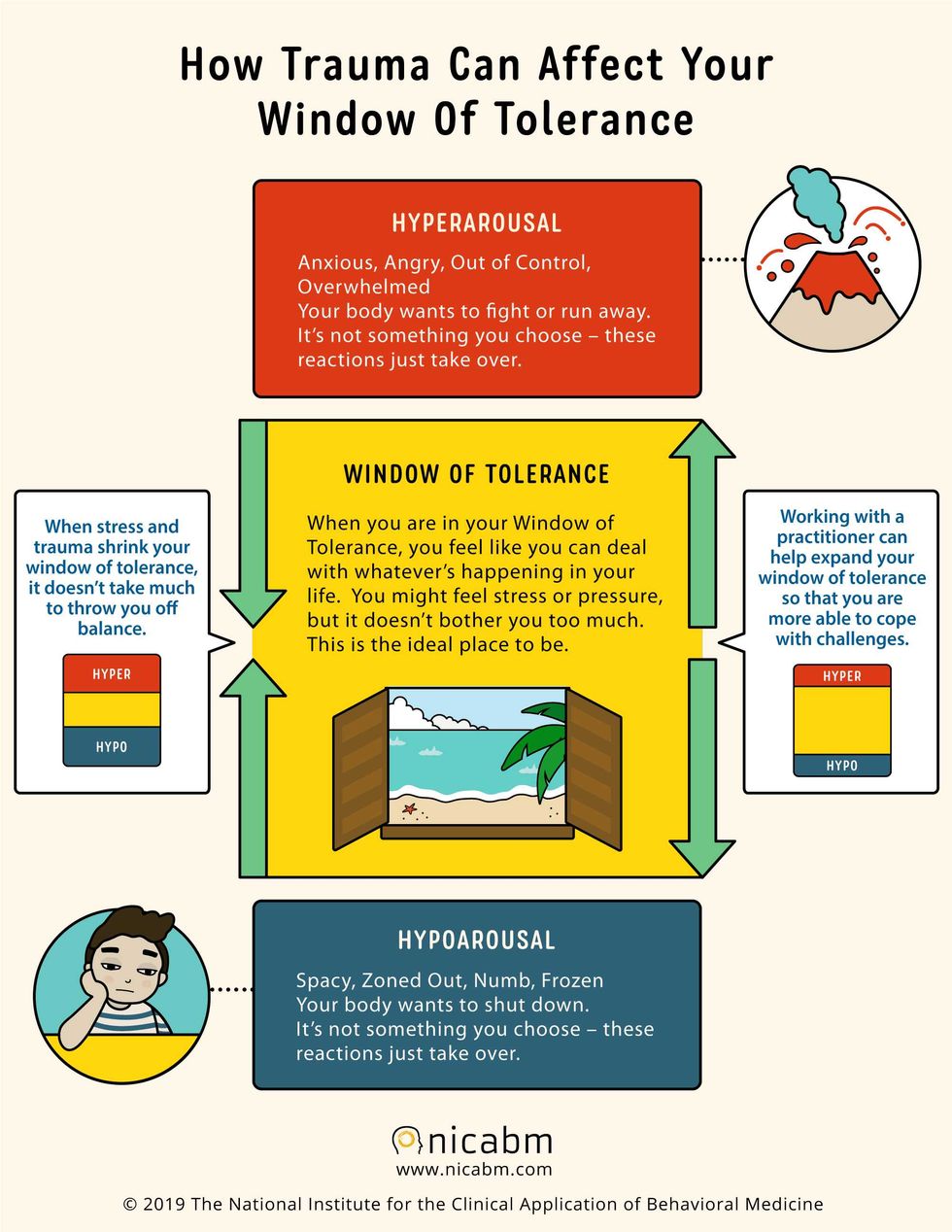 Information from the NICABM website regarding the "Window of Tolerance."Photo Credit: The National Institute for the Clinical Application of Behavioral Medicine
  Waves cycle in the ocean. Photo by
Gen Xers and Millennials share 17 of the strangest things their Baby Boomer parents do
"My mom writes her emails in MS Word, then attaches the Word document to the email."
A Baby Boomer couple.
Generational fights have raged since the dawn of time, and a recent spat between Millennials and Baby Boomers is no exception. Baby Boomers, who raised Millennials, accuse the younger generation of being entitled and irresponsible with money. At the same time, Millennials accuse Boomers of having it easier economically while making it harder for those who came after them.
Where is Gen X in the battle? Probably off in the corner somewhere, saying, "Whatever." Aside from the generational sniping, there are some things the older generation does that are just plain baffling to younger people. Whether it's outdated worldviews, a refusal to adapt to modern technology, or a lack of self-awareness, Baby Boomers can do some strange things.
To help the younger folks get over their frustrations with parents from the "Me Generation," a Redditor asked: "What is the most Boomer thing your parents still do?" The stories were pretty funny and relatable, showing that almost everyone with parents over 60 is dealing with the same thing.
Here are 17 of the "strangest" things people's Baby Boomer parents do:
1. Phones on full blast
"Play iPhone slot machine games at full volume in the doctor’s office."
"My dad pretty much exclusively has his phone on speaker, and just walks around in public talking with it at max volume (and talking really loud himself). I’m like 'Dad, the entire supermarket doesn’t want to listen to you, and Uncle Jim complains about how often you have to pee.'"
2. Still using checkbooks
"My mom balances her checkbook every week. They still have a landline."
"And she probably has way more money than you will until she dies!"
3. Email issues
"My mom writes her emails in MS Word, then attaches the Word document to the email."
"Like the email is just the virtual envelope for the digital letter."
4. Restaurant jokes
"All those little restaurant comments.
'Wow, they'll let anyone in here!' when seeing a friend at said restaurant.
'Thanks for having us, not everyone will' to the waiter at the end of the meal.
'As you can see, it was terrible' when the staff takes away the clearly entirely eaten plate.
'You're going to have me floating away in a minute' when more water is put into their glass"
5. Always have to mention race
"Constantly mentioning the race or ethnicity of everyone she mentions. Never with any negative connotation or comment, but usually, there is no reason for it to be relevant to the conversation."
"My Jewish mother will always whisper the word 'black' in case anyone hears her: 'So the nice black man at the hardware store helped me find the right garden hose.'"
6. Googling their Google
"Typing Google on Google before they Google the thing they’re looking for."
"In the Google search bar, they type Google? Lol."
7. Getting a job is a cinch
"Believing you can walk into a business and hand in a resume. If you have a college degree in any field, they'll hire you."
"Just physically hand over your resume to HR or the hiring manager. You'll make a mark and get hired!! Call the office and ask to speak to HR/Hiring Manager."
Any Millennial who argued with their Boomer parents about how hard it is to land a good job should feel vindicated by a 2022 study, which found that most older Millennials didn't secure good jobs until their early 30s, while most Boomers did so in their 20s. "To secure a good job, young adults need to acquire more education and high-quality work experience than was necessary for previous generations," the researchers wrote.
8. Why are they together?
"Stay married forever while they behave like neither one of them can stand each other."
"I'm on the other side of that. After my mom passed, my dad now acts like their marriage was picture perfect and they were the love of each other's lives, even though they couldn't stand each other for at the very least 40 of the 54 years they were married."
9. Collectables or hoarding?
"Think their 'collectibles' are truly valuable."
"My mom insists her Hummels are going to put my kids through college!"
"Mine are the Thomas Kincade paintings. She has a Victorian glass piece that might actually be worth something, but those damn paintings are the real investment."
10. Can you grab the mail?
"Ask me to bring in the mail when they go away for more than 24 hours."
"My parents think everybody is standing at the door waiting for the mailman every day, and don’t believe me when I tell them that some people go days without checking their mail. They think everybody is waiting for the mailman every day because 'somebody might send them a check.' Like, really?"
11. Zero responsibility
"'Well, I guess I was just a bad father.' Yeah. That attitude of anti-responsibility is exactly why 3 out of 4 of your children don't talk to you."
"Ha! Have the same dad, do we?"
12. Comment on people's appearance
"Comment on EVERYBODY’s body/appearance/weight. The first thing my dad does after not seeing me for a year is poke me in the gut and tell me how fat I am."
13. Boomer panic is real
"Literally throwing their hands up in a panic when they don't understand something. Where did they learn that?"
"Or just saying 'well, I don't know', especially when that comes right after you explaining it and showing them how to do something, with them nodding along and asking relevant questions all the way through."
In a video by YourTango, editor Brian Sundholm tried to explain Boomer panic in an empathetic way: "Most of us nowadays know the importance of recognizing and feeling our emotions." Sundholm then quoted therapist Mitzi Bachman, who explained that when people struggle to express their emotions, it can result in an "unhinged" reaction.
14. Annoying Facebook posts
"Post nonsensical rants on Facebook for other boomers to like, share, and comment. Often these rants are political, but not always. Basically cringe-fest."
"Most people won't do it, but share this post if you believe in god and freedom."
"I do NOT give Facebook permission to use my photos and personal information!"
15. Dinner pushers
"While we're eating breakfast. What do you want to do for supper?"
"Can't we enjoy this meal without worrying about the next?"
16. They print everything
"My boomer in-laws print EVERYTHING! The number of times I have said, 'quit wasting ink, email it to me, or text me the link. Or just text me the schedule, don't print it out.' GPS on their phones? Nope...print a map."
"Boomers and their paper man. My dad has finally started using the internet, but he still prints everything he likes. Like he'll see a boat listing on Craigslist and print the entire page, including a massive color photo of it, and he's definitely not going to be buying it either. He's got a stack of papers that is the internet that sits by his recliner. He just sits there with Fox News on (though it's usually muted for some reason, that's a plus) and looks at his papers."
17. Flirting with servers
"My dad is 77 still flirts with the young waitresses. It's f**king weird for everyone."
"He thinks he is in cute old man territory, but he is not."