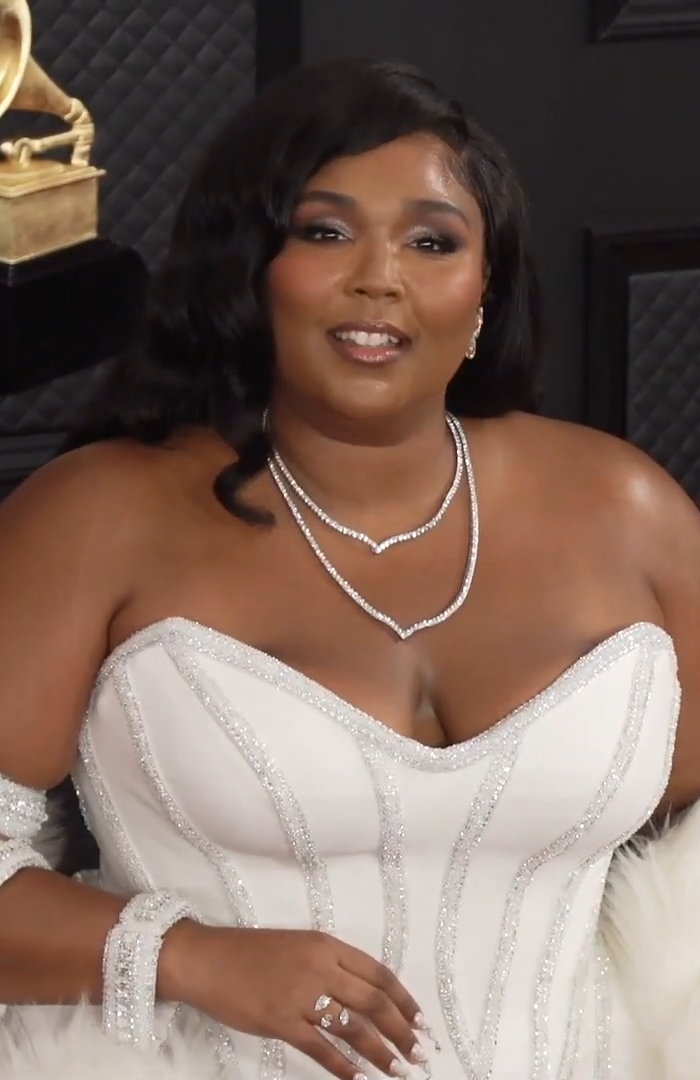
Lizzo removes controversial lyric from her new song after a moving exchange with disabled fans
She knew exactly what to do.
She's the pudding in the proof, alright.
Lizzo—an artist who has made inclusion a part of her platform—received criticism from fans for a word included in her newly released single “Grrrls,” which was seen by some as derogatory toward disabled people.
The song’s opening line includes the word “spazz,” which in broad slang terms can mean “random, wild outburst,” according to Urban Dictionary. As many disability advocates pointed out, however, “spastic” is also used to describe someone with an actual medical condition where they lose control of their muscles (cerebral palsy, in particular). The term has often been used as an insult, implying that someone is “awkward or clumsy.” Hence why many view it as an “ableist slur.”
Fans who were disappointed by its inclusion in her song posted about it online, which eventually caught the attention of Lizzo herself.
"Hey @lizzo, my disability Cerebral Palsy is literally classified as Spastic Diplegia (where spasticity refers to unending painful tightness in my legs) your new song makes me pretty angry + sad. 'S--z' doesn’t mean freaked out or crazy. It’s an ableist slur. It’s 2022. Do better,” one person explained.
Another added: “Oh @lizzo. A VERY influential figure, using the word sp@z in her new song. An offensive and derogatory term. As someone who’s written about the use of disability language, especially slang/slur words which have been used in schools, this is a huge step back. Please, remove it.”
So … what do you do when you say something hurtful, despite that being the furthest thing from what you intended? How do you make it right without compromising your own integrity? You do exactly what Lizzo did.
Without missing a beat, Lizzo made a statement on Instagram that acknowledged the pain caused by using the word, focusing on impact rather than intent. It's a crucial shift that makes an apology authentic.
"It’s been brought to my attention that there is a harmful word in my new song 'GRRRLS'. Let me make one thing clear: I never want to promote derogatory language. As a fat black woman in America, I’ve had many hurtful words used against me so I overstand the power words can have (whether intentionally or in my case, unintentionally),” the singer wrote.
That simple change made a world of difference. Lizzo soon received an outpouring of love, even from those who initially reached out in retaliation. Amazing things happen when people feel heard.
I’m going to cry 😭 Thank you so much for hearing us Lizzo and for understanding that this was only ever meant gently and being open to learning, it honestly means the world ❤️. You’re a real true ally https://t.co/RbQCbAwpR6
— Hannah Diviney (@hannah_diviney) June 13, 2022
Some even noted their own discoveries, sharing how they too learned about the word’s other meaning and plan to change moving forward.
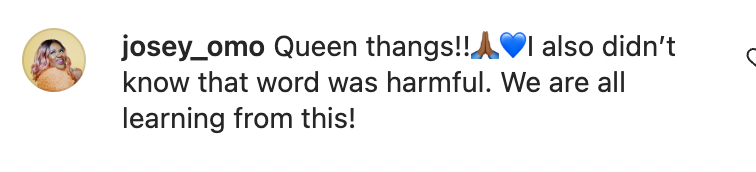
We're all learning together.
Even the most conscientious person doesn’t know everything. No one is going to know how every word is translated across cultures and backgrounds. We are all human. But compassion doesn’t have to get lost in translation. There doesn’t have to be drama in allyship. Sometimes it might be as simple as a more mindful approach to our ever-evolving language.
Despite what another Lizzo song suggests, maybe truth doesn’t have to hurt.

- Man who now uses a wheelchair explains ableism, and it'sa ... ›
- Elementary school teacher leads students in empowering remix of ... ›
- Lizzo launches a reality show for dancers with bigger bodies, then ... ›
- Lizzo took giving someone clothes off your back literally - Upworthy ›
- Lowe's employee helps boy with spastic cerebral palsy - Upworthy ›


a man sitting at a desk with his head on his arms Photo by
Can a warm cup of tea help you sleep better? If you believe it, then yes. Photo by 
A woman is getting angry at her coworker.via
A man with tape over his mouth.via
A husband is angry with his wife. via 
Three women sit on a blanket in the park. 
Two women engaging in a pleasant conversation inside a coffee shop
Two men engaging in a peaceful disagreement.
Resurfaced video of French skier's groin incident has people giving the announcer a gold medal
"The boys took a beating on that one."
Downhill skiing is a sport rife with injuries, but not usually this kind.
A good commentator can make all the difference when watching sports, even when an event goes smoothly. But it's when something goes wrong that great announcers rise to the top. There's no better example of a great announcer in a surprise moment than when French skier Yannick Bertrand took a gate to the groin in a 2007 super-G race.
Competitive skiers fly down runs at incredible speeds, often exceeding 60 mph. Hitting something hard at that speed would definitely hurt, but hitting something hard with a particularly sensitive part of your body would be excruciating. So when Bertrand slammed right into a gate family-jewels-first, his high-pitched scream was unsurprising. What was surprising was the perfect commentary that immediately followed.
This is a clip you really just have to see and hear to fully appreciate:
- YouTube youtu.be
It's unclear who the announcer is, even after multiple Google inquiries, which is unfortunate because that gentleman deserves a medal. The commentary gets better with each repeated viewing, with highlights like:
"The gate the groin for Yannick Bertrand, and you could hear it. And if you're a man, you could feel it."
"Oh, the Frenchman. Oh-ho, monsieurrrrrr."
"The boys took a beating on that one."
"That guy needs a hug."
"Those are the moments that change your life if you're a man, I tell you what."
"When you crash through a gate, when you do it at high rate of speed, it's gonna hurt and it's going to leave a mark in most cases. And in this particular case, not the area where you want to leave a mark."
Imagine watching a man take a hit to the privates at 60 mph and having to make impromptu commentary straddling the line between professionalism and acknowledging the universal reality of what just happened. There are certain things you can't say on network television that you might feel compelled to say. There's a visceral element to this scenario that could easily be taken too far in the commentary, and the inherent humor element could be seen as insensitive and offensive if not handled just right.
The announcer nailed it. 10/10. No notes.
The clip frequently resurfaces during the Winter Olympic Games, though the incident didn't happen during an Olympic event. Yannick Bertrand was competing at the FIS World Cup super-G race in Kvitfjell, Norway in 2007, when the unfortunate accident occurred. Bertrand had competed at the Turin Olympics the year before, however, coming in 24th in the downhill and super-G events.
As painful as the gate to the groin clearly as, Bertrand did not appear to suffer any damage that kept him from the sport. In fact, he continued competing in international downhill and super-G races until 2014.
According to a 2018 study, Alpine skiing is a notoriously dangerous sport with a reported injury rate of 36.7 per 100 World Cup athletes per season. Of course, it's the knees and not the coin purse that are the most common casualty of ski racing, which we saw clearly in U.S. skier Lindsey Vonn's harrowing experiences at the 2026 Olympics. Vonn was competing with a torn ACL and ended up being helicoptered off of the mountain after an ugly crash that did additional damage to her legs, requiring multiple surgeries (though what caused the crash was reportedly unrelated to her ACL tear). Still, she says she has no regrets.
As Bertrand's return to the slopes shows, the risk of injury doesn't stop those who live for the thrill of victory, even when the agony of defeat hits them right in the rocks.