Hundreds of doctors have asked the FDA not to rush—or politicize—a coronavirus vaccine

"There's only one thing more dangerous than a bad virus, and that's a bad vaccine," Dr. Mike Ryan, executive director of WHO's health emergencies programme, said in March. "We have to be very, very, very careful in developing any product that we're going to inject into potentially most of the world population."
Since the beginning of the pandemic, experts have said that developing a vaccine and getting it through the necessary safety and efficacy protocols would take, at minimum, 12 to 18 months. Yet here we are, 7 months in, and Vladimir Putin has just announced that Russia has already approved a vaccine for the coronavirus.
According to the BBC, there are more than 100 vaccines in various stages of development and testing. Six of those have reached phase 3 trials, involving more widespread testing in humans. Russia's vaccine is not among those six.
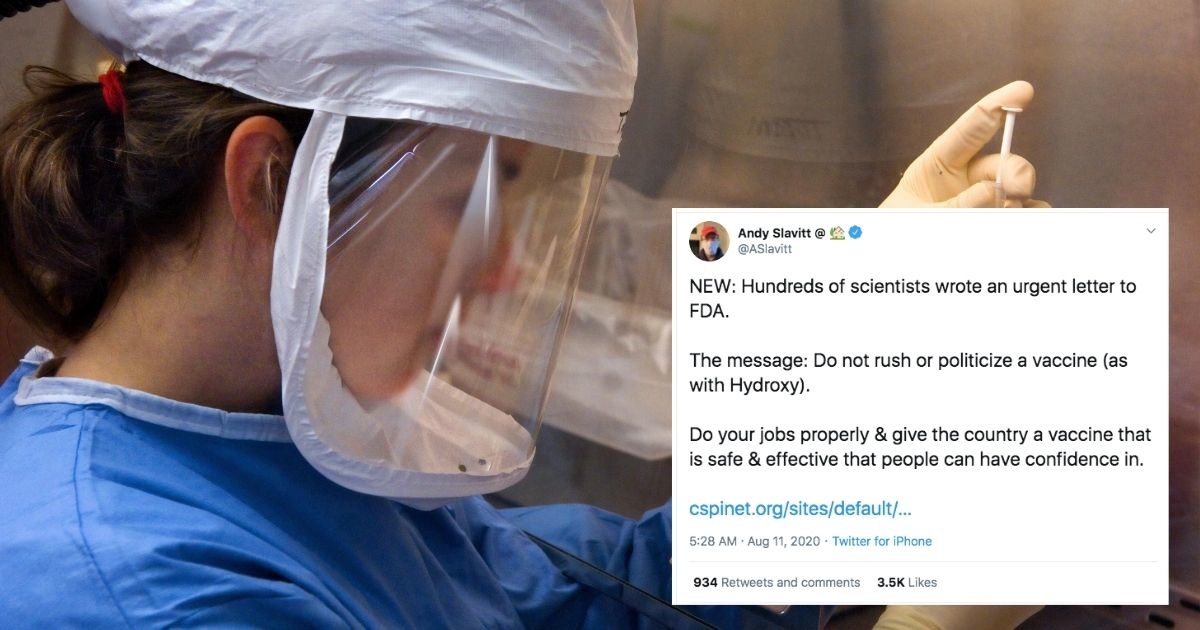
Meanwhile, hundreds of U.S. doctors have signed a letter urging the FDA not to rush or politicize vaccine trials.
"We are experts in virology, epidemiology, vaccinology, infectious disease, clinical care and public health," the letter opens, before declaring the "urgent" need for a COVID-19 vaccine. "We are committed to promoting the broad uptake of safe and effective COVID-19 vaccines. The need is urgent but all vaccines must be rigorously studied to determine whether their benefits exceed their risks."
The letter expresses concern that public confidence in a vaccine will be greatly undermined by rushing the process, and that thorough safety trials must be followed through in order for doctors themselves to confidently recommend and administer one.
For those reasons, the doctors urged transparency in the process of trialing and documenting any potential vaccines:
"The foundation of public confidence in vaccine safety has long been, and must remain, the well-established and trusted FDA approval procedures. The public is typically and rightly able to comment on vaccine approval. It is important that investigators share Phase 3 trial design details. For example, Data Safety Monitoring Boards apply predetermined 'stopping rules' to decide whether a study should be terminated early based on the detection of early benefits, the likelihood of no benefit, or the emergence of serious safety problems. These stopping rules should be publicly available. There must also be continuous monitoring for unexpected severe side effects that might only become apparent after large numbers of people are vaccinated."
Finally, they drove home the point that doctors can only recommend a vaccine if they believe it is safe, and that evaluating safety can only be done with a transparent process unmarred by politics.
"We can only perform as advocates if we ourselves are persuaded that the vaccine(s) truly is safe and effective. We must be able to explain to the public what we know and what we don't know about these vaccines. For that to happen, we must be able to witness a transparent and rigorous FDA approval process that is devoid of political considerations."
Russia's announcement could very well push vaccine makers and the government to rush the development and trialing process, which would be a mistake. Vaccine development usually takes years, not months, and skipping safety steps in the name of competition or expediency could make public health problems worse, not better.
As always, government needs to listen to the health experts on this front. We need a vaccine as soon as possible, but we also need to make sure we utilize the knowledge and processes that will ensure any vaccine will be safe to administer, no matter which company or country gets there first.
- When his daughter got sick, he made a vaccine and saved millions ... ›
- COVID-19 has done the impossible: It's made some anti-vaxxers ... ›
- WHO launches 'solidarity trial,' bringing countries together to study ... ›
- Let's take a moment for the unsung hero who died volunteering in the Moderna vaccine trial - Upworthy ›
- Why seeing Presidents Obama, Bush and Clinton get the COVID-19 vaccine on live TV matters - Upworthy ›


A Generation Jones teenager poses in her room.Image via Wikmedia Commons
An office kitchen.via
An angry man eating spaghetti.via 
Gif of baby being baptized
Woman gives toddler a bath Canva


An Irish woman went to the doctor for a routine eye exam. She left with bright neon green eyes.
It's not easy seeing green.
Did she get superpowers?
Going to the eye doctor can be a hassle and a pain. It's not just the routine issues and inconveniences that come along when making a doctor appointment, but sometimes the various devices being used to check your eyes' health feel invasive and uncomfortable. But at least at the end of the appointment, most of us don't look like we're turning into The Incredible Hulk. That wasn't the case for one Irish woman.
Photographer Margerita B. Wargola was just going in for a routine eye exam at the hospital but ended up leaving with her eyes a shocking, bright neon green.
At the doctor's office, the nurse practitioner was prepping Wargola for a test with a machine that Wargola had experienced before. Before the test started, Wargola presumed the nurse had dropped some saline into her eyes, as they were feeling dry. After she blinked, everything went yellow.
Wargola and the nurse initially panicked. Neither knew what was going on as Wargola suddenly had yellow vision and radioactive-looking green eyes. After the initial shock, both realized the issue: the nurse forgot to ask Wargola to remove her contact lenses before putting contrast drops in her eyes for the exam. Wargola and the nurse quickly removed the lenses from her eyes and washed them thoroughly with saline. Fortunately, Wargola's eyes were unharmed. Unfortunately, her contacts were permanently stained and she didn't bring a spare pair.
- YouTube youtube.com
Since she has poor vision, Wargola was forced to drive herself home after the eye exam wearing the neon-green contact lenses that make her look like a member of the Green Lantern Corps. She couldn't help but laugh at her predicament and recorded a video explaining it all on social media. Since then, her video has sparked a couple Reddit threads and collected a bunch of comments on Instagram:
“But the REAL question is: do you now have X-Ray vision?”
“You can just say you're a superhero.”
“I would make a few stops on the way home just to freak some people out!”
“I would have lived it up! Grab a coffee, do grocery shopping, walk around a shopping center.”
“This one would pair well with that girl who ate something with turmeric with her invisalign on and walked around Paris smiling at people with seemingly BRIGHT YELLOW TEETH.”
“I would save those for fancy special occasions! WOW!”
“Every time I'd stop I'd turn slowly and stare at the person in the car next to me.”
“Keep them. Tell people what to do. They’ll do your bidding.”
In a follow-up Instagram video, Wargola showed her followers that she was safe at home with normal eyes, showing that the damaged contact lenses were so stained that they turned the saline solution in her contacts case into a bright Gatorade yellow. She wasn't mad at the nurse and, in fact, plans on keeping the lenses to wear on St. Patrick's Day or some other special occasion.
While no harm was done and a good laugh was had, it's still best for doctors, nurses, and patients alike to double-check and ask or tell if contact lenses are being worn before each eye test. If not, there might be more than ultra-green eyes to worry about.