
The secret felt layer on Converse sneakers is actually a brilliant money-saving hack
It helps them save millions on shipping costs.

This is a prime example of "tariff engineering."
If you’ve ever thrown on a pair of fresh Converse Chuck Taylor sneakers, you might have noticed an unusual feature—felt soles. While Converse might want you to think this odd layer of fabric is for things like “shape retention” and “quieter usage,” the real reason behind it all comes down to exploiting legal loopholes for the bottom line.
Converse is part of Nike, which imports its products into the U.S. from China. Back in 2018, the Trump administration imposed large new tariffs on a wide range of US imports from China, but some items had heftier price tags than others. As Nicholas Mortimer of the Strategic Sourceror explained, sneaker imports are subject to a 37.5% tariff.
Slippers, on the other hand, have a measly 3% tariff. And lucky enough for Nike, the legal requirement for a shoe to be considered a slipper is having a fuzzy sole. Meaning that by slapping enough felt to the bottom—which eventually deteriorates with a few wears—the company was able to save a ton of money on import taxes.
Interestingly enough, if you look at the images associated with the Converse Chuck Taylor patent, they look a lot more slipper-esque than the sneakers you’ll see on their website.
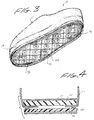
This also kind of explains how Converse can boast of the slip resistance of their shoes, when anyone who’s worn a new pair of Chuck Taylors in the rain—and proceeded to bust their ass—can tell you that is definitely not true. For that issue, GearPatrol suggests using sandpaper to slough off “the hairy bits.”
The whole fuzzy sole loophole is a prime example of “tariff engineering,” which, unlike, say, tax evasion, is a legal way of avoiding higher import rates, usually by redesigning a product—like tweaking the materials or structure, or breaking it into smaller values to qualify for a tariff exemption.
@let_me_ask_you_this #let #me #ask #you #this #trivia #question #fun #facts #fact #Converse #all #star #Chuck #Taylor #felt #tarrif #taxes #import #slippers #converseallstar
An even stranger example of tariff engineering is brought to you by Disney. As explained in Slash Film, the company, which owns Marvel, had its X-Men action figures classified as toys representing “non-human characters,” since apparently human “dolls” are taxed at a higher rate. A bit of an odd move, considering the entire overarching theme of X-Men. But probably not Disney’s most egregious sin committed in order to make more money.
As Donald Trump’s second term approaches, tariff talk, and its potential consequences, has been all a flutter. The President-elect has said the goal would be to impose a 25% tariff on all items imported from Canada and Mexico and an additional 10% tariff on imports from China, possibly affecting electronics, clothing, household appliances, furniture, footwear and travel goods.
Considering that Jonathan Gold, Vice President for supply chains and customs policy at the National Retail Federation, mentioned tariffs for toys specifically would be going from a "practically 0% tariff rate” to upwards of 36% to 56%, it seems that the X-Men are going to feel a much bigger blow than any sneakers will. Although, it wouldn't be a surprise to see Disney and various other companies finding more clever ways of skirting the system as to not upset their profits. Cause after all, isn’t that what capitalism’s all about?

- Should we wear shoes in the house? Experts weigh in and turns out we should stop immediately. ›
- Teen with size 23 feet had trouble finding shoes until Shaq heard about his struggle ›
- Hey, quick question: What color is this !@#$ shoe? ›
- American mom and small business owner hit with massive tariff bill - Upworthy ›


A woman is getting angry at her coworker.via
A man with tape over his mouth.via
A husband is angry with his wife. via 
a man sitting at a desk with his head on his arms Photo by
Can a warm cup of tea help you sleep better? If you believe it, then yes. Photo by 
Three women sit on a blanket in the park. 
Two women engaging in a pleasant conversation inside a coffee shop
Two men engaging in a peaceful disagreement.
Resurfaced video of French skier's groin incident has people giving the announcer a gold medal
"The boys took a beating on that one."
A good commentator can make all the difference when watching sports, even when an event goes smoothly. But it's when something goes wrong that great announcers rise to the top, and there's no better example of a great announcer in a surprise moment than when French skier Yannick Bertrand took a gate to the groin in a 2007 super-G race.
Competitive skiers fly down runs at incredible speeds, often exceeding 60 mph. Hitting something hard at that speed would definitely hurt, but hitting something hard with a particularly sensitive part of your body would be excruciating. So when Bertrand slammed right into a gate family-jewels-first, his high-pitched scream was unsurprising. What was surprising was the perfect commentary that immediately followed.
This is a clip you really just have to see and hear to fully appreciate:
- YouTube youtu.be
It's unclear who the announcer is, even after multiple Google inquiries, which is unfortunate because that gentleman deserves a medal. The commentary gets better with each repeated viewing, with highlights like:
"The gate the groin for Yannick Bertrand, and you could hear it. And if you're a man, you could feel it."
"Oh, the Frenchman. Oh-ho, monsieurrrrrr."
"The boys took a beating on that one."
"That guy needs a hug."
"Those are the moments that change your life if you're a man, I tell you what."
"When you crash through a gate, when you do it at high rate of speed, it's gonna hurt and it's going to leave a mark in most cases. And in this particular case, not the area where you want to leave a mark."
Imagine watching a man take a hit to the privates at 60 mph and having to make impromptu commentary, straddling the line between professionalism and acknowledging the universally understood reality of what just happened. There are certain things you can't say on network television that you might feel compelled to say. There's a visceral element to this scenario that could easily be taken too far in the commentary, and the inherent humor element could be seen as insenstive and offensive if not handled just right.
The announcer nailed it. 10/10. No notes.
The clip frequently resurfaces during the Winter Olympic Games, though the incident didn't happen during an Olympic event. Yannick Bertrand was competing at the FIS World Cup super-G race in Kvitfjell, Norway in 2007, when the unfortunate accident occurred. Bertrand had competed at the Turin Olympics the year before, however, coming in 24th in the downhill and super-G events.
As painful as the gate to the groin clearly as, Bertrand did not appear to suffer any damage that kept him from the sport. In fact, he continued competing in international downhill and super-G races until 2014.
Alpine skiing is a notoriously dangerous sport, with a reported injury rate of 36.7 per 100 World Cup athletes per season, according to a 2018 study. Of course, it's the knees and not the coin purse that are the most common casualty of ski racing, which we saw clearly in U.S. skiier Lindsey Vonn's harrowing experiences at the 2026 Olympics. Vonn was competing with a torn ACL and ended up being helicoptered off of the mountain after an ugly crash that did additional damage to her legs, requiring multiple surgeries (though what caused the crash was reportedly unrelated to her ACL tear). Still, she says she has no regrets.
As Bertrand's return to the slopes shows, the risk of injury doesn't stop those who live for the thrill of victory, even when the agony of defeat hits them right in the rocks.