
upworthy
Add Upworthy to your Google News feed.
Google News Button
Climate Change

This glacier was featured on a postcard in 1900. A camera captured where it is today.

Whoa.

This glacier was featured on a postcard in 1900. A camera captured where it is today.


116 years ago, the Pasterze glacier in the Austria's Eastern Alps was postcard perfect:

Snowy peaks. Windswept valleys. Ruddy-cheeked mountain children in lederhosen playing "Edelweiss" on the flugelhorn.

But a lot has changed since 1900.

Much of it has changed for the better! We've eradicated smallpox, Hitler is dead, and the song "Billie Jean" exists now.

On the downside, the Earth has gotten a lot hotter. A lot hotter.

The 15 warmest years on record have all occurred since 1998. July 2016 was the planet's hottest month — ever.

Unsurprisingly, man-made climate change has wreaked havoc on the planet's glaciers — including the Pasterze, which is Austria's largest.

Just how much havoc are we talking about? Well...

A series of stunning photos, published in August, show just how far the glacier has receded since its heyday.

Photo by Sean Gallup/Getty Images.

First measured in 1851, the glacier lost half of its mass between that year and 2008.

The glacier today.

Photo by Sean Gallup/Getty Images.

A marker placed in 1985 shows where the edge of the glacier reached just 31 years ago. You can still see the ice sheet, but just barely, way off in the distance. In between is ... a big, muddy lake.
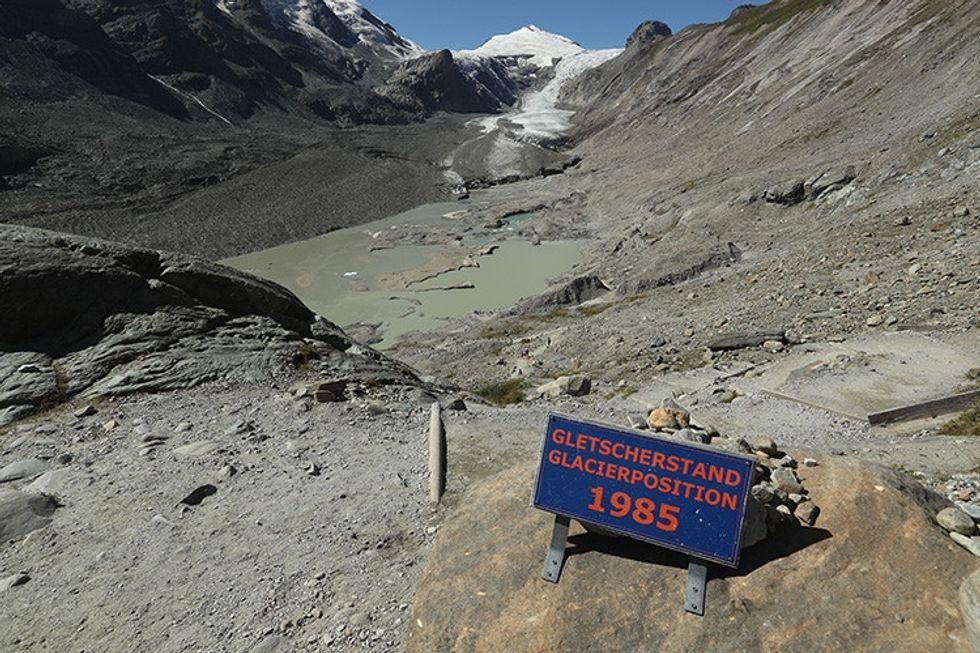
Photo by Sean Gallup/Getty Images.

The view from the glacial foot marker from 1995 — 10 years later — isn't much more encouraging.

Photo by Sean Gallup/Getty Images.

Even in just one year, 2015, the glacier lost an astounding amount of mass — 177 feet, by some estimates.

Photo by Sean Gallup/Getty Images.

Ice continues to melt daily, and while the dripping makes for a good photo, it's unfortunate news for planet Earth. Glacial melting is one of the three primary causes of sea-level rise.

Photo by Sean Gallup/Getty Images.

According to a European Environment Agency report, the average temperature in the Alps has increased 2 degrees Celsius in the last 100 years — double the global average.

Beautiful, but ominous, fissures in the glacier.

Photo by Sean Gallup/Getty Images.

It's not unreasonable to assume that that's why this mountain hut has been abandoned by the flugelhorn-playing children who once probably lived in it.
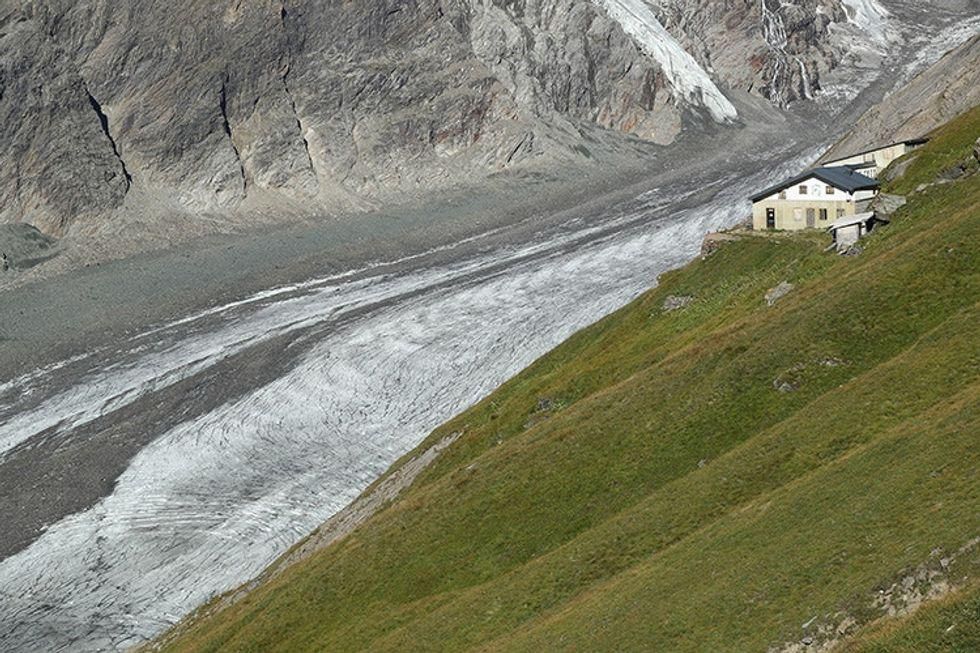
Photo by Sean Gallup/Getty Images.

Is there anything we can do to stop climate change besides look at scary glacier photos?

Climate change is, unfortunately, still a robust debate in the United States as many of our elected officials refuse to acknowledge that we humans are the ones doing the changing. As of last year, that list included a whopping 49 senators. Calling them to gently persuade them otherwise would be helpful. Not voting for them if they don't change their minds would be even more so.

There is some tentative good news — the Paris Agreement signed in December 2015 commits 197 countries, including the U.S., to take steps to limit future global temperature rise to 2 degrees Celsius. While it may be too late for the Pasterze glacier, if we really commit as a world, we might be able to stop ourselves from sinking whole countries and turning Miami into a swimming pool and stuff like that.

And who knows, with a little luck, and a little more not poisoning the sky, we just might recapture a little of that Alpine magic one day.

OK, these guys are Swiss. But who's counting?

Photo by Cristo Vlahos/Wikimedia Commons.

This article originally appeared seven years ago.

discussion, debate, disagreement, conversation, communication, curiosity

How do you get someone to open their minds to another perspective?

The diversity of humanity means people won't always see eye to eye, and psychology tells us that people tend to double down when their views are challenged. When people are so deeply entrenched in their own perspectives they're refusing to entertain other viewpoints, what do we do?

Frequently, what we do falls into the "understandable but ineffective" category. When we disagree with someone because their opinion is based on falsehoods or inaccurate information, we may try to pound them with facts and statistics. Unfortunately, research shows that generally doesn't work. We might try to find different ways to explain our stance using logic and reasoning, but that rarely makes a dent, either. So often, we're left wondering how on Earth this person arrived at their perspective, especially if they reject facts and logic.


According to Stanford researchers, turning that wondering into an actual question might be the key.

discussion, debate, disagreement, conversation, communication, curiosity Questions are more effective than facts when it comes to disagreements.Photo credit: Canva

The power of "Tell me more."

Two studies examined how expressing interest in someone's view and asking them to elaborate on why they hold their opinion affected both parties engaged in a debate. They found that asking questions like, "Could you tell me more about that?” and ‘‘Why do you think that?" made the other person "view their debate counterpart more positively, behave more open-mindedly, and form more favorable inferences about other proponents of the counterpart’s views." Additionally, adding an expression of interest, such as, ‘‘But I was interested in what you’re saying. Can you tell me more about how come you think that?” not only made the counterpart more open to other viewpoints, but the questioner themselves developed more favorable attitudes toward the opposing viewpoint.

In other words, genuinely striving to understand another person's perspective by being curious and asking them to say more about how they came to their conclusions may help bridge seemingly insurmountable divides.

discussion, debate, disagreement, conversation, communication, curiosity Asking people to elaborate leads to more open-mindedness.Photo credit: Canva

Stanford isn't alone in these findings. A series of studies at the University of Haifa also found that high-quality listening helped lower people's prejudices, and that when people perceive a listener to be responsive, they tend to be more open-minded. Additionally, the perception that their attitude is the correct and valid one is reduced.

Why curiosity works

In some sense, these results may seem counterintuitive. We may assume that asking someone to elaborate on what they believe and why they believe it might just further entrench them in their views and opinions. But that's not what the research shows.

Dartmouth cognitive scientist Thalia Wheatley studies the role of curiosity in relationships and has found that being curious can help create consensus where there wasn't any before.

“[Curiosity] really creates common ground across brains, just by virtue of having the intellectual humility to say, ‘OK, I thought it was like this, but what do you think?’ And being willing to change your mind,” she said, according to the John Templeton Foundation.

discussion, debate, disagreement, conversation, communication, curiosity Curiosity can help people get closer to consensus. Photo credit: Canva

Of course, there may be certain opinions and perspectives that are too abhorrent or inhumane to entertain with curious questions, so it's not like "tell me more" is always the solution to an intractable divide. But even those with whom we vehemently disagree or those whose views we find offensive may respond to curiosity with more open-mindedness and willingness to change their view than if we simply argue with them. And isn't that the whole point?

Sometimes what's effective doesn't always line up with our emotional reactions to a disagreement, so engaging with curiosity might take some practice. It may also require us to rethink what formats for public discourse are the most impactful. Is ranting in a TikTok video or a tweet conducive to this shift in how we engage others? Is one-on-one or small group, in-person discussion a better forum for curious engagement? These are important things to consider if our goal is not to merely state our case and make our voice heard but to actually help open people's minds and remain open-minded in our own lives as well.

Parenting

Instead of a 'Sweet 16,' mom hosts 'Coming of Age Brunch' with adult mentors for her teen daughter

She calls it a "birthday tradition that will change your teenager's life."

sweet sixteen, birthday, birthday brunch, coming of age, young adulthood, parenting, parenting tip, parenting teens

A group of women raising glasses (left) A happy teen girl (right)

Turning sixteen is considered a milestone. It symbolizes the beginning of the transition from childhood to young adulthood, and the start of new privileges, responsibilities, and identities.

Many families celebrate this new chapter with some kind of “Sweet 16” ritual. Depending on one’s culture, it might go by a different name, such as a bar/bat mitzvah (when a boy/girl turns 13 in Jewish culture) or a quinceañera,, (when a girl turns 15 in Latin American culture). Each celebration involves slightly different traditions, but generally have the same intention of commemorating a child’s newfound maturity.


A mom who posts parenting tips under the handle of @simplyonpurpose recently shared her unique take on a “Sweet 16,” which she hails as “a birthday tradition that will change your teenager’s life.”

She calls it the “Coming of Age Brunch.”

Rather than having a birthday party with friends, this mom has her child choose a select group of adult mentors who have played a “special part” in the child’s life. These guests are asked to bring letters conveying, in their own words, “what it means to be a strong woman” and sharing special praise for the teen.

The reason is simple: “Children need a village during their adolescent years more than at any other time in their lives,” @simlyonpurpose wrote in her caption. This was a tradition that began with her eldest daughter, who is now 22. Doing it for now the third time, @simplyonpurpose feels confident that “every teenager needs this- a room full of adults that you admire praising you.”

It sounds lovely. Imagine if every girl had this kind of support as they entered an undeniably turbulent stage of life. Sure, maybe the hormonal fluctuations, body image issues, changing friend groups, relationship dramas, and social media challenges would still be there, but perhaps they wouldn’t be quite so all-consuming.

sweet sixteen, birthday, birthday brunch, coming of age, young adulthood, parenting, parenting tip, parenting teens A teen girl getting a hug.Photo credit: Canva

And to be clear, the OP clarified that this was not strictly a girls-only ritual, though she would tweak it slightly for a boy, featuring a “fire pit with roasted hotdogs and marshmallows” and male mentors to share words of wisdom and love.

This is great to hear as well, considering there have been a lot of conversations centered around how a lack of healthy mentors has led many young men to getting “red pilled,” or influenced by misogynistic and radicalized online forums that target lonely or vulnerable boys by offering a sense of belonging.

sweet sixteen, birthday, birthday brunch, coming of age, young adulthood, parenting, parenting tip, parenting teens A teen boy wearing headphones while looking at his phone. Photo credit: Canva

By and large, other parents were totally on board with a “Coming of Age Brunch.” Quite a few were excited to try it out for their own teens.

“This really resonates. 💗 I want to do something similar for my daughter as she turns 17," one person wrote.

"Teens don’t need more preaching. Instead they need trusted adults who model strong values, healthy boundaries, and long-term thinking. That kind of guidance sticks,” added another.

Another added, “I cannot even think of anything that could possibly be a better gift - you just cemented her village. How incredible!”

The proverb “It takes a village” is an extremely popular saying found in many cultures across the world, but it's lately accompanied with the lament that villages are not so easy to come by in the modern world. Maybe by creating new traditions like this, we are able to reclaim that sense of much-needed community. At the very least, young folks don’t have to feel so alone, and that in itself is a great thing.

Science

Her groundbreaking theory on the origin of life was rejected 15 times. Then biology proved her right.

Lynn Margulis had the audacity to challenge Darwin. And we're lucky she did.

lynn margulis, lynn margulis symbiosis, biology, scientific breakthroughs, darwin, darwinism, women in science
Facts That Will Blow Your Mind/Facebook

A photo of Lynn Margulis.

Throughout her prolific and distinguished career, biologist Lynn Margulis made several groundbreaking contributions to science that we take for granted as common knowledge today. For example, she championed James E. Lovelock’s “Gaia concept,” which posited that the Earth self-regulates to maintain conditions for life.

But by far, her most notable theory was symbiogenesis. While it was first written off as “strange” and “aesthetically pleasing” but “not compelling,” it would ultimately prevail, and completely rewrite how we viewed the origin of life itself.


In the late 1960s, Margulis wrote a paper titled "On the Origin of Mitosing Cells," that was quite avant-garde. In it, she proposed a theory: that life evolved through organisms merging together to become inseparable.

In essence, cooperation is the driver of life, not competition and domination. This directly went against Darwin’s “survival of the fittest” principle that was considered gospel in scientific circles. Margulis’ paper was rejected by fifteen journals before getting accepted into the Journal of Theoretical Biology.

- YouTube www.youtube.com

Time would be on Margulis’ side, however. By the late ‘70s and early ‘80s, research proved that the two major building blocks of plants and animals, chloroplasts and mitochondria were at one time independent bacteria. This solidified the fact that on a biological level, connection trumps autonomy for longevity. And now that fact is written in textbooks, with no real story of the adversity it overcame to get there.

While it is customary for most new scientific theories to be met with criticism, especially those that completely shift the current narrative, many have noted that sexism played a key part in Margulis’ initial lack of acceptance. On more than one occasion, she herself had hinted that women were seen as mothers and wives first, and scientists second. She recalled that while married to fellow scientist Carl Sagan that “Carl would finish his sentence, unperturbed” while she was expected to “handle all the duties of a 1950s housewife, from washing dishes to paying the household bills.”

And yet, Margulis would have other ideas that were controversial that had nothing to do with her gender. Most famously, she did not believe that AIDS was caused by HIV, and instead believed it was cause by a syphilis-causing type of bacteria, despite there already being decades of research proving otherwise. That view was seen as an endorsement of AIDS denialism, which undermined prevention and treatment effort. Then later in life, Margulis became a vocal proponent of 9/11 conspiracy theories suggesting government involvement the in Twin Towers attacks.

And yet, perhaps this is one of those “you gotta take the good with the bad” situations. Margulis’ inherent contrarian nature gave us both these unfounded, even harmful stances, in addition to entirely new paradigms that altered our understanding of life itself.

And if nothing else, it illuminated the need for science to include multiple points of view in order to unlock the truth. It seems life is, after all, about coming together.

Brendan Fraser, Saving Superman, Kelly Clarkson, autism
Images via Wikicommons and IMBD

Brendan Fraser and Jonathan Charbonneau

As an actor, Brendan Fraser can strip down to his core and expose the most vulnerable aspects of humanity. (His heart-wrenching work in Darren Aronofsky's film The Whale earned him a well-deserved Best Actor Oscar at the 2023 Academy Awards.)

So, it's not surprising when he gets emotional discussing things near and dear to his heart—like autism awareness. In past interviews, Fraser has been very open about his son Griffin's diagnosis and the unexpected beauty that came with it. In a 2022 piece for Interview Magazine, Fraser shared, "And because of the beauty of his spectrum—call it a disorder if you will, I disagree with you—he knows nothing of irony. He doesn't know what cynicism is. You can't insult him. He can't insult you. He's the happiest person and is, in my life and many others', also the manifestation of love."


The documentary short film Saving Superman www.youtube.com, Switchboard Magazine

In 2024, Fraser co-executive produced the award-winning short documentary film Saving Superman. It tells the heartwarming story of Jonathan Charbonneau, a man in his fifties on the spectrum who loves to dress up as the DC comic book character. As seen in the film, he delightfully appears around his hometown of Glen Ellyn, Illinois, to play music and greet the community. In the movie, Charbonneau shares why he was specifically struck by Superman, which he learned about on Sesame Street. "I believe in the ideals he represents. There's only one reason why he does 'no mischief,' let alone anything criminal or evil. He chooses not to out of respect for morale."

On an recent appearance on The Kelly Clarkson Show in November 2025, Fraser tearfully discusses the film and explains how the community in Glen Ellyn wholesomely came together to raise money for Charbonneau after finding out he was not going to be able to afford rent once his apartment building got sold. (In the film, it's relayed that his dear friend started a GoFundMe which went viral around the world.)

Fraser tells Clarkson, "I'm the dad of a son with special needs. I want to be a part of it and for that reason—we need to do well by everyone who has a family on the spectrum. We need more services available to them. And I do know that he's the hero that we need right now." Getting choked up, Fraser then tearfully hugs Clarkson.

This has struck such a deep chord in the community, as exemplified by the comments on The Kelly Clarkson Show (@KellyClarksonshow) Instagram Reel. Many people praise Fraser for his kindness, but also relay tales of Jonathan firsthand. One fan writes, "I grew up and came back to live in Glen Ellyn. Everyone knows Jonathan aka Superman here. He's a staple in our community and we are lucky to have him. Glad he's getting the support he very much deserves."

Another commenter echoes this warm acknowledgement. "As soon as his picture came up in this video, I audibly went 'Superman!!' My family is from Glen Ellyn, and I worked in downtown in my late teenage years. Jonathan is a staple!" They later add, "While GE isn't my hometown, I have spent a lot of time there, and don't remember him NOT being in town."

This comment reflects pure love for Fraser: "And I was thinking I couldn't love this man more. He just proved me wrong! He is simply wonderful!"

And this Instagrammer is especially impressed with Fraser using his platform to effect change, writing, "Thank you for using your voice & speaking for those that need it the most 💙 we have more that united us than divides us after all."

Pop Culture

In 1968, Vanilla Fudge played a blistering, dark cover of The Supremes' 'You Keep Me Hangin' On'

It's the musical version of an athlete "leaving it all out on the field."

vanilla fudge, vanilla fudge live, ed sullivan show, rock music, the supremes

Vanilla Fudge on "The Ed Sullivan Show" in 1968.

In 1966, The Supremes scored a massive hit with "You Keep Me Hangin' On," written by Brian Holland, Eddie Holland, and Lamont Dozier. The Supremes' arrangement has an iconic Motown bounce, even though the song is about a woman who's heartbroken after being breadcrumbed by her man.

Vanilla Fudge, a psychedelic rock band from Long Island, New York, had a history of slowing down pop tunes to expose their true meaning, and "You Keep Me Hangin' On" was a perfect song to dig deeper into.


"We used to slow songs down and listen to the lyrics and try to emulate what the lyrics were dictating," drummer Carmine Appice said, according to Far Out Magazine. "That one was a hurtin' song; it had a lot of emotion in it."

Vanilla Fudge plays "You Keep Me Hangin' On" on The Ed Sullivan Show

The band gave an electrifying performance of the song in January 1968 on The Ed Sullivan Show, and it was not only a thoroughly inventive take on The Supremes' song, but also one that featured elements of early heavy metal, driven by Appice's bombastic drumming. The take-no-prisoners performance is raw, emotional, and dark for a family TV show in the '60s. It's the musical version of an athlete "leaving it all out on the field."

- YouTube www.youtube.com

Appice recalled being incredibly nervous after an elevator operator at the studio told him the show was watched by around "50 million" people. But he quickly relaxed once the band kicked in.

"Then afterwards, it went off so amazing, everyone was claiming, and there were reviews in the newspapers and radio, even TV, was saying that it was the most amazing performance that anyone ever did on Ed Sullivan," he told Music Night At The Majestic. "Because it was so dynamic. So emotional."

"You Keep Me Hangin' On" made a comeback on TV and in film

Vanilla Fudge's version of the classic has enjoyed a renaissance over the past few decades, playing a pivotal role in the final episode of The Sopranos and in season seven of Mad Men. The song perfectly captures the tortured spirit of Don Draper as he contemplates how he lost his way while sitting in the cold.

- YouTube www.youtube.com

The song also set the emotional tone for the climactic encounter between Brad Pitt's character, Cliff Booth, and the Manson Family in Quentin Tarantino's masterpiece, Once Upon a Time… in Hollywood.

"That was pretty cool! And it definitely helped with our streaming numbers. A lot of young people found out about the song that way," vocalist and keyboardist Mark Stein told Houston Press. "And Tarantino did his own edit on it. He's a real music guy."

Tarantino has a long history of taking fantastic songs from the '60s and '70s that weren't necessarily classic rock or oldies staples and bringing them back into the public consciousness. He reintroduced Stealers Wheel's "Stuck in the Middle with You" after it was featured in a horrific scene in Reservoir Dogs.

- YouTube www.youtube.com

Tarantino put the spotlight back on Chuck Berry's "You Never Can Tell" in Pulp Fiction during the Jack Rabbit Slim's Twist Contest.

- YouTube www.youtube.com

In Jackie Brown, "Across 110th Street" by Bobby Womack plays during the film's opening credits as we're introduced to the titular character.

- YouTube www.youtube.com

Vanilla Fudge's rendition of "You Keep Me Hangin' On" is a great reminder that some songs are so great they can be interpreted in multiple ways—either as a pop radio hit by a girl group or as a dirty freak-out by a proto-metal band. Some songs have such strong DNA that they can be powerful in any context.