

Speech pathologist teaches her dog to use a soundboard and now it communicates in sentences
"I just imagine how much deeper the bond will be."
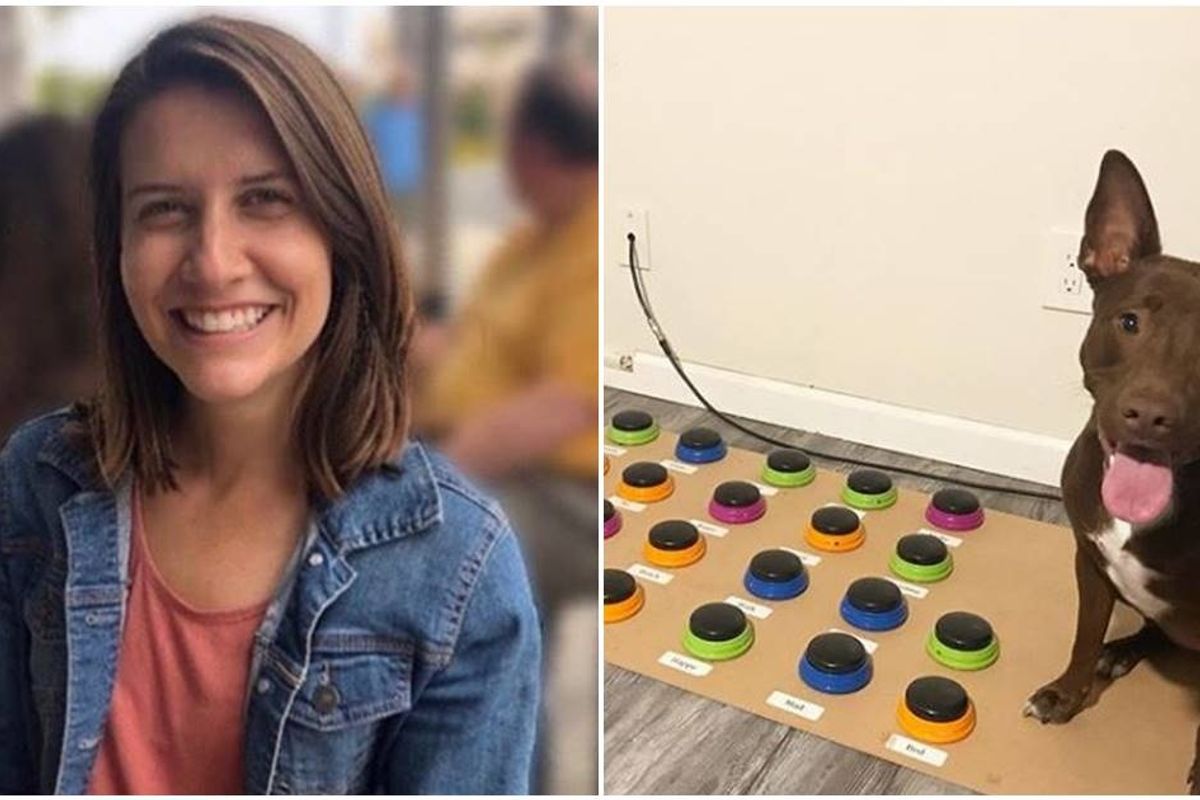
Christina hunger and her dog, Stella
Christina Hunger is a speech-language pathologist in San Diego, California who believes that "everyone deserves a voice."
Hunger works with one- and two-year-old children, many of which use adaptive devices to communicate. So, she wondered what would happen if she taught her then two-month-old puppy, a Catahoula/Blue Heeler named Stella, to do the same.
"If dogs can understand words we say to them, shouldn't they be able to say words to us? Can dogs use AAC to communicate with humans?" she wondered.
Hunger and her fiancé Jake started simply by creating a button that said "outside" and then pressed it every time they said the word or opened the door. After a few weeks, every time Hunger said "outside," Stella looked at the button.
Soon, Stella began to step on the button every time she wanted to go outside.
They soon added more buttons that say "eat," "water," "play," "walk," "no," "come," "help," "bye," and "love you."
"Every day I spent time using Stella's buttons to talk with her and teach her words just as I would in speech therapy sessions with children," she wrote on her blog.
"Instead of rewarding Stella with a treat for using a button, we responded to her communication by acknowledging her message and responding accordingly. Stella's voice and opinions matter just as our own do," she continued.
If Stella's water bowl is empty, she says "water." If she wants to play tug of war, she says, "play." She even began to tell friends "bye" if they put on their jackets by the door.
Stella soon learned to combine different words to make phrases.
One afternoon, shortly after daylight savings, she began saying "eat" at 3:00 pm. When Hunger didn't respond with food, she said, "love you no" and walked out of the room.
Stella has learned over 29 words and can combine up to five at a time to make a phrase or sentence.
"The way she uses words to communicate and the words she's combining is really similar to a 2-year-old child," Hunger says of her blog.
She believes her work has the potential to transform the bond between humans and dogs.
"I think how important dogs are to their humans," Hunger says. "I just imagine how much deeper the bond will be."
Stella asks to play ball outside.
Stella clearly wants some more breakfast.
After a fun day at the beach, Stella wants to go back.
Stella telling Hunger that she doesn't want her to leave to work.
Login • Instagram
Six years later, Stella has widened her vocabular even more. Keep up with Stella and Christina on their Instagram, and marvel at how much Stella has grown.
This article originally appeared six years ago.
- Amazing Sheepadoodle appears to talk to her owner using a soundboard - Upworthy ›
- A rescue pit bull is so convinced he's a cat he even climbs up on the fridge - Upworthy ›
- A viral TikTok video explains why interrupting others isn't always as rude as it might seem - Upworthy ›
- Couple buys new home and finds dog tied to a tree outside - Upworthy ›
- Doberman gets a spa day and the video is so sweet - Upworthy ›
- Australian Shepherd uses talk buttons to warn family - Upworthy ›
- Service dog flunks out of training school in spectacular fashion - Upworthy ›
- A dog saves a drowning puppy - Upworthy ›
- After no one showed up for a puppy's first birthday party strangers on the Internet stepped in - Upworthy ›
- Dog mom shares adorable video of the 'chores' her pitbull pup thinks she’s doing - Upworthy ›
- Australian Shepherd shows incredible smarts using 'talk buttons' to warn family of disaster - Upworthy ›



 a man sitting at a desk with his head on his arms Photo by
  Can a warm cup of tea help you sleep better? If you believe it, then yes. Photo by
 A happy Gen X couple have patience for younger generations, like Gen Z.
 A group of friends chatting wearing masks.via
 Some stray cats wander from home to home like a drifter.
  Stray cats should be spayed and neutered.
 A woman getting her nails painted.via
Curvy-and-proud newscaster takes the wildest viewer comments turns them into pure comedy gold