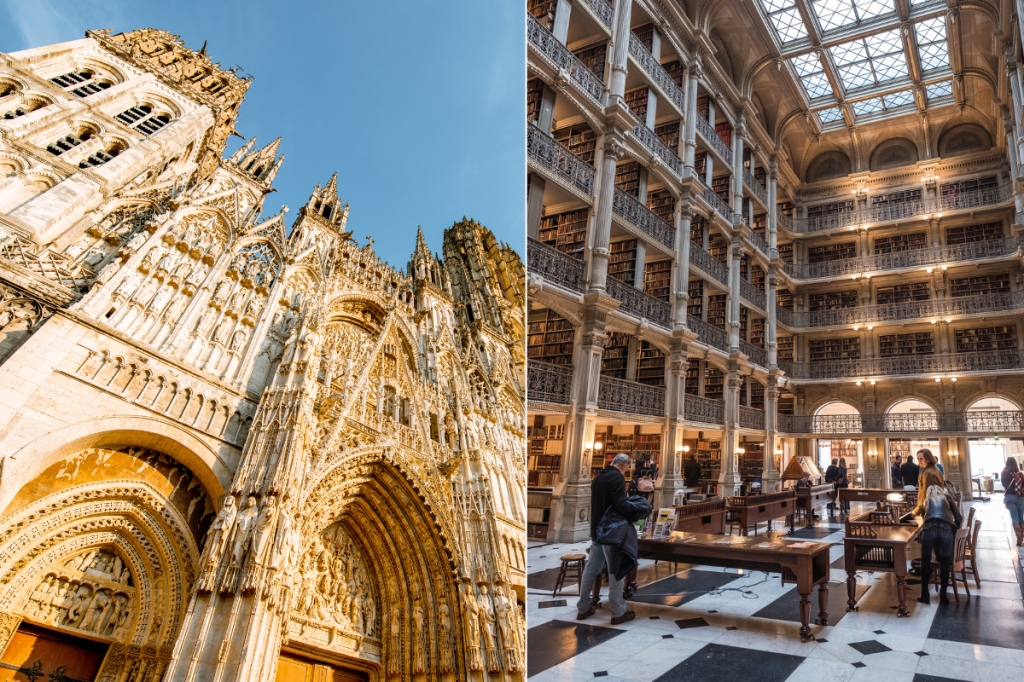
Our physical surroundings play a larger role in our behavior, emotions, and well-being than we might think. For example, if you ever feel like you’re stuck in a creative rut or having trouble with critical thinking, you might want to look up at the ceiling.
Research has discovered a correlation between ceiling height in a room and our ability to think creatively. It’s called the “Cathedral Effect.”
When you imagine a cathedral, of course, you envision a great open space with towering ceilings far above your head. It’s cavernous and spacious. In pictures, people standing in cathedrals appear incredibly tiny; almost insignificant. Therein lies the magic.

Architect and designer Patricia Fierro-Newton is an expert on “neuroarchitecture,” or how built environments impact the human brain. She writes, “In the 1960s, the American anthropologist Edward T. Hall explained what is known as the Cathedral Effect. The idea that a high ceiling evokes feelings of freedom and openness, fostering abstract thinking, creativity, and holistic problem-solving in individuals.”
Brain scans taken of people in high-ceiling environments show activation of brain areas associated with “abstract thinking and spatial processing,” along with “visuospatial exploration and mental imagery.” The brain is also triggered for more “abstract and integrative thinking processes.”
That’s a perfect recipe for creative work, brainstorming, big-picture thinking, and clarity.
Another study measured how the ceiling height of an art gallery impacted the emotions and perceptions of the art on participants. Higher-ceiling environments elevated certain feelings like joy (and, strangely, disgust), while lower ceilings were correlated with feelings like fear and anger.
The concept was discussed on a recent episode of Huberman Labs. Neuroscientist Andrew Huberman says of the Cathedral Effect, “There’s a way you can arrange your work environment, or should I say that you can place yourself into certain environments, that will allow abstract thinking, creative thinking, and indeed, expansive thinking to emerge.”
It’s not just elite artists and creatives who should be aware of this effect. Normal everyday interactions can be colored by our surroundings in a very similar way.
Psychiatrist Dr. Maya Reynolds of Choice Point Health tells Upworthy that she sees the impact of this effect in her daily practice.
“Speaking from personal experience, clients also feel more comfortable opening up in rooms with higher ceilings or natural light. The space feels welcoming and they are more willing to sit with tough emotions and look at things from different angles.”
You might consider the venue for your next heart-to-heart, date, or tough conversation. Could that interaction benefit from your brain feeling more open and fluid?
Inventor and author Martin Lucas, who specializes in behavior psychology and the science of decision, says “The brain is constantly reading the environment for cues about how to operate. … There’s also an attention effect. In more expansive spaces, people tend to mentally zoom out. You notice more. You connect more. That wider attentional state is exactly the kind of soil creativity grows in.”

Though not everyone has access to a cathedral, there are always ways of changing or tweaking our working and thinking environments.
“Go somewhere that feels mentally open. A public atrium, a gallery, a big quiet café, even outside under the sky. Give your brain the cue that it’s allowed to think bigger,” says Lucas. Specifically, according to Fierro-Newton, ceilings 10 feet or higher are ideal. But there may be a tipping point—working in an actual cathedral with way too much vertical space could lead to “feelings of being ungrounded or unfocused.”
But do smaller, cozier working spaces ever have their place? The experts say of course they do.
Huberman suggests lower-ceiling or more confined spaces are better suited for more detailed, analytical work. Editing, repetitive tasks, highly focused thinking. These areas of the brain are primed by a more enclosed space, which narrows your focus and the scope of your thinking.
“The real takeaway is simple and kind of beautiful,” Lucas says. “Your environment is not just background. It’s part of the conversation your brain is having with itself.”