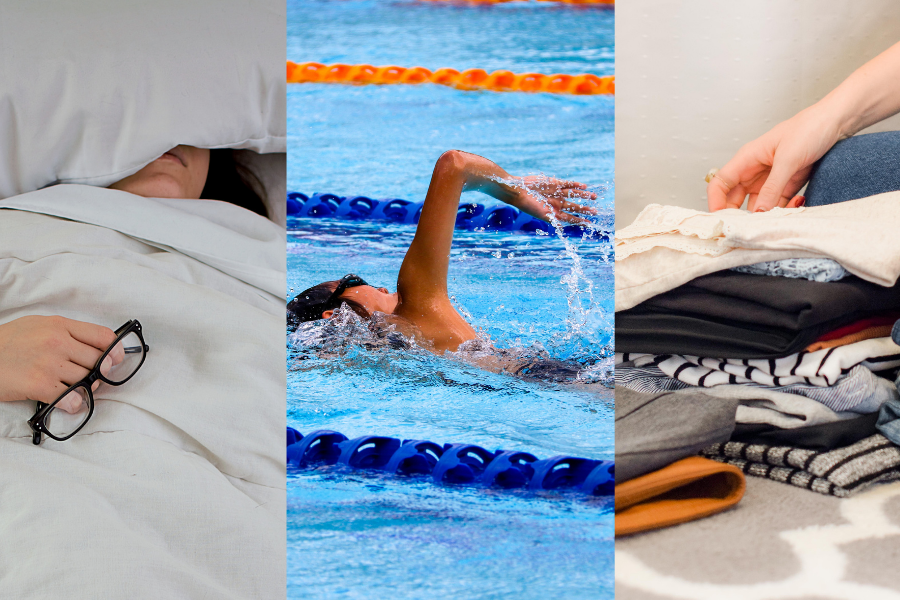
People shared the small changes they made that improved their lives in big ways

Real advice from real people.

daily habits, atomic habits, james clear, self improvement
Photo credit: Photo by Isabella and Zsa Fischer on Unsplash, Marcus Ng on Unsplash, Sarah Brown on Unsplash <a href="https://unsplash.com/@twinsfisch?utm_source=unsplash&utm_medium=referral&utm_content=creditCopyText">Isabella and Zsa Fischer</a> , <a href="https://unsplash.com/@marcusxsnapz?utm_source=unsplash&utm_medium=referral&utm_content=creditCopyText">Marcus Ng</a>, <a href="https://unsplash.com/@sweetpagesco?utm_source=unsplash&utm_medium=referral&utm_content=creditCopyText">Sarah Brown</a>

In his book Atomic Habits, James Clear notes that “your outcomes are a lagging measure of your habits … you get what you repeat.” Basically, if you want to predict where your life is leading, take a look at your daily choices. And Clear is certainly not the first or last motivational speaker to promote this wisdom. Pick up any self-help book, and it will most likely tout the message of how small, incremental changes can have an enormous impact on our lives.

A recent thread on AskReddit posed the question: What improved your quality of life so much you wished you did it sooner? For those of us who still can’t seem to tick off things like “drink more water” from the to-do list (despite knowing full well all the benefits) it might help hearing success stories from real, everyday people.

Here are some of the highlights:


Swimming for back pain

back pain, back pain remedies

“Drugs, bed rest for weeks, chiro, deep massage, electroshock. Then I swam some laps and over a three day period months of decrepitude vanished. I couldn’t believe and am now obsessed with swimming.” – DontShootTheFood

“Most people who have back pain (especially lower back pain) have it as a result of sedentary lifestyle (exacerbated by sitting in office chairs for a long period of time). Swimming is a fantastic total body and core workout which just builds and balances strength to reduce back pain. If you have pain due to an injury, it may not be as effective.” – hanksredditname

Managing road rage
road rage, driving habits

“Someone wants to pass me when I’m in the left lane? Move over and let them pass. Someone wants in my lane? That’s ok, I don’t consider the gap ahead of me to be my real estate. Semi puts on their blinkers when I’m intending to pass? Let off the speed and flick my high beams to let them know there’s enough room to enter my lane. All of this helps traffic flow better, makes things safer, and actually feels good to do. And all it required was to stop feeling like all of those things were a personal attack on me and my desire to get to my destination.” – Buddahrific

Setting boundaries … even with family
setting boundaries, healthy lifestyle

“I used to feel like I had to hang out with people when they asked, and as an introvert would resent losing my ‘me’ time. Now I’m just honest with people and say I’m tired, or that I had a long weekend of Great British Bakeoff and dog snuggles that I was really looking forward to. Might sound lame but I’m 150% happier.” – Acceptable-Place0872“…I’m in my late twenties and talk to neither of my parents. I forgive them for what they did, but I don’t want a relationship of any kind with them and have made that very clear. I just stopped picking up the phone, texting back, messaging back at all. My brother still talks to one, but he suffers for it. I know I made the right decision.” – thekindwillinherit

Exercising for more than just your body
exercise, exercise and mental health, mental health

“I wish more people knew exactly how helpful exercise really is for both mental and physical health! Throughout high school I was seeing psychologists for anxiety and other issues and they repeatedly told me to eat healthy and exercise to improve my mental state. It’s pretty easy when you are in a bad place to dismiss that and say ‘a chemical imbalance in my brain isn’t going to fix itself if I go for a run’ so I never followed their advice. When I was around 20 I got a gym membership and actually started exercising for unrelated reasons and WOW does it help a lot! If you have mental health issues, a healthy lifestyle might not totally fix you but it will DEFINITELY help.” – vindaflyfox

Breaking free from phone addiction
social media, phone addiction

“Disable your push notifications in tandem with uninstalling all social media apps. It’s quite fascinating how much better you feel when social media isn’t installed. Bye bye FB/Meta, Insta, Twitter, all of it gone. Talk about liberating. Took me about a month of “training”, but now I hardly ever look at my phone, and I no longer feel phantom vibrations while it’s in my pocket. It’s disgusting how we’ve become slaves to our devices.” – dj92wa

Improving sleep
sleep, sleep and health, improving sleep

“I’ve been using my CPAP for a few weeks now and I actually know what it’s like to have energy and motivation and not be a zombie by 2 pm. If anyone else feels like that, I heavily recommend talking to your doctor about having a sleep study done.” – whomikehidden

“Sunrise Alarm Clock. I wake up so much better during the dark winter months.” – herbstavore

Decluttering
cleaning, cleaning tips, decluttering

“…A consistently clean home is amazing and doesn’t take a ton of time. 10-15 minutes a day I can keep things fairly tidy.” – unwinagainstable“Nothing feels so relaxing when everything is in its place, organized and uncluttered. This obviously goes for at home, but also a clean car, clean desk, clean and organized computer and filing. Taking notes and reminders and deleting them when the task is done really relieves the mind. You can relax and focus better when your brain isn’t cluttered and overwhelmed.” – KanataCitizen

Walking for an hour
walking, walking benefits

“This literally saved my life. A lot of people think just going out for a walk has minimal benefits, but it has both great physical and mental ones. Highly underrated (and free).” – grittypitty

Journaling affirmations
journaling, affirmations, affirmation journal

“…it helps remind me of my values, which helps me make better decisions each day, and having done it for three years now, I can see the progress I’ve made in learning not to sweat the small stuff. It’s encouraging. I’m figuring myself out.” – babblewocky

Dropping sarcasm
better attitudes, self improvement, mindset

“I thought this gave me sharp, dry wit but really it was one step up from a teenager’s whiney voice making fun of people. It really was a low form of humor and, indeed, the perfect analog to the pseudo-intellectualism of the cynical act. It’s so easy to be sarcastic and nasty and it gets old REALLY fast.” – zazzlekdazzle

Opting for positive content

positivity, postive content

“I stopped consuming true crime content this past summer. It overall made me a more fearful, less empathetic, and more judgemental person by nature. The content encouraged my negative thought spirals and called it awareness. Never going back.” – notwest94

Practicing gratitude
gratitude

“It is small but it genuinely makes a big impact. I had an assignment for a university course last year where we had to spend one week noting down something positive/good each day and then the next week negative things and I hadn’t realized just how much my life has improved until the week where I focused on negative things, it really solidified how much of a difference it made on my mood, how I felt about myself, and even how much I accomplished.” – supersaurus65
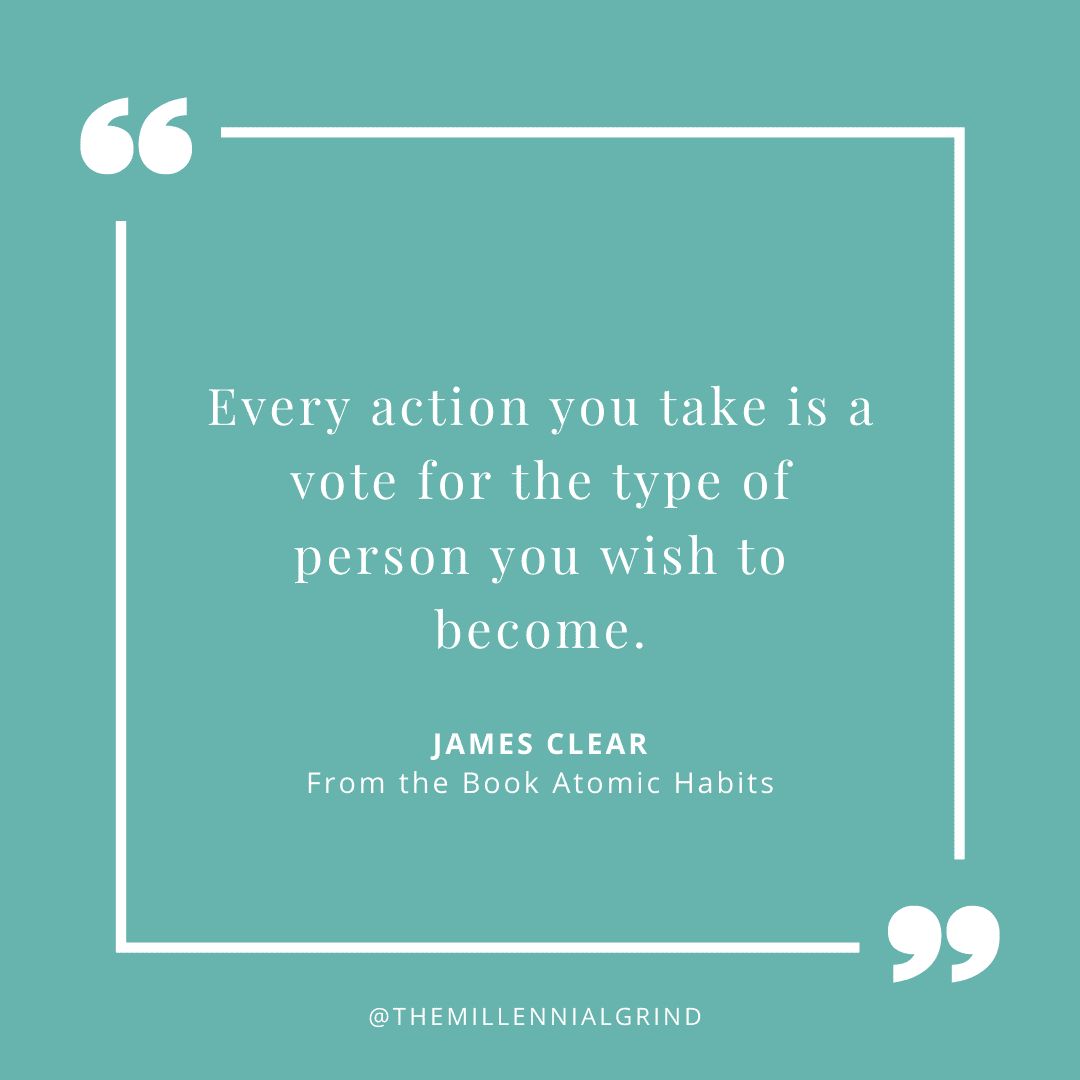
There were some other great contenders: daily dancing, seeing a therapist, stretching before bed and at waking … just to name a few. But no matter the habit, they planted seeds for not only a new life, but for a new identity. As Clear would put it, “every action you take is a vote for the type of person you wish to become.”

Let authors like Clear help guide you—and stories like the ones above help inspire you—as you forge a better path for yourself, one small step at a time.


This article originally appeared on 12.8.21

  • Anne Hathaway shares the ‘unintended consequence’ of her iconic ‘Princess Diaries’ makeover
    Photo credit: RedditAnne Hathaway in The Princess Diaries.
    ,

    Anne Hathaway shares the ‘unintended consequence’ of her iconic ‘Princess Diaries’ makeover

    One of the film’s most memorable moments came with a “terrible side effect.”

    It’s a trope as old as time: the charming, yet conventionally unattractive girl gets a makeover, and suddenly her looks match her winning personality, opening an entire world of possibilities…and love interests. 

    And how do we know she’s conventionally unattractive? Glasses (because attractive people don’t read and can see perfectly, duh) and unkempt curly hair. 

    In pop culture, almost nothing instantly clocks a woman as less desirable or polished. At best, they can be the carefree bohemian or funny best friend. But you can bet you bottom dollar that if they are to be seen as a romantic love interest in any way, shape, or form, that hair is gonna be flat-ironed within an inch of its life. It’s screenwriting 101, people. 

    An era-defining transformation

    One lasting example of this is the makeover scene in The Princess Diaries, wherein Mia Thermopolis (played by Anne Hathaway) goes from adorkable to refined thanks to a bit of hair straightening, plus some makeup, contacts, and intense eyebrow tweezing. 

    In a recent interview with People, Hathaway shared that the filmmaker never actually intended to promote the “curly = ugly” stereotype. It was actually just a logistical strategy. 

    “My natural hair is rather straight, so we had to create a contrast,” she shared, adding that going with her naturally straight hair meant “less time in the makeup trailer” overall. 

    …with “unintended consequences”

    As a result, however, the message many audiences read was “curly hair is unattractive,” which Hathaway labeled as a “terrible, completely unintended side effect.”

    If the comments section was any indicator, Hathaway was correct in saying the “unintended consequence” of that scene was the profound effect it left with viewers. 

    “I (a curly haired girly) started straightening my hair after I saw the scene at 12.”

    “Yeah, watching this movie when it came out as someone who had curly hair and glasses did something to me lol.”

    “I had curly hair and glasses when this movie came out and was bullied for both. I was in middle school and to this day I can’t watch this movie because it made me feel like the bullies were right. As an adult I know better but the gut feelings are still there.”

    Granted, the creative decision might have been made in part for practical reasons, but let’s not forget that this movie came out in the early 2000s…a fairly rigid time period for beauty standards overall. The Princess Diaries was far from the only movie to portray curls (or glasses, or freckles, or anything past a size 2) as “ugly.” For all its good parts, the film was definitely a product of its time. 

    Straightening out the curl narrative

    Thankfully, we’ve seen a lot of progress in this department. Not only do we see far more characters in media sporting their curls, but, thanks to social media, there’s a much larger wealth of knowledge for how to style and take care of curly hair.

    Truly, there’s an entire language (I’m 2C to 3B type myself…iykyk) dedicated to curls now that simply did not exist at an earlier time. Not knowing that curls require an entirely different routine left many of us to resort to straightening or making peace with feeling like the ”ugly” one. 

    Even still, curls that aren’t styled and left in their Mia Thermopolis state are still often viewed by society as unprofessional, undesirable, or unclean in some way. That’s why representation matters. It’s so important to have our pop culture reflect a different reality so that we might start internalizing a different story and unlearning harmful stigma.

    All this to say…Princess Diaries 3 should definitely let Mia’s curls go free. Just sayin’. 

  • Disney re-animates 3 iconic songs to include ASL, and the Deaf community calls it ‘incredible’
    Photo credit: The Walt Disney Company and Walt Disney Animation Studios/YoutubeMoana 2, Frozen 2, and Encanto

    On April 27, in celebration of National Deaf History Month, Disney unveiled three beloved songs completely reanimated to feature the characters performing in American Sign Language (ASL).

    The idea for the project, titled Songs in Sign Language, came from Senior Animator and Director Hyrum Osmond, whose Disney credits include Frozen (2013) and Zooptopia (2016). 

    In a special “making of video,” Osmond recalled growing up with a father who was “hard of hearing,” but never learning sign language to communicate with him. 

    “I have a lot of regret about that, because I couldn’t connect with him. I wanted to take down barriers with this project. It’s really all about connection.”

    A groundbreaking effort rooted in authenticity

    In a never-before-done undertaking for the studio, a team of more than 20 animators, many of them passionate volunteers, collaborated with the Tony Award-winning company Deaf West Theatre to curate signs that best matched each character’s specific personality. 

    This didn’t only involve hand movements, but “facial grammar” as well, meaning specific ways the face is used in ASL to further convey linguistic information. Raised eyebrows, for example, are used at the end of a sentence when asking simple questions. Furrowed eyebrows, on the other hand, are used when asking more complex “Who, What, Where, Why” type questions.

    These efforts—done without AI, praise be—resulted in new animation for approximately 95% of the shots from “The Next Right Thing” (Frozen 2), “We Don’t Talk About Bruno” (Encanto), and “Beyond” (Moana 2). 

    This is far from Disney’s first attempt at making its magic available in ASL. There have been many heartwarming stories of characters in the park using sign language to connect with guests. But, save that one episode of the Little Mermaid series in the ’90s (iykyk), this is something completely new. 

    “We’ve never done anything like this at Disney Animation before,” shared Osmund. 

    People are already speaking out in praise of Songs in Sign Language, and hoping it leads to more. 

    “As someone who is partially deaf in one ear, I fully support this and think it’s very important and heartwarming that they’re doing this.”

    “I would love to see more Encanto, Frozen II and Moana 2 songs in ASL! I am currently learning ASL and I’m a senior in high school, my ASL teacher who is hearing and is learning ASL like me and my classmates are would love this!”

    Many of the compliments weren’t even about inclusivity. People also shared relief to see “creativity breaking through again,” as one viewer put it. 

    “Disney if you get back into funding cool, artistic and niche things like this that people want you’ll win people back over !!!!!!! What was special was always the details and that’s been lost the last 6 years or so. This is amazing,” commented one viewer. 

    DJ Kurs, artistic director for Deaf West Theatre, also hopes the collaboration will lead to more. 

    “Disney stories are the universal language of childhood. The chance to bring our language into that world was a historic opportunity to reach a global audience. Working on this project was very emotional. For so long, we have known and loved the artistic medium of Disney Animation. Here, the art form was adapting to us. I hope this unlocks possibilities in the minds and hearts of Deaf children, and that this all leads to more down the road.”

    Where to watch

    Songs in Sign Language is currently only available to stream on Disney+, but we know it’s only a matter of time before the Internet does its thing. 

  • At 6:30 a.m., Japanese radio plays ten minutes of ‘Radio Taiso’ and it’s getting people moving
    Photo credit: CanvaTwo people exercise in a park.
    ,

    At 6:30 a.m., Japanese radio plays ten minutes of ‘Radio Taiso’ and it’s getting people moving

    “Radio Taiso was inspired a century ago by a similar radio program in the United States.”

    It’s early morning and you’re snuggled tightly under the warm covers. Your alarm buzz isn’t quite enough to entice you to get up and en route to begin your day. But what if there was a public radio announcement with a trusty reminder that it’s good for the body, if possible, to get up and move? Well, in Japan, there is.

    The Associated Press posted a clip on YouTube of people lightly stretching in various locations across Japan. They explain that this is a common practice. “This is how Japan wakes up,” a voiceover shares. “It’s called Radio Taiso. In English, it’s radio exercise. It’s a very simple idea. At 6:30 in the morning, on the radio, you get music. You get choreography to exercise by. People gather in city parks to do it. People gather in their offices. At schools. You can do it at home.”

    Good for all ages

    The exercise regimen is nothing too heavy. “The exercises are not very strenuous—just exercise and basic calisthenics,” they explain. “It’s suitable for all ages and everybody can do it. You can exert yourself a lot if you want, but you don’t have to.”

    The host of the segment points out that Japan has a “long-lived population.” He shares, “As we all know, Japan is famous for longevity. I wouldn’t say that Radio Taiso is why, but it certainly can’t hurt anything.”

    According to the BBC, Japan continues to break records for long, healthy lives: “The number of people in Japan aged 100 or older has risen to a record high of nearly 100,000, its government has announced. Setting a new record for the 55th year in a row, the number of centenarians in Japan was 99,763 as of September.”

    100-year history

    In a recent article, Yahoo!life explains that this tradition has been around for nearly a century. “Radio Taiso has an almost 100-year history,” write article author Stephen Wade, “formally introduced in 1928 and coinciding with the enthronement of Emperor Hirohito. The tradition endures because the exercises are suitable for all ages and capabilities, and easily accessible.”

    Even more interestingly, Wade shares the roots of the exercise, writing, “Radio Taiso was inspired a century ago by a similar radio program in the United States sponsored by the Metropolitan Life Insurance Co. The Japan Radio Taiso Federation says officials of the postal ministry visited the United States in the 1920s and returned to Japan with the concept.”

    The Japan Society explains that these routines, of course, are helpful for all ages. On their website they write, “Fun for children and adults alike, Radio Taiso is commonly used for group warm-ups in Japan and the whole school will participate in the exercises at the beginning of school Sports Day.”

    They add that it gained popularity because of the positive mental and physical effects it seemed to have on citizens. “The purpose of Radio Taiso is to improve general health and fitness,” they write, “and the routine is therefore designed to be simple and accessible to all. It requires no equipment, can be done in a small space, and can be modified for those with mobility issues.”

    Simple movements

    The movements, as mentioned, are simple. Similarly to yoga, it begins with arm exercises. Participants lift their arms up and move them in gentle circles. Then, they slightly bend and twist their legs.

    This continues for about ten-second intervals, adding bends in each direction, like a ballet routine. Then, there’s more twists, shoulder movements, slight hopping, and squats. Wade shares, “Each movement is repeated four to eight times, with instructions throughout to relax, breathe, and inhale and exhale slowly.”

    Kodomokai

    I reached out to an old high school friend, Nathan Hillyer, who has been living in Japan for quite some time. He confirmed that while it still exists, it’s mostly practiced by and beneficial to the elderly. “In the park near where I live, old people tend to go there to do it. It is run by NHK Radio 1 at 6:30 in the morning,” he shares.

    He adds that his wife, Asuka Hillyer, shared that she would wake up early to do it back in the day. “My wife said when she was a kid, she would do it as a part of the ‘kodomokai’ (community kids club). They would get a stamp or something every morning, and if they had a certain number by the end of the year, they would get a prize. They would show up wearing their community paper kind of tied around their neck.”

    Hillyer also recalled that the radio exercises began in the West. “I remember watching old American comedies in black and white, maybe W.C. Fields or something like that. They were in funny situations in which someone is trying to do their radio exercises and hearing the voice, but either they can’t keep up or something happens in the real space which is not matching the radio routine.”

    He adds, “In Japan, it is quite the phenomenon because the Japanese tend to be very community-oriented.”

  • Fake towns on real maps: Why ‘phantom settlements’ exist and how one became real…sort of
    Photo credit: CanvaWhat do you do when you see a town name on a map but it doesn't actually exist?
    ,

    Fake towns on real maps: Why ‘phantom settlements’ exist and how one became real…sort of

    Algoe, New York, was a fake town at the heart of a legal dispute between two mapmakers.

    When you look at a state map, you see cities and towns of various sizes and populations. Even the tiniest towns with a handful of people—or even just one resident—have a place on the map.

    One might assume, then, that every named town on every published map is a real place. But as it turns out, there have been imaginary towns on maps, from centuries ago up until the relatively recent past. And they were published that way on purpose.

    The map trap was a clever way to prevent plagiarism

    They’re called “phantom settlements” or “paper towns” and are part of a phenomenon known as map traps. Basically, map traps are place names conjured out of thin air and put on a map to protect a mapmaker’s copyright.

    It may seem strange for a professional mapmaker to make a map wrong on purpose, but it’s actually rather brilliant. Historically, cartography has been an incredibly important profession. Before the Internet and global positioning systems, paper maps were how people oriented themselves and found their way from place to place. Creating an accurate map was a vital and valuable skill.

    If a cartographer created and published a map, they wouldn’t want people to plagiarize it. Inventing phantom settlements—pretend places with fake names that only exist on a map—was a way for cartographers to essentially “watermark” their original maps. If someone else made a map that included the fake town (or street or other detail), it would be clear whose map they had plagiarized.

    Two women looking at a map. Photo credit: Canva

    The confusing nonexistence of Algoe, New York

    One of these phantom settlement map traps was (or wasn’t?) Algoe, New York. If you’ve read John Green’s novel Paper Towns, you’re probably familiar with it. It’s not a real town. It never existed.

    Algoe was the brainchild of Otto Lindberg and Ernest Alpers from General Drafting Company. In the 1930s, they were commissioned to create a map of New York and dropped the fictional Algoe at a dirt road intersection in the Catskill Mountains.

    Some years later, Rand McNally published a map that included Algoe. The trap worked. Or did it? When General Drafting threatened to sue the mapmaking giant, Rand McNally told them they would lose.

    general store, geography, maps, mapmaking
    Who knew a general store could be enough to prove a place existed? Photo credit: Canva

    In an ironic twist of events, an “Algoe General Store” had been built at the intersection where Algoe was located (but didn’t really exist) on the map. The store owner had seen Algoe on the map and named his general store accordingly. Rand McNally claimed it had obtained the coordinates for Algoe from county records. And those records showed the Algoe General Store located at that place on the map, hence Algoe showing up on their map.

    Do map traps still exist in the age of online maps?

    Though there wasn’t a real town there and the shop didn’t last long, the general store’s name was enough to prove that a place called Algoe did exist. In fact, it was apparently included on Google Maps up until 2014, even though it was never actually a real place.

    Today, if you type “Algoe, New York” into a Google Maps search, it comes back with a “no results” message. The same goes for “goblu” and “beatosu,” two fictional places in Michigan that were included in the official map of Michigan in 1978. (Variations of “Go Blue” and “Beat OSU” were a shout-out to the rivalry between the University of Michigan and Ohio State University by Peter Fletcher, the former chairman of the Michigan State Highway Commission. The map was also reprinted after some complaints.)

    It’s hard to know how many phantom settlements in countries around the world have snuck into our modern navigation systems, but by now, it’s safe to guess they’ve mostly, if not entirely, been weeded out.

    But hey, if you want to invent your own town, maybe start by building a general store with your proposed town’s name on it. It seems to be the way to go.

  • Texas dad and son have first encounter with a trans woman, and dad sets a powerful example
    Sometimes allyship is simple

    Now more than ever, the transgender community needs support. In Texas, the legislative environment for transgender people has only grown more hostile. In 2025, Texas enacted Senate Bill 8, known as the bathroom bill, banning transgender people from using facilities that match their gender identity in public buildings, schools and universities. A separate bill was also filed that would charge transgender people with gender identity fraud, making it a felony to identify as trans on official documents. Combined with earlier laws restricting gender-affirming care for minors and new definitions of sex in state law, the cumulative effect has been devastating for the transgender community in the state.

    Still, even if your heart is in the right place, it can be hard to know the best or most feasible way to even show up as an ally. And that’s the beauty of this story. Sometimes it really is a simple matter to accept people as they are and treat all humans with dignity, kindness and respect, even if we don’t fully understand them.

    A small moment with a big lesson

    A dad shared his first encounter with a transgender woman in his small Texas town, and the simple lesson he taught his son inspired hope in others. James Eric Barlow shared a video on TikTok describing how he and his son just saw a trans woman in real life for the first time.

    “We all know that there’s people that are disgusted whenever they see a trans person,” Barlow began. “And we all know of the people who don’t care if they see a trans person. “But apparently, we’re a third type of person (or at least I am, I can’t speak for him),” he says, indicating his son in the backseat who chimes in with “I am, too!”

    Barlow went on to explain how they had just had their first experience with a trans woman. It wasn’t anything major. She just walked through a door behind them and Barlow held the door for her, just as he would any other person. He didn’t even notice she was trans at first, but once he did, his immediate reaction was one we can all learn from.

    “When I tell you how happy it made me,” he said, beginning to tear up, “to be able to see somebody be out and open to the world here in small town Texas. You just gotta know how much bravery that takes. Right, Mikey?”

    “Hell yeah!” the son agreed.

    Barlow wanted to say something to her, but he didn’t want to make her feel uncomfortable, either.

    “But if you’re a trans woman and you came here to the Landmark truck stop in Clyde, Texas, just know we’re proud of you,” he concluded.

    The internet was moved by his reaction

    Barlow’s video was shared on Reddit, where it’s received a slew of views and comments that prove parents set the tone for their kids’ sense of acceptance.

    “Indoctrinate your children with kindness, compassion, consideration and respect for others.” – Toddthmpsn

    “When I was younger I would get my hair cut by a woman named Liz. She spoke Spanish so it was hard for to understand her English sometimes. My dad spoke Spanish so would translate for her and me. I noticed Liz looked a little different then other women. But I never said anything, I never felt any differently about her. She never scared me, or made me question anything. She was just Liz. As I got older I realized she was a trans woman. And it literally changed nothing. She was still just Liz. Liz was always kind and treated everyone warmly. I havnt seen her in years but I hope she is doing well. I really liked her.” – PerplexedPoppy

    “This literally happened to me as a child in the 80s. A cashier at a store we visited suddenly started dressing in a feminine style and it appeared that they were transitioning. My mom explained to me in an age appropriate way that sometimes people decide they want to be a man instead of a woman, or a woman instead of a man. She told me that people would probably be mean to the cashier and it was important for us to remember that and always be polite to her, as we would anyway. This was way before trans issues were as mainstream as they are now, but my mom had seen an episode of Phil Donahue where trans woman discussed their stories, and she recognized it as a medical issue. Core memory for me.” ZipCity262

    “As a trans woman, im deathly afraid whenever I have to go to rural areas. I can instantly feel physical tension when I walk into a gas station or a restaurant in these areas. Thank you for being supportive. Trans people need you now more than ever.” – rainbow_lenses

    This is what allyship actually looks like

    As this dad and son showed, it’s a simple matter to demonstrate non-judgmental acceptance in front of our kids so they hopefully will grow up without being bound by chains of bigotry they’ll later have to learn to unload.

    This article originally appeared three years ago. It has been updated.

  • The one reason Americans can’t build quaint, walk-up apartments like they have in Europe
    Photo credit: via About Here/YouTubeWhy North America can't build European-style apartments.
    ,

    The one reason Americans can’t build quaint, walk-up apartments like they have in Europe

    The stairs themselves are the problem in North America, though that’s starting to change.

    One of the most beautiful features of old European neighborhoods are the rows of quaint, walk-up apartments that are the backbone of walkable neighborhoods. They help create a community where people can exit their front door and walk to a local café or market without getting in their car. Unfortunately, these neighborhoods are hard to find in the United States, where these types of apartment buildings are exceedingly rare.

    Uytae Lee is the founder of About Here, an adjunct journalism professor at UBC, and a BC Housing Board commissioner. As an urban planner and videographer, he is passionate about sharing stories about our cities.

    In the video below, he explains why regulations in North America have made these quaint walk-up apartments, known by architects as point access blocks, nearly impossible to build.

    It all comes down to staircases

    “Quaint walk-up apartments … are a beloved feature in cities around the world,” Lee says in his video entitled “Why North Americans Can’t Have Nice Apartments.” “They’re inviting and full of character. But, here in North America, they are not allowed to be built today. Instead, our apartments are big and imposing, often stretching across the entire block and the reason why it really comes down to one reason: staircases.”

    The problem is that one stairway in a point access block allows access to all apartments. This became a problem in the late 1800s when fires were commonplace in urban areas worldwide and people were more likely to die in a fire with only one exit route. So, in the U.S. and Canada, they created new regulations that made it so all buildings over two to three stories had to have two staircases to allow them to exit during a fire.

    “Staircases take up a lot of space and fitting two of them in a small building means that there is much less usable floor space on every floor,” Lee says in the video. “As a result, developers here construct much larger buildings so that the staircases and hallways take up a much smaller proportion of the overall building. It’s why apartments in North America, in general, are much bigger and wider than their European counterparts.”

    So why didn’t Europe make the same call?

    But there are fires in Europe, too. Why did they stop short of requiring multiple staircases in apartment buildings on the other side of the Atlantic Ocean? Instead of changing the floorplans on new buildings, Europeans opted to require fireproof materials in new building construction. A big reason why the U.S. and Canada opted for larger buildings over fireproofing was because they had better access to materials and the new direction aligned with the move towards suburban sprawl.

    The two-staircase regulations in the U.S also made it harder to build units greater than one bedroom because the buildings needed long hallways which reduced the number of layout options.

    Now cities are rethinking the rules

    The current housing crisis has many rethinking the regulations that require apartment buildings to have two stairways in North America. Many urban planners believe that modern-day demands mean we should return to building more point access block buildings, but this time with modern fire-retardant materials.

    Cities like Seattle, Washington, were early adopters, but the movement has since gone national. As of 2025, seven states have passed bipartisan legislation allowing single-stairway apartment buildings, including Colorado, Montana, New Hampshire, and Texas, with 19 states and Washington D.C. having introduced bills since 2022.

    “Now, if all this makes you a bit nervous, I get it. After all, these codes are about our safety. But I do want to mention that these codes do change over time as our technology and our understanding of safety evolves,” Lee finishes the video. “It’s important that we discuss and update these rules as our world changes.”

    Pew Charitable Trust reports that small, single-stairway apartments actually have a strong safety record, sharing that those kinds of buildings as tall as six stories are “at least as safe as other types of housing.” As we gather data and learn more, we should be able to adjust our regulations. So maybe, hopefully, there are more quaint apartment buildings in our future.

    This article originally appeared three years ago. It has been updated.

  • Woman who lives on a cruise ship shares the hardest part about her otherwise dream life
    Christine Kesteloo has one big problem living on a cruise ship.
    ,

    Woman who lives on a cruise ship shares the hardest part about her otherwise dream life

    “I could have anything I wanted, and I want it, I absolutely want it.”

    A lot of folks would love to trade lives with Christine Kesteloo. Her husband is the Staff Chief Engineer on a cruise ship, so she gets to live on the boat pretty much for free as the “wife on board.” For Christine, life is a lot like living on a permanent vacation.

    “I live on a cruise ship for half the year with my husband, and it’s often as glamorous as it sounds,” she told Insider. “After all, I don’t cook, clean, make my bed, do laundry or pay for food.“

    The one thing that makes it hard

    Living an all-inclusive lifestyle seems like paradise, but it has some drawbacks. Having access to all-you-can-eat food all day long can really have an effect on one’s waistline. Kesteloo admits that living on a cruise ship takes a lot of self-discipline because the temptation is always right under her nose.

    @dutchworld_americangirl

    The hardest part about living on a cruise ship is that I am surrounded by free food all of the time anything I want I just had lunch but it’s 2 o’clock in my body tells me it’s either cookie time or time for a hamburger. The hardest part is telling myself not to eat. #hardestpart #cruiseship #livingatsea #koningsdam #weliveonacruiseship #cruisefoodie #foodtok #itsaproblem #halcruises #hollandamericaline

    ♬ Pieces (Solo Piano Version) – Danilo Stankovic

    “One of the hardest things about living on a cruise ship is that I know right now, if I just leave my cabin, I can go and have cookies, pizza, a shake, I could have anything I wanted, and I want it, I absolutely want it,” she said in a TikTok video that received over 400,000 views.

    “I am laying here. It is 2 pm. I had a salad for lunch, I had some fresh fruit, but that didn’t fill me up,” she continued. “Right now, all I can think about is eating a burger with some French fries and some mayonnaise.”

    “And that, folks, is the absolute hardest part about living on a cruise ship,” she said. “I am surrounded by food all the time.”

    She added, “The hardest part is telling myself not to eat.”

    She is not alone in this struggle

    Kesteloo’s trouble is a common problem among people on cruise ships. A study by Admiral Travel Insurance found that over 60% of people who go on a week-long cruise anticipate gaining weight. Seventeen percent of people say they gain 2 to 3 pounds on a cruise, while 14% say they gain 4 to 5 pounds.

    Other estimates show that the average cruiser will put on 5 to 10 pounds on a weeklong cruise. Imagine living on a cruise ship for half the year, like Kesteloo. She could quickly put on 100 pounds a year if she’s not careful.

    “I’d be huge if I lived there. I would feel like I’m on a constant vacation, and who diets on vacation?” Theresa Gramelsapcker-Wilson wrote in the comments.

    “This is my main reason why I couldn’t do this HHAHAHAHAHAA,” Cara Mia added.

    “I never thought about those who actually live on a cruise ship. I would be 500 pounds,” Lucky Penny2468 said.

    cruise ships, dieting, all you can eat, living on a cruise ship, tiktok
    A woman eats and drinks while enjoying the view on a cruise ship. Photo credit: Canva

    Kesteloo’s battle with temptation shows that in every life, a little rain must fall. Nobody ever truly has it perfect. Kesteloo seems to be living the perfect life on board a cruise ship, but she still has to fight temptation every moment of the day or make good use of the ship’s gym facilities. But, obviously, having access to too much food is far better than having too little.

    This article originally appeared four years ago. It has been updated.

  • A teacher asked 7th graders what 40-year-olds do for fun and their answers are merciless
    Photo credit: Canva Photos7th grade students guessed what hobbies 40-year-olds have and the answers are hilarious.
    ,

    A teacher asked 7th graders what 40-year-olds do for fun and their answers are merciless

    Elder millennials are feeling attacked, but the kids aren’t exactly wrong.

    Like it or not, kids will tell you what they really think. Their naive honesty is refreshing, hilarious, and at times, a little bit rough on the self-esteem of the adults around them. Regardless, they don’t shy away from telling it like it is, or at least how they see it.

    That’s why 7th grade teacher Shane Frakes loves to frequently poll his students for their opinions on, well, almost anything.

    Going by @7thgradechronicles on TikTok, Frakes regularly goes viral for his hilarious content and observations about his Gen Alpha students. But more than just building a platform and side hustle for his own gain, Frakes makes great use of his social media savvy to keep his kids energized and engaged in the daily lessons.

    In a recent video, he asked his students to weigh in on this question: “What do you think people in their 40s do for fun?!”

    The responses are not for the faint of heart. Here’s the list the kids came up with:

    • Play Wordle
    • Watch TV in black and white
    • Go gamble!
    • Spoiling all [their] grandchildren or nieces and nephews
    • Play Pickleball! A sport that doesn’t move as much
    • Count coupons
    • Go on Facebook
    • Go and buy home decor
    • Grill food on Sundays
    • Saying No to everything I ask for
    • Bingo
    • Take their medicine
    • Knitting
    • Play golf
    • Sitting in a chair on the patio yelling, “Get off my lawn!”

    The internet could not handle the accuracy

    Commenters in their 40s wanted to be offended, but had to admit that the kids had them pegged.

    “Home goods is accurate,” one wrote.

    “I needed this laugh right before bed and I see no wrong answers,” a commenter said.

    “40 and I scored fairly high on this,” said another.

    “The accuracy. I feel attacked,” added another user.

    “These are more accurate than I would’ve guessed,” another summed up perfectly.

    Millennials have been called the Peter Pan generation because of their apparent delays in “growing up.”

    They look younger, seem younger, and even feel younger than a lot of their predecessors. It’s a well-documented phenomenon, in fact. Part of it has to do with cultural and societal factors that have delayed major life milestones. Millennials came of age in a time where earning high-pay in their careers, getting married, and buying a house were more difficult than they ever were for their parents. Many people in the “Peter Pan generation” are just beginning to really get on their feet in their 30s.

    Millennials also hold a deep fear of aging, more so than Gen X does. That may drive them to cling to styles, cultural references, and other preferences from their younger days. But it’s not weird, no. This blurring of the lines that define what a generation is has actually been pretty seamless.

    “A millennial parent can post a TikTok dance with their kids, binge Stranger Things, or geek out over a Marvel premiere without feeling like they’re stepping out of their lane,” says Stacy Jones, a pop culture expert and founder and CEO of Hollywood Branded. “Earlier generations were pigeonholed into what their generation was supposed to be. Millennials are defining that instead. That cross-generational cultural participation blurs what ‘age’ looks and feels like. And it doesn’t stop there. Today’s 50-year-old doesn’t look or act like the 50-year-old of yesterday. Wellness, skincare, acceptance of Botox, fitness, and social media have redefined what ‘middle age’ even means, pushing the whole curve of youthfulness upward.”

    Jones definitely has a point about how people look; there must be something in the water. This is what a 40 year old looked like just a few decades ago. No offense to the great Kelsey Grammer, but by today’s standard, the style and hair would have most people peg him to be in his (late) 50s.

    All the more reason that Mr. Frakes’ students’ list is absolutely hysterical. If there’s anyone bound to be playfully offended by being prematurely aged, it’s us millennials. But the fact of the matter is, whether we like it or not, we are getting older and settling down. Many of us truly do enjoy shopping for home decor and playing a round of low-impact pickleball.

    What the kids don’t understand is that we’re still rocking the hottest music of 2001 and wearing our baseball cap backwards while we do it.

    This article originally appeared one year ago. It has been updated.

Culture

At 6:30 a.m., Japanese radio plays ten minutes of ‘Radio Taiso’ and it’s getting people moving

Nostalgia

Fake towns on real maps: Why ‘phantom settlements’ exist and how one became real…sort of

Communication

Relationship coach reveals 5 rules she and her wife ‘never break’ to still feel like newlyweds

Pets

Experts rank the most ‘loyal dog breeds’ and it’s stirring a debate among canine lovers