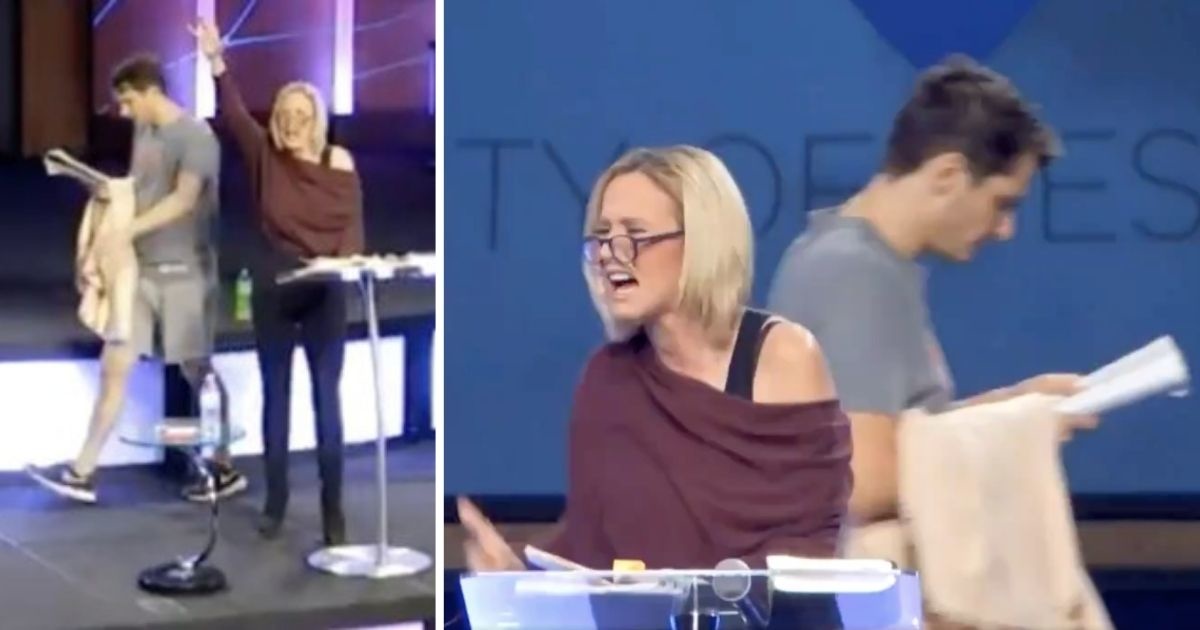
Who is this guy wandering the stage behind Paula White as she summons spirits for Trump?
One of the most confounding things for many people in the Trump era is how on Earth a porn star banging, pussy grabbing, serial lying, charity stealing, student defrauding, non-church-going, faith-mocking, unrepenting president could have won the support of conservative evangelical Christians. The hypocrisy has always been a bit stunning, but a viral video of…
One of the most confounding things for many people in the Trump era is how on Earth a porn star banging, pussy grabbing, serial lying, charity stealing, student defrauding, non-church-going, faith-mocking, unrepenting president could have won the support of conservative evangelical Christians. The hypocrisy has always been a bit stunning, but a viral video of Trump’s “spiritual adviser” Paula White offering a prayer—or something—for his reelection really puts a feather in the cap of the absurdity of it all.
Known for her charismatic televangelism and for asking people to send her part of their January salaries before anything else, White’s preaching often focuses on the “prosperity gospel” (which basically preaches that God wants us to be rich, so if you’re rich you’re clearly doing the right thing in God’s eyes—Hallelujah, unbridled capitalism and materialism!). But this week, she was focused on Trump’s reelection, and phew, this is a performance you just have to see.
Presidential spiritual adviser Paula White is currently leading an impassioned prayer service in an effort to secure Trump's reelection. pic.twitter.com/hCSRh84d6g— Right Wing Watch (@RightWingWatch) November 5, 2020
So, there’s a lot to talk about here. For people who come from this particular tradition, this might seem normal, but the repetitive, rhythmic chanting feels a bit brainwashy to many of us. The summoning of angels from Africa and South America thing was…interesting. We’ll get to that in a bit. The speaking in tongues part was also…interesting. There’s too much to dive into on that front, so I just won’t go there.
In addition to all that, what has people really scratching their heads is the dude walking back and forth behind White on the stage. Seriously, who is that guy and what is he doing?
It’s the guy walking behind her which is also the greatest subplot if this video.— Dr. Jennifer Cassidy (@OxfordDiplomat) November 5, 2020
People were mesmerized by the guy just popping in and out of the camera shot.
Couldn't stop watching this dude daundering about behind the president's spiritual adviser Paula White pic.twitter.com/tVwH5pj00z— Sarah Mackie (@lumi_1984) November 5, 2020
Sooooo many questions about wandering back and forth man. Is he one of the angels from Africa or South America that she summoned? Doesn’t really look like it. Is that a towel draped over his arm? Did he get lost on his way to the shower? Why is he wearing a t-shirt and shorts up on the stage? Why is he even up on the stage at all? Does Paula even know he’s there? Is that a Bible he’s carrying? Or is he just getting some pleasure reading in while he’s out for a stroll?
Carl T. Bergstrom, a virologist at University of Washington, tweeted a screenshot of the man walking behind Paula White with the caption “We are all this guy,” and it’s painfully true. People like Bergstrom—who has been on the front lines of COVID-19 research since the beginning of the pandemic—have been calmly going about their business while nuttiness raves around us for months (or years, really). This guy is every sane American trying to act like everything is normal in the face of total insanity.
In all seriousness, though, what’s with the summoning of angels from Africa and South America thing all about? While White’s purpose may have been different than this, one Twitter user explained her Pentecostal upbringing and said that it could, at its heart, be what many of us suspected (ahem, racism).
In a small village in Pwani, a district on Tanzania’s coast, a massive dance party is coming to a close. For the past two hours, locals have paraded through the village streets, singing and beating ngombe drums; now, in a large clearing, a woman named Sheilla motions for everyone to sit facing a large projector screen. A film premiere is about to begin.
It’s an unusual way to kick off a film about gender bias, inequality, early marriage, and other barriers that prevent girls from accessing education in Tanzania. But in Pwani and beyond, local organizations supported by Malala Fund and funded by Pura are finding creative, culturally relevant ways like this one to capture people’s interest.
The film ends and Sheilla, the Communications and Partnership Lead for Media for Development and Advocacy (MEDEA), stands in front of the crowd once again, asking the audience to reflect: What did you think about the film? How did it relate to your own experience? What can we learn?
Sheilla explains that, once the community sees the film, “It brings out conversations within themselves, reflective conversations.” The resonance and immediate action create a ripple effect of change.
MEDEA Screening Audience in Tanzania. Captured by James Roh for Pura
Across Tanzania, gender-based violence often forces adolescent girls out of the classroom. This and other barriers — including child marriage, poverty, conflict, and discrimination — prevent girls from completing their education around the world.
Sheilla and her team are using film and radio programs to address the challenges girls face in their communities. MEDEA’s ultimate goal is to affirm education as a fundamental right for everyone, and to ensure that every member of a community understands how girls’ education contributes to a stronger whole and how to be an ally for their sisters, daughters, granddaughters, friends, nieces, and girlfriends.
Sheilla’s story is one of many that inspired Heart on Fire, a new fragrance from the Pura x Malala Fund Collection that blends the warm, earthy spices of Tanzania with a playful, joyful twist. Here’s how Pura is using scent as a tool to connect the world and inspire action.
A partnership focused on local impact, on a global mission
Pura, a fragrance company that recognizes education as both freedom and a human right, has partnered with Malala Fund since 2022. In order to defend every girl’s right to access and complete 12 years of education, Malala Fund partners with local organizations in countries where the educational barriers are the greatest. They invest in locally-led solutions because they know that those who are closest to the problems are best equipped to solve and build durable solutions, like MEDEA, which works with communities to challenge discrimination against girls and change beliefs about their education.
But local initiatives can thrive and scale more powerfully with global support, which is why Pura is using their own superpower, the power of scent, to connect people around the world with the women and girls in these local communities.
The Pura x Malala Fund Collection incorporates ingredients naturally found in Tanzania, Nigeria, Pakistan, and Brazil: countries where Malala Fund operates to address systemic education barriers. Eight percent of net revenue from the Pura x Malala Fund Collection will be donated to Malala Fund directly, but beyond financial support, the Collection is also a love letter to each unique community, blending notes like lemon, jasmine, cedarwood, and clove to transport people, ignite their senses, and help them draw inspiration and hope from the global movement for girls’ education. Through scent, people can connect to the courage, joy, and tenacity of girls and local leaders, all while uniting in a shared commitment to education: the belief that supporting girls’ rights in one community benefits all of us, everywhere.
You’ve already met Sheilla. Now see how Naiara and Mama Habiba are building unique solutions to ensure every girl can learn freely and dare to dream.
Naiara Leite is reimagining what’s possible in Brazil
Julia with Odara in Brazil. Captured by Luisa Dorr for Pura
In Brazil, where pear trees and coconut plantations cover the Northeastern Coast, girls like ten-year-old Julia experience a different kind of educational barrier than girls in Tanzania. Too often, racial discrimination contributes to high dropout rates among Black, quilombola and Indigenous girls in the country.
“In the logic of Brazilian society, Black people don’t need to study,” says Naiara Leite, Executive Coordinator of Odara, a women-led organization and Malala Fund partner. Bahia, the state where Odara is based, was once one of the largest slave-receiving territories in the Americas, and because of that history, deeply-ingrained, anti-Black prejudice is still widespread. “Our role and the image constructed around us is one of manual labor,” Naiara says.
But education can change that. In 2020, with assistance from a Malala Fund grant, Odara launched its first initiative for improving school completion rates among Black, quilombola, and Indigenous girls: “Ayomidê Odara”. The young girls mentored under the program, including Julia, are known as the Ayomidês. And like the Pura x Malala Fund Collection’s Brazil: Breath of Courage scent, the Ayomidês are fierce, determined, and bursting with energy.
Ayomidês with Odara in Brazil. Captured by Luisa Dorr for Pura
Ayomidês take part in weekly educational sessions where they explore subjects like education and ethnic-racial relations. The girls are encouraged to find their own voices by producing Instagram lives, social media videos, and by participating in public panels. Already, the Ayomidês are rewriting the narrative on what’s possible for Afro-Brazilian girls to achieve. One of the earliest Ayomidês, a young woman named Debora, is now a communications intern. Another former Ayomidê, Francine, works at UNICEF, helping train the next generation of adolescent leaders. And Julia has already set her sights on becoming a math teacher or a model.
“These are generations of Black women who did not have access to a school,” Naiara says. “These are generations of Black women robbed daily of their dreams. And we’re telling them that they could be the generation in their family to write a new story.”
Mama Habiba is reframing the conversation in Nigeria
Centre for Girls' Education, Nigeria. Captured by James Roh for Pura
In Mama Habiba’s home country of Nigeria, the scents of starfruit, ylang ylang and pineapple, all incorporated into the Pura x Malala Collection’s “Nigeria: Hope for Tomorrow,” can be found throughout the vibrant markets. Like these native scents, Mama Habiba says that the Nigerian girls are also bright and passionate, but too often they are forced to leave school long before their potential fully blooms.
“Some of these schools are very far, and there is an issue of quality, too,” Mama Habiba says. “Most parents find out when their children are in school, the girls are not learning. So why allow them to continue?”
When girls drop out of secondary school, marriage is often the alternative. In Nigeria, one in three girls is married before the age of 18. When this happens, girls are unable to fulfill their potential, and their families and communities lose out on the social, health and economic benefits.
Completing secondary school delays marriage, and according to UNESCO, educated girls become women who raise healthier children, lift their families out of poverty and contribute to more peaceful, resilient communities.
Centre for Girls’ Education, Nigeria. Captured by James Roh for Pura
To encourage young girls to stay in school, the Centre for Girls’ Education, a nonprofit in Nigeria founded by Mama Habiba and supported by Malala Fund and Pura, has pioneered an initiative that’s similar to the Ayomidê workshops in Brazil: safe spaces. Here, girls meet regularly to learn literacy, numeracy, and other issues like reproductive health. These safe spaces also provide an opportunity for the girls to role-play and learn to advocate for themselves, develop their self-image, and practice conversations with others about their values, education being one of them. In safe spaces, Mama Habiba says, girls start to understand “who she is, and that she is a girl who has value. She has the right to negotiate with her parents on what she really feels or wants.”
“When girls are educated, they can unlock so many opportunities,” Mama Habiba says. “It will help the economy of the country. It will boost so many opportunities for the country. If they are given the opportunity, I think the sky is not the limit. It is the starting point for every girl.”
From parades, film screenings to safe spaces and educational programs, girls and local leaders are working hard to strengthen the quality, safety and accessibility of education and overcome systemic challenges. They are encouraging courageous behavior and reminding us all that education is freedom.
Experience the Pura x Malala Fund Collection here, and connect with the stories of real girls leading change across the globe.
Fans of professional football club FC Barcelona may have noticed the team wearing a unique kit against Newcastle United during the Champions League round of 16 on March 18. The traditional blue-and-red striped jerseys were reworked with a standout typeface by Anna Vives, a fan and artist with Down syndrome.
FC Barcelona teamed up with Vives in honor of World Down Syndrome Day, which takes place on March 21. The team also secured a 7–2 victory over Newcastle United.
Before the matchup, FC Barcelona shared the news on X, including a photo of Vives’ design on player Lamine Yamal’s kit.
“A special jersey with a purpose, honoring International Down Syndrome Day and celebrating the talent of Anna Vives, an incredible artist with Down syndrome,” they shared.
Una camiseta especial con un propósito: dar visibilidad al Día Internacional del Síndrome de Down y celebrar el talento de Anna Vives, una artista increíble con síndrome de Down. ♾️ pic.twitter.com/R6Jbu183oc
In a press release, FC Barcelona noted that the collaboration with Vives was made possible through the FC Barcelona Foundation. It’s also the second time the two have teamed up.
“It is not the first time Barça have used Anna’s inclusive typeface,” the release stated. “The club previously supported the initiative during the 2013 Joan Gamper Trophy match against Santos, highlighting its commitment to raising the visibility of people who are too often overlooked.”
🚨 Barcelona are set to debut with a special kit for "World Down Syndrome Day" against Newcastle United in the Champions League this week.
The kit's typeface was been designed by Anna Vives, a talented young Catalan artist who has Down Syndrome.
On X, fans shared their praise for the collaboration with Vives:
“Precious and even more so for the cause it is, I want one.”
“I love it even more this way.”
“What a beautiful initiative, the t-shirt highlights talent and inclusion. Congratulations to Anna and the team.”
“The letters are super awesome.”
“An epic t-shirt for an epic match.”
“It’s a beautiful shirt, they have to wear it in all the Champions League matches.”
Who is Anna Vives?
In an interview with Pixartprinting, Vives’ brother Marc said her artistic journey began in 2011 after she lost her job at a local supermarket. He encouraged her to learn how to write on a computer, adding, “with no idea what she could do.” She was a fast learner and quickly became obsessed with typefaces.
This led her to create her own typeface, which combines lowercase and uppercase letters interchangeably and was first digitized in 2012.
She is currently showcasing her typeface around the world with a campaign called Visible-IN to promote visibility and social equality. Eight international soccer clubs will wear her typeface to mark World Down Syndrome Day, including four South American clubs, three European clubs, and one South African club.
World Down Syndrome Day has been part of the United Nations calendar since 2012. This year, it falls on March 21.
That it falls on the 21st is a meaningful nod to Down syndrome, also known as trisomy 21. The condition occurs when a person has an extra copy of chromosome 21—three instead of two.
According to Down Syndrome International, the day “calls everyone to action with a theme to ensure the human rights of people with Down syndrome and works with members to organize worldwide activities and discussions.”
This year’s theme centers on loneliness. The organization noted that “for many people with Down syndrome and other intellectual disabilities, loneliness is a more common and painful experience. Their families can feel lonely too, and feel cut off from support.”
The 1980s ushered in a new kind of childhood: the latchkey kid. With both parents working, these children used a latchkey to let themselves into their homes after school.
And they were hungry. By the ’80s, microwaves had entered most kitchens, making it quick and easy to prepare food—something latchkey kids treasured after long school days.
Gen Xers on Reddit shared the “latchkey kid cuisine” they made for themselves after school. Some jokingly called their concoctions a “crime,” while others still crave the classics.
Here are 14 of their most memorable creations:
Hot dogs
“Hot dogs in the microwave.” – Fabulous-Airline-473
“I ate 2 hot dogs after school every day of either 6th or 7th grade. Couldn’t eat them again for at least a year.” – Second_City_Saint
Canned pasta
“Raviolis from the can. I remember housing the family size can all the time.” – hey_suburbia
“Spaghetti O’s with a Kraft single melted into it.” – joy_to_the_world_
“Wow, look at rockafella over here. Beefaroni 4 life, my friend.” – n10w4
Eggs
“We used to have ‘eggs in a basket’ as my Mom called it all the time as kids. The best part is taking the little circle of bread and making a mini French toast with it.” – Kronos1A9
Cinnamon, sugar, and butter on toast
“Cinnamon, sugar, and creamed butter mixed together to form a sort of cinnamon icing, spread onto slices of bread, bagels, whatever, and then toasted in the broiler until the sugar caramelized and turned into a crunchy crust on top. That was my childhood go-to for breakfast or snacks.” – ilikeaffection
“Latchkey kid food was cinnamon toast.” – kathatter75
Frozen pizza varieties
“Pizza Rolls.” – RojoRugger
“Or bagel bites if I was extra good.” – Prestigious-War-1825
“Frozen pizza for me.” – JD_tubeguy
Ramen
“For us, it was Top Ramen” – blueyedwineaux
“I used to make a cup noodle/top ramen on the stove and add a sautéed hot dog. I was 10 thinking I was a chef.” – Euphoric_Management8
Quesadilla
“Sometimes a tortilla with shredded cheese microwaved for the worst quesadilla ever.” – blueyedwineaux
Frozen dinners
“Starting the Schwanns frozen dinner if you were fancy.” – Weekly_Library9883
“As a Latchkey Kid this delight from Swanson [fried chicken dinner] fed me, many a times after school, while watching reruns of The Little Rascals, waiting for my parents to come home from work.” – CharlieMcN33l
“Micro Magic (discontinued brand from the 80s) burgers and fries. These were so good. All you did was open the box and nuke it for 90 seconds. These hit hard. Good old Gen X stuff that doesn’t exist anymore.😥” – Setsuna00XN
Canned soup
“Canned beans/soup with toast for this guy!” – skinnyminnesota
“My other go-to was a family size can of Campbell’s beef vegetable soup with an entire sleeve of Town House crackers dumped into it.” – hey_suburbia
Chipped beef on toast
“This was called ‘sh*t-on-a-shingle’ in our house.” – po_ta_toes_80
Nachos
“My latchkey go-to was microwave nachos.” – billskns5th
“Saltine crackers and peanut butter, always the full sleeve because nobody was there to stop me.” – SaskatchewanKenobi
“I was a grilled cheese or Spaghettio kid.” – PlatypusFreckles
Cereal
“Yep, I put way too much sugar in a bowl of cheerios, collapsed in a sugar coma for about 25 min and skateboarded the rest of the evening.” – Combatical
Pot pie
“Frozen pot pie made in a toaster oven” – hisamsmith
The usually respectful crowd at a “Wheel of Fortune” taping couldn’t hold back after they felt that a puzzle given to finalist Rob Dodson was too harsh. A big reason for their outrage (and why the puzzle was so tricky) was because $1 million was on the line.
Before the puzzle, Dodson chose from a selection of cards that held the prize he would win for solving it. Amongst the cards was the $1 million jackpot, so, understandably, tensions were high. Did Dodson choose the million-dollar card? Will he solve the puzzle under the “What Are You Doing Category”?
Well, things didn’t start too great.
After the usual R, S, T, L, N, and E were put up on the board, Dodson was looking at “_ _ _ _ _ L _ N _.” He quickly guessed C, H, P and A, none of which appeared on the board. He then guessed “funneling” and “finding,” but they didn’t work.
After the solution to the puzzle was revealed, the audience began to boo because they didn’t think it was fair. It had 2 Bs in the short answer, started with a Q and was a word that isn’t used often in casual conversation. The crowd’s reaction was an excellent show of support for Dodson, who encouraged the crowd to keep going by raising his hands.
Host Pat Sajak, 77, pushed back against the boos, jokingly asking the audience, “Who asked you?”
So, would Dodson have won the $1 million if he guessed quibbling? Nope. The card he chose would have earned him an Infiniti car if he had guessed correctly. But all in all, it wasn’t a bad outing for Dodson, a father of 2 from Aurora, Ohio. He managed to win $33,500 against Venetia Brown ($7,550) and Jessica Huffman ($2,000).
The tough puzzle earned a lot of boos on social media as well. X was lit up with people who thought that Dodson got cheated by being given a challenging puzzle with a word seldom used in conversation.
Sajak’s final episode as host aired on June 7, 2024. Sajak has been the host of “Wheel” since 1981. Vanna White, his co-host since 1982, will remain with the show. “I couldn’t be happier to have shared the stage with you for all these years with one more to come,” she wrote on X after Sajak announced this would be his last season. “Cheers to you.”
When we started @WheelofFortune who could have imagined we’d still be at it 41 seasons later? I couldn’t be happier to have shared the stage with you for all these years with one more to come. Cheers to you, @patsajak! https://t.co/yYmo3G0Dtb
Sajak has been a beloved host on “Wheel of Fortune,” earning 19 Daytime Emmy Award nominations for Outstanding Game Show Host and winning three times. In 2019, he set a Guinness World Record for the longest career as a game show host for the same show, beating the previous record held by Bob Barker.
“I can’t wait to continue the tradition of spinning the wheel and working alongside the great Vanna White,” he said after it was announced he was the new host.
So, how did he do after taking over the coveted role of host? The first week that Seacrest took over for Sajak the ratings took a giant leap, bringing in the most viewers since 2015, making it the number one syndicated show that week. Time will tell if Seacrest can replace Sajak’s magic, but he has time; reports show that he has signed on for the gig into the 2030s.
On March 10, 78-year-old Richard Pulley of eastern Tennessee gingerly walked up the stairs at Brittany Smith’s house to deliver Starbucks to her husband, who is quadriplegic.
“I open up the (Ring) camera, and I see this little old man walking up my steps with a Starbucks bag and … my heart just sank,” Smith told Today. She never had the chance to interact with him because her husband chose the “leave at door” option.
After seeing the video, Smith wanted to get in touch with the man, but all she knew was his name was Richard. So she posted the Ring video to Facebook, asking if anyone knew where he lived.
“Help me find this precious man!” she wrote on Facebook, adding a link to the donation page. “Why is he having to DoorDash his name is Richard! Help me find him.”
Smith located the man, spoke with him, and learned that after retiring at 65, he returned to work as a DoorDash driver because his wife lost her job and they couldn’t afford her healthcare, which costs thousands a year.
“My wife [Brenda] was working for an insurance company, and they ended up letting her go,” Pulley told Today, adding that their Social Security payments weren’t enough to make ends meet.
70 year old retired man, Richard Pulley, had to return to DoorDash to cover medical bills after his wife lost her job & insurance.
A customer (Brittany Smith) saw him struggling on her Ring cam delivering Starbucks, tracked him down, and started a GoFundMe.
So the Pulleys teamed up, with Brenda driving and Richard picking up and dropping off deliveries. “With just one income in the family, you have to push… Just losing that, we had to supplement it,” Richard told WSMV.
Smith stopped by the Pulley residence to give the couple $200, but she knew it wasn’t enough to ease their financial strain. She then created a GoFundMe page to raise money for Pulley so he could “rest again.” “Let’s help Richard go back into retirement!” she wrote on the campaign page.
In eight days, the GoFundMe campaign raised more than $960,000.
GoFundMe funds were life-changing for the Pulleys
The extra money has brought peace of mind to the Pulley family. “It’s taking a lot of pressure off of us. And making life livable once again,” Richard told WSMV. “We appreciate every one of them [donors].”
The campaign has helped the Pulleys gain some financial breathing room, but it has also created a new friendship. “I just love this man,” Smith said. “I want him to be my grandpa,” Smith’s daughter added.
Even though the money has made the Pulleys more comfortable, Richard has found a new sense of purpose in delivering food and doesn’t want to give it up.
“I taught myself how to be a good worker again, although the last couple of shifts have worked out hard because people stop and take pictures with me and all sorts of things,” he told Today. “I’ll get back to work in the next few days.”
New Zealander Tyler Warwick decided to take a stroll down memory lane while visiting a friend from the United States. The experience proved slightly traumatic for his American friend in a weirdly funny way.
Warwick recently uploaded an Instagram video capturing his friend’s reaction to a “traumatic” PSA that aired in New Zealand during his childhood. The video begins with a woman casually strolling through the frame, with children playing in the background.
At first, it looks like a typical commercial for a snack bar: a suburban mom with a Kiwi accent talking about the “right snacks” to keep kids going. But as soon as she shows the snack bar, she trips over a toy dump truck, falling face-first through a glass coffee table. What starts as an innocent commercial quickly turns into a mini horror movie.
The American friend lets out a loud “Oh my God!” followed by an uncomfortable laugh. As the woman lies on the floor, whimpering, a male voiceover says, “Preventing trips around your home can be as easy as tidying up toys.”
“Ok I was completely unprepared for the emotional whiplash,” a viewer writes in the comments.
Warwick shared even more comically unhinged commercials with his friend. In a second video, the Kiwi points out that the ad they’re watching aired during the Rugrats cartoon. In the clip, a man happily climbs a ladder to paint the trim on his house. Suddenly, he plummets from the ladder and lands on his back.
“…Is New Zealand okay?!” a concerned commenter asks.
In another video, Warwick shows his friend a similarly traumatic fall. The commercials have people wondering how often New Zealanders were taking extreme tumbles. Was there no gentler way to reinforce securing ladders, picking up toys, or using a bath mat when getting out of the shower? But apparently, New Zealand didn’t have a monopoly on these memory-searing ads. Some viewers report seeing similar ads as children in Canada, Australia, and Ireland.
An Aussie writes, “In Australia we had a work safe ad of a girl working in a bakery severing a finger in the bread slicer.” A Canadian shares, “Canada had the avoidable accidents ads with teenage girls falling through display cases, a guy impaled with rebar, and a woman dumping a boiling pot all over herself.”
These commercials aired during children’s cartoons as ad breaks. While the ones from New Zealand are jarring, the Canadian ads take it up a notch. In one Canadian workplace safety PSA, now on YouTube, a chef works in a busy kitchen. She studies her engagement ring, then announces there won’t be a wedding—a terrible accident is coming.
Seconds later, she’s moving a large pot of boiling water when she slips on something spilled on the floor, dumping it over her face. She screams as her skin visibly burns.
It seems these three countries may have used the same advertising agency. It’s unclear whether the ads were meant to provoke shock or simply to be seen as honest. Judging by the comments on Warwick’s videos, some people who saw these ads as children still feel a bit traumatized.
One Kiwi asks, “Why were all our ads so terrifying?”
Another writes, “It worked though. I’m still reminded as an adult today from watching this as a kid.”
Further in the comments, one New Zealander puts in a request: “NOW SHOW HIM THE 2002 FIRE AD!!!! That was trauma at its finest!!!!”
“New Zealand…I’m starting to become concerned,” an American chimes in.
For young baseball fans, meeting a Major League Baseball player can be a memorable highlight of a trip to the ballpark. However, one fan not only got to enjoy their favorite hobby with a player, but also walked away with two impromptu autographs from others thanks to him.
MLB veteran Paul Lo Duca met a young baseball card collector named Noah and his brother on the sidelines before a Mets game. He took the time to open a pack of 2008 Topps baseball cards with Noah, even joking that one of his own cards might appear. When the pack was opened, Lo Duca wasn’t among the players—but two of his former teammates were: Mike Piazza and Johan Santana. Without prompting, Lo Duca grabbed the cards and a pen and ran onto the field to have both players autograph them.
Watch til the end! Our number 1 video of the season! We rip a pack of 2008 Topps with Paul Lo Duca! He pulls both a Mike Piazza AND Johan Santana! He then goes and gets both signed! #baseballcards#packrip#sportscards#topps#baseball @Topps @MLB Network @MLB @ESPN @Collect @Fanatics @Baseball Lifestyle @The Athletic @New York Mets
It would have been understandable for Lo Duca to just give Noah a quick hello, maybe even sign a card if one of his had turned up in the pack. Instead, he went out of his way to get signatures from other players for the young fan. Noah graciously thanked Lo Duca for the gesture and even posed for a photo with him.
The comments on the boy’s TikTok were abuzz with praise for Lo Duca and the interaction:
“You never see a professional player interact with a fan this long. He opened a pack and then RAN to get both the cards he got signed. What an amazing guy.”
“That’s so cool, ripping packs with the pros 💪”
“It was unbelievable. The kids will never forget this.”
“This is why baseball will forever be America’s favorite pastime…My friend’s daughter was lucky enough to get a game-used Bryce Harper bat from Harp himself at one game.”
“How can you not be romantic about baseball?”
“Outstanding! Made a lifelong memory for the kids and cost nothing but kindness.”
“I love EVERYTHING about this!!! 💙 I have two grandsons who play baseball and I think I would be literally in tears if this were to happen to them because I know how much they love the game and look up to men like this in the sport! 🧢⚾️”
“This is officially the best card opening pack video I’ve ever seen. Regardless of sport or collectible.”
“Paul is every kid’s dream interaction at the ball park. Class act.”
“Not a Mets fan, but just became a Paul fan!”
“It doesn’t take long for athletes and former athletes to make a story for a kid they’ll never forget. Lots of respect for Paul doing this!”
“He’s just happy to see kids still into baseball cards! Keeping it alive!”
Baseball cards are making a comeback
Since the COVID-19 pandemic, baseball cards and other trading cards have surged in popularity among young fans like Noah, as well as adults. Lo Duca even mentions that he owns a collectible card store. In an era when many young people’s hobbies revolve around screens and online interaction, parents and teachers are largely welcoming the return of trading cards to schoolyards.
Trading cards can have several benefits for kids, including: 1. Fostering a sense of community and social connections through trading and collecting with friends and peers. 2.Encouraging organization and categorization skills as they sort and manage their collections. 3.Developing research and critical thinking skills as they learn about different cards, players, and teams. 4.Promoting patience, persistence, and self-discipline as they hunt for rare or hard-to-find cards. 5.Enhancing knowledge and interest in various subjects, such as sports, history, or pop culture. 6.Encouraging entrepreneurship and business skills through buying, selling, and trading cards. 7.Building self-confidence and pride in their collections and accomplishments. 8.Developing fine motor skills through handling and sorting cards. 9.Learning about the value of money and responsible spending habits. 10.Having fun and enjoying a hobby that can last a lifetime! #lawlerballers#topps#bowman#panini#baseballcards#sportstradingcards#cardbreaks#memories#baseballboys @mlb (Also they have already started a nice little savings!) @topps
While trading cards still require the same parenting and supervision as any hobby, they’re often seen as a way to “trick” kids into learning math. Sports cards like Noah’s offer opportunities to measure and learn statistics, while kids interested in commerce can learn to assess value in collector markets. Even non-sports cards, like Pokémon or Magic: The Gathering, involve similar math both in the cards themselves and in gameplay.
It’s players like Lo Duca who help keep fandom alive, whether it’s baseball, card collecting, or both. As commenters noted, that kind of joy, kindness, and excitement gets passed on to future fans and players alike.
The Oscars are a major event that draws millions of viewers each year. But for Marshall, the March 15 ceremony became a moment of inclusion. As she watched Coogler sign, her emotions grew. The filmmaker took to social media to share her excitement with her followers.
In her Instagram video, Marshall excitedly signs, “That’s director Ryan Coogler signing ‘I love you.’ But there’s more.”
A brief clip of musician Ludwig Göransson saying Coogler’s name plays, prompting the Black Panther director to sign, “I love you. Thank you, brother.” Marshall then reappears to explain that Coogler was signing to people all night. As she shows more clips, her emotions build until she’s nearly in tears.
Marshall adds, “I just learned that his wife Zinzi, is an ASL interpreter… my heart…As a Deaf filmmaker, watching them normalize sign language like that…More please!”
Zinzi Coogler, who co-founded Proximity Media with her husband and Sev Ohanian, didn’t always plan to work in film—in fact, the career wasn’t on her radar. She attended California State University, Fresno, where she studied communicative sciences and deaf studies, according to Marie Claire. After graduating, she worked as an interpreter at the nonprofit Deaf Counseling, Advocacy & Referral Agency. Given their shared professional paths, it’s likely Ryan Coogler picked up some sign language, though it’s unclear to what extent.
The inclusion of ASL isn’t new to the Cooglers. In 2015, Leonard Maltin hosted Ryan Coogler for his film symposium class at the USC School of Cinematic Arts. One student asked why the lead female character in Creed, played by Tessa Thompson, experiences hearing loss.
Maltin shared, “Ryan explained that his fiancée teaches ASL (American Sign Language) and being with her has brought him into that sphere. In other words, a significant facet of the movie is drawn from reality and is not a mere bit of business.”
It seems that ASL is integrated into the lives of the Cooglers, and they regularly incorporate it into their films. This seamless inclusion helps normalize sign language for audiences. Advocates report that the media underrepresents deaf and hard-of-hearing people, as well as ASL users.
In a statement, the National Association of the Deaf said, “Portrayals of deaf and hard of hearing people in film, television, and theater have a significant impact on the public image of our community. There is no shortage of professional deaf and hard of hearing actors to fill these roles. … We call for increased casting of deaf and hard of hearing actors in all roles.”
People who viewed Marshall’s post expressed gratitude for the inclusion of ASL and agreed that representation matters. One person wrote, “Inclusivity is not that hard and makes an incredibly huge impact.”
Advocating for ASL to be taught alongside English, another commenter wrote, “Sign Language should be taught to everyone along English or the main language. Imagine if we could ALL communicate in silence as well! Like calling or texting, we should be able to switch between talking and signing!”
Another person revealed, “His wife has Deaf family members. That’s why he learned (and there’s a lot of stories of him interpreting for Deaf/hoh people without making a big deal of it.) That’s also why there was a push for HBO to have BASL interpreted version of sinners.”
Further in the comments, someone shared their anticipation for the next Creed movie bringing more representation to the big screen. They wrote:
“And in his ‘CREED’ movies one of his main characters has a condition where she is losing her hearing. By CREED 3 there is the introduction of a Deaf character, Creed’s daughter. The two main characters and the daughter use sign language. This daughter seems interested in becoming a boxer…so now that CREED 4 has been announced, I predict the daughter will be the main character. This will be a movie that champions the ASL community, so keep an eye out for CREED 4.”
The notice informed her that a neighbor had filed a complaint about her “inappropriate public displays” and “disturbance of community aesthetics.” She was baffled. She practiced at 6 AM when almost no one else was awake, wore standard workout clothes, and made no noise.
Then it got stranger. When she followed up with the HOA manager for specifics, she learned the neighbor had gone further than a written complaint. They had been photographing her in various poses and submitted the photos as evidence, arguing they were “inappropriate for children to potentially see” and were “promoting Eastern religious practices in a family community.”
A woman meditates while doing yoga. Photo credit: Canva
“I’m literally just doing basic vinyasa flow!” she wrote.
The detail about Eastern religious practices caught significant attention when the post went viral on Reddit, and for good reason. Legal experts and housing advocates are clear on this point: the Fair Housing Act prohibits HOAs from restricting a homeowner’s use of their property based on religion. As one legal resource explains it plainly, an HOA can ban exercise broadly, but it cannot single out yoga specifically because of its perceived religious associations. The same logic applies to holiday decorations — an HOA that bans string lights for Diwali but allows Christmas lights is on legally shaky ground.
Commenters on the post were quick to flag this. “If that whole promoting Eastern religion thing is an exact quote, I feel like that right there is your ticket to fight,” wrote u/cheybananas. “They can’t just outlaw religious practices.”
Others were more focused on the neighbor’s surveillance. Several urged her to file a counter-complaint about someone photographing her on her own private terrace at dawn. “Taking photos of someone on their private residence without their knowledge or consent?” u/ok-pomegranate-6479 wrote. “Involve authorities if you have to, that’s creepy.”
A woman executes an advanced yoga pose on the beach. Photo credit: Canva
The homeowner had already come to the same conclusion on her own. After reviewing her HOA’s bylaws, she found nothing prohibiting yoga or exercise on private terraces, only a vague clause about maintaining community standards. She drafted a formal email to the HOA board requesting the specific bylaw citation they were relying on, along with copies of all photos collected of her. She also made clear she was considering a counter-complaint about the neighbor’s behavior.
“The irony is that yoga is supposed to reduce stress,” she wrote, “but this whole situation is doing the opposite.”
Her experience isn’t unusual. A Rocket Mortgage survey of more than 1,000 HOA homeowners found that more than 3 in 10 feel their HOA has too much power, and 10% have considered selling their home because of it.
This article originally appeared earlier this year.