

Homosexuality in the Bible: Here's what six passages say and how to interpret them.
The video does a really great job of contextualizing each reference.
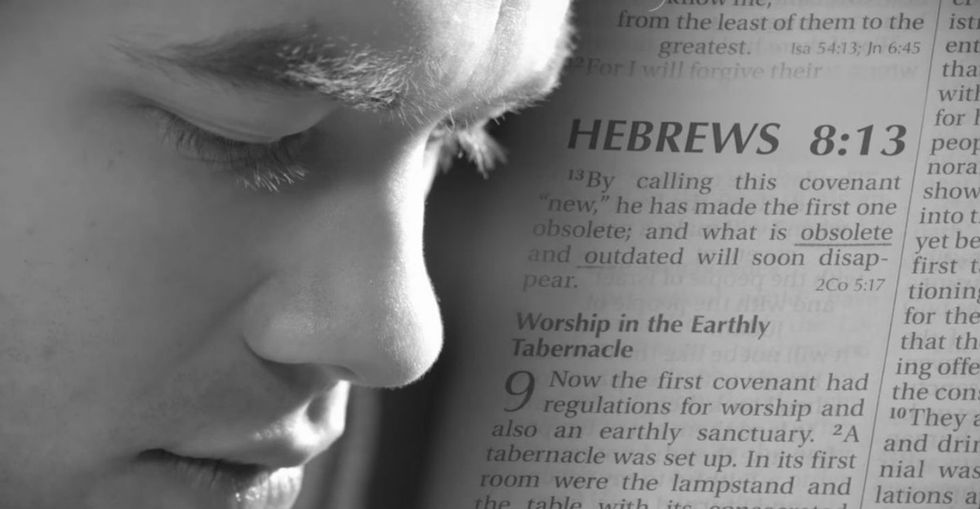
Looking into the text of the Bible.
Matthew Vines' "God and the Gay Christian” video at the bottom of this article analyses six passages related to homosexuality in the Bible. It does a really great job of contextualizing each reference (because we all know that Scriptures out of context can cause misinterpretation at best and d-r-a-m-a at worst).
We've also broken down each reference to homosexuality in the Bible here:
The Story of Sodom & Gomorrah (Genesis 19)
This story in Genesis 19 is probably the most popular passage used to condemn homosexuality. Here is how Vines explains it:
"God sends two angels disguised as men into the City of Sodom where the men of Sodom threatened to rape them. The angels blind the men, and God destroys the city. For centuries, this story was interpreted as God's judgment on same-sex relations, but the only form of same-sex behavior described is a threatened gang rape."
So gang rape = not good (also not the same thing as homosexuality). But the recap of Sodom and Gomorrah found in Ezekial 16:49 highlights what Vines believes is the real point of the story:
"Now, this was the sin of your sister, Sodom. She and her daughters were arrogant, overfed, and unconcerned, they did not help the poor and needy."
In other words, everyone using this story as evidence of the sin of homosexuality, might be missing the point entirely.
When God calls homosexuality an abomination(Leviticus 18:22) (Leviticus 20:13)
Yep. We've all heard that Leviticus is where the Bible straight-up says that homosexual behavior is an abomination. And yes, it does. It also says that homosexuals should receive the death penalty (!!!). It also says the same thing about eating pork or shellfish, charging interest on loans, and a whole bunch of other restrictions that were a part of the Old Testament Law Code. But for Christians, the Old Testament doesn't (dare I say "shouldn't?") settle any issue because Romans 10:4 says that Christ is the end of the law. Which is probably why most Christians today eat meat, use credit cards, wear makeup, and support equality for women. Because, as Hebrews 8:13 says, the old law is obsolete and aging.
When people turn away from God (Romans 1:26-27)
"Even their women exchanged natural sexual relations for unnatural ones; in the same way, men committed shameful acts with other men and received in themselves the due penalty for their error."
This is where Vines really digs in on the the cultural context angle. In Biblical times, same-sex behavior was primarily seen as happening between adult men and adolescent boys (masters and servants — yikes), via prostitution, and by men who were married to women. In all of those cases, we can see why it would have been viewed as sinful, excessive, lustful, and against God's law. But he makes no mention of love, commitment, faithfulness, or the type of same-sex relationships that are at question in the debate around marriage. (By the way, Paul also says that men having long hair is "unnatural" and that women shouldn't speak in church, so it's clear Paul himself may have had some issues of his own.)
Uses of the Greek works "Malakoi" and "Arsenokoitai"(1 Corinthians 6:9-10) (1 Timothy 1:10)
These words are included in the New Testament's lists of people who will not inherit God's kingdom. And there has been much debate over their original meaning. (Translating ancient words is hard, guys.) Some believe them to mean homosexuality and sodomy, whereas others have said that the closest modern translation would be "dirty old men." Ha! Here's how Vines explains it:
Many modern translators have rendered these terms as sweeping statements about gay people, but the concept of sexual orientation didn't even exist in the ancient world. Yes, Paul did not take a positive view of same-sex relations (nor did he support women speaking in church...), but the context he was writing in is worlds apart from gay people in committed, monogamous relationships. The Bible never addresses the issues of sexual orientation or same-sex marriage, so there's no reason why faithful Christians can't support their gay brothers and sisters.
Fascinating, right? If you'd like to learn more about homosexuality in the Bible or hear Matthew Vines' personal story check out his book "God and the Gay Christian."
This article originally appeared on 06.27.14




 Thomas Jefferson's Monticello.via
  The Jefferson Memorial in Washington, D.C.via Joe Ravi/Wikimedia Commons

 Family baking fun in the kitchen.
 Three generations smiling by the sea.
 Caregiver discusses a patient with another family member.
 A caregiver takes a break. Photo by
  Elderly people holding hands. Photo by

 You don't have to take an all or nothing approach to change.