One dad is delighting readers on X with an epic tale of nearly missing his daughter’s birth after fainting. His story of rushing to make it in time feels like something straight out of a movie—complete with a happy ending.
Luke Epplin’s wife had gone into labor on a Friday. Most of that night, and all of Saturday, Epplin stayed awake, waiting. Finally, on Sunday, he began to doze off. That’s when he got word that his wife had gone into active labor.
And this is where our hilarious saga begins.
“I got on my feet, threw on my clothes, and then was thrust in the middle of the action. Whether because of exhaustion, lack of food, or having just gotten up, I don’t remember anything else. I fainted,” he wrote.
I was awoken at four in the morning today (Sunday) to active labor. I got on my feet, threw on my clothes, and then was thrust in the middle of the action. Whether because of exhaustion, lack of food, or having just gotten up, I don’t remember anything else. I fainted.
When he finally woke up, blood was “oozing” from his head and he was whisked away to the emergency room. EMT’s told him he might need a CT scan, “which would make me miss the birth of my daughter.”
Thankfully, all that Epplin ended up needing was staples. Which meant it was all smooth sailing from here on out, right? Guess again.
There was still a “massive” hospital to navigate, the nurse guiding him through the multiple hallways was called away on an emergency. Leaving him to make it through the labyrinth to the opposite side, with nothing but some verbal directions the nurse had given him. Which somehow got him to the bone marrow center.
“Granted, I’m in the clothes I slept in, with a massive white bandage wrapped around my head, like something you’d see in a World War I movie,” he wrote. As he frantically tried to tell another nurse that his was was in labor, she said, “I think you need to see security.”
I told him the same thing: “My wife is in labor!” Again, he looked at me, bandage and all, patient tag on my wrist, and said, “Sir, I’m gonna need to see some discharge papers.” I had no ID, no visitor’s badge, no cellphone, nothing. Suddenly, it dawned on me: I’m in trouble.
Cut to Epplin saying the same thing to a security guard, who asks to see some discharge papers. That’s when Epplin realizes he has nothing on him. No papers, no ID, no visitors badge. Not even a cellphone.
Pulling a Hail Mary, Epplin told the guard the truth: that he had fainted while his wife was in labor, cut a gash into his head, got that treated, and then got himself lost. That must have done the trick, because the guard let him out.
Epplin had to sprint down two blocks (in slippers, mind you) and get past a parking valet and yet another security guard before making it up to the 10th floor of the correct building and into the maternity ward. By this time, he had somehow become famous.
“The attendant looked at me, and said, ‘Oh, you’re the guy everyone’s talking about,” he recalled.
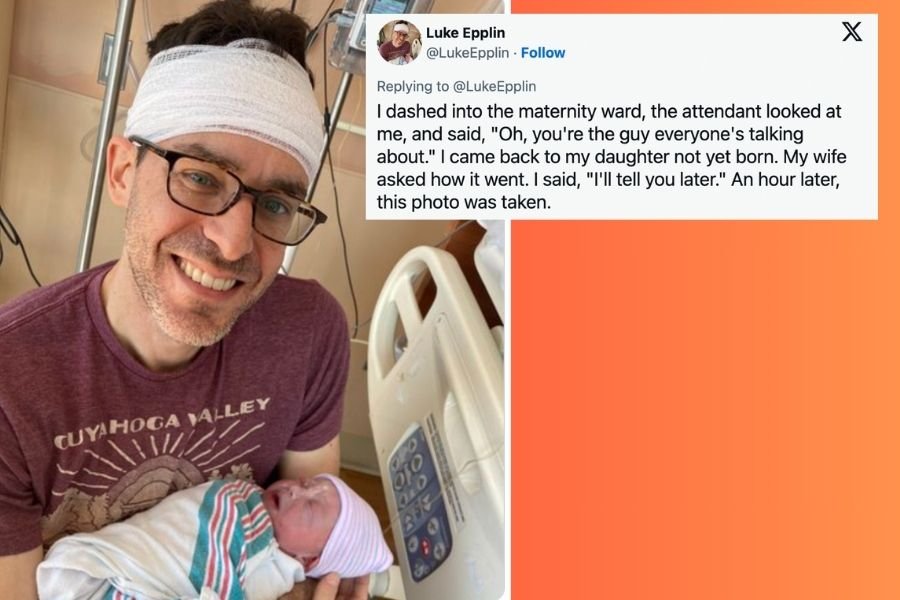
Epplin’s determination ultimately paid off. He had made it before his daughter Ava had been born. Below is their first photo together, head bandages and all.
I dashed into the maternity ward, the attendant looked at me, and said, “Oh, you’re the guy everyone’s talking about.” I came back to my daughter not yet born. My wife asked how it went. I said, “I’ll tell you later.” An hour later, this photo was taken. pic.twitter.com/cke7bbmlmS
“Every picture of me during Ava’s first day on Earth looks like this. I hope that she has a good sense of humor about it some day.”
It’s not completely uncommon for soon-to-be dads to faint in the delivery room. Often, as it seemed to be in Epplin’s case, the cause is low blood sugar. So it might be wise to pack snacks, drinks and meals in a cooler, according to Father Resource. Of course, packing snacks might be the last thing that’s on a father’s mind when the time comes.
But the point is: the situation is nothing to be ashamed of. In fact, it can make for a great birth story. Just ask Epplin!

In a small village in Pwani, a district on Tanzania’s coast, a massive dance party is coming to a close. For the past two hours, locals have paraded through the village streets, singing and beating ngombe drums; now, in a large clearing, a woman named Sheilla motions for everyone to sit facing a large projector screen. A film premiere is about to begin.
It’s an unusual way to kick off a film about gender bias, inequality, early marriage, and other barriers that prevent girls from accessing education in Tanzania. But in Pwani and beyond, local organizations supported by Malala Fund and funded by Pura are finding creative, culturally relevant ways like this one to capture people’s interest.
The film ends and Sheilla, the Communications and Partnership Lead for Media for Development and Advocacy (MEDEA), stands in front of the crowd once again, asking the audience to reflect: What did you think about the film? How did it relate to your own experience? What can we learn?
Sheilla explains that, once the community sees the film, “It brings out conversations within themselves, reflective conversations.” The resonance and immediate action create a ripple effect of change.
MEDEA Screening Audience in Tanzania. Captured by James Roh for Pura
Across Tanzania, gender-based violence often forces adolescent girls out of the classroom. This and other barriers — including child marriage, poverty, conflict, and discrimination — prevent girls from completing their education around the world.
Sheilla and her team are using film and radio programs to address the challenges girls face in their communities. MEDEA’s ultimate goal is to affirm education as a fundamental right for everyone, and to ensure that every member of a community understands how girls’ education contributes to a stronger whole and how to be an ally for their sisters, daughters, granddaughters, friends, nieces, and girlfriends.
Sheilla’s story is one of many that inspired Heart on Fire, a new fragrance from the Pura x Malala Fund Collection that blends the warm, earthy spices of Tanzania with a playful, joyful twist. Here’s how Pura is using scent as a tool to connect the world and inspire action.
A partnership focused on local impact, on a global mission
Pura, a fragrance company that recognizes education as both freedom and a human right, has partnered with Malala Fund since 2022. In order to defend every girl’s right to access and complete 12 years of education, Malala Fund partners with local organizations in countries where the educational barriers are the greatest. They invest in locally-led solutions because they know that those who are closest to the problems are best equipped to solve and build durable solutions, like MEDEA, which works with communities to challenge discrimination against girls and change beliefs about their education.
But local initiatives can thrive and scale more powerfully with global support, which is why Pura is using their own superpower, the power of scent, to connect people around the world with the women and girls in these local communities.
The Pura x Malala Fund Collection incorporates ingredients naturally found in Tanzania, Nigeria, Pakistan, and Brazil: countries where Malala Fund operates to address systemic education barriers. Eight percent of net revenue from the Pura x Malala Fund Collection will be donated to Malala Fund directly, but beyond financial support, the Collection is also a love letter to each unique community, blending notes like lemon, jasmine, cedarwood, and clove to transport people, ignite their senses, and help them draw inspiration and hope from the global movement for girls’ education. Through scent, people can connect to the courage, joy, and tenacity of girls and local leaders, all while uniting in a shared commitment to education: the belief that supporting girls’ rights in one community benefits all of us, everywhere.
You’ve already met Sheilla. Now see how Naiara and Mama Habiba are building unique solutions to ensure every girl can learn freely and dare to dream.
Naiara Leite is reimagining what’s possible in Brazil
Julia with Odara in Brazil. Captured by Luisa Dorr for Pura
In Brazil, where pear trees and coconut plantations cover the Northeastern Coast, girls like ten-year-old Julia experience a different kind of educational barrier than girls in Tanzania. Too often, racial discrimination contributes to high dropout rates among Black, quilombola and Indigenous girls in the country.
“In the logic of Brazilian society, Black people don’t need to study,” says Naiara Leite, Executive Coordinator of Odara, a women-led organization and Malala Fund partner. Bahia, the state where Odara is based, was once one of the largest slave-receiving territories in the Americas, and because of that history, deeply-ingrained, anti-Black prejudice is still widespread. “Our role and the image constructed around us is one of manual labor,” Naiara says.
But education can change that. In 2020, with assistance from a Malala Fund grant, Odara launched its first initiative for improving school completion rates among Black, quilombola, and Indigenous girls: “Ayomidê Odara”. The young girls mentored under the program, including Julia, are known as the Ayomidês. And like the Pura x Malala Fund Collection’s Brazil: Breath of Courage scent, the Ayomidês are fierce, determined, and bursting with energy.
Ayomidês with Odara in Brazil. Captured by Luisa Dorr for Pura
Ayomidês take part in weekly educational sessions where they explore subjects like education and ethnic-racial relations. The girls are encouraged to find their own voices by producing Instagram lives, social media videos, and by participating in public panels. Already, the Ayomidês are rewriting the narrative on what’s possible for Afro-Brazilian girls to achieve. One of the earliest Ayomidês, a young woman named Debora, is now a communications intern. Another former Ayomidê, Francine, works at UNICEF, helping train the next generation of adolescent leaders. And Julia has already set her sights on becoming a math teacher or a model.
“These are generations of Black women who did not have access to a school,” Naiara says. “These are generations of Black women robbed daily of their dreams. And we’re telling them that they could be the generation in their family to write a new story.”
Mama Habiba is reframing the conversation in Nigeria
Centre for Girls' Education, Nigeria. Captured by James Roh for Pura
In Mama Habiba’s home country of Nigeria, the scents of starfruit, ylang ylang and pineapple, all incorporated into the Pura x Malala Collection’s “Nigeria: Hope for Tomorrow,” can be found throughout the vibrant markets. Like these native scents, Mama Habiba says that the Nigerian girls are also bright and passionate, but too often they are forced to leave school long before their potential fully blooms.
“Some of these schools are very far, and there is an issue of quality, too,” Mama Habiba says. “Most parents find out when their children are in school, the girls are not learning. So why allow them to continue?”
When girls drop out of secondary school, marriage is often the alternative. In Nigeria, one in three girls is married before the age of 18. When this happens, girls are unable to fulfill their potential, and their families and communities lose out on the social, health and economic benefits.
Completing secondary school delays marriage, and according to UNESCO, educated girls become women who raise healthier children, lift their families out of poverty and contribute to more peaceful, resilient communities.
Centre for Girls’ Education, Nigeria. Captured by James Roh for Pura
To encourage young girls to stay in school, the Centre for Girls’ Education, a nonprofit in Nigeria founded by Mama Habiba and supported by Malala Fund and Pura, has pioneered an initiative that’s similar to the Ayomidê workshops in Brazil: safe spaces. Here, girls meet regularly to learn literacy, numeracy, and other issues like reproductive health. These safe spaces also provide an opportunity for the girls to role-play and learn to advocate for themselves, develop their self-image, and practice conversations with others about their values, education being one of them. In safe spaces, Mama Habiba says, girls start to understand “who she is, and that she is a girl who has value. She has the right to negotiate with her parents on what she really feels or wants.”
“When girls are educated, they can unlock so many opportunities,” Mama Habiba says. “It will help the economy of the country. It will boost so many opportunities for the country. If they are given the opportunity, I think the sky is not the limit. It is the starting point for every girl.”
From parades, film screenings to safe spaces and educational programs, girls and local leaders are working hard to strengthen the quality, safety and accessibility of education and overcome systemic challenges. They are encouraging courageous behavior and reminding us all that education is freedom.
Experience the Pura x Malala Fund Collection here, and connect with the stories of real girls leading change across the globe.
Actor Alan Rickman gave us so many memorable characters, from the terrorist Hans Gruber in Die Hard to the oft ill-tempered antihero Severus Snape in the Harry Potter films, to the unfaithful husband who broke Emma Thompson’s heart in Love Actually.
Though he was often cast as a villain, Rickman’s distinctive voice and irresistible screen presence made audiences love him. He brought a unique human touch even to his most odious bad guy characters, a quality that makes perfect sense when you hear Thompson, his friend and co-star in seven films, talk about his character in real life.
In a moving tribute upon the release of his diaries in October 2022, Thompson shared insights into the virtues and quirks that made Rickman “blissfully contradictory.”
Alan Rickman signing autographsu00a0at the Brooklyn Academy of Music, January 2011. Photo Credit: Marie-Lan Nguyen via Wikimedia Commons
Thompson is at the top of her award-winning writer game here, and her words about Alan Rickman are filled with heart, wit, respect, admiration and love. It’s truly a eulogy for the ages.
Watch (or read the full transcript below):
People love Thompson’s tribute to her friend and some have even shared their own stories of their encounters with Alan Rickman:
“A close friend of mine bumped into him in a theatre in London many years ago. My friend instantly recognised Mr Rickman and from nowhere, instantly found the courage to ask him for his autograph. Having neither pen nor paper for this, he asked Mr Rickman if he would mind waiting a moment whilst he collected the items from somewhere, anywhere! The moment became at least 10 minutes or so, and when my friend ran back to a now empty theatre foyer, he noticed one solitary figure. Mr Rickman had waited patiently for my friend to give him what he asked for.”
“I was lucky enough to work with him on a film. At lunchtime I joined the line for a meal and as I payed and went to turn to look for a table, someone knocked into me from behind and my drink went flying. I turned and it was Alan, he apologized put his hand on my shoulder and said let me get you another. He came back with a cup of tea and I was so overwhelmed. I was shocked how he was so down to earth and a real gentleman.”
“I meet him once in Boots and said hello, he realised it was a reflex to recognising a known face. He picked up an item we both were looking at, smiled and said “well hello there are we going to arm wrestle for this?” That deep tone rendered me mute, I realised it was Mr Rickman and instantly denied needing this forgotten thing, apologised for well nothing really, smiled and backed away. He was a giant of a fellow on and off the stage and will be missed.”
“Everything she said is true. I was fortunate to have dinner with him and his wife and his drama teacher. He was charming and friendly and shared some great ideas about directing, which I use today in my theater group. He is missed by many.”
Indeed he is.
Here’s the full transcript of Thompson’s tribute:
“The most remarkable thing about the first days after Alan died was the number of actors, poets, musicians, playwrights and directors who wanted to express their gratitude for all the help he’d given them. I don’t think I know anyone in this business who has championed more aspiring artists nor unerringly perceived so many great ones before they became great. Quite a number said, latterly, that they’d been too shy to thank him personally. They had found it hard to approach him. And of all the contradictions in my blissfully contradictory friend (hold on, Thompson), this is perhaps the greatest this combination of profoundly nurturing and imperturbably distant.
He was not, of course, distant. He was alarmingly present at all times the inscrutability was partly a protective shield. If anyone did approach him with anything like gratitude or even just a question, they would be greeted with a depth of sweetness that no one who didn’t know him could even guess at. And he was not, of course, unflappable. I could flap him like nobody’s business and when I did he was fierce with me and it did me no end of good.
He was generous and challenging, dangerous and comical, sexy and androgynous, virile and peculiar, temperamental and languid, fastidious and casual, the list could go on. I’m sure you can add to it. There was something of the sage about him, and had he had more confidence and been at all corruptible, he could probably have started his own religion.
His taste in all things from sausages to furnishings appeared to me anyway to be impeccable. His generosity of spirit was unsurpassed and he had so much time for people I used to wonder if he ever slept or ever got time for himself. A word not traditionally associated with Alan is gleeful, but when he was genuinely amused he was absolutely the essence of glee. There would be a holding back as the moment built, and then a sudden leaning forward and a swinging around of the torso as a vast, impish grin flowered, sometimes accompanied by an inarticulate shout of laughter. It was almost as if he was surprised by himself. It was my life’s mission to provide those moments. I remember Imelda Staunton nearly killing him by telling him a story about my mother and an unfortunate incident with some hashish—it’s a really good story, I won’t tell it now—I’ve never seen him laugh more before or since. It was a bit like watching someone tickling the Sphinx.
One Christmas Eve party I had a sprig of mistletoe hanging up at home, and I was loitering under it and turned to find Alan bearing down on me. I lifted up my chin hopefully. He smiled and approached. I puckered. He leaned in under the mistletoe and a sudden change came over his face. His eyes started to glitter and his nostrils to quiver. He lifted up a hand, reached in, and pulled a longish hair out of my chin. ‘Ow!’ I said. ‘That’s an incipient beard,’ he said, handing me the hair and walking off.
That was the thing about Alan—you never knew if you were going to be kissed or unsettled, but you couldn’t wait to see what would come next. And the trouble with death is that there is no next. There’s only what was, and for that, I am profoundly and heartbrokenly grateful. So the last thing we did together was change a plug on a standard lamp in his hospital room. The task went the same way as everything we have ever done together. I had a go. He told me to try something else. I tried. It didn’t work, so he had a go. I got impatient. I took it from him. I tried it again. It still wasn’t right. We both got slightly irritable, then he patiently took it all apart again and got the right lead into the right hole. I screwed it in with a screwdriver. We complained about how fiddly it was, and then we had a cup of tea. Took us at least half an hour, this thing, and he said after, ‘Well it’s a good thing I decided not to become an electrician.’
I’m still heartbroken that Alan’s gone, but these diaries bring back so much of what I remember of him. There is that sweetness I mentioned, his generosity, his champion of others, his fierce, critical eye, his intelligence, his humor. He was the ultimate ally in life, art, and politics. I trusted him absolutely. He was, above all things, a rare and unique human being and we shall not see his like again.”
It’s a parent’s worst nightmare: Taking your child to the doctor and receiving a life-changing diagnosis. It only adds to the heartbreak when they find out there may be no effective treatment at all, and that all they can do is hope for the best.
Few diagnoses strike fear in the heart of parents and doctors more than a cancer called diffuse intrinsic pontine glioma, or DIPG. Primarily found in children, DIPG is a highly aggressive brain tumor that is uniformly fatal, with less than 10 percent of children surviving longer than two years after diagnosis. The tumors grow fast and on extremely vital areas like the spine and brain stem, making them exceptionally hard to remove. Though young patients have been treated with radiation, chemotherapy, and surgeries, no one had ever been cured of the fatal cancer.
But for the first time ever, a 13-year-old boy from Belgium named Lucas Jemeljanova has beaten the odds.
Various brain scans. Photo credit:
Diagnosed with DIPG at age six, Lucas’ doctor Jacques Grill told Lucas’ parents, Cedric and Olesja, that he was unlikely to live very long. Instead of giving up hope, Cedric and Olesja flew Lucas to France to participate in a clinical trial called BIOMEDE, which tested new potential drugs against DIPG.
Lucas was randomly assigned a medication called everolimus in the clinical trial, a chemotherapy drug that works by blocking a protein called mTOR. mTOR helps cancer cells divide and grow new blood vessels, while everolimus decreases blood supply to the tumor cells and stops cancer cells from reproducing. Everolimus, a tablet that’s taken once per day, has been approved in the UK and the US to treat cancers in the breast, kidneys, stomach, pancreas, and others—but until the BIOMEDE clinical trial, it had never before been used to treat DIPG.
Lucas Jemeljanova poses with his mother. Photo credit: Lesja Jemeljanova via Facebook
Though doctors weren’t sure how Lucas would react to the medication, it quickly became clear that the results were good.
“Over a series of MRI scans, I watched as the tumor completely disappeared,” Grill said in an interview. Even more remarkably, the tumor has not returned since. Lucas, who is now thirteen, is considered officially cured of DIPG.
Even after the tumor was gone, Grill, who is the head of the Brain Tumor Program in the Department of Child and Teenage Oncology at Gustave Roussy cancer research hospital in Paris, was reluctant to stop Lucas’ treatments. Until about a year and a half ago, Lucas was still taking everolimus once every day.
“I didn’t know when to stop, or how, because there was no other reference in the world,” Grill said.
While Lucas is the only one in the clinical trial whose tumor has completely disappeared, seven other children have been considered “long responders” to everolimus, meaning their tumors have not progressed for more than three years after starting treatment.
Lucas with his mother. Photo credit: Lesja Jemeljanova via Facebook
So why did everolimus work so well for Lucas? Doctors think that an extremely rare genetic mutation in Lucas’ tumor “made its cells far more sensitive to the drug,” Grill said, while the drug worked well in other children because of the “biological peculiarities” of their tumors.
While everolimus is by no means a cure, the trial has provided real hope for parents and families of children diagnosed with DIPG. Doctors must now work to better understand why Lucas’ tumor responded so well to the drug and how they can replicate those results in tumor “organoids”—artificially-grown cells that resemble an organ. After that, said Marie-Anne Debily, a researcher in the BIOMEDE trial, “the next step will be to find a drug that works as well on tumor cells.”
A more recent clinical trial tested a new immunotherapy treatment on young DIPG patients and showed promising results. Many of the patients’ tumors shrank and several participants saw functional improvements in their symptoms and day-to-day lives. But only one of the 11 patients has seen success that rivals Lucas’ — a young man identified only as Drew, who has been thriving tumor-free for over four years after receiving treatment.
Once considered a definitive death sentence, there is real hope for the first time. But there’s much more research and work to be done. Until then, however, Lucas’ doctors are thrilled.
“Lucas’ case offers real hope,” said Debily.
Lucas with his parents and sister. Photo credit: Lesja Jemeljanova via Facebook
This article originally appeared two years ago. It has been updated.
Have you ever watched a chicken lay an egg? Think hard before you answer. Many of us may instinctively say, “Of course I have!” but then realize we’ve only seen movie scenes or cartoonsdepictinghens laying eggs. Few of us have actually witnessed a real egg come out of a real hen in real life.
Even fewer of us have seen it the way the folks at @chickenwifehappylife captured it. One of their chickens hopped onto a workbench and laid her egg right on the table in front of them. No nesting-box privacy for this lady. She wanted to show the world what she goes through to lay a single egg, and frankly, she has every right.
“Girl… I promise not to complain about the price of eggs. Please take a day off, you deserve it.”
“I’d be pissed if I had to lay an egg every day.”
“We should have a moment of silence every time we crack an egg as respect. That was some work!”
The overwhelming sentiments people shared were: (1) “Wow, I have truly never watched a hen lay an egg before,” and (2) “Wow, I will never take eggs for granted again.” Some also said, “I don’t know if I want to eat eggs anymore,” rethinking their breakfast choices.
Does it hurt a chicken to lay an egg?
Watching this hen lay her egg on the workbench had people feeling for her. It’s a bit reminiscent of giving birth, especially with her bearing down and “singing the egg song” just before it popped out.
“The reason it is hard to answer this question with complete clarity is because, of course, chickens cannot tell us for sure whether they’re experiencing pain when laying eggs. There are some signs, but we have to be careful not to misread them. For example, for a long time humans (including that first century Roman writer, Columella) believed that the sound many chickens make before laying indicated pain. However, studies found that the sound was instead an “egg song,” which could have a number of explanations, including happiness and scaring off predators. Another study found that when a hen “sings” it is more likely to be associated with contentment, while cackling aligns with danger.”
Naturally, there are things that can go wrong during the egg-laying process that can make it painful. Signs that a hen is in distress while laying include wheezing, distressed squawking, not eating or drinking, isolating, hunching over, drooping, avoiding movement or activity, and slow or awkward movements. Most of the time, however, a hen will recover immediately after laying an egg and go on with life as if nothing happened.
How often do chickens lay eggs?
Hens basically lay eggs daily, but that’s a bit oversimplified.
The University of Wisconsin–Madison notes that hens ovulate, releasing an egg yolk, every 24 to 26 hours. It then takes about 26 hours for the egg white and shell to form around the yolk. As a result, hens typically lay one egg per day, but the timing shifts later each day. Once in a while, a hen will also “skip” a day or two.
Hens did not originally lay more than 300 eggs a year, however. Through centuries of selective breeding, humans have “engineered” chickens to become more prolific egg layers.
Many people have concerns about the well-being of hens used in the industrial production of eggs. Even when we try to make ethical choices about the food we consume, the details are not always clear. Labels on egg cartons, such as “organic,” “cage-free,” and “pasture-raised,” can be confusing, but Certified Humane offers an explainer that helps demystify these terms.
Whatever egg choices we make, seeing the laying process may at least give us a newfound respect and gratitude for the hens who lay them.
It turns out “the voice of a generation” isn’t just a metaphor. Different generations have different ways of speaking, and nowhere is it more obvious than in our television, commercials, and other pop culture.
Even more interestingly, the way people talk in these cultural artifacts sometimes says more about culture in general than the way real people actually speak. For example, the classic “old-timey” accent you hear in films and radio from the early 1900s—called Good American Speech or the Transatlantic accent—wasn’t exactly a reflection of how real people talked. It was adopted by actors to sound more refined and elite, but it’s how many of us often remember the period sounding.
So, too, do modern Millennials have their own distinct voice. And one voice artist says it’s all Jim Halpert’s fault.
The origins of “Millennial speak”
Voice artist Tawny Platis has lent her vocal talents to Hulu, Warner Brothers, Disney+, and many more. She also creates content on YouTube and recently took to the platform to share a fascinating bit of history from her unique industry.
“Jim from The Office is responsible for the Millennial voice,” she proclaims.
In order to explain why actor John Krasinski is the reason “Millennials talk like that,” she takes us back to the popular TV commercials of our youth. Brands like Macy’s and Revlon would feature voiceover actors with a bright, cheery, in-your-face “commercial” voice.
Platis performs them perfectly in her video because, she says, she actually starred in many commercials just like these.
But before Krasinski made it big with his role on The Office, he was a prominent voice actor for brands like Verizon and Blackberry. In those commercials, many of which aired in the early 2000s (when Millennials were coming of age), he was famous for his extraordinarily casual, conversational tone. Think his laid-back Jim Halpert vibe. It’s a stark contrast to the way commercials were performed in the ’90s.
“It was basically just like, ‘Hey, I’m just a guy. I’m not really an actor. … You can trust me. It’s like you’re talking to a friend,” Platis says.
Platis says that for years, until very recently, almost every audition and job she went out for was seeking a “conversational read” exactly like Krasinski’s performances. They became genre-defining.
Hallmarks of Millennial Voice explained
Platis isn’t the first person to identify this distinct way of speaking. For years, “Millennial speak” has been examined (and sometimes maligned) in popular media.
In 2016, NPR wrote about Millennials love of tacking on “I feel like,” to their thoughts as a way of making a point casually and avoiding confrontation. Millennials are also famous for vocal fry, which the University of Melbourne describes as “the creaky voice they often do at the end of sentences that makes them sound eternally bored, cool and relaxed, depending on the listener.”
The style of speaking reflected a powerful move away from anything that felt cheesy, artificial, or overly formal.
For example, remember the “movie trailer voice” guy? Movie trailers don’t use those big, over-the-top narrators with deep gravitas anymore, preferring to let the footage and music speak for itself. This is partly due to the death of legendary voiceover man Don LaFontaine, but the movie trailer voiceover was also becoming too cliche and predictable for the Millennial audience.
Krasinski, who’s naturally likable and “cool,” was the perfect person to bring all of this to life in his super chill but still-friendly way of speaking. It was only furthered cemented by the huge popularity of his character on The Office.
Something changed in the last four years
Platis goes on to say that the Golden Age of Millennial Voice has come and gone, and Gen Zers are taking center stage in the voiceover world.
She describes Gen Z voice as detached and apathetic, “like you’re talking to someone without looking up from your phone.”
And it’s what all the brands want now.
Interestingly, Platis says that the Gen Z voice more closely resembles the sarcasm and unbothered-ness of Gen X—or, their parents.
In other words, it all comes back around. No matter what generation you come from, it’s all but certain that the next one will want to do things their own way. It can hurt to feel like pop culture is leaving you behind, but it’s a necessary process for young people to form their own identities as they take a leading role in the world.
As far as Millennials go, though, that trademarked Jim Halpert voice will never go out of style.
Seven-year-old Ben O’Reilly was the only deaf student in his entire school district. Add the fact that New Hampshire, where Ben lives, is one of the few states in the country without a dedicated school for the deaf, and Ben was pretty alone. Apart from his aide, Cheryl Ulicny, Ben had virtually no one to talk to.
“He didn’t have relationships with his peers or teachers, for that matter,” Ulicny told CBS News. “He was very alone. And he acted very alone.”
That is until a few of Ben’s classmates at Campton Elementary took it upon themselves to start learning basic sign language to communicate with him. Pretty soon, the rest of the class joined in, then other teachers in other grades, until the entire school was in on the project.
Today, almost every member knows at least a little ASL, meaning Ben finally has a community he can communicate with.
As for why the school to this on, Ben’s classmate Reid, who helped start this sweet movement, said it best:
“He is my friend.”
The kind gesture took Ben’s adoptive mothers, Etta and Marlaina O’Reilly, completely aback. Etta shared with CBS News, “I could barely breathe. Like it was just so overwhelming.”
Down in the YouTube comments, viewers were equally moved.
“That is amazing. The first two boys decided to learn asl to communicate with a deaf child. And those three boys sparked a movement for the whole school to learn.”
“There is hope in our children. Thank you for a beautiful story.”
“All of these adults and children, such humanity.”
“Young children who have so much compassion, so beautiful to see. We grownups could learn a lot from them.”
A few folks even reflected on how much a similar act of kindness might have meant for their own deaf loved ones.
“Wow, what a beautiful story. I’m a (CODA) Child Of DEAF Adults. I would have loved to see this when I was younger. The kids in school would make fun of me and my brothers because our parents were deaf. Love this story, thank you to everyone that made this possible for this young boy,” one person wrote.
Another echoed, “My husband is deaf. Born in 1991 in Chicago. He had a great education but he hates thinking back on his school years because he was so isolated; especially in high school. I can only imagine how happy he would’ve been if those around him had done this when he was this boy’s age…”
Children often lead with curiosity and empathy, unburdened by the inhibition adults sometimes carry. This often leads to profound lessons. What started as a small effort by a few classmates became a ripple effect that transformed an entire school community. What a sweet reminder that inclusion does not always require grand gestures. Sometimes it only takes a willingness to meet someone where they are.
It also speaks to a broader shift happening across the country. In recent years, American Sign Language education has steadily expanded, appearing more frequently in school curricula and even fulfilling foreign language requirements in many districts. Online resources, apps, and social media have made learning ASL more accessible than ever, helping bridge communication gaps and normalize its use among hearing individuals.
Ultimately, Ben’s story is about what happens when people choose connection over convenience. Compassionate acts, both big and small, can bring people together in ways that truly change lives for the better.
For folks who struggle with social anxiety, an awkward silence in a conversation rings like a death knell. Strategies for avoiding those moments feel like both cheat codes and life preservers, which is why people are loving the three tips for never running out of things to say shared by Smartish Stuff.
“Being good at conversations isn’t about being confident,” the video states. “It’s about skill. And like any other skill, from playing an instrument to writing well, it can be learned.”
Here are three things to do when you don’t know what to say:
1. Ask intentional questions
At their core, conversations are a back-and-forth of questions and answers and related statements. Mastering the questions part gives you a lot more control over how the conversation goes.
when there's an awkward lull in the conversation and u try to think of any conversation starter pic.twitter.com/dLkvegEHQh
— buffysummere.bsky.social (@buffysummere) June 20, 2016
The example given in the video is someone saying, “I went golfing over the weekend.” How do you respond?
You might say, “Oh, that’s cool.” But that’s where the conversation dies.
Instead, you can ask questions like, “Where do you usually play?” or “How long have you been playing? Do you play competitively?”
“Even if you don’t care about golf, this shows genuine interest or at least creates the feeling of interest,” the video points out. “It also keeps the conversation alive and gives you control to guide it wherever you want.”
2. Listen more than you speak
It might seem logical that talking more will make you a better talker. But in reality, the best conversationalists are skilled listeners.
“Not the fake kind of listening where you’re just waiting for your turn to talk, but active listening,” the video says. “That means paying full attention, not preparing your next line in your head. Because when you do that, you often miss the point completely and end up saying something random or off topic.”
Saying something random because you weren’t really listening is just as mortifying as awkward silence, so active listening is an important skill to master. It also ties into the asking intentional questions tip. As the video states:
“Active listening gives you real material to work with. You’ll pick up details, emotions, or small clues that lead to better follow-up questions. That’s how you keep the flow going, not through clever lines, but through genuine attention. There’s a quote that sums this up perfectly. Most people don’t listen with the intent to understand. They listen with the intent to reply. Don’t be that person. The world has enough of them already.”
Easier said than done when you’re stressed about what to say, but just remember that keeping the focus on really listening will actually give you more to talk about.
Active listening means not trying to think of what you’re going to say next. Photo credit: Canva
3. Find common ground
Sharing interests, experiences, values, tastes in music or food, etc. can help us connect with people quickly. But how do we determine what we might have in common with a person we’re just striking up a conversation with?
The answer to that question will depend on the specific conversation, of course. But employing the first two tips will usually lead you to some kind of common ground.
“Once you find that shared point, steer the conversation there,” the video suggests. “Suddenly, it stops feeling like effort. It becomes natural, fluid, and even fun.”
Will that happen every time? No. And that’s where a bonus tip comes into play: Accept that awkward lulls happen.
“Let’s be honest. Not every conversation will flow perfectly,” the video states. “Some will still hit dead ends. There will be awkward pauses and silent moments. That’s okay. Silence isn’t failure. It’s just space. Learn to be comfortable with it and it’ll stop feeling like pressure.”
I wish people didn’t think silence was awkward, just enjoy it. Not every space has to be filled with words
The goal is not to convince people you’re interesting
The Smartish Stuff video wraps up with some wise words about what makes a good conversation:
“The truth is, good conversations aren’t about charm or confidence. They’re about curiosity, patience, and presence. If you apply these three methods, asking intentional questions, listening actively, and finding common ground, you’ll never truly run out of things to say. And over time, you’ll realize the goal isn’t to be interesting. It’s to be genuinely interested.”
People with social anxiety may still be left with questions, such as “How do I think of follow-up questions when my anxiety makes my mind go blank? How do I listen when I have loud, anxious thoughts blaring through my head? What if I can’t find common ground no matter how many questions I ask and how well I actively listen?”
Anxiety loves to come up with worst-case scenarios and imagine all of the ways something won’t work. And for people with severe social anxiety who need professional help to manage it, these tips may not be enough. But they are still worth working on, as they can help build the foundation that good conversations are based on.
For further help, talking with a therapist, doctor, or trusted friend could lower the volume on anxious thoughts.
Before there was Plato, Aristotle, or even Socrates, there was a group of Greek philosophers who imparted their wisdom onto others in the early 5th century BCE. One such scholar was Empedocles, who was said to have been influential and unique in many ways. (And that’s not just because, as rumor had it, he thrust himself into an active volcano as a sacrifice.) His use of hexameter verse, an impactful writing style which helped turn his philosophical thoughts into poetry, was especially appreciated by writers.
So when researchers in Cairo uncovered 30 unpublished poetic verses approximately 2,000 years after they were written, many took note. Until this discovery, much of his reputation had been built on the backs of historians who came after him. Finding actual additional verses from his work has been downright mind-blowing for many.
An enormous finding
In a paper edited by scientific editor Stephanie Baum for University de Liege, they share that a “2,000-year-old papyrus fragment, discovered in the archives of the French Institute of Oriental Archaeology in Cairo, reveals 30 previously unpublished verses by Empedocles, a pre-Socratic philosopher of the fifth century BCE. This discovery offers researchers direct access to a body of thought previously known only through quotations from later authors.”
The article also eloquently notes what a huge achievement this is by comparing it to the hypothetical discovery of a more modern writer. “To grasp the significance of such a discovery, the authors offer an illuminating analogy: Imagine that in a few centuries’ time, all that remains of Victor Hugo are excerpts from Les Misérables in school textbooks, the musical Notre-Dame de Paris, and the program for a performance of the play Hernani. The discovery of a few pages from an original edition of Hugo’s work would then be a momentous event.”
Love and strife
Empedocles and his work were incredibly impactful. Britannica states that, “Although strongly influenced by Parmenides, who emphasized the unity of all things, Empedocles assumed instead that all matter was composed of four essential ingredients, fire, air, water, and earth, and that nothing either comes into being or is destroyed but that things are merely transformed, depending on the ratio of basic substances to one another.”
These ideas, centered around the basic elements, also helped shape his belief that the human struggle is centered around “love and strife.” “Like Heraclitus, he believed that two forces, Love and Strife, interact to bring together and to separate the four substances. Strife makes each of these elements withdraw itself from the others; Love makes them mingle together. The real world is at a stage in which neither force dominates.”
A famous quote thought to be attributed to Empedocles says, “The force that unites the elements to become all things is Love, also called Aphrodite; Love brings together dissimilar elements into a unity, to become a composite thing. Love is the same force that human beings find at work in themselves whenever they feel joy, love, and peace. Strife, on the other hand, is the force responsible for the dissolution of the one back into its many, the four elements of which it was composed”.
A predecessor to many great thinkers
Philosophy professor Graham Blackbourn, of the School of Philosophy and Economic Science in Edinburgh, is one of many who speak at length on the topic of Empedocles. On a podcast, he shared just how influential his work was.
“Many scholars think that Empedocles was the source of Plato’s myth of the soul’s journey in his dialogue Phaedrus, in addition to some of the themes in his Symposium, including Diotima’s teaching on love. Aristotle referenced Empedocles more often in his writings than anyone other than Plato himself.
So what do we know of Empedocles’ thinking?
Until recently, it was thought that Empedocles wrote two very different books, or poems, since he composed in hexameter verse. One poem was called “On Nature,” a bizarre but essentially materialist account of the evolution of the cosmos. The other was called “Purifications,” concerning religious ideas and practices which it was thought were rather at odds with Empedocles’s materialist cosmology. Neither poem was preserved in its entirety, being known only from quotations in later writings.”
Where can we find these uncovered verses?
Edited by Nathan Carlig, Alain Martin, and Olivier Primavesi, the works are translated with commentary in L’Empédocle du Caire.
The Liege University site directly confirms “It was at the French Institute of Oriental Archaeology in Cairo (IFAO) that Nathan Carlig, a papyrologist at the University of Liège, identified papyrus P.Fouad inv. 218 as an unknown fragment of the Physica, the great poem by the philosopher Empedocles of Agrigentum.”
While the text is not readily available (just yet), the university site gives a bit of insight into what the verses reveal. “The text that has come to light deals with the theory of particle effluvia and sensory perceptions, particularly vision.”
Furthermore, they explain how much the new verses seem to have influenced philosophers who came after him. “Analysis of the text has revealed unexpected connections, including the probable direct source of a passage by Plutarch (2nd century), as well as a dialogue by Plato and a text by Theophrastus, a disciple of Aristotle, both from the 4th century BCE.”
Towards the end of The Beatles’ illustrious but brief career, Paul McCartney wrote Let it Be, a song about finding peace by letting events take their natural course. It was a sentiment that seemed to mirror the feeling of resignation the band had with its imminent demise.
The bittersweet song has had an appeal that has lasted generations, and that may be because it reflects an essential psychological concept: the locus of control. “It’s about understanding where our influence ends and accepting that some things are beyond our control,” Jennifer Chappell Marsh, a marriage and family therapist, told The Huffington Post. “We can’t control others, so instead, we should focus on our own actions and responses.”
The ‘Let Them’ theory, explained
This idea of giving up control (or the illusion of it) when it does us no good was perfectly distilled into two words that everyone can understand: “Let Them.” This is officially known as the “Let Them” theory. Podcast host, author, motivational speaker and former lawyer Mel Robbins explained this theory perfectly in a vial Instagram video posted in May 2023.
“I just heard about this thing called the ‘Let Them Theory,’ I freaking love this,” Robbins starts the video.
“If your friends are not inviting you out to brunch this weekend, let them. If the person that you’re really attracted to is not interested in a commitment, let them. If your kids do not want to get up and go to that thing with you this week, let them.” Robbins says in the clip. “So much time and energy is wasted on forcing other people to match our expectations.”
“If they’re not showing up how you want them to show up, do not try to force them to change; let them be themselves because they are revealing who they are to you. Just let them – and then you get to choose what you do next,” she continued.
Put the ‘Let Them’ theory into practice
The phrase is a great one to keep in your mental health tool kit because it’s a reminder that, for the most part, we can’t control other people. And if we can, is it worth wasting the emotional energy? Especially when we can allow people to behave as they wish and then we can react to them however we choose?
Stop wasting energy on trying to get other people to meet YOUR expectations. Instead, try using the “Let Them Theory.” 💥 Listen now on the melrobbinspodcast!! “The “Let Them Theory”: A Life Changing Mindset Hack That 15 Million People Can’t Stop Talking About” 🔗 in bio #melrobbins#letthemtheory#letgo#lettinggo#podcast#podcastepisode
How you respond to their behavior can significantly impact how they treat you in the future.
It’s also incredibly freeing to relieve yourself of the responsibility of changing people or feeling responsible for their actions. As the old Polish proverb goes, “Not my circus, not my monkeys.”
“Yes! It’s much like a concept propelled by the book The Subtle Art of Not Giving a F**k. Save your energy and set your boundaries accordingly. It’s realizing that we only have “control” over ourselves and it’s so freeing,” one viewer wrote.
Finding Peace Through Acceptance
“Let It Be” brought Paul McCartney solace as he dealt with losing his band in a very public breakup. The same state of mind can help all of us, whether it’s dealing with parents living in the past, friends who change and you don’t feel like you know them anymore, or someone who cuts you off in traffic because they’re in a huge rush to go who knows where.
The moment someone gets on your nerves and you feel a jolt of anxiety run up your back, take a big breath and say, “Let them.”
This article originally appeared two years ago.It has been updated.