upworthy
Add Upworthy to your Google News feed.
Google News Button
Pop Culture

People are sharing the adult problems that 'nobody prepared you for' and they're so true

Here are 21 of the most relatable.
being an adult, adult lessons, growing up
via PixaBay

Being an adult is tough.

Nothing can ever fully prepare you for being an adult. Once you leave childhood behind, the responsibilities, let-downs and setbacks come at you fast. It’s tiring and expensive, and there's no easy-to-follow roadmap for happiness and success. A Reddit user asked the online forum, “What’s an adult problem nobody prepared you for?” and there were a lot of profound answers that get to the heart of the disappointing side of being an adult.

One theme that ran through many responses is the feeling of being set adrift. When you’re a kid, the world is laid out as a series of accomplishments. You learn to walk, you figure out how to use the bathroom, you start school, you finish school, maybe you go to college, and so on.

However, once we’re out of the school system and out from under our parents’ roofs, there is a vast, complicated world out there and it takes a long time to learn how it works. The tough thing is that if you don’t get a good head start, you can spend the rest of your life playing catch-up.

Then, you hit middle age and realize that life is short and time is only moving faster.

Adulthood also blindsides a lot of people because we realize that many adults are simply children who grew older. The adult world is a lot more like high school than a teenager could ever imagine.

The Reddit thread may seem a bit depressing at first, but there are a lot of great lessons that younger people can take to heart. The posts will also make older people feel a lot better because they can totally relate.

Being an adult is hard, exhausting and expensive. But we’re all in this together and by sharing the lessons we’ve learned we can help lighten each other's load just a bit.

Here are 21 of the most powerful responses to the question: “What is an adult problem nobody prepared you for?”

1. Lack of purpose

"Lack of purpose. All your young life you are given purpose of passing exams and learning, then all of a sudden you are thrown into the world and told to find your own meaning," — Captain_Snow.

2. No bed time

"You can stay up as late as you want. But you shouldn't," — geek-fit

3. Friendships

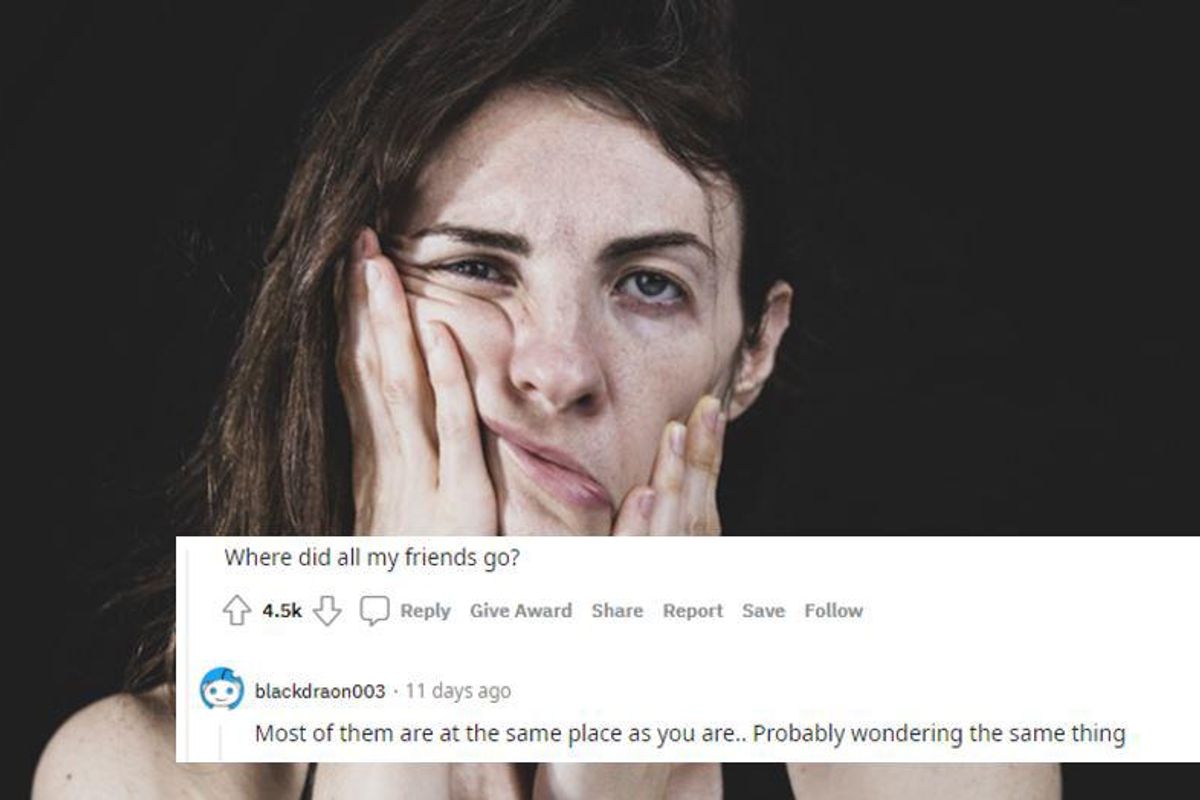
"Where did all my friends go?" — I_Love_Small_Breasts

Most of them are at the same place as you are ... Probably wondering the same thing," — Blackdraon003

4. Bodily changes

"I'm closer to fifty than forty, would have been nice to be better prepared for some of the ways your body starts to change at this point that don't normally get talked about. For instance your teeth will start to shift from general aging of your gums," — dayburner.

5. People don't change

"Didnt know that other adults have the emotional intelligence of teenagers and its almost impossible to deal with logically," — Super-Progress-6386

6. Money

"$5K is a lot to owe, but not a lot to have," — Upper-Job5130

7. Our parents age, too

"Handling the decline and death of your parents," - Agave666

8. Free time

"Not having a lot of free-time or time by myself," — detective_kiara

9. No goals

"Not having a pre-defined goal once I was out of college. Growing up my goals were set for me: get through elementary school! then middle school! Then high school, and get into college and get a degree, then get a job, and then...? Vague "advance in your career, buy a house, find a spouse, have a kid or multiple, then retire." At 22 I had no idea how to break that down more granularly," — FreehandBirdlime

10. Constant upkeep

"Life is all about maintenance. Your body, your house, your relationships, everything requires constant never ending maintenance," — IHateEditedBGMusic

11. Exhaustion

"Being able to do so many things because I'm an adult but too tired to do any of them," — London82

12. Loneliness

"Being an adult feels extremely lonely," — Bluebloop0

13. Dinner

"Having to make dinner every. Fucking. Day," — EndlesslyUnfinished

14. Time changes

"The more life you’ve lived, the faster time seems to go," — FadedQuill

15. You're responsibile, even if you didn't mean it

"You are held to account for bad behaviour for which you are negligent even if you had no intention to cause harm. As a lawyer, I see this all the time. People don't think they're responsible for mistakes. You are," — grishamlaw

16. Work is like high school

"The intricacies of workplace politics," — Steve_Lobsen writes. "

"When you're in school, you think that you won't have to deal with gossiping and bullying once you leave school. Unfortunately, that is not true," — lady_laughs_too_much

17. Nowhere to turn

"How easy it is to feel stuck in a bad situation (job, relationship, etc) just because the cost and effort of getting out can seem daunting. And sometimes you just have to accept a figurative bowl full of shit because you can't afford to blow up your life," — movieguy95453

18. The happiness question

"Figuring out what makes you happy. Everyone keeps trying to get you to do things you're good at, or that makes you money, but never to pursue what you enjoy," — eternalwanderer5

19. Constant cleaning

"The kitchen is always dirty. You’ll clean it at least three times every day," — cewnc

20. Life costs money

"One adult problem nobody prepared me for is how expensive everything is. I always thought that as an adult I would be able to afford the things I wanted, but it turns out that's not always the case! I've had to learn how to budget and save up for the things I want, and it's been a difficult process," — Dull_Dog_8126

21. Keeping above water

"All of it together. I was relatively warned about how high rent is, car bills and repairs, how buying healthy food is expensive as hell but important for your health, how to exercise and save what you can, my parents did their best to fill in my knowledge about taxes and healthcare and insurance that my schooling missed, about driving and cleaning a household, about setting boundaries at work but working hard and getting ahead if you can, about charity and what it means to take care of a pet and others, about being a good partner if you were lucky enough to have one, about how dark and messed up the world is when you just read the news and what all that means to me and my community… I was reasonably warned about all of it.

"No one could have ever prepared me for how hard doing all of it at the same time and keeping your head above that water would actually be," — ThatNoNameWriter


This article originally appeared two years ago.

Joy

People from around the globe share 15 signs that someone is obviously an American

"An Italian told me that Americans walk confidently in the wrong direction."

tourists, american tourists, us tourists, vacation, american style

Americans on vacation.

One of the fun things about traveling to different countries is that you not only get to learn about other cultures, but you also learn some things about your own. Americans who travel abroad often learn that people around the world appreciate them for being open, friendly, and good at spreading hope and optimism.

On the other hand, people in other countries can often tell when an American is coming from a mile away because they speak loudly, whether indoors or outdoors. Americans also have a very peculiar body language and are known to lean on things when they have to stand for an extended period.


A Reddit user posed a question in the AskReddit subforum to learn more about how Americans stand out abroad: What's an "obvious" sign that someone is American? The post received more than 35,000 responses, with an overwhelming number of commenters noting that Americans are all smiles and love to make small talk, something most people appreciate.

According to Redditors, here are 15 "obvious" signs that someone is American:

1. They have a unique confidence

"An Italian told me that Americans walk confidently in the wrong direction."

"Been taught to walk fast, and look worried.. People think you know what you're doing."

2. They're friendly

"I worked as a cashier in a tourist place in Paris, I always recognised Americans because they were kinda friendly to me and they always left tips."

"I guess there are worse things than friendly and generous."


3. Time = distance

"If someone asks how far away something is, an American will tell how you long it takes to get there as opposed to a physical distance."

"It actually pisses off some Americans to give a distance in miles, unless they're calculating gas mileage. In some places, you have to give with and without traffic options. I think it's more valuable info in time than in distance."

4. Grinning at strangers

"The gentle grins you give to strangers if you make eye contact with them as you pass by, at least in the Midwest. was not well received in Germany."

"I dated a European man here in the US. When we walked together, every time I made eye contact with someone on our path I would smile at them, and they would always smile back. Boyfriend was so confused at all these strangers smiling at me. Kept asking if I knew all these people. It was hilarious."


5. They like personal space

"How much personal space they give themselves. Americans like at LEAST an arm's length."

"We're conditioned to fill spaces evenly. I noticed when i worked delivery, spending lots of quality time on elevators that for every new person that enters, everybody shuffles to even things out. Similar thing plays out in social gatherings and bars. Not sure if that's universal or not, but I find it interesting. I think the size of our personal bubbles is because our spaces are generally much larger because we've got the space (heh) to build bigger buildings, sidewalks, roads etc. Might also explain why we're louder. Used to filling larger spaces with volume."

Body language expert Joe Navarro says that among Americans, the social zone for acquaintances and casual interactions is four to 12 feet, while family and close friends stand 1.5 to four feet apart. The intimate zone, for those closest to us, ranges from the skin to about 18 inches.


6. They lean

"According to the CIA, when training to be a spy, you have to unlearn how to lean. Americans tend to lean on things when standing still."

All of this is true, according to Jonna Mendez, the former chief of disguise at the CIA, who has shared some of her tips and tricks for making Americans seem more European. "So we would de-Americanize you," Mendez told NPR. "They think that we are slouchy, a little sloppy. And they think that they can almost see that in our demeanor on the street because they stand up straight. They don't lean on things."


7. They don't have an indoor voice

"I've lived in America for 25 years, and it still irritates me that instead of lowering their voices in restaurants so everyone can hear, Americans just scream over each other and make their restaurants as loud as clubs."

"For some reason, my otherwise smart and wonderful American friends will speak in the same volume, diction, and speed regardless of any outside factor unless specifically asked."

8. Dessert for breakfast

"In my homestay in London, I was told that I was 'so American' for enjoying a piece of cake for breakfast (not frosted cake, but like a nuts and dried fruit spiced coffeecake kind of thing). Apparently, that's exclusively for like a 4 pm snack, and breakfast is more of a savory meal."

"A lot of American breakfast items in my mind are desserts (pancakes, muffins, waffles, etc.). It doesn't mean I won't eat them, but it's kinda weird to do so."

9. They wear their clothes differently

"A British man once told me he knew I was American because I was wearing a baseball cap backwards."

"An Italian told me they could tell I was American because I wore my sunglasses on the top of my head when I wasn't using them."


10. Exposed soles

"While visiting Turkey, I was told that I looked American because I was sitting with one leg across the other, and the bottom of my shoe was exposed. Apparently, it's rude idk."

"In a lot of places outside of the US, showing the bottom of your shoe is rude."

11. Tactical gear

"Tactical sunglasses."

"I'm in the US, and virtually anything marketed towards men has the word 'tactical' in front of it."

12. They love small talk

"I'm from California (though a smallish town), and we wave to neighbors on our road, even if we haven't met, and start conversations in the grocery line with people if the opportunity presents itself. Also, smiling and saying hello to someone you happen to walk by and make eye contact with is quite normal. We are a social species, it would be so weird not to be friendly, even to strangers, for me, and I'm not even that social of a person."

"What really gets me to it is not that Americans do small talk constantly, but the fact that they are so good and fast at it. I mean, I say 'yeah, it's hot,' and they reply with some interesting fact or make a connection to their hometown. I feel less of myself after this. They must have some small talk class in school or some sh*t."

13. They like to point

"I've always observed my US friends like to point at stuff while walking and say what it is…. We were out walking around Amsterdam recently and they were like 'hey look it's a smoke shop'…. 'Oh look a sex shop'…. 'Oh hey, it's a prostitute' …. 'Look at the canal'…. 'Wow it's another prostitute'….. 'another canal' etc etc. It was like watching Netflix with Audio Descriptions turned on."

"You know that little voice inside your head, your internal monologue? Americans seem to monologue their thoughts."


14. Optimism and enthusiasm

"Dunno in all context, but Americans in Europe stand out with their ceaseless optimism and enthusiasm."

"I'm reminded a lot of Ted Lasso. Everyone I know (all Americans) loves the show. I wonder what kind of European fan base it has."

"Americans are so positive and have such a thirst for life. It sickens me."

15. They eat while walking

"When I lived in Europe, people said only Americans eat while walking. I'd be eating a bagel or something on the way to work or class, and multiple people asked if I was American lol."

"Jay Leno said on Top Gear, I think it was, that Americans are also the only people who eat while driving. I don't do this, but I constantly see people who do, haha, especially in LA, where people spend a lot of time in their cars."

ableism, disability, inclusion, conversation, identity

Jackie Lopez is eating soup and spouting her truth.

When she was three years old, Jackie Lopez lost her arms in an accident. Growing into adulthood without those appendages, she has learned and trained to use her legs as arms and her feet as her hands to feed herself, make meals, play video games, wrap Christmas gifts, and any other activity a person could do. Throughout her life, people have remarked about how tough her circumstances are and how strong she is, and to all of those people she has one request: Please stop.

“Because I don’t have arms, I get these comments a lot and a lot of people think it’s a compliment when it really isn’t. It’s so annoying and irritating to see and hear all the time,” Lopez explained on social media.


@minjacks

[my audio got messed up 🫩]this how I FEEL, maybe other disabled ppl don’t mind but i do. #foryou #disabilitytiktok #disabled #disabilityawareness #imjustagirl

In her video, Lopez shared the three most common comments she receives as a disabled person that aren’t outwardly or intentionally mean, but annoy and actually hurt her. She prefaced her video saying that, while these comments are mostly her pet peeve and other disabled folks may not mind them, it might be a good idea to not say these things to other disabled people either.

“I could never…”

Lopez shared how hearing people say “I could never be like you/use my feet like you/live like you/etc.” really annoyed her because she had no other option but to use her feet as her hands. Saying “I could never” can be interpreted as a form of othering, even though the intention of the comment was good.

“Oh, my problems are suddenly small.”/ “I should stop complaining about my life.”

Lopez shared that this type of comment made her feel guilty, both for herself and for those who say it to her. She explains that just because an able-bodied person’s problems are different, it doesn't invalidate them. Her having no arms doesn’t make the able-bodied person’s problems go away or mean those problems should be unaddressed.

“Girl, just complain,” said Lopez. “If I were you and I had hands, best believe I would complain, too.”

@minjacks

how i play my switch 🎀🎮✨. #foryou #latina #chapina #armlessgirl #disability #disabilitytiktok #howtotiktok #girlgamer #GamerGirl #nintendo #nintendoswitch #nintendoswitcholed #oledswitch

“God gives the hardest struggle to the strongest people.”

This comment really annoyed and hurt Lopez, especially when she was growing up in the church. Aside from the presumption of faith with a comment like this, the framing of it makes it seem like Lopez’s disability was destined or given as some form of divine “test” after going through a life-altering experience.

“Keep your belief to yourself and don’t put it on me,” she asked. “I went through this, not you.”

Other comments and thoughts

Commenters noted how impressed they were by what Lopez could do with her feet, while other commenters immediately replied to them with versions of, “This is the type of stuff she’s talking about.” In spite of that, several other commenters cosigned Lopez’s feelings with some of them sharing “kind” comments that bothered them:

“While you’re sitting commenting that you ‘couldn’t imagine’ living her life, she’s eating soup and making a TikTok like any other person.”

“I hate when people say ‘You're such an inspiration’ like in what way have I inspired you? Are you trying to become disabled?”

“‘Suddenly my problems are small’, translation ‘I’m happy that I’m not like you and I see you as your struggles.’”

“‘You’re so strong, I just would’ve died’ Like, oh, okay, so you’d rather choose death than what I went through? What should I do with that information?”

“Those are very valid points. People need to be more considerate about what they say.”

“‘I could never.’ Well yeah, it didn't happen to you, it happened to her and as we can all see she could and can. You aren't obliged to make fantasy scenarios to be horrified at.”

“I get so annoyed for you. Even in this current comment section people are saying similar-ish things.”

“Some of them come from a place of kindness, but like you said, it gets to a point where you need to stop infantilizing and pitying every single disabled person you meet by reminding them that their life and their normal is different to everyone else’s.”

Lopez's video went viral, encouraging her to make a second one with even more "compliments" or "nice" comments that she frequently hears that aren't boosting or helpful at all.

@minjacks

if u ain’t disabled stop telling me how i should feel bout these comments. #foryou #disabilitytiktok #disabled #disabilityawareness #imjustagirl

She ends her video saying that those types of comments have formed into a type of ableism—and she has a point based on anecdotes from others who are blind, paralyzed, or are otherwise differently-abled. Based on hearing these experiences, it's best for everyone to stop, slow down, and take an intentional beat to consider their words before saying them—even if they have the best intentions.

john waite, police, cops, rock stars, musicians
Photo credit: Kiowa County Sheriff’s Office via Facebook, cropped

Kansas police pulled over an '80s pop star, and it led to a wholesome moment.

Being pulled over by the police is always nerve-racking, and it's probably even more awkward when the driver is a pop star with multiple chart-topping singles. In July 2025, one such encounter went viral after sheriff's deputies in Kiowa County, Kansas, stopped a vehicle transporting British '80s hitmaker John Waite. But instead of leading to tension, the traffic stop resulted in a genuinely wholesome moment.

Waite and his band were en route to their concert at United Wireless Arena in Dodge City when they were pulled over for speeding. Sergeant Justin Rugg just happened to be a longtime fan. "I'm not even on cloud nine; I'm on like cloud 12," he said after making the stop, according to the Kiowa County Sheriff Office's Facebook page. The post continued: "It's not every day our Deputies get to pull over cool guys!!"


Everyone was a good sport about the whole thing. Waite took a photo with the officer and even had his band pose for another, leaning over the hood of the patrol car and looking back at the camera in mock confusion. The band eventually made it to the show, and both Waite and the sheriff's office shared the photos. The KCSO wrote to Waite, "Have a rockin' time and check out that beautiful Kansas sky!" On his own account, the musician added, "Pulled over for speeding. Good guy cop!"

- YouTube www.youtube.com

"The next thing I know, I'm taking photographs with him, and we're almost wrestling"

Neither the report nor the social media posts officially say whether Waite's crew received a speeding ticket, but given the cordial tone of the photo session, it seems likely they were let off with a warning.

The comment sections are full of solid jokes and observations, including this one: "Excuse was he didn't want to be late for a show. He got off with a verbal. I'm going to have to try that next time." A commenter whose profile lists their occupation as a 911 dispatcher with the Kiowa County Sheriff's Office wrote: "I was just excited to dispatch on this call lol!! Freaking AMAZING!!!!! Hey, John Waite, stop in here on your way back!! It's my weekend to work so I didn't get to see you!!!!"

Months later, Waite laughed about the viral encounter during an interview with the YouTube channel AccordingToAmabile.

"[The officer] says, 'Who are you?'" he recalled. "I'm going, 'John Waite.' He says, 'John Waite!' And the next thing I know, I'm taking photographs with him, and we're almost wrestling. Everybody's cracking up and laughing. He was a great guy! That night, I look out in the audience, and he's raging, jumping up and down about four rows back! You meet some fantastic people [as a musician]. You really do. And a lot of it's very funny."

- YouTube www.youtube.com

You've probably heard Waite's '80s hits

While many people admitted they don't recognize the singer's name, it's likely they've heard at least a few of his songs.

Waite's first prominent gig came in the late '70s as the frontman and bassist of the hard rock–power pop band The Babys, best known for minor hits like "Isn't It Time" and "Every Time I Think of You." The group, which briefly included Journey keyboardist Jonathan Cain, broke up in 1981, and Waite launched a solo career the following year with his debut LP, Ignition. He enjoyed a long run of commercial success in the decade, landing 10 singles on the Billboard Hot 100, including his ultra-smooth 1984 No. 1 hit "Missing You." (If you haven't seen the music video, do yourself a favor. It's 1984 in visual form. Classic stuff.)

In between his various solo projects and tours, Waite had another breakthrough moment. In 1988, he co-founded the supergroup Bad English, which scored a No. 1 hit the following year with the sleek ballad "When I See You Smile." No wonder Sergeant Rugg was so impressed.

- YouTube www.youtube.com

interruptions, conversation techniques, problem solving, psychology, behavior

Stop being interrupted.

There are times when you end up with that one friend who never lets you get a word in. They constantly cut you off or interrupt. You know they're not intentionally trying to hurt or annoy you, but you still wish you could bring it up in a way that won't cause friction or put them on the defensive.

Fortunately, a behavior researcher has a three-part tip that allows you to raise the issue naturally and without being harsh.


Former lawyer turned self-leadership expert Dr. Shadé Zahrai took to social media to share a simple technique for getting interrupters to slow down and let you finish your thoughts. Here are the three steps she recommends:

@shadezahrai

Someone keep cutting you off? Try this.

1. Identify their behavior

Zahrai recommends starting a one-on-one conversation with a chronic interrupter by saying, "When you interrupt me…" or something similar.

This approach lets you point out the behavior itself without judgment, passive aggression, or labels like calling it "rude" or "mean."

2. Express how their interruptions impact you

Zahrai says to follow up by acknowledging the interrupting behavior and using "I feel…" statements.

This shifts the focus to you rather than the interrupter, helping them understand that the behavior makes you feel annoyed, hurt, unheard, or however you feel when they cut you off mid-conversation. This approach is less accusatory because you're explaining how the interrupting behavior affects you, not criticizing the person themselves.


@boots.withthefurr

i’m sorry to people who have to have a conversation with me #foryoupage #fyp #funny #relatable

3. Give opportunity for explanation

In the final step, Zahrai recommends offering the floor to the interrupter by asking questions like, "Can you help me understand…?"

This gives the interrupter their "day in court," allowing them to take ownership and explain why they keep interrupting you. It can help you better understand where they're coming from, give them space to recognize their behavior and adjust it, or open a dialogue to establish ground rules for future conversations. Instead of sounding accusatory with a "You need to fix your behavior"–type statement, this approach puts them in control and helps prevent conflict.

Other options

Along with Zahrai's method, there are other effective tips for handling interruptions that can be incorporated into her three-step technique or used on their own.

For example, if you plan to use Zahrai's advice, it can help to make this a separate, private conversation rather than addressing it in the moment you were interrupted. This allows you to approach the discussion calmly and ensures the interrupter doesn't feel embarrassed or shamed by others who might overhear.

If you notice someone being interrupted in a conversation, you can casually give them a second chance to finish their thought by inviting them back in. For example: "Carol, you were mentioning something about ____. Could you elaborate on that?"

After you've spoken with the interrupter about their behavior, and they're still struggling, different solutions may help depending on why they interrupt. For example, if they're afraid of losing a thought, you might suggest a simple nonverbal signal, like raising a finger or hand, so you can acknowledge them and return to their point after you finish your sentence.

Regardless of the solution you and the interrupter settle on, Zahrai's tips help ensure the conversation happens with as little friction, hurt feelings, and conflict as possible.

sleep, bedtime, better sleep, how to get good sleep, consistent bedtime

The time of night you should go to bed for the best sleep, according to science.

Getting a full night of deep, restful sleep is a struggle. From waking up in the middle of the night to having trouble falling asleep, figuring out the perfect nighttime routine to lull you into sleep is crucial to wake up fully rested. One element that may be throwing off your sleep schedule is what time you go to bed. According to Apple Watch data published in the Apple Heart and Movement Study from 2025 (via Axios), the average American bedtime is 11:37 p.m.

But when is the best time to go to bed for optimal sleep? According to science, 10 p.m.


Researchers in the United Kingdom found that study participants who consistently went to bed at 10 p.m. reported the lowest risk of cardiovascular disease. Those who went to bed between 10:00 p.m. and 10:59 p.m. reported lower incidence than those who went to bed between 11:00 p.m.–11:59 p.m., and after 12:00 a.m.

- YouTube www.youtube.com

Dr. Emma Lin, a board-certified pulmonologist and sleep medicine specialist and the co-founder of AimVein, tells Upworthy that the body starts preparing you for sleep even earlier.

"Around 9 to 10 p.m., the production of melatonin begins in the brain. This is the hormone that gives your body the signal that it is time to go to sleep," she says. "The body temperature drops. The heart beats slower. The breathing becomes rhythmic."

By then, the body is perfectly prepped for a good night of sleep.

"When people go to bed at 10 p.m., they sleep better and faster. Their bodies breathe better," says Dr. Lin. "Most people wake up feeling refreshed. Going to bed at this time corresponds to the body’s natural rhythm."

sleep, deep sleep, good sleep, better sleep, bedtime Woman wearing a sleeping mask asleep in bed by 10 p.m.Photo credit: Canva

Of course, going to bed at 10 p.m. may be way too late or totally unrealistic for some people. In that case, Dr. Lin stresses that what's most important is going to bed at the same time every night.

"Your body loves the same routine every day. This is what I always tell my patients. The brain works like a clock. If the clock doesn’t go to bed and wake up at the same time every day, it will be confused," she explains. "But if the clock goes to bed at the same time every day, it will know when it’s time to slow down. The melatonin will be released on schedule. The breathing will calm down. Patients with insomnia and sleep apnea will see an improvement in their sleep pattern just by having the same bed time every day."

The goal is to sleep 7–9 hours each night, which is recommended by the National Sleep Foundation. Dr. Lin adds that this amount of sleep allows the body and brain to recover completely.

sleep, phone use at night, on phone in bed, bedtime, phone use before bed Woman struggles to sleep on her phone.Photo credit: Canva

"Sleeping is cyclical. Some phases are good for the immune system. Others are good for memory. Deep phases are good for allowing the lungs and heart to rest, she says. "When people get less than 7 hours’ sleep, I see increased daytime sleepiness, increased levels of stress hormones in the body, and increased breathing difficulties in people with breathing problems like asthma or lung disease when they get inadequate sleep. Adequate sleep allows the body to heal itself."

So, if you are looking to go to bed at 10 p.m. (or a time that will be consistent for you to hit the 7-9 hours), Dr. Lin suggests you avoid these two things to get good sleep: "Exposure to bright light can turn the brain’s internal clock back. Using electronic devices at night suppresses melatonin," she says. "And drinking alcohol can exacerbate breathing problems at night. I tell all my patients that sleep is not a lazy activity. Sleep is a healing activity."