upworthy
Add Upworthy to your Google News feed.
Google News Button
Pop Culture

People are sharing the adult problems that 'nobody prepared you for' and they're so true

Here are 21 of the most relatable.
being an adult, adult lessons, growing up
via PixaBay

Being an adult is tough.

Nothing can ever fully prepare you for being an adult. Once you leave childhood behind, the responsibilities, let-downs and setbacks come at you fast. It’s tiring and expensive, and there's no easy-to-follow roadmap for happiness and success. A Reddit user asked the online forum, “What’s an adult problem nobody prepared you for?” and there were a lot of profound answers that get to the heart of the disappointing side of being an adult.

One theme that ran through many responses is the feeling of being set adrift. When you’re a kid, the world is laid out as a series of accomplishments. You learn to walk, you figure out how to use the bathroom, you start school, you finish school, maybe you go to college, and so on.

However, once we’re out of the school system and out from under our parents’ roofs, there is a vast, complicated world out there and it takes a long time to learn how it works. The tough thing is that if you don’t get a good head start, you can spend the rest of your life playing catch-up.

Then, you hit middle age and realize that life is short and time is only moving faster.

Adulthood also blindsides a lot of people because we realize that many adults are simply children who grew older. The adult world is a lot more like high school than a teenager could ever imagine.

The Reddit thread may seem a bit depressing at first, but there are a lot of great lessons that younger people can take to heart. The posts will also make older people feel a lot better because they can totally relate.

Being an adult is hard, exhausting and expensive. But we’re all in this together and by sharing the lessons we’ve learned we can help lighten each other's load just a bit.

Here are 21 of the most powerful responses to the question: “What is an adult problem nobody prepared you for?”

1. Lack of purpose

"Lack of purpose. All your young life you are given purpose of passing exams and learning, then all of a sudden you are thrown into the world and told to find your own meaning," — Captain_Snow.

2. No bed time

"You can stay up as late as you want. But you shouldn't," — geek-fit

3. Friendships

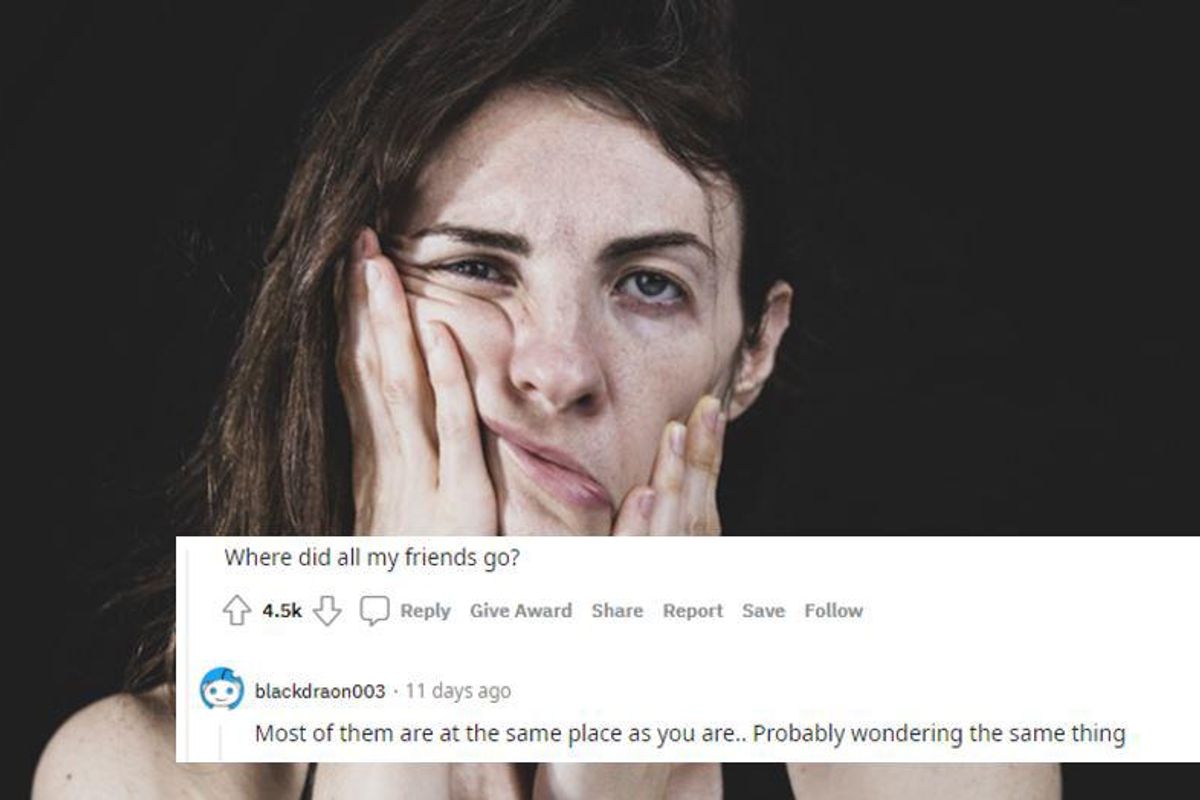
"Where did all my friends go?" — I_Love_Small_Breasts

Most of them are at the same place as you are ... Probably wondering the same thing," — Blackdraon003

4. Bodily changes

"I'm closer to fifty than forty, would have been nice to be better prepared for some of the ways your body starts to change at this point that don't normally get talked about. For instance your teeth will start to shift from general aging of your gums," — dayburner.

5. People don't change

"Didnt know that other adults have the emotional intelligence of teenagers and its almost impossible to deal with logically," — Super-Progress-6386

6. Money

"$5K is a lot to owe, but not a lot to have," — Upper-Job5130

7. Our parents age, too

"Handling the decline and death of your parents," - Agave666

8. Free time

"Not having a lot of free-time or time by myself," — detective_kiara

9. No goals

"Not having a pre-defined goal once I was out of college. Growing up my goals were set for me: get through elementary school! then middle school! Then high school, and get into college and get a degree, then get a job, and then...? Vague "advance in your career, buy a house, find a spouse, have a kid or multiple, then retire." At 22 I had no idea how to break that down more granularly," — FreehandBirdlime

10. Constant upkeep

"Life is all about maintenance. Your body, your house, your relationships, everything requires constant never ending maintenance," — IHateEditedBGMusic

11. Exhaustion

"Being able to do so many things because I'm an adult but too tired to do any of them," — London82

12. Loneliness

"Being an adult feels extremely lonely," — Bluebloop0

13. Dinner

"Having to make dinner every. Fucking. Day," — EndlesslyUnfinished

14. Time changes

"The more life you’ve lived, the faster time seems to go," — FadedQuill

15. You're responsibile, even if you didn't mean it

"You are held to account for bad behaviour for which you are negligent even if you had no intention to cause harm. As a lawyer, I see this all the time. People don't think they're responsible for mistakes. You are," — grishamlaw

16. Work is like high school

"The intricacies of workplace politics," — Steve_Lobsen writes. "

"When you're in school, you think that you won't have to deal with gossiping and bullying once you leave school. Unfortunately, that is not true," — lady_laughs_too_much

17. Nowhere to turn

"How easy it is to feel stuck in a bad situation (job, relationship, etc) just because the cost and effort of getting out can seem daunting. And sometimes you just have to accept a figurative bowl full of shit because you can't afford to blow up your life," — movieguy95453

18. The happiness question

"Figuring out what makes you happy. Everyone keeps trying to get you to do things you're good at, or that makes you money, but never to pursue what you enjoy," — eternalwanderer5

19. Constant cleaning

"The kitchen is always dirty. You’ll clean it at least three times every day," — cewnc

20. Life costs money

"One adult problem nobody prepared me for is how expensive everything is. I always thought that as an adult I would be able to afford the things I wanted, but it turns out that's not always the case! I've had to learn how to budget and save up for the things I want, and it's been a difficult process," — Dull_Dog_8126

21. Keeping above water

"All of it together. I was relatively warned about how high rent is, car bills and repairs, how buying healthy food is expensive as hell but important for your health, how to exercise and save what you can, my parents did their best to fill in my knowledge about taxes and healthcare and insurance that my schooling missed, about driving and cleaning a household, about setting boundaries at work but working hard and getting ahead if you can, about charity and what it means to take care of a pet and others, about being a good partner if you were lucky enough to have one, about how dark and messed up the world is when you just read the news and what all that means to me and my community… I was reasonably warned about all of it.

"No one could have ever prepared me for how hard doing all of it at the same time and keeping your head above that water would actually be," — ThatNoNameWriter


This article originally appeared two years ago.

Pop Culture

All In: 5 Ways This Week

From the silly to the sentimental, there are so many ways people like to go “all in” on something. Here are our five favorite examples we found this week across the internet.

5 ways people are going "All In" this week
True

When you hear the words “all in,” what do you think? You might picture a Dancing with the Stars trend gone viral or maybe bridesmaids who fully supportive of the bride's favorite movie (and recreates an iconic scene). Whatever you picture, the idea is the same: Someone who does something with 100 percent total commitment. Going “all in” means giving your all—going completely over the top, no second guessing, no holding back. Just full-throttle enthusiasm, with some flair and creativity thrown in. And when people go “all in,” something truly special usually happens as a result.


The internet abounds with examples of people giving it their all—whatever it is. In this roundup, we’ve found the very best examples of people going “all in”—moments where passion, creativity, and commitment take center stage. Some are sentimental, some are silly, but all of them are a reminder that giving 100 percent is truly the only way to leave a mark on this world. Get ready: These folks didn’t just show up, they went all in.


1. An Iconic "snow-coaster"

One thing about going all in - it can be crazy and childish at times. That’s something that makes going all in special, connecting with that side of you that takes things less seriously in order to have some fun. Shira Goldstone and her husband took to that mindset when it started snowing in their backyard. Shira’s husband picked up planks of wood (and whatever other tools are required) and within the same night, in the falling snow, built a “snow-coaster” for the two of them to play on.

2. A Truck That's Feeding It's Community

You already know our friends at All In—they’ve got some seriously tasty snacks that are not only healthy and affordable (scroll to the bottom of this article to see how you can snag a free bar), they help fund food banks, gardens, community fridges, meal programs, and other amazing things

For Giving Tuesday, All In teamed up with Fresh Truck, a weekly mobile market that brings fresh and affordable produce to neighborhoods in the Boston area. Fresh truck hosts weekly markets, pop-up events, and an online storefront, all to help strengthen communities who need it the most. They’re going all in on local nutrition and food access, and we’re here for it.


3. All In on Madam Morrible

I’m always all in on a good TikTok trend. This week, I’m going to share with you a classic that has come out of the Wicked franchise and the incredible actress Michelle Yeoh.

Michelle, who plays Madame Morrible in the Wicked movies, is an outstanding actress. She’s known for iconic films like Everything, Everywhere, All At Once, as well as Crazy Rich Asians and Star Trek. But her legacy might be this one quote, which she’s said in interviews countless times, and now people can’t stop making videos with the phrase “Madame Morrible, M.M…flip it around, W.W. Wicked Witch!”

You might have to take a look at how people are going all in yourself, the sound has taken off with already 14.3K videos, and the variations are unstoppable...defying all odds and maybe even...defying gravity?

4. Spotify Wrapped: All in on "Coconut Mall"

TikTok · Ale

www.tiktok.com

There’s nothing better than finding a song that hits just right and gets you feeling productive. For some people, it’s lofi beats. For others, it’s orchestra music. For TikTok user @aleinmotion, it was the “coconut mall” song from the Mario Kart racing soundtrack. Ale never realized how much she listened to the song until it became #1 on her Spotify Wrapped. Sometimes you’ll be surprised by what you love most, and I’m thinking this is one of those moments for Ale.

5. A Family Prank Everyone Enjoys

This girl said her boyfriend had an ugly hat, so her family decided to go all in on supporting him instead. This is when love and humor come together, a perfect prank that actually made the boyfriends day…and taught his girlfriend that nothing is really that serious! They even got the daughter her very own hat as well, and she looked happy to wear it!

As someone who grew up with a dad who always wore floppy hats to protect him from the sun, I understand the embarrassment. Maybe it’s time I go all in and show my support with a matching hat and white long sleeve sun shirt!

Snag your free (!!) snack bar here while this deal lasts. Simply sign up with your phone number, pick up your favorite flavor of an All In bar at Sprouts, and then text a picture of your receipt through Aisle. They’ll Venmo or PayPal you back for the cost of one bar. Enjoy!

batteries, energy, sustainability, power, breakthroughs

UCI doctoral candidate Mya Le Thai has developed a nanowire-based technology that allows lithium-ion batteries to be recharged hundreds of thousands of times.

A quote widely attributed to the Roman philosopher Seneca says, "Luck happens when preparation meets opportunity." In 2016, a doctoral candidate at the University of California Irvine proved that this is indeed the truth.

Nine years ago, Mya Le Thai, PhD was playing around in the lab when she made a colossal discovery that could lead to a rechargeable battery—that could last up to 400 years. That means longer-lasting appliances, laptops, smartphones, cars and so much more, plus fewer lithium ion batteries piling up in landfills.


A team of researchers at UCI had been experimenting with nanowires for potential use in batteries, but found that, over time, the thin fragile wires would break down and crack after too many charging cycles. A charge cycle is when a battery goes from completely full to completely empty and back to full again.

charging station, battery, charging battery, charge, batteries Phone charging.Canva Photos.

But one day on a whim, Thai coated a set of gold nanowires in manganese dioxide and a Plexiglas-like electrolyte gel.

"She started to cycle these gel capacitors, and that's when we got the surprise," said Reginald Penner, chair of the university's chemistry department. "She said, 'this thing has been cycling 10,000 cycles and it's still going.' She came back a few days later and said 'it's been cycling for 30,000 cycles.' That kept going on for a month."

This discovery is mind-blowing because the average laptop battery lasts 300 to 500 charge cycles. The nanobattery developed at UCI made it though 200,000 cycles in three months. That would extend the life of the average laptop battery by about 400 years. The rest of the device would have probably gone kaput decades before the battery, but the implications for a battery that lasts hundreds of years are pretty startling.

- YouTube www.youtube.com

“Mya was playing around, and she coated this whole thing with a very thin gel layer and started to cycle it,” Penner added. “She discovered that just by using this gel, she could cycle it hundreds of thousands of times without losing any capacity.”

“That was crazy,” he added, “because these things typically die in dramatic fashion after 5,000 or 6,000 or 7,000 cycles at most. ”"The big picture is that there may be a very simple way to stabilize nanowires of the type that we studied. If this turns out to be generally true, it would be a great advance for the community."

Not bad for just fooling around in the laboratory!

science, discovery, lab, batteries, Bill Nye, gif bill nye chemistry GIF by NETFLIX Giphy

Since her discovery, Mya Le Thai earned her PhD and has gone on to a successful career as the Principal Scientist with the Enevate Corporation, a company set "to develop innovative battery technologies that accelerate adoption of electrified mobility," according to their website.

She has also filed patents for her various inventions, the most recent of which being "Cells with blocking devices for delayed heat propagation" in July 2025. Her full list of patents can be found on Justia.

This article originally appeared eight years ago. It has been updated.

neuroscience, brain coach, emotions, success, achievement, change, evolution, the self

A woman at a laptop.

Just about all of us have something we’d like to improve in our lives. Most of us would like to be more resilient, more proactive in accomplishing our goals, break bad habits, remain open to change, and stay calm when we are emotionally triggered.

Ed Janes, a life coach who uses scientifically proven neurological research to help people improve their lives, says these changes all start in our minds, specifically with our beliefs. In a recent TikTok video, he shared the five beliefs that we should all adopt to change our lives for the better.


“I don't know who needs to hear this, but here are the five best beliefs to have, backed by neuroscience. If you have these, pat yourself on the back. And if you don't have these, start to integrate them,” he opens the video.

@rewirethemindcoaching

Have you got these? #fyp #successful #selfbelief #neuroscience #goals

Note: I have simplified Jane’s explanations so they are easier to understand for everyone.

1. “My emotions are data, not my identity”

When you are emotionally affected by something that you read on the Internet or that someone tells you face-to-face, realize that the emotions you experience are just a symptom of the situation and do not reflect who you are as a person. This belief activates the prefrontal cortex, the part of your brain associated with impulse control, and the emotional part of your brain relaxes, allowing you to think more clearly.

2. “My actions create clarity.”

Do you have a project you’d love to start but never feel it’s the right time? This belief actually trains your brain to avoid taking action, leading to predictive paralysis and overthinking. However, once you take the first steps on the task, whether it’s the perfect moment or not, your body floods with adrenaline and dopamine, which reward you with clarity to proceed with your project. “Stop waiting for the perfect moment. It's intellectualized procrastination,” Janes' says.

Jane's words echo those of Napoleon Hill, author of the 1937 mega bestseller Think and Grow Rich. In the book, he says that if you want to do something, start now. “Do not wait: the time will never be ‘just right.’ Start where you stand, and work with whatever tools you may have at your command, better tools will be found as you go along."


3. “Pain is neurofeedback, not punishment”

Reframing discomfort as feedback activates the part of the brain that helps guide you through stressful situations and increases your threshold for stress. In the long run, activating this belief when you experience physical pain will help you build a pain threshold and remain calm in stressful situations.

4. My identity drives my behaviour, not my willpower

Let’s say you have a problem with wasting your time doomscrolling. Janes says you should change your self-concept from someone who doom-scrolls to someone who isn’t interested in what’s happening on [insert your social media platform]. When you change to the new belief, the parts of your brain associated with habit formation will kick into action. “So when you change your identity, you will change your actions,” the name says.


5. “My brain can change at any age”

When you genuinely believe that your brain still has the power to change, the areas of the brain associated with learning (the hippocampus, basal ganglia, and prefrontal cortex) begin to fire up. “So when you actually give yourself this belief, it already starts making you learn faster, deal with emotions better, you regulate yourself better, and you also come back from your losses and become more resilient,” Janes says.

Janes’ video does a great job at explaining the brain science behind why we can easily get stuck with unproductive habits. It seems that our minds are afraid of pain, change, and taking action. But the good news is that when we change what we think is possible by accepting new beliefs. We can develop a mind eager to adopt new habits that make us happier, healthier, and more successful.

snl, christmas, holidays, satire, comedy, kristen wiig, saturday night live, humor, youtube, christmas presents, moms
SNL/YouTube

Classic SNL Christmas sketch has people rethinking the holiday dynamics in their family.

Five years ago, one of the most iconic Christmas sketches ever aired on Saturday Night Live. It's called simply, "Christmas Robe," and it depicts an average American family excitedly waking up on Christmas morning, running to the tree, and opening their presents. In song form, each member of the family takes turns rapping about their own gift haul: A hat, a drone, a pinball machine...

Except for poor mom, played perfectly by Kristen Wiig, who only got a robe—that was 40% off. Things only get worse for Mom as she discovers that her stocking is also empty and she must now go make the family breakfast while everyone plays with their new gifts.


If you haven't seen it, here it is. It's well worth watching in its entirety:


- YouTube www.youtube.com

The sketch got a lot of laughs and resonated deeply with people—especially moms—who watched it.

It's no big secret that moms are the primary makers of Christmas magic in most Western families. While they get joy out of making the holidays special for their families, it's a lot of exhausting work, made worse when it goes unnoticed and unappreciated. It's implied, of course, that Kristen Wiig's character bought everyone their presents while no one in the family bothered to think of her at all.

Jessica Cushman Johnston writes for Motherly: "[Making Christmas magic] is not something my husband or my kids put on me, it’s my own deal. It’s also a tinsel-covered baton handed down from generation to generation of women. As a kid, I just thought the warm fuzzy feelings I felt on Christmas morning 'happened.' Now I know that the magic happens because someone is working hard, and now that someone is me."

Kristin Wiig's character beautifully says it all with the dead-inside expression as she feigns excitement over her lonely robe. In just two and a half minutes, the cast and writers managed to capture a frustrating feeling that millions of women relate to.

The sketch spawned discussions, think pieces, and even parodies when it aired in 2020. Real moms took to social media to "show off" their own robes in an act of solidarity. The sketch had, one could say, a moment. And then, quietly, it retired and took its place in the SNL holiday hall of fame, destined to be re-watched for years to come.

And then something funny happened. People kept tuning in. The skit continued to reach new viewers, and somewhere along the line, a few people actually learned something from the extremely silly sketch.

Saturday Night Live's YouTube and social media are full of comments from viewers who say the sketch opened their eyes in a very real way. And even better, that they're changing their behavior because of it:

"As a retail worker, I actually heard multiple people reference this sketch while buying presents for their wife/mom this year. Thanks SNL!"

"This skit changed Christmas in our house. The year it aired my husband made sure I didn’t get a robe and since this aired (okay, two Christmases have gone by) it’s a joy to see boxes under the tree and a full stocking- now in our house when I’m forgotten my husband says, “you got a robe” and adjusts the situation. Never thought a skit could change my life."

"I just saw this first time. I'm definitely going to buy better present next Christmas to my mom."

"A few years ago, I got a robe. This year, I got a new iPad plus all the accessories. SNL doing all the moms a solid."

"As a grown man, this skit is the first time I've realized how true this is. And now I feel so damn awful :( Gonna bombard moms with the presents this year"

"Seriously! I got a bunch more stuff for my mom after seeing this! It's so accurate. No more robes for mom!"

"I was laughing at this, then realized my mom's stocking was empty and ran out and bought her a truckload of stuff. Love you Mom!"

"Thanks, SNL. After watching this with the family, I had the most bountiful Christmas ever!! And the gifts were wrapped instead of left in the bags the came in."

"This video did more to stimulate spending on Moms this year than almost anything else, guaranteed. Look at SNL actually making a difference with their humor"

The comments go on and on, with the video now reaching over 12 million views. Some moms changed their behavior, too, after seeing the sketch:

"This is spot on, and exactly why I now buy myself Christmas presents, without feeling guilty about it."

The trouble of moms unfairly shouldering too much labor around the holidays (and, well, most other times of the year) is not a new problem. Not by a long shot. So why has this skit reached people when other forms of messaging has failed to sway them?

Marie Nicola, a pop culture historian and cultural analyst, says that no amount of deeply serious essays or shrugged off "mom is complaining again" can fix what satire easily addresses. That's the power of comedy at its best:

"It allows the audience see what was historically unseen or ignored, and it validates the labour as visible and concrete, without being accusatory because it wraps the whole thing up in camp comedy and exaggeration. The skit makes it safe to laugh. This is what psychologists call benign violation," she says. "SNL is showing viewers that something is wrong but they have made it safe enough that people can laugh at it instead of feeling attacked. Once the defenses drop, then recognition can flow through that opening."

The Humor Research Lab writes that humor occurs when an accepted "norm" is violated in a benign way—that's the benign violation Nicola's referring to. "Jokes ... fail to be funny when either they are too tame or too risqué."

The best pieces of satire—the ones that reach the highest levels of cultural relevance—thread that needle perfectly. The norm, in this case, according to Nicola, is that it is "a privilege to curate the perfect holiday experience for the family, the gift is the joy in the moment and their memories for years to come." We're not allowed to talk about the dejection and exhaustion that come from all that hard work. This sketch gave a lot of people permission for the first time to do so.

It’s not the first time that SNL’s comedy and satire have had a palpable effect on how we view the world.


- YouTube www.youtube.com

Once SNL performed the "More Cowbell" sketch, none of us could look at the bizarrely overproduced "Don't Fear the Reaper" the same way again. An old Eddie Murphy sketch got a lot of laughs out of the idea of "white privilege" long before it became a commonly known concept. And people had a hard time taking Sarah Palin seriously after Tina Fey's spot-on yet over-the-top impersonation, with studies later investigating the "Tina Fey Effect's" impact on the election.

And now, the more than 12 million people who have seen "Christmas Robe" are going to have a hard time looking at Mom’s empty stocking without being reminded of Kristen Wiig’s pitch-perfect performance.

Of course, "Christmas Robe" continues to land and connect with viewers today in part because it has not solved the problem of household inequities. The phenomenon continues to exist in spades. But the fact that it’s made even a small dent is pretty remarkable for a two-and-a-half-minute parody rap song.

teacher pay, teachers, education, school funding, police, arrests

Deyshia Hargrave speaking at a school board meeting, being arrested.

We all know teachers have one of the hardest jobs in America: Educating our country's children while often working without enough resources, institutional support, or even a livable salary. But a story from 2018, showcases one of the most egregious examples of unfair pay in the public school system. But we promise it has a happy ending.

Why should a superintendent get a raise while teachers in the same district struggling to make ends meet see their paychecks flatline — year after year after year?


Teacher Deyshia Hargrave begged the question. Minutes later, she was handcuffed and placed in the backseat of a cop car. The scene was captured below by YouTube user Chris Rosa, who attended a Vermilion Parish Schools board meeting in Louisiana. You can watch Hargrave begin speaking about 33 seconds in. The situation starts becoming contentious around 6:35 minutes. Hargrave was arrested at 8:35 and then walked outside in handcuffs and was placed in the back of a police vehicle.


- YouTube www.youtube.com


Hargrave was questioning the school board about how they can vote to give the superintendent a raise when school employees have not gotten a raise.

"We work very hard with very little to maintain the salaries that we have," Hargrave, who teaches middle school language arts, said during a public comment portion of the meeting, stating that she's seen classroom sizes balloon during her time at the school with no increased compensation. "We're meeting those goals, while someone in that position of leadership [the superintendent] is getting raise? It's a sad, sad day to be a teacher in Vermilion Parish."

According to comments Hargrave made to BuzzFeed News, she believes Superintendent Jerome Puyau was already making $110,000 before the board voted to give him a raise of $38,000. The raise alone is roughly the salary of "a teacher, or two cafeteria workers, or two janitors," Hargrave told the outlet.

After Hargrave spoke out again later in the meeting, a city marshal on duty asked her to leave — even though the school board was still addressing her.

"You're going to leave, or I'm going to remove you," the officer told her, as seen in the video. Many people in attendance seemed shocked. "Are you serious?" someone asked, aghast, in the crowd.

Hargrave leaves the room, followed by the officer. But moments later, someone chimed in, "he's putting her in handcuffs" — and the room erupts in disarray.

"I am not [resisting], you just pushed me to the floor!" Hargrave is heard screaming at the officer, as he forcibly removes her down the hallway and out the building in handcuffs. "Sir, hold on! I am way smaller than you!"


- YouTube www.youtube.com

According to KATV News, Hargrave was booked in the city jail for resisting an officer — a fact that left many commenters online flabbergasted. School officials are reportedly not pressing charges. "Umm ... what charges could they possibly make?" one Redditor noted.

With help from the Reddit community, Rosa's video has gone viral, garnering more than 600,000 views in less than 24 hours. Clearly, Hargrave's earnest question about inequality in our education system — met with a grotesque abuse of power — has clearly touched a nerve with people across the country.

"I don't know how this teacher could have been more polite and patient in her earnest desire to find out why the superintendent deserves a raise while the teachers work harder with less," YouTube commenter Scott Wells chimed in. "She continued to press because they refused to come up with an answer. Seems like a good question to me."

We agree.

After the incident, Hargrave suffered bruising, pain, mental anguish, and had expenses for therapy and the cost of being released from jail. The case came to the attention of the ACLU of Louisiana, which became involved. "This incident was a clear violation of Deyshia Hargrave's constitutional rights for which the officials and officer responsible should absolutely be held accountable," Executive Director Alanah Odoms HebertHebert said in a statement.


Things didn't go well for the superintendent

Thankfully, Hargrave's efforts were not in vain. The incident went viral, drawing national attention from several media outlets, including Upworthy, which pointed out the injustice of blocking educators like Hargrave from having a place to speak in opposition to the pay raises. Later in 2018, a Lafayette court invalidated the superintendent's contract, according to The Daily Advertiser. A state appeals court backed the decision.

The Advertiser reports that in 2019, Hargrave filed a lawsuit over her arrest. Later that year, the Vermilion Parish School Board voted to remove Payou from his role, according to KATC. Later that year, Payou agreed to resign from his position, and a settlement was reached over the initial case surrounding his pay raise. He is now retired.

This article originally appeared six years ago. It has been updated.

Pasterze, Pasterze Glacier, climate change, satellite, weather, global warming

The Pasterze Glacier in a 1900 postcard and in March 2025

One hundred twenty-five years ago, the Pasterze Glacier in Austria's Eastern Alps was postcard perfect: Snowy peaks. Windswept valleys. Ruddy-cheeked mountain children in lederhosen playing "Edelweiss" on the flugelhorn.

But a lot has changed since 1900. Much of it has changed for the better. We've eradicated smallpox, Hitler is dead, and the song "Billie Jean" exists now. On the downside, the Earth has gotten hotter. A lot hotter. From June 2023 to May 2024, each subsequent month was the hottest ever recorded in the planet's history. July 2023 was the planet's hottest month—ever. And as of this writing, Yale Climate Connections declared June 2025 "the planet's third-warmest in history."


Unsurprisingly, man-made climate change has wreaked havoc on the planet's glaciers—including the Pasterze, which is Austria's largest. Just how much havoc are we talking about? Well, this is how the Pasterze Glacier looked in a 1900 postcard:

Pasterze, Pasterze Glacier, climate change, weather, glacier The Pasterze Glacier in a 1900 postcard Image via Wikicommons

And this is how it looked in March 2025:

Pasterze Glacier, Pasterze, Austria, climate change, alps, Eastern Alps What's left of the Pasterze Glacier European Union, Copernicus Sentinel-2 imagery

First measured in 1851, the glacier lost half of its mass between 1856 (when it first began receding) and the early 2000s. A marker placed in 1985 shows where the edge of the glacier reached just 40 years ago. You can still see the ice sheet, but just barely, way off in the distance. In between is...a big, muddy lake. The view from the glacial foot marker from 1995—just 10 years later—isn't much more encouraging. Even in just one year, 2015, the glacier lost an astounding amount of mass—177 feet, by some estimates.

Overall, it is estimated that the glacier has retracted by 980 feet since the park first opened in 1963.

Ice continues to melt daily, and while the dripping makes for a good photo, it's unfortunate news for planet Earth. Glacial melting is one of the three primary causes of sea-level rise. Pasterze is still technically the largest glacier in Austria and the Eastern Alps at approximately 6.2 miles. And even in its reduced form, Pasterze remains a significant tourist destination.

- YouTube youtu.be

According CREA Mont-Blanc, a research center for Alpine Ecosystems, the average temperature in the Alps has increased two degrees Celsius in the last 100 years—double the global average. It's not unreasonable to assume that that's why this mountain hut has been abandoned by the flugelhorn-playing children who once probably lived in it.

Is there anything we can do to stop the Pasterze Glacier from disappearing?

There are efforts underway to save Pasterze and other significant glaciers. However, Gerhard Lieb, the co-leader of the Austrian Alpine Club described the glacier's retreat as "unstoppable" with predictions that it and Austria's other major glaciers will be gone in as little as 45 years. It would take decades of meaningful counter climate change initiatives, with even the existing ones being too slow for meaningful action, "and the time is up,” Lieb said. “That means nothing can be done anymore.”

This article originally appeared 10 years ago. It has been updated with new information.