
upworthy
Add Upworthy to your Google News feed.
Google News Button
Joy

10 awkward friendships you probably have—we all have a #9.

Not all friendships are meant to last forever.

Comic with stick figures
via Wait But Why and used with permission

The ten types of friends

When you're a kid, or in high school or college, you usually don't have to work too hard on your friendships. Friends just kind of happen.

For a bunch of years, you're in a certain life your parents chose for you, and so are other people, and none of you have that much on your plates, so friendships inevitably form. Then in college, you're in the perfect friend-making environment, one that hits all three ingredients sociologists consider necessary for close friendships to develop: “proximity; repeated, unplanned interactions; and a setting that encourages people to let their guard down and confide in each other." More friendships happen.

Maybe they're the right friends, maybe they're not really. But you don't put that much thought into any of it — you're still more of a passive observer.

But once student life ends, the people in your life start to shake themselves into more distinct tiers.

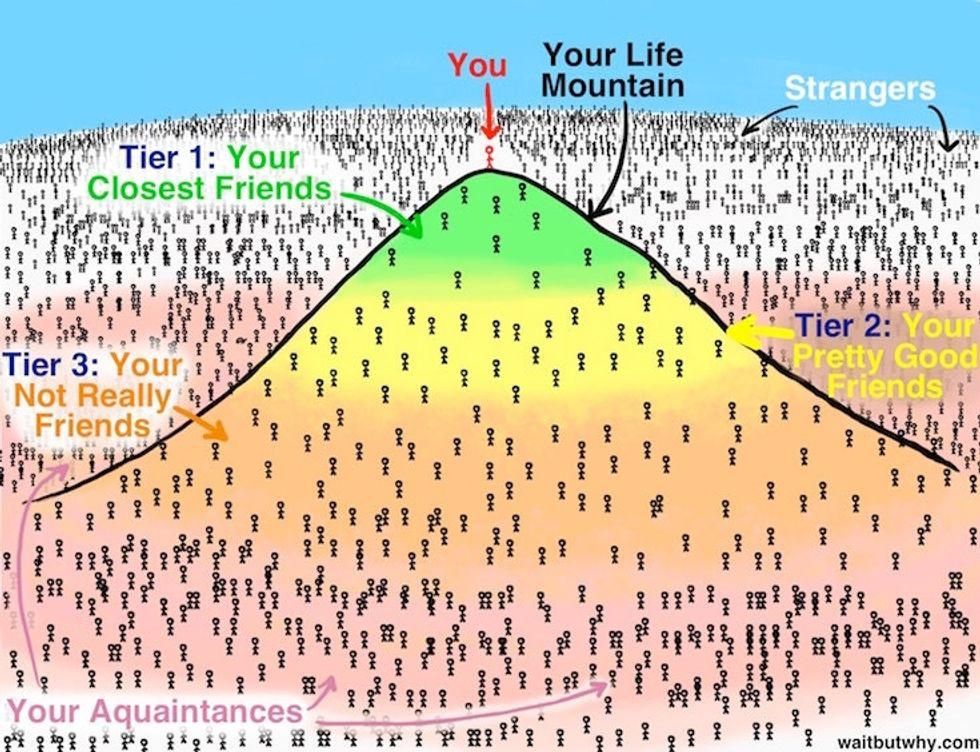
It looks something like this mountain:
Infographic of a mountain

Visual interpretation of where friends fall on the mountain of “You."

via Wait But Why post and used with permission.

At the top of your life mountain, in the green zone, you have your Tier 1 friends—the people who feel like brothers and sisters.

These are the people closest to you, the ones you call first when something important happens, the ones you love even when they suck, who make speeches at your wedding, whose best and worst sides you know through and through, and whose relationship with you is eternal; even if you go months or years without hanging out, nothing has changed when you find yourself together again.

Unfortunately, depending on how things went down in your youth, Tier 1 can also contain your worst enemies, the people who can ruin your day with one subtle jab that only they could word so brilliantly hurtfully, the people you feel a burning resentment for, or jealousy of, or competition with. Tier 1 is high stakes.

Below, in the yellow zone, are your Tier 2 friends: your Pretty Good friends.

Pretty Good friends are a much calmer situation than your brothers and sisters on Tier 1. You might be invited to their wedding, but you won't have any responsibilities once you're there. If you live in the same city, you might see them every month or two for dinner and have a great time when you do, but if one of you moves, you might not speak for the next year or two. And if something huge happens in their life, there's a good chance you'll hear it first from someone else.

Toward the bottom of the mountain in the orange zone, you have your Tier 3 friends: your Not Really friends.

You might grab a one-on-one drink with one of them when you move to their city, but then it surprises neither of you when five years pass and drink #2 is still yet to happen. Your relationship tends to exist mostly as part of a bigger group or through the occasional Facebook Like, and it doesn't even really stress you out when you hear that one of them made $5 million last year. You may also try to sleep with one of these people at any given time.

The lowest part of Tier 3 begins to blend indistinguishably into your large group of acquaintances (the pink zone): those people you'd stop and talk to if you saw them on the street or would maybe email for professional purposes but whom you'd never hang out with one-on-one. When you hear that something bad happens to one of these people, you might be sad but not too affected.

Finally, acquaintances gradually blend into the endless world of strangers.

And depending on who you are and how things shook out in those first 25 years, the way your particular mountain looks will vary.

For example, there's Walled-Off Wally:

Comic of a lone person on top of a mountain

Some people keep a barrier up between acquaintances.

via Wait But Why post and used with permission.

And Phony Phoebe, who tries to be everyone's best friend and ends up with a lot of people mad at her:

Comic of a mountain with a lot of people at the top

The life of the party.

via Wait But Why post and used with permission.

Even Unabomber Ulysses has a mountain:

Comic of a mostly empty mountain with one person at the top

Hermits exist.

via Wait But Why post and used with permission.

Whatever your particular mountain looks like, eventually the blur of your youth is behind you, the dust has settled, and there you are living your life.

Then one day, usually around your mid or late 20s, it hits you: It's not that easy to make friends anymore.

Sure, you'll make new friends in the future—at work, through your spouse, through your kids—but you won't get to that Tier 1 brothers level, or even to Tier 2, with very many of them because people who meet as adults don't tend to get through the 100+ long, lazy hangouts needed to reach a bond of that strength. As time goes on, you start to realize that the 20-year frenzy of not-especially-thought-through haphazard friend-making you just did was the critical process of you making most of your lifelong friends.

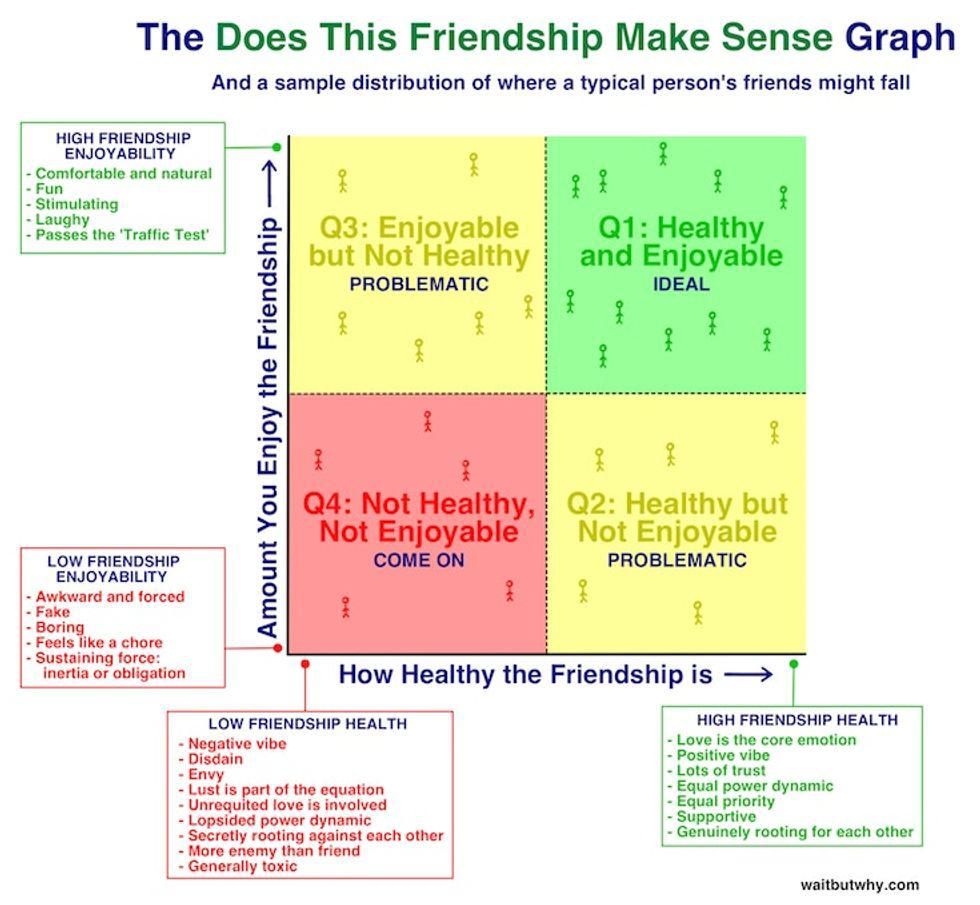
And since you matched up with most of them A) by circumstance, and B) before you really knew yourself yet, the result is that your Tier 1 and Tier 2 friends—those closest to you—fall in a very scattered way on what I'll call the Does This Friendship Make Sense? Graph:
Graph

The friendship graph.

via Wait But Why post and used with permission.

So, who are all those close friends in the three non-ideal quadrants?

As time goes on, most of us tend to have fewer friends in Quadrants 2 through 4 because A) people mature, and B) people have more self-respect and higher standards for what they'll deal with as they get older. But the fact is, friendships made in the formative years often stick, whether they're ideal or not, leaving most of us with a portion of our Tier 1 and Tier 2 friendships that just don't make that much sense. We'll get to the great, Quadrant 1 friendships later in the post, but in order to treat those relationships properly, we need to take a thorough look at the odd ones first.

Here are 10 common ones:

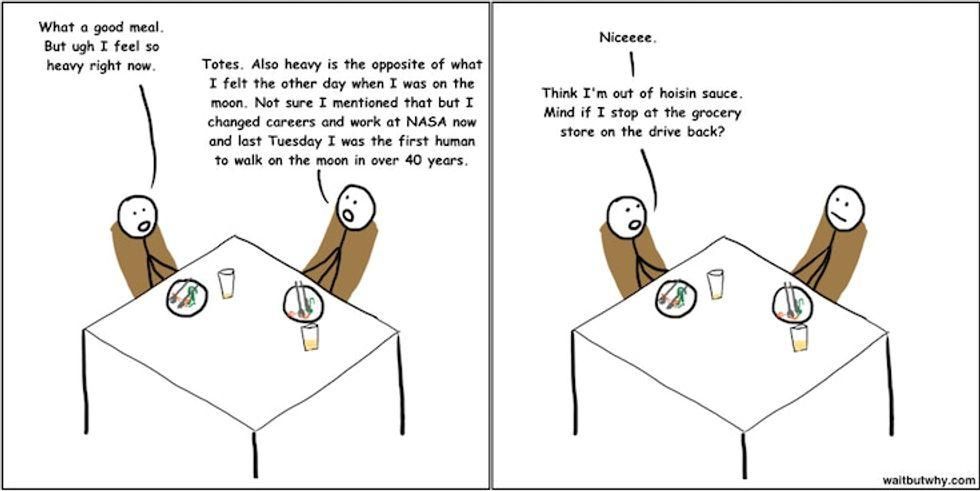
1. The non-question-asking friend
Comic of two people at dinner

Odd moments that happen between friends.

via Wait But Why post and used with permission.

You'll be having a good day. You'll be having a bad day. You'll be happy at work. You'll quit your job. You'll fall in love. You'll catch your new love cheating on you and murder them both in an act of incredible passion. And it doesn't matter, because none of it will be discussed with The Non-Question-Asking Friend, who never, ever, ever asks you anything about your life. This friend can be explained in one of three ways:

  1. He's extremely self-absorbed and only wants to talk about himself.
  2. He avoids getting close to people and doesn't want to talk about either you or himself or anything personal, just third-party topics.
  3. He thinks you're insufferably self-absorbed and knows if he asks you about your life, you'll talk his ear off about it.

Giving you the benefit of the doubt here, we're left with two possibilities. Possibility #1 isn't fun at all and this person should not be allowed space on Tier 1. The green part of the mountain is sacred territory, and super self-absorbed people shouldn't be permitted to set foot up there. Put him on Tier 2 and just be happy you're not dating him.

Possibility #2 is a pretty dark situation for your friend, but it can actually be fun for you. I have a friend who I've hung out with one-on-one about four times in the last year, and he has no idea Wait But Why exists. I've known him for 14 years and I'm not sure he knows if I have siblings or not. But I actually enjoy the shit out of this friend—sure, there's a limit on how close we'll ever be, but without ever spending time talking about our lives, we actually end up in a lot of fun, interesting conversations.

2. The friend in the group you can't be alone with under any circumstances

Comic of three stick people having a conversation

Why have relationships when there is a phone around?

via Wait But Why post and used with permission.

In almost every group of friends, there's one pair who can't ever be alone together. It's not that they dislike each other—they might get along great—it's just that they have no individual friendship with each other whatsoever. This leaves both of them petrified of the lumbering elephant that appears in the room anytime they're alone together. They're way too on top of shit to ever end up in the car alone together if a group is going somewhere in multiple cars, but there are smaller dangers afoot—like being the first two to arrive at a restaurant or being in a group of three when the third member goes to the bathroom.

The thing is, sometimes it's not even that these people couldn't have an individual friendship—it's just that they don't, and neither one has the guts to try to make that leap when things have gone on for so long as is.

3. The non-character-breaking friend you have to be “on" with
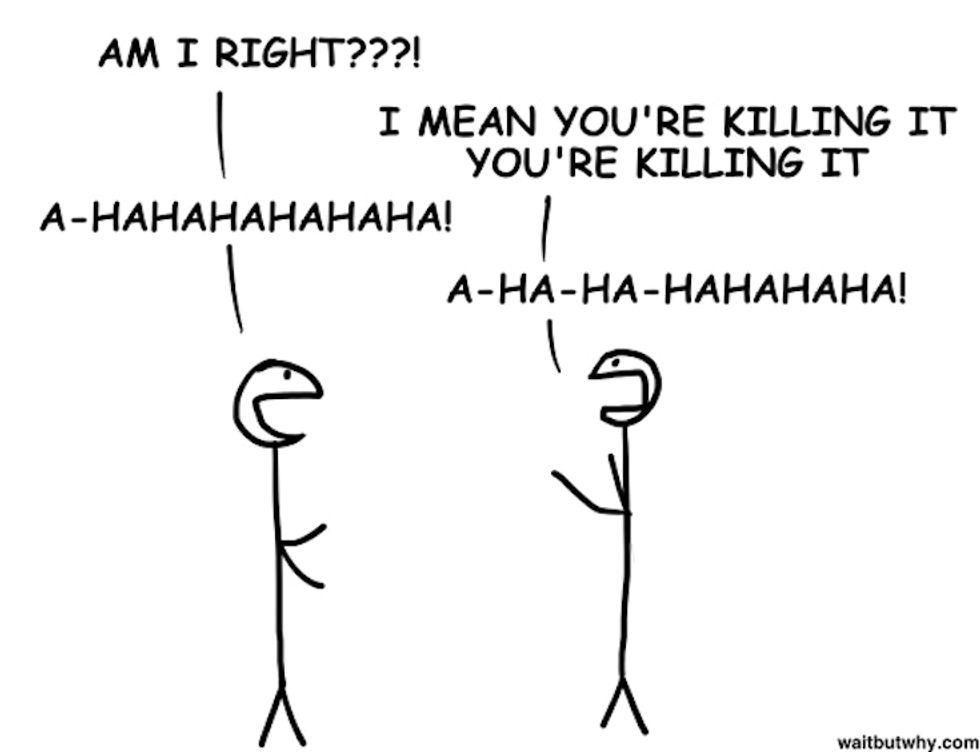
Comic of stick people laughing together

Controlled intimacy and distancing through language.

via Wait But Why post and used with permission.

This is a friend who's terrified of having an earnest interaction, and as such, your friendship with him is always in some kind of skityou always have to be on when you're interacting.

Sometimes the skit is that you both burst out laughing at everything constantly. He can only exist with you in “This is so fucking hilarious, it's too much!" mode, so you have to be in some kind of joke-telling or sarcastic mode yourself at all times or he'll become socially horrified.

Another version of this is the “always and only ironic" friend, who you really bum out if you ever break that social shell and say something earnest. This type of person hates earnest people because someone being earnest dares him to come out from under his ironic safety blanket and let the sun touch his face, and no fucking thanks.

A third example is the “You're great, I'm great, ugh why is everyone else so terrible and not great like us" friend. Of course, she doesn't really think you're perfectly great at all—if she were with someone else, you'd be one of the voodoo dolls on the table to be dissected and scoffed at. The key here is that the two of you must be on a team at all times while interacting. The only comfortable mode for this person is bonding with you by building a little pedestal for you both to stand on while you criticize everyone else. You can either play along and everything will go smoothly, even though you'll both despise yourselves and each other the whole time, or you can commit the ultimate sin and have the integrity to disagree with the friend or defend a non-present party the friend criticizes. Doing this will shatter the fragile team vibe and make the friend recoil and say something quietly like, “Hm ... yeah ... I guess." The friend now respects you for the first time and will also criticize you extra hard next time she's playing her pedestal game with a different friend.

What these all have in common is the friend has tall walls up, at least toward you, and so she builds a little skit for you two to hang out in to make sure any authentic connection can be avoided. Sometimes that person only does this out of her own social anxiety and can become a great, authentic friend if you can just stomp through the ice. Other times, the person is just hopelessly scared and closed off and there's no hope and you have to get out.

In any case, I can't stand these interactions and am in a full panic the entire time they're happening.

4. The double-obligated friendship
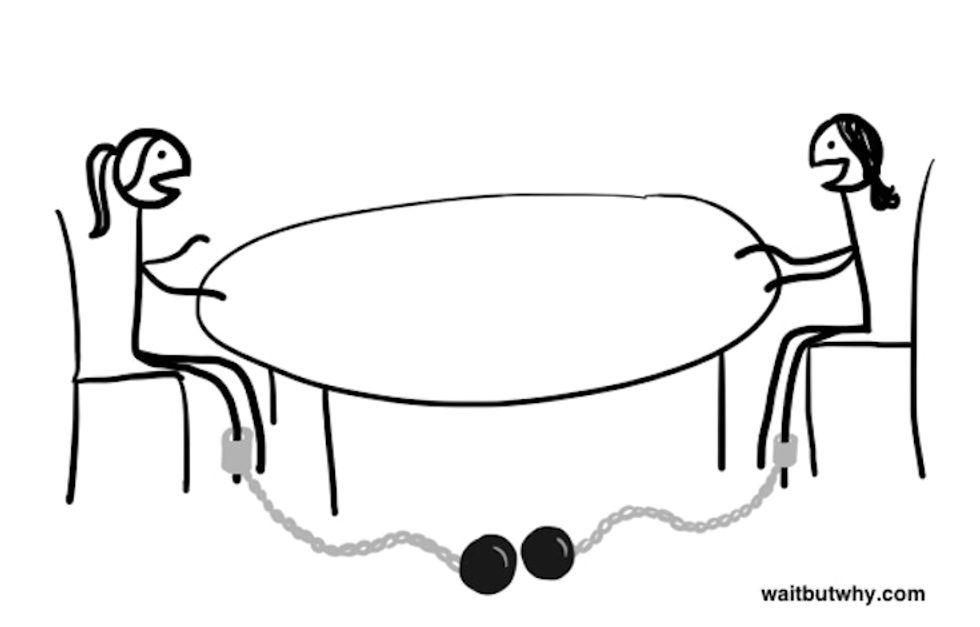
Comic of two men chatting a table with balls and chains around their legs

I think we need a bigger table.

via Wait But Why post and used with permission.

Think of a friend you get together with from time to time, which usually happens after a long and lackluster email or text exchange during which you just can't find a time that works for both of you — and you're never really happy when these plans are being made and not really psyched when you wake up and it's finally on your schedule for that day.

Maybe you're aware that you don't want to be friends with that person, or maybe you're delusional about it — but what you're most likely not aware of is that they probably don't want to see you either.

There are lopsided situations where one person is far more interested in hanging out than the other (we'll get to those later), but in the case we're talking about here, both parties often think it's a lopsided situation without realizing that the other person actually feels the same way — that's why it takes so long to schedule a time. When someone's excited about something, they figure out how to get it into their schedule; when they're not, they figure out ways to push it farther into the future.

Sometimes you don't think hard enough about it to even realize you don't like being friends with the person, and other times you really like the idea or the aesthetic of being friends with that particular person — being friends with them is part of your Story. But even in cases where you're perfectly lucid about your feelings, since neither of you knows the other feels the same way and neither has the guts to just cut things off or move it down a tier, this friendship usually just continues along for eternity.

5. The half-marriage

Two stick people each holding a half of a heart

An ego boost through controlling the relationship.

via Wait But Why post and used with permission.

Somewhere in your life, you're probably part of a friendship that would be a marriage if only the other person weren't very, very, extremely not interested in that happening. 1 for 2 on yes votes — just one vote away — so close.

You might be on either side of this — and either way, it's one of the least healthy parts of your life. Fun!

If you're on the if only side of things, probably the right move is to get your fucking shit together? Ya know? This friendship is one long, continuous rejection of you as a human being, and you're just wallowing there in your yearning like a sobbing little seal. Plus, duh, if you gather your self-respect and move on with your life, it'll raise their perception of your value and they might actually become interested in you.

If you're on the Oh yeah, definitely not side of the situation, here's what's happening: There's this suffering human in the world, and you know they're suffering, and you fucking love it, because it gives your little ego a succulent sponge bath every time you hang out with them. You enjoy it so much you probably even lead them on intentionally, don't you — you make sure to keep just enough ambiguity in the situation that their bleeding heart continues to lather your ego from head to toe at your whim.

Both of you — go do something else.

6. The historical friend
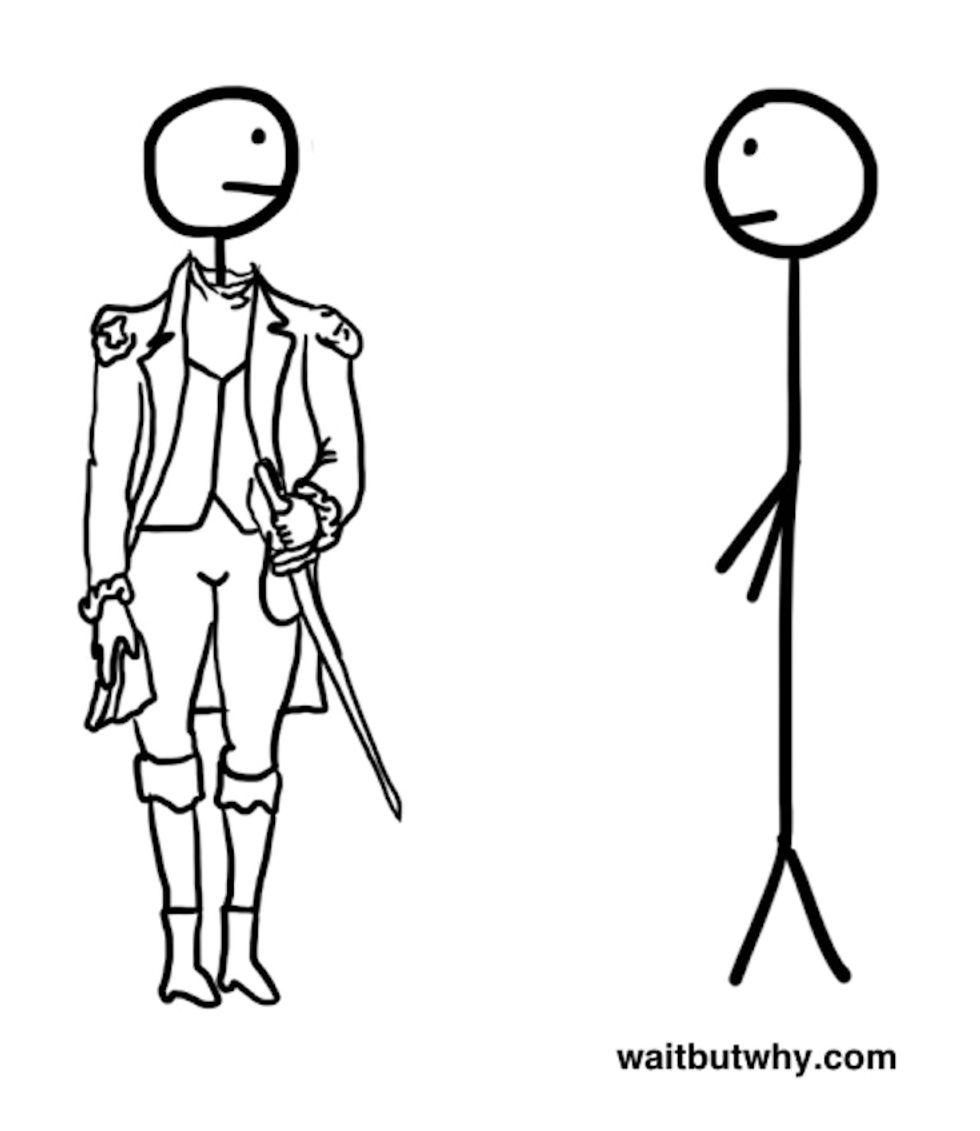
Stick person in historical garb beside a regular stick person

We met in kindergarten.

via Wait But Why post and used with permission.

A Historical Friend is someone you became friends with in the first place because you met when you were little and stayed friends through the years, even though you're a very weird match. Most old friends fall somewhat into this category, but a true Historical Friend is someone you absolutely would not be friends with if you met them today.

You're not especially pleased with who they are, and they feel the same way about you. You're not each other's type one bit. Unfortunately, you're also extremely close friends from when you were four, and you're both just a part of each other's situation forever, sorry.

7. The non-parallel life paths friendship
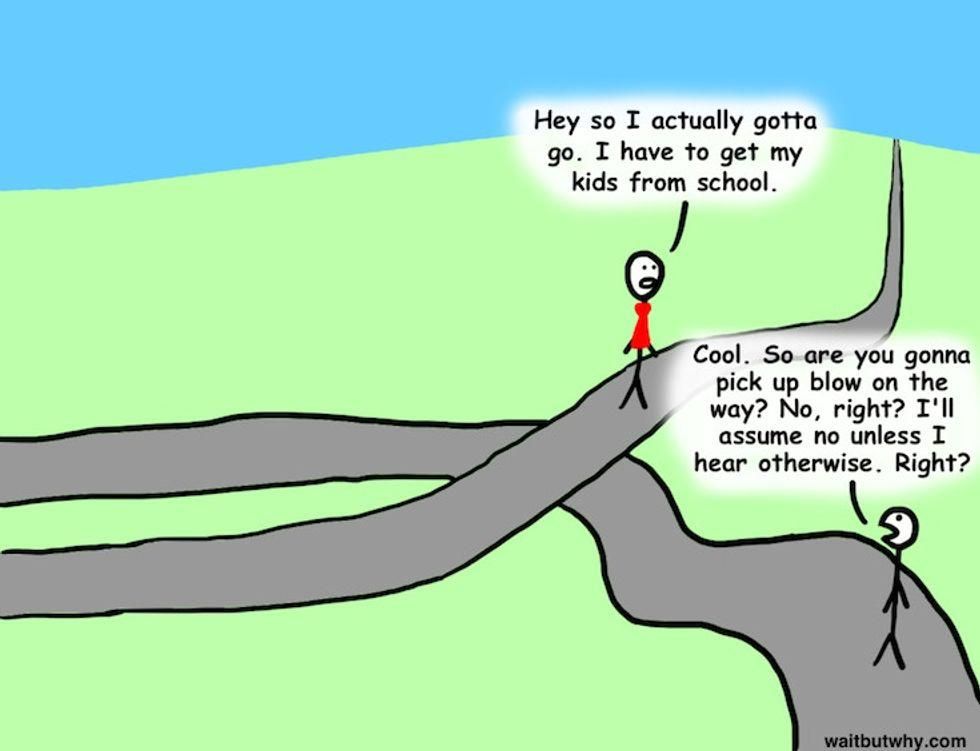
Two stick people on opposite paths

Looking for love in all the wrong places.

via Wait But Why post and used with permission.

Throughout childhood and much of young adulthood, most people your age are in the same life stage as you are. But when it comes to advancing into full adulthood, people do so at widely varying paces, which leads to certain friends suddenly having totally different existences from one another.

Anyone within three years of 30 has a bunch of these going on. It's just a weird time for everyone. Some people have become Future 52-year-olds, while others are super into being Previous 21-year-olds. At some point, things will start to meld together again, but being 30-ish is the friendship equivalent of a kid going through an awkward pubescent stage.

There are darker, more permanent Non-Parallel Life Path situations. Like when Person A starts to become a person who rejects material wealth, partially because she genuinely feels that pursuing an artistic path matters more and partially because she needs a defense mechanism against feeling envious of richer people, and Person B's path makes her scoff at people who pursue creative paths, partially because she genuinely thinks expressing yourself is an inherently narcissistic venture and partially because she needs a defense mechanism against feeling regretful that she never pursued her creative dreams — these two will have problems.

They may still like each other, but they can't be as close as they used to be — each of their lives is a bit of a middle finger at the other's choices, and that's jst awkward for everyone. It's not always that bad — but to survive an Off-Line Life Situation, friends need to be really different people who don't at all want the same things out of life.

8. The frenemy
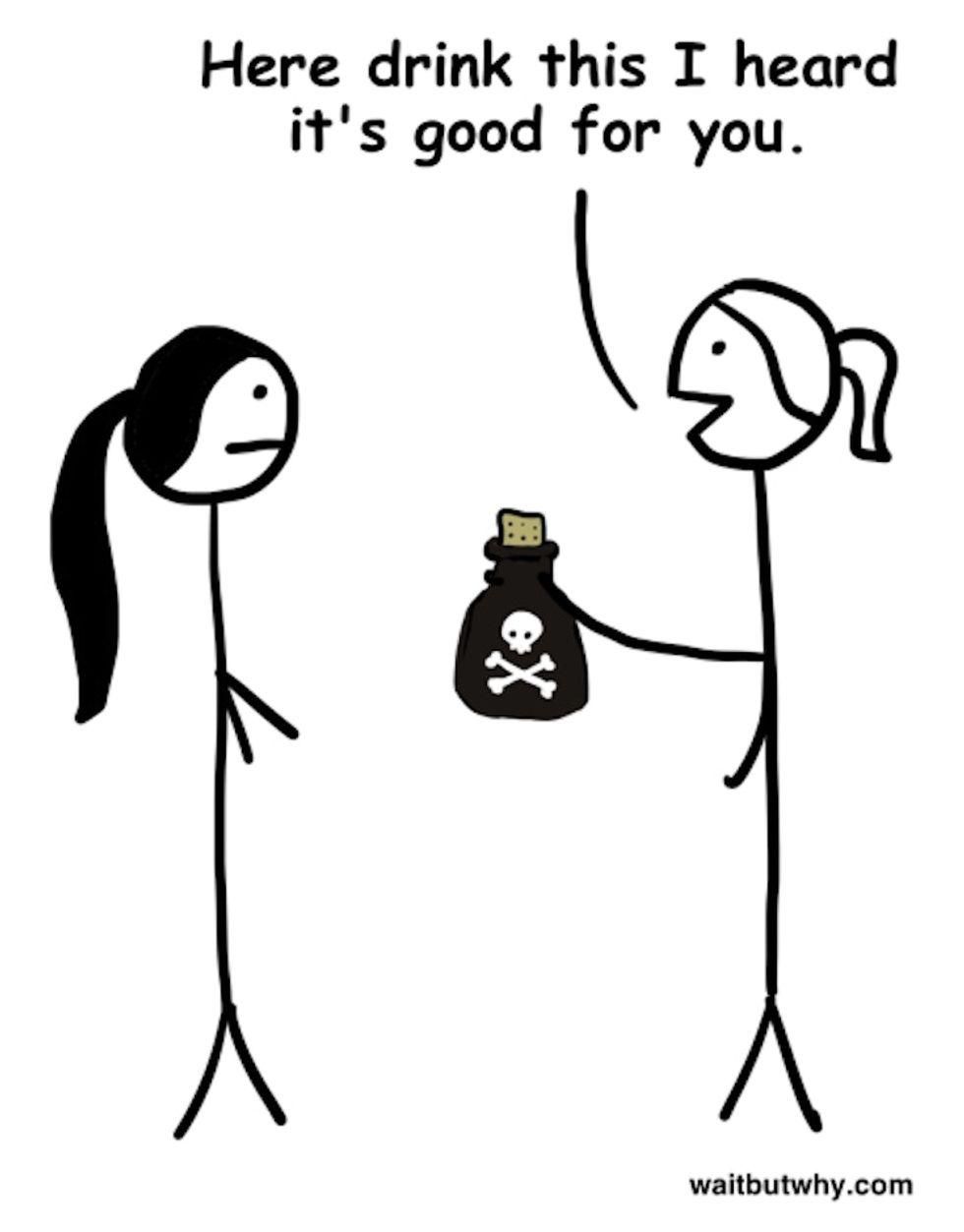
One stick person offers another stick person poison pretending it's safe

This is awful. Taste it.

via Wait But Why post and used with permission.

The Frenemy roots very hard against you. And I'm not talking about the friends that will feel a little twinge of pleasure when they hear your big break didn't pan out after all or that your relationship is in bad shape. I'm not even talking about someone who secretly roots against you when they're not doing so well at some area of life and it hurts them to see you do better. Those are bad emotions, but they can exist in people who are still good friends.

I'm talking about a real Frenemy — someone who really wants bad things for you. Because you're you.

You and the Frenemy usually go way back, have a very deep friendship, and the trouble probably started a long time ago. There's a lot of complex psychology going on in these situations that I don't fully understand, but my hunch is that a Frenemy's resentment is rooted in his own pain, or his own shortcomings, or his own regret — and for some reason, your existence stings them in these places hard.

A little less dark but no less harmful is a bully situation where a friend sees some weakness or vulnerability in you and she enjoys prodding you there either for sadistic reasons or to prop herself up.

A Frenemy knows how to hurt you better than anyone because you're deeply similar in some way and she knows how you're wired. She'll do whatever she can to bring you down any chance she gets, often in such a subtle way it's hard to see that it's happening.

Whatever the reason, if you have a Frenemy in your life, kick her toxic ass off your mountain, or at least kick her down the mountain — just get her off of Tier 1. A Frenemy has about a 10th of the power to hurt you from Tier 2 as she does from Tier 1.

9. The Facebook celebrity friend
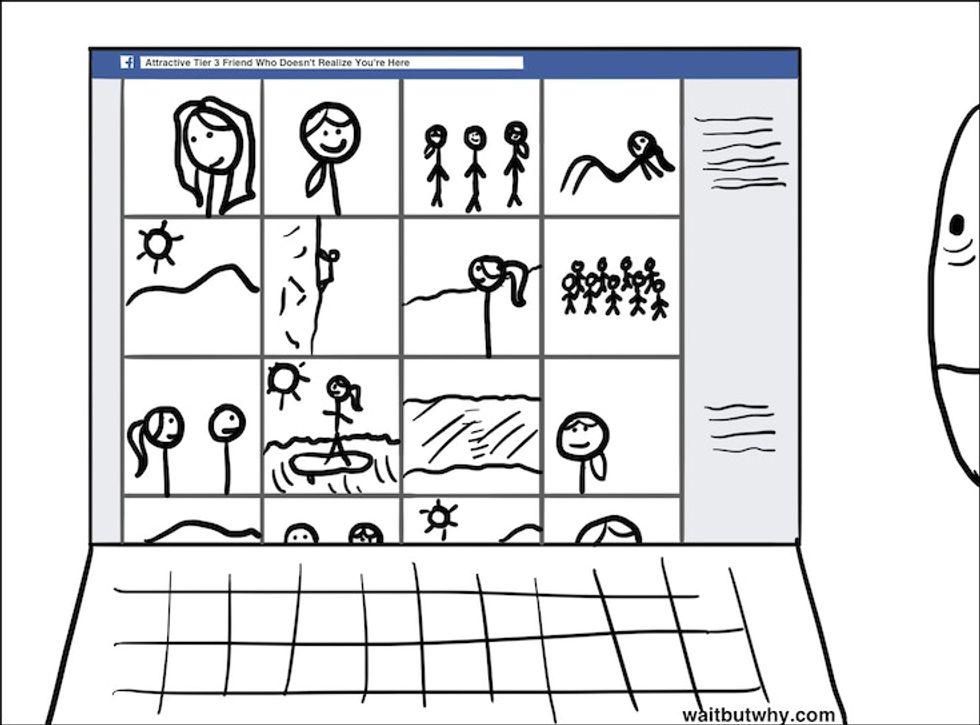
Comic of a computer with photo grid

What’s happening on social media?

via Wait But Why post and used with permission.

This person isn't a celebrity to anyone other than you, you creep. You know exactly who I'm talking about — there are a small handful of people whose Facebook page you're uncomfortably well-acquainted with, and those people have no idea that this is happening. On the plus side, there are people out there you haven't spoken to in seven years who know all about the new thing you're trying with your hair, since it goes both ways.

This is a rare Tier 3 friend, or even an acquaintance, who qualifies as an odd friendship because you found a way to make it unhealthy even though you're not actually friends. Well done.

10. The lopsided friendship
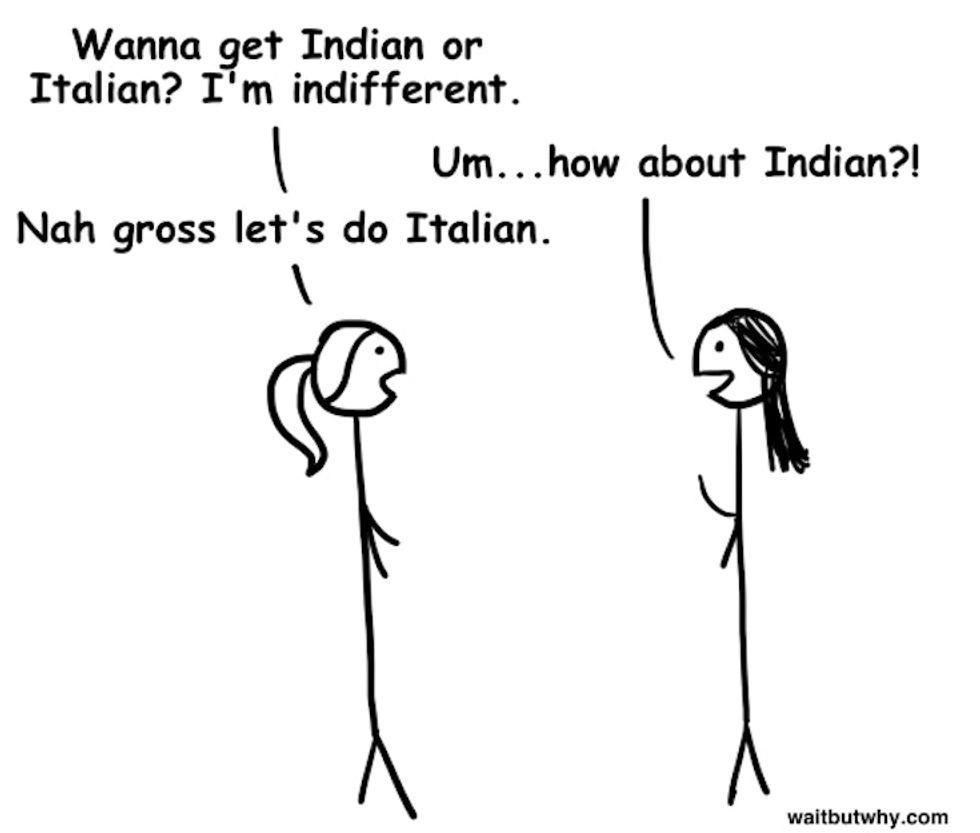
Two stick women discussing dinner

Can I make all the decisions... that was rhetorical.

via Wait But Why post and used with permission.

There are a lot of ways a friendship can be lopsided: Someone can be higher on their friend's mountain than vice versa. Someone can want to spend more time with a friend than vice versa. One member can consistently do 90% of the listening and only 10% of the talking, and in situations where most of the talking is about life problems, what's happening is a one-sided therapy situation, with a badly off-balance give-and-take ratio, and that's not much of a friendship—it's someone using someone else.

And then there's the lopsided power friendship. Of course, this is a hideous quality in many not-great couples, but it's also a prominent feature of plenty of friendships.

A near 50/50 friendship is ideal, but anything out to 65/35 is fine and can often be attributed to two different styles of personality. It's when the number gap gets even wider that something less healthy is going on—something that doesn't reflect very well on either party.

There are some obvious ways to assess the nature of a friendship's power dynamic: Does one person cut in and interrupt the other person while they're talking far more than the other way around? Is one person's opinion or preference just kind of understood to carry more weight than the other's? Is one person allowed to be more of a dick to the other than vice versa?

Another interesting litmus test is what I call the “mood determiner test." This comes into play when two friends get together but they're in very different moods — the idea is, whose mood “wins" and determines the mood of the hangout. If Person A is in a bad mood, Person B is in a good mood, and Person B reacts by being timid and respectful of Person A's mood, leaving the vibe down there until Person A snaps out of it on her own — but when the moods are reversed, Person B quickly disregards her own bad mood and acts more cheerful to match Person A's happy mood — and this is how it always goes — then Person A is in a serious power position.

But hey, not all friendships are grim.

In the Does This Friendship Make Sense graph above, the friendships we just discussed are all in Quadrants 2, 3, or 4 — i.e., they're all a bit unenjoyable, unhealthy, or both. That's why this has been depressing. On the bright side, there's also Quadrant 1—all the friendships that do make sense.

No friendship is perfect, but those in Quadrant 1 are doing what friendships are supposed to do: They're making the lives of both parties better. And when a friendship is both in Quadrant 1 of the graph and on Tier 1 of your mountain, that friendship is a rock in your life.

Rock friendships don't just make us happy — they're the thing (along with rock family and romantic relationships) that makes us happy.

Investing serious time and energy into those is a no-brainer long-term life strategy. But in the case of most people over 25—at least in New York— I think A) not enough time is carved out as dedicated friend time, and B) the time that is carved out is spread too thin, and too evenly, among the Tier 1 and Tier 2 friendships in all four quadrants. I'm definitely guilty of this myself.

There's something I call the Perpetual Catch-Up Trap. When you haven't seen a good friend in a long time, the first order of business is a big catch-up — you want to know what's going on in their career, with their girlfriend, with their family, etc., and they want to catch up on your life. In theory, once this happens, you can go back to just hanging out, shooting the shit, and actually being in the friendship. The problem is, when you don't make enough time for good friends, seeing them only for a meal and not that often — you end up spending each get-together catching up, and you never actually get to just enjoy the friendship or get far past the surface. That's the Perpetual Catch-Up Trap, and I find myself falling into it with way too many of the rocks in my life.

There are two orders of business right now:

First, think about your friendships, figure out which ones aren't in Quadrant 1, and demote them down the mountain. I'm not suggesting you stop being friends with those people—you still love them and feel loyal to them, and old friends are critical to hold onto—but if the friendships aren't that healthy or enjoyable, they don't really deserve to be in your Tier 1, and you probably shouldn't be in theirs. Most importantly, doing this clears up time to...

Second, dedicate even more time to the Quadrant 1, Tier 1 rocks in your life. If you're in your mid-20s or older, your current rocks are probably the only ones you'll ever have. Your rock friendships don't warrant two times the time you give to your other friends—they warrant five or 10 times!

Your rocks deserve serious, dedicated time so you can stay close. So go make plans with them.


This article was written by Tim Urban and originally published on Wait But Why. It originally appeared here nine years ago.

Once a refugee seeking safety in the U.S., Anita Omary is using what she learned to help others thrive.
Pictured here: Anita Omary; her son, Osman; and Omary’s close friends
True

In March 2023, after months of preparation and paperwork, Anita Omary arrived in the United States from her native Afghanistan to build a better life. Once she arrived in Connecticut, however, the experience was anything but easy.

“When I first arrived, everything felt so strange—the weather, the environment, the people,” Omary recalled. Omary had not only left behind her extended family and friends in Afghanistan, she left her career managing child protective cases and supporting refugee communities behind as well. Even more challenging, Anita was five months pregnant at the time, and because her husband was unable to obtain a travel visa, she found herself having to navigate a new language, a different culture, and an unfamiliar country entirely on her own.


“I went through a period of deep disappointment and depression, where I wasn’t able to do much for myself,” Omary said.

Then something incredible happened: Omary met a woman who would become her close friend, offering support that would change her experience as a refugee—and ultimately the trajectory of her entire life.

Understanding the journey

Like Anita Omary, tens of thousands of people come to the United States each year seeking safety from war, political violence, religious persecution, and other threats. Yet escaping danger, unfortunately, is only the first challenge. Once here, immigrant and refugee families must deal with the loss of displacement, while at the same time facing language barriers, adapting to a new culture, and sometimes even facing social stigma and anti-immigrant biases.

Welcoming immigrant and refugee neighbors strengthens the nation and benefits everyone—and according to Anita Omary, small, simple acts of human kindness can make the greatest difference in helping them feel safe, valued, and truly at home.

A warm welcome

Dee and Omary's son, Osman

Anita Omary was receiving prenatal checkups at a woman’s health center in West Haven when she met Dee, a nurse.

“She immediately recognized that I was new, and that I was struggling,” Omary said. “From that moment on, she became my support system.”

Dee started checking in on Omary throughout her pregnancy, both inside the clinic and out.

“She would call me and ask am I okay, am I eating, am I healthy,” Omary said. “She helped me with things I didn’t even realize I needed, like getting an air conditioner for my small, hot room.”

Soon, Dee was helping Omary apply for jobs and taking her on driving lessons every weekend. With her help, Omary landed a job, passed her road test on the first attempt, and even enrolled at the University of New Haven to pursue her master’s degree. Dee and Omary became like family. After Omary’s son, Osman, was born, Dee spent five days in the hospital at her side, bringing her halal food and brushing her hair in the same way Omary’s mother used to. When Omary’s postpartum pain became too great for her to lift Osman’s car seat, Dee accompanied her to his doctor’s appointments and carried the baby for her.

“Her support truly changed my life,” Omary said. “Her motivation, compassion, and support gave me hope. It gave me a sense of stability and confidence. I didn’t feel alone, because of her.”

More than that, the experience gave Omary a new resolve to help other people.

“That experience has deeply shaped the way I give back,” she said. “I want to be that source of encouragement and support for others that my friend was for me.”

Extending the welcome

Omary and Dee at the Martin Luther King, Jr. Vision Awards ceremony at the University of New Haven.

Omary is now flourishing. She currently works as a career development specialist as she continues her Master’s degree. She also, as a member of the Refugee Storytellers Collective, helps advocate for refugee and immigrant families by connecting them with resources—and teaches local communities how to best welcome newcomers.

“Welcoming new families today has many challenges,” Omary said. “One major barrier is access to English classes. Many newcomers, especially those who have just arrived, often put their names on long wait lists and for months there are no available spots.” For women with children, the lack of available childcare makes attending English classes, or working outside the home, especially difficult.

Omary stresses that sometimes small, everyday acts of kindness can make the biggest difference to immigrant and refugee families.

“Welcome is not about big gestures, but about small, consistent acts of care that remind you that you belong,” Omary said. Receiving a compliment on her dress or her son from a stranger in the grocery store was incredibly uplifting during her early days as a newcomer, and Omary remembers how even the smallest gestures of kindness gave her hope that she could thrive and build a new life here.

“I built my new life, but I didn’t do it alone,” Omary said. “Community and kindness were my greatest strengths.”

Are you in? Click here to join the Refugee Advocacy Lab and sign the #WeWillWelcome pledge and complete one small act of welcome in your community. Together, with small, meaningful steps, we can build communities where everyone feels safe.

This article is part of Upworthy’s “The Threads Between U.S.” series that highlights what we have in common thanks to the generous support from the Levi Strauss Foundation, whose grantmaking is committed to creating a culture of belonging.

quiet, finger over lips, don't talk, keep it to yourself, silence

A woman with her finger over her mouth.

It can be hard to stay quiet when you feel like you just have to speak your mind. But sometimes it's not a great idea to share your opinions on current events with your dad or tell your boss where they're wrong in a meeting. And having a bit of self-control during a fight with your spouse is a good way to avoid apologizing the next morning.

Further, when we fight the urge to talk when it's not necessary, we become better listeners and give others a moment in the spotlight to share their views. Building that small mental muscle to respond to events rather than react can make all the difference in social situations.


argument, coworkers, angry coworkers, hostile work enviornment, disagreement A woman is getting angry at her coworker.via Canva/Photos

What is the WAIT method?

One way people have honed the skill of holding back when they feel the burning urge to speak up is the WAIT method, an acronym for the question you should ask yourself in that moment: "Why Am I Talking?" Pausing to consider the question before you open your mouth can shift your focus from "being heard" to "adding value" to any conversation.

The Center for The Empowerment Dynamic has some questions we should consider after taking a WAIT moment:

  • What is my intention behind what I am about to say?
  • What question can I ask to better understand what the other person is saying?
  • Is my need to talk an attempt to divert the attention to me?
  • How might I become comfortable with silence rather than succumb to my urge to talk?

tape over muth, sielnce, be quiet, mouth shut, saying nothing A man with tape over his mouth.via Canva/Photos

The WAIT method is a good way to avoid talking too much. In work meetings, people who overtalk risk losing everyone's attention and diluting their point to the extent that others aren't quite sure what they were trying to say. Even worse, they can come across as attention hogs or know-it-alls. Often, the people who get to the heart of the matter succinctly are the ones who are noticed and respected.

Just because you're commanding the attention of the room doesn't mean you're doing yourself any favors or helping other people in the conversation.

The WAIT method is also a great way to give yourself a breather and let things sit for a moment during a heated, emotional discussion. It gives you a chance to cool down and rethink your goals for the conversation. It can also help you avoid saying something you regret.

fight, spuse disagreement, communications skills, upset husband, argument A husband is angry with his wife. via Canva/Photos

How much should I talk in a meeting?

So if it's a work situation, like a team meeting, you don't want to be completely silent. How often should you speak up?

Cary Pfeffer, a speaking coach and media trainer, shared an example of the appropriate amount of time to talk in a meeting with six people:

"I would suggest a good measure would be three contributions over an hour-long meeting from each non-leader participant. If anyone is talking five/six/seven times you are over-participating! Allow someone else to weigh in, even if that means an occasional awkward silence. Anything less seems like your voice is just not being represented, and anything over three contributions is too much."

Ultimately, the WAIT method is about taking a second to make sure you're not just talking to hear yourself speak. It helps ensure that you have a clear goal for participating in the conversation and that you're adding value for others. Knowing when and why to say something is the best way to make a positive contribution and avoid shooting yourself in the foot.

cars, car salesman, new car, sales, shopping, anxiety, psychology, social anxiety
via Antoni Shkraba/Pexels
A car salesman leaks secret phrases to stop pushy salesmen in their tracks

Being approached by a salesperson when making a big purchase, such as a car or an appliance, is an experience most people find to be at least a little uncomfortable. Heck, even much smaller stakes shopping like walking through the mall or browsing jewelry can be wracked with anxiety over potentially running into a pushy salesman. Salespeople can provide help and expertise, of course, but they can also be pushy and add unnecessary pressure especially for people who aren't quite ready to buy.

Car salesmen, in particular, have the worst reputation. Surveys show a large chunk of consumers have felt pressured by salesmen to buy add-ons they don't need, felt like they were being tricked, or otherwise felt the salesperson was being dishonest.


Even if you say, “I’m just looking.” The words will not deter them, as they're trained to push past those objections by pestering with you questions and "encouraging" you to move the sale forward.

A car salesman on TikTok recently went viral with a video explaining why “I’m just looking” doesn’t work on a car lot and, crucially, providing more effective phrases you can use instead.

Russell of RussFlipsWhips normally gives advice to car dealers and salespeople on how to generate leads and close more sales, but he occasionally helps out the average consumer with behind-the-scenes information that helps them make better decisions.

cars, car salesman, new car, sales, shopping, anxiety, psychology, social anxiety Car salesmen have the worst reputation of all. Photo by Sara Kurfeß on Unsplash

"There's two main reasons, and here's what you should say instead of 'I'm just looking,'" he said in a video with nearly 2 million views. “One is, we hear it every single day. So when somebody tells me, ‘I’m just looking,’ I’m so used to hearing that, I almost like brush it off and ignore it because I’m like, ‘That’s what the customer’s supposed to say.’ “

'Secondly," he goes on, "every car salesman has had a customer say, ‘I’m just looking,’ and we ended up selling them a car."

It's a harsh and slightly grimy truth of the business, but there's no arguing with the realities.

Instead, Russell suggests you say: "Hey, I’d really like to look alone. Can I please have your business card?"

The second phrase, which is even more clear that you want the salesman to go away, is: “I’m really not in the market for a car.”

These responses are firm and direct, leaving little to no room for interpretation or push back. As much as salespeople want to make a deal, they really don't want to waste their own time. So being firm and clear in the fact that you're not ready is a great way to make them go away.

Watch Russ explain the process and why it works here:

@russflipswhips

Replying to @SoyPablo This is what I would say #carsales #carsalesman #cardealership #carbuyingtips

The post received funny responses from folks who had a few effective ideas of their own:

“The ‘I have 2 repos and no money down' line works wonders,’” one TikToker joked.

“I just tell them my credit score and they run,” another added.

"If 'I’m just looking' doesn’t work, I usually wait until they go home, follow them home, stare into their bedroom window at night, and repeat the line when he comes out to ask what I’m doing," someone commented.

Others chimed in with their own stories, or support of Russ' advice:

"My first week in the business, one of the older guys told me to say 'I’ll look with ya' the first time I used that line, sold a car to the customer’s daughter and upgraded his lease"

"I just say ‘Ill come get you when Im ready’ and if they dont immediately go away, and I do find a car that I want, they will not be the one catching the sale."

"I once told a salesman I was just looking and ended up leaving with a new car"

cars, car salesman, new car, sales, shopping, anxiety, psychology, social anxiety Some very strong-willed people have been talked into buying a new car they weren't ready for. Photo by Swansway Motor Group on Unsplash

Plenty of viewers chimed in that the really good salespeople know when to respect someone's wishes and back off. If a salesman is too pushy, it can be a huge turnoff for customers — even if they really are almost ready to buy. Russell's audience is made up primarily of dealers and salesmen, so they know all too well that pushing too hard can backfire.

In the end, Russell’s suggestions show that sometimes, the best way to get our point across is to be direct and honest. There’s absolutely nothing wrong with wanting to shop alone and if the salesperson can respect that request, they deserve the sale if you decide to buy something.

Russ has developed a following of over 750,000 followers giving advice to people in the auto industry and helping customers be prepared for one of the biggest purchases of their lifetime.

@russflipswhips

Asking the right questions when buying a car can save you a lot #carsales #carsalesman #carbuyingtips #cardealership

With so much info at our fingertips, we've come a long way from the days of car salesmen holding all the power and tricking customers with elaborate games and negotiating tricks. But... that doesn't change the fact that, sometimes, we just want to look around without being pressured.

This article originally appeared two years ago. It has been updated.

80s game show; just like mom; Fergie Olver; 80s childhood; family game show; body autonomy

Girl stops 80s game show host in his tracks as he tries to kiss her

The 80s seems like a completely different lifetime when it comes to what was considered acceptable behavior. Things people deemed acceptable or were just part of everyday expectations for television back in the 60s through well into the 90s would get stars blacklisted today. But there was one game show in the 80s that had moments so cringy that even for the times may have raised some eyebrows though everyone seemed to go along with it, except one brave little girl.

The Canadian show, Just Like Mom ran from 1980-1985 even with the uncomfortable moments between the game show host and young girls. The girls who were aged 7-12 would appear on the show with their mother answering questions about each other and competing in bake-offs to see which pair knew each other best. Just Like Mom was created by Catherine Swing, the wife of the show's host Fergie Olver who would often stand uncomfortably close to the girls and elicit kisses.


80s game show; just like mom; Fergie Olver; 80s childhood; family game show; body autonomy Mom hugging crying daughterPhoto credit: Canva

Recently a compilation video of the game show host behaving in a manner people might consider questionable is going viral. In the video the Olver stands near the girls, often putting his hand on their backs, placing his face close to theirs to ask questions. The very first clip shows 11-year-old Lee Ann, Olver hovers over her asking what color her eyes are.

"What color are your eyes?" Olver asks before the child tells him they're blue, to which he responds, "they're not blue, now don't tell me that. Look at me a little closer." Just as the girl leans in slightly, appearing hesitant to do so, Olver quickly kisses the child on the side of her mouth and declares, "they're green."

80s game show; just like mom; Fergie Olver; 80s childhood; family game show; body autonomy Dad kissing child on cheekPhoto credit: Canva

The audience sounds as if they didn't know how to react to the bizarre moment. Some people loudly gasp, others uncomfortably chuckle, while a few seem to let out a high pitched surprised squeal. The girl also laughs uneasily while the host remains extremely close. Video clip after video clip shows similar interactions where the host tries to either kiss the girls or have them kiss him but one little girl refused. While it appeared that she was nervous to do so in front of a live audience, on television and refusing a directive from an adult, she stood her ground.

This was a moment where parents can see in real time the benefit of teaching body autonomy and the power of teaching children that no is a complete sentence. Olver originally didn't accept the young girl's "no," attempting to coerce her into kissing him when she was clearly uncomfortable and uninterested in the request.

The host perches himself up close to the young girl and says, "you look like a girl who likes to give out hugs and kisses," to which the girl laughs with discomfort before saying, "not really." That didn't stop him, Olver continued, "not really? can I have a hug and a kiss?" This time the girl gives a very direct answer through nerves by shaking her head no while saying "uh-uh." She's clearly uncomfortable as she bites her fingernail trying to assert authority over her body against someone much older.

At this point the child has been clear. She immediately told the host she didn't give out hugs and kisses and when that didn't work she mustered the courage to say no more directly. Olver was still not accepting of the child's boundaries and continued to apply pressure by questioning her decision, "I can't have one?" Again the child shakes her head and says no but he persists, saying "even if I say...whisper in your ear that Alison you're going to win the show? I still can't have a hug and a kiss?" Alison sticks to her answer so Olver changes tactics, telling the child, "Well I guess you can't win the show then if I don't get a hug and a kiss."

80s game show; just like mom; Fergie Olver; 80s childhood; family game show; body autonomy Mom comforting daughterPhoto credit: Canva

Alison stayed firm in her no but the host's behavior resulted in the child's mother calling him a dirty old man. In the end the host appears to have moved on and told the girl she did a good job answering one of the questions, but to top the praise Olver attempts to sneak a kiss. The little girl didn't let that deter her as she quickly dodged his advance.

It seems apparent that Alison's parents instilled the idea of bodily autonomy in her giving her full permission to say no to adults and anyone else who dares to get in her space without consent. While the experience was probably not one that she would've ever wanted to have, that moment likely gave permission to other young girls watching to tell the host and other like him no. And no is a complete sentence, especially when it comes to someone's body. There's no further explanation needed. No further clarification. The answer is simply no. Well done Alison. Well done.

This article originally appeared in May.

side hustles, side hustle, side gigs, side hustle ideas, side gig ideas, high paying side gigs, best side gigs
Photo credit: Canva

Side hustle ideas to help you earn more money.

Side hustles are becoming more and more common (and necessary) in the United States. According to a recent study by Bankrate, nearly one in four Americans have a side hustle to earn extra income each month.

Finding a lucrative side job on top of a 9-to-5 can be challenging. However, there are definitely ways to drum up side hustles that make sense with your lifestyle, that draw on your own interests, skills, and values, and truly add to your life, whether they be through acts of service, reselling items online, or creating new items (be they artistic or practical).


Someone on Reddit recently asked, “What’s something you do on the side that makes real extra money?” And people shared their brilliant side hustle ideas that have brought in additional money. In some cases, they made an extra $20,000.

- YouTube www.youtube.com

While some may not be bringing in that much cash, many people explained that their side hustles still add hundreds of dollars to their bank accounts. From private baseball coaching and flipping furniture, these are some successful side gig ideas to consider.

24 side hustle ideas

Sales

"I sell rare house plants on the side. "

"If I want some money for a spa or date night, I’ll just chop and propagate some plants for an easy $300-$500…Rare alocasias, monsteras, and anthuriums. There are a ton of people who collect, trade, etc. It’s my hobby, which has made it so easy to turn into a side hustle. Best part is it’s all cash."

"I used to flip furniture on Craigslist and Facebook Marketplace.

"I did have to invest in a small trailer and a good cleaner. But I would get free or cheap furniture. Clean it and spruce it up. Sell it for a couple hundred bucks. Mostly couches."

Creative arts

"I make cosplay props for people."

"I use my personal social media, and I have a commissions page on Ko-Fi. People will see what I usually make and ask me if I am able to make a certain prop. I will then make an agreement with the customer before starting the work."

"I used to sell my artwork online, it was a good $15,000 to $20,000 a year."

"I work freelance in the arts."

"I’ve done a decent job advertising my own business and have developed a side hustle doing social media marketing for other small businesses. Writing posts, finding imagery, and scheduling the posts in advance. The amount of actual work varies from month to month, but the retainer fee does not, and it’s made my life much easier and more predictable."

"During the winter, I sell 3D-printed ornaments and make between $100 and $300 a week for the first two to three weeks of December."

"I specifically target the last-minute crowd and get most of my work through word of mouth. Production cost per ornament is $1.04. It takes me under an hour to make/edit the model, and then it takes 5-8 hours to print, but that can be done while I'm sleeping. I charge between $15 and $25 for an ornament. Last year, I also started selling name ornaments for $5 a pop, but they take under two hours to edit and print, so they're easy to make in large batches. These customers also tend to message me throughout the year, so I make around $600 during the Christmas season and $20-$100 other months. So kinda $20 here and there with a big yearly payout."

"Real estate Photography."

"It's usually $150 per house, $300 if it's a large property, and I need to use a drone. It takes about an hour to shoot and less than an hour to edit. I usually do two to three houses throughout the week. I'll stop on my way home from work, then on Saturday, I can group appointments by location. My busiest Saturday was seven houses. It's really easy. You just need a camera capable of HDR and a lens with a wide angle. I use a Nikon 16-24mm and a tripod."

- YouTube www.youtube.com

Manual labor

"I put up and take down Christmas lights on weekends and evenings from October to January."

"$24k a season is very doable, but you gotta be able to haul and carry ladders, confidently and safely climb up and down ladders, and be OK with working in the wind and rain in the coldest part of the year. It isn’t glamorous, but it can be a nice chunk of extra money."

"If you're even a little handy, you can make good money as a handyman in elderly neighborhoods."

"My dad started out just helping neighbors with hanging curtains, painting bathrooms, etc... after about a year he was busy enough to quit his full time job and just work for himself. You don't need a lot of tools or an expensive truck, but if you can operate a drill, swing a brush, and are good with old people - there's good paying work out there for you.”

"I work as an ad model."

"All kinds of ads. Internet, TV, print. Work is sporadic and irregular, which means you'd better have solid income from a main source. But a little $500-$800 check from time to time sure comes in handy. Generally, one can set up an account for a small annual fee on places like castingnetworks.com or actorsaccess.com. Specifically, it would be better if you would connect with a local talent/modeling agency. They will also ask you to sign up for a talent website, and you’re going to need professional photos. Spend money on THAT, for sure. Good photos are critical!"

"Landscaping."

"Cash under the table, you dictate how many jobs you want to take on, and you can focus on one specific neighborhood to limit gas mileage. A mower, trimmer, blower, and small trailer will all pay themselves off in three weeks. It’ll beat you up a little, but it’s rewarding work. It’s also extremely straightforward. As long as you do what you’re supposed to do, the customer will be happy. Don't target people with complex yards. Drive through the neighborhood and find someone who's obviously over a month behind on mowing their lawn. Knock and offer to do it for $40. Tell them you'll come back every two weeks if that works for them. Get to a point where you've got 10 or so yards on rotation and you can knock them out in a day. $400 for a day's work every two weeks, under the table. Do more or less depending on how much or little you want to make."

"I started a cleaning business."

"It was very easy, and I did it on Saturday afternoons. I just posted my contact info, services, and prices to local online communities. I worked for a young, wealthy couple cleaning a condo two to three times a month. I got around $600 extra per month for just a general cleaning. I also now include move-out cleans, which can get me $400-$600 per job. It's not huge cash, but it helped me kick a car note down from $24k to $16k. And that was with one client."

"I do side work car repairs."

"And by repairs I mean mostly just brakes. To get 4 brakes and rotors done at a shop today is typically around $1000 or more, because they up-charge parts and labor. I am able to do it for people for around $600. I charge $300-400 in labor (for 2 hours of work), and the parts just cost what they cost. So I save people a few hundred dollars and I make a few hundred myself. Sometimes I do one of these a month. Sometimes I do a few of them. I would like to get one a week, cause then I could legit get an extra $300 a week."

@baddie.brad

I’m so tired but so grateful! I love you guys!

Services

"I did Rover for three years, boarding dogs in my home."

"I made $11k a year consistently. Month to month could vary widely, $0-$2k, but I always finished the year the same. But you really should have some experience and be an actual responsible person, because dogs are living beings and deserve proper care. You also need to account for things like Rover fees (20%), taxes, insurance, supplies, and licensing laws. You will end up working all holidays because that's the busiest season for dog sitting, and you'll need to commit your schedule months in advance."

"Deliver pizza for a local place under the table."

"You can do pretty good Friday night through Sunday."

"I host bar trivia."

"It's usually three hours a night, and it makes me about $150 a night (plus tips). I'm actually trying to make this my full-time job; I enjoy it so much. It's not hard to buy trivia games or hook up with an existing company. I am independent and write my own games that I try to sell on the side."

"I started a YouTube channel a few years ago, and now it’s actually pulling in between $1,500 and $3,000 a month!"

"It’s nuts!!! It was just a hobby. I talk about tech stuff. I review computers, network-attached storage systems, and occasionally a tech company I follow pretty closely. My channel name is the same as my Reddit name. It did take several years before money started flowing, but now it's a pretty great side hustle because it's something I would do for free anyway."

"I make about $120/hr coaching baseball lessons."

"I’ll spend a weekend with 10 lessons coaching middle school to college athletes. I also charge $75/month to program throwing/pitching training. This can be 10-30 pitchers a session, ranging from high school to professional. It’s about 5-15 extra hours a week."

"Election work."

"Literally in 14 days this year, I'll gross $6,900. Long days, easy peasy work."

side hustle, side hustles, side hustle ideas, election work, polling work Working the polls or assisting with elections is a great side hustle.Photo credit: Canva

Food

Over ten years ago I started my own hummus business."

"Took a bit to get started but once I was accepted to different farmer’s markets, I made pretty good dough. But omg setting up a tent and tables at 5:30am on weekends was not fun after a couple of years. It was called Bean There, Done That and I had tons of creative flavors (and punny names).”

"I have a kettle corn pop-up."

"I do fairs, festivals, pumpkin patches, and can turn $300 of product and space rent into $6k+ sales in a day. Some states require [a food or vendor license] but in my popcorn is exempt from licensing because of its very low risk for foodborne illness."

"None of these enterprises have made me two thousand a month individually, but all of them combined have equaled that over many months of production."

"Edible mushrooms. Microgreens. Composting worms. Compost. Vegetable plant starts. Cloned fruit trees. I've been doing these for years, and I sell directly to consumers, no restaurants or middlemen."

Science

"I participate in focus groups and research studies."

"They're a pretty cool way to spend a couple of hours, and they usually pay $150-$250 a pop. I do this with several research companies in my area because most of them only let you participate once every few months. So, if you keep filling out questionnaires and screeners with various research companies, you can rotate through them and get picked more often. Using this method, I participate in one or two studies per month. I've actually been grinding hard on applying for research studies for the last few months to pay off my credit card debt. Been making some pretty good progress!"

"My very first month of donating plasma, I made $900."

"Paid for my three-and-a-half week road trip last summer to Canada. I only do it once a week now because the center closest to me changed their hours, so I get $40 a week instead of my usual $100, but that’s still an extra $160 a month I put back into savings that doesn’t have to come out of my normal paychecks, it’s just extra. So that’s nice. I do miss the $400 months, though."

This article originally appeared last year. It has been updated.

middle kids, middle children, middle child day, siblings, brother, sister, family, love, parents, parenting, adult children
via Wikimedia Commons/ABC Television and Wikimedia Commons/ABC Television

Eve Plumb and Christopher Knight from "The Brady Bunch"

Just think of the list: Stephanie Tanner, Jan Brady, Cory Matthews. Where would we be without these iconic middle children who made for such great TV in the '60s-'90s? And let's not forget Malcolm in the Middle, which managed to get an entire seven-season run out of all the conflict experienced by the misunderstood and overlooked middle child (not to mention the reboot coming April 2026).

August 12 is National Middle Child Day in America, dedicated to recognizing the sibling in the middle. It’s a special day to highlight the kids who often get lost in the familial mix while the youngest hogs all the attention and the eldest has all the responsibilities.


Elizabeth Walker founded the day in the 1980s because she thought middle children were “left out.” But we think the great traits of being the kid in the middle are worth highlighting any day of the week.

When people discuss the plight of these kids, they often bring up Middle Child Syndrome, which some say leads kids caught in the middle to feel rebellious or have a chip on their shoulder. However, at Upworthy, we like looking at the bright side of things, so we’ve made a list of the seven traits that make middle children amazing.

1. They’re good kids


@vintagetvshows

Malcolm In The Middle Intro Theme! #fyp #malcolminthemiddle #malcolm #intro #theme #song #tvshow #tvseries #series #show #opening #family

Research shows that, historically, middle children have been the most behaved out of the bunch. One study in 1964 and another in 2009 found that middle children were the least likely to act out.

Middle children have been shown to be humble, honest, and agreeable. The fact that they get less attention and have a less defined role in the family can lead to high levels of independence and self-sufficiency from a young age.

2. They’re wonderful team players

Middle children are the way to go if you’re building a team, whether on the field or in the office. “They become more independent, think outside the box, feel less pressure to conform, and are more empathetic,” Katrin Schumann, author of The Secret Power of Middle Children, told Psychology Today. “This gives them great skills as employees and also makes them excellent team players and partners.”

Did you know that Michael Jordan was a middle child? To be fair, he was known to be a near-psychotic competitor and not the kindest teammate around, but he knew how to get the job done. Simone Biles is a middle child, too! Can't argue with that.

3. They are successful

Schumann also says middle children are more successful than their older and younger siblings. She notes that at least 52% of US presidents were middle children, as were Warren Buffet, Mark Zuckerberg, Jennifer Lopez, Princess Diana, and the aforementioned Michael Jordan.

"When they realize how many the useful skills they've developed as a result of being in the middle, they are empowered in ways that positively influence their lives," Schumann said, according to Business Insider. The expert claims that middle children are successful because they had to vie for attention and aren't used to giving up on what they want.”

4. They are great negotiators

Middle children must develop excellent negotiating skills because they are at a power disadvantage in the home. "When middleborns are growing up, they don't get their way because they're the biggest and they don't get their way because they're the baby who was indulged,” Catherine Salmon, PhD. told CBS News.

They learn to be clever and crafty to get what they want. They also develop a more easy-going nature when things don't go their way. They're used to being overlooked in one way or another, and don't get as bent out of shape about it as the youngest and oldest sometimes do.

5. They’re humble


Middle children have to learn humility the hard way because their birth order makes them the least important in the bunch. But even though it’s a harsh lesson, the benefits are great. “Humility can produce more happiness, positive emotions, and well-being because a person has a clearer understanding of the self,” Tiara Blain writes in a PsyD-reviewed article for Verywell Mind. “They are able to be comfortable with who they are and who they are not.”

6. They are creative

Middle children may also be more creative because they are “trying to be different from their elder and younger sibling,” Michele Borba, Ed.D., writes. Given that the eldest and youngest naturally stand out, the middle child may have to work a bit harder to receive attention for their creativity, so they push themselves further.

It could also be that middle children get a little more alone time spent in solitude to pursue creative endeavors.

7. They’re likeable

- YouTube youtu.be

Suzanne Degges-White, PhD, says middle children may be more “agreeable” and easygoing” than their siblings. “They are more extroverted, as well,” she writes. “They don’t have to lead the pack, and they don’t get the 'babying' their younger siblings do. This allows them a bit more freedom to be themselves.”

What's more is that the likability and agreeableness of middle children was found to be higher the more children a family had. So when kids get even more "lost in the shuffle" in a four or five-children household, some of these traits and phenomenon become amplified. In other words, anyone who's not the oldest or youngest qualifies for the label.

Ultimately, we’re all individuals, so not all middle children will develop these qualities. It depends how much stock you want to put into birth order theory. Some believe that birth order plays a monumental role in your personality and the trajectory of your life. Others are more skeptical. There's no denying, however, that the eldest, youngest, and middle children receive different amounts and kinds of parenting due to the nature of the family hierarchy. One study from 2008 showed that youngest children, for example, get 3,000 more hours of quality time with their parents during their key childhood years than other siblings. That's a massive difference!

In any case, it’s nice to take a second and heap some praise on the kids who may have felt a little neglected by letting them know that they are special, too. (Just not as special as Marsha. “Marcia, Marcia, Marcia!”).

This article originally appeared two years ago. It has been updated.