upworthy
Add Upworthy to your Google News feed.
Google News Button
Pop Culture

Younger people are admitting baby boomers got these 17 things right

"Kids shouldn't be on phones or iPads all the time. It makes them weird."

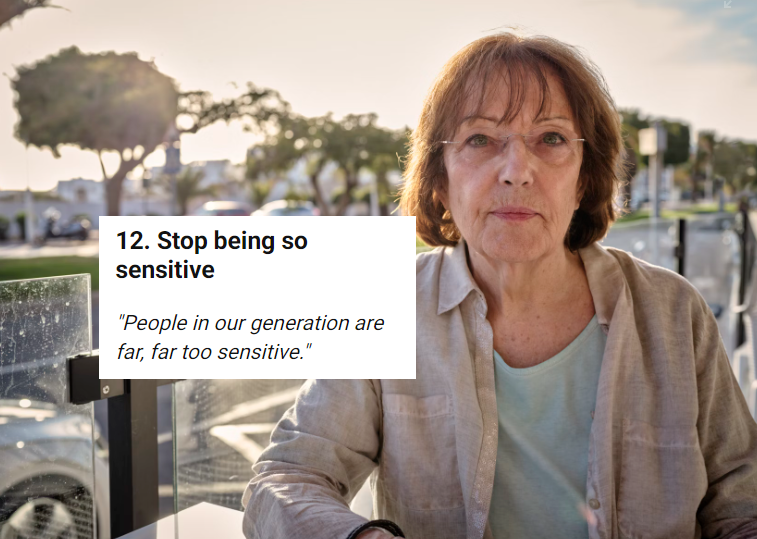
an older woman standing outside looking stern beside overlay of comment that reads, "12. Stop being so sensitive"

Baby boomers didn't get everything wrong.

In recent years, baby boomers have often been the target of criticism from younger generations. The most common accusations are that boomers are selfish and don’t care about leaving ample resources (whether financial or environmental) to subsequent generations. They also come under fire for not being able to acknowledge that it was easier for people of their generation to come of age when things were more affordable and life was a lot less competitive.

However, we should also understand that many of today’s problems are not the boomers’ doing, especially when it comes to the issues that stem from entitled children and technology run amok. In hindsight, there’s something to be said about the importance boomers placed on self-reliance, letting kids be kids, and having a healthy skepticism towards technology.

In the end, each generation contributes to the tapestry of society in its unique way, whether good or bad, even baby boomers. This became evident after a Reddit user named Youssef4573 asked the AskReddit subforum: ‘What is something you can say ‘I'm with the boomers on this one’ about?” Over 4,700 people responded to the prompt, and the most prevalent problems mentioned by the younger generations were overreliance on technology, the modern world’s lack of human touch, and how Gen Xers and millennials have raised their children.

Here are 17 things that younger people are “with the boomers” about.

1. Public filming

"Just because I’m in public doesn’t mean I want to be filmed. Yeah, I know legally you can, but common courtesy people." — Jayne_of_Canton

2. Customer service

"I want to talk to a person in customer service, not a machine." — lumpy_space_queenie

"And also a person that actually works at the company I bought the product from, not a teenager at an outsourced call center with a script to follow and who answers calls for 15 different companies on the same day." — Loive.

3. Turn up the dialog

"For the love of all that is holy, can we fix the audio in movies so that the music and sound FX aren’t drowning out the dialogue?" — Caloso

"And the action sequences don’t burst your eardrums or the dialogue is whispers." — Whynottry-again

4. Bring back buttons

"No, I don't need everything in my car to be electronic. Some stuff needs buttons." — LamborghiniHEAT

"This was the big thing for me in my last car - trying to adjust volume or change songs while driving is way more dangerous when it’s all touch screen. Thankfully my current car has physical knobs for everything." — GeekdomCentral

5. App overload

"Every store/service does not need an app." — BigDigger324

"I was standing at a car rental counter at an airport (boomer here) to rent a car. My daughter’s car broke down on the way to pick me up. While standing at the counter, with a customer service rep right there and not busy, I had to log in to their site, create an account, and reserve a car. It seemed ridiculous and it took a long time, filling in my license information and all that. This was last September." — Cleanslate

6. Bring back DIY

"Learning DIY skills is crucial. I had basically zero DIY skills when I bought my house because I had lived in apartments for so long and I've had to learn a lot. YouTube tutorials are absolutely clutch." — JingleJongleBongle

7. Turn off the speakerphone

"I hated this when I worked at Walmart. So many of my coworkers would talk on speaker or watch TikTok at full volume. It's just trashy imo, nobody wants to hear your media." — WhiteGuy1x

"I work at an emergency medical office and holy sh*t the amount of people that sit in a quiet, peaceful lobby and just have the LOUDEST conversations on their phone…. Speaker or otherwise. Not to mention the people that still watch sh*t without headphones. Like do you not see the plethora of other people around you that you’re disturbing?" — Cinderpuppins

8. Ban QR code menus

"I think menus should be tangible." — Limp-Management9684

"QR codes kill the vibe. We’re all on our phones constantly throughout the day and then when you go to spend some quality time with someone, it’s another excuse to whip out the phone and stare at it. There’s an intimacy to a physical menu. You’re looking at what the other person is reading, you’re each pointing to parts of the menu. You’re noticing the lighting of the restaurant. QR codes feel chintzy and kill the ambiance completely." — VapeDerp420

9. Stop subscriptions

"When I was your age, you only had to pay for a video game once to own it." — CattonCruthby

10. Free the children

"A kid in 2024 should have the same freedom to exist unsupervised and move about their community independently as a boomer did growing up." — PixelatedFish

"The world is safer than it's ever been and people are more scared than ever. I blame true crime and local news." ⲻ Unhappyhippo142

11. Kids need to touch grass

"Kids shouldn't be on phones or iPads all the time. It makes them weird." — Ubstantial_Part_952

"The same could be said about most adults." — DrunkOctopus

12. Stop being so sensitive

"People in our generation are far, far too sensitive. Don't get it twisted; empathy is, by and large, a good thing and it takes some serious doing for me to say it's gone too far. But collectively, we've become people willing to throw every last bit of energy fighting against every slight and making sure our pet cause gets top billing to the point of fighting amongst each other even if we're in almost complete agreement otherwise. Emotional energy - like any other kind of energy - is very much a finite resource. Whereas boomers could at least generally agree to disagree and get on with things (obvious cross-wielding exceptions doth apply). Culturally, we've lost sight of the adage of 'winning the battle, losing the war.'" — almighty_smiley

13. Stop delivery

"Food delivery services are a complete ripoff; if you use them regularly, you’re terrible with money. Get off my lawn." — VapeDerp420

14. Parking meters

"So rather than throwing a few coins in your meter, you have to now get your license plate #, get your meter number, go to the meter station, stand in line with everyone waiting to pay their meter, then you're set. It's an unnecessary amount of extra steps. I don't carry cash much anymore, but I can hide a small amount of coin in my car to quickly pay a meter." — Luke5119

15. Kids should know their place

"Not letting your children rule the roost. When did it become acceptable to let your kids back-talk to you, slap you, climb all over shi*t in public places? As we've raised ours, I've witnessed so many parents around us just let these behaviors slide. It's kind of sad when I'm the one saying things like, "Did I just hear you just say that to your mom?!?!?!?! That is not ok. You go and apologize right now!!". Then I get this stunned "deer in headlights" look back that tells me they aren't used to someone calling them out on their behavior." — Cobblestone-Villain

16. Pride in ownership

"Seems that a lot of boomers have pride of ownership and enjoy maintaining what they have." — Awkward_Bench123

17. Don't follow leaders

"My dad (a solid boomer) has been saying that ALL politicians are crooks since he became disenchanted with politics around the Nixon era. He was starry-eyed before that, trying to make social change, yada yada. He still votes, but holds his nose. Can’t say I disagree with him." — Thin_white_duchess


This article originally appeared last year.
Pop Culture

All In: 5 Ways This Week

From the silly to the sentimental, there are so many ways people like to go “all in” on something. Here are our five favorite examples we found this week across the internet.

5 ways people are going "All In" this week
True

When you hear the words “all in,” what do you think? You might picture a Dancing with the Stars trend gone viral or maybe bridesmaids who fully supportive of the bride's favorite movie (and recreates an iconic scene). Whatever you picture, the idea is the same: Someone who does something with 100 percent total commitment. Going “all in” means giving your all—going completely over the top, no second guessing, no holding back. Just full-throttle enthusiasm, with some flair and creativity thrown in. And when people go “all in,” something truly special usually happens as a result.


The internet abounds with examples of people giving it their all—whatever it is. In this roundup, we’ve found the very best examples of people going “all in”—moments where passion, creativity, and commitment take center stage. Some are sentimental, some are silly, but all of them are a reminder that giving 100 percent is truly the only way to leave a mark on this world. Get ready: These folks didn’t just show up, they went all in.


1. An Iconic "snow-coaster"

One thing about going all in - it can be crazy and childish at times. That’s something that makes going all in special, connecting with that side of you that takes things less seriously in order to have some fun. Shira Goldstone and her husband took to that mindset when it started snowing in their backyard. Shira’s husband picked up planks of wood (and whatever other tools are required) and within the same night, in the falling snow, built a “snow-coaster” for the two of them to play on.

2. A Truck That's Feeding It's Community

You already know our friends at All In—they’ve got some seriously tasty snacks that are not only healthy and affordable (scroll to the bottom of this article to see how you can snag a free bar), they help fund food banks, gardens, community fridges, meal programs, and other amazing things

For Giving Tuesday, All In teamed up with Fresh Truck, a weekly mobile market that brings fresh and affordable produce to neighborhoods in the Boston area. Fresh truck hosts weekly markets, pop-up events, and an online storefront, all to help strengthen communities who need it the most. They’re going all in on local nutrition and food access, and we’re here for it.


3. All In on Madam Morrible

I’m always all in on a good TikTok trend. This week, I’m going to share with you a classic that has come out of the Wicked franchise and the incredible actress Michelle Yeoh.

Michelle, who plays Madame Morrible in the Wicked movies, is an outstanding actress. She’s known for iconic films like Everything, Everywhere, All At Once, as well as Crazy Rich Asians and Star Trek. But her legacy might be this one quote, which she’s said in interviews countless times, and now people can’t stop making videos with the phrase “Madame Morrible, M.M…flip it around, W.W. Wicked Witch!”

You might have to take a look at how people are going all in yourself, the sound has taken off with already 14.3K videos, and the variations are unstoppable...defying all odds and maybe even...defying gravity?

4. Spotify Wrapped: All in on "Coconut Mall"

TikTok · Ale

www.tiktok.com

There’s nothing better than finding a song that hits just right and gets you feeling productive. For some people, it’s lofi beats. For others, it’s orchestra music. For TikTok user @aleinmotion, it was the “coconut mall” song from the Mario Kart racing soundtrack. Ale never realized how much she listened to the song until it became #1 on her Spotify Wrapped. Sometimes you’ll be surprised by what you love most, and I’m thinking this is one of those moments for Ale.

5. A Family Prank Everyone Enjoys

This girl said her boyfriend had an ugly hat, so her family decided to go all in on supporting him instead. This is when love and humor come together, a perfect prank that actually made the boyfriends day…and taught his girlfriend that nothing is really that serious! They even got the daughter her very own hat as well, and she looked happy to wear it!

As someone who grew up with a dad who always wore floppy hats to protect him from the sun, I understand the embarrassment. Maybe it’s time I go all in and show my support with a matching hat and white long sleeve sun shirt!

Snag your free (!!) snack bar here while this deal lasts. Simply sign up with your phone number, pick up your favorite flavor of an All In bar at Sprouts, and then text a picture of your receipt through Aisle. They’ll Venmo or PayPal you back for the cost of one bar. Enjoy!

kitten, cute kitty, cute aggression, cuteness, baby cat

There's nothing like a kitten to bring out the cuteness aggression.

It's hard to explain the all-consuming adorableness of a kitten to someone who's never had one. Yes, we all see how cute they are in photos and videos, but falling in love, in real life, with a kitten of your own is a whole other level of swoon. Every single thing they do is cute. Every yawn. Every stretch. Every pounce. Don't even get me started on sneezes.

How many times have we seen the classic "didn't want a cat" story of a "not a cat person" falling hard and fast for a kitten? It happens. And a viral video of a man who is unable to contain himself over his new kitten's cuteness perfectly encapsulates what that looks like.


kitten, orange tabby, cute kitty, cute aggression, cuteness Kittens are the cutest. Photo credit: Canva

"Well, I'm just going to explode, aren't I?" the man says to the woman behind the camera before going on and on about how he'd step in front of a bullet for the kitten.

"Look at that cute little boy," he says as the small orange tabby lies curled up in a blanket. "Yeah, that's mine forever now. That's mine forever. And he comes before you, now. He's mine."

@waif8chimney

So I guess I’d die for this kitty🤝

The pacing around with energy to burn. The "cute patootie bobooty." The "I'm literally going to explode" moving right into the "I'm going to eat him," and "I would die for you." The fact that they just met and he's already up to his eyeballs in gushy, smushy love. It's all so relatable to those of us who've gone off the deep end after adding a tiny furry feline to our family.

People in the comments shared the sentiment.

"I got a kitten a week ago and it literally pains me to leave her everyday. She’s all i think about 😭"

"The overstimulated pacing is so real.😂😂"

"Every second of this was the correct response."

"I just got two and the overload of emotions is beyond words."

"12 years later and I still talk about my cat like this 😂"

"The amount of times I tell her 'I'd shmurder for you!!'"

"The cuteness aggression is completely appropriate! 'Cutie-patootie-bobootie, I'm gonna eat em.'"

kitten, orange tabby, cute kitty, cute aggression, cuteness Grrrr, wook at his widdle paws and his widdle whiskers. Photo credit: Canva

Cute aggression is a real thing

Lots of people mentioned "cuteness aggression" in the comments, and that's exactly what we're witnessing in the video. When you feel so overwhelmed by the cuteness of something that you want to squish it, squeeze it, bite it, or even eat it? That's cute aggression, a term coined by social psychologist Oriana Aragon in 2014.

"Cute aggression seems to be a mechanism to manage the overload of positive feelings we can get when we interact with something too cute for us to handle," says Associate Professor Lisa A. Williams, a social psychologist from the University of New South Wales. "In other words, to counter an overwhelming barrage of positive feelings, we seek to tamp it down – and weirdly enough, that can play out as an aggressive inclination."

@sadiebreann_

unreal #cutenessaggression #motherhood #newborn #newbaby #motherhoodunplugged #motherhoodunfiltered #sahm #momlife #sahmsoftiktok #baby

It's not actually aggression in the strictest sense, as the impulse comes along with a strong feeling of wanting to protect the cute little animal, child, or whatever is causing the explosion of feeling. Like, you might feel a strong urge to bite your baby, but you would never actually bite your baby. You might want to squish your kitten or hug your puppy as tight as you can, but you wouldn't because you know it would harm them.

It's a weird contrast of feelings, but it's common. And it's hard to explain to people who don't experience it. Interestingly, Aragon says that those who do experience cute aggression also tend to experience other dimorphous expressions of positive emotion, which includes crying when happy. "People who, you know, want to pinch the baby's cheeks and growl at the baby are also people who are more likely to cry at the wedding or cry when the baby's born or have nervous laughter," she told NPR.

Whatever we call it, the urge to bite the baby or squish the kitten is real for many of us who feel totally seen in these videos.

postal workers, mailman, mail carrier, usps, mail, handwriting, package delivery, delivery driver

The remote mail processing facility that deciphers our sloppy chicken-scratch addresses.

ALT HL: When mail addresses are too hard to read, they get sent to this strange and fascinating facility

ALT HL: The crack team of 800 specialists that works around the clock to decipher sloppy handwriting on US mail


Our handwriting is getting worse. More and more of our writing and communications are being done digitally, and young people, in particular, are getting a lot less practice when it comes to their calligraphy. Most schools have stopped teaching cursive, for example, while spending far more time on typing skills.

And yet, we still occasionally have to hand-address our physical mail, whether it's a holiday card, a postcard, or a package.

We don't always make it easy on the postal service when they're trying to decipher where our mail should go. Luckily, they have a pretty fascinating way of dealing with the problem.

The U.S. Postal Service sees an unimaginable amount of illegible addresses on mail every single day. To be fair, not all of it comes down to sloppy handwriting. Labels and packaging can get wet, smudged, ripped, torn, or otherwise damaged, and that makes it extremely difficult for mail carriers to decipher the delivery address.

You'd probably imagine that if the post office couldn't read the delivery address, they'd just return the package to the sender. If so, you'd be wrong. Instead, they send the mail (well, at least a photo of it) to a mysterious and remote facility in Salt Lake City, Utah called the U.S Postal Service Remote Encoding Center.

According to Atlas Obscura, the facility is open 24 hours per day. Expert workers take shifts deciphering, or encoding, scanned images of illegible addresses. The best of them work through hundreds per hour, usually taking less than 10 seconds per item. The facility works through over five million pieces of mail every day.

Every. Single. Day.

- YouTube www.youtube.com

The process of encoding the mail is very cool. The electronic system the encoders—called "keyers"—use is connected to real conveyer belts full of mail all over the country.

The local mail distributors are counting on the REC to properly process the illegible mail items before they get dumped off the conveyer belt and into a bin that must be sorted by hand.

Time is of the essence! That's why the best keyers process an address about every four seconds. Like a library, there's no talking or extra noise allowed in the work room. It's important that the keyers have the utmost focus at all times.

Not all of the items that come through the REC are the result of bad or damaged handwriting, by the way. Sometimes, the handwriting is highly stylized. That's why posters displaying cursive letters are hung in every cubicle, next to coding sheets that list state abbreviations, cities, etc.

At one point, there were 55 similar sites all across the United States. But improvements in software that can automatically read addresses and the lower volume of handwritten mail and letters going out means the Salt Lake City facility is the last one standing.

The REC currently employs about 800 people, but the facility is processing less and less mail every year.

Even still, the human keyers are the last line of defense when AI, machine-learning, and fancy algorithms fail. The technology will continue to improve, but human intuition and judgment simply can't be replaced in the toughest cases.

- YouTube www.youtube.com

What happens if the keyers at the USPSREC can't decipher an address? All is not lost.

A local postal worker would retrieve the mail from the "reject bin" and do his or her best to figure it out upon closer, physical inspection. If that fails, the mail would likely be returned to its original sender.

However, some postal workers have been known to go above and beyond to deliver mail. One famous viral story out of Iceland shows a sender that hand-doodled a map on the outside of a letter in lieu of an address—and it worked.

In recent years, there's been a lot of supposed "concern" about the U.S. Postal Service not being profitable and losing money each year. It is self-funded and receives no funds from American tax dollars.

Amid talks of the USPS's "broken business model," it's easy to forget that mail and package delivery is an essential public service. It keys our economy, our communities, and our democracy.

The postal service is in danger of being shut down or privatized, but that would be a major disservice to the postal workers and Encoding Center keyers who work tirelessly to make sure mail gets delivered on time to the right place.

Science

Video of a 1949 kitchen design has people drooling over its brilliant features

Can we bring back some of these "step saving" design elements?

1949 step saving kitchen, 1950s, vintage kitchen, functional kitchen design, home economics

People are fascinated by the features in this 1949 kitchen design.

Modern kitchens are pretty epic in the historical scheme of things. We have refrigerators that dispense ice, cold water, and even hot water. We have faucets that turn on and off with a touch. We have garbage disposals, automatic trash-can lids, and pot-filling faucets over stoves—all manner of modern conveniences that might make us assume that today's kitchens are superior to every era that came before.

In some ways, they are. But a video from the National Archives demonstrating the features of a 1949 step-saving kitchen design has some of us rethinking just how much. The video was put out by the United States Department of Agriculture’s Home Economics division and it details every part of this efficient kitchen design:


- YouTube www.youtube.com

No wonder kitchens from that era feel small compared to most new homes today. Modern kitchens tend to be sprawling but far less functional. This design may be small, but it’s mighty.

The movie itself is a bit of a time capsule—not only in the cabinetry and clothing styles, but in the clear assumption that only women would be using the kitchen. On one hand, it’s great that work traditionally viewed as "women’s work" became the focus of innovation aimed at making life easier. On the other hand, it’s interesting to see how much has changed around gender roles since the 1940s.

But why did the government even make a video like this in the first place? Why would the government even care about kitchen design?

kitchen design, home design, functional kitchen, interior design, kitchens Design 3D GIF Giphy

It all began with a push for science and innovation in the late 19th and early 20th centuries.

As food historian Sarah Wassberg Johnson wrote, "This kitchen design is the culmination of several decades of work studies. During the Progressive Era, American interest in science began to increase, and scientific theories were applied to everything from factories to households. The Efficiency Movement was part of this application of scientific principles to everyday life. Led by mechanical engineer Frederick Winslow Taylor, the movement posited that everyday life, from industry to government to households, were plagued by inefficiencies, which wasted time, energy, and money."

This movement, known as "Taylorism," spilled over into the home economics movement, which eventually became of interest to the U.S. government. A USDA report published in 1948 explained the push for efficient kitchen design:

"To help homemakers reduce time and work involved in kitchen activities, the Bureau is designing and preparing construction drawings for kitchens, with different arrangements of equipment — the U, L, broken U and L, and parallel-wall types of arrangement. They are designed to reduce walking, stooping, and stretching to a minimum, in accordance with accepted principles of work simplification."

And that's how we ended up with this glorious video.

Many people cheered for the features of this nearly 80-year-old kitchen design:

"Wow! That is an amazing well thought out kitchen. And we think we are modern today. That kitchen was has way more features than our kitchen today!" – @TheCrystalLion1

"I say I want an old time kitchen all the time! Everything was so functional." –@LizSmit97381516

"Yeah, that is pretty amazing! I would be completely happy with this." – @TexasAris

"I have a garbage pail and potato drawer like this. Love it. Our kitchen is brand new tho. I requested these things. Also a full size pull out pantry, 15 inches wide and 6 ft tall. Hideaway kitchen utensils vertical pullout 6 inches wide, full size microwave drawer. Modern kitchens can be amazing or terrible." – @NativeNoticer

Some people have expressed concern about bugs in those potato and onion bins, but someone who grew up in that era noted that potatoes and onions were such daily staples that families went through them quickly:

"We kept things real clean and, no, that was never a problem - the potatoes and onions were gone through on pretty much a weekly basis. We normally figured 1/2 an onion per person per day and a potato per person. We had a small family. Grandfather, grandmother, Uncle, Mom, myself, and a kid that no one wanted - 6 people; that is 6 potatoes and 3 onions a day or a 20# bag of each a week. And they were used as hash browns, potato pancakes, baked potatoes, sautéed onions in dishes (all dishes) and of course fried potatoes and french fries. They were pretty much a staple. We also had flour bins, two types - cooking and baking, and also two different kinds of sugar. There was baked bread and a pie or cake every single day and always biscuits. And everything was from scratch. All vegetables were prepared before cooking and did not come from cans and had only when in season, same with fruits. We did can some items but not many." – @DannerFoundati1

Naturally, times change, the way we use our homes changes, and new innovations often replace the old for good reason. But there may be some things we can learn from an era when function and efficiency were prioritized over Instagrammable spaces. What good is a beautiful kitchen if it's cumbersome to use?

Love Stories

Penn Badgley compares romantic relationships to gardening, and the metaphor is spot on

He beautifully illustrates the difference between falling in love and being in love.

penn badgley, joe from you, botanical garden, gardening, flowers

Penn Badgley's botanical garden analogy is resonating with people.

Poets and philosophers have been using metaphors and analogies to try to define love for millennia, so it seems like we would have heard them all by now. But Penn Badgley, whose role as serial killer Joe in the TV series You couldn't be further from his real-life persona, has shared a metaphor for relationships that is hitting home.

Badgley has been married to his wife, Domino, since 2017, and he shared on the Mighty Pursuit Podcast some thoughts on the difference between falling in love and being in a real, long-term relationship. He explained that the initial experience of falling in love is "a total dream state that does not last."


"It's like the 'falling in love' energy," he says, "and if you go real hard and fast, then you'll burn through it quickly, and if you go slow it might last two years." But the physiological addiction of love, the infatuation period, always comes to an end. "And then, what are you left with?" he asks.

He talks about allowing your partner to be a whole person, with qualities that might be unattractive or uninteresting or imperfect. "Love on those terms is completely different," he says.

"You know, you go to the Brooklyn Botanical Gardens. It's gorgeous. Being in love—falling in love—is like walking through the Brooklyn Botanical Gardens. Maybe you've gotten a free ticket. You walk in, you're like, 'Wow, this is beautiful.'"

garden, flowers, brooklyn botanical gardens, gardening metaphor, beautiful garden Bluebells at the Brooklyn Botanical Gardens. Rhododendrites/Wikimedia Commons

"I think being in a relationship is more like being a gardener at the Botanical Gardens," Badgley says. "It's like, you know how this all works. And you got to do some work, but that should be joyful, because you're making it beautiful. You go from being a passive person visiting a garden exhibit to becoming a master gardener. You really have to understand things about the soil, just the diversity of the plants that affect one another."

"The ecosystem of one person's interior and another is like that," he continues. "It's like the interaction of ecosystems. They have to find balance. And when they do, there's this really lovely, new kind of perfection."

The analogy is a powerful one that might help people who may be familiar with the falling in love experience but not so skilled in the being in a relationship part. Falling in love is passive enjoyment. Being in a relationship is learning how to create beauty and maintain it, building skills and understanding as you go.

"So many people these days want the botanical garden without putting in the gardening work. I love this analogy🪴🪏💚."

"Wow the way he explained this is so mesmerizing and relatable."

"His example of garden/nature is perfect; relationship/your partner is sacred. It shouldn't be treated as anything less."

"This is a very good analogy, most just want to visit daily vs becoming a gardner."

"The garden comparison was brilliant, very bright man who knows the hardships and struggles of a relationship but learning how to navigate through it to make it something meaningful and beautiful!!!"

"Hearing a man talk about relationships in this way gives me hope."

For relationships to work, having a comprehensive view of what love means and how you and your partner's "ecosystems" work together is super helpful. Love may not be simple or easy, but when you're dedicated to learning the skills to nurture it, you can go beyond just enjoying the pretty scenery and work to co-create something even more beautiful.

Watch the full Penn Badgley interview on Mighty Pursuit here:

- YouTube www.youtube.com

doorbell, millennials, comedian, strangers, generational differences
Photo credit: Canva, Africa images (left, cropped) / Khosro (right, cropped)

Millennials bond over their doorbell anxiety.

If you’re a Millennial who reacts to a knock on the door like it's a "jump scare" from a horror flick, you’re not alone. Comedian Jake Lambert nailed that particular form of anxiety in a new Instagram video titled "how different generations react to the doorbell," in which he acts out stereotypical responses from Boomers, Gen X, Millennials, and Gen Z.

The Boomer reaction is simply asking, reasonably, "Who’s that?" and walking over to the door. For Gen X, it’s wondering, "Who’s that?" and checking the security camera. The Gen Z move is apparently ignoring the sound entirely. But only Millennials, according to Lambert, react to a doorbell with genuine fear—in this case, appearing totally stunned and sliding off the couch into a puddle on the floor. The clip is hilarious, but it also appears to have touched a nerve. A large chunk of the top comments come from that demographic, with people pointing out the video’s accuracy.


Millennials say doorbell phobia is real

Here are some highlights from the flood of responses:

"Look, Millennials were locked up in the house alone when our parents were at work, we were told under NO circumstance were we to open the door for stranger’s. 🚪#strangerdanger⚠️"

"100% accurate on millennial 😂❤️"

"Millennial here. I definitely hide immediately and try not to make any noise"

"Millennials are not home ever unless you text first and give them hours notice. Facts."

"Yep, as a millennial, I can confirm that if I'm not expecting anything or anyone, there's no way I'm answering the door. The same applies to phone calls. Leave me alone. I don't exist. You don't need my time, and I yours."

"Millennial here. I've even removed my doorbell 😂"

"Millennial running quickly to the bathroom to hide hoping I wasn’t seen. I thought it was just me 😭"

"Millennials were latch key kids who were left home alone and told to never answer the door under any circumstances. We weren’t even supposed to let anyone see we were home alone, hence staying away from windows, closing the blinds, staying silent, etc. That was a large part of our childhood."

"And we stuck to it! 😂"

"Millennials are so anxiously traumatized 😂 I love us!"

"I'm a millennial and I feel so seen, but also attacked.😂"

"That millennial was quite accurate if I could disappear completely I would😂💯"

Safe spaces for this specific Millennial anxiety

This isn’t the only online safe space where Millennials have expressed their knock/ring stress. Ethan Lapierre (@Withethanlap) spoke "for all Millennials" in a funny and fascinating video, saying, "If someone rings the doorbell, we’re basically treating it like it’s a home invasion."

What’s interesting, Lapierre says, is a perceived shift in how this generation has interacted with that particular sound: "It’s so crazy because, growing up, someone ringing the doorbell was exciting. It meant one of your friends was coming over to see if you could go play or someone was selling, like, wrapping paper or Girl Scout cookies, you know?...Now [when] someone rings the doorbell, it’s like panic and anger. It’s like, 'Who even knows where I live? Who has the audacity to ring my doorbell right now?’ You start asking yourself, 'Do I even have the capacity to have a face-to-face conversation with another human?'"

But this response, Lapierre says, is "insane" because of how many Millennials were raised: "[A]ll of us are very well-versed in small talk, in pleasantries. That’s how we grew up. But somewhere along the line, we started needing a head’s up before you came to our house. Like 'Text me, call me, send a carrier pigeon—I don’t care. Just let me know before you come over.’ Because, for some reason, that ringing of the doorbell or that knock at the door is triggering a fight-or-flight response. It’s so wild because we grew up answering landlines without hesitation, but now we treat the doorbell ring like it’s a jump scare."

"I have no desire to open the door when I don't know who it is"

This same topic even launched a thread on the /Millennials subreddit' user rethinkingfutures wrote that they don’t answer the door unless they know someone is coming over. "Do other millennials not answer the door if they don’t know who it is? Even with a peep hole?" they asked. "I have no desire to open the door when I don’t know who it is or if I’m not expecting anyone. It’s not even that I’m a single woman who lives alone; I just hate answering the door for people whose arrival I’m not anticipating."

Lambert even touched on a similar topic in a video about how different generations show up to people’s houses. "Millennials will have hoped that the plans would've been canceled," he says in the clip. "There’s no reason that a millennial will ever actually want to come to your house…They will arrive late, but they will text you to let you know they're on their way, just as they're about to get into the shower. And a millennial will never knock on your door. You'll just get a text either saying 'here' or 'outside,' and that's your cue to go and let them in."

- YouTube www.youtube.com