upworthy
Add Upworthy to your Google News feed.
Google News Button
Identity

A woman requested inspiring middle-age success stories, and the internet delivered—big time

There's nothing magical about "making it" in your younger years.
success, middle-age, success stories, life, dreams, aspirations

It all can happen at just the right time.

Media outlets love to compile lists of impressive people under a certain age. They laud the accomplishments of fresh-faced entrepreneurs, innovators, influencers, etc., making the rest of us ooh and ahh wonder how they got so far so young.

While it's great to give credit where it's due, such early-life success lists can make folks over a certain age unnecessarily question where we went wrong in our youth—as if dreams can't come true and successes can't be had past age 30.


Weary of lists celebrating youngsters, television writer and producer Melissa Hunter sent out a tweet requesting a new kind of list for 2020. "Instead of 30 Under 3 or NextGen lists," she wrote, "please profile middle-aged people who just got their big breaks. I want to read about a mother of 2 who published her first novel, a director who released their first studio feature at 47, THAT'S THE LIST WE WANT."

The Twitterverse responded with a resounding "YAAASSS." Story after story of folks finding success in their 40s, 50s, and beyond began pouring in. If you worry that you're not far enough along in your 20s or 30s, or think it's too late for you to follow your passion in the autumn of your life, take a look at these examples of people crushing it in their mid-to-late adulthood.

Take this mother of four teens who released her first full-length book at 45 and started law school this year at age 47.

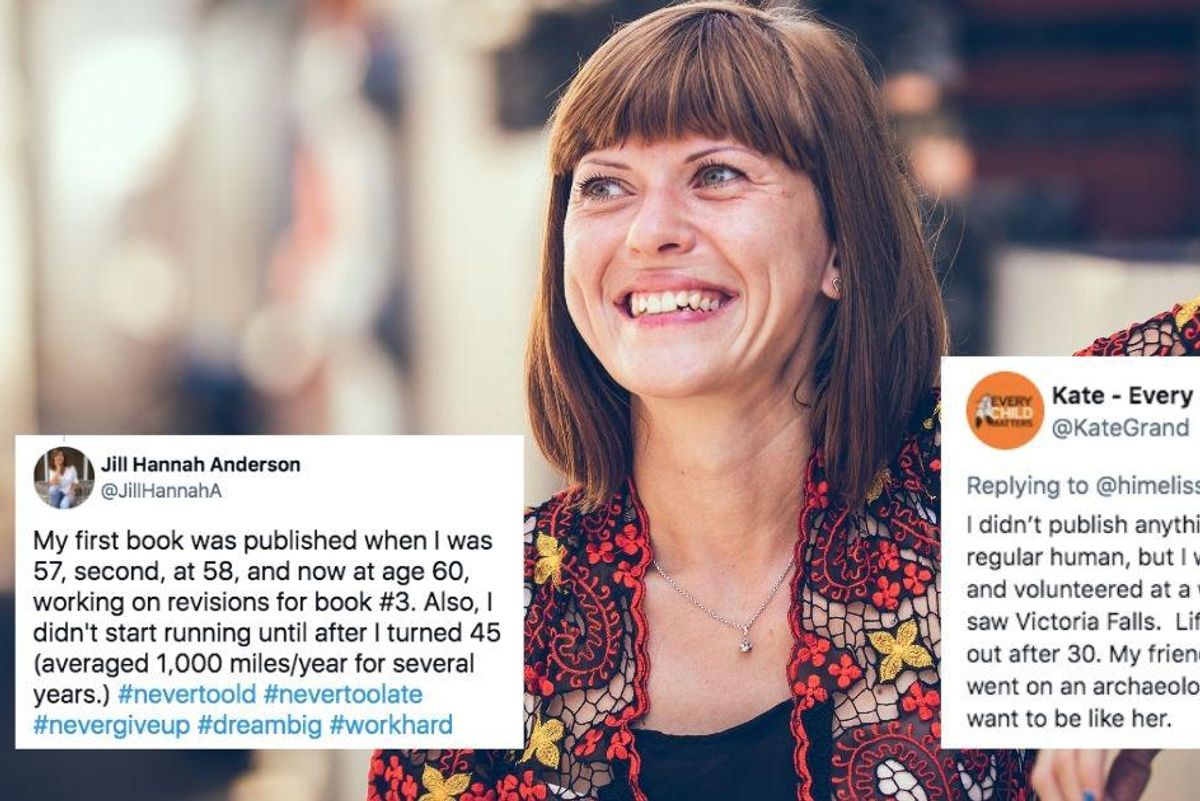
Or the woman who published two books in her late 50s and is revising book #3 at age 60. Oh, she also started running at age 45.

Another person shared how they got out of prison for drugs at age 49, stayed clean and started their own business, and broke the $1 million sales mark last year at 56.

"Lauching my clothing line now—at 48," wrote a mom of two. "Next venture feels amazing."

Another user chimed in with "Yes! Plus the 40 under 40, 30 under 30 can be quite contrived (sometimes). I want to see people juggling school, career, and family.”

Yet another mother of two teens finished her PhD at 41 and got a tenure-track position at age 47. She's also working on a book on Indigenous Early Childhood.

How about this woman who hadn't taken a math class for 40 years? She aced her statistics classes and will graduate with a perfect GPA after she turns 60. "Lots of life to live!" she says.

Another mom (are we seeing a theme here?) discovered a passion for interior design and won a national TV design challenge in her late 40s. Now, at 60, she has a successful design career and contributes to radio and magazines.

Of course, we also know there are fabulously successful folks who got a "late" start in Hollywood, including the incomparable Ava DuVernay, "who left her job at age 40 to focus on filmmaking and then became the first black woman to make over $100 million at the box office.”

As one man pointed out, "The idea that you've got five years between 20 and 30 to do everything you're ever going to do is ridiculous." Hunter agreed, writing, "The advice is always that it's a marathon, not a race, and I wanna read about the people who finished that marathon!!"

So many stories of people publishing their first books, landing their ideal jobs, or discovering a passion later in life just kept coming, and person after person shared how inspiring and motivating they were.

Of course, not everyone has lofty career goals. If these stories aren't quite hitting the mark for you, check out this woman's contribution to the conversation. She's "just a regular human," she says, but she went to Zimbabwe and volunteered at a wildlife refuge at age 47. "Life doesn't just peter out after 30," she wrote. "My friend Elsa is 96 and went on an archaeological dig at 75. I want to be like her."

Don't we all.

Age really is just a number, and there's nothing magical about "making it" in your younger years. Let's be sure to celebrate people living their best lives and making dreams come true at any and every age.


This article originally appeared on 01.10.20

kids, school, school days, school week, schedule, 4 day week
Unsplash

Many school districts are moving to a 4-day week, but there are pros and cons to the approach.

American kids have fewer school days than most other major countries as it is, which poses a big challenge for families with two working parents. In a system designed for the "classic" stay-at-home mom model, it's difficult for many modern families to cover childcare and fulfill their work obligations during the many, many holidays and extra days off American children receive in school.

Some school districts, in fact, are ready to take things one step further with even fewer instructional days: for better or for worse.


Whitney Independent School District in Texas recently made news when it decided to enact a four-day week heading into the 2025 school year. That makes it one of dozens of school districts in Texas to make the change and over 900 nationally.

The thought of having the kids home from school EVERY Friday or Monday makes many parents break out in stress hives, but this four-day school week movement isn't designed to give parents a headache. It's meant to lure teachers back to work.

Yes, teachers are leaving the profession in droves and young graduates don't seem eager to replace them. Why? For starters, the pay is bad—but that's just the beginning. Teachers are burnt out, undermined and criticized relentlessly, held hostage by standardized testing, and more. It can be a grueling, demoralizing, and thankless job. The love and passion they have for shaping the youth of tomorrow can only take you so far when you feel like you're constantly getting the short end of the stick.

School districts want to pay their teachers more, in theory, but their hands are often tied. So, they're getting creative to recruit the next generation of teachers into their schools—starting with an extra day off for planning, catch-up, or family time every week.

Teachers in four-day districts often love the new schedule. Kids love it (obviously). It's the parents who, as a whole, aren't super thrilled.

- YouTube www.youtube.com

So far, the data shows that the truncated schedule perk is working. In these districts, job applications for teachers are up, retirements are down, and teachers are reporting better mental well-being. That's great news!

But these positive developments may be coming at the price of the working parents in the communities. Most early adopters of the four-day week have been rural communities with a high prevalence of stay-at-home parents. As the idea starts to take hold in other parts of the country, it's getting more pushback. Discussions on Reddit, Facebook, and other social media platforms are overrun with debate on how this is all going to shake up. Some parents, to be fair, like the idea! If they stay-at-home or have a lot of flexibility, they see it as an opportunity for more family time. But many are feeling anxious. Here's what's got those parents worried:

The effect on students' achievement is still unclear.

The execution of the four-day week varies from district to district. Some schools extend the length of each of the four days, making the total instructional time the same. That makes for a really long day, and some teachers say the students are tired and more unruly by the late afternoon. Some districts are just going with less instruction time overall, which has parents concerned that their kids might fall behind.

A study of schools in Iowa that had reduced instructional days found that five-days-a-week students performed better, on average.

Four-day school weeks put parents in a childcare bind.

Having two working parents is becoming more common and necessary with the high cost of living. Of course—"school isn't daycare!" But it is the safe, reliable, and educational place we send our kids while we we work.

Families with money and resources may be able to enroll their kids in more academics, extracurriculars, sports, or childcare, but a lot of normal families won't be able to afford that cost. Some schools running a four-day week offer a paid childcare option for the day off, but that's an added expense and for families with multiple kids in the school system, it's just not possible.

kids, school, school days, school week, schedule, 4 day week In a 4-day model, kids often (but not always) receive less instructional time. Photo by Ivan Aleksic on Unsplash

This will inevitably end with some kids getting way more screentime.

With most parents still working five-day weeks, and the cost of extra activities or childcare too high, a lot of kids are going to end up sitting around on the couch with their iPad on those days off. Adding another several hours of it to a child's week seems less than ideal according to expert recommendations.

Of course there are other options other than paid childcare and iPads. There are play dates, there's getting help from family and friends. All of these options are an enormous amount of work to arrange for parents who are already at capacity.

Working four days is definitely a win for teachers that makes the job more appealing. But it doesn't address the systemic issues that are driving them to quit, retire early, or give up their dreams of teaching all together.

@5th_with_ms.y

Replying to @emory here are my thoughts on my 4day work week as a teacher✨ #foryou #fyp #fypシ #foryoupage #foryoupageofficiall #teachersoftiktokfyp #teachersoftiktok #teachertok #teachersbelike #teachertiktok #tik #tiktok #viralllllll #teachertoks #teaching #teacher #tok #viralvideo #teacherlife #viral #trendy #teacher #teaching #worklifebalance #worklife #publicschool #publiceducation #school #student

A Commissioner of Education from Missouri calls truncated schedules a "band-aid solution with diminishing returns." Having an extra planning day won't stop teachers from getting scapegoated by politicians or held to impossible curriculum standards, it won't keep them from having to buy their own supplies or deal with ever-worsening student behavior.

Some teachers and other experts have suggested having a modified five-day school week, where one of the days gets set aside as a teacher planning day while students are still on-site participating in clubs, music, art—you know, all the stuff that's been getting cut in recent years. Something like that could work in some places.

In any case, the debate over a shortened school week is not going away any time soon. More districts across the country are doing their research in preparation for potentially making the switch.

Many parents don't theoretically mind the idea of their busy kids having an extra day off to unwind, pursue hobbies, see friends, catch up on projects, or spend time as a family. They're also usually in favor of anything that takes pressure off of overworked teachers. But until we adopt a four-day work week as the standard, the four-day school week is always going to feel a little out of place.

This article originally appeared in February. It has been updated.

gen z, gen zer, boomers, baby boomers, good thing about boomers

A Gen Zer hangs with Boomers.

The Baby Boomer generation (those born from 1946 to 1964) often gets flak from younger generations. From their unique texting style to their approach to grandparenting and their perceived "angry" attitudes, Boomers are widely criticized.

But one Gen Zer on Reddit was curious about the good Boomers have brought into the world and asked a question aimed at surfacing positive takes on their impact: "What are the best things Boomers have done?"


People shared their thoughts on the great things Boomers have contributed to society. From social activism to supportive parenting and out-of-this-world cooking, here are 10 things to appreciate about Boomers:

boomer, boomers, boomer friends, boomers socializing, positive boomers Boomers laugh together.Photo credit: Canva

"Let's not forget how vocal and persistent the civil rights activists of the Baby Boomer generation were when protesting, including against the Vietnam War and racism and against women's oppression. Let's not forget how hard the artists, and especially musicians, of that generation worked to lift their voices LOUDLY and unflinchingly. Those Boomers served as my blueprint growing up, and they helped me see how to be a humanitarian." - BloodyBarbieBrains

"The recipes... I love all the pastries... Cookies and cakes!" - Ambitious_Welder6613

"Women in the workplace. Women able to get loans without a husband's signature. Civil rights." - Minute-Frame-8060

elton john, elton john gif, elton john singing, elton john piano, elton john fashion Elton John GIF Giphy

"They gave us some pretty good music. Elton John, David Bowie, Stevie Wonder, Jimmy Page, Patti Smith, Neil Young, Elvis Costello." - gramersvelt001100, Ok_Still_3571

"I never hated Boomers like many others did. I find that most Boomers, especially those born in the 50s seem to understand the world is hard for youth and are sympathetic. The most generous people I know are Boomers whether it's tipping or giving you a gift for a small favor. I feel much of the hate is unwarranted and unfair." - Erythite2023

"Baby boomers get a lot of sh*t, but they heavily contributed to a lot of good things: civil rights, LGBTQ rights, women's rights, workplace protections, environmental laws, car safety standards, emission standards. If they screwed some things up, they also got a hell of a lot of things right. Boomers just lived their lives like everyone else does, doing the best they could. I really think when people complain, they should be honest about what they're doing differently than boomers did, and how they're going to make the world a better place so their grandchildren don't blame them for everything, too, which they probably will despite all efforts." - Electric-Sheepskin

boomer, boomers, baby boomer, baby boomers, boomer couple Boomer couple poses together.Photo credit: Canva

"One big thing I credit them with is normalizing not having to dress so formally all the time for public settings. They were the ones who said 'f*ck no' to having to wear suits or skirts just to go run errands. I know they caught flak for that but I am very grateful for it😂." - Antique_Remote_5536

"My parents were baby boomers. while they certainly had their own set of issues, one thing I will always admire is their work ethic. It was one of the last generations that was raised with very little poor-me if that makes sense. My dad would show up to work with a good attitude and get all of his duties done without complaining while having the flu. Not because he didn't want to stay home but because that was just — normal back then. You made things work. He put his families security first over his sickness." - Forward-Air-4462

"They created the best forms of music and media. I don't care what anyone says today's stuff doesn't even begin to compare to the entertainment boomers created." - AroundTheBlockNBack

"Changed what it meant to age, mostly in positive ways. Older people were cast aside by industry and culture much quicker before they came along." - AnswerGuy301

couple fight, argument, upset woman, woman in sweatshirt, marriage

A woman can't stand what she's hearing.

Some folks in this world just have to be right. All the time. Even when you present them with every fact imaginable that proves they are wrong, they will resort to any rhetorical tactic they can to make it seem as though they are right. If that doesn't work, they turn to personal attacks.

People like this can be infuriating to deal with because talking to them is like screaming at a wall. Fortunately, communication expert Jefferson Fisher recently shared a two-step method on TikTok for dealing with these impossible people.


Fisher, who has become massively popular online, offers tips "to help people argue less and talk more."

@art_for_feeling

How to handle someone who is always right. 3 steps from @ Jefferson Fisher #power #insporation

Here is Fisher's two-step process for dealing with people who will never admit they are wrong:

Step 1. Diffuse the situation

"Know that the harder we work to prove that they're wrong, the more convinced they are that they're right," he says. "So what you're gonna do is diffuse that by just saying something simple as well, 'maybe you're right,' or 'maybe so.' That diffuses the whole situation."

Step 2. Open the conversation up

Fisher says you can encourage the other person to explore your ideas by saying: "'It's helpful for me to know that you're at least considering my thoughts, even if you don't agree with me.' Now you've made a safe space to have a discussion that's not threatening their identity. That's how you talk to somebody who thinks they're always right. So try that."

coffee, women having coffee, serious talk, women on couch, agreement Two woman having a heart-to-heart conversation. via Canva/Photos

Why identity matters

In his video, Fisher notes that people who won't admit when they are wrong have developed an identity based on always being correct. That's why, when they're confronted with the possibility that they may be incorrect, they will do anything to avoid admitting it.

Research shows that when people feel their identity is being attacked, they perceive it as an affront to their authenticity and value as human beings. This can lead to a physical reaction known as the amygdala hijack, where people feel as if they are being physically threatened. That's a big reason some people get enraged when discussing politics or religion. If their views on these issues are closely tied to their identity and those views are challenged, it can invalidate their entire sense of self.

angry, arms folded, angy man, won't listen, sneer A man who has dug in his heels. via Canva/Photos

The 'backfire effect'

Fisher explains that the harder we try to prove someone wrong, the more convinced they become they're right, due to a psychological phenomenon known as the "backfire effect." When people are shown facts that clearly contradict their views, they often cling to those beliefs even more strongly. That's because those beliefs are tied to emotion, not facts. When their views are challenged, it triggers defensiveness, and the brain works to protect their self-image rather than reconsider the belief.

Getting through to stubborn people who always think they're right isn't easy, but Fisher's advice can help break through the wall they erect when their beliefs are challenged. It's good for you and the other person. When you're never wrong, you never learn from your mistakes, and that can quickly lead to problems far worse than admitting you were wrong.

washer, washing machine setting, how to use washing machine, laundry, laundry tips
Image courtesy of @granolabarpan/Instagram (with permission)

Stay-at-home mom Catrina shares shock at learning what the 'heavy' setting on her washer means.

Knocking out loads of laundry is a feeling of accomplishment that is unmatched. Depending on what needs to be washed, washing machines offer a variety of settings for the ideal clean. But even the most seasoned laundry pros can admit that they don't fully understand how to use them properly.

One stay-at-home mom shared her funny and relatable washing machine mistake. Catrina (@granolabarpan) got the shock of a lifetime when she realized that she had been using the "heavy" setting on her washer wrong for years.


"POV: today years old when it clicks why my blankets are sopping wet!!! I thought HEAVY meant heavy items being washed," she wrote in the video's overlay.

"Heavy on my machine means heavily soiled," she went on to add in the comments. "I thought it meant the stuff I was putting in the machine was heavy in weight/pounds."

Some moms are also realizing this for the first time. "Ok.. so I am 66 years old learning this???!! I always thought that heavy meant weight also😂," one person commented. Another person wrote, "Well I was today years old when I learned what heavy meant too…😂"

Others expressed confusion with so many settings, and reminiscing on simpler times. "Wait a minute. 😂. I think I need to for once go and read the manual because I have been wondering about all of the options," another user wrote. And another chimed in, "I want my old $250 3 options hot/warm/cold on/off washer back. It didn’t die it rusted out but took 25yrs to do it. I had 5 kids, plus my ex in-laws living with me."

Washing machine settings, explained

Struggling to understand the settings on your washing machine? You're not alone.

"Knowing these settings helps avoid common laundry mistakes, such as using the heavy cycle for heavy fabric weight instead of heavy soil, which can lead to ineffective cleaning or damage over time," Vanessa Ruiz, a professional organizer at Sparkly Maid San Antonio, tells Upworthy.

These are five washing machine settings and how they work:

1. Normal/Regular Cycle
Ruiz explains that this is your typical setting for day-to-day loads such as t-shirts, jeans, sheets, and underwear.

"These laundry loads are typically washed in warm water and the setting is rinsed with medium spin speeds through agitation in order to properly clean moderately soiled garments," she says. "This cycle is safe enough to wash a variety of different fabric content with a somewhat dirty load."

2. Delicate/Gentle Cycle
Ruiz notes that the delicate cycle is created specifically for delicate fabrics—lingerie, silk, lace, or embellished clothing—that may become damaged in a normal or regular wash.

"This cycle will use moderate spin speeds through gentle agitation to thoroughly dry clean and not damage clothes too easily," says Ruiz. "This is the preferred cycle when laundry items that require extra care or are labeled 'delicate' or 'hand wash' need to be washed."

3. Heavy Duty Cycle
The heavy duty cycle is specifically for heavily soiled items like work clothes, kitchen towels, and bedding.

"This setting uses higher water temperatures, longer wash times, and powerful agitation to remove stubborn dirt and grime. It’s perfect for those tough laundry jobs, but not recommended for delicate fabrics," explains Ruiz.

- YouTube www.youtube.com

4. Bulky/Bedding Cycle
This cycle is often confused with "heavy."

"This cycle accommodates larger, heavier items that absorb a lot of water, such as comforters, pillows, and sleeping bags," says Ruiz. "It uses more water, medium spin speeds, and longer wash times to thoroughly clean bulky items without causing damage or imbalance."

5. Quick Wash
In a rush? This is the perfect setting to use.

"It is an accelerated wash cycle designed for small loads of lightly soiled clothes, usually lasting 15 to 40 minutes," says Ruiz. "It’s great for when you need clean clothes fast and can save energy compared to longer cycles."

This article originally appeared last year.

phone, toilet, hemorrhoids, smartphone, tiktok, social media, toilet health

A man looking at his phone on the toilet.

Have you ever been scrolling through social media on your phone and then suddenly wondered where all the time went? You glance at the clock and wonder, “OMG, did I really just spend 30 minutes mindlessly scrolling on this app?” Well, after a new report published in PLOS ONE, you’ll think twice about getting lost doomscrolling while sitting on the toilet.

A team of researchers at Boston Medical Center found that people who scroll on their phones while pooping have a much higher chance of getting hemorrhoids. Hemorrhoids are swollen veins, akin to varicose veins, that are either internal or external. They can be painful, itchy, and sometimes bleed.


Looking at your smartphone on the toilet could cause hemorrhoids

“Smartphone use on the toilet was associated with a 46% increased risk of hemorrhoids,” the paper found after adjusting for sex, age, fiber intake, and exercise activity. To come to this grim conclusion, the researchers interviewed 125 patients at the medical center and asked them about their toilet habits, including whether they scrolled through their phone or not.

phone, toilet, hemorrhoids, smartphone, tiktok, social media, toilet health A woman looking at her phone on the toilet.via Canva/Photos

What the researchers found was that those who bring their phone into the bathroom spend more time on the toilet; therefore, increasing the likelihood of developing hemorrhoids. “Of all respondents, 83 (66%) used smartphones while on the toilet,” the study found. “Furthermore, smartphone users spent considerably more time on the toilet compared to non-smartphone users, with many spending more than five minutes on the toilet per visit.”

Of those who looked at the phone on the toilet, 37.3% said that they sat on the throne for six to fifteen minutes. Non-phone users sat longer than six minutes only 7.1% of the time. "The likely explanation is that prolonged sitting increases pressure in the veins around the rectum, which can contribute to hemorrhoids," Dr. Ernesto Gonzaga, a gastroenterologist from the Hospital of the University of Pennsylvania, told ABC News.

“When you’re sitting on an open toilet bowl, you have no pelvic floor support,” Dr. Trisha Pasricha, the study’s senior author and a gastroenterologist at Massachusetts General Hospital, told CNN. The study said that 54% of people who use the phone while pooping are reading the news, and 44% said they were scrolling through social media.

phone, toilet, hemorrhoids, smartphone, tiktok, social media, toilet health A man looking at his phone on the toilet.via Canva/Photos

The study was conducted on people 45 and over

The study was conducted on people aged 45 and older, a beneficial group to examine because some individuals in this age group don’t bring their phones to the bathroom. The study would have been much harder to conduct on younger people.

“It was helpful to have this (45 and older) group because there were people who didn’t use their smartphones on the toilet. So we had a comparison group,” Dr. Trisha Pasricha, the study’s senior author, told CNN. “Having a third of people not bringing their smartphones to the bathroom helped us understand what a baseline could look like, especially as I imagine the situation is more profound for younger individuals.”

If you’re afraid of developing hemorrhoids, the first step is to make sure that, if you take your phone with you to the bathroom, you stop scrolling when you’re done evacuating your bowels. You can also eat more high fiber foods, such as fruits and vegetables, and be sure to exhale while pushing and not strain. It’s also important to keep a healthy weight and to avoid sitting for too long, whether on a toilet or in your car. Hemorrhoids are a pain in the butt, and they’re not worth it, no matter how great the latest tea is on TikTok.

This article originally appeared last year