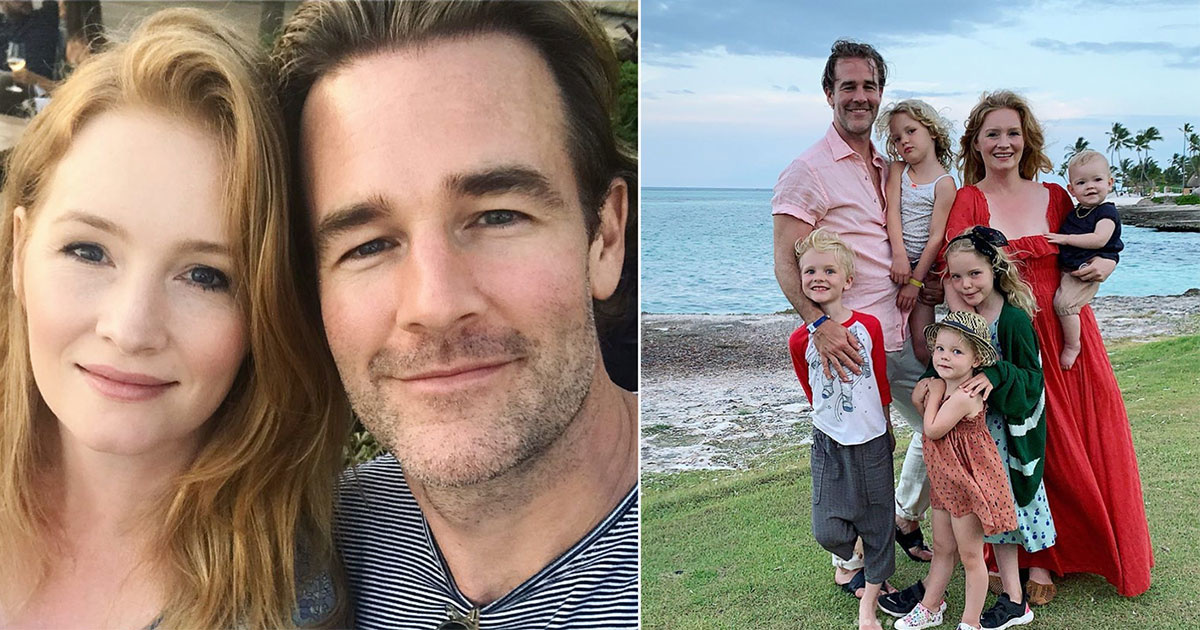
James Van Der Beek’s pregnancy announcement casually helps destigmatize miscarriages
About one in five pregnancies end in miscarriage, although it is believed the number might be higher because many miscarriages occur before the woman knows she is pregnant. Miscarriage is actually quite common, yet many people who’ve had one feel alone, partly because there’s still a taboo around talking about it. In order to reduce…
About one in five pregnancies end in
miscarriage, although it is believed the number might be higher because many miscarriages occur before the woman knows she is pregnant. Miscarriage is actually quite common, yet many people who’ve had one feel alone, partly because there’s still a taboo around talking about it. In order to reduce the stigma surrounding the loss, James Van Der Beek opened up about the struggles him and his wife, Kimberly, experienced.
The Van Der Beeks, who have been
married since 2010, have five children and one on the way. In a pre-taped segment on “Dancing with the Stars,” Van Der Beek announced that his family will be welcoming a new baby. But the segment gave us a more personal look as Van Der Beek revealed they’ve experienced three miscarriages as well. “We’ve had five kids and three miscarriages,” Van Der Beek told his dance partner, Emma Slater. “Miscarriage is something that people don’t really talk about, and we wanted to recognize that it happens to people. We wanted to destigmatize that as much as we possibly could.”
The Van Der Beeks also gave us a look into the ultrasound, revealing many of the anxieties the couple had while waiting to hear their baby’s heartbeat for the first time. “Hearing the heartbeat was something we never take for granted,” he said
in the segment.
Van Der Beek has no regrets about sharing the moment with the world. “It’s a part of life,” he
told People. “It really helps to go through when you have the support of friends and family. People so often go through it in secret. You need to allow yourself space to grieve and go through it. For us, we walked out incredibly happy and excited.”
Van Der Beek posted about the moment on Instagram, revealing why he chose to bring cameras in on such a personal moment. “Thrilled beyond belief to announce that another little bundle of joy has picked us to be their family. We chose to have our first ultrasound on camera with our #DWTS crew capturing the result – something I NEVER thought we’d ever do… but @vanderkimberly and I have been through three of those first appointments to discover either no heartbeat, or no baby, and she wanted to share this moment,”
he wrote.
Van Der Beek also spoke about how miscarriage shouldn’t come with a stigma. “Miscarriage (a word that needs a replacement – nobody failed to ‘carry’, these things sometimes just happen) is something that people rarely talk about, and often go through in secret. But there needs to be zero shame around it, or around giving yourself the time and space to grieve,” he continued.
We celebrate pregnancies and births in a very public fashion, yet many people choose to grieve their miscarriages in private. It might be hard for those who’ve experienced the loss of a pregnancy to connect with others just because we don’t talk about it. By opening up about his struggles and being vulnerable, Van Der Beek helps people who have had similar experiences feel less alone. You’re never alone.
A Somali refugee and current resident of Minneapolis, the multimedia artist and activist draws on her lived experiences to create work that explores trauma, displacement, and resilience. But like so many of the guests on Freedom to Thrive, an award-winning podcast produced by the National Immigration Law Center (NILC), Mansour doesn’t want to focus only on trauma; she also wants to celebrate the unexpected beauty she’s found during difficult experiences.
“One of the beautiful things about tragedies is that it activates hearts, and courageous people are born,” she says. For example, Mansour has noticed more Minnesotans than ever are reaching out to help the vulnerable, after the anti-immigrant crackdowns carried out by the Department of Homeland Security. “They are bringing food, they’re bringing extra clothes, they’re walking with people, and it’s just really beautiful.”
Hector Flores, co-founder of the Las Cafeteras and host of Freedom to Thrive, agrees with her. A child of immigrants himself, he has also seen how hope and hardship often live side by side.
Flores comes from a family with mixed status and is highly aware of the challenges immigrants and refugees in his community face, and how they’re affected by people’s misconceptions. “People want to know about trauma all the time, but we’re more than just undocumented,” he says. “We’re artists, singers, creatives … there’s so much richness in the culture.”
At its core, Flores’ comment is exactly what the Freedom to Thrive podcast is all about: Celebrating immigrants as complex, dynamic individuals, and challenging the dominant narrative that too often reduces them to symbols of hardship.
Launched in 2024, Freedom to Thrive explores heritage, resilience, community, and the ways art and comedy can spark social change. Now in its second season, the podcast continues to feature conversations with immigrants, policymakers, artists, musicians, activists, and more. Recent guests have included comedian Mo Amer, Grammy Award-winning singer Lila Downs, and Pulitzer Prize-winning author Viet Thanh Nguyen.
Where the first season focused on individual stories of identity and belonging, Flores says his goal for season two, where he joins as host, is to “take it to the next level” — using storytelling to highlight “the fact that we’re more similar than different.”
One recent podcast episode drives this point home. In December, Flores interviewed Bryan Andrews, a rising country music star and rural Missouri native who frequently uses his platform to speak about issues affecting immigrant families. At the heart of his message and his songwriting, Andrews says, is the idea that small-town Americans and the rest of the country, including immigrants, have more in common than they realize.
“It doesn’t matter where you’re from,” Andrews says on the podcast. “We’re all trying to make a living and we’re tired of getting railroaded by corporate greed or by politicians who don’t care.”
Rural Americans, Andrews says, are often stereotyped as racist and misogynistic but “the overwhelming majority of people in my home town have love in their hearts.” Media stereotypes often amplify differences and divide, he says, but at the end of the day, “we’re all in this together.”
Flores, who was raised in a working-class immigrant neighborhood in East Los Angeles, had similar thoughts. He says he often sees its residents stereotyped as wealthy, consumerist, and status obsessed. “That exists, but that’s not my life, that’s not my community,” he says. Like small-town Americans, people in the city “just want to work hard and take care of their families. We all want the same thing.”
Although the podcast tackles some heavy issues, each episode’s ultimate focus is how personal and collective struggles can be healed through art, driving home a message of hope and resilience:
Mansour’s episode about her experiences in Minnesota is just one of many examples. Flores asks her,
“What gives you hope for the people creating a home here?”
“The love I feel from other Minnesotans. It is trumping any hate we’re experiencing,” she replies.
CTA: Stream all episodes now on the Freedom to ThriveYouTube channel or the website,here.
The podcast has been nominated for a Webby in the “Belonging & Inclusion” category. You can vote for it to win until Thursday, April 16!
This article is part of Upworthy’s “The Threads Between U.S.” series that highlights what we have in common thanks to the generous support from the Levis Strauss Foundation, whose grantmaking is committed to creating a culture of belonging.
Julian wasn’t expecting anything unusual when he pulled up to pick up his stepdaughter from school. Just another ordinary afternoon errand. But when one of her classmates pointed at him and asked who he was, his stepdaughter answered without hesitating for even a second.
“That’s my dad.”
Stepping up to just ‘dad’
Julian shared the moment in a TikTok video that quickly resonated with thousands of viewers, many of whom have lived some version of this story themselves. He said he wasn’t sure she’d ever give him that title — not because things were bad between them, but because he’d never pushed for it. He’d just tried to show up, consistently, and let her lead.
That’s what made the moment so meaningful. She didn’t say it for him. She said it because it was simply true to her.
People knew how it made him feel
The comments filled up almost immediately with people who understood exactly what that kind of moment feels like. One commenter wrote that her husband cried the first time one of his stepsons said the same thing. Another, who grew up with a stepfather herself, offered a perspective worth sitting with: “She will see you differently the moment you just call her your daughter, not a stepdaughter. Just like how you felt — that feeling is the same both ways.”
Kids are figuring things out, too
That symmetry is easy to miss in blended families, where so much of the emotional weight tends to fall on the adults trying to figure out their role. Kids are often doing the same calculus quietly on their end, watching to see if this person is going to stick around, wondering what to call them, not wanting to get it wrong either.
Julian ended his video saying he was going to take her out for food — which, as many commenters pointed out, is about the most dad response imaginable.
The title of “dad” isn’t something you can ask for or negotiate. It’s conferred. And apparently, a school pickup on an ordinary afternoon is exactly the kind of place where it happens.
Charles Boehm had never written an obituary before. When his father Robert died in October 2024 after a fall in his Clarendon, Texas apartment, Charles sat down in his Houston home, completely stumped, and did what anyone would do.
He Googled it.
“I decided to Google, ‘What do you put in an obituary?’” he told The Washington Post. What came up changed everything. He found the obituary of a Connecticut man named Joe Heller, written with wit and irreverence and genuine love, and immediately thought: that sounds like something my dad would do.
So Charles did the same. What he wrote for Robert Adolph Boehm, 74, of Clarendon, Texas (population 2,000) went viral almost instantly when Robertson Funeral Directors shared it on Facebook. It has since been viewed more than a million times.
The viral obituary of a Texas man
It begins like this:
“Robert Adolph Boehm, in accordance with his lifelong dedication to his own personal brand of decorum, muttered his last unintelligible and likely unnecessary curse on October 6, 2024, shortly before tripping backward over ‘some stupid mother****ing thing’ and hitting his head on the floor.”
It continues. Robert was born in Winters, Texas in 1950, “after which God immediately and thankfully broke the mold and attempted to cover up the evidence.” He managed to avoid the Vietnam draft by getting his wife Dianne pregnant three times between 1967 and 1972. His youngest son Charles arrived in 1983, the obituary notes, “with Robert possibly concerned about the brewing conflict in Grenada.”
His lack of military service was, the obituary observes, “probably for the best” — given that Robert later took up shooting as a hobby and managed to blow two holes in his own car’s dashboard on two separate occasions. His wife Dianne, “much accustomed to such happenings in his presence, may have actually been safer in the jungles of Vietnam the entire time.”
Good grief: Humor helps a family heal
There’s the fashion: homemade leather moccasins, a wide collection of unconventional hats, boldly mismatched shirts and pants. The career: he became “a semi-professional truck driver — not to be confused with a professional semi-truck driver.” The hobbies: historical weapons spanning from a 19,000 BC French atlatl to a Soviet-era Mosin-Nagant, plus a wide selection of harmonicas he kept on hand but rarely played. When Robert’s wife Dianne died in February 2024, Charles wrote that God had gotten her “the hell out of there for some well-earned peace and quiet.” In her absence, Robert had thrown himself into entertaining the people of Clarendon with what the obituary calls his “road show.”
It closes: “We have all done our best to enjoy/weather Robert’s antics up to this point, but he is God’s problem now.”
Attendees at the funeral were requested to wear “outlandish or mismatched outfits” in his honor.
The reaction said it all
Chuck Robertson, who owns the funeral home and received the obituary, told The Washington Post he almost choked on his breakfast laughing. “I told people in the office, ‘Well, this is going to get us some attention,’” he said. “I’d never had a family come through the doors that wrote an obituary as classic as that one.”
Charles said he was astonished by the response. “I was sad that my father was going to be forgotten and that my parents’ small life would get packed up into my trailer and that would be the end of it everywhere but inside my own mind,” he told TODAY. “That obituary was intended to ease my own pain and make a handful of people in a town of two thousand smile instead of frown, and it’s probably done that for 2 million at this point.”
The message behind the laughs
He also has a message for anyone reading: don’t let your parents slip through the cracks in small towns. “There are people all over the country like my dad,” he said. “They go there to retire, then when they’re old, their kids scatter and they end up alone.”
When the family cleaned out Robert’s apartment, they found four harmonicas immediately.
Dean Whitehead is 23 years old and in his first year of teaching high school English. He’d heard enough complaints from students about boring essay topics to know he needed to try something different. So one day he set up a camera in his classroom, opened a shared document he’d titled “Argumentative Fun,” and gave his students an assignment unlike anything they’d been asked to do before.
Ten minutes. Any topic. No grammar corrections, no spelling deductions. The only way to win bonus points was to be genuinely convincing.
“It has to be something you feel so strongly about that you can type for 10 minutes straight,” Whitehead told them, as captured in his TikTok video posted to @mrcoachwhitehead. A few students immediately had questions. One asked for a minute to think. Whitehead gave them eleven. Voice-to-text was off the table.
Students take writing to another level – their own
The essays came in. They were, as promised, unhinged.
One student ranted about curfews, arguing that weekends should be completely free because school is already hard enough. Another went after boys in general. One made a detailed case for wanting to be rich specifically so they could give money to their friends and family. Someone addressed the injustice of teachers confiscating phones. One student, apparently undaunted by the fact that their teacher was reading this, wrote in the middle of their essay that Whitehead wasn’t actually the best teacher.
Caillou hits a big nerve
But the winner, and it wasn’t close, wrote about Caillou.
For those who have blocked the PBS Kids animated series from memory: Caillou is a perpetually four-year-old Canadian child who whines his way through every episode and faces consequences for approximately nothing. The student’s essay, Whitehead reported in a follow-up video that has now been viewed more than 11 million times, cited Caillou’s baldness as suspicious and his ability to get away with everything as a fundamental injustice. “When I say this was the most convincing rant I’d received, I mean it,” Whitehead told his class. “I also hated Caillou.”
Five bonus points, awarded.
Finding passion through freewriting
What surprised Whitehead most wasn’t the content — it was the quality. When students actually cared about their topic, the mechanics followed. “The craziest surprise was they actually did fantastic on their own with grammar and creating full, complete sentences,” he wrote in the comments. “I was super proud of them.”
The technique Whitehead stumbled onto has a real name: freewriting. Teachers have used low-stakes, high-freedom writing exercises for decades precisely because removing the fear of being graded wrong tends to unlock students who’ve otherwise decided they hate writing. The catch is getting them to care about the topic enough to sustain it. Turns out strong opinions about animated characters work just fine.
Like most marsupials, wallaby joeys typically remain inside their mother‘s pouch for up to nine months to grow, nurse, and stay warm. At around six to seven months, they begin emerging to explore, but will continue returning to the pouch for security.
A baby in need
But when Blossom, a baby albino wallaby, showed up at Lindsay Clarity’s UK-based animal rescue center, Animal School, she was far too young to manage without that safe, enclosed space.
Unfortunately, Blossom’s mom was nowhere to be found, and every other resident wallaby at the rescue already had a joey tucked into their pouch. There was no natural substitute available.
Clarity, who had years of experience caring for vulnerable animals (particularly rearing babies), stepped in with a creative solution. She placed a soft pink pillowcase inside a backpack and turned it into a portable pouch. The setup gave Blossom the warmth and closeness she needed to feel secure.
Clarity carried Blossom in that improvised pouch for an entire year. She compared the experience to “walking around like a pregnant lady,” sharing with GeoBeats Animals that it became part of her daily routine.
Feeding Blossom required extra effort. Specialized milk and a particular bottle had to be shipped from Australia so the joey could develop properly. Every detail mattered, and Clarity stayed committed through it all.
Growing strong
The care paid off. Blossom did indeed “blossom,” eventually outgrowing her pouch and exploring the world on her own terms. Today, she’s developed a distinct personality, described as “more catlike than doglike,” and even showed a fondness for soft, calming sounds, which Clarity plays herself.
Not to mention, she has a loyal fanbase invested in the daily adventures of her life. What began as an emergency rescue turned into a journey that many people feel connected to.
As for Clarity, she credits Blossom with changing her life, saying, “Caring for her is one of the most rewarding things I have ever done.”
Fascinating wallaby facts
Blossom’s story also highlights how remarkably adaptable wallabies are: able to live in forests, rocky areas, or open grasslands. They are known to be opportunistic feeders, grazing at dawn and dusk to avoid midday heat. They also have the ability to pause pregnancy, which aids survival in uncertain environmental conditions.
Albino wallabies like Blossom are especially rare. Their lack of pigmentation gives them their striking pale appearance, though it can also make them more vulnerable in the wild due to reduced camouflage.
However, Blossom is, of course, just one of the many happy animals at Animal School. For Clarity, inspiring others to learn about animals has been a lifelong passion. And when she’s not running animal therapy sessions, “Creative Creatures” art classes, or various other onsite activities, she loves using social media to offer glimpses into the continuously fascinating animal kingdom.
To stay up to date with Blossom and the other Animal School residents, be sure to head over to Instagram and give a follow.
Chris Greene recently found himself living every parent’s nightmare. While visiting Oceanside Harbor Beach in California, his 6-year-old daughter was playing in shallow water when she was suddenly swept out to sea by a powerful riptide.
Greene had warned her just minutes earlier about the current, telling her not to get too close to the nearby jetty. Riptides are often more powerful, persistent, and unpredictable near structures like piers and jetties. Greene knew that, yet he still found himself in a life-or-death situation. As soon as Greene’s daughter, Coco, was pulled out by the current, he jumped in after her. But by the time he reached her, he was completely exhausted from fighting the current himself, according to FOX 5 San Diego.
Harrowing video footage captured by a bystander on a nearby jetty shows Coco screaming and her father struggling to keep them both afloat.
That’s when a stranger, surfer Lucas Taub, sprang into action. Coaching a competition on the jetty, the surf instructor didn’t hesitate to jump in after the pair. The entire rescue was caught on camera.
Taub is being hailed as a hero. People who know him say they aren’t surprised in the least that he stepped in when needed.
“Coach Lu….we love you!!! You’re our hero…always have been, always will be!! . Thank you for being such an amazing human!” one commenter wrote on Instagram.
“Lucas is an all around good human. He’s my son’s coach at Westcliff. This does not surprise me that he did this,” added another.
But just as many people were quick to give Greene credit for battling through exhaustion to stay with his daughter long enough for help to arrive.
“Poor dad was exhausted. It’s amazing how you can hang in there when your child’s life is in your hands,” one person wrote.
“Hero indeed, Dad doing everything he had and dealing with that moment with everything he had,” another added.
Taub is taking all the newfound attention in stride.
“There wasn’t a second that went through my mind that I wasn’t gonna jump in that water,” Taub told FOX 5 San Diego. “I knew it was a matter of seconds between life or death, and I knew that was my calling right there … God put me on that jetty at that moment to be that person to serve. And be that person … to help, you know?”
Surfers save many people from drowning in the ocean
According to SurferToday, surfers (in this case, surf instructors) are often the first on the scene when someone is in trouble. Already positioned in deeper water with strong visibility, they can often reach struggling swimmers before lifeguards even realize there’s an emergency.
They cite a recent survey of surfers that found some staggering results: On average, respondents helped someone struggling in the water at least once every 100 outings.
On a busy beach, that adds up to tens of thousands of saves, assists, and first-aid applications per year.
We always knew surfers were cool, but most of us had no idea just how cool. Hang ten, dude!
The golden age of “summering,” or spending most if not all of a summer away from home on extended vacation, brings certain images to mind: lavish beach houses, European isles, luxurious cottages, and a service staff that caters to your every need. You know, wealthy person stuff.
The truth is surprisingly commonplace. In the early 1900s, normal working-class to upper-middle-class families would often “summer” away from home for weeks at a time. Believe it or not, these extended stays were often affordable, practical, and offered an incredible sense of community.
For people who grew up in the 1950s and surrounding years, these summers remain some of the most magical and nostalgic of their lives.
Costs and common summering destinations in the 1950s
If you’ve ever seen Dirty Dancing or The Marvelous Mrs. Maisel, you’ll be familiar with the scenes.
In Dirty Dancing, which is based on the screenwriter’s own childhood, the majority of the plot takes place at a resort in the Borscht Belt, near the Catskill Mountains in New York. Several episodes of The Marvelous Mrs. Maisel also take place at a similar Jewish resort in the Catskills. The 1999 film A Walk on the Moon features a similar plotline, also set in the Catskills.
To be fair, these family resorts make a great location for a movie. But the inspiration for these films and TV shows is very much drawn from real life.
In the 1950s and preceding decades, families in the Northeast, especially in New York City, were drawn to these getaways for a number of reasons. The most pressing reason was the heat. Families living in busy cities in the pre-air-conditioning era often needed to escape the suffocating smog.
Air travel was also new and not widely accessible to the working class at the time. As a result, families often drove to find fresh air and a good place to vacation. The Catskills, Poconos, Adirondacks, Berkshires, and Jersey Shore were all popular destinations.
The Catskills, in particular, were heavily associated with the Jewish community. However, many different ethnic groups—who were sometimes not welcome at resorts in other parts of the country—carved out their own niches. Finding community was part of the appeal of these vacations.
Wealthy families would either own or rent prestigious houses in places like the Hamptons.
But family-style resorts, like those found in the Catskills, became incredibly popular among middle-class families. They might stay for one or two weeks or even the entire summer, particularly if the family’s primary breadwinner was able to commute back to the office during the week and join them on weekends.
It’s hard to say exactly how much these all-inclusive family resorts cost, but TravelPulse estimates the average hotel rate in the 1950s at just $5.91 per night. That is equivalent to about $160 today.
Accounting for inflation, family travel was at least half as expensive as it is today. That explains why normal families were sometimes able to spend multiple weeks in upstate New York.
What were these 1950s summer family resorts really like?
Days were simple. Kids would attend day camp, where counselors ran a variety of activities, from horseback riding and canoeing to time at the pool. Afterward, they were mostly free to roam and play with one another while the adults socialized and enjoyed the spa, sports facilities, the pool, and more.
At night, there was entertainment, including singers, comedians, and variety shows—sometimes even performances by legendary entertainers such as Louis Armstrong, Tony Bennett, and Sammy Davis Jr.
“My family went to Grossingers in the Catskills and Wild Echo in Canada when I was younger,” a Reddit user wrote. “Those memories are my favorite from when I was a kid. Shuffleboard tournaments, fishing derbys, baseball, campfires, talent shows, so many crazy weeks sleeping in mini cabins. Really cheap family vacations for middle class folks. Sadly they tore all those cabins down and built condos.”
“I spent a summer with an also middle class Jewish family in the Catskills this way,” another added. “Basically an Au Pair. Dad would come up on weekends while mom would socialize and play cards with the other moms til dinner time. It was 2 kids, very well behaved around ages 5 and 8. The other girls ( every family had one of us ) and I would hang out in the pool with the kids all day … The family was awesome to me. Just had to keep the kids out of mom’s hair while she did her thing and again, the kids were really well behaved, so no issues. It was also a great way to get out of the city for the summer.”
One person wrote that their family continued the tradition into the 1980s and 1990s: “My family was lower-middle to middle-middle and we did the summer in upstate New York while my dad worked during the week coming up on weekends … every other summer through the 80s and early 90s. On the odd years we stayed in the city. I much preferred the upstate summers.”
Another wrote, “My grandparents were far from wealthy. They lived in a small apartment in the South Bronx. But every summer they would rent a bungalow in the Catskill, with friends & relatives renting their own in the same community (or colony), and my grandfather would stay in the city during the week for work. Towards the end of the summer my grandfather would take his vacation time and stay with them.”
One woman told Next Avenue of her childhood summers in the Catskills: “I remember all the activities — ice skating, horseback riding, swimming in the pool … I went to the day camp when I was little, but as I got older, I found other kids to play with. … I had total freedom to roam the property. My parents were never worried about me. It was a simpler time.”
“I wish these types of resorts hasn’t gone out of style,” a Redditor wrote. “It’s basically summer camp for families. I know they have similar resorts in Mexico etc but I’d love to go to a place in the US where each family has their own cabin, lots of activities and a dining hall.”
Why summering went away… mostly
Several major changes occurred in America during the 1970s and 1980s.
For starters, air conditioning became more ubiquitous, and it was no longer mandatory for families to escape the city heat in the summer. Air travel also became more commonplace, allowing families access to a far greater selection of vacation destinations. Old favorites like the Catskills and Poconos became less popular over time.
Travel also became more expensive. Multi-week, all-inclusive vacations today are out of reach for most families.
However, some families still seek out this same kind of nostalgic experience, although they usually cannot afford to do it for as long. All-inclusive resorts and cruises are places where families can settle in for a week or so and enjoy built-in activities, food that requires no thought or planning, no cleaning, plenty of friends to meet, and, most of all, childcare.
Family vacations look a lot different today than they did in the 1950s. Even though the costs and methods have changed, many families are still looking for that perfect combination of adult social time, free-roaming kids, and pure relaxation.
Late one evening in Baltimore, Twitch streamer-slash-food truck owner Muhsin Sarac was doing what he always does: grilling and chatting with viewers during a livestream. Known online as @Musa_usa, Sarac often shares the rhythm of his workday with a growing audience.
On March 27, that routine was interrupted by something both frustrating and all too familiar for small business owners.
As reported by The Baltimore Sun, a customer approached Sarac’s truck, placed an order, and lingered for a moment. With Sarac’s back turned, the man reached into the tip jar and took cash. The act was subtle…but not invisible. Viewers watching the stream quickly realized what had happened. And Sarac, trying to piece it together in real time, asked aloud whether the money had actually been taken.
Unfortunately, by the time Sarac turned around, the man was already walking away, claiming he was heading to his car for payment. He never returned.
The incident left Sarac shaken. Around $30 was missing, and the situation felt both brazen and disheartening. Police were called, and when officers arrived, they reportedly recognized the suspect. Sarac couldn’t hide his confusion, wondering why someone who seemed polite would make that choice.
For viewers, it was another example of how quickly trust can be broken, especially for people working long hours to serve their communities.
But the story didn’t end there.
A mother steps forward
Four days later, something remarkable happened: a woman approached Sarac’s truck and introduced herself in a way he never expected.
“A little while ago, a young man came to your stand and took money out of your tip jar. I’m his mother,” she said.
The woman, later identified as Pastor Tonya Gray, asked how much her son had taken. When Sarac told her it was about $30, she immediately reached into her purse.
“No, I want to pay, because my son wasn’t raised like that,” she said. “My son drinks, and when he drinks, he does stupid stuff. I want to pay you back because you don’t deserve to be stolen from.”
She placed the money back into the tip jar, making it clear that accountability mattered just as much as compassion.
Gray later explained that holding her son responsible didn’t mean turning her back on him. In fact, it meant the opposite. She shared that she had placed him in treatment and was focused on helping him heal while still addressing his actions.
“My son had no right to go in and take anything from him,” she told WJZ News. “He deserved to be made whole.”
Her message to other parents was direct and rooted in care. She encouraged them to face difficult moments head-on and support their children without ignoring harmful behavior.
“We have to care about them enough to check them,” she said. “No matter what he did, at the end of the day, that’s my son.”
Twitch streamer and street vendor Muhsin sarac is robbed live on stream. Later, the robber’s mother comes to pay him back. 🎥: musa_usa1981 on Instagram
Sarac was deeply moved by the interaction. After accepting the money, he stepped out of his truck and embraced Gray. The exchange struck a chord far beyond that street corner.
“She almost made me cry,” he later said to WJZ.
As the video spread online, viewers responded to more than just the act of repayment. They connected with a mother willing to step forward, a business owner open to forgiveness, and a moment where responsibility met compassion in a very human way.
It goes to show that a little accountability, honesty, and empathy can turn even the most disheartening moments into hopeful ones.
Earlier this year, a baby stray cat named Zoe showed up at the Palm Springs Animal Shelter, Caldwell’s facility, looking more like a balloon than anything feline, her tiny body swollen to an absurd degree. The poor thing had been suffering from subcutaneous emphysema. Due to some damage to her windpipe, air (and lots of it) was trapped underneath her skin.
Caldwell told Upworthy, “My guess is that she was bitten by another cat, possibly even her mother? I don’t think the trauma was anything malicious … just one of those accidents that happened.”
Regardless of its cause, the medical condition was rare enough in grown cats, let alone kittens. Caldwell told KVUE, “This is the craziest veterinarian case I’ve seen in quite some time.”
The antidote to this bizarre dilemma was surprisingly straightforward. Caldwell carefully “poked” Zoe in various parts of her body with a needle and syringe, slowly releasing the trapped air. With each deflation, she became less balloon and more kitten, appetite and all. After only a week of treatment, she already weighed a healthy two pounds.
“She’s eating like a champ,” Caldwell wrote on Instagram. “She loves to eat, and she’s gaining weight every single day.”
Zoe, affectionately known online as “Puff Kitty,” “Mrs. Puff,” and “Marshmallow,” instantly captured hearts with her unusual and harrowing story. Her videos have not only gone viral, they have been picked up by national outlets like ABC. Suffice it to say, people were invested.
“I’m obsessed with Zoe…My cats think I’m cheating when I talk about her!” one fan wrote.
“I would die for Zoe,” echoed another.
“Protect Zoey at all costs,” added a third.
Zoe’s now-famous face (the puffed-up version, of course) is even featured on a T-shirt with all proceeds going to the Palm Springs Animal Shelter’s “Love Fund,” so other animals can have more access to specialized care. In other words, she is making sure other fur babies can have their own happy ending.
“Zoe, our Puff Kitty warrior — a tiny but mighty kitten — has touched the hearts of so many with her story of resilience,” the shelter wrote in an Instagram and Facebook post.
Of course, all this high praise has apparently “gone to her head,” Caldwell joked. Now she even has a “publicist, an agent, and a stylist!”
As of March 13, Zoe has been recovering well in foster care and is preparing to find her forever home. Caldwell assures that from here on out, “she’ll be normal but will demand copious amounts of love.” But hey, after all that…she deserves it!
While Zoe’s next chapter will likely be far less dramatic than her first, she will certainly have no trouble earning that love, even without the balloon-like condition. That is thanks in no small part to Dr. Caldwell and other professionals like him who fight for an animal’s second chance.
By the way, Caldwell has even more crazy stories found in his book, The Pet Doctor’s Shoes: True Tales from the Trenches of Veterinary Medicine, which you can find here.