upworthy
Add Upworthy to your Google News feed.
Google News Button
Family

Childless people over 50 are honestly reflecting on whether they made the right decision

Spoiler alert: They’re totally fine with it.
childless couples, kid-free life, regrets of seniors
via Pexels

Childless people over 50 discuss their decision.

People who decide not to have children are often unfairly judged by those who chose a different life path. People with children can be especially judgmental to women who’ve decided to opt out of motherhood.

“You will regret it!” is one of the most common phrases lobbed at those who choose to remain childless. Why do people think they’ll have such awful regrets? Because they often say they’ll wind up “lonely and sad” when they’re older.

They also say that life without children is without purpose and that when the childless get older they’ll have no one to take care of them. One of the most patronizing critiques thrown at childless women is that they will never “feel complete” unless they have a child.

However, a lot of these critiques say more about the person doling them out than the person who decides to remain childless.

Maybe, just maybe, their life is fulfilling enough without having to reproduce. Maybe, just maybe, they can have a life full of purpose without caring for any offspring.

Maybe the question should be: What’s lacking in your life that you need a child to feel complete?


Studies show that some people regret being childless when they get older, but they’re in the minority.

An Australian researcher found that a quarter of child-free women came to regret the decision once they were past child-bearing age and began contemplating old age alone.

People revealed the reasons they’ve decided to be childless in an article by The Upshot. The top answers were the desire for more leisure time, the need to find a partner and the inability to afford child care. A big reason that many women decide not to have children is that motherhood feels like more of a choice these days, instead of a foregone conclusion as it was in previous decades.

Reddit user u/ADreamyNightOwl asked a “serious” question about being childless to the AskReddit subforum and received a lot of honest answers. They asked “People over 50 that chose to be childfree, do you regret your decision? Why or why not?”

The people who responded are overwhelmingly happy with their decision not to have children.

A surprising number said they felt positive about their decision because they thought they’d be a lousy parent. Others said they were happy to have been able to enjoy more free time than their friends and family members who had kids.

Here are some of the best responses to the Askreddit question.

1. Never had any desire.

"I explain it to people like this - you know that feeling you get where you just can't wait to teach your kid how to play baseball? or whatever it is you want to share with them? I don't have that. Its basically a lack of parental instinct. Having children was never something I aspired to. My SO is the same way.

"Don't get me wrong, I have nothing against children. And I get really angry at people who harm them or mistreat them. I just never wanted my own." — IBeTrippin

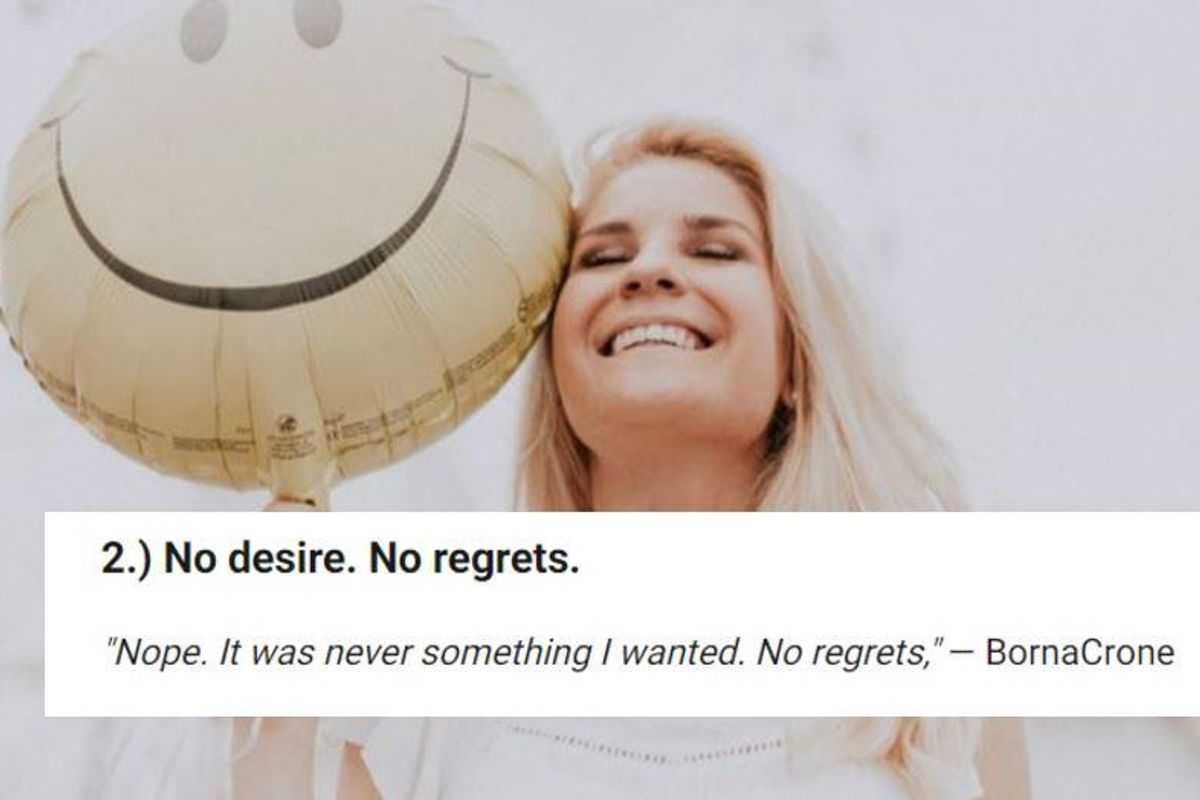
2. No desire. No regrets.

"Nope. It was never something I wanted. No regrets." — BornaCrone

3. Mixed feelings.

"I have mixed feelings. I don't care much for children and I think it would have been disastrous for us to have them. I was also able to retire at 52. Pretty sure that wouldn't have happened with kids. So yeah, absolutely the right decision.
But I love my family and I do wonder what it would be like to have my own, to teach my child the things I know and not to be without someone who cares about me at the time of my death.

"But again, absolutely the right decision and at 55 I'm very happy NOT to have them. This is reinforced every time I'm exposed to other people's kids." — ProfessorOzone

4. They never visit.

"My wife worked at a nursing home for years. Imagine seeing for years that over 95% of old people never have family visit. Till they die and people want a piece of the pie. This when I learned that the whole 'well who is gonna visit you or take care of you when you're older' line is complete bullshit. We decided to not have kids ever after that. Made great friends and saw the world. No regrets." — joevilla1369

5. It wasn't an option.

"I don't necessarily regret not having them, but I regret the fact that I wasn't in a healthy enough relationship where I felt I COULD have children. I regret not being stronger to leave the abuse earlier, if I had been stronger, I think maybe I could have had the choice at least. So yeah... I have regrets." — MaerakiStudioMe

6. Grandkids are cooler.

"No. I knew what I was getting into when I agreed to marry my husband. He had two sons from his first marriage and a vasectomy. He was worried because I was so young (comparatively, he's 10 years older). I did think it over seriously and concluded that a life with him compared to a life without him but (perhaps!) with a baby I didn't even have yet was what I wanted. It worked out for us, we've been together for 26 years. As a bonus I have 9 grandchildren. All the fun without the work of the raising!" — Zublor

7. I'd be a bad parent.


"Not one bit. I have never believed that I would be a good parent. I have a short temper, and while I don't think I would have been physically abusive, my words and tone of voice would be harsh in a very similar way to my own father. I wasn't happy growing up with that kind parent and I wouldn't want to subject any child to that kind of parenting."
— Videoman7189

8. I'd rather be the cool aunt and uncle.

"No and I found a partner who feels the same. We are the cool aunt and uncle." — laudinum

9. Loneliness is underrated.


"54 yrs.old. I've lived the past 30 years alone. Presently my dog and I are chillin' in a nice hotel on a spur of the moment vacation. I'd maybe be a grandfather by now?! I can't imagine what it would be like to have family. I picture a life lived more "normally" sometimes. All sunshine and roses, white picket fence, etc. but I realize real life isn't like that. No I don't regret being childfree or wifefree for that matter. My life can be boring at times but then I look back at all the drama that comes with relationships and think I've dodged a bullet. I spent 20 years trying to find a wife to start a family. Then I realized the clock had run out, so fuck it, all the money I'd saved for my future family would be spent on myself. Hmmmmm...what do I want to buy myself for Christmas?" — Hermits_Truth

10. No diaper changes and no regrets.

"Nope. I never had the urge to change diapers or lose sleep, free time and most of my earnings. Other people's kids are great. Mostly because they are other people's. When people ask 'Who will take care of you when you're old' I tell them that when I'm 75 I will adopt a 40-year-old." — fwubglubbel

11. Zero desire.

"I’m 55 (F) and never wanted children. I just don’t much like them, and 20+ years of motherhood sounded (and still sounds) like a prison sentence. Maternal af when it comes to cats and dogs, but small humans? No chance.

"And I’m very happy to be childless. Cannot imagine my life any other way." — GrowlKitty

12. D.I.N.K.

"Dual income no kids = great lifestyle!" — EggOntheRun

13. Some regrets

"Over 50 and child free. My only regret is that my wife would have been a great mother, and sometimes I feel like I deprived her of that, even though we both agreed we didn’t want kids. Sometimes I wonder if I pushed her into that decision. She works with the elderly every day and sees a lot of lonely folks so it gets to her sometimes. I was always afraid I’d screw up the parenting thing, so I was never really interested in the idea. I’m a loner by nature though." — Johnny-Virgil


This article originally appeared on 02.08.22

Gen Z; Millennials; technology; cell phones; social media; teens and technology; teens social media

Gen Z is the first generation less cognitively capable than their parents. Denmark has the solution.

Nearly every parent hopes their child will be better off than they are: smarter, more secure, and more well-adjusted. Many parents see this as a stamp of successful parenting, but something has changed for children growing up today. While younger generations are known for their empathy, their cognitive capabilities seem to be lagging behind those of previous generations for the first time in history.

Dr. Jared Cooney Horvath, a teacher turned cognitive neuroscientist who focuses on human learning, appeared before Congress to discuss concerns about cognitive development in children. In his address to the members of Congress, he says, "A sad fact that our generation has to face is this: our kids are less cognitively capable than we were at their age. Since we've been standardizing and measuring cognitive development since the late 1800s, every generation has outperformed their parents, and that's exactly what we want. We want sharper kids."


kids, intelligence, sharp kids, generations, education, cognitive abilities Student smiling in a classroom, working on a laptop.Photo credit: Canva

Horvath explains that the reason this happens is that each generation has gone to school longer than the previous generation. Gen Z is no exception to the longer duration of time spent in school, but they're the first ones who aren't meeting this normal increase in cognitive development. According to the cognitive neuroscientist, the decline is due to the introduction of screens in the classroom, which started around 2010.

"Across 80 countries, as Jean was just saying, if you look at the data, once countries adopt digital technology widely in schools, performance goes down significantly. To the point where kids who use computers about five hours per day in school for learning purposes will score over two-thirds of a standard deviation less than kids who rarely or never touch tech at school," Horvath reveals.

In most cases, the decline in performance doesn't result in better strategies. The neuroscientist shares that the standardized testing has been adjusted to accommodate lower expectations and shorter attention spans. This is an approach that educators, scientists, and researchers went to Capitol Hill to express wasn't working. But not every country is taking the approach of lowering standards to meet lowered cognitive ability. Denmark went in the opposite direction when it realized their students were slipping behind.

France24 recently interviewed educators in Denmark following their seemingly novel approach to students struggling with cognitive development. Since the beginning of the 2025/2026 school year, Denmark has not only been having students turn in their cellphones, but they've also taken tablets, laptops, and computers out of the classroom. No more digital learning for the majority of the school day. Danes went old school by bringing back physical textbooks, workbooks, and writing assignments. The results have been undeniable. Even the students can't seem to deny the success of the countrywide shift in educational approach.

"I think the biggest issue has been that, because we kind of got rid of the books and started using screens instead, that we've noticed that a lot of the kids have trouble concentrating, so it's pretty easy to swipe with three fingers over to a different screen and have a video game going, for example, in class," Copenhagen English teacher, Islam Dijab tells France24.

Now, instead of computers being part of every lesson, Denmark uses computers very sparingly and with strict supervision. One student says that it has been nice not having screen time at school because she loves to read and write. But it wasn't just the lack of attention span children were developing, they were also developing low self-esteem and poor mental health due to the amount of time spent on devices.

kids, intelligence, sharp kids, generations, education, cognitive abilities Students focused and ready to learn in the classroom.Photo credit: Canva

The data showing the negative impact of screens on teens' brains has prompted a nationwide change in Denmark that extends outside of the classroom. Afterschool activities are eliminating or extremely limiting electronic use. There is also a national No Phone Day that encourages everyone to put away their devices for the day, and Imran Rashid, a physician and digital health expert, is petitioning parliament to ban social media use for children under the age of 15. The no phone movement in Denmark is a nationwide effort that hopes to right the ship before another generation feels the effects.

hiccups, health, hiccup remedy, stopping hiccups, holding your breath

A simple method of stopping the hiccups takes less than 20 seconds.

Most of us get the hiccups on occasion, and some people have waged battles with persistent bouts of them. While harmless, hiccups are annoying, especially when it feels like they're never going to stop. There are all kinds of tips people have for getting rid of them, from drinking a glass of water upside down (which has never made sense) to holding your breath (which sometimes works) to having someone startle you (it's hard to be startled when you know it's coming).

Stanford University neuroscientist Andrew Huberman explains a science-supported technique to "reliably" stop hiccups in their tracks. It's a variation on holding your breath, with a couple of simple but important tweaks. Watch:


- YouTube www.youtube.com

"It's a technique that takes advantage of hypercontracting the phrenic nerve over a short period of time," he explains, "so that it then subsequently relaxes or alleviates the spasming of the phrenic nerve. And that simple method is to inhale three times in a row."

On the first inhale, you breathe in deeply through your nose. Then, without exhaling any air, you inhale again through the nose (however brief). Then you inhale a third time, which might be just a micro- or millisecond of breath, and hold your breath for about 15 to 20 seconds before exhaling slowly.

People in the comments said they tried it and shared their experiences:

"Amazing how fast this worked. 10/10!"

"It really stopped, I had them for 10 minutes and it worked, thank you!"

"Just finished first chemo treatment. Hiccups have been terrible. This helped me so much. Thank you!"

"This man is saving lives. I had hiccups for hours tried this and it worked right away."

"It worked!!! I have been hiccuping for the past 30 mins and it's started to get frustrating for me, then I came across this short and now I'm fine. Thank you."

What exactly are hiccups?

The Cleveland Clinic explains:

"Hiccups are repeated spasms of your diaphragm paired with a 'hic' sound from your vocal cords closing. Your diaphragm is a thin, dome-shaped muscle that separates your chest from your belly. It moves downward when you breathe in and upward when you breathe out.

Two things happen when you hiccup:

  • Your diaphragm pulls down suddenly between breaths, making you quickly suck in air.
  • The glottis (space between your vocal cords) suddenly closes to stop more air from coming in.

These actions make the 'hic' sound of a hiccup."

Hiccups usually go away on their own, but some people experience episodes that last much longer than expected. If they persist for more than two days, it's time to see a doctor.

hiccups, health, hiccup remedy, stopping hiccups, holding your breath Three inhales is all it takes.Photo credit: Canva

What causes hiccups?

As for the physiological cause, something irritates the phrenic nerve or vagus nerve, causing your diaphragm to contract and spasm. A number of factors can cause the irritation that leads to hiccups, and the Cleveland Clinic categorizes them as transient (temporary), persistent, and intractable.

Transient hiccups

According to the Cleveland Clinic, there's "often no clear cause for a random hiccup or two. But certain triggers might play a role, like:

  • Eating too much or too fast.
  • Eating spicy foods or foods that are very hot or cold.
  • Drinking carbonated beverages.
  • Swallowing excessive air (aerophagia).
  • Smoking tobacco or cannabis.
  • Drinking beverages containing alcohol."

chili pepper, spicy food, hiccups, hiccup triggers, what causes hiccups Spicy foods can trigger hiccups.Photo credit: Canva

Persistent and intractable hiccups

The Cleveland Clinic says "various medical conditions can cause persistent hiccups, including:

  • Gastrointestinal diseases, like GERD or gastritis.
  • Conditions affecting your central nervous system, like stroke, Parkinson's disease or multiple sclerosis.
  • Lung conditions, like pneumonia, pulmonary embolism or pleurisy.
  • Tumors or lesions, like mediastinal tumors, esophageal cancer, or pancreatic cancer.
  • Conditions that disrupt your metabolism and related nerve signaling, like uremia or hypocalcemia.
  • Certain infections, like flu, shingles, and herpes simplex.

Some medications can also cause persistent hiccups. Examples include:

  • Dopamine agonists.
  • Benzodiazepines (at low doses).
  • Some chemotherapy drugs.
  • Dexamethasone.
  • Azithromycin.

Persistent hiccups may also happen after certain surgeries or procedures, including those that require general anesthesia."

Whatever is causing your hiccups, getting them to stop is surely the primary concern. Try Huberman's three-inhale trick and see if it works as reliably as he suggests.

parenting, teens, raising teens, teen hangout, high school, game night for teens, activities for teens, parenthood

Amy White explains how her house became "the house" for her teens.

I grew up in "the house." In high school, my home was the designated place where my friends gathered, sometimes in big groups, sometimes just my small core squad. My three best friends spent the night there almost every Friday and/or Saturday night for four years straight. We devoured Totino's frozen pizzas by the dozen, inhaled soda, and laid waste to any snacks or leftovers that were brave enough to survive in the kitchen. Not only that, but my house was pretty small — four teenage boys took up a lot of space in the living room (the whole thing) and made a lot of noise playing video games deep into the night. It must have driven my parents and older brothers crazy. It's a wonder anyone put up with it.

Or so I thought when I was younger. When I became a parent myself, I started to understand a little more why my mom and dad were so willing to host and feed all my friends and me every single weekend. Why the outrageous grocery bill and constant chaos in the house were probably a small price to pay.


Mom explains how to make your house 'the house' where teenagers hang

One mom has perfectly encapsulated the value of turning your home into "the house" for your kids and their friends, and exactly how she did it for her family.

teens, teen house, teens hanging out, teens having fun, teenagers Teens hanging out in a living room.via Canva/Photos

Amy White shared a reel on Instagram showing her college-aged son hanging in her dining room with a group of friends playing cards. The text overlay reads "What makes your kids' high school friends want to come over, play cards & spend the night on their College Christmas Break." I think most parents can agree that we want our kids to keep coming home as long as possible! So how exactly did White pull this off?

Her explanation in the caption was spot-on.

First, White says that you have to start early. Become "the hang out house" in high school or even earlier. Then you have a better chance of holding onto the mantle into your kid's college years.


Next, be ready to stock the house with snacks and drinks, and don't make a fuss when your kid's friends have at it. "The kids knew we had food," she writes, "BUT they also knew I didn't care what they had. They knew they could eat anything in my pantry and fridge."

Third, and this is a big one, don't mistake being the "cool house" for being "the house." Some parents choose to allow their underage kids and friends to drink alcohol under their supervision, but you don't have to bend your morals and the law to lure the squad over to your place. Pizza and Coke is plenty to keep most teens happy. "We were not the house that served alcohol or even allowed the kids to bring alcohol to our house. And Guess What?? The kids still came and wanted to hang at our house!"

teens, teen house, teens hanging out, teens having fun, teenagers Teenagers eating pizza.via Canva/Photos

Fourth, always say Yes (as often as possible, anyway) when your kids want to have friends over. "They know my answer is 99% of the time YES," White writes. "You have to have your kids take the leadership of offering your home and if your home was 'open' to their friends in high school, they know it will be 'open' to their friends in college."

As a bonus tip, White pleas with parents not to worry about the mess having friends over makes. "I love a clean house and organization, BUT I would much rather have a crazy messy house for the kids where memories are made than a quiet house with nothing going on just to keep my house 'clean.'"

Should parents allow teens to drink at home?

There's an age-old debate over whether parents should allow teens to drink at home because it's better than if they do is unsupervised or keep their home dry as a bone. A recent study out of the University of Buffalo found that kids who grew up drinking at home had a greater chance of having addiction problems when they got older. "A robust relationship was found between parental permission to use alcohol during adolescence and increased alcohol use frequency and quantity, alcohol use disorder symptoms, and alcohol-related harms in young adulthood," the study says.

White writes, "It's worth being 'the house', so let go of control & get to know your kids friends." Commenters agreed.

White's video went viral to the tune of 8.5 million views and hundreds of comments. Parents shared their own experiences of what it's like being the default hang out house.

"Our house was the high school hangout for my son and friends... every weekend... I loved it!! Miss it now that they are all college graduates and have moved away. I love seeing them when they do come home for the holidays"

"A wise man once said don't be the house with the alcohol. Be the house with the food."

"Amy 1000% agree!!! My house is full of teenagers on the weekends and I love every bit of it. Even though I wake up to a kitchen that looked much different from when I left it"


teens, teen house, teens hanging out, teens having fun, teenagers Teenagers eating pizza.via Canva/Photos

"We never allowed alcohol, drugs, bad language, always respectful, and guess what, our house was always the house where the kids hung out. First my daughter, then my son. Through grade school, high school, then when my kids went out of state for college their college friends would come spend a couple weeks during the summer. I always thought of it this way, I loved knowing my kids friends and, who knows, maybe some of those kids, especially during the younger years, just maybe those kids just needed an adult to care. Anyway, it was always fun to have them here!"

"It used to crack me up when my daughter would bring over a bunch of her friends (girls and boys) in high school and instead of hanging out in the family room they all wanted to crowd into either the kitchen with me or our tiny office and happily share all the gossip with me."

Experts say that knowing your kids' friends, and their parents, can have huge benefits. Not only will it bring you the peace of mind of knowing where your kid is and who they're with when they get to those crucial high school years, it has been shown to tangibly improve kids ability to create positive relationships and problem-solve collaboratively. Plus, it can actually be really fun! Kids and teens are the funniest, silliest, most interesting people on the planet. Having a house full of them is messy and loud, but it's always a good time.

One caveat: "don’t feel bad if your house isn’t the chosen house," one commenter reminds us. "Just be happy your kid has a good group of friends and be thankful they have somewhere safe to hang out."

This article originally appeared last year.

map, san francisco, tourist, california tourist, map of us, european tourist

Tourists looking at a map in San Francisco.

A few years ago, there was an online trend in which Americans posted things the “European mind can’t comprehend,” a series of memes featuring photos of vast spaces, incredibly huge restaurant portions, and Costco shopping sprees, to name a few. It was basically a joke about American grandiosity, which contrasts with more modest European sensibilities.

A significant difference between the European Union and the United States is size. Europe comprises 47 countries spread across 3,837,083 square miles, and the United States is one country covering 3,796,742 square miles. Therefore, in the U.S., the distance between major cities, especially in the west, is hundreds, if not thousands, of miles. Europeans may casually think that the U.S. is the size of a single country, such as Germany, when in reality, each state is the size of a European country.


The difference in distance and size leads to some rather funny moments in which Europeans assume they can travel from one coast to another in the same day. Or, at least, to different destinations in the same state in an hour or two. However, this couldn’t be further from the truth.

A Reddit user on the Casual Conversations subforum shared a funny story about a friend from the UK who thought they could wake up in Los Angeles, drive to the Grand Canyon for a quick hike, and then have dinner back in West Hollywood. In reality, even on a weekend, this round trip would take about 17 hours in the best-case scenario. That's without factoring in time to hike the canyon. The story inspired other Americans to share funny stories about friends in Europe who seriously underestimated the size of the U.S.

road trip, touring american, maps, mountains, snow, car A tourist takes out their map.via Canva/Photos

Here are 11 funny stories about Europeans who misjudged the size of the U.S.

1. Detroit for the afternoon?

"Not me, but my grandparents. They'd emigrated from Germany to the US in the late 1920's while in their 20s. Lived in the NY metro area. Somewhere in the 1960 or 70s or so, they had friends or relatives (I don't remember which) visiting from the old country who asked if they could perhaps drive to visit other friends of theirs, maybe for afternoon coffee one day... in Detroit. They politely explained that wouldnt work and how far it was.... but chuckled about it for decades after the visit."

"Detroit for coffee?! That is a 600-mile latte run."

2. Stop by Seattle?

"Distant relative from Austria was visiting his friend in Connecticut. Asked if he could stop by and see me on his week-long trip. I live in Seattle."

3. Stop by Dallas for dinner?

"My mom speaks Italian and on her way home one year, her plane was about to land in Chicago when she heard the two Italian men behind her excitedly talking about their plans. One said to the other, 'Okay. We'll pick up the rental car and then we'll drive to Dallas for dinner.' My mom eventually got them to realize that they'd be spending two full days in the car just getting to Dallas if all they did was drive. She suggested they find some food in Chicago instead."

dallas, texas, dallas freeway, sallas skyline, dallas sunset, The freeway leading into Dallas.via Canva/Photos

4. Shopping in San Francisco?

"My uncle is from Hawaii. He thought we could drive from LA to San Francisco to shop that morning and then maybe hit Venice Beach before dinner."

5. San Francisco for dinner?

"Fellow Angeleno here. When I was still in my last retail job, we got a lot of overseas tourists, and it wasn’t unusual for them to not realize how BIG the USA is. One customer asked me 'We’re thinking about going to San Francisco for dinner. What time should we leave?' He was so shocked when I explained that San Francisco was about an 8-hour drive with afternoon traffic."

It is about 380 miles to get from Los Angeles to San Francisco.

6. LA, DC, Miami in a single day?

"I had a group of EU friends who wanted to visit the US for a week. By the time I got out of that 5hr group call, they cancelled the whole trip. They wanted to land in Seattle, spend about 3 hours with me giving them a tour of the city, get a rental car, and explore LA, DC, and Miami all in a single day. The next day, hit up Yellowstone, the Grand Canyon, and mt rainer. The day after, hit up a Buckees for breakfast in Texas, eat lunch in NYC, and have dinner at my place in Seattle with my family, then go to Las Vegas after dinner to go party... Oh, and they only had $500 each (2k total), with plans to individually pay their own way, no travel insurance, and no temporary "travel" phone plans (meaning no phone service OR insured hospital visits if something went wrong). First thing i did when i got added to the call was pull up a pic of the US overlayed on top of Europe, and pointed out where seattle was, and all the other places they wanted to go, in comparison to Europe. Instantly deflated in excitement, then i went into cost of living for each state they wanted to visit."


7. 9/11 worries

"A Scottish family we knew lived in the States during 9/11. They got several concerned calls from friends and family wanting to make sure if they were okay and asking if they could see the Towers. They were in Michigan."

8. Why American's 'don't travel'

"I think this misunderstanding is at the root of a lot of how Europeans can judge Americans for “not traveling.” If it takes someone two hours to get to a different country and it takes me more than two hours to drive across Massachusetts, then the cost and time burdens aren’t equivalent."

9. How close is Florida to California?

"I was in Belfast earlier this year. The woman at the hotel front desk asked how the 'long drive' from Dublin was. As Americans, we were like, Oh, it wasn’t bad at all. Everything is a long drive in America. And she said, 'Yeah, it’s probably like twelve hours from Florida to Cali.'"

In reality, it would take about 45 hours to drive from San Francisco to Miami.

10. Walk from Syracuse to NYC?

"Years ago, a friend in the former Czechia was thinking of going to art school in NY. They were excited that they would be able to study, and have fun in the NYC clubs at night. The school was in Syracuse. It broke both his heart and brain when I told him it would be a 4.5-hour drive to NYC. He was under the impression he could 'just walk there.'"

11. Disney to Disney in 6 hours?

"Had a friend who wanted to rent a car and drive from Disneyland to Disney World. When they told me I immediately started laughing.They had no idea of how big the USA is and thought it might be a 6-hour drive tops."

In reality, it would take around 40 hours to drive from Disneyland in Anaheim, California, to Disney World in Orlando, Florida.

Pop Culture

A random woman wrote this Dr Pepper jingle just for fun. It's so good that now it's a real commercial.

"I love when amazing things happen to people who dare and have good intentions."

piano, keyboards, music, jingles, Dr. Pepper, commercial advertisement
Photo Credit: Canva, www.flickr.com

A TikToker writes a Dr Pepper jingle.

When a young person with the TikTok handle @Romeosshow belted out a few bars of a made-up Dr Pepper commercial last December, they probably didn't envision that it would become a full-fledged advertisement. Or that its virality could be life-changing.

Such was the case for Romeo. The song itself is quite simple. The lyrics are: "Dr Pepper, baby. It's good and nice. Doo Doo Doo." That's it. In the chyron overlaying the close-up shot of their face while singing, they wrote, "Had to act on this before someone got sent this in a dream and steal it from me so I impulsively posted this."


@romeosshow

@Dr Pepper please get back to me with a proposition we can make thousands together. #drpepper #soda #beverage

With more than 5.5 million likes, the clip has received nearly 53,000 comments and counting. Many checked in to say they loved their voice and overall vibe. Some even offered advice if they wanted to expand on the jingle. "Second verse 'Dr. Pepper baaaabaaaay," one person wrote. "It's great with ice. Do D do.'" Another got straight to the business end of things: "I am waiting for Dr. Pepper to offer a massive contract."

Over on Instagram, @Bantrbusiness (among many other accounts) posted the same video, noting, "Yes, she got paid." The comments are equally supportive. "I love when amazing things happen to people who dare and have good intentions," one person wrote. Another shared, "This is the wholesomeness I needed today."

What amazing things were they referring to? Just nine days after Romeo's initial post, Dr Pepper's official TikTok account entered the chat. "CHECK YOUR DMS DOODOOODOO," the company exclaimed. Sure enough, they turned the tune into a banger and aired it in a commercial on January 19 during the College Football Playoff National Championship Game.

Dr Pepper commercial written by @Romeosshow www.youtube.com, Dr Pepper

From there, an avalanche of other corporations began rolling into the comment section. And while the jingle itself is ultra-catchy, it's also an excellent way for brands to score some pretty good coverage.

Popeyes, for example, wrote, "GET HER ON THE PHONE NOW." Wingstop, Tic Tac, Mentos, Hyundai, and even Denny's (among countless others) followed, each hoping to get in on the viral game.

An Instagrammer pointed out, "Jingles work. It's been decades and anyone can recognize a Mentos tune, lol."

According to an article by Ad Skate:

"The first commercial radio jingle aired on Christmas Eve, 1926, for Wheaties cereal. A barbershop quartet sang 'Have You Tried Wheaties?', repeating the brand name in a way listeners couldn't forget. The result? Sales soared, proving music could sell as well as entertain.

By the 1930s, jingles had become a staple of radio ads, giving brands a personality and making them stick in consumers' minds."

First ever jingle from Wheaties cereal. www.youtube.com, Francisco Paez

Ad Skate notes that as jingles rose in popularity, they eventually fell out of favor: "In 1998, about 12% of TV ads used original jingles; by 2011, it was just 2.6%. Even jingle powerhouses like Oscar Mayer dropped them altogether in favor of other approaches."

But they're making a comeback. According to Insider Radio:

"Jingles — those snappy, melodic hooks that stick in your brain and resurface when you least expect them — are making a comeback. A friend hums 'Ba da ba ba ba' and you instantly respond with 'I'm lovin' it,' maybe even craving a Big Mac. These catchy tunes have long been a key weapon in the advertising arsenal, embedding brands into our memories with just a few unforgettable notes."

Insider Radio adds that there's a pretty simple science to it:

"Music activates multiple areas of the brain, making it easier to recall. That's why you can still hum jingles from your childhood, even if you haven't heard them in years. This effortless recall is invaluable for brands. A well-crafted jingle doesn't just promote a product; it creates an emotional connection. When paired with nostalgia, jingles can evoke warmth and familiarity, reminding consumers of simpler times. It's a shortcut to creating brand loyalty without overloading audiences with information."

(In an article I wrote for Upworthy about earworms, I cite ways to get a song unstuck from your head if it becomes too embedded.)

As for Romeo, they're continuing to enjoy their newfound fame online. They made a follow-up video styled as a mock awards show, in which they genuinely thank Dr Pepper and all of their TikTok supporters: "THANK YOU GUYYYSSS THAT WAS AWESOME I LOVE YOU #drpepper #commercial #nationalchampionship."

@romeosshow

THANKYOU GUYYYSSS THAT WAS AWESOME I LOVE YOU #drpepper #commercial #nationalchampionship

The moment has been inspiring to jingle writers, to say the least. And just try to get this song out of your head after listening. As one commenter put it, "Well it did what it was supposed to do. It's gonna be stuck in my head all day."