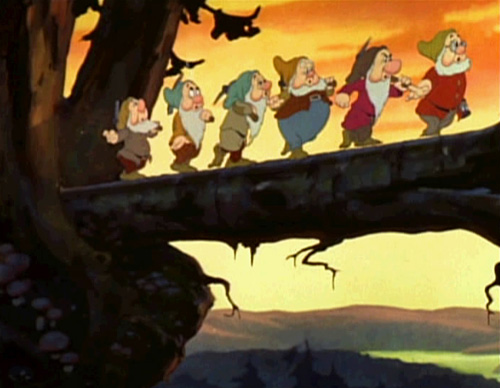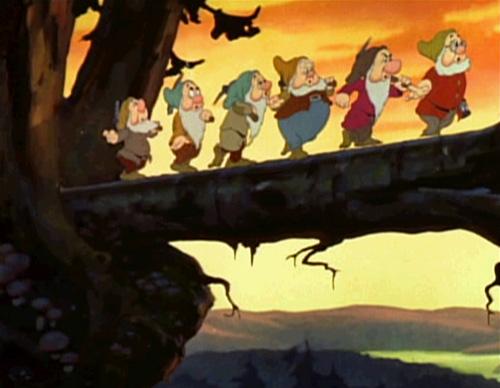
Incredible video shows the genius that went into creating sounds for old-school cartoons

I’ll never watch ‘Snow White’ the same way again.

Sound effects; Disney; cartoons; foley artists
Photo credit: en.wikipedia.orgSound effects sound much different today than when we were kids.

I remember as a kid thinking I knew everything there was to know about how sound effects were made because I watched some guy on PBS show how to make the sound of thunder with sheet metal. Obviously, you needed more than one piece of sheet metal to make all the different sound effects and calamity in those old cartoons, but the gist of it was the sounds were made with imagination and by human operators.

Today, the sounds found in cartoons and movies are different. They’re not necessarily worse, but they’re certainly different to the created-for-the-moment sounds of yesteryear.

A rediscovered video demonstrates exactly how the sounds of old Disney movies were made and it’s truly fascinating. The video is presented side by side, showing the elaborate setups that made the sounds next to the parts in the cartoon they coincided with. Interestingly, many of the sounds you hear in today’s animated movies are created similarly to the way they were made back in the day, so why do they sound so different?


The sound effects you hear in animated movies now are enhanced using better quality recording devices and also by additional layers that are added by the sound editors as well as digital effects that alter the sound, making it sound more rounded and complete. Foley artists are in charge of creating and recording the sound effects, and they’re made one at a time and then layered on top of each other in a process that is similar but different than the old-school ways.

Sound effects back in the day relied solely on the people who made the sounds. There weren’t computers to layer additional noises to fill it out, yet they made it work. Check out the fascinating side-by-side video below.


  • Anne Hathaway shares the ‘unintended consequence’ of her iconic ‘Princess Diaries’ makeover
    Photo credit: RedditAnne Hathaway in The Princess Diaries.
    ,

    Anne Hathaway shares the ‘unintended consequence’ of her iconic ‘Princess Diaries’ makeover

    One of the film’s most memorable moments came with a “terrible side effect.”

    It’s a trope as old as time: the charming, yet conventionally unattractive girl gets a makeover, and suddenly her looks match her winning personality, opening an entire world of possibilities…and love interests. 

    And how do we know she’s conventionally unattractive? Glasses (because attractive people don’t read and can see perfectly, duh) and unkempt curly hair. 

    In pop culture, almost nothing instantly clocks a woman as less desirable or polished. At best, they can be the carefree bohemian or funny best friend. But you can bet you bottom dollar that if they are to be seen as a romantic love interest in any way, shape, or form, that hair is gonna be flat-ironed within an inch of its life. It’s screenwriting 101, people. 

    An era-defining transformation

    One lasting example of this is the makeover scene in The Princess Diaries, wherein Mia Thermopolis (played by Anne Hathaway) goes from adorkable to refined thanks to a bit of hair straightening, plus some makeup, contacts, and intense eyebrow tweezing. 

    In a recent interview with People, Hathaway shared that the filmmaker never actually intended to promote the “curly = ugly” stereotype. It was actually just a logistical strategy. 

    “My natural hair is rather straight, so we had to create a contrast,” she shared, adding that going with her naturally straight hair meant “less time in the makeup trailer” overall. 

    …with “unintended consequences”

    As a result, however, the message many audiences read was “curly hair is unattractive,” which Hathaway labeled as a “terrible, completely unintended side effect.”

    If the comments section was any indicator, Hathaway was correct in saying the “unintended consequence” of that scene was the profound effect it left with viewers. 

    “I (a curly haired girly) started straightening my hair after I saw the scene at 12.”

    “Yeah, watching this movie when it came out as someone who had curly hair and glasses did something to me lol.”

    “I had curly hair and glasses when this movie came out and was bullied for both. I was in middle school and to this day I can’t watch this movie because it made me feel like the bullies were right. As an adult I know better but the gut feelings are still there.”

    Granted, the creative decision might have been made in part for practical reasons, but let’s not forget that this movie came out in the early 2000s…a fairly rigid time period for beauty standards overall. The Princess Diaries was far from the only movie to portray curls (or glasses, or freckles, or anything past a size 2) as “ugly.” For all its good parts, the film was definitely a product of its time. 

    Straightening out the curl narrative

    Thankfully, we’ve seen a lot of progress in this department. Not only do we see far more characters in media sporting their curls, but, thanks to social media, there’s a much larger wealth of knowledge for how to style and take care of curly hair.

    Truly, there’s an entire language (I’m 2C to 3B type myself…iykyk) dedicated to curls now that simply did not exist at an earlier time. Not knowing that curls require an entirely different routine left many of us to resort to straightening or making peace with feeling like the ”ugly” one. 

    Even still, curls that aren’t styled and left in their Mia Thermopolis state are still often viewed by society as unprofessional, undesirable, or unclean in some way. That’s why representation matters. It’s so important to have our pop culture reflect a different reality so that we might start internalizing a different story and unlearning harmful stigma.

    All this to say…Princess Diaries 3 should definitely let Mia’s curls go free. Just sayin’. 

  • Disney re-animates 3 iconic songs to include ASL, and the Deaf community calls it ‘incredible’
    Photo credit: The Walt Disney Company and Walt Disney Animation Studios/YoutubeMoana 2, Frozen 2, and Encanto

    On April 27, in celebration of National Deaf History Month, Disney unveiled three beloved songs completely reanimated to feature the characters performing in American Sign Language (ASL).

    The idea for the project, titled Songs in Sign Language, came from Senior Animator and Director Hyrum Osmond, whose Disney credits include Frozen (2013) and Zooptopia (2016). 

    In a special “making of video,” Osmond recalled growing up with a father who was “hard of hearing,” but never learning sign language to communicate with him. 

    “I have a lot of regret about that, because I couldn’t connect with him. I wanted to take down barriers with this project. It’s really all about connection.”

    A groundbreaking effort rooted in authenticity

    In a never-before-done undertaking for the studio, a team of more than 20 animators, many of them passionate volunteers, collaborated with the Tony Award-winning company Deaf West Theatre to curate signs that best matched each character’s specific personality. 

    This didn’t only involve hand movements, but “facial grammar” as well, meaning specific ways the face is used in ASL to further convey linguistic information. Raised eyebrows, for example, are used at the end of a sentence when asking simple questions. Furrowed eyebrows, on the other hand, are used when asking more complex “Who, What, Where, Why” type questions.

    These efforts—done without AI, praise be—resulted in new animation for approximately 95% of the shots from “The Next Right Thing” (Frozen 2), “We Don’t Talk About Bruno” (Encanto), and “Beyond” (Moana 2). 

    This is far from Disney’s first attempt at making its magic available in ASL. There have been many heartwarming stories of characters in the park using sign language to connect with guests. But, save that one episode of the Little Mermaid series in the ’90s (iykyk), this is something completely new. 

    “We’ve never done anything like this at Disney Animation before,” shared Osmund. 

    People are already speaking out in praise of Songs in Sign Language, and hoping it leads to more. 

    “As someone who is partially deaf in one ear, I fully support this and think it’s very important and heartwarming that they’re doing this.”

    “I would love to see more Encanto, Frozen II and Moana 2 songs in ASL! I am currently learning ASL and I’m a senior in high school, my ASL teacher who is hearing and is learning ASL like me and my classmates are would love this!”

    Many of the compliments weren’t even about inclusivity. People also shared relief to see “creativity breaking through again,” as one viewer put it. 

    “Disney if you get back into funding cool, artistic and niche things like this that people want you’ll win people back over !!!!!!! What was special was always the details and that’s been lost the last 6 years or so. This is amazing,” commented one viewer. 

    DJ Kurs, artistic director for Deaf West Theatre, also hopes the collaboration will lead to more. 

    “Disney stories are the universal language of childhood. The chance to bring our language into that world was a historic opportunity to reach a global audience. Working on this project was very emotional. For so long, we have known and loved the artistic medium of Disney Animation. Here, the art form was adapting to us. I hope this unlocks possibilities in the minds and hearts of Deaf children, and that this all leads to more down the road.”

    Where to watch

    Songs in Sign Language is currently only available to stream on Disney+, but we know it’s only a matter of time before the Internet does its thing. 

  • The one reason Americans can’t build quaint, walk-up apartments like they have in Europe
    Photo credit: via About Here/YouTubeWhy North America can't build European-style apartments.
    ,

    The one reason Americans can’t build quaint, walk-up apartments like they have in Europe

    The stairs themselves are the problem in North America, though that’s starting to change.

    One of the most beautiful features of old European neighborhoods are the rows of quaint, walk-up apartments that are the backbone of walkable neighborhoods. They help create a community where people can exit their front door and walk to a local café or market without getting in their car. Unfortunately, these neighborhoods are hard to find in the United States, where these types of apartment buildings are exceedingly rare.

    Uytae Lee is the founder of About Here, an adjunct journalism professor at UBC, and a BC Housing Board commissioner. As an urban planner and videographer, he is passionate about sharing stories about our cities.

    In the video below, he explains why regulations in North America have made these quaint walk-up apartments, known by architects as point access blocks, nearly impossible to build.

    It all comes down to staircases

    “Quaint walk-up apartments … are a beloved feature in cities around the world,” Lee says in his video entitled “Why North Americans Can’t Have Nice Apartments.” “They’re inviting and full of character. But, here in North America, they are not allowed to be built today. Instead, our apartments are big and imposing, often stretching across the entire block and the reason why it really comes down to one reason: staircases.”

    The problem is that one stairway in a point access block allows access to all apartments. This became a problem in the late 1800s when fires were commonplace in urban areas worldwide and people were more likely to die in a fire with only one exit route. So, in the U.S. and Canada, they created new regulations that made it so all buildings over two to three stories had to have two staircases to allow them to exit during a fire.

    “Staircases take up a lot of space and fitting two of them in a small building means that there is much less usable floor space on every floor,” Lee says in the video. “As a result, developers here construct much larger buildings so that the staircases and hallways take up a much smaller proportion of the overall building. It’s why apartments in North America, in general, are much bigger and wider than their European counterparts.”

    So why didn’t Europe make the same call?

    But there are fires in Europe, too. Why did they stop short of requiring multiple staircases in apartment buildings on the other side of the Atlantic Ocean? Instead of changing the floorplans on new buildings, Europeans opted to require fireproof materials in new building construction. A big reason why the U.S. and Canada opted for larger buildings over fireproofing was because they had better access to materials and the new direction aligned with the move towards suburban sprawl.

    The two-staircase regulations in the U.S also made it harder to build units greater than one bedroom because the buildings needed long hallways which reduced the number of layout options.

    Now cities are rethinking the rules

    The current housing crisis has many rethinking the regulations that require apartment buildings to have two stairways in North America. Many urban planners believe that modern-day demands mean we should return to building more point access block buildings, but this time with modern fire-retardant materials.

    Cities like Seattle, Washington, were early adopters, but the movement has since gone national. As of 2025, seven states have passed bipartisan legislation allowing single-stairway apartment buildings, including Colorado, Montana, New Hampshire, and Texas, with 19 states and Washington D.C. having introduced bills since 2022.

    “Now, if all this makes you a bit nervous, I get it. After all, these codes are about our safety. But I do want to mention that these codes do change over time as our technology and our understanding of safety evolves,” Lee finishes the video. “It’s important that we discuss and update these rules as our world changes.”

    Pew Charitable Trust reports that small, single-stairway apartments actually have a strong safety record, sharing that those kinds of buildings as tall as six stories are “at least as safe as other types of housing.” As we gather data and learn more, we should be able to adjust our regulations. So maybe, hopefully, there are more quaint apartment buildings in our future.

    This article originally appeared three years ago. It has been updated.

  • Woman who lives on a cruise ship shares the hardest part about her otherwise dream life
    Christine Kesteloo has one big problem living on a cruise ship.
    ,

    Woman who lives on a cruise ship shares the hardest part about her otherwise dream life

    “I could have anything I wanted, and I want it, I absolutely want it.”

    A lot of folks would love to trade lives with Christine Kesteloo. Her husband is the Staff Chief Engineer on a cruise ship, so she gets to live on the boat pretty much for free as the “wife on board.” For Christine, life is a lot like living on a permanent vacation.

    “I live on a cruise ship for half the year with my husband, and it’s often as glamorous as it sounds,” she told Insider. “After all, I don’t cook, clean, make my bed, do laundry or pay for food.“

    The one thing that makes it hard

    Living an all-inclusive lifestyle seems like paradise, but it has some drawbacks. Having access to all-you-can-eat food all day long can really have an effect on one’s waistline. Kesteloo admits that living on a cruise ship takes a lot of self-discipline because the temptation is always right under her nose.

    @dutchworld_americangirl

    The hardest part about living on a cruise ship is that I am surrounded by free food all of the time anything I want I just had lunch but it’s 2 o’clock in my body tells me it’s either cookie time or time for a hamburger. The hardest part is telling myself not to eat. #hardestpart #cruiseship #livingatsea #koningsdam #weliveonacruiseship #cruisefoodie #foodtok #itsaproblem #halcruises #hollandamericaline

    ♬ Pieces (Solo Piano Version) – Danilo Stankovic

    “One of the hardest things about living on a cruise ship is that I know right now, if I just leave my cabin, I can go and have cookies, pizza, a shake, I could have anything I wanted, and I want it, I absolutely want it,” she said in a TikTok video that received over 400,000 views.

    “I am laying here. It is 2 pm. I had a salad for lunch, I had some fresh fruit, but that didn’t fill me up,” she continued. “Right now, all I can think about is eating a burger with some French fries and some mayonnaise.”

    “And that, folks, is the absolute hardest part about living on a cruise ship,” she said. “I am surrounded by food all the time.”

    She added, “The hardest part is telling myself not to eat.”

    She is not alone in this struggle

    Kesteloo’s trouble is a common problem among people on cruise ships. A study by Admiral Travel Insurance found that over 60% of people who go on a week-long cruise anticipate gaining weight. Seventeen percent of people say they gain 2 to 3 pounds on a cruise, while 14% say they gain 4 to 5 pounds.

    Other estimates show that the average cruiser will put on 5 to 10 pounds on a weeklong cruise. Imagine living on a cruise ship for half the year, like Kesteloo. She could quickly put on 100 pounds a year if she’s not careful.

    “I’d be huge if I lived there. I would feel like I’m on a constant vacation, and who diets on vacation?” Theresa Gramelsapcker-Wilson wrote in the comments.

    “This is my main reason why I couldn’t do this HHAHAHAHAHAA,” Cara Mia added.

    “I never thought about those who actually live on a cruise ship. I would be 500 pounds,” Lucky Penny2468 said.

    cruise ships, dieting, all you can eat, living on a cruise ship, tiktok
    A woman eats and drinks while enjoying the view on a cruise ship. Photo credit: Canva

    Kesteloo’s battle with temptation shows that in every life, a little rain must fall. Nobody ever truly has it perfect. Kesteloo seems to be living the perfect life on board a cruise ship, but she still has to fight temptation every moment of the day or make good use of the ship’s gym facilities. But, obviously, having access to too much food is far better than having too little.

    This article originally appeared four years ago. It has been updated.

  • Michael Jackson’s sounds engineer reveals the genius origins of ‘Annie’ from ‘Smooth Criminal’
    Photo credit: Anthony Marinelli Music/YouTubeMichael Jackson, left, and Matt Forger.

    With the latest Michael Jackson biopic taking the box office by storm, the late singer and his work are back in the pop culture zeitgeist. Now, even more lore has been added to the conversation, courtesy of Jackson’s longtime personal sound engineer, Matt Forger.

    In an interview with Anthony Marinelli, Forger revealed the inspiration behind the character Annie in “Smooth Criminal,” saying that while on tour with the Jackson 5, each of the brothers took a CPR class, where they practiced on a Resusci Anne doll. Part of the protocol was asking, “Annie, are you okay? Are you okay, Annie?” to check a patient’s condition.

    A nod to genius

    “That catchphrase sort of stayed in his memory,” Forger said, noting it as one of many examples of Jackson’s innate gift for songwriting. Like many of the greats, Jackson was able to expertly pinpoint hooks with the most emotional punch and build out full-blown stories from there.

    In the song lyrics, we get a story of a woman attacked in her apartment by a “smooth criminal,” who breaks in through the window and then violently strikes the victim. By the second verse, Annie is being resuscitated, seemingly to no avail.

    The doll has a fascinating, dark history

    Anne’s story began in France in the late 1880s, when the body of an unidentified teenage girl was found in the River Seine. Unlike the case in “Smooth Criminal,” there was no evidence of violence at the scene. Presumably, the girl had taken her own life. Death masks were still a common ritual, and one was created for her to immortalize the eerily calm expression she left behind, as some legends say. It became so popular that it was mass-produced.

    Fast forward to the late 1950s, when Norwegian toy maker and publisher Åsmund S. Laerdal was commissioned to create a realistic, life-sized manikin for training people in the new mouth-to-mouth resuscitation method. He recalled seeing one of these masks in his in-laws’ home and felt it was the perfect expression for the dummy.

    Today, Resusci Anne is also known as “the most kissed girl in the world”  since millions of trainees have performed mouth-to-mouth resuscitation on her over the decades. 

    Viewers react

    You would think this connection is well known among those who have learned CPR. But judging from the comments on Forger’s interview, it’s still a largely buried fact:

    “Wow, too many times I have said, ‘Annie are you ok” and proceeded to give compressions and then 3 breaths. I never made the connection.”

    “I studied CPR last year and the mannequin was called Annie but I thought it was because of the song, didn’t realise the mannequin Annie came first.”

    “I took CPR but never put that together about this song.”

    Whether you’re into obscure history, pop music, or fun explainers, this story has just what you’re looking for. It also goes to show just how deeply interconnected our world is. Thanks to a bit of human creativity, a tragic mystery from 19th-century France turned into a life-saving training tool, followed by one of pop’s most iconic songs. There really is an endless supply of inspiration.

  • Matthew Lillard had a surprisingly humble explanation for his recent Hollywood comeback
    Photo credit: Super Festivals/Wikimedia CommonsActor Matthew Lillard.
    ,

    Matthew Lillard had a surprisingly humble explanation for his recent Hollywood comeback

    The “Scooby-Doo” star is back in the limelight after the massive “Five Nights at Freddy’s” success.

    Actor Matthew Lillard can trigger Millennial nostalgia like few others. He was perfectly cast in the popular Scooby-Doo films of the early aughts as Norville “Shaggy” Rogers and appeared as Stu Macher in the original Scream (1996). He also had memorable roles in She’s All That (1999), Thirteen Ghosts (2001), and Without a Paddle (2004).

    Lillard’s career began to cool down in the late ‘00s. Although he never went away, he transitioned from a comedic performer to starring in dramatic roles, most notably in 2017’s Twin Peaks: The Return. However, now, after the lead role in the massive 2023 horror hit, Five Nights at Freddy’s, Lillard is in the midst of a comeback, starring in Five Nights at Freddy’s 2 (2025), The Life of Chuck (2024), and the Marvel series Daredevil: Born Again.

    Lillard talked about his recent success with a refreshing sense of gratitude and humility on a recent episode of the Phase Hero podcast, hosted by Brandon Davis.

    Scooby-Doo one and two are more popular now than they ever were when they came out,” Lillard said. “So I do think there’s a weird nostalgia thing happening in our industry and in the zeitgeist, because I think that people are longing for ye olde times.”

    “I think that’s one of the reasons I’m having this moment, to be honest, is because I was identified in that moment, so people are hiring me again,” he added. “That’s why I’m working. I don’t think anyone really likes me. They just missed the old times. ‘Who should we get? Who’s old and relatively warm and fuzzy feeling? Let’s get Matthew Lillard. Talented? No. But do we like him? Yes.’”

    The 56-year-old actor’s self-awareness was also on display in how he gracefully handled some very blunt criticism from director Quentin Tarantino. Last December, Lillard was brought up in a conversation in which Tarantino criticized actor Paul Dano’s performance in There Will Be Blood.

    “I’m not saying he’s giving a terrible performance,” Tarantino said. “I’m saying he’s giving a non-entity [performance]. I don’t care for him. I don’t care for Owen Wilson, I don’t care for Matthew Lillard.”

    The very public diss inspired many of Lillard’s colleagues to sing his praises.

    “It felt like I had died and was in heaven watching everyone send out their RIP tweets. I mean, it was really being a part of your own wake, sort of sitting there living through all the nice things people say after you die,” Lillard told People. “Everyone, from the people at the mall this weekend with my kids to George Clooney and James Gunn and Mike Flanagan, I mean, people have sort of been really generous with telling me how much they loved me and liked my work.”

    Lillard’s response to his sudden success is a great example of someone who has been in the industry for decades and has learned how to keep his head on his shoulders. There are going to be highs and lows, but when your feet are firmly planted in reality, you can make it through them all.

  • 19 viral photos show what happens after drinking 1, 2, and 3 glasses of wine
    Before and after photos of people who drank wine.

    Marcos Alberti’s “3 Glasses” project began with a joke and a few drinks with his friends.

    The photo project originally depicted Alberti’s friends drinking, first immediately after work and then after one, two, and three glasses of wine.

    But after Imgur user minabear circulated the story, “3 Glasses” became more than just a joke. In fact, it went viral, garnering more than 1 million views and nearly 1,800 comments in its first week. So Alberti started taking more pictures and not just of his friends.

    “The first picture was taken right away when our guests (had) just arrived at the studio in order to capture the stress and the fatigue after a full day after working all day long and from also facing rush hour traffic to get here,” Alberti explained on his website. “Only then fun time and my project could begin. At the end of every glass of wine, a snapshot, nothing fancy, a face and a wall, 3 times…by the end of the third glass several smiles emerged and many stories were told.”

    Why was the series so popular? Anyone who has ever had a long day at work and needed to “wine” down will quickly see why.

    Take a look:

    Drinking, wine, viral photos
    Drinking, wine, viral photos
    Drinking, wine, viral photos
    Drinking, wine, viral photos
    Drinking, wine, viral photos
    Drinking, wine, viral photos
    Drinking, wine, viral photos
    Drinking, wine, viral photos
    Drinking, wine, viral photos
    Drinking, wine, viral photos
    Drinking, wine, viral photos
    Drinking, wine, viral photos
    Drinking, wine, viral photos
    Drinking, wine, viral photos
    Drinking, wine, viral photos
    Drinking, wine, viral photos
    Drinking, wine, viral photos
    Drinking, wine, viral photos
    Drinking, wine, viral photos

     This article originally appeared ten years ago. It has been updated.

  • Jimmy Fallon asked people to share their wildest stories from their bad summer jobs
    Photo credit: YouTubeHis face is all of us after that first summer job paycheck.

    Call it a rite of passage, a baptism by fire, or simply a necessary evil, but a terrible summer job is pretty much a staple of young adulthood. Those concert tickets aren’t gonna pay for themselves, after all. Some summer jobs are heinous by the sheer amount of manual labor involved. Others are just plain weird. I remember one year working as a “live strolling table.” Yep, just walking around attached to an elaborately dressed table offering hors d’oeuvres and champagne. A human-furniture hybrid. How do you put that on a resume?

    No matter the role, there is one thing all summer jobs have in common: they teach us humility in one way or another … especially once we see that first paycheck. There’s simply no way to prepare for seeing two weeks worth of hard work equate to a (usually) paltry sum. Hopefully that experience alone makes generous tippers of us all.

    Back in 2022, during one of his popular “hashtag” bits, Jimmy Fallon asked people to share their own “funny, weird, or embarrassing story about a bad summer job” as part of his iconic #hashtags challenge.

    When Jimmy Fallon asked, people delivered

    Here are 15 that might make your own summer job memory feel a little less dreadful:

    “I planted trees for the US Forest Service one summer in HS. Our foreman would go through our lunches, eat our cookies and chips, and take bites out of our sandwiches. We were all about 15 so too afraid to tell.” – @dumpster_diva 

    “One summer I worked at Taco Bell during lunch and Furr’s cafeteria during dinner. People would see me at both and ask if I was twins.” – @kerrikgray

    “As a young comedian I was hired to MC an event for a furniture store. The owner paid me 5 bucks for every time I would fake trip and fall on my way to the mic. He said he was a 3 stooges fan.” @Brentfo4242

    “I applied for a job while in high school at a toy store. I called back days after the interview asking if they had any news for me. They told me I got the job, and they forgot to tell me. They had me scheduled for that day and was told ‘you’re late.’” – @RockerSam91

    “In high school, I worked at an insurance agency…let’s just say the bus ride to and from work was the best part of the job.” – @SharonZurcher

    “In high school I worked at a bounce house company. My first day working was an elementary school field day and the huge inflatable slide starting deflating and collapsing with kids at the top…angry parents staring at me like I had an answer for this at 16 years old.” @calamari_carly

    “In middle school my friend and I got paid to fill, lick and seal about 500 envelopes with documents for a lawyer – a penny per envelope. 3 hours later, we asked for 2 cans of soda from his cooler. He said sure, and took $2 each from our pay. We made a dollar.” – @CameronFontana

    It gets weirder from here

    “I worked at a dog kennel. A guy brought in 2 dogs to stay a month. He told me to give a pill every morning to dog #1. So, I did for the month. When he returned, I brought out dog #1 and he said, ‘Hi, dog #2!’ My face turned so red. Oh, well. The dog survived.” – @TheTomeWebster

    “I babysat identical twin boys where one constantly screamed and got into mischief but potty trained early while the other was quiet, well behaved but always blowing out diapers. They never did anything ‘identical’. I’m shocked that I still wanted kids after that!” – @overbaughs

    “Worked at Crumbl in high school. One coworker had the exact same shifts as me, and she was a theater kid. Like MAJOR theater kid, was cracked out 24/7, randomly performing theater at work. I am not proud to say I memorized 10 Shakespeare monologues because of her.” – @itstherealmeboo

    “I held human hearts with a white cotton glove during open heart surgeries, so they didn’t ‘slip’.…No pressure! That’s why l am now a planetary medium and asteroid deflector. Much less stress.” – @rosamalvaceae

    “I worked for a local sweet corn farm. I had to sort the corn into boxes for their stands around the state or local grocery stores. It came off the truck onto a conveyor belt by the 1000s. I literally saw thousands of corn cobs in my dreams at night.” – @jdianemiller

    “In high school my mom got me a job working with the city to clean an island in the local lake that ducks lived on. Everyday I had to fight a duck, and everyday I needed a bandaid after getting bit by a duck. It was a nightmare and I still hate ducks 30 years later.” @KingSergioS

    “Hired at an amusement park for the summer, taking summer college classes at the same time…Show up for my 1st day to a supervisor who says ‘Oh, the girl who didn’t show up!’ Proceeds to show me the previous week’s schedule where I had 40 hours during my class time. He rolls his eyes when I explain and gives me every crappy task he can find…….I left after the 2nd day, never picked up my check, but kept my employee ID & got in for free all summer!” – @trixiebelle47

    What bad summer jobs actually teach us

    While certain summer jobs, like the ones above, sound like a total nightmare, there have been studies that indicate they may lead to better school outcomes, similar to other out-of-school activities such as sports and clubs. That said, recent reporting from CNBC and other outlets confirms that low-wage, entry-level positions are among the first to be compromised by the rise of artificial intelligence. So unfortunately, not as many heart-holding gigs will be available.

    This article originally appeared four years ago. It has been updated.

Culture

At 6:30 a.m., Japanese radio plays ten minutes of ‘Radio Taiso’ and it’s getting people moving

Nostalgia

Fake towns on real maps: Why ‘phantom settlements’ exist and how one became real…sort of

Communication

Relationship coach reveals 5 rules she and her wife ‘never break’ to still feel like newlyweds

Pets

Experts rank the most ‘loyal dog breeds’ and it’s stirring a debate among canine lovers