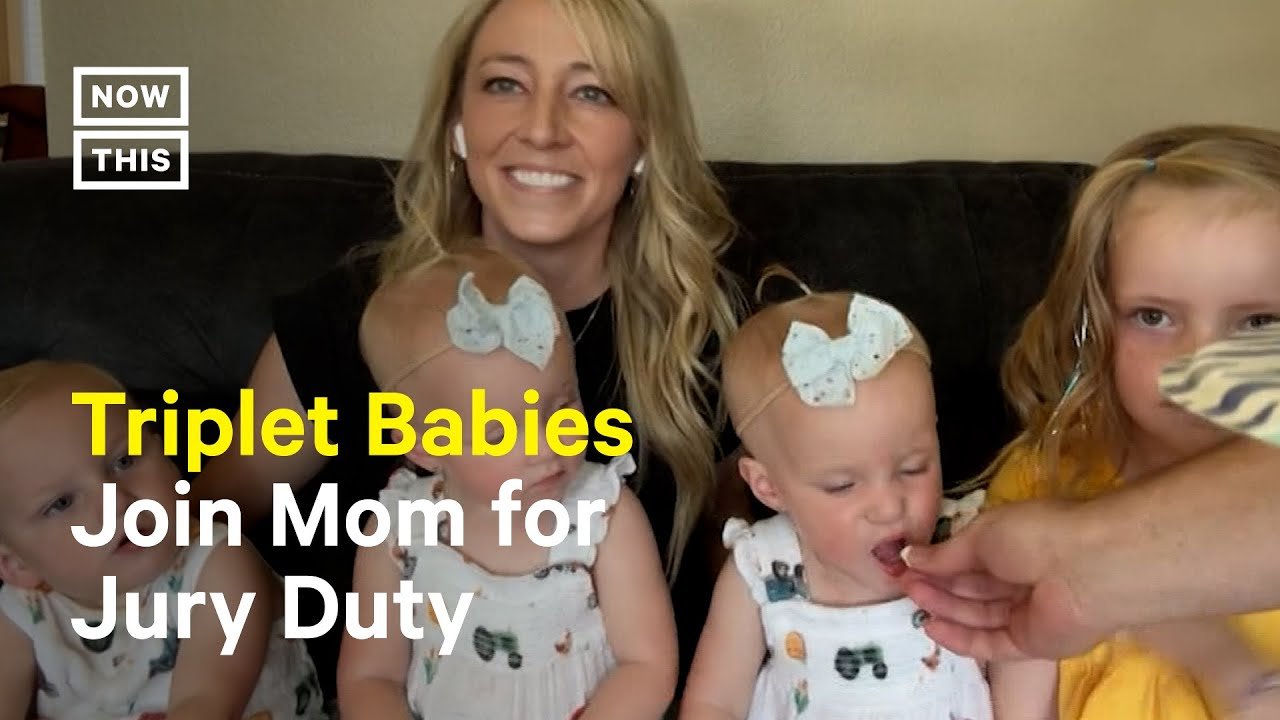
Utah mom goes viral for bringing her triplets to jury duty.
Nobody likes jury duty...well, there may be some people that enjoy it, but for most people, it's an inconvenience that you hope you're somehow cut from. If you work, you have to take time off to make a very small daily stipend in comparison to your regular hourly wage. If you're a stay-at-home parent, you have to find childcare so you can sit in a cold courtroom on uncomfortable seats, waiting to hear if you need to show up again tomorrow.
But what happens when childcare can't be secured? Your civic call to duty still has to be answered. Torrey Scow, a Utah mom of four found herself in this very predicament after her call to jury duty was not excused. Instead of risking a fine of $1,000, Scow decided to bring her 1-year-old triplets and 4-year-old with her on a field trip to the local courthouse.
Scow's husband couldn't get out of work according to the now-viral video the mom posted to Instagram. She assured him that it wouldn't be a big deal because she'd have the babies with her and the judge would likely send her right back out the door. Except, he didn't. The mom, with more babies than hands, was stuck entertaining three babies and a preschooler for two-and-a-half hours before the judge finally dismissed her.
"I just knew it was going to be a crap show. So that's why I was like, 'I'm going to film some of this,'" Scow told CNN.
She fed them all the snacks they could handle before everybody pooped. The courtroom then smelled, and the babies were truly everyone's problem at that point, but she still wasn't excused. It'd be surprising if it didn't sound like she won the lottery when the judge finally dismissed her from the courtroom.
A Business Insider column noted that
two-thirds of the bottled water sold in the United States is in individual 16.9-ounce bottles, which comes out to roughly $7.50 per gallon. That's about 2,000 times higher than the cost of a gallon of tap water.
And in an
article in 20 Something Finance, G.E. Miller investigated the cost of bottled versus tap water for himself. He found that he could fill 4,787 20-ounce bottles with tap water for only $2.10! So if he paid $1 for a bottled water, he'd be paying 2,279 times the cost of tap.
2. Bottled water could potentially be of lower quality than tap water.
Fiji Water ran an ad campaign that was pretty disparaging about the city of Cleveland. Not a wise move. The city ordered a test of the snooty brand's water and found that Fiji Water contained levels of arsenic that weren't seen in the city's water supply.
" Bottled water manufacturers are not required to disclose as much information as municipal water utilities because of gaps in federal oversight authority. Bottom line: The Food and Drug Administration oversees bottled water, and U.S. EPA is in charge of tap water. FDA lacks the regulatory authority of EPA."
3. The amount of bottled water we buy every week in the U.S. alone could circle the globe five times!
That sounded like it just had to be impossible, so we looked into it. Here's what our fact-checkers found:
"According to the video, ' People in the U.S. buy more than half a billion bottles of water every week.' National Geographic says for 2011, bottled water sales hit 9.1 billion gallons (roughly 34 billion liters).
A 'typical' water bottle is a half-liter, so that's about 68 billion bottles per year. Divided by 52 weeks would be a little over 1 billion bottles of water sold per week in the U.S. Because that's based on a smaller 'typical' bottle size, it seems reasonable that a half billion bottles a week could be accurate.
The Earth is about 131.5 million feet around, so yep, half a billion bottles of varying sizes strung end-to-end could circle the Earth five times."
Beverage companies have turned bottled water into a multibillion-dollar industry through a concept known as manufactured demand. Bottled water advertisements used a combination of scare tactics (Tap water bad!) and seduction (From the purest mountain streams EVER!) to reel us in.
Well, we now know their claims about the superior quality of bottled water are mostly bogus. And research shows that anywhere from a quarter to 45% of all bottled water comes from the exact same place as your tap water (which, to reiterate, is so cheap it's almost free).
It takes oil — lots of it — to make plastic bottles. According to the video, the energy in the amount of oil it takes to make the plastic water bottles sold in the U.S. in one year could fuel a million cars. That's not even counting the oil it takes to ship bottled water around the world.
On top of all that, the process of manufacturing plastic bottles is polluting public water supplies, which makes it easier for bottled water companies to sell us their expensive product.
6. There are 750 million people around the world who don't have access to clean water.
A child dies every minute from a waterborne disease. And for me, that's the core of what makes bottled water so evil.
The video wraps by comparing buying bottled water to smoking while pregnant. That may sound extreme, but after learning everything I just did about the bottled water industry, I can't disagree.
Here's an article to send to every jerk in your life who denied you the right to complain about your period cramps: A medical expert says that some women experience menstruation pains that are "almost as bad as having a heart attack." John Guillebaud, who is a professor of reproductive health at University College London, spoke to Quartz on the subject, and said that the medical community has long ignored what can be a debilitating affliction, because it's a problem that mostly inconveniences women.
"I think it happens with both genders of doctor," Guillebaud told Quartz. "On the one hand, men don't suffer the pain and underestimate how much it is or can be in some women. But I think some women doctors can be a bit unsympathetic because either they don't get it themselves or if they do get it they think, 'Well I can live with it, so can my patient.'"
And it's a problem that can't just be treated with common painkillers. Some people who experience dysmenorrhea, the medical term for painful menstruation, also suffer from endometriosis, a condition that can cause infertility if it's not treated properly. But research on the subject is scant, so doctors often misdiagnose it, or dismiss the pain entirely. It's estimated, however, that one out of 10 women has the condition.
Earlier this month, Girls creator Lena Dunham was forced to take a rest from show promotion and other work duties because she suffers from endometriosis. In a recent edition of her newsletter, Lenny Letter, Dunham wrote a frank essay about her struggle with the condition, and particularly with a medical institution that didn't know how to diagnose her. She didn't know how to put a name to her pain until she turned 24 and underwent laparoscopic surgery, "which is the only way to definitively diagnose endometriosis," according to Dunham.
Quartz reporter Olivia Goldhill had the same problem. She suffered from frequent period pains that were as distressing as a slipped disk, she says. But doctors had no answer for her. "Before I had my MRI scans, I told my primary care doctor that the pain seemed to be triggered by my period," she said. "He didn't think this was relevant and ignored the comment."
For now, the medical community has been dragging its feet to do research on the subject. Goldhill says the only thing people can do right now is talk about it, to heighten awareness. "Tell your doctor, your friends, your colleagues," she wrote. "We need to talk about period pain long and loudly enough for doctors to finally do something about it."
There’s no shortage of stories out there showing how emotionally distant or out of touch some baby boomers can be. Younger generations are so fed up with it that they have their own catchphrase of frustration, for crying out loud.
The disconnect becomes especially visible in parenting styles. Boomers, who grew up with starkly different views on empathy, trauma and seeking help, have a reputation for being less than ideal support systems for their children when it comes to emotional issues.
But even if they often have a different way of showing it, boomer parents do have love for their children, and many try their best to be a source of comfort in some way when their kid suffers.
Occupational therapist Jacqueline (@jac.rose8) recently shared a lovely example of this by posting a video of her boomer dad helping her through a divorce in the best way he knew how.
Turns out, it was the perfect thing.
“My husband just said he’s divorcing me and my dad came over and I was non-functional in bed,” Jacqueline wrote her video, adding that “...boomer dad didn’t know what to do, so he played his favorite song, the Dua Lipa ‘Rocket Man’ remix 😂”
In the clip, Jacqueline’s dad never really looks at her, but shifts the focus by describing what he imagines while listening to the song and performing the sweetest dad dance ever.
The heartwarming moment served as a great reminder that words aren’t always necessary.
‘“I am CRYING. This is so precious, he is trying his hardest to be there for you in any capacity. How pure ❤️,” one person wrote.
Another added, “This would instantly make me feel better.”
Even Jacqueline shared in the comments that her dad “didn’t know what to say but he was there and helped me in such a sweet way. He’s the best 🥰”
Proving that he has multiple love languages, Jacqueline later shared that her dad also went out to Home Depot to replace her lightbulbs. Not only that, but her mom also made Jacqueline’s favorite dinner. Maybe boomers are okay after all.
Really, it goes to show that great parents can be found in every generation. Part of what makes them great is knowing that they don't need to be perfect in order to show up when things are hard. Being there and sharing their love is enough.
That's right: the semicolon. It's a tattoo that has gained popularity in recent years, but unlike other random or mystifying trends, this one has a serious meaning behind it. (And no, it's not just the mark of a really committed grammar nerd.)
The semicolon tattoo represents mental health struggles and the importance of suicide prevention.
They describe themselves as a "movement dedicated to presenting hope and love to those who are struggling with depression, suicide, addiction, and self-injury. Project Semicolon exists to encourage, love, and inspire."
But why a semicolon?
"A semicolon is used when an author could've chosen to end their sentence, but chose not to. The author is you and the sentence is your life."
Originally created as a day where people were encouraged to draw a semicolon on their bodies and photograph it, it quickly grew into something greater and more permanent. Today, people all over the world are tattooing the mark as a reminder of their struggle, victory, and survival.
I spoke with Jenn Brown and Jeremy Jaramillo of The Semicolon Tattoo Project, an organization inspired by the semicolon movement. Along with some friends, Jenn and Jeremy saw an opportunity to both help the community and reduce the stigma around mental illness.
In 2012, over 43 million Americans dealt with a mental illness. Mental illness is not uncommon, yet there is a stigma around it that prevents a lot of people from talking about it — and that's a barrier to getting help.
More conversations that lead to less stigma? Yes please.
"[The tattoo] is a conversation starter," explains Jenn. "People ask what it is and we get to tell them the purpose."
"I think if you see someone's tattoo that you're interested in, that's fair game to start a conversation with someone you don't know," adds Jeremy. "It provides a great opportunity to talk. Tattoos are interesting — marks we put on our bodies that are important to us."
In 2014, The Semicolon Tattoo Project held an event at several tattoo shops where people could get a semicolon tattoo for a flat rate. "That money was a fundraiser for our crisis center," said Jenn. In total, over 400 people received semicolon tattoos in one day. Even better, what began as a local event has spread far and wide, and people all over the world are getting semicolon tattoos.
And it's not just about the conversation — it's about providing tangible support and help too.
Jenn and Jeremy work with the Agora Crisis Center. Founded in 1970, it's one of the oldest crisis centers in the country. Through The Semicolon Tattoo Project, they've been able to connect even more people with the help they need during times of crisis. (If you need someone to talk to, scroll to the end of the article for the center's contact information.)
So next time you see this small punctuation tattoo, remember the words of Upworthy writer Parker Molloy:
"I recently decided to get a semicolon tattoo. Not because it's trendy (though, it certainly seems to be at the moment), but because it's a reminder of the things I've overcome in my life. I've dealt with anxiety, depression, and gender dysphoria for the better part of my life, and at times, that led me down a path that included self-harm and suicide attempts.
But here I am, years later, finally fitting the pieces of my life together in a way I never thought they could before. The semicolon (and the message that goes along with it) is a reminder that I've faced dark times, but I'm still here."
No matter how we get there, the end result is so important: help and support for more people to also be able to say " I'm still here."
To a stranger I met at a coffee shop a few years ago who introduced me to what my life as a parent would be like:
My "welcome to black fatherhood moment" happened five years ago, and I remember it like it happened yesterday.
I doubt you'll remember it, though — so let me refresh your memory.
It was a beautiful Saturday morning in Los Angeles in 2011, and I decided to walk my then 3-month-old daughter to the corner Starbucks. That's when I met you — a stylish older white woman who happened to be ahead of me in line.
You were very friendly and offered up many compliments about how cute my daughter was, and I agreed wholeheartedly with you. She's cute.
But after you picked up your drink, you delivered this parting shot:
"No offense, but it's not often that I see black guys out with their kids, but it's such a wonderful thing," she said. "No matter what happens, I hope you stay involved in her life."
And then you put on your designer sunglasses and left.
Meanwhile, I was like...
That was unexpected.
GIF from "Live with Kelly and Michael."
Here's the thing: I'm not angry with you, but I want you to understand the impact you had on my life.
Do I think you're a mean-spirited racist? No, I don't. Actually, I bet you're a really nice lady.
But let's be real for a second: Your view on black dads was tough for me to stomach, and I want you to know a few things about what it's really like to be me.
1. I want you to know that we have challenges that other dads don't experience.
I know what you're thinking: "Oh boy — let me brace myself while he 'blacksplains' how hard his life is while shaming me for ignoring my white privilege."
But that would be missing the point. We all have our challenges in life, and I'm not about to bring a big bottle of whine to a pity party.
Instead, as you probably know, today's dads are trying to shed the stigma of being clueless buffoons.
But black dads have an additional obstacle to hurdle in that we're often seen as completely disinterested in fatherhood. Trust me, it gets old when people automatically assume you're not good at something because of the color of your skin.
Our encounter was the first of many examples of this that I've witnessed, directly or indirectly, in my five and a half years of fatherhood, and I'm sure there will be more to come.
2. I want you to know that I'm not a shiny unicorn. There are plenty of black men just like me who love fatherhood.
During the months that followed our brief meeting, I felt a need to prove that you — a complete stranger — were wrong. I needed to prove there were plenty of black men just like me who loved being dads.
I knew a lot of these great men personally: My dad, my two brothers, and many others embraced fatherhood. But could any data back up how much black dads embraced fatherhood? Because the examples in mainstream media were few and far between.
Thankfully, the answer is yes.
A few years after I met you, a study from the Centers for Disease Control and Prevention showed that 70% of black dads are likely to engage in common child-rearing activities such as diaper changing, bathing, toilet training, etc., on a daily basis. That's a higher percentage than white or Hispanic fathers.
Full stop.
This isn't about black dads being "the best" because parenthood isn't a competition. It's about showing that we're not even remotely as bad as society makes us out to be.
And outside of the CDC study, I saw firsthand how hands-on black dads are when I was thrust into the public eye, too, because a lot of them reached out to me to tell their stories.
And none of that should come as a surprise to anyone.
3. I want you to know that I believe you meant well when you praised me for being involved in my daughter's life, but that's what I'm programmed to do.
I will always be there for her and her baby sister.
Even though I just described how black dads are different from many dads, I hope the takeaway you have from this is that we have a lot of similarities, too.
Please don't fall into the trap of saying that you want to live in a colorblind world because it makes it harder to identify with inequality when it happens. Instead, I hope you can recognize that we have the same hopes, dreams, and fears as other parents, but the roads we travel may not be the same.
And no, I don't want an apology.
But I hope when you pick up your next latte and see a dad who looks like me that you'll smile knowing he's the rule rather than the exception.
Nearly 12 percent of the U.S. population lives in poverty. That's more than one in ten Americans—and the percent is even higher for children.
If you're not up on the current numbers, the federal poverty line is $12,760 for an individuals and $26,200 for a family of four. If those annual incomes sound abysmally low, it's because they are. And incredibly, the Trump administration has proposed lowering the poverty line further, which would make more poor Americans ineligible for needed assistance.
However, debates over the poverty line don't even capture the full extent of Americans struggling to make ends meet. For many people, living above the poverty line is actually worse. These are the folks who make too much to qualify for aid programs but not enough to actually get by—a situation millions of working American families find themselves stuck in.
Amy Jo Hutchison is a single mother of two living in West Virginia, and a community organizer for West Virginia Healthy Kids and Families and Our Future West Virginia. She has also lived in poverty and been part of the working poor herself. In an impassioned speech, she spoke to the House Committee on Oversight and Reform about what poverty really looks like for working families—and even called out Congress for being completely out of touch with what it takes for a family to live on while they're spending $40,000 a year on office furniture.
Watch Hutchison's testimony here (transcript included below):
Ms. Hutchison Testimony on Proposed Changes to the Poverty Line Calculation
"I'm here to help you better understand poverty because poverty is my lived experience. And I'm also here to acknowledge the biased beliefs that poor people are lazy and the poverty is their fault. But how do I make you understand things like working full-time for $10 an hour is only about $19,000 a year, even though it's well above the federal minimum wage of $7.25 an hour?
I want to tell you about a single mom I met who was working at a gas station. She was promoted to manager within 30 days. She had to report her new income the DHHR within 60 days. Her rent bumped from $475 to $950 a month, she lost her SNAP benefits and her family's health insurance, so she did what poor people are forced to do all the time. She resigned her promotion and went back to working part-time, just so she and her family could survive.
Another single mom I know encouraged her kids to get jobs. For her DHHR review she had to claim their income as well. She lost her SNAP benefits and her insurance, so she weaned herself off of her blood pressure medicines because she—working full-time in a bank and part-time at a shop on the weekends—couldn't afford to buy them. Eventually the girls quit their jobs because their part-time fast food income was literally killing their mother.
You see the thing is children aren't going to escape poverty as long as they're relying on a head of household who is poor. Poverty rolls off the backs of parents, right onto the shoulders of our children, despite how hard we try.
I can tell you about my own with food insecurity the nights I went to bed hungry so my kids could have seconds, and I was employed full time as a Head Start teacher. I can tell you about being above the poverty guideline, nursing my gallbladder with essential oils and prayer, chewing on cloves and eating ibuprofen like they're Tic Tacs because I don't have health insurance and I can't afford a dentist. I have two jobs and a bachelor's degree, and I struggle to make ends meet.
The federal poverty guidelines say that I'm not poor, but I cashed in a jar full of change the other night so my daughter could attend a high school band competition with her band. I can't go grocery shopping without a calculator. I had to decide which bills not to pay to be here in this room today. Believe me, I've pulled myself up by the bootstraps so many damn times that I've ripped them off.
The current poverty guidelines are ridiculously out of touch. The poverty line for a family of three is $21,720. Where I live, because of the oil and gas boom, a 3-bedroom home runs for $1,200 a month. So if I made $22,000 a year, which could disqualify me from assistance, I would have $8000 left to raise two children and myself on. And yet the poverty guidelines wouldn't classify me as poor.
I Googled 'congressman salary' the other day and according to Senate gov the salary for Senators representatives and delegates is $174,000 a year so a year of work for you is the equivalent of almost four years of work for me. I'm $24,000 above the federal poverty guidelines definition of poor. It would take nine people working full-time for a year at $10 an hour to match y'all's salary. I also read that each senator has authorized $40,000 dollars for state office furniture and furnishings, and this amount is increased each year to reflect inflation.
That $40,000 a year for furniture is $360 more than the federal poverty guidelines for a family of seven, and yet here I am begging you on behalf of the 15 million children living in poverty in the United States—on behalf of the one in three kids under the age of five and nearly 100,000 children in my state of West Virginia living in poverty—to not change anything about these federal poverty guidelines until you can make them relevant and reflect what poverty really looks like today.
You have a $40,000 dollar furniture allotment. West Virginia has a median income of $43,000 and some change. People are working full-time and are hungry. Kids are about to be kicked off the free and reduced lunch rolls because of changes y'all want to make to SNAP, even though 62 percent of West Virginia SNAP recipients are families with children—the very same children who cannot take a part-time job because their parents will die without insurance. People are working full-time in this country for very little money.
They're not poor enough to get help. They don't make enough to get by. They're working while their rationing their insulin and their skipping their meds because they can't afford food and healthcare at the same time.
So shame on you. Shame on you, and shame on me, and shame on each and every one of us who haven't rattled the windows of these buildings with cries of outrage at a government that thinks their office furniture is worthy of $40,000 a year and families and children aren't.
I'm not asking you to apologize for your privilege but I'm asking you to see past it. There are 46 million Americans living in poverty doing the best they know how with what they have and we, in defense of children and families, cannot accept anything less from our very own government."
In addition to Hutchison's testimony, a coalition of 26 patient organizations, including the American Cancer Society Action Network, American Heart Association, and United Way, wrote a joint letter opposing the proposed lowering of the poverty line, stating:
"The current Official Poverty Measure (OPM) is based on an old formula that already does not fully capture those living in poverty and does not accurately reflect basic household expenses for families, including by underestimating child care and housing expenses. The proposed changes to the inflation calculation would reduce the annual adjustments to the poverty measure and therefore may exacerbate existing weaknesses, putting vulnerable Americans – including those with serious and chronic diseases – at great risk. Further lowering the poverty line would also give policymakers and the public less credible information about the number and characteristics of Americans living in poverty."