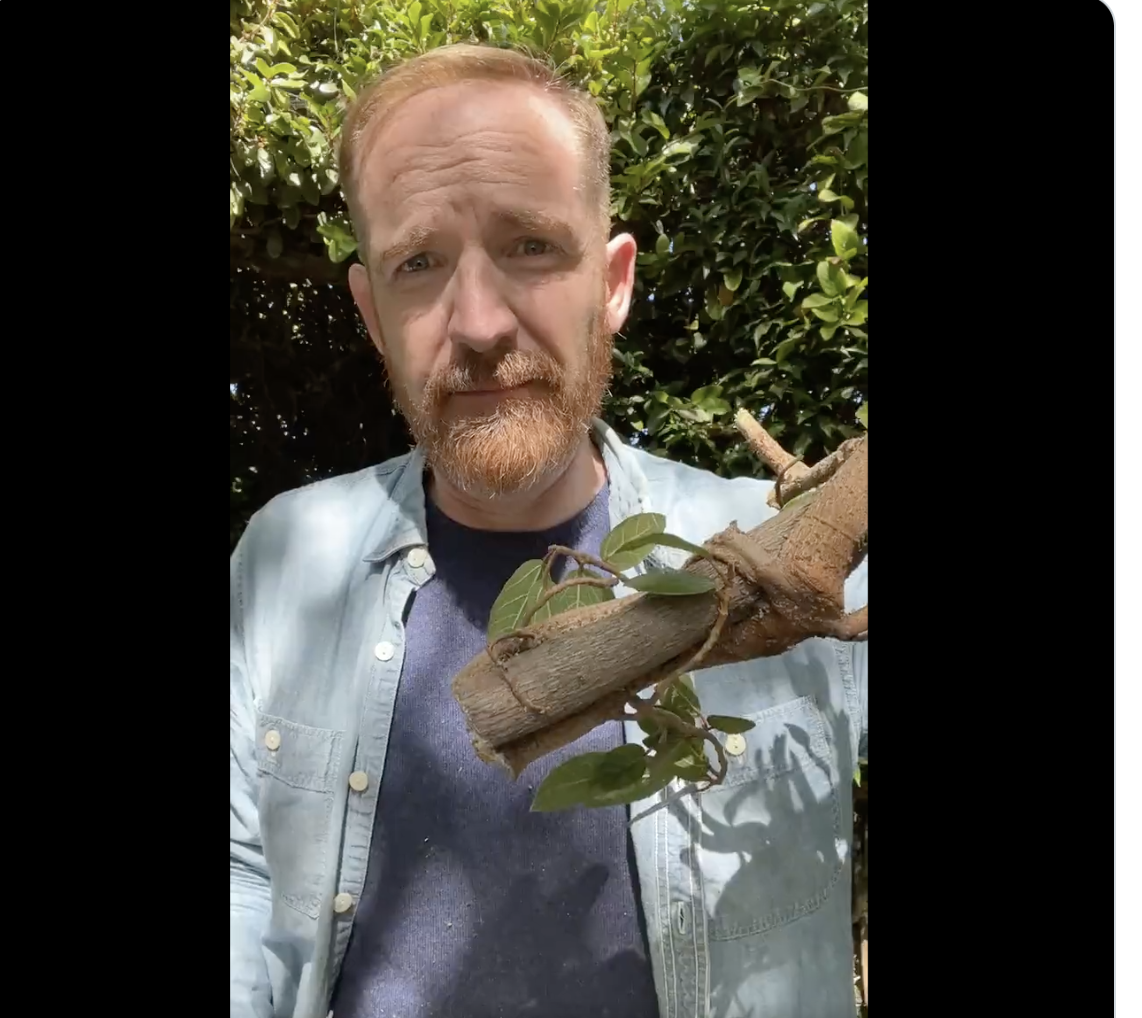
The Good Place’s Marc Evan Jackson delivers pure joy playing his ‘tree bassoon’
Marc Evan Jackson makes everything a delight. The comedy star from “The Good Place” and “Brooklyn Nine-Nine” is even providing top notch entertainment on social media, all while giving us a new appreciation for both bassoons and tree-trimming. What a legend. In addition to acting, stand-up and improv, it seems that Jackson is also a…
Marc Evan Jackson makes everything a delight. The comedy star from “The Good Place” and “Brooklyn Nine-Nine” is even providing top notch entertainment on social media, all while giving us a new appreciation for both bassoons and tree-trimming. What a legend.
In addition to acting, stand-up and improv, it seems that Jackson is also a gardener. He posted on Twitter today: “I was trimming the fig and bougainvillea, and uncovered this perfectly good bassoon. (Be kind. Double reeds are not my forte, and are harder than they look.)”
I was trimming the fig and bougainvillea, and uncovered this perfectly good bassoon. (Be kind. Double reeds are not my forte, and are harder than they look.) pic.twitter.com/8n1oqsN1qd— Marc Evan Jackson (@MarcEvanJackson) October 26, 2021
Can we all just bask in the fact that this guy just said that he has “fig and bougainvillea”? His tweet has more class than I have in my entire body.
Snappy jazz starts to play in the video. And Jackson, holding a piece of tree that does look uncannily like a bassoon, starts to do an “air solo.” My favorite part is the calm, cool, seriousness with which he “plays.”
A few musicians gave their kudos, and some decided to chime in with a few tree bassoon pointers. One person wrote, “Pretty good! (Even though I think your embouchure probably isn’t correct.) But still…impressive!”
As a former bassoon player, I say well done, sir. — Teresa Sayles (@tsayles33) October 26, 2021
Pretty good! (Even though I think your embouchure probably isn’t correct.) But still…impressive! — Christine (@IAmBigCurvyGirl) October 26, 2021
(By the way, in case you don’t know, an embouchure is “the way in which a player applies the mouth to the mouthpiece of a brass or wind instrument.” I had to look it up.)
Another person gave us a gem of wisdom, saying, “Fig jazz is all about the fig notes that you *don’t* play.” Can fig jazz please be a thing? I’m so ready for it.
Fig jazz is all about the fig notes that you *don't* play.— Joey Headset (@joeyheadset) October 26, 2021
I hope Jackson is a fan of puns, cause boy did he get them in the comments.
Gives a whole new meaning to “woodwind.” — Steve (@spinetanium) October 27, 2021
One mom wrote, “My kid, the bassoonist who’s watching b99 for the first time and helping every time he sees you, is going to lose it for this. Thank you.” I would love to see this kid’s reaction.
My kid, the bassoonist who’s watching b99 for the first time and helping every time he sees you, is going to lose it for this.
I really hope that Jackson delivers a follow-up that this was all research for a new role he’ll be playing. But until then, I’ll be playing this on repeat.
In a small village in Pwani, a district on Tanzania’s coast, a massive dance party is coming to a close. For the past two hours, locals have paraded through the village streets, singing and beating ngombe drums; now, in a large clearing, a woman named Sheilla motions for everyone to sit facing a large projector screen. A film premiere is about to begin.
It’s an unusual way to kick off a film about gender bias, inequality, early marriage, and other barriers that prevent girls from accessing education in Tanzania. But in Pwani and beyond, local organizations supported by Malala Fund and funded by Pura are finding creative, culturally relevant ways like this one to capture people’s interest.
The film ends and Sheilla, the Communications and Partnership Lead for Media for Development and Advocacy (MEDEA), stands in front of the crowd once again, asking the audience to reflect: What did you think about the film? How did it relate to your own experience? What can we learn?
Sheilla explains that, once the community sees the film, “It brings out conversations within themselves, reflective conversations.” The resonance and immediate action create a ripple effect of change.
MEDEA Screening Audience in Tanzania. Captured by James Roh for Pura
Across Tanzania, gender-based violence often forces adolescent girls out of the classroom. This and other barriers — including child marriage, poverty, conflict, and discrimination — prevent girls from completing their education around the world.
Sheilla and her team are using film and radio programs to address the challenges girls face in their communities. MEDEA’s ultimate goal is to affirm education as a fundamental right for everyone, and to ensure that every member of a community understands how girls’ education contributes to a stronger whole and how to be an ally for their sisters, daughters, granddaughters, friends, nieces, and girlfriends.
Sheilla’s story is one of many that inspired Heart on Fire, a new fragrance from the Pura x Malala Fund Collection that blends the warm, earthy spices of Tanzania with a playful, joyful twist. Here’s how Pura is using scent as a tool to connect the world and inspire action.
A partnership focused on local impact, on a global mission
Pura, a fragrance company that recognizes education as both freedom and a human right, has partnered with Malala Fund since 2022. In order to defend every girl’s right to access and complete 12 years of education, Malala Fund partners with local organizations in countries where the educational barriers are the greatest. They invest in locally-led solutions because they know that those who are closest to the problems are best equipped to solve and build durable solutions, like MEDEA, which works with communities to challenge discrimination against girls and change beliefs about their education.
But local initiatives can thrive and scale more powerfully with global support, which is why Pura is using their own superpower, the power of scent, to connect people around the world with the women and girls in these local communities.
The Pura x Malala Fund Collection incorporates ingredients naturally found in Tanzania, Nigeria, Pakistan, and Brazil: countries where Malala Fund operates to address systemic education barriers. Eight percent of net revenue from the Pura x Malala Fund Collection will be donated to Malala Fund directly, but beyond financial support, the Collection is also a love letter to each unique community, blending notes like lemon, jasmine, cedarwood, and clove to transport people, ignite their senses, and help them draw inspiration and hope from the global movement for girls’ education. Through scent, people can connect to the courage, joy, and tenacity of girls and local leaders, all while uniting in a shared commitment to education: the belief that supporting girls’ rights in one community benefits all of us, everywhere.
You’ve already met Sheilla. Now see how Naiara and Mama Habiba are building unique solutions to ensure every girl can learn freely and dare to dream.
Naiara Leite is reimagining what’s possible in Brazil
Julia with Odara in Brazil. Captured by Luisa Dorr for Pura
In Brazil, where pear trees and coconut plantations cover the Northeastern Coast, girls like ten-year-old Julia experience a different kind of educational barrier than girls in Tanzania. Too often, racial discrimination contributes to high dropout rates among Black, quilombola and Indigenous girls in the country.
“In the logic of Brazilian society, Black people don’t need to study,” says Naiara Leite, Executive Coordinator of Odara, a women-led organization and Malala Fund partner. Bahia, the state where Odara is based, was once one of the largest slave-receiving territories in the Americas, and because of that history, deeply-ingrained, anti-Black prejudice is still widespread. “Our role and the image constructed around us is one of manual labor,” Naiara says.
But education can change that. In 2020, with assistance from a Malala Fund grant, Odara launched its first initiative for improving school completion rates among Black, quilombola, and Indigenous girls: “Ayomidê Odara”. The young girls mentored under the program, including Julia, are known as the Ayomidês. And like the Pura x Malala Fund Collection’s Brazil: Breath of Courage scent, the Ayomidês are fierce, determined, and bursting with energy.
Ayomidês with Odara in Brazil. Captured by Luisa Dorr for Pura
Ayomidês take part in weekly educational sessions where they explore subjects like education and ethnic-racial relations. The girls are encouraged to find their own voices by producing Instagram lives, social media videos, and by participating in public panels. Already, the Ayomidês are rewriting the narrative on what’s possible for Afro-Brazilian girls to achieve. One of the earliest Ayomidês, a young woman named Debora, is now a communications intern. Another former Ayomidê, Francine, works at UNICEF, helping train the next generation of adolescent leaders. And Julia has already set her sights on becoming a math teacher or a model.
“These are generations of Black women who did not have access to a school,” Naiara says. “These are generations of Black women robbed daily of their dreams. And we’re telling them that they could be the generation in their family to write a new story.”
Mama Habiba is reframing the conversation in Nigeria
Centre for Girls' Education, Nigeria. Captured by James Roh for Pura
In Mama Habiba’s home country of Nigeria, the scents of starfruit, ylang ylang and pineapple, all incorporated into the Pura x Malala Collection’s “Nigeria: Hope for Tomorrow,” can be found throughout the vibrant markets. Like these native scents, Mama Habiba says that the Nigerian girls are also bright and passionate, but too often they are forced to leave school long before their potential fully blooms.
“Some of these schools are very far, and there is an issue of quality, too,” Mama Habiba says. “Most parents find out when their children are in school, the girls are not learning. So why allow them to continue?”
When girls drop out of secondary school, marriage is often the alternative. In Nigeria, one in three girls is married before the age of 18. When this happens, girls are unable to fulfill their potential, and their families and communities lose out on the social, health and economic benefits.
Completing secondary school delays marriage, and according to UNESCO, educated girls become women who raise healthier children, lift their families out of poverty and contribute to more peaceful, resilient communities.
Centre for Girls’ Education, Nigeria. Captured by James Roh for Pura
To encourage young girls to stay in school, the Centre for Girls’ Education, a nonprofit in Nigeria founded by Mama Habiba and supported by Malala Fund and Pura, has pioneered an initiative that’s similar to the Ayomidê workshops in Brazil: safe spaces. Here, girls meet regularly to learn literacy, numeracy, and other issues like reproductive health. These safe spaces also provide an opportunity for the girls to role-play and learn to advocate for themselves, develop their self-image, and practice conversations with others about their values, education being one of them. In safe spaces, Mama Habiba says, girls start to understand “who she is, and that she is a girl who has value. She has the right to negotiate with her parents on what she really feels or wants.”
“When girls are educated, they can unlock so many opportunities,” Mama Habiba says. “It will help the economy of the country. It will boost so many opportunities for the country. If they are given the opportunity, I think the sky is not the limit. It is the starting point for every girl.”
From parades, film screenings to safe spaces and educational programs, girls and local leaders are working hard to strengthen the quality, safety and accessibility of education and overcome systemic challenges. They are encouraging courageous behavior and reminding us all that education is freedom.
Experience the Pura x Malala Fund Collection here, and connect with the stories of real girls leading change across the globe.
Speaking with the astronauts, a CBS News reporter noted that the Apollo 8 crew delivered a Christmas Eve message during their 1968 mission. He asked whether the Artemis II crew had a message to share for Easter. When the microphone floated to Glover, he said he hadn’t prepared anything, but offered some impromptu thoughts:
“We are the same thing”
“I think these observances are important, as we are so far from Earth and looking back at the beauty of creation. I think for me, one of the really important personal perspectives that I have up here is I can really see Earth as one thing.
And you know, when I read the Bible, and I look at all of the amazing things that were done for us, who we’re created, it’s…you have this amazing place, this spaceship. You guys are talking to us because we’re in a spaceship really far from Earth. But you’re on a spaceship called Earth that was created to give us a place to live in the universe, in the cosmos.
Maybe the distance we are from you makes you think what we’re doing is special. But we’re the same distance from you, and I’m trying to tell you—just trust me—you are special. In all of this emptiness—this is a whole bunch of nothing, this thing we call the universe—you have this oasis, this beautiful place that we get to exist together.
I think as we go into Easter Sunday, thinking about all the cultures all around the world, whether you celebrate it or not, whether you believe in God or not, this is an opportunity for us to remember where we are, who we are, and that we are the same thing, and that we got to get through this together.”
People of all faiths—and no faith—appreciated the message
Commenters appreciated Glover’s perspective as he looked out at all 8 billion of us on our beautiful “pale blue dot.”
“One of the most beautiful perspectives I’ve ever heard on this topic. Thank you Victor.”
“Beautiful unifying message.”
“I am not a religious person at all but this speech made me cry.”
“It gave me chills. What a beautiful message.”
“As someone who’s not religious this is the perfect message conveyed by someone of faith without feeling unwarranted or preaching in a way that doesn’t land. Delivered perfectly and I respect him for that.”
“What a beautiful sentiment we all so desperately need to hear.”
Glover’s remarks reflect what others who have viewed Earth from space have said. The emotional experience of that perspective, known as the “overview effect,” often results in a profound awareness of humanity’s place in the universe.
The “overview effect” is a common experience for people who see Earth from space
For Star Trek actor William Shatner, who went to space at age 90 in 2021, that awareness gave him a surprising feeling of deep grief.
“It was the death that I saw in space and the lifeforce that I saw coming from the planet — the blue, the beige and the white,” he said. “And I realized one was death and the other was life.”
Earth and life are “so fragile,” Shatner said. “We hang by a thread…we’re just dangling.” Seeing humanity from that distance put conflicts between humans into perspective. “We’re entangled with each other,” he said. “We have a war…the stupidity of it all is so obvious.”
Frank White, the space philosopher who coined the term “overview effect” in his 1987 book of the same name, wrote that astronauts who leave Earth generally come back with “a greater distaste for war and violence, and a desire to do something to improve life back on the surface, because they’ve seen the truth of our situation.”
Space travel highlights our shared humanity
When Glover referred to Earth as a spaceship, he wasn’t just being metaphorical. Our planet is a self-contained, closed-loop system, meaning its resources are produced and recycled here. And we are hurtling through space at about 67,100 miles per hour—much faster than any spacecraft we’ve sent into space. For all intents and purposes, we are traveling together on a giant, round spaceship.
The universe is vast, yet it’s so easy to get wrapped up in the little details of life on our planetary ship. Zooming out—seeing Earth from a distance—can help us view ourselves and our lives in a different light. Seeing our home, our people, our lives as one has the power to change something within us. It’s a potent reminder that, for all our uniqueness, we really are one.
Watch the highlights from Day 4 of the Artemis II mission:
Millennials have noticed a problem with their Boomer parents’ phone addiction, and they’re calling it out. At first, it seemed like harmless teasing about role reversal, but their excessive screen time just might be an issue. Dr. Sue Varma, Board Certified Psychiatrist, reveals the risks related to increased screen time in adults.
The negative effects of too much screen time have been discussed ad nauseam when it comes to children and teens. However, rarely talked about is the cognitive impact it has on adults of all ages. Given that Boomers have reached senior status, cognitive lapses are already a heightened concern for many.
It turns out that screens might be mimicking a serious issue. This can create concern and anxiety for Boomers and their children. The psychiatrist joined the CBS Mornings co-hosts for a candid chat about the research on screen time.
When discussing the impacts of screen time on adults, Varma drops a bombshell, saying, “We end up getting something called digital dementia or digital fog, where the symptoms of poor attention span, memory, concentration all go down, and it very much mimics a real dementia where you walk into a room and you’re like ‘why am I here, what did I come for, where are my keys?’ The tip of the tongue feeling, like there’s a word, there’s a name, ‘I know that person, I can picture them in my head,’ and the word doesn’t come to mind.”
Researchers Rinanda Shaleha and Nelson Roque from the Pennsylvania State University Department of Human Development and Family Studies, Center for Healthy Aging, report concerning findings. “Digital engagement among older adults also carries risks, including attention deficits, disrupted sleep patterns, social isolation, reduced physical activity, and structural brain changes that could accelerate cognitive decline and dementia onset. Extended screen exposure may further contribute to visual fatigue, chronic distraction, and sedentary behaviors, potentially exacerbating cognitive vulnerabilities,” the duo writes in a recent study.
Dr. Varma tells CBS Mornings that the symptoms can “very much look like dementia,” invoking the “if you don’t use it, you lose it” warning. This isn’t just a quirky thing that happens and stops when the phone is put down.
According to Dr. Varma, “There are real structural changes in the brain for people who are using excessive screens, and we see that a lot of older adults are using 10 hours a day. That’s seven and a half hours of TV plus four hours of phones.” She later adds that 63% of seniors “find that social media strengthens their connections.”
Not all Boomers fall into this category. Many are connecting with their community physically, but those with chronic illnesses tend to be on screens more often. Pew Research found that 41% of all adults report being online constantly, 84% say they’re online multiple times a day.
If people are interested in breaking their phone habit, she advises them to put their phone in grayscale mode. Varma adds that replacing digital things with their analog counterparts will also help break a phone habit. Finding ways to connect in person instead of passively scrolling also reduces screen time. Varma says that these small changes can help limit your screen time and re-engage your brain.
Losing someone you love is never easy, and the process is different for everyone. For some people, keeping their deceased loved one’s things exactly the way they left them is part of it. But to some people, this act of enshrinement can be viewed as unhealthy. Dr. Jason Singh argues that this behavior isn’t unhealthy at all. In fact, he explains that it’s actually your brain doing something intelligent.
In a recent video, Singh makes his case. The doctor asks, “Have you ever lost someone and couldn’t bring yourself to touch a single thing they left behind?” At this point people may be expecting that he would touch on ways to move on from this kind of grief, but he doesn’t.
Instead, he shares information about the brain that can help those who are struggling with the reality of being unable to move these items. “Here’s something you may not have realized,” Singh says. “You’re not keeping their stuff because you’re stuck. You’re keeping it because your brain is doing something profoundly intelligent.”
Singh explains that while people around you may think leaving a deceased loved one’s unwashed coffee mug untouched is unhealthy, it’s not. He shares that our brains are constantly updating information on the people we know. Like a computer system, it’s always processing new information and looking for updates. When someone we love dies, there is no new information about that person for our brains to process and categorize.
Leaving things as the deceased person left them is bridging this stalled function in a way. According to Singh, “Objects are not just objects to a grieving mind. They’re the last negotiation your nervous system has with permanence. See, when your dad passes away, or your mom passes away, something neurologically catastrophic happens that has nothing to do with sadness. Your brain, which has spent decades building a mental model of that person, their voice, their patterns, their presence, suddenly receives no more data to update that model with, and it refuses to close the file.”
He says a brain that refuses to “close that file isn’t grief” because closing it would dismantle the attachment architecture that person helped build. “So that room is not a shrine,” Singh explains. “It’s a server that’s still running, and I don’t believe you’re in denial of their death. I honestly don’t. You’re in a silent war between two parts of your brain. The prefrontal cortex, which is the logical, forward-moving, knows that they’re gone, and the limbic system. The part that holds every memory of being loved by them.”
The doctor says that Bond’s Theory explains that there is no logical way to override that program breakdown. Picture it like the old Windows buffering signal. The computer is on, it’s running, but it can’t move forward, no matter which button you press to escape the screen. Due to this theory, Singh shares that getting rid of their things may feel like participation in their erasure.
Singh’s explanation resonated with viewers deeply. One person reveals, “This is awesome, thank you. Husband’s clothing still in closets and dresser, his two pair of running shoes still under the bed. Two years, 4 months since he passed.”
Another shares, “Thank you. I thought maybe I wasn’t dealing with my husband’s death 4 months ago very healthy….I can’t even remove his things from the shower as it feels like I’m moving him out of my life and that’s the last thing I want to do. He was ,y best friend and we were married 36 1/2 years and I miss him so much it hurts every day.
It took me 3 months to finally wash his dress socks and the entire time I was washing them I was asking myself why I was washing them and what I was going to do with them once they were all washed? I matched them and put them away in his drawer and thought to myself how silly I was as these are just “things” but these socks had his feet in them and I just can’t bare to get rid of things he touched or wore or used and Ona afraid of being a ridiculous pack rat, but I have given and will continue to give my 5 adult kids his things and try to figure out what to do with the rest.”
One grieving child writes, “This was good to hear. I lost my Mama 5 years ago, my parents live with my family and we’ve barely touched anything in her room, my Dad and me go in and sit ‘with her’ when we need to and although we have taken a few things out and moved some things around it’s basically as it was when we lost her that day… mug still there, slippers by the bed, clothes folded on the chair, clothes still hanging in the wardrobe, teddy on the bed and ornaments on the shelves etc all sitting there… like they’re waiting for her to come home.”
Someone else shares, “Wow, this makes so much sense. I walk into my father’s closet, touch the clothes, smell them and then close the door. That’s all I can do right now. I also am still paying for his phone.”
Take it from a Gen Xer: midlife regrets are no fun. But what if it were possible to learn from our elders and avoid making the same mistakes? We’ve reached a moment when Gen X (and, frankly, some Millennials) has entered its silver age of wisdom and is ready to pass it on to the next generation.
In a Reddit thread titled “Middle-aged people, what advice would you give a young person to avoid going through a mid-life crisis later in life?” there have been more than 400 responses in less than a week. They range from beautifully earnest to highly practical, with none crossing into judgmental territory. Here are some of the best:
“Don’t spend your 20s and 30s becoming someone else’s idea of successful and then wonder at 45 why nothing feels like yours.”
“Try and become what you want to be, rather than what you think you should want to be.”
“This is it. I followed my parents’ idea of a career and success and I’m lost at 40. I should have followed my own path.”
Decisions have consequences
“Every decision you make can have life-altering consequences later on. Watch your diet, exercise, money, and mental health and constantly keep tabs on them and generally speaking, you should avoid most of the common pitfalls.”
Nutritious food. Photo credit: Canva
“A good way to try to teach yourself these habits is to just make a list of brand new things you’ll do for ten minutes in a day, then track them for a week. So, say, ‘I’ll do ten minutes of walking, ten minutes of writing, and ten minutes of reading.’ At the end of the day, after doing these things, you’ll notice they were easier each time and you even felt like you could go longer in the next session. It just shows how habits are built pretty quickly and doing something only once isn’t pointless because it’s starting a whole new act.”
Reflect and ask questions
“Spend time alone, reflecting on your thoughts. I know, it seems scary. But trust me. Go to a park or some outdoor space where you can be alone. Don’t look at your phone, don’t listen to music, no distractions. Just try to be there in the moment.
Consider and reflect on any thoughts that pop into your head. Good or bad, ask yourself what are the origins of these thoughts and the meaning of them? The point of this exercise is to become more attuned to yourself and your unique life that you may not realize because we rarely give ourselves time to reflect.
Figuring out ‘what you want to be’ requires a deep understanding of yourself, and this comes from spending time reflecting on who you are.”
“The best way to self-reflect is by asking questions:
Why are you unhappy?
What causes you to feel fulfilled?
Where do you want to see yourself in 5, 10, or 20 years from now?
What’s holding you back?
What can you change now?
As you keep digging, you start to notice questions you don’t know the answers to, or try to avoid.
Those are usually the things that you slowly have to work on, maybe with a therapist, a friend, or by yourself to become a better person.”
Someday is now
“Build a life that actually feels like yours—keep growing, take risks you believe in, and don’t postpone living for ‘someday.’”
“Everything you want to do and everything you want to be is just on the other side of embarrassment. Don’t be afraid to be bad at something, we all start somewhere.”
Online, you’ll find hundreds of newfangled hacks to get food crispy and golden brown without the oil. But one new method taking over TikTok isn’t new at all. In fact, it’s centuries old.
Enter: salt frying. Recently, Roice Bethel (@roicebethel) went viral after sharing a clip of himself dropping chicharrones and popcorn kernels into a frying pan filled to the brim with salt and salt alone. Then voila, each of the foods puffed out, ready to eat…leaving some viewers dumbfounded.
In truth, the technique of using salt (or sand) to cook certain foods has been around for millennia in countries like China, India, and Greece. And you’ll still find it among street food vendors today. In India, for instance, far far (or fryums), made from potato starch, tapioca, and/or wheat flour, are often made this way.
In China, chestnuts roasted in large woks filled with hot sand are a seasonal winter staple, prized for their subtly smoky flavor. And in Bangladesh, peanuts are traditionally toasted in pans of hot black sand, which helps them roast evenly without burning.
Similar techniques have also appeared in parts of the Middle East and Mediterranean, where cooks have long relied on heated salt beds to gently cook or warm foods. Historically, these methods were especially useful in places where cooking oil was scarce or expensive, making salt and sand practical alternatives. Not to mention that watching foods cooks this way is also a treat for the eyes.
In Turkey, sand has also been a tried-and-true way to make coffee, seen below.
How salt frying works
Really, salt or sand frying isn’t so much frying as it is dry roasting. Frying food in oil makes food crispy by rapidly dehydrating the outer layer. The intense heat triggers the Maillard reaction, which is responsible for browning and complex flavors, and causes surface starches to gelatinize and harden while the inside stays moist.
When heated, salt and sand act as equally excellent heat conductors. Both can store and distribute heat evenly, surrounding food on all sides and eliminating hot spots. This creates a consistent cooking environment that mimics the effect of deep frying, only without added fat.
As Kurush F. Dalal, an archaeologist and culinary anthropologist, told Food & Wine, “it’s an incredibly cost-effective and very controllable process,” especially since you can reuse the salt you fry with. Tell that to the southerners among us who save every drop of their bacon grease!
Salt frying tips
Now, if you’re excited to try this cooking style out yourself, there are a few caveats—the most important being that this really only works on dry ingredients. Salt will stick to any damp ingredients and completely ruin the taste of the dish.
Second, it is advised to use coarse salt, according to Food & Wine. And at least one person on Reddit suggests that no matter what salt or sand you use, “let it heat for 15 minutes to let the volatile compounds evaporate (like iodine).”
Lastly, you’ll need a large, deep fryer-friendly utensil, like a wok or cast-iron skillet, that can hold a lot of salt or sand.
So, while it may look like a viral magic trick, salt frying is really just ancient ingenuity making a well-deserved comeback. Some things are timeless for a reason.
Tipping culture is ever-changing and, for many, has always been a bit confusing. Perhaps that’s why a training video was made circa the 1980s to give “tips” (pun intended) on gratuity after a meal.
The Instagram account Totally 80s Room (@totally80sroom) posted the clip, with a chyron reading, “How much should you tip?” We see a video of a young woman receiving her bill. She ponders, “Hmm, how much should I tip?” A male voiceover answers, “That’s a good question. The gratuity can range from 10% for acceptable service to 20% for exceptional service.”
An 80s training video on how to tip. Credit: Totally 80s Room, Instagram
The screen then flashes over to a “waitperson” rocking a stained shirt. Mascara drips down her face, while she casually blows bubbles with her gum. The voiceover continues, “But if your waitperson is blatantly bad or has some attitude, don’t tip. Just leave a penny to show you didn’t forget to tip. And tell the manager your complaints. Believe me, he wants to know.”
During this advice, the server then says to the customer, “Look. You’re just lucky I’m waiting on you.”
The question is posed: “Basically, did the waitperson do everything in their power to make your dining experience pleasant? Were they courteous? Were they knowledgeable about specials, preparation methods, menu accompaniments, and other aspects of the restaurant? Or don’t they?”
While the appropriate waitperson seems caring and calm, the “bad” employee files her nails and quips, “I ain’t got all day. Are ya gonna order or what?” The customer asks, “Ma’am, what’s the soup today?” The server is annoyed by the question. “Soup? I don’t know! Some kind of vegetable thing.”
People in the comment section have a wide range of views. Many joke about the absurdity of the video itself. “I hate when servers constantly tell me how lucky I am they are waiting on me.”
Others debate tipping etiquette in general with a variety of thoughts. “Always 20%.” “Australia = no tipping.” “15% if it’s okay service. 10% if it’s terrible service. 20% if the service was amazing and 0 if I have to order at the counter and get my own food.”
How tipping culture has taken over. Credit: WSJ, YouTube
Another notes how even the idea of a pressured gratuity has changed. “It’s not tipping anymore. It’s commission.”
What’s up with tipping anyway?
In MSN‘s recently posted piece, “The right thing: Should waiters expect a tip on every meal?” Jeffrey L. Seglin explains how much wait staff (and the restaurant owners) depend on these tips, especially in the United States. “The federal minimum wage in the United States is $7.25 per hour (a rate that hasn’t changed since 2009), and the federal tipped minimum wage is $2.13 per hour. Because the federal tipped minimum wage is below the federal minimum wage, most Americans who dine out know that most servers make a living wage based on the tips they receive.”
CNBC writer Emily Lorsch reveals that expected gratuity percentages have grown over the decades. While in the past few years tips have crept up to over 20% for some diners, it didn’t used to be that way. “During the 1950s, people commonly tipped 10% of the bill. By the 1970s and 1980s, that percentage had jumped to 15%.”
How tipping has evolved. Credit: Casually Explained, YouTube
Lorsch shares data from a study conducted by Creditcards.com, who claim that the sleek machines brought to the table may pressure many to tip more. “22% of respondents said when they’re presented with various suggested tip amounts, they feel pressured to tip more than they normally would.”
Regardless of steadfast tipping etiquette, it’s safe to say that wait staff should never file their nails at the table. Hopefully, that doesn’t change.
An interaction between a 4-year-old boy and a Cast Member at Disneyland highlights the importance of inclusion and shows that learning American Sign Language (ASL) can have an incredible impact on deaf people and their families.
Callie Foster, 38, and her husband, Leonardo Silva, 39, were recently at the park when their son, Luca, came across Disney Cast Members dressed as Jessie and Woody from the Toy Story series. The parents were taken aback when, for the first time at the park, the boy initiated a conversation in ASL with Jessie.
Jessie from Toy Story communicates in ASL
“Because we go to the parks often, we really try not to put that expectation on anyone. We never assume a character will know ASL, so usually we’re the ones interpreting for Luca; we’re used to stepping in to help facilitate those interactions,” Foster told People. “This time was completely different. Luca initiated it on his own. He signed to her first, and there was this split second where we all kind of looked at each other like, ‘Wait… did that just happen?’ And then she recognized it and started signing back to him.”
When Jessie and Luca first met, she didn’t know that he was deaf. Then, he looked up to her and signed, “What’s your name?” to which Jessie responded in ASL, “Name, J-E-S-S-E.” She then asked Luca, “Your name?” to which he responded, “Luca.” Jessie then said, “Nice to meet you,” and “Thank you.”
“Watching your child be included in their language… It’s a kind of magic you don’t forget,” Foster concluded the video.
This isn’t the first time Luca has gone viral for interacting with a character at Disneyland. Two years ago, when Luca was just 2 years old, a Cast Member playing Bo Peep communicated with Luca in ASL. When Luca approached Bo Peep, his mother signed, “This is Luca.” Bo Peep returned the greeting with, “Nice to meet you,” in ASL.
Bo Peep then knelt down to Luca’s height and signed, “You’re our friend.” Excited, Luca then tried to tell Jessie that her friend, Buzz Lightyear, was nearby.
Disney is committed to ASL inclusion in its theme parks
The fact that many characters in Disney Parks know ASL isn’t an accident. Since 1997, Walt Disney World Resort and Disneyland Resort have offered ASL interpretation at many attractions and shows. Sign language interpretation is a service that is available in parks for guests with hearing disabilities.
“When a show or new attraction that warrants Sign Language interpretation is being developed, my team at Walt Disney World Resort and the Disneyland Resort Accessibility team are included in planning conversations and rehearsal process. We work to ensure appropriate interpreter placement and lighting are being considered and to share show scripts and videos with the fantastic theatrical interpreters who do work for us,” Mark Jones, Manager of Accessibility and Services for Guests with Disabilities at Walt Disney World Resort, told Disney Parks Blog.
The passing down of stories, memories, and keepsakes is important in many families. But how to do that isn’t always so simple. A lot can get lost over the years, both figuratively and literally. And younger generations don’t always want or appreciate physical heirlooms. One woman shared a brilliant heirloom that belonged to her grandma,…
The passing down of stories, memories, and keepsakes is important in many families. But how to do that isn’t always so simple. A lot can get lost over the years, both figuratively and literally. And younger generations don’t always want or appreciate physical heirlooms.
One woman shared a brilliant heirloom that belonged to her grandma, which solves some of these problems. It’s called a perpetual calendar, and it keeps the whole family’s major memories in one spot. Essentially, it’s a ring of index cards that each have a month and day on them, but no year. As events happen in the family, they get written on the day they happened, with the year written next to them.
Watch Jenn Perez Miller explain how her grandma’s perpetual calendar, which she started in the 1970s, works:
The beauty of this idea is that it doesn’t take up a huge amount of space. If the cards eventually fill up, they can be stored physically or digitally and replaced with new ones, making the calendar filled with family memories essentially eternal.
Another plus is that people can decide what they think is important to document. Will your great-grandkids care if you replaced your carpet 60 years ago? Maybe, maybe not. But not all memories have to be monumental. There’s something special about seeing the everyday events our loved ones felt were worth noting.
A sample of what a perpetual calendar card might entail. Photo credit: Canva
People loved the idea:
“Brb, gonna go put a perpetual calendar on my wedding registry and start this from our wedding day.”
“If I came across something like this in an estate sale I’d immediately sit on the floor and read every single one.”
“My boyfriend’s grandma did this and we were cryinnnnng laughing…. She talked about diarrhea a lot.”
“This is the coolest thing I’ve ever seen.”
“This is some serious matriarchal behavior and i am sooo jealous that you have something like this!!!”
“I just love how women bring the family together in simple ways. 🥰”
“I love the idea of seeing the major and insignificant things that happen on the same day years apart. Puts things into perspective.”
“Genuinely this is such a treasure, future archeologists would lose their minds finding something like this.”
You can make a perpetual calendar yourself with index cards. Photo credit: Canva
The concept is not only simple, but it’s pretty easy to make yourself. All you need is index cards (one for each day of the year, including February 29th for leap years), a hole punch, and large binder rings. You could also use an index card box with dividers for each month instead of the rings.
Some of us might see this idea and love it, but wish we had started earlier. But it’s never too late, especially when you think of it as something to pass down through the generations. Someone has to start sometime.