upworthy
Add Upworthy to your Google News feed.
Google News Button
Education

Teachers are sharing their students' wildest excuses that actually turned out to be true

Here are 17 of the best responses.
teachers, students excuses, teachers funny stories

Teachers share the best excuses.

Kindergarten through 12th grade teachers and college professors have heard every excuse in the book. Whether it’s a third grader claiming their “dog ate my homework” or a college freshman claiming their grandmother died to get out of a test, they’ve heard it all a billion times.

A college professor once listed the top 21 excuses he’s heard from his students. Here are the top five:

5. “It’s the last week of the semester.”

4. “It’s St. Patrick’s Day or 4/20”

3. “Our other teacher held us back.”

2. “My timetable showed the class was canceled.”

1. “I’m taking a vacation.”


Yes, some students actually say they didn’t do their work because of a holiday predicated on drinking or getting stoned and others have the audacity to say, “Hey! I needed a vacation.” After spending week after week fielding excuses, there’s a good reason why most educators are skeptical when they hear one from their students.

But every once in a while, an excuse that seems way too improbable to be believed actually is true.

Reddit user u/minecraftplayer48 asked the teachers of Reddit to share the “best excuse for being late that turned out to be true” and the stories were all pretty great. But it wasn’t only teachers who chimed in; a lot of people shared stories from when they were students and had an excuse that was so crazy they didn’t think anyone would believe them.

Here are 17 of the best excuses for being late that were actually true.

1. Revenge of the torque wrench


"My auto teacher let me practice removing and adding the tires on his vehicle. The next morning it was about 20 minutes into first period and no sign of him. He comes running into the classroom out of breath and his hair is all messed up. He points at me and says 'YOU!!!! What is a torque wrench used for???' I respond with "I don't know." He says ' I know you don't know!!!" Turns out one of his tires came off while driving down the highway." — ethnicjello

2. Mom wanted to sleep in


"She had to take her sister to school and drive her mom to rehab. She was always late to class because her mom just wanted to sleep in. Problem was if the mom was late or did not go she would have violated her probation and gone to prison. I never marked her late. If she missed anything important she could come in at lunch or after school to make it up." — RM156

3. "That was you?"


"Student here, I headed into school early to get some studying done in the library before my night class. I was one exit away when I was caught in a 3 car accident. Most of the expressway afterwards was gridlock with only one lane left open. I did eventually make it into my lab class 15 minutes late, with a few scrapes and bruises. My professors reaction was simply 'Oh that was you!''" — AlienCowAbduction

4. "School bus blew up"


"I was one of about 20 kids who were late to school. We showed up at the school office as a group and when questioned why we were late, we said 'The school bus blew up.' They questioned 'So the engine blew up?' The kids 'No, the whole bus, in flames. It blew up.'

"There was much conference between the teachers, all of them thinking we embellished the story. Next thing you know, one of the admin staff has the news website open, very obvious image of an entire bus on fire with a bunch of kids in our school uniform standing in front of it. Our late slip for class read 'School bus blew up.'" — AusPB90

5. B.U.I.


"Told me he got pulled over by the cops for wobbly driving on his bike and they thought he was drunk. Turned out he was just dodging all the slugs on the street." — Fortisvol

6. Chicken of death


"A guy in my college class missed class one day. The next day he came in with his eye covered up and medical paperwork in hand. Apparently he got pecked in the eye by a chicken." — BrrToe

7. Chicken 2: The chickening


"When I was student teaching, I was late because there was bunch chickens in the middle of the road. They wouldn't move at all. This is in the middle of a city of 200,000 people. Freaking chickens.

"I finally get to school and profusely apologize to my mentor teacher and I told her why I was late thinking it sounded ridiculous. She said, 'yeah, those chickens are fucking assholes, they surrounded my car in the McDonalds parking lot last year. Don't worry about it." — Makenshine

8. Cracker Barrel conference


"Taught a group of seniors first period. It was towards the end of the year. I had a class of around 30 and only 5 were there when the bell rang. Halfway through class, the rest of them show up. They went out to Cracker Barrel for breakfast and brought me some back. All was forgiven." — SwansonsLoveChild

9. Beary late


"Bear on the backyard. No access gate. Animal control had to tranq it from the room and drag it through the house. Made the news. Got to retake the test I missed after sending her the news article." — Vladtehwood

10. Present the flat


"We had an exam in my class and the teacher got a message from a student saying that he was going to be late because his car had a flat tire (the student was known to party), the teacher didn't think it could be true, so as a joke the teacher asked him to bring the tire back. He brought the flat tire back in the middle of the exam. Needless to say, the professor didn't expect that." — Sapang

11. Moo


"A kid missed my first-period class one morning but was in school later that day. When I asked him why he hadn't arrived in time for my course, he said his cow was birthing its calf that morning, so he'd picked being in the barn over English. Made sense to me. His essays weren't going to win any ribbons at the county fair, but his calf could." — Bobosbigsister

12. Abduction


"In high school a kid came late to history class. He was a joker so when someone asked him where he had been, he goes 'I was kidnapped.' Everyone laughed, until he goes 'no really.'

"Turns out 2 guys kidnapped him and tossed him into the back of the minivan he was using for his morning paper route. They drove him around while they robbed something. I can’t remember what happens after. I think they just drove the van somewhere and got away." — notinmybackyardcanad

13. Honesty is the best excuse


"Not a teacher, but a kid walked into my class one day and literally just said 'Sorry I'm late, I didn't want to be here.' He wasn't wrong I suppose." — Scally59

14. It actually was the dog


"A little off topic but in 8th grade, a friend of mine turned in their homework late because her dog literally ate her homework. She even brought a note from her parents." — JoeyJoey2004

15. Is this a real excuse? Or is it fantasy?


"'Sorry Bohemian Rhapsody came on just as I parked.' — My art teacher when he was about 5:55 minutes late." — Deeberber

16. "I took a shortcut"


"This happened to me as a pupil; a very quiet, unassuming kid in our class came in to German with about five minutes of the class left. We went to a Catholic school and the teachers were all quite strict and intimidating. Classes were usually silent, especially in junior school. When this boy came into class at the end of the lesson that day, the door flew inwards with such force that the teacher gave an audible gasp.

"It had been raining heavily outside, his hair was plastered to his forehead. His blazer was dripping and sodden. He had mud caked into his trousers up to his knees, and he was breathing heavily. The teacher exclaimed, ‘Brendan! What happened?’ We all stared up at him in shocked silence. This quiet, unassuming little boy let out a big sigh and just said, ‘I took a shortcut.’ And went straight to his seat.

"That line became iconic in our school for years afterward." — lestat85

17. Pug lovers can attest


"Kid was late to school and had to miss a very important football game. The reason? His fat pug fell asleep on his phone. The pug’s fat rolls muffled his alarm." — tip52


This story originally appeared on 02.24.22

boomer grandparents, boomer grandparent, millennial parents, millennial parent, grandkids
Image via Canva/PeopleImages

Boomer grandparents are excessively gifting their grandkids, and Millennial parents have had enough.

Millennial parents and Boomer grandparents don't always see eye to eye on parenting and grandparenting. Now, Millennial parents are uniting on a nightmare Boomer grandparenting trend that sees them "excessively gifting" their grandkids with tons of both new and old *unwanted* stuff during visits.

Ohio mom Rose Grady (@nps.in.a.pod) shared her "Boomer grandparent" experience in a funny and relatable video. "Just a millennial mom watching her boomer parents bring three full loads of 'treasures' into her home," she wrote in the overlay.


Grady can be seen looking out the window of her home at her Boomer mom and dad carrying bags and boxes up her driveway after several visits. The distressed and contemplative look on Grady's is speaking to plenty of Millennial moms.

@nps.in.a.pod

Today's "treasure" highlight was the mobile that hung in my nursery... #boomerparents #boomers #boomersbelike #millennialsoftiktok #millenialmom #motherdaughter

Grady captioned the video, "Today's 'treasure' highlight was the mobile that hung in my nursery..."

The humorous video resonated with with fellow Millennial parents. "Straight to the trash when they leave," one viewer commented. Another added, "I always say 'if you don’t want it in yours, we don’t want it in ours' 😂."

Even more Millennial parents have shared and discussed their situations with Boomer grandparents buying their kids too much stuff on Reddit. "Both my mother and my MIL love buying and sending toys, books, clothes, etc. I don't want to be ungrateful but we just don't need it and don't have the space. I have brought this up politely in 'we are all out of drawers for that' but it hasn't slowed things down," one explained. "I think part of the issue is that the grandparents live in different cities and vacation a lot. They don't get to see our daughter much so they buy stuff instead."

Another Millennial parent shared, "While the intention is very kind behind these, all the grandparents are very aware that we do not need, nor wish to receive these gifts in such an excessive volume - as it creates a daily struggle to store and accommodate in our home. I struggle to keep on top of tidying as it is, and this is a massive added challenge."

millennial parents, millennial parent, millennial mom, kids room, organize Millennial mom struggles to organize her son's room.Image via Canva/fotostorm

How to talk to Boomer grandparents about gifts

So, why are Boomer grandparents excessively gifting? "Boomer grandparents may be the first grandparent generation to have accumulated the substantial discretionary funds that enables them to spend money on their grandchildren," Sari Goodman, a Certified Parent Educator and founder of Parental Edge, tells Upworthy. "These grandparents probably grew up with grandparents who didn’t have that kind of money and so they may be excited to give their grandchildren the things they didn’t get."

Goodman suggests that Millennial parents first discuss with them the "why" behind the gifting. "What comes before setting a boundary to limit over-the-top gift-giving is delving into the reasons grandparents are buying so much," she explains. "Coming from a place of compassion and understanding makes it possible to come up with mutually beneficial solutions."

- YouTube www.youtube.com

She recommends that Millennial parents sit down with their Boomer parents to learn more. "Did they grow up without many toys and clothes and are fulfilling a dream? Ask them about the values they learned as children (hard work, perseverance, the power of delayed gratification) and how they can pass on these lessons to the grandchildren," she suggests.

She adds that another reason may be that Boomer grandparents live far away and want their grandchildren to feel a connection with them. "Set up a regular FaceTime or Zoom meeting. Rehearse with the kids so they have something to say and suggest a topic for the grandparents," says Goodman. "Or send snail mail. Kids love getting mail. The grandparents can send postcards from where they live and explain some of the special sites."

boomer grandparents, boomer grandparenting, video chat, video call, grandkids Boomer grandparents have a video call with grandkids.Image via Canva/Tima Miroshnichenko
Finally, Goodman adds that for some grandparents, this may be is the only way they know how to show their love. Millennial parents could ask if they would be open to other ideas. "Parents can set up an activity for grandparents and kids to do when they come over—a jigsaw puzzle, art activity, board game, magic tricks," she says. "Arrange for the grandchildren to teach the grandparents something their phones can do or introduce them to an app they might like."

This article originally appeared last September

kids, school, school days, school week, schedule, 4 day week
Unsplash

Many school districts are moving to a 4-day week, but there are pros and cons to the approach.

American kids have fewer school days than most other major countries as it is, which poses a big challenge for families with two working parents. In a system designed for the "classic" stay-at-home mom model, it's difficult for many modern families to cover childcare and fulfill their work obligations during the many, many holidays and extra days off American children receive in school.

Some school districts, in fact, are ready to take things one step further with even fewer instructional days: for better or for worse.


Whitney Independent School District in Texas recently made news when it decided to enact a four-day week heading into the 2025 school year. That makes it one of dozens of school districts in Texas to make the change and over 900 nationally.

The thought of having the kids home from school EVERY Friday or Monday makes many parents break out in stress hives, but this four-day school week movement isn't designed to give parents a headache. It's meant to lure teachers back to work.

Yes, teachers are leaving the profession in droves and young graduates don't seem eager to replace them. Why? For starters, the pay is bad—but that's just the beginning. Teachers are burnt out, undermined and criticized relentlessly, held hostage by standardized testing, and more. It can be a grueling, demoralizing, and thankless job. The love and passion they have for shaping the youth of tomorrow can only take you so far when you feel like you're constantly getting the short end of the stick.

School districts want to pay their teachers more, in theory, but their hands are often tied. So, they're getting creative to recruit the next generation of teachers into their schools—starting with an extra day off for planning, catch-up, or family time every week.

Teachers in four-day districts often love the new schedule. Kids love it (obviously). It's the parents who, as a whole, aren't super thrilled.

- YouTube www.youtube.com

So far, the data shows that the truncated schedule perk is working. In these districts, job applications for teachers are up, retirements are down, and teachers are reporting better mental well-being. That's great news!

But these positive developments may be coming at the price of the working parents in the communities. Most early adopters of the four-day week have been rural communities with a high prevalence of stay-at-home parents. As the idea starts to take hold in other parts of the country, it's getting more pushback. Discussions on Reddit, Facebook, and other social media platforms are overrun with debate on how this is all going to shake up. Some parents, to be fair, like the idea! If they stay-at-home or have a lot of flexibility, they see it as an opportunity for more family time. But many are feeling anxious. Here's what's got those parents worried:

The effect on students' achievement is still unclear.

The execution of the four-day week varies from district to district. Some schools extend the length of each of the four days, making the total instructional time the same. That makes for a really long day, and some teachers say the students are tired and more unruly by the late afternoon. Some districts are just going with less instruction time overall, which has parents concerned that their kids might fall behind.

A study of schools in Iowa that had reduced instructional days found that five-days-a-week students performed better, on average.

Four-day school weeks put parents in a childcare bind.

Having two working parents is becoming more common and necessary with the high cost of living. Of course—"school isn't daycare!" But it is the safe, reliable, and educational place we send our kids while we we work.

Families with money and resources may be able to enroll their kids in more academics, extracurriculars, sports, or childcare, but a lot of normal families won't be able to afford that cost. Some schools running a four-day week offer a paid childcare option for the day off, but that's an added expense and for families with multiple kids in the school system, it's just not possible.

kids, school, school days, school week, schedule, 4 day week In a 4-day model, kids often (but not always) receive less instructional time. Photo by Ivan Aleksic on Unsplash

This will inevitably end with some kids getting way more screentime.

With most parents still working five-day weeks, and the cost of extra activities or childcare too high, a lot of kids are going to end up sitting around on the couch with their iPad on those days off. Adding another several hours of it to a child's week seems less than ideal according to expert recommendations.

Of course there are other options other than paid childcare and iPads. There are play dates, there's getting help from family and friends. All of these options are an enormous amount of work to arrange for parents who are already at capacity.

Working four days is definitely a win for teachers that makes the job more appealing. But it doesn't address the systemic issues that are driving them to quit, retire early, or give up their dreams of teaching all together.

@5th_with_ms.y

Replying to @emory here are my thoughts on my 4day work week as a teacher✨ #foryou #fyp #fypシ #foryoupage #foryoupageofficiall #teachersoftiktokfyp #teachersoftiktok #teachertok #teachersbelike #teachertiktok #tik #tiktok #viralllllll #teachertoks #teaching #teacher #tok #viralvideo #teacherlife #viral #trendy #teacher #teaching #worklifebalance #worklife #publicschool #publiceducation #school #student

A Commissioner of Education from Missouri calls truncated schedules a "band-aid solution with diminishing returns." Having an extra planning day won't stop teachers from getting scapegoated by politicians or held to impossible curriculum standards, it won't keep them from having to buy their own supplies or deal with ever-worsening student behavior.

Some teachers and other experts have suggested having a modified five-day school week, where one of the days gets set aside as a teacher planning day while students are still on-site participating in clubs, music, art—you know, all the stuff that's been getting cut in recent years. Something like that could work in some places.

In any case, the debate over a shortened school week is not going away any time soon. More districts across the country are doing their research in preparation for potentially making the switch.

Many parents don't theoretically mind the idea of their busy kids having an extra day off to unwind, pursue hobbies, see friends, catch up on projects, or spend time as a family. They're also usually in favor of anything that takes pressure off of overworked teachers. But until we adopt a four-day work week as the standard, the four-day school week is always going to feel a little out of place.

This article originally appeared in February. It has been updated.

the great depression; Florence Thompson; Mona Lisa of the Great Depression; Mona Lisa; the depression; depression era
Photo by Dorothea Lange via Library of Congress
The woman from the famous Great Depression photo didn't know about her fame for 40 years.

It's one of the most iconic and haunting photos of all time, up there with the likes of Hindenburg, The Falling Soldier, Burning Monk, Napalm Girl, and many others. It's called simply Migrant Mother, and it paints a better picture of the time in which it was taken than any book or interview possibly could.

Nearly everyone across the globe knows Florence Owens Thompson's face from newspapers, magazines, and history books. The young, destitute mother was the face of The Great Depression, her worried, suntanned face looking absolutely defeated as several of her children took comfort by resting on her thin frame. Thompson put a human face and emotion behind the very real struggle of the era, but she wasn't even aware of her role in helping to bring awareness to the effects of the Great Depression on families.


It turns out that Dorothea Lange, the photographer responsible for capturing the worry-stricken mother in the now-famous photo, told Thompson that the photos wouldn't be published.

Of course, they subsequently were published in the San Francisco News. At the time the photo was taken, Thompson was supposedly only taking respite at the migrant campsite with her seven children after the family car broke down near the campsite. The photo was taken in March 1936 in Nipomo, California when Lange was concluding a month's long photography excursion documenting migrant farm labor.

the great depression; Florence Thompson; Mona Lisa of the Great Depression; Mona Lisa; the depression; depression era Worried mother and children during the Great Depression era. Photo by Dorthea Lange via Library of Congress
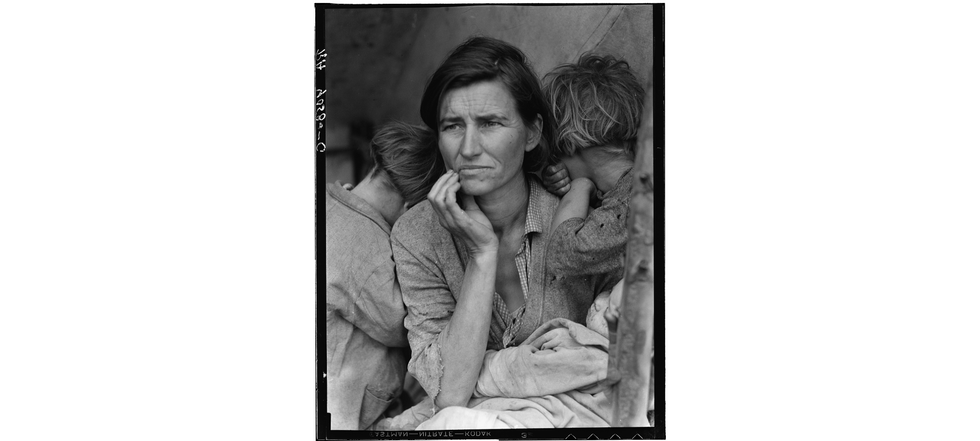
"Migrant worker" was a term that meant something quite different than it does today. It was primarily used in the 30s to describe poverty-stricken Americans who moved from town to town harvesting the crops for farmers.

The pay was abysmal and not enough to sustain a family, but harvesting was what Thompson knew as she was born and raised in "Indian Territory," (now Oklahoma) on a farm. Her father was Choctaw and her mother was white. After the death of her husband, Thompson supported her children the best way she knew how: working long hours in the field.

"I'd hit that cotton field before daylight and stay out there until it got so dark I couldn't see," Thompson told NBC in 1979 a few years before her death.

the great depression; Florence Thompson; Mona Lisa of the Great Depression; Mona Lisa; the depression; depression era A mother reflects with her children during the Great Depression. Photo by Dorthea Lange via Library of Congress
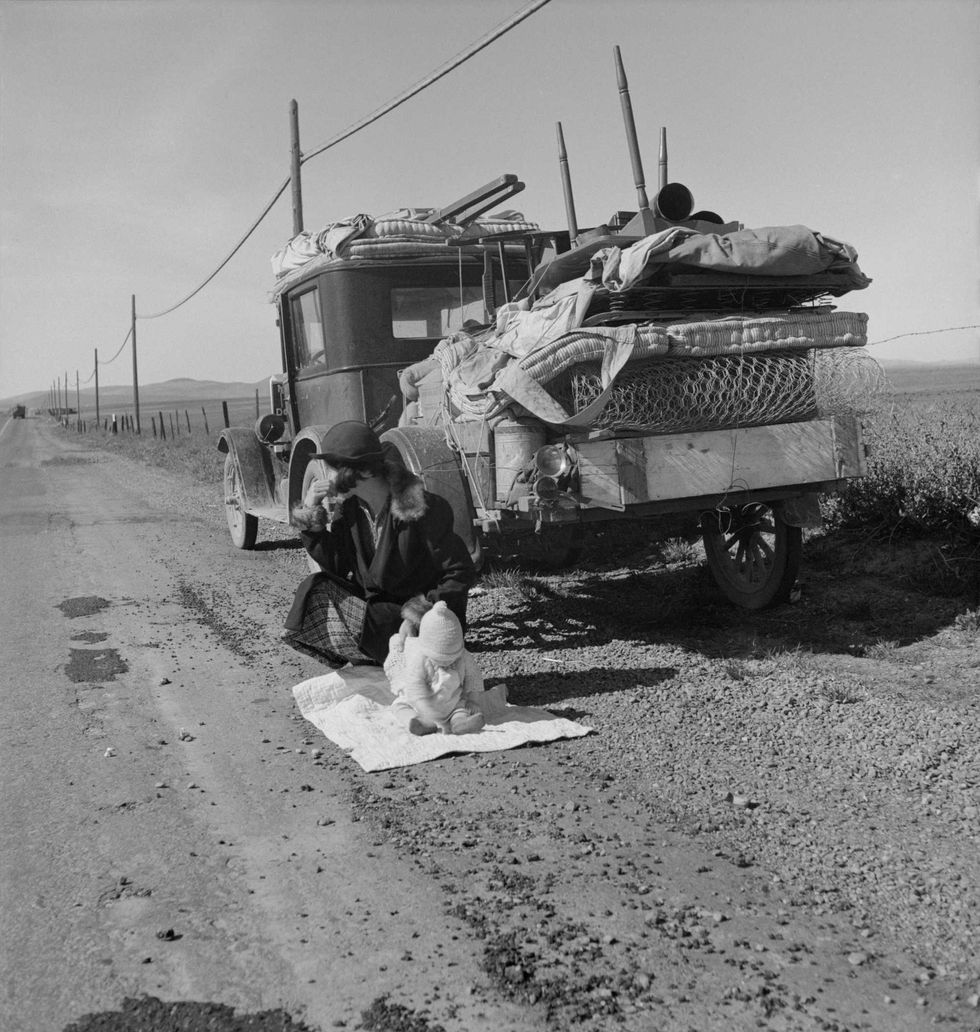
When talking about meeting Thompson, Lange wrote in her article titled "The Assignment I'll Never Forget: Migrant Mother," which appeared in Popular Photography, Feb. 1960, "I saw and approached the hungry and desperate mother, as if drawn by a magnet. I do not remember how I explained my presence or my camera to her, but I do remember she asked me no questions. I made five exposures, working closer and closer from the same direction. I did not ask her name or her history. She told me her age, that she was thirty-two. She said that they had been living on frozen vegetables from the surrounding fields, and birds that the children killed."

Lange goes on to surmise that Thompson cooperated because on some level she knew the photos would help, though from Thompson's account she had no idea the photos would make it to print. Without her knowledge, Thompson became known as "The Dustbowl Mona Lisa," which didn't translate into money in the poor family's pocket.

In fact, according to a history buff who goes by @baewatch86 on TikTok, Thompson didn't find out she was famous until 40 years later after a journalist tracked her down in 1978 to ask how she felt about being a famous face of the depression.

@baewatch86

Florence Thompson, American Motherhood. #fyppppppppppppppppppppppp #historytok #americanhistory #migrantmother #thegreatdepression #dorthealange #womenshistory

It turns out Thompson wished her photo had never been taken since she never received any funds for her likeness being used. Baewatch explains, "because Dorothea Lange's work was funded by the federal government this photo was considered public domain and therefore Mrs. Florence and her family are not entitled to the royalties."

While the photo didn't provide direct financial compensation for Thompson, the "virality" of it helped to feed migrant farm workers. "When these photos were published, it immediately caught people's attention. The federal government sent food and other resources to those migrant camps to help the people that were there that were starving, they needed resources and this is the catalyst. This photo was the catalyst to the government intercepting and providing aid to people," Baewatch shares.

- YouTube www.youtube.com

As for Lange, Migrant Mother was not her only influential photograph of the Great Depression. She captured many moving images of farmers who had been devastated by the Dust Bowl and were forced into a migrant lifestyle.

"Broke, baby sick, and car trouble!" is just one of her many incredible photos from the same year, 1937.

She also did tremendous work covering Japanese internment in the 1940s, and was eventually inducted into the International Photography Hall of Fame and Museum and the National Women's Hall of Fame.

the great depression; Florence Thompson; Mona Lisa of the Great Depression; Mona Lisa; the depression; depression era Families on the move suffered enormous hardships during The Great Depression.Photo by Dorthea Lange via Library of Congress
Thompson did find some semblance of financial comfort later in life when she married a man named George Thompson, who would be her third husband. In total, she had 10 children. When Thompson's health declined with age, people rallied around to help pay her medical bills citing the importance of the 1936 photo in their own lives. The "Migrant Mother" passed away in 1983, just over a week after her 80th birthday. She was buried in California.

"Florence Leona Thompson, Migrant Mother. A legend of the strength of American motherhood," her gravestone reads.

kids, boys, play, playing outside, sad, bored

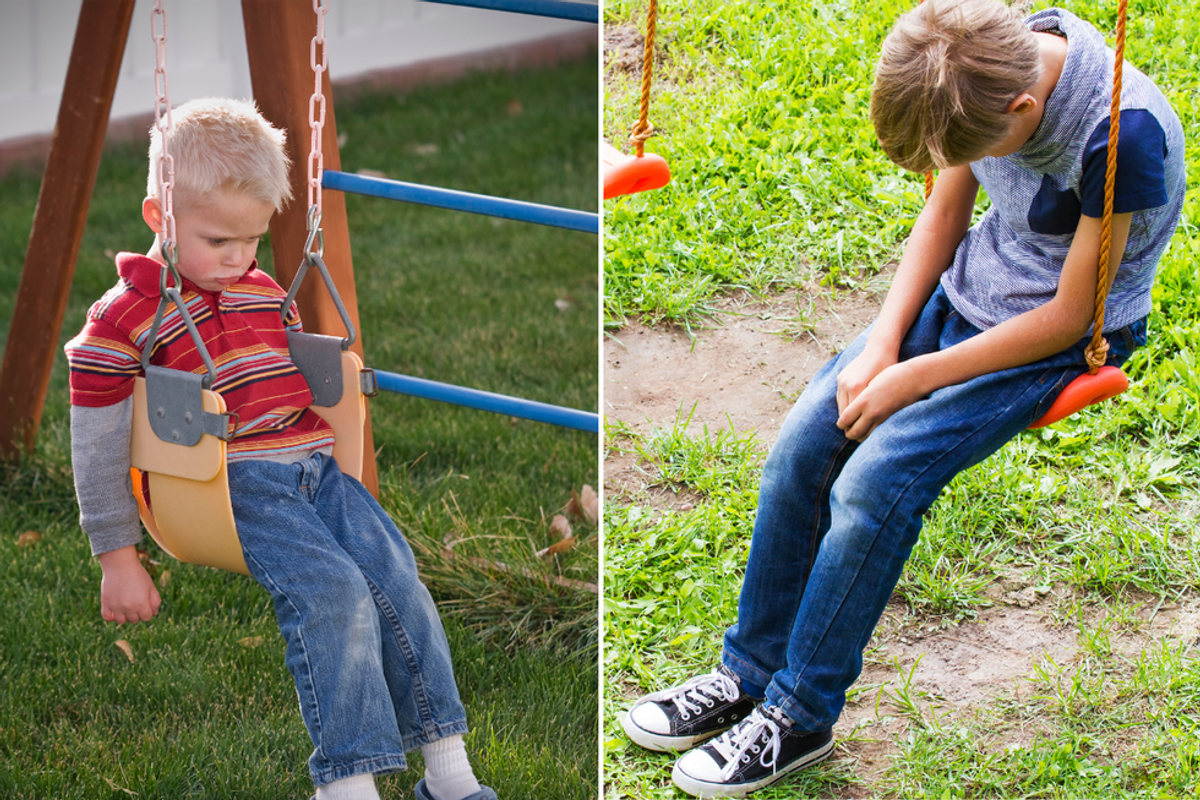
Two boys sitting on swings, with heads down, looking miserable.

It's become a common refrain: "These dang kids and their dang screens!"

"I'm loathe to admit that I've had this thought a lot lately myself. When it comes to planning our kids' summer break, a part of my brain assumes they'll just want to play outside with their friends most of the day making up games, riding bikes, and only coming inside to grab popsicles. The stuff I did at their age. But in reality, it hasn't worked out like that. Most kids in the neighborhood are at camp or they're inside watching TV or playing video games.


When I try to encourage my kids to go outside more, I get a lot of grumbling and push back. Is it possible this generation has just...forgotten how to play? Are the phones and tablets to blame for this strange phenomenon? One dad recently had the brilliant idea to take his kids to the park, take away their phones, and force them to go play. The results were...not exactly what he was hoping for.

play outside, kids, sad, bored, playtime, parenting Play Go GIF Giphy

"It was a nice day outside," Charles Lavea told Newsweek. "I thought we could go get food and eat at the park. I took my daughters' devices, phones and iPads, off them and left them at home. I wanted them to get some sun and fresh air, so we went."

In footage shared by Lavea on TikTok, you can see what happened next. His two girls are shown sitting on swings, forlornly swaying back and forth, not knowing what to do with themselves. You can tell they're just disassociating until dad's weird little experiment is over and that they would rather be anywhere else in the world. Specifically, they'd like to check in on what's going on on their phones. It's all over their faces and in their sad, hunched body language.

Watch the hilarious video here:

@lifewithlaveas

This generation man 🤣🤣🤦 I remember growing up all we did was play at the park with the kids in the neighbourhood 🤷 #lifewithlaveas #girldad #funnymoments #trendingsound #titanicflutefail #tiktokparent #viralvideos #fyp

Commenters had a field day, and most agreed: Kids "these days" don't know how to play outside.

"Bro when I was that age me and my sista be seeing who can swing the highest and jump off the swing on our feet"

"They would ratha watch other kids playing from there devices"

"Kids these days won't know the struggles we been through since the 80s - 90s kids been through with no phones, gaming pc, iPhone, Samsung, tablets, Facebook, tiktok, YouTube & Instagram wasn't invented. Even internet was hard to get when we use to have dial-up internet back then."

"Honestly the kids nowadays have no idea how to play outside eh? My kids too 😂🙈 I used to run out the door and never came back til the street lights turned on."

Bluey, kids, outside play, 80s, 90s, no screens Things were different when we were kids. assets.rebelmouse.io

The data backs it up. There's been a shocking decline in how often kids play outside in the last couple of decades. One study estimates only six percent of kids aged nine to thirteen regularly play outside unsupervised.

But is it as simple as saying that phones and tablets have rewired our kid's brains so the fun of playing outside can't keep up with the quick and easy dopamine hits found on screens? That's part of the problem, sure. But did you know that only around 20% of kids walk or bike to school, compared to 70% of parents who did so when they were young? That's not our kids' fault, and it's definitely not because they're in their room playing on their iPads. It's because our culture has stoked so much fear in parents that our kids will be kidnapped or hit by a car that we rarely let them out of our sight anymore.

Kids have less unstructured free time than they did in the past, too. Your average kid is enrolled in more sports, clubs, and extracurriculars than ever before. Those are generally good things on their own—these activities challenge them, teach them new skills, and help them make new friends. But it doesn't leave them a lot of time to flex their imagination and invent silly outside games with other kids, and that time is important too.

imagination, kids, playing, play outside, games imagination GIF Giphy

It's easy to grumble about how kids are obsessed with their devices—and, of course, genuinely laugh when dads like Lavea show that their kids barely know how to use a swing set—but change is going to have to start with us parents. The screens aren't going anywhere. Time spent playing outside is so good for a child's mind, body, and soul. We may just have to awkwardly force them into it a little more often, and that might mean pushing our own fears aside, or (the scariest thing of all) putting our own phones down to lead the way, too.

This article originally appeared last year. It has been updated.

period, punctuation, gen x, gen z, texting

Periods aren't aggressive. Full stop.

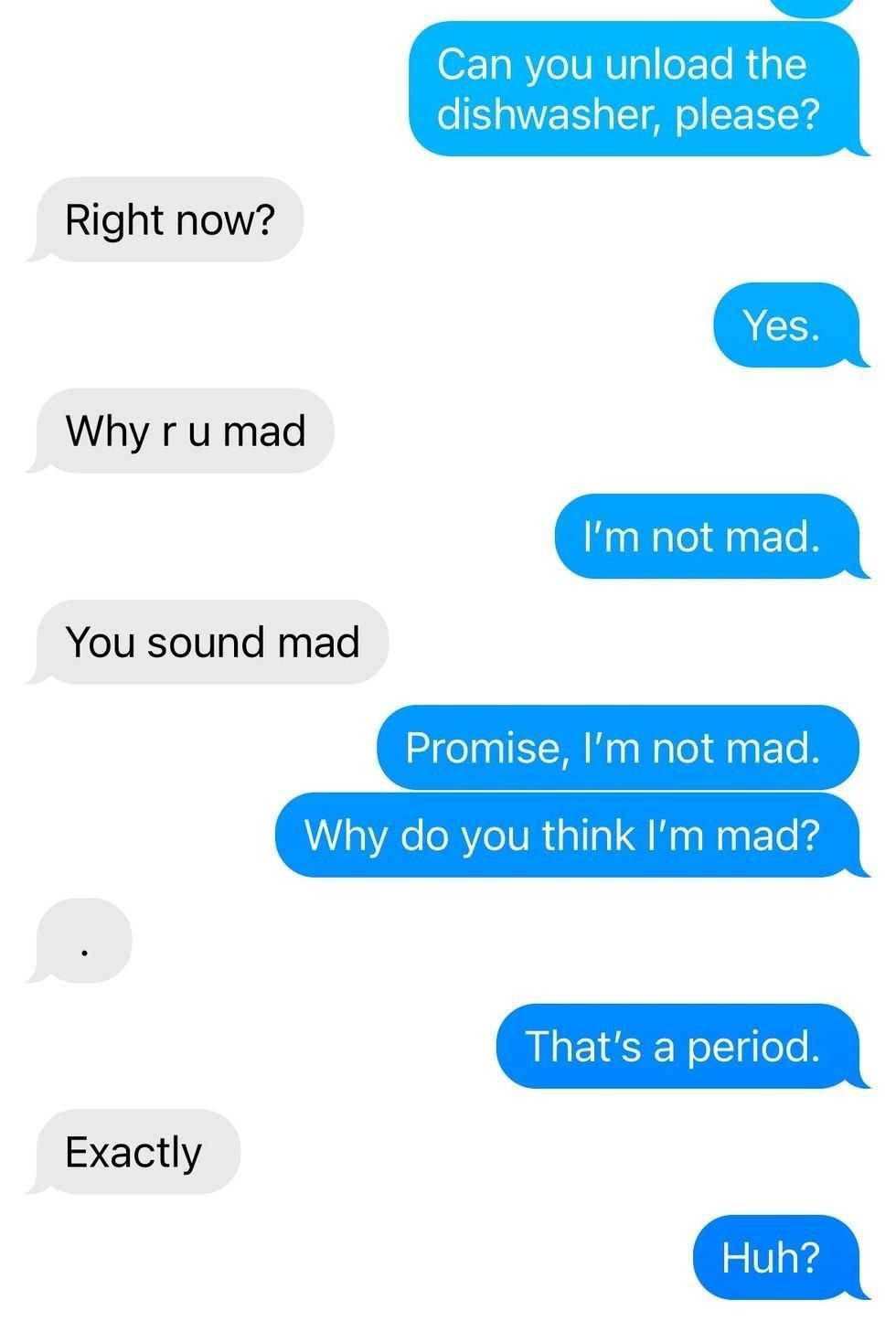
"Good morning." ... "Omg, why are you mad at me?"

Alright, let's make something clear here. As a Gen X mom of three Gen Z kids in their teens and 20s, there are many things I'm willing to concede and even celebrate when it comes to our generation gap. I love Gen Z's global consciousness, their openness about mental health, their focus on inclusivity, and their insistence on wearing comfortable shoes with formal wear. But there's one Gen Z feature that I simply cannot abide, and that is the ridiculous weaponization of basic punctuation.


"It freaks me out when you say 'yes period' in a text," my high schooler told me one day. "It feels so aggressive, like I feel like I'm in trouble or something." I stared at him incredulously as his 20-year-old sister laughed and then agreed with him. "It does! The period makes it feel like you're mad," she said.

Texting, periods, gen z, gen x, generation gap How can we see a period so differently?Photo credit: Annie Reneau
Ah yes, the period, literally the most benign punctuation mark of them all, is now "aggressive." I want to laugh, but I'm far too aware of the consequences of miscommunication. Far from being a mere generational quirk, this misinterpretation of normal punctuation in text messages as aggressive or angry could result in serious communication breakdowns. Talking by text is already hard enough, and now we're adding a layer of meaning that flies in the face of everything older folks have ever been taught about writing?

The kids are serious about this, though. According to Gen Zers, pretty much any time someone puts a period at the end of a text, it means they're mad or irritated, as if the period is being emphasized.

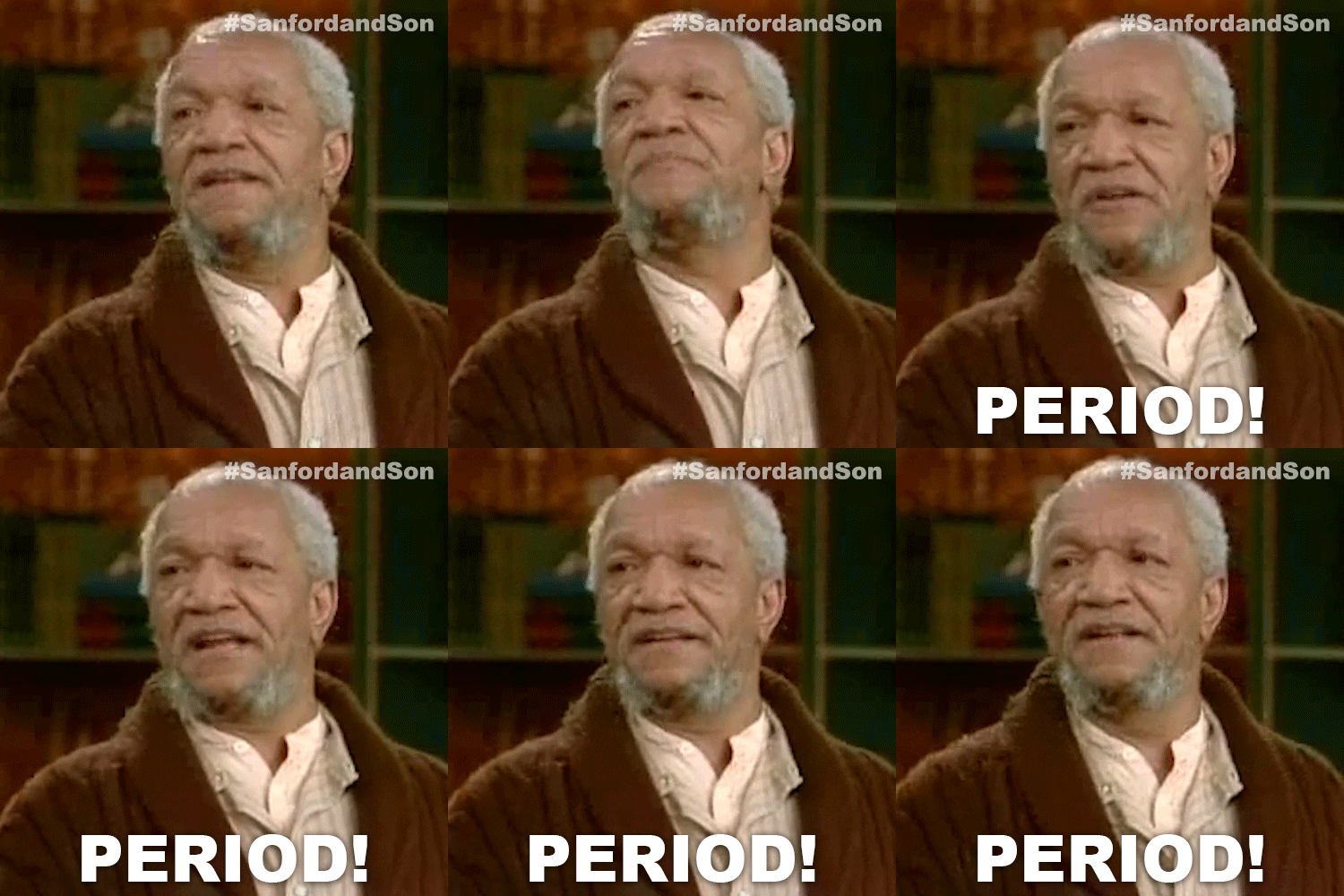
period, punctuation, texting, gen z, gen x "Period!" means period. An actual period means nothing.Giphy GIF by Sony Pictures Television
At the risk of sounding like a dinosaur, I'd like to point out that reading into periods in texts like this is silly. It's silly when the young folks do it with each other, but it's extra silly when they do it with adults who didn't grow up with texting and have ingrained grammatical habits that aren't easy to shake. (And frankly, some of us don't want to shake—I'm a former English teacher, for crying out loud. Might as well ask me to start misspelling words on purpose.)

In no reasonable world can "Yes." be automatically viewed as aggressive. It's just not. Neither is "Time to get off the computer." Neither is "Got it." Or "OK." or "Sure." I understand that texting conventions have evolved such that end punctuation isn't viewed as necessary, but when did we start assigning negative intentions to it? A period should not be read as anything more than a matter-of-fact, neutral-toned statement, since we have other tools for conveying tone in writing—capital letters, italics, bold, exclamation points. I mean, if I wanted to be aggressive, I'd text, "HEY—it's time to GET OFF the COMPUTER!" We also have a slew of emojis to convey tone. A period is and has always been neutral. That's literally the entire point of a period.

I'm even willing to give Gen Z an inch on the thumbs-up emoji (they think that's aggressive, too) only because emojis are new and their meanings are up for interpretation. But a period? Not budging. That little dot has been signaling the end of people's thoughts for centuries. Periods can and do sometimes affect tone in subtle ways—"No, I didn't," hits slightly differently than "No. I didn't."—but their basic inclusion at the end of a thought in no way signals aggression or anger, by text or otherwise. Not on Gen X's watch, at least. This is one generational hill I am willing to die on.

mic drop, period, texting, gen x, gen z Mic drop. Giphy Parks And Recreation Mic Drop GIF

These unwritten rules of texting seem to have been concocted by Gen Z, but when? And how? Who decides these things? Is there a group of powerful and influential young adults who put out a bat signal at some point, saying that periods are symbols of aggression? If the young folks want to play the reading-into-basic-punctuation game amongst themselves, unnecessarily making communication much more complicated for themselves, have at it. But please don't ascribe intent to us old fogies who've had "declarative statements end in periods" ingrained in us since elementary school.

Texting wasn't always like this. When texting first became a thing, using periods in them was pretty normal. As more and more people started dropping them (and capitalization—another deep English teacher wound), I held firm to their usage, mostly out of habit and feeling like my texts were incomplete without them. As my kids got old enough to text and informed me that periods are viewed by their age group as aggressive, I reconsidered. Should I stop using them, giving in to the tyranny of Gen Z's overthinking? Should I keep using them, embracing the fact that I'm old and set in my ways?

period, punctuation, gen x, gen z, texting A period is just a period. Period. Photo credit: Canva

Ultimately, I landed on sometimes using periods in texts and sometimes not—a compromise between my own rigid grammar rules and Gen Z's seemingly senseless texting rules. Except only using periods sometimes just confuses my kids even more, which is hilarious. Is Mom mad? Is she not? My daughter said she just has to remind herself who is texting, knowing that I—and most of my generation—simply don't use periods aggressively.

This is the way. I adore you, Gen Z, but you are perfectly capable of discerning who you're talking to, and I'm not giving up that useful little dot. Not now. Not ever. Period.

This article originally appeared in February. It has been updated.