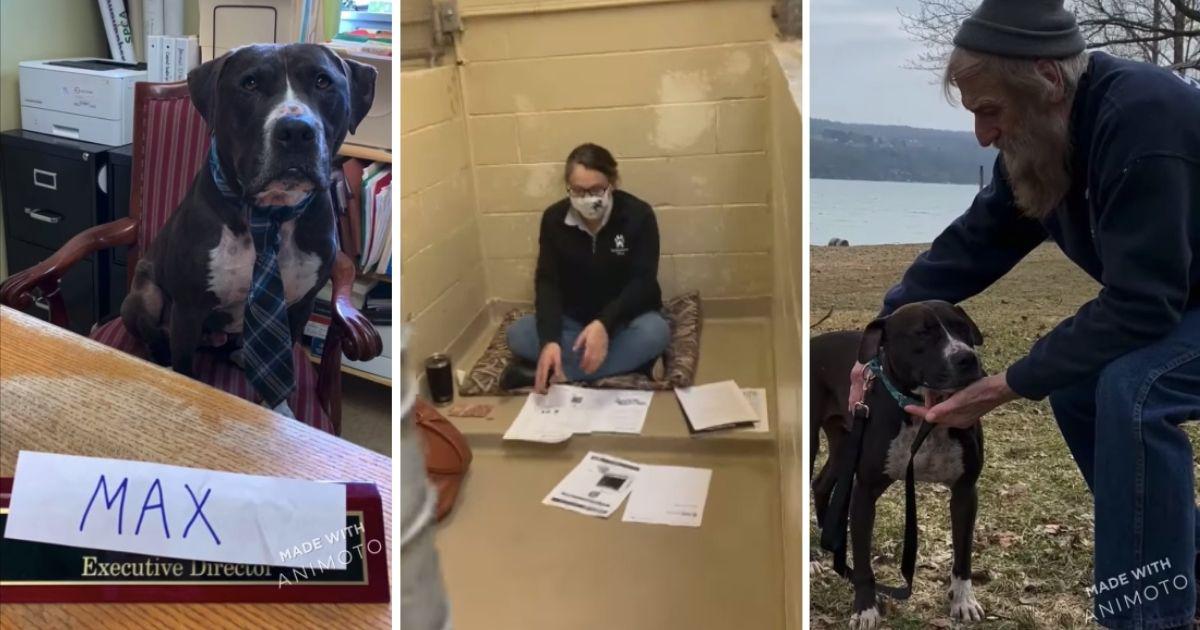
Rescue dog finally lands 'forever home' after swapping places with shelter director

When Max first arrived at the Susquehanna SPCA shelter, the workers didn't think he'd stay long. The 5-year-old pit bull terrier mix was sweet and friendly—which ironically led to a longer than normal stay. As of March 3, he had been at the shelter for 444 days.

"When he came here, we thought he would find his home easily because he is such a nice guy," executive director Stacie Haynes told Fox 5 News. "Turns out, he just kept getting looked over and he wasn't on our radar as an urgent dog to get out because he is just so sweet."

Max stepped into the limelight recently when Haynes swapped places with the dog for a day in an effort to raise awareness about the shelter and educate people about what life is like for a shelter dog. Max got to hang out in Haynes's office and even wore a tie for the day, while Haynes did her work on Max's bed in his kennel (with an occasional bathroom break, some enrichment activities, and people walking by to check her out, she said).

Haynes told WBGN that Max didn't really know life outside the shelter, having been there so long.


"He's a very good boy. He's very friendly, he comes up to the kennel wagging his tail," said Haynes. "He just wants to be your friend."

However, shelter life is generally hard on dogs, as they're constantly trying to protect their space from different people coming through. "You're constantly trying to make sure you're safe," said Haynes.

Dogs often become anxious when they're sheltered too long, always on alert and prone to panic. But Max's response was different. The longer he stayed, the more he became depressed and lethargic, sometimes staring at a wall.

Haynes said the 444 minutes she spent in the kennel gave her an extra dose of empathy for Max. Shelters provide a wonderful service, giving animals food and a place to live while trying to find them permanent arrangements, but they aren't meant to be long-term.

"Time feels like it's stood still. It has gone very, very slowly. I can understand why Max is staring at the wall. I found myself sitting here trying to count the links of the chain link," Haynes said of her time in the kennel.

The dog-director day swap got the attention of local news agencies, which led Ed Panus of Moravia, New York to come to the shelter to meet Max. Panus said he felt an instant connection with the doggo.

"I noticed he was almost like the dog I had that passed away here at the end of last year," Panus told WBNG News 12.

So after 450 days living at the Susquehanna SPCA and four months at a different shelter before that, Max has finally found his forever home with Panus.

The shelter had said that when Max was adopted, they would help provide a behavioral specialist to ease him through the transition from shelter life to home life. So far, so good it seems. Panus said Max immediately made himself at home, even jumping right into Panus's human bed.

Congratulations Ed and Max! Hope you both enjoy your new life together.

Images courtesy of John Scully, Walden University, Ingrid Scully
True

Since March of 2020, over 29 million Americans have been diagnosed with COVID-19, according to the CDC. Over 540,000 have died in the United States as this unprecedented pandemic has swept the globe. And yet, by the end of 2020, it looked like science was winning: vaccines had been developed.

In celebration of the power of science we spoke to three people: an individual, a medical provider, and a vaccine scientist about how vaccines have impacted them throughout their lives. Here are their answers:

John Scully, 79, resident of Florida

Photo courtesy of John Scully

When John Scully was born, America was in the midst of an epidemic: tens of thousands of children in the United States were falling ill with paralytic poliomyelitis — otherwise known as polio, a disease that attacks the central nervous system and often leaves its victims partially or fully paralyzed.

"As kids, we were all afraid of getting polio," he says, "because if you got polio, you could end up in the dreaded iron lung and we were all terrified of those." Iron lungs were respirators that enclosed most of a person's body; people with severe cases often would end up in these respirators as they fought for their lives.

John remembers going to see matinee showings of cowboy movies on Saturdays and, before the movie, shorts would run. "Usually they showed the news," he says, "but I just remember seeing this one clip warning us about polio and it just showed all these kids in iron lungs." If kids survived the iron lung, they'd often come back to school on crutches, in leg braces, or in wheelchairs.

"We all tried to be really careful in the summer — or, as we called it back then, 'polio season,''" John says. This was because every year around Memorial Day, major outbreaks would begin to emerge and they'd spike sometime around August. People weren't really sure how the disease spread at the time, but many believed it traveled through the water. There was no cure — and every child was susceptible to getting sick with it.

"We couldn't swim in hot weather," he remembers, "and the municipal outdoor pool would close down in August."

Then, in 1954 clinical trials began for Dr. Jonas Salk's vaccine against polio and within a year, his vaccine was announced safe. "I got that vaccine at school," John says. Within two years, U.S. polio cases had dropped 85-95 percent — even before a second vaccine was developed by Dr. Albert Sabin in the 1960s. "I remember how much better things got after the vaccines came out. They changed everything," John says.

Keep Reading Show less

Every year, around 100 million carats of rough diamonds are mined to supply the world's multi-billion dollar diamond jewelry industry, leaving both human and environmental damage behind.

The ethical issues at the heart of diamond mining, from violence to human rights abuses to forced labor, are no secret. The destruction of land and water in the mining process is also well known. Though an official chain of practices for creating "conflict-free" diamonds known as the Kimberley Process is supposed to reduce some of these issues, ongoing problems remain.

Science has a solution.

Instead of digging up gemstones that have taken a billion or more years to form in the earth, scientists can now make diamonds in a lab in just six to ten weeks—without the bloodshed and devastation involved in mining traditional diamonds.

Are they the same, though? If anyone were going to be a purist about gems, you'd think the world's largest jewelry brand would. But Pandora, the Danish jeweler that boasts that title, is all in on lab-grown bling.

Keep Reading Show less
Courtesy of CeraVe
True

"I love being a nurse because I have the honor of connecting with my patients during some of their best and some of their worst days and making a difference in their lives is among the most rewarding things that I can do in my own life" - Tenesia Richards, RN

From ushering new life into the world to holding the hand of a patient as they take their last breath, nurses are everyday heroes that deserve our respect and appreciation.

To give back to this community that is always giving so selflessly to others, CeraVe® put out a call to nurses to share their stories for a chance to be featured in Heroes Behind the Masks, a digital content series shining a light on nurses who go above and beyond to provide safe and quality care to patients and their communities.

First up: Tenesia Richards, a labor and delivery nurse working in New York City who, in addition to her regular job, started a community outreach program in a homeless shelter that houses expectant mothers for up to one year postpartum.

Tenesia | Heroes Behind the Masks presented by CeraVe www.youtube.com

Upon learning at a conference that black mothers in the U.S. die at three to four times the rate of white mothers, one of the widest of all racial disparities in women's health, Richards decided to take further action to help her community. She, along with a handful of fellow nurses, volunteered to provide antepartum, childbirth and postpartum education to the women living at the shelter. Additionally, they looked for other ways to boost the spirits of the residents, like throwing baby showers and bringing in guest speakers. When COVID-19 hit and in-person gatherings were no longer possible, Richards and her team found creative workarounds and created holiday care packages for the mothers instead.

Keep Reading Show less