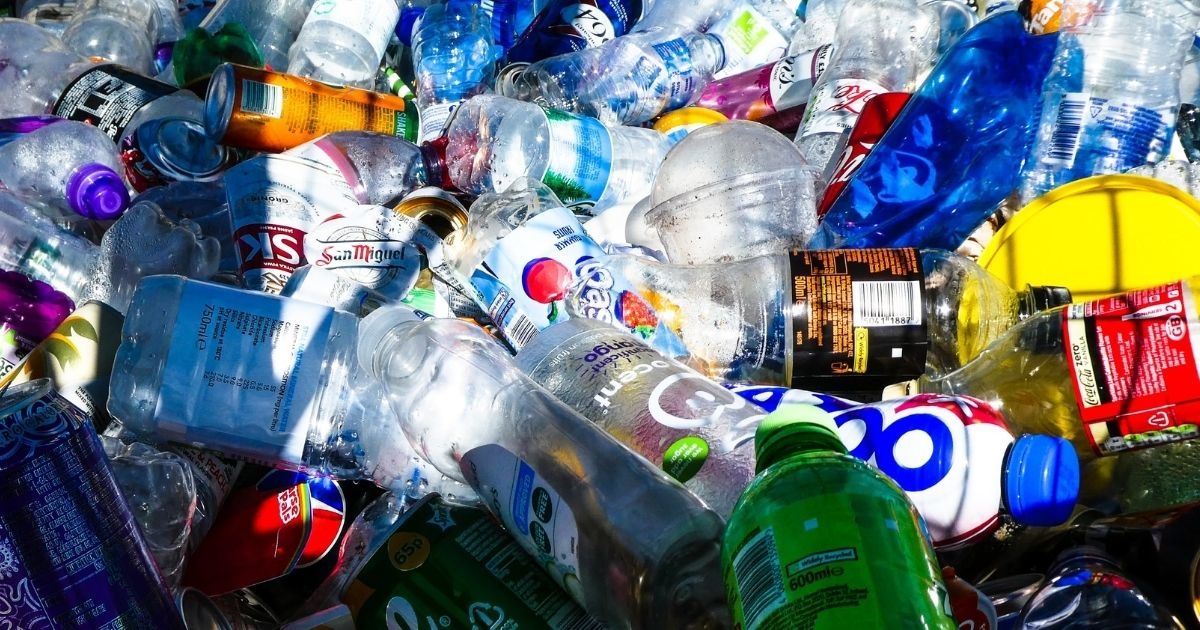
Last year, we shared the sad impact that plastic pollution has had on some of our planet's most beautiful places. With recycling not turning out to be the savior it was made out to be, solutions to our growing plastic problem can seem distant and complex.
We have seen some glimmers of hope from both human innovation and nature itself, however. In 2016, a bacteria that evolved with the ability to break down plastic was discovered in a Japanese waste site. Two years later, scientists managed to engineer the mutant plastic-eating enzyme they called PETase—named for polyethylene terephthalate, the most common plastic found in bottles and food packaging—in a lab.
Here's an explainer of how those enzymes work:
Ending Plastic Pollution with Designer Bacteriayoutu.be
Now researchers have revealed another game-changer in the plastic-eater—a super-enzyme that can break down plastic six times faster than PETase alone.
The super-enzyme is a bit of a frankenzyme, created by linking different enzymes together. "When we linked the enzymes, rather unexpectedly, we got a dramatic increase in activity," Prof John McGeehan, at the University of Portsmouth, UK, told The Guardian. "This is a trajectory towards trying to make faster enzymes that are more industrially relevant. But it's also one of those stories about learning from nature, and then bringing it into the lab."
This new research has been published in the journal Proceedings of the National Academy of Sciences.
Combining enzymes could be the key to making various kinds of plastics and combined materials fully recyclable. "There's huge potential," said McGeehan. "We've got several hundred in the lab that we're currently sticking together."
For example, combining the plastic-eating enzymes with existing enzymes that break down natural fibers could allow fabrics made of mixed materials to be recycled, McGeehan told The Guardian. "Mixed fabrics [of polyester and cotton] are really tricky to recycle. We've been speaking to some of the big fashion companies that produce these textiles, because they're really struggling at the moment."
This newest research isn't the first to improve upon the plastic-eating bacteria discovery. In April, a French chemistry company called Carbios shared their own mutant enzyme that can degrade 90% of plastic bottles within 10 hours. However, that enzyme, which originally discovered in a pile of composting leaves, requires heating above 70 degrees Celsius (nearly 160 degrees Fahrenheit), whereas this new super-enzyme works at room temperature.
Not that it's a cutthroat competition. We are talking about helping out the entire planet and saving life as we know it, after all. McGeehan suggested that the researchers work together with the private sector to get the enzymes working out in the real world. "If we can make better, faster enzymes by linking them together and provide them to companies like Carbios, and work in partnership, we could start doing this within the next year or two," McGeehan told The Guardian.
McGeehan did emphasize to CNN that the super-enzyme is "still way too slow" to be commercially viable at this point, but it is a huge step in the process. "We were actually quite surprised it worked so well," he told CNN.
Here's to science coming up with solutions to the problems human scientific advances have created, and here's to learning to live in better balance with nature in the process.

- An accident resulted in a plastic-eating mutant that just might save ... ›
- We haven't just paved paradise—we've plastered it in plastic ... ›
- It may sound weird, but Lego is quietly trying to ditch plastics ... ›
- eXXpedition sailing crews set out to tackle ocean plastic. Here's how we can all get on board. - Upworthy ›
- Four years ago an accident resulted in a plastic-eating mutant that just might save us all - Upworthy ›


Student smiling in a classroom, working on a laptop.
Students focused and ready to learn in the classroom.
Fish find shelter for spawning in the nooks and crannies of wood.
Many of these streams are now unreachable by road, which is why helicopters are used.
Tribal leaders gathered by the Little Naches River for a ceremony and prayer.

Communications expert shares the perfect way to gracefully shut down rude comments
Taking the high ground never felt so good.
A woman is insulted at her job.
It came out of nowhere. A coworker made a rude comment that caught you off guard. The hair on the back of your neck stands up, and you want to put them in their place, but you have to stay tactful because you're in a professional setting. Plus, you don't want to stoop to their level.
In situations like these, it helps to have a comeback ready so you can stand up for yourself while making making sure they don't disrespect you again.
Vince Xu, who goes by Lawyer Vince on TikTok, is a personal injury attorney based in Torrance, California, where he shares the communication tips he's learned with his followers. Xu says there are three questions you can ask someone who is being rude that will put them in their place and give you the high ground:
Question 1: "Sorry, can you say that again?"
"This will either make them have to awkwardly say the disrespectful remark one more time, or it'll actually help them clarify what they said and retract their statement," Xu shares.
Question 2: "Did you mean that to be hurtful?"
The next step is to determine if they will repeat the disrespectful comment. "This calls out their disrespect and allows you to learn whether they're trying to be disrespectful or if there's a misunderstanding," Xu continues.
Question 3: "Are you okay?"
"What this does, is actually put you on higher ground, and it's showing empathy for the other person," Xu adds. "It's showing that you care about them genuinely, and this is gonna diffuse any type of disrespect or negative energy coming from them."
The interesting thing about Xu's three-step strategy is that by gracefully handling the situation, it puts you in a better position than before the insult. The rude coworker is likely to feel diminished after owning up to what they said, and you get to show them confidence and strength, as well as empathy. This will go a lot further than insulting them back and making the situation even worse.
Xu's technique is similar to that of Amy Gallo, a Harvard University communications expert. She says that you should call out what they just said, but make sure it comes out of their mouth. "You might even ask the person to simply repeat what they said, which may prompt them to think through what they meant and how their words might sound to others," she writes in the Harvard Business Review.
More of Gallo's suggested comebacks:
“Did I hear you correctly? I think you said…”
“What was your intention when you said…?”
“What specifically did you mean by that? I'm not sure I understood.”
“Could you say more about what you mean by that?”
Ultimately, Xu and Gallo's advice is invaluable because it allows you to overcome a negative comment without stooping to the other person's level. Instead, it elevates you above them without having to resort to name-calling or admitting they got on your nerves. That's the mark of someone confident and composed, even when others are trying to take them down.