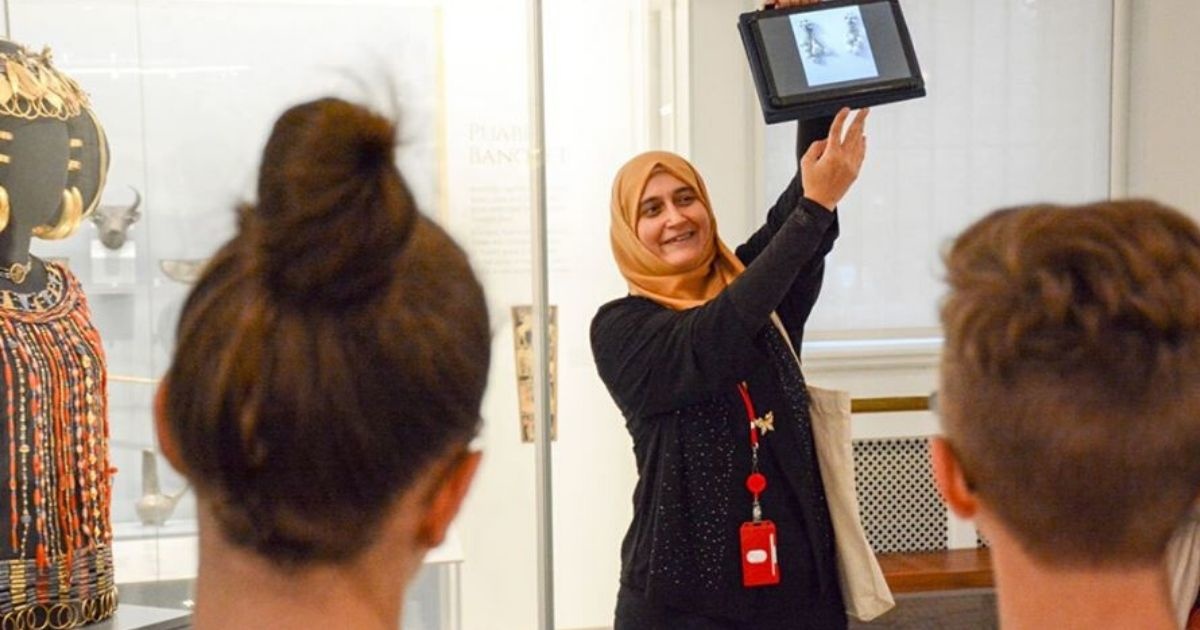
In a brilliant move, Penn Museum hires refugees as guides to exhibits from their homelands
Imagine walking through a museum exhibit from the Middle East with a personal guide from that region explaining the artifacts. Imagine having the same experience as you move through galleries from different parts of the world, each time with a docent from that region who lends a personal touch by sharing first-hand perspectives. That’s the…
Imagine walking through a museum exhibit from the Middle East with a personal guide from that region explaining the artifacts. Imagine having the same experience as you move through galleries from different parts of the world, each time with a docent from that region who lends a personal touch by sharing first-hand perspectives.
That’s the basis of Penn Museum’s Global Guides program, which hires docents (the people who explain exhibits and show people around the galleries) from the regions being showcased. It’s a brilliantly simple concept—a museum staff that is culturally representative of the artifacts it houses—but one that has not often been implemented. That may be one reason the program has taken off with great success.
Another reason may be because the docents the museum has hired come from the refugee and immigrant community—a win-win situation for both the people serving and the people being served.
According to NPR, Ellen Owens, director of learning and public engagement at Philadelphia’s Penn Museum, noted that most of the museum’s docents were aging. They were also mostly white. Owens thought that creating a more diverse group of docent might help the museum connect with more communities.
The museum is known for its collections from the Middle East, Africa, and Central America—regions that make up a large part of the global refugee community. So Owen and her colleague, Kevin Schott, decided to reach out to non-profit organizations serving refugees and immigrants to recruit new docents.
The Global Guides are trained in archaeology and ancient history and are able to share some of their personal stories with the people they guide through the exhibits. That personal touch makes all the difference.
“We really wanted to have the narratives of lots of different people, to bring the authentic voices of people that live in other places into the galleries of the museum,” Owens told NPR.
For example, Clay Katongo fled the Democratic Republic of the Congo 33 years ago and now serves as a pastor in a West Philadelphia evangelical church. As a new Global Guide, he enjoys sharing African religious artifacts predating Christianity with museum-goers.
“I love this place,” Katongo told NPR. “This is my culture. This is my story.”
The Global Guides is truly a mutually beneficial program. “One of the big goals of this project was actually to provide jobs for people that are immigrants and refugees,” Owens told NPR. Guides work part-time and are paid about $20 an hour. The Barra Foundation grant that funds them also helps them navigate employment details, such as filling out tax forms and going through HR procedures.
The museum, in turn, not only gets first-hand accounts from the areas of the world it’s showcasing, but the new docents have also proved invaluable in helping to translate documents and helping with on-the-ground research.
Attendance at the museum has skyrocketed since the Global Guides program was implemented, with a third of visitors coming specifically because of it. Other museums around the world have begun implementing similar programs as well.
Well done, Penn Museum. Thank you for leading the way.
A single door can open up a world of endless possibilities. For homeowners, the front door of their house is a gateway to financial stability, job security, and better health. Yet for many, that door remains closed. Due to the rising costs of housing, 1 in 3 people around the world wake up without the security of safe, affordable housing.
Since 1976, Habitat for Humanity has made it their mission to unlock and open the door to opportunity for families everywhere, and their efforts have paid off in a big way. Through their work over the past 50 years, more than 65 million people have gained access to new or improved housing, and the movement continues to gain momentum. Since 2011 alone, Habitat for Humanity has expanded access to affordable housing by a hundredfold.
A world where everyone has access to a decent home is becoming a reality, but there’s still much to do. As they celebrate 50 years of building, Habitat for Humanity is inviting people of all backgrounds and talents to be part of what comes next through Let’s Open the Door, a global campaign that builds on this momentum and encourages people everywhere to help expand access to safe, affordable housing for those who need it most. Here’s how the foundation to a better world starts with housing, and how everyone can pitch in to make it happen.
Volunteers raise a wall for the framework of a new home during the first day of building at Habitat for Humanity’s 2025 Carter Work Project.
Globally, almost 3 billion people, including 1 in 6 U.S. families, struggle with high costs and other challenges related to housing. A crisis in itself, this also creates larger problems that affect families and communities in unexpected ways. People who lack affordable, stable housing are also more likely to experience financial hardship in other areas of their lives, since a larger share of their income often goes toward rent, utilities, and frequent moves. They are also more likely to experience health problems due to chronic stress or environmental factors, such as mold. Housing insecurity also goes hand-in-hand with unstable employment, since people may need to move further from their jobs or switch jobs altogether to offset the cost of housing.
Affordable homeownership creates a stable foundation for families to thrive, reducing stress and increasing the likelihood for good health and stable employment. Habitat for Humanity builds and repairs homes with individual families, but it also strengthens entire communities as well. The MicroBuild® Initiative, for example, strengthens communities by increasing access to loans for low-income families seeking to build or repair their homes. Habitat ReStore locations provide affordable appliances and building materials to local communities, in addition to creating job and volunteer opportunities that support neighborhood growth.
Marsha and her son pose for a photo while building their future home with Southern Crescent Habitat for Humanity in Georgia.
Everyone can play a part in the fight for housing equity and the pursuit of a better world. Over the past 50 years, Habitat for Humanity has become a leader in global housing thanks to an engaged network of volunteers—but you don’t need to be skilled with a hammer to make a meaningful impact. Building an equitable future means calling on a wide range of people and talents.
Here’s how you can get involved in the global housing movement:
Speaking up on social media about the growing housing crisis
Volunteering on a Habitat for Humanity build in your local community
Travel and build with Habitat in the U.S. or in one of 60+ countries where we work around the globe
Join the Let’s Open the Door movement and, when you donate, you can create your own personalized door
Every action, big and small, drives a global movement toward a better future. A safe home unlocks opportunity for families and communities alike, but it’s volunteers and other supporters, working together with a shared vision, who can open the door for everyone.
I’m not a psychologist or a sociologist; I’m just a human joining my fellow humans in the cryfest. But that human identity sits at the heart of the why question, so here are nine reasons I’ve observed that people are getting emotional over Artemis II.
“A Setting Earth” taken on the Artemis II mission. (Photo credit: NASA)
We desperately need something good and wholesome right now
Let’s just acknowledge this one upfront. In too many ways, the world has felt like a horror circus in recent years, and many people have lost a bit of faith in humanity. We need some solid reminders that we’re actually okay, and Artemis II is full of them.
Apollo and Artemis unite our past with our future
The name Artemis holds poetic significance. In Ancient Greek mythology, Artemis was Apollo’s twin sister as well as the goddess of the moon, the hunt, wild places, and childbirth. The original lunar missions being named Apollo and the modern missions being named Artemis is a beautiful hat-tip to that ancient history, as well as a nod to this mission carrying the first woman to circle the moon.
The Artemis II mission feels like a bridge between our past and our future.
“The pairing of Apollo and Artemis is more than poetic,” writes Samantha Mathewson for Space.com. “In mythology, the twins balance day and night, or sun and moon. In spaceflight, Apollo represents what humanity has already accomplished, while Artemis represents what comes next.”
It reminds us of how far we’ve come, both literally and figuratively
Like others before them, the astronauts of Artemis II took some legacy keepsake items into space. Among them is a one-inch square piece of fabric from the Wright Flyer, the plane the Wright brothers used in their first successful flight in 1903.
The significance of that tiny piece of fabric can’t be overstated. To fly through the air above Earth’s surface was a major milestone in human history. Did the Wright brothers imagine us going this far from Earth when they had just figured out how to get us off the ground?
Innovation and progress require imagination, so they probably did imagine it. Just as the women who worked on the Apollo lunar program probably imagined women becoming astronauts one day.
Christina Koch becoming the first woman to fly around the Moon isn’t the only sign of progress for women in the Artemis mission, though. Women played critical roles in the Apollo program as well, but they were smaller in number and not really visible to the public. Now we have this:
Earth may feel big to us, but in the context of the universe, our planet is infinitesimally tiny. And yet, we are here, eight billion individuals making our home on this little blue marble.
Pilot Victor Glover delivered an impromptu message on Easter that reminds us of the unique reality of being human on planet Earth:
“You guys are talking to us because we’re in a spaceship really far from Earth. But you’re on a spaceship called Earth that was created to give us a place to live in the universe, in the cosmos.
Maybe the distance we are from you makes you think what we’re doing is special. But we’re the same distance from you, and I’m trying to tell you—just trust me—you are special. In all of this emptiness—this is a whole bunch of nothing, this thing we call the universe—you have this oasis, this beautiful place that we get to exist together.“
Shifts the perspective a bit, doesn’t it?
The naming of the Moon crater ‘Carroll’ hit us right in the heart
Crater Carroll. A bright spot on the Moon that her kids can look up to and see Mom. What an incredible tribute.
Historic space missions are big deals. These astronauts represent all of humanity as we collectively breach new frontiers. And yet, it’s the personal relationships, our individual loved ones, the bonds of family and friendship that make us what and who we are as humans. This moment just beautifully highlighted the human in humanity, forever linking the personal with the universal.
It’s healing something in Gen X kids who watched the Challenger disaster live
There have been many space shuttle launches since 1986, but few have seen the widespread excitement and attention that Artemis II has received leading up to it. Perhaps that’s why so many Gen Xers who remember watching the Challenger explode as children were nervous to watch the launch and held our breath until the astronauts were safely out of the atmosphere.
OMG, you get it. I was watching with my son and almost started crying when the two boosters separated cleanly. I had tears well up. I told him I have serious PTSD when it comes to red rockets with boosters. 🙁
It may sound like an overstatement to call it PTSD, but watching a school teacher and astronauts we’d all been following on TV for months blow up on a live broadcast had an impact on our psyches. The shock and horror of it all, with none of the adults prepared to handle it, left a mark.
I was a news photographer in Lake Charles, La., on my day off, watching it on TV. I spent the rest of the day chasing debris and stories throughout East Texas.
I didn't breathe until after the first separation.
Until now, I didn't realize how deeply that scarred me.
But awe is often quiet and introspective. The photos we’ve seen from the astronauts on board the Orion have provided a view that we rarely get to see. Only when courageous humans launch themselves into space and look out a window do we get to see our world and our Moon this way.
Taking a few moments to sit in awe of space and our place in it can be an emotional experience. Awe-inspired existential tears are good tears.
It reminds us of what we’re capable of
Humanity has always had its ups and downs, and they often happen at the same time. But science advancements, when done for the greater good and collective progress, are some of our biggest ups. This mission is a reminder of what we can do when we work together on innovating and creating instead of conquering and destroying.
It reminds us we are one
“This is an opportunity to remember where we are, who we are, and that we are the same thing,” Victor Glover said in his Easter message. “And that we got to get through this together.”
We really are the same thing. Looking at Earth from space, there are no neatly drawn lines. There are no borders, no nations, nothing actually dividing us but rivers, oceans, and mountains.
Of course, we are complex people with diverse cultures, languages, and identities. But seeing Earth from afar makes these differences seem far less significant. Certainly, they don’t seem worth killing one another over.
Do you ever wonder how future history books will treat this time period we’re living in? What will they teach and what will they leave out? How will they analyze us? How will we be remembered?
Will they know how we collectively wept over the naming of a Moon crater? Or will that detail—the one that defines us more than any war or conflict ever could—be omitted?
I hope the beauty and humanity we’ve witnessed in this mission are remembered in the story of who we were, because it really is the best of who we are.
Odds are you’ve heard Wally de Backer, aka Gotye, and his song “Somebody That I Used to Know.” It’s the Australian musician’s biggest commercial hit, selling more than 20 million copies since its release in 2011, making it one of the best-selling digital singles of all time. Not to mention it inspired several amazing covers, which you might have also stumbled upon.
The music video, in its poignant simplicity, is every bit as iconic. Gotye stands naked facing the camera, as featured singer Kimbra faces him. As they sing, they are slowly “painted” into and out of the background of geometric shapes using stop motion animation. There’s a very Wes Anderson feel to it that adds so much to the story told in the song, making it all the more memorable.
This dance troupe was up to the task
All this to say…it would be a challenge to recreate the magic that’s so inherent in the original. And yet, Netherland-based dance troupe CDK clearly understood the assignment with their highly stylized movement performance set to the well-known art pop ballad.
As thousands of viewers were quick to note, it’s not just the incredible dance moves that made this performance so captivating. It’s the killer combination of choreography, camerawork and costumes that make the piece impossible to turn away from.
“This is pure art,” one person wrote. While another added, “I think I’m going to watch it everyday for the rest of my life.”
Watch CDK’s Stunning Performance Here
This group is clearly at the top of their game, simply by how easy they make it all look (like, I’ve already convinced myself that I can pull off those moves). But what’s more evident is that they enjoy what they’re doing to the nth degree. Over on their Instagram page, you’ll find equally mesmerizing routines set to Billie Eilish, Nicki Minaj, and more.
1: Gotye allows small independent projects, like student films—and probably this dance piece—to use his music free of charge. “If someone wants to use it commercially I look at what the budget is and the creativity of the project,” he said, according to News.com.
2: CDK isn’t the only group to have recently breathed new life into the song. Also in 2024, an electronic remix of the song titled “Somebody (2024),” created by electronic music producers Chris Lake, Fisher, and Sante Sansone, debuted. Much like its predecessor, “Somebody (2024) topped the charts.
This article originally appeared two years ago. It has been updated.
During an episode from the latest season of Love on the Spectrum, Netflix’s heartwarming, critically acclaimed reality series that follows autistic individuals navigating the complexities of relationships, two fan favorites—Madison Marilla and her now fiancée, Tyler White—shared a moment that many couples face regardless of neurodivergence: emotional triggers.
As the two approached their date location, a fan can be heard saying, “Maddie! I love you!” This visibly affected Marilla, who explained that her autism causes “black and white thinking.” So hearing a nickname, like “Maddie,” causes her to feel “anxious and thrown off.” In fact, she noted it’s one of her “biggest sensitivities.”
In an Instagram post, marriage counselors Chris & Jamie Bailey break down how the couple’s handling of the situation was a prime example for anyone who witnesses their significant other getting triggered.
Chris and Jamie noted that in the clip, White stayed calm, moved towards Madison, validated her feelings without judgment, stayed present in the situation, listened to understand, and then, after Madison was able to express herself, he reassured her that they are a team and that he is there for her.
And for her part, Madison “chose to process what was happening instead of reacting.” She also reminded herself that “it was going to be ok” and “moved forward” rather than ruminate.
All relationships deal with triggers
While relationships involving autism or other forms of neurodiversity have their own unique set of challenges, Chris and Jamie noted that every couple will at some point face triggers. When that happens, each partner has a “responsibility.” The triggered person is responsible for their emotional regulation, while the non-triggered person is responsible for offering support. Both Tyler and Madison exemplified what can go right when each partner takes on their individual responsibility—especially staying present.
“What couples often miss is the simplicity of just remaining with your spouse during a trigger, “ Chris and Jamie added.
Judging by the comments, the Baileys were clearly not the only ones who felt Madison and Tyler offered a “masterclass in emotional regulation and communication.”
“This was incredibly impressive. The way she worked through a trigger, the way he supported her and validated it. Well done everyone. We could all learn from this. ❤️”
“Responding before reacting is something every single person I’ve ever met has struggled with. I love how hard she’s working to stay aware of her mind, heart and body and how best to keep them regulated in these really difficult situations.
“This was such an incredible thing to witness. I’m so grateful for Madison’s ability to be vulnerable through this and to allow the world the opportunity to learn from her 😭 I needed this today!
“These two humans are pure good. They totally get each other and provide such a safe space.”
“I love that Tyler didn’t even try to hug her or touch her and he let Madison’s nervous system calm down first. Full respect!!”
Expert-backed methods for dealing with emotional triggers in a relationship
For your own triggers, awareness is the first step. Many people notice physical cues before anything else. It might be a racing heart, a tight chest, or a sudden urge to withdraw or lash out. Naming what is happening, even silently, can help create space between the feeling and the reaction. Simple grounding techniques, like slowing your breathing, focusing on your senses, or giving yourself permission to pause, can make a meaningful difference. Just as Madison demonstrated, reminding yourself that the moment will pass can help shift your nervous system out of alarm mode.
When it comes to supporting a partner who is triggered, the goal isn’t to fix the feeling, but to help create safety. That often looks like staying calm, listening without interrupting, and validating what they are experiencing, even if you do not fully understand it. Avoid rushing them, minimizing their reaction, or immediately offering solutions. Instead, gentle reassurance and presence can go much further than advice.
Of course, this kind of mutual support works best when both people are willing to take ownership of their emotional patterns over time. Conversations outside of triggered moments can help partners learn each other’s sensitivities, boundaries, and preferred ways of being supported.
As Madison and Tyler remind us, when both people are willing to meet each other with awareness and care, even the most uncomfortable moments can become opportunities for deeper connection.
It seems like at least once a year, the debate over BMI (body mass index) resurfaces. Experts are quick to point out that it’s a flawed system: at best, it ignores key factors that shape a person’s body composition; at worst, it creates real health consequences, influencing eligibility for weight loss medications, insurance rates, joint-replacement surgery and fertility treatment. Then the conversation fades, life moves on and not much changes.
And yet, despite the constant debunking, the belief in BMI still marches on. This time, it was hurled at the USA rugby star and Olympian Ilona Maher. More specifically, someone commented “I bet that person has a 30% BMI” on one of Maher’s TikTok videos.
Could this person have simply been pointing out the inherent flaw of BMI and that Maher, an elite athlete, would be considered “overweight” using this system? Perhaps. But this is the internet we’re dealing with, so Maher (and others) interpreted it to be an insult.
Under that context, Maher wasn’t having it, and chose “not to just ignore the haters.”
“Hi, thank you for this comment. I think you were trying to roast me, but this is actually a fact. I do have a BMI of 30. Well, 29.3 to be exact,” Maher said in response video…which became something of a roast itself.
Maher talked about how she had been considered “overweight” her entire life, and even recalled being “so embarrassed” to turn in a physical form to the office which had “overweight” written on it.
“I chatted with my dietitian, because I go off facts, and not just what pops up here. You know, like you do.” she quipped while tapping her temples.
What the numbers actually tell us
Maher is 5-ft.-10-in. and 200 lbs, which is considered “overweight” by BMI standards. But as she explained, about 170 of those 200 pounds are “lean muscle mass.”
“Do that math in your head…you probably can’t,” Maher said sarcastically.
It’s easy to see through this example how bogus BMI really is, especially for athletes.
Essentially, “BMI doesn’t tell you what I can do.”
“It doesn’t tell you what I can do on the field. How fit I am. It’s just a couple of numbers put together,” she said. “It doesn’t tell you how much muscle I have, or anything like that.”
Maher concluded by faux lamenting, “I do have a BMI of 30. I am considered overweight. But alas, I am going to the Olympics, and you’re not.” Maher went on to win a silver medal at the 2024 Paris Olympics.
The U.S. women’s rugby team with First Lady Jill Biden and members of the U.S. delegation to the 2024 Summer Olympic Games The White House/Public Domain
Why This Hit Home for So Many People
While Maher’s clapback was certainly satisfying, it also provided some much needed reassurance to folks. So many commented on how this outdated concept has affected (or still effects) their own body image or that of a loved one.
“How can I get my teenage daughter with a high BMI (but fit!) to understand this?! She feels shamed even at the doctor for her BMI.”
“Dancer here, I’ll never forget at 13 being told I had the BMI of 24 of ‘overweight.’ I broke down and the nurse said it didn’t mean anything and all I could think was then WHY are you making me do this?!”
A registered dietitian explains why BMI is so flawed. YouTube
“I had to ask the doctor’s office to put a note on my child’s file to not bring up/talk about BMI in her check ups. It isn’t an accurate representation of health!”
“Thank you for sharing your weight, bc seeing lbs numbers in different bodies has been so helpful in me loving mine. I’m nowhere near an athlete’s body but damn, the numbers really do us in.”
Until a more affordable solution pops up, BMI will continue to rear its ugly head in doctor’s offices and in our psyches. Maybe this is a reminder that our bodies are so much more than height and weight every now and again is a good thing. And if it comes from an Olympian…even better.
Maher also shut down any notions that her BMI was high due to anything other than muscle with a Sports Illustrated cover shoot in August of 2024. Um, yeah.
Have you ever had trouble catching all of the dialogue in a TV show or movie at home? Not necessarily because you’re hard of hearing, but because you were distracted, the speakers on your television are terrible, the sound mixing is all over the place, or the characters were just talking really fast? If so, you should definitely take a cue from the younger generations.
If you’re a Gen Xer or older, one surprising habit the younger generations developed is their love of subtitles or closed-captioning while watching TV, during which every word of dialogue appears in crystal clear white text at the bottom of the screen. To older generations, closed-captioning was only for grandparents, the hearing impaired or when watching the news in a restaurant or gym.
But these days, studies show that Millennials and Gen Z are big fans of captions and regularly turn them on when watching their favorite streaming platforms.
Subtitles are becoming the new normal
A recent study found that more than half of Gen Z and Millennials prefer captions on when watching television. It’s believed that their preference for subtitles stems from the ubiquity of captioning on social media sites such as TikTok or Instagram. Think about it, most of us watch videos on their phone without the sound, so younger people in particular are used to and adept at following along this way without missing a beat. It’s comfortable for them.
This generational change perplexed TikTokker, teacher and Gen Xmother, Kelly Gibson.
“I have three daughters, and they were here. Two of them are young millennials; the other one is an older Gen Z,” Gibson explained in a video that went viral. “All of them were like, ‘Why don’t you have the captions on?’”
The mother couldn’t believe that her young kids preferred to watch TV like her grandparents. It just did not compute.
“My Gen X butt was shocked to find out that these young people have decided it’s absolutely OK to watch movies with the captions going the whole time,” she said jokingly.
Why subtitles? One reason is focus
Like a good mother, Gibson asked her girls why they preferred to watch TV with captioning, and their reason was straightforward: With subtitles, it’s easier not to lose track of the dialog if people in the room start talking.
The Today Show talks about the growing popularity of subtitles. – YouTube
“They get more out of it,” Gibson explained. “If somebody talks to them in the middle of the show, they can still read and get what’s going on even if they can’t hear clearly. Why are young people so much smarter than us?”
At the end of the video, Gibson asked her followers whether they watch TV with subtitles on or off. “How many of you out there that are Millennials actually do this? And how many of you Gen Xers are so excited that this is potentially an option?” she asked.
Gibson received over 400,000 views on her video, along with over 8,400 responses to her question. People have a lot of different reasons for preferring to watch TV with captions.
“Millennial here. I have ADHD along with the occasional audio processing issues. I love captions. Also, sometimes I like crunchy movie snacks,” Jessileemorgan wrote.
“We use the captions because I (GenX) hate the inability of the movie makers to keep sound consistent. Ex: explosions too loud conversation too quiet,” Lara Lytle added.
“My kids do this and since we can’t figure out how to turn it off when they leave, it’s become a staple. GenX here!” Kelly Piller wrote.
One user made an astute point: “GenX here. Hubby and I do this! Especially watching British shows…sometimes my American ear doesn’t hear Scottish or Welsh accents well!”
The interesting takeaway from the debate is that anti-caption people often believe that having writing on the screen distracts them from the movie. They’re too busy reading the bottom of the screen to feel the film’s emotional impact or enjoy the acting and cinematography.
“Gen X here. I hate the captions. I find I don’t watch the actual scene, I’m just reading the captions,” one user commented.
However, those who are pro-caption say that it makes the film easier to understand and helps them stay involved with the film when there are distractions.
Here’s another drawback, or con: The captions often screw up the timing of jokes and punchlines in comedies, which is a huge bummer. Watching a sitcom with the captions on, for example, can be a frustrating experience.
But here’s a pro! It’s way easier to follow convoluted plot points layered into fast paced dialogue when you can read it and never miss a name or reference.
Another pro: Turning on subtitles for young kids has been shown to help them to read!
Con: Even now, live TV closed captioning is still an absolute disaster on many programs, full of errors and inaccuracies. Surprisingly, AI captions have historically lagged behind human accuracy, though the gap is narrowing quickly.
So are captions and subtitles superior, or a pain? Who’s right? W.hoever’s holding the remote, that’s who.
This article originally appeared two years ago. It has been updated.
Actor Alan Rickman gave us so many memorable characters, from the terrorist Hans Gruber in Die Hard to the oft ill-tempered antihero Severus Snape in the Harry Potter films, to the unfaithful husband who broke Emma Thompson’s heart in Love Actually.
Though he was often cast as a villain, Rickman’s distinctive voice and irresistible screen presence made audiences love him. He brought a unique human touch even to his most odious bad guy characters, a quality that makes perfect sense when you hear Thompson, his friend and co-star in seven films, talk about his character in real life.
In a moving tribute upon the release of his diaries in October 2022, Thompson shared insights into the virtues and quirks that made Rickman “blissfully contradictory.”
Alan Rickman signing autographsu00a0at the Brooklyn Academy of Music, January 2011. Photo Credit: Marie-Lan Nguyen via Wikimedia Commons
Thompson is at the top of her award-winning writer game here, and her words about Alan Rickman are filled with heart, wit, respect, admiration and love. It’s truly a eulogy for the ages.
Watch (or read the full transcript below):
People love Thompson’s tribute to her friend and some have even shared their own stories of their encounters with Alan Rickman:
“A close friend of mine bumped into him in a theatre in London many years ago. My friend instantly recognised Mr Rickman and from nowhere, instantly found the courage to ask him for his autograph. Having neither pen nor paper for this, he asked Mr Rickman if he would mind waiting a moment whilst he collected the items from somewhere, anywhere! The moment became at least 10 minutes or so, and when my friend ran back to a now empty theatre foyer, he noticed one solitary figure. Mr Rickman had waited patiently for my friend to give him what he asked for.”
“I was lucky enough to work with him on a film. At lunchtime I joined the line for a meal and as I payed and went to turn to look for a table, someone knocked into me from behind and my drink went flying. I turned and it was Alan, he apologized put his hand on my shoulder and said let me get you another. He came back with a cup of tea and I was so overwhelmed. I was shocked how he was so down to earth and a real gentleman.”
“I meet him once in Boots and said hello, he realised it was a reflex to recognising a known face. He picked up an item we both were looking at, smiled and said “well hello there are we going to arm wrestle for this?” That deep tone rendered me mute, I realised it was Mr Rickman and instantly denied needing this forgotten thing, apologised for well nothing really, smiled and backed away. He was a giant of a fellow on and off the stage and will be missed.”
“Everything she said is true. I was fortunate to have dinner with him and his wife and his drama teacher. He was charming and friendly and shared some great ideas about directing, which I use today in my theater group. He is missed by many.”
Indeed he is.
Here’s the full transcript of Thompson’s tribute:
“The most remarkable thing about the first days after Alan died was the number of actors, poets, musicians, playwrights and directors who wanted to express their gratitude for all the help he’d given them. I don’t think I know anyone in this business who has championed more aspiring artists nor unerringly perceived so many great ones before they became great. Quite a number said, latterly, that they’d been too shy to thank him personally. They had found it hard to approach him. And of all the contradictions in my blissfully contradictory friend (hold on, Thompson), this is perhaps the greatest this combination of profoundly nurturing and imperturbably distant.
He was not, of course, distant. He was alarmingly present at all times the inscrutability was partly a protective shield. If anyone did approach him with anything like gratitude or even just a question, they would be greeted with a depth of sweetness that no one who didn’t know him could even guess at. And he was not, of course, unflappable. I could flap him like nobody’s business and when I did he was fierce with me and it did me no end of good.
He was generous and challenging, dangerous and comical, sexy and androgynous, virile and peculiar, temperamental and languid, fastidious and casual, the list could go on. I’m sure you can add to it. There was something of the sage about him, and had he had more confidence and been at all corruptible, he could probably have started his own religion.
His taste in all things from sausages to furnishings appeared to me anyway to be impeccable. His generosity of spirit was unsurpassed and he had so much time for people I used to wonder if he ever slept or ever got time for himself. A word not traditionally associated with Alan is gleeful, but when he was genuinely amused he was absolutely the essence of glee. There would be a holding back as the moment built, and then a sudden leaning forward and a swinging around of the torso as a vast, impish grin flowered, sometimes accompanied by an inarticulate shout of laughter. It was almost as if he was surprised by himself. It was my life’s mission to provide those moments. I remember Imelda Staunton nearly killing him by telling him a story about my mother and an unfortunate incident with some hashish—it’s a really good story, I won’t tell it now—I’ve never seen him laugh more before or since. It was a bit like watching someone tickling the Sphinx.
One Christmas Eve party I had a sprig of mistletoe hanging up at home, and I was loitering under it and turned to find Alan bearing down on me. I lifted up my chin hopefully. He smiled and approached. I puckered. He leaned in under the mistletoe and a sudden change came over his face. His eyes started to glitter and his nostrils to quiver. He lifted up a hand, reached in, and pulled a longish hair out of my chin. ‘Ow!’ I said. ‘That’s an incipient beard,’ he said, handing me the hair and walking off.
That was the thing about Alan—you never knew if you were going to be kissed or unsettled, but you couldn’t wait to see what would come next. And the trouble with death is that there is no next. There’s only what was, and for that, I am profoundly and heartbrokenly grateful. So the last thing we did together was change a plug on a standard lamp in his hospital room. The task went the same way as everything we have ever done together. I had a go. He told me to try something else. I tried. It didn’t work, so he had a go. I got impatient. I took it from him. I tried it again. It still wasn’t right. We both got slightly irritable, then he patiently took it all apart again and got the right lead into the right hole. I screwed it in with a screwdriver. We complained about how fiddly it was, and then we had a cup of tea. Took us at least half an hour, this thing, and he said after, ‘Well it’s a good thing I decided not to become an electrician.’
I’m still heartbroken that Alan’s gone, but these diaries bring back so much of what I remember of him. There is that sweetness I mentioned, his generosity, his champion of others, his fierce, critical eye, his intelligence, his humor. He was the ultimate ally in life, art, and politics. I trusted him absolutely. He was, above all things, a rare and unique human being and we shall not see his like again.”
It turns out “the voice of a generation” isn’t just a metaphor. Different generations have different ways of speaking, and nowhere is it more obvious than in our television, commercials, and other pop culture.
Even more interestingly, the way people talk in these cultural artifacts sometimes says more about culture in general than the way real people actually speak. For example, the classic “old-timey” accent you hear in films and radio from the early 1900s—called Good American Speech or the Transatlantic accent—wasn’t exactly a reflection of how real people talked. It was adopted by actors to sound more refined and elite, but it’s how many of us often remember the period sounding.
So, too, do modern Millennials have their own distinct voice. And one voice artist says it’s all Jim Halpert’s fault.
The origins of “Millennial speak”
Voice artist Tawny Platis has lent her vocal talents to Hulu, Warner Brothers, Disney+, and many more. She also creates content on YouTube and recently took to the platform to share a fascinating bit of history from her unique industry.
“Jim from The Office is responsible for the Millennial voice,” she proclaims.
In order to explain why actor John Krasinski is the reason “Millennials talk like that,” she takes us back to the popular TV commercials of our youth. Brands like Macy’s and Revlon would feature voiceover actors with a bright, cheery, in-your-face “commercial” voice.
Platis performs them perfectly in her video because, she says, she actually starred in many commercials just like these.
But before Krasinski made it big with his role on The Office, he was a prominent voice actor for brands like Verizon and Blackberry. In those commercials, many of which aired in the early 2000s (when Millennials were coming of age), he was famous for his extraordinarily casual, conversational tone. Think his laid-back Jim Halpert vibe. It’s a stark contrast to the way commercials were performed in the ’90s.
“It was basically just like, ‘Hey, I’m just a guy. I’m not really an actor. … You can trust me. It’s like you’re talking to a friend,” Platis says.
Platis says that for years, until very recently, almost every audition and job she went out for was seeking a “conversational read” exactly like Krasinski’s performances. They became genre-defining.
Hallmarks of Millennial Voice explained
Platis isn’t the first person to identify this distinct way of speaking. For years, “Millennial speak” has been examined (and sometimes maligned) in popular media.
In 2016, NPR wrote about Millennials love of tacking on “I feel like,” to their thoughts as a way of making a point casually and avoiding confrontation. Millennials are also famous for vocal fry, which the University of Melbourne describes as “the creaky voice they often do at the end of sentences that makes them sound eternally bored, cool and relaxed, depending on the listener.”
The style of speaking reflected a powerful move away from anything that felt cheesy, artificial, or overly formal.
For example, remember the “movie trailer voice” guy? Movie trailers don’t use those big, over-the-top narrators with deep gravitas anymore, preferring to let the footage and music speak for itself. This is partly due to the death of legendary voiceover man Don LaFontaine, but the movie trailer voiceover was also becoming too cliche and predictable for the Millennial audience.
Krasinski, who’s naturally likable and “cool,” was the perfect person to bring all of this to life in his super chill but still-friendly way of speaking. It was only furthered cemented by the huge popularity of his character on The Office.
Something changed in the last four years
Platis goes on to say that the Golden Age of Millennial Voice has come and gone, and Gen Zers are taking center stage in the voiceover world.
She describes Gen Z voice as detached and apathetic, “like you’re talking to someone without looking up from your phone.”
And it’s what all the brands want now.
Interestingly, Platis says that the Gen Z voice more closely resembles the sarcasm and unbothered-ness of Gen X—or, their parents.
In other words, it all comes back around. No matter what generation you come from, it’s all but certain that the next one will want to do things their own way. It can hurt to feel like pop culture is leaving you behind, but it’s a necessary process for young people to form their own identities as they take a leading role in the world.
As far as Millennials go, though, that trademarked Jim Halpert voice will never go out of style.
Seven-year-old Ben O’Reilly was the only deaf student in his entire school district. Add the fact that New Hampshire, where Ben lives, is one of the few states in the country without a dedicated school for the deaf, and Ben was pretty alone. Apart from his aide, Cheryl Ulicny, Ben had virtually no one to talk to.
“He didn’t have relationships with his peers or teachers, for that matter,” Ulicny told CBS News. “He was very alone. And he acted very alone.”
That is until a few of Ben’s classmates at Campton Elementary took it upon themselves to start learning basic sign language to communicate with him. Pretty soon, the rest of the class joined in, then other teachers in other grades, until the entire school was in on the project.
Today, almost every member knows at least a little ASL, meaning Ben finally has a community he can communicate with.
As for why the school to this on, Ben’s classmate Reid, who helped start this sweet movement, said it best:
“He is my friend.”
The kind gesture took Ben’s adoptive mothers, Etta and Marlaina O’Reilly, completely aback. Etta shared with CBS News, “I could barely breathe. Like it was just so overwhelming.”
Down in the YouTube comments, viewers were equally moved.
“That is amazing. The first two boys decided to learn asl to communicate with a deaf child. And those three boys sparked a movement for the whole school to learn.”
“There is hope in our children. Thank you for a beautiful story.”
“All of these adults and children, such humanity.”
“Young children who have so much compassion, so beautiful to see. We grownups could learn a lot from them.”
A few folks even reflected on how much a similar act of kindness might have meant for their own deaf loved ones.
“Wow, what a beautiful story. I’m a (CODA) Child Of DEAF Adults. I would have loved to see this when I was younger. The kids in school would make fun of me and my brothers because our parents were deaf. Love this story, thank you to everyone that made this possible for this young boy,” one person wrote.
Another echoed, “My husband is deaf. Born in 1991 in Chicago. He had a great education but he hates thinking back on his school years because he was so isolated; especially in high school. I can only imagine how happy he would’ve been if those around him had done this when he was this boy’s age…”
Children often lead with curiosity and empathy, unburdened by the inhibition adults sometimes carry. This often leads to profound lessons. What started as a small effort by a few classmates became a ripple effect that transformed an entire school community. What a sweet reminder that inclusion does not always require grand gestures. Sometimes it only takes a willingness to meet someone where they are.
It also speaks to a broader shift happening across the country. In recent years, American Sign Language education has steadily expanded, appearing more frequently in school curricula and even fulfilling foreign language requirements in many districts. Online resources, apps, and social media have made learning ASL more accessible than ever, helping bridge communication gaps and normalize its use among hearing individuals.
Ultimately, Ben’s story is about what happens when people choose connection over convenience. Compassionate acts, both big and small, can bring people together in ways that truly change lives for the better.