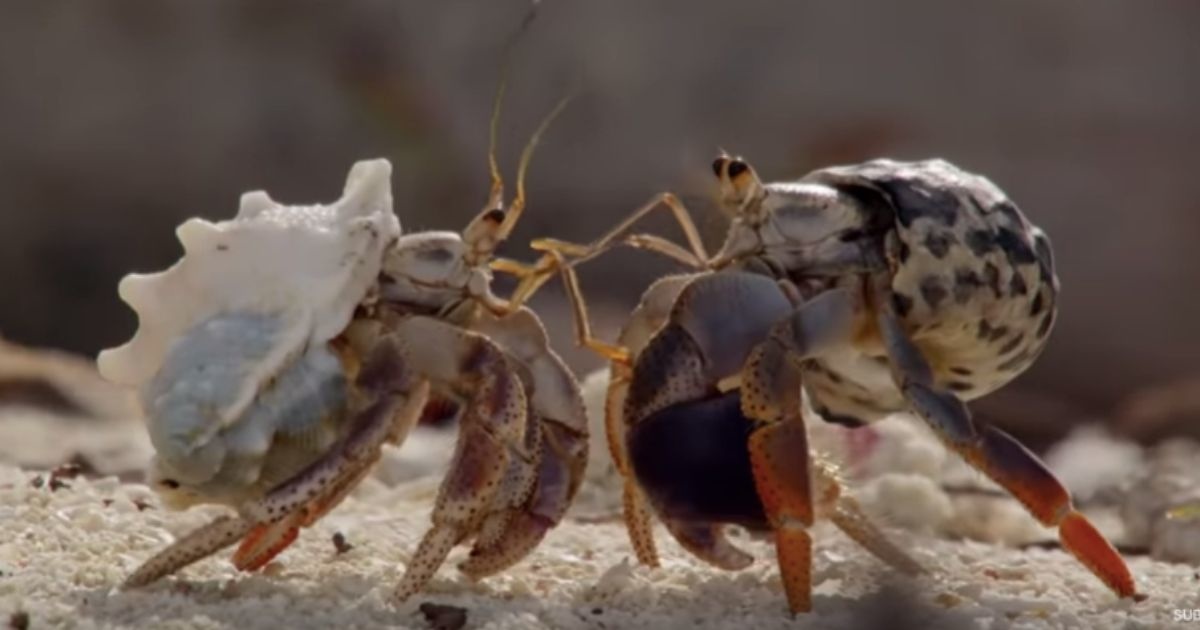
Hermit crabs line up biggest to smallest to exchange shells, and it’s mind-blowing to watch
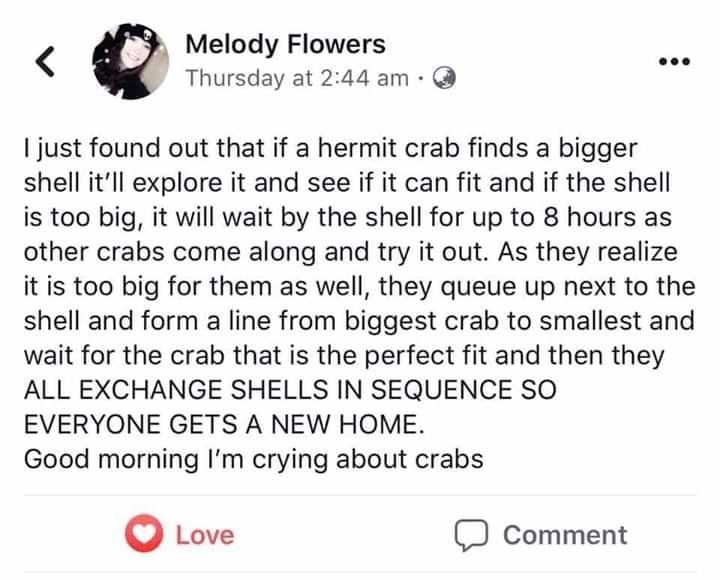
The other day, I came across this post on my Facebook page describing the way hermit crabs exchange shells. Never having given hermit crabs any thought, I almost passed it up, but the bold text “ALL EXCHANGE SHELLS IN SEQUENCE SO EVERYONE GETS A NEW HOME” caught my eye. Like, what? I was astounded to…
The other day, I came across this post on my Facebook page describing the way hermit crabs exchange shells. Never having given hermit crabs any thought, I almost passed it up, but the bold text “ALL EXCHANGE SHELLS IN SEQUENCE SO EVERYONE GETS A NEW HOME” caught my eye. Like, what?
I was astounded to find out that hermit crabs who need new, bigger shells will line up in a queue, biggest to smallest. When a crab that fits the largest empty shell shows up, the others all move up one shell, leaving the smallest shell empty at the end of the line.
Like, WHAT?!
I’m not one to believe every meme that comes through my social media feed, so I decided to research this myself. A 10-second Google search brought up a video of the entire process from the BBC and OH. MY. GOSH. This is seriously the best thing ever.
In a small village in Pwani, a district on Tanzania’s coast, a massive dance party is coming to a close. For the past two hours, locals have paraded through the village streets, singing and beating ngombe drums; now, in a large clearing, a woman named Sheilla motions for everyone to sit facing a large projector screen. A film premiere is about to begin.
It’s an unusual way to kick off a film about gender bias, inequality, early marriage, and other barriers that prevent girls from accessing education in Tanzania. But in Pwani and beyond, local organizations supported by Malala Fund and funded by Pura are finding creative, culturally relevant ways like this one to capture people’s interest.
The film ends and Sheilla, the Communications and Partnership Lead for Media for Development and Advocacy (MEDEA), stands in front of the crowd once again, asking the audience to reflect: What did you think about the film? How did it relate to your own experience? What can we learn?
Sheilla explains that, once the community sees the film, “It brings out conversations within themselves, reflective conversations.” The resonance and immediate action create a ripple effect of change.
MEDEA Screening Audience in Tanzania. Captured by James Roh for Pura
Across Tanzania, gender-based violence often forces adolescent girls out of the classroom. This and other barriers — including child marriage, poverty, conflict, and discrimination — prevent girls from completing their education around the world.
Sheilla and her team are using film and radio programs to address the challenges girls face in their communities. MEDEA’s ultimate goal is to affirm education as a fundamental right for everyone, and to ensure that every member of a community understands how girls’ education contributes to a stronger whole and how to be an ally for their sisters, daughters, granddaughters, friends, nieces, and girlfriends.
Sheilla’s story is one of many that inspired Heart on Fire, a new fragrance from the Pura x Malala Fund Collection that blends the warm, earthy spices of Tanzania with a playful, joyful twist. Here’s how Pura is using scent as a tool to connect the world and inspire action.
A partnership focused on local impact, on a global mission
Pura, a fragrance company that recognizes education as both freedom and a human right, has partnered with Malala Fund since 2022. In order to defend every girl’s right to access and complete 12 years of education, Malala Fund partners with local organizations in countries where the educational barriers are the greatest. They invest in locally-led solutions because they know that those who are closest to the problems are best equipped to solve and build durable solutions, like MEDEA, which works with communities to challenge discrimination against girls and change beliefs about their education.
But local initiatives can thrive and scale more powerfully with global support, which is why Pura is using their own superpower, the power of scent, to connect people around the world with the women and girls in these local communities.
The Pura x Malala Fund Collection incorporates ingredients naturally found in Tanzania, Nigeria, Pakistan, and Brazil: countries where Malala Fund operates to address systemic education barriers. Eight percent of net revenue from the Pura x Malala Fund Collection will be donated to Malala Fund directly, but beyond financial support, the Collection is also a love letter to each unique community, blending notes like lemon, jasmine, cedarwood, and clove to transport people, ignite their senses, and help them draw inspiration and hope from the global movement for girls’ education. Through scent, people can connect to the courage, joy, and tenacity of girls and local leaders, all while uniting in a shared commitment to education: the belief that supporting girls’ rights in one community benefits all of us, everywhere.
You’ve already met Sheilla. Now see how Naiara and Mama Habiba are building unique solutions to ensure every girl can learn freely and dare to dream.
Naiara Leite is reimagining what’s possible in Brazil
Julia with Odara in Brazil. Captured by Luisa Dorr for Pura
In Brazil, where pear trees and coconut plantations cover the Northeastern Coast, girls like ten-year-old Julia experience a different kind of educational barrier than girls in Tanzania. Too often, racial discrimination contributes to high dropout rates among Black, quilombola and Indigenous girls in the country.
“In the logic of Brazilian society, Black people don’t need to study,” says Naiara Leite, Executive Coordinator of Odara, a women-led organization and Malala Fund partner. Bahia, the state where Odara is based, was once one of the largest slave-receiving territories in the Americas, and because of that history, deeply-ingrained, anti-Black prejudice is still widespread. “Our role and the image constructed around us is one of manual labor,” Naiara says.
But education can change that. In 2020, with assistance from a Malala Fund grant, Odara launched its first initiative for improving school completion rates among Black, quilombola, and Indigenous girls: “Ayomidê Odara”. The young girls mentored under the program, including Julia, are known as the Ayomidês. And like the Pura x Malala Fund Collection’s Brazil: Breath of Courage scent, the Ayomidês are fierce, determined, and bursting with energy.
Ayomidês with Odara in Brazil. Captured by Luisa Dorr for Pura
Ayomidês take part in weekly educational sessions where they explore subjects like education and ethnic-racial relations. The girls are encouraged to find their own voices by producing Instagram lives, social media videos, and by participating in public panels. Already, the Ayomidês are rewriting the narrative on what’s possible for Afro-Brazilian girls to achieve. One of the earliest Ayomidês, a young woman named Debora, is now a communications intern. Another former Ayomidê, Francine, works at UNICEF, helping train the next generation of adolescent leaders. And Julia has already set her sights on becoming a math teacher or a model.
“These are generations of Black women who did not have access to a school,” Naiara says. “These are generations of Black women robbed daily of their dreams. And we’re telling them that they could be the generation in their family to write a new story.”
Mama Habiba is reframing the conversation in Nigeria
Centre for Girls' Education, Nigeria. Captured by James Roh for Pura
In Mama Habiba’s home country of Nigeria, the scents of starfruit, ylang ylang and pineapple, all incorporated into the Pura x Malala Collection’s “Nigeria: Hope for Tomorrow,” can be found throughout the vibrant markets. Like these native scents, Mama Habiba says that the Nigerian girls are also bright and passionate, but too often they are forced to leave school long before their potential fully blooms.
“Some of these schools are very far, and there is an issue of quality, too,” Mama Habiba says. “Most parents find out when their children are in school, the girls are not learning. So why allow them to continue?”
When girls drop out of secondary school, marriage is often the alternative. In Nigeria, one in three girls is married before the age of 18. When this happens, girls are unable to fulfill their potential, and their families and communities lose out on the social, health and economic benefits.
Completing secondary school delays marriage, and according to UNESCO, educated girls become women who raise healthier children, lift their families out of poverty and contribute to more peaceful, resilient communities.
Centre for Girls’ Education, Nigeria. Captured by James Roh for Pura
To encourage young girls to stay in school, the Centre for Girls’ Education, a nonprofit in Nigeria founded by Mama Habiba and supported by Malala Fund and Pura, has pioneered an initiative that’s similar to the Ayomidê workshops in Brazil: safe spaces. Here, girls meet regularly to learn literacy, numeracy, and other issues like reproductive health. These safe spaces also provide an opportunity for the girls to role-play and learn to advocate for themselves, develop their self-image, and practice conversations with others about their values, education being one of them. In safe spaces, Mama Habiba says, girls start to understand “who she is, and that she is a girl who has value. She has the right to negotiate with her parents on what she really feels or wants.”
“When girls are educated, they can unlock so many opportunities,” Mama Habiba says. “It will help the economy of the country. It will boost so many opportunities for the country. If they are given the opportunity, I think the sky is not the limit. It is the starting point for every girl.”
From parades, film screenings to safe spaces and educational programs, girls and local leaders are working hard to strengthen the quality, safety and accessibility of education and overcome systemic challenges. They are encouraging courageous behavior and reminding us all that education is freedom.
Experience the Pura x Malala Fund Collection here, and connect with the stories of real girls leading change across the globe.
It’s not easy being a river in the desert under the best of circumstances. The ecosystem exists in a very delicate balance, allowing water sources to thrive in the harsh conditions. These water sources in otherwise extremely dry areas are vital to the survival of unique wildlife, agriculture, and even tourism as they provide fresh drinking water for the people who live nearby.
But man-made problems like climate change, over-farming, and pollution have made a tough job even tougher in some areas. Rivers in Utah and Colorado that are part of the Colorado River Basin have been barely surviving the extremely harsh drought season. When the riverbeds get too dry, fish and other aquatic creatures die off and the wildfire risk increases dramatically.
About six years ago, one team of researchers had a fascinating idea to restore the health of some of Utah’s most vulnerable rivers: Bring in the beavers.
In 2019, master’s student Emma Doden and a team of researchers from Utah State University began a “translocation” project to bring displaced beavers to areas like Utah’s Price River, in the hopes of bringing it back to life.
Why beavers? It just makes dam sense! (Sorry.)
Beaver dams restrict the flow of water in some areas of a river, creating ponds and wetlands. In drought-stricken areas, fish and other wildlife can take refuge in the ponds while the rest of the river runs dry, thus riding out the danger until it rains again.
When beavers are present in a watershed, the benefits are unbelievable: Better water quality, healthier fish populations, better nutrient availability, and fewer or less severe wildfires.
It’s why beavers have earned the title of “keystone species,” or any animal that has a disproportionate impact on the ecosystem around them.
Doden and her team took beavers who were captured or removed from their original homes due to being a “nuisance,” interfering with infrastructure, or being in danger, and—after a short period of quarantine—were brought to the Price River.
Despite the research team’s best efforts, not all the translocated beavers have survived or stayed put over the years. Some have trouble adapting to their new home and die off or are killed by predators, while others leave of their own accord.
But enough have stayed and built dams since 2019 that the team is starting to see the results of the effort. In fact, beaver projects just like this one have been going on all over the state in recent years.
The water levels in the river are now the healthiest they’ve been in years. The fish are thriving. Residents of Utah are overjoyed at the results of the experiment.
A column in The Salt Lake Tribune from 2025 (six years after the beaver translocation began) writes that the revitalization of the Price River “helped save our Utah town.”
“A tributary of the Colorado River, the Price River runs through downtown Helper. On a warm day, you’re likely to find the river filled with tourists and locals kayaking, tubing and fishing along its shore. A decade ago, it was hard to imagine this scene—and the thriving recreation economy that comes with it—was possible.”
Of course, it wasn’t JUST the beavers. Other federal water cleanup investments helped remove debris, break down old and malfunctioning dams, and place tighter regulations on agriculture grazing in the area that depleted vital plant life.
But the experts know that the beavers, and their incredible engineering work, are the real MVPs.
An actual beaver dam on the now-thriving Price River Public Domain
In other drying, struggling rivers in the area, researchers are bringing in beavers and even creating manmade beaver dams. They’re hoping that the critters will take over the job as the rivers get healthier.
Utah’s San Rafael river, which is in bleak condition, is a prime candidate. In on area of the river, a natural flood inspired a host of beavers to return to the area and “riparian habitat along that stretch had increased by 230%, and it had the most diverse flow patterns of anywhere on the river,” according to KUER.
It’s hard to believe that beavers nearly went extinct during the heyday of the fur trapping industry, and continued to struggle as they were considered nuisances and pests. Now, they’re getting the respect they deserve as engineer marvels, and their populations have rebounded due to better PR and conservation programs.
To that I say…it’s about dam time!
This article originally appeared last year. It has been updated.
As spring approaches, gardeners begin planning what they want to plant and when. Often, they starting seeds indoors rather than outside. Usually, seeds are planted in trays or small cups and nurtured into seedlings before being transplanted outdoors once the danger of frost has passed.
Seed starts require space, though, and not everyone has it in abundance. That’s why a “revolutionary” method of starting seeds using recycled packaging materials has people excited. Using the “seed snail” or “seed sushi” method, you can grow far more seedlings in a much smaller area than with traditional trays or cups.
When you start seeds, they need to be spaced far enough apart that their roots don’t get entangled, which is why traditional seed starter trays have small compartments. The seed snail keeps seedlings’ roots separate while allowing them to grow in a compact space.
Benedict Vanheems, author of GrowVeg: The Beginner’s Guide to Easy Vegetable Gardening, demonstrates how to make the seed snail using different kinds of packaging materials. However, he says bubble wrap is his “absolute favorite.”
“This, with its air pockets, helps to create a slightly sturdier roll so it sits firmer,” Vanheems says in a YouTube clip. “And the air pockets will also help to insulate the roots from swings in temperature, which our seedlings will much prefer. Bubble wrap is flexible, retains moisture well, and can be reused time and again.”
Bubble wrap isn’t an obvious gardening tool, but it’s useful. Photo credit: Canva
However, he acknowledges concerns people may have about microplastics and offers a solution. First, he cuts the bubble wrap into long strips about three inches wide. Next, he cuts a strip of baking parchment twice as wide. He then folds the parchment in half and wraps it over both sides of the bubble wrap. This ensures the soil never touches the plastic while still providing the temperature-regulation benefits of the bubble wrap.
Vanheems adds water to the potting mix to make it very moist. Depending on the size of the seeds you plan to use, you’ll cover the strip of packaging with between 1/2 inch and 2 inches of soil. Pat the soil down fairly firmly, and leave an inch or two uncovered at the end.
After you roll up the “snail,” use painter’s or masking tape to secure it. Then it’s ready for you to add your seeds according to the individual seed instructions. Vanheems doesn’t recommend sowing the seeds before rolling, as they can get moved around and dislodged. He also gives tips for retaining moisture in the snail rolls, from misting or light watering to keeping them covered with clear plastic.
Traditional seed trays take up more space than a seed snail. Photo credit: Canva
Vanheems showed what the seedlings looked like once they had developed roots and shoots. This method allows long, deep roots to grow, making it easy to separate the plants after unrolling the snail.
Some seedlings may need more soil added to the roll once their roots begin to grow. Simply unroll the snail, sprinkle more soil over the roots, and reroll. Easy peasy. The main thing to watch with the snail is that it stays moist, since it uses less soil per seedling than traditional trays.
Both amateurs and pros are loving the idea in the YouTube video comments:
“Your method is a LOT cheaper than buying these expensive plastic containers in the DIY garden market that barely survive one year in the garden. I surely will give it a try. Thank you!”
“I just ran across these a few days ago and I’ve already got a bunch of them going! This is going to be a game changer! I’m using disposable shower caps to cover the ones that need it – they’re infinitely reusable as long as you don’t break the elastic.”
Once your seedlings grow large enough, you can transplant them. Photo credit: Canva
“I tried this ‘seed snail’ method with my Sweet Peas last week and I’m officially a convert! The vertical root growth is incredible, but the real win for me was the space saving—I fit twice as many under my grow lights than I usually do. If you’re tight on indoor space, this is a total game-changer. Great tutorial!”
“I’ve been wondering how to go about growing a large number of native plant plugs without having to buy more plastic. Using this technique I’m going to stretch my supplies to grow even more seeds in a single season. Thank you so much for the tip. You weren’t kidding when you said it would change the way you do things. I’m officially converted.”
“A little advice from an old nurseryman, when handling tiny seedlings, it is much safer to handle them by their leaves, not the stems. Even a finger can damage a very sensitive seedling stem and can cause damping off that will kill the seedling. The seed snail idea is brilliant and I will start using it myself. It has several advantages but the best for me is the unrolling and the easy removal of the seedlings without damage to their root systems. Thank you!”
A baby monkey named Punch has captured the hearts of people around the world. The now seven-month-old Japanesemacaque, who lives at Japan’s Ichikawa City Zoo and Botanical Garden, was rejected by his mother shortly after birth. Videos of him clinging to zookeepers coming into the enclosure broke people’s hearts, but that was just the beginning of the saga.
Zookeepers gave Punch a stuffed orangutan toy as a surrogate “mom” to cuddle with. Naturally, that has only increased the “Awww” factor. Punch drags the toy around with him and runs back to it for comfort when he’s scared or lonely, and he’s been scared and lonely a lot since he was introduced to the larger macaque troop in January. Videos show him being pushed away and even dragged around by older macaques, after which he runs back to cling to his stuffed mama.
People can’t take watching a baby monkey be rejected
However, things have not been quite as dire for Punch as they may appear. The zoo has reassured the public in a statement that the “bullying” Punch has endured is actually a pretty normal part of primate socialization. Being “disciplined” by other macaques will teach him appropriate behavior in the troop, even if it appears mean to our human sensibilities.
People’s reactions to Punch and his struggles to fit in have been emotional and fierce, though. It’s like Punch’s story was designed to trigger every compassionate, protective instinct we have as humans. The motherless outcast who just wants to be loved. The big, mean bullies who knock him around. The rejection when he attempts to make friends. The finding comfort wherever he can, even in an inanimate object.
Comedian Britt Migs captured the emotional investment people have in this monkey in a parody video. It may be hilariously over the top, but it’s actually not far off from how many people feel after watching Punch videos.
Comments on the videos range from sadness to empathy to rage:
“Punch needs to have his own kingdom.”
“At dawn we ride for Punch.”
“How do I apply to foster and ultimately adopt punch. He can stay with me.”
“This story has wrecked my life this week.”
“I love Punch and I’ve never met him!”
“Every video I see of punch I’m crying, He’s so cute and innocent.”
Punch is doing better than people think, thankfully
There has been good news on the Punch front, thankfully. The zoo says he “shows resilience and mental strength” even as he goes through his social pitfalls. And he has started making friends with others. Newer videos show him being carried and cuddled by at least one older macaque, playing with a peer, and even being groomed. All good signs.
Ichikawa Zoo has seen a massive influx of visitors since Punch’s story went viral and has had to make adjustments. They have asked visitors to limit their time on Monkey Mountain (where the macaques live) and observe quietly so as not to disturb them.
The zoo has been keeping people posted on how Punch is doing. A zookeeper update from February 22 reads (translated from Japanese on X): “Thanks to everyone’s good manners, it was a calm atmosphere with no fights or anything like that. Punch, around 5 PM, was meticulously groomed by two monkeys and is steadily fitting into the group.”
The reality of zoos can often give people pause and prompt concern for the well-being of the animals in human care. Dr. Tessa Wilde, executive director at For the Love of Primates, shared some insights into how macaques live in the wild and how that influences the way enclosures are designed.
It’s #MonkeyMonday 🐒❄️ You asked about #PunchTheMonkey and Japanese macaque enclosures, so let’s break down how snow monkeys live in the wild—and how zoos and sanctuaries can mirror those rocky, mountainous habitats. #AnimalCare#fyp#viral
There’s a rather fuzzy line between caring for animals and anthropomorphizing them to the point where we might interfere with normal behavior, such as the socialization we’ve seen Punch going through. Wilde pointed out in a previous video that early rejection and scolding are not unusual in a case like Punch’s. And we’re seeing progress as he gets integrated into the troop, so that’s promising.
It is hard to watch, though, and our feelings of compassion for a creature we think is going through a hard time certainly isn’t a bad thing. We need more compassion in the world, even if it comes through a monkey with a stuffy just trying to find a family.
Punch the 6-month-old macaques monkey has gone viral for seeking comfort in a stuffed orangutan that is like his “surrogate mom.” Punch was abandoned by his real mom shortly after birth and the staff at Ichikawa City Zoo near Tokyo, Japan have been raising him. Punch, however, has hit some bumps in the road while trying to learn how to socialized with the other monkeys. In one viral video, another monkey is seen getting aggressive with him, but the zoo explained why that may happen. Here’s what the zoo says about Punch’s development – and why his “surrogate mom” stuffed animal is helpful. #monkey#punch
Working out isn’t always fun, but sometimes what’s good for you isn’t fun. An orange and white tabby cat named Mr. Kitty is realizing that all of those cat treats are a lifetime on the hips. So many things are tasty going down, but they’re not so great when working to get the pounds off.
Mr. Kitty received the news that he had to not only go on a diet but also participate in an exercise regimen. His owner has been sharing his weight loss journey on her Instagram page, The Mr. Kitty Show. His less-than-stellar attitude about exercise has garnered him a fan club. There’s nothing like a sassy cat being forced to work out to make cat lovers cheer.
A chubby cat sits near a scale. Photo credit: Canva
Mr. Kitty does not appear amused. The sassy cat does everything in his power to avoid working out. He must’ve been taking dieting tips from Garfield, because he’s a whopping 30 pounds. On the cat chonk chart, Mr. Kitty would be an “OH, LAWD HE COMIN.‘”
People can find “The Chonk Chart” in cheeky veterinary offices. It shows cats’ weights, ranging from “A Fine Boi” (average weight) to “A Heckin’ Chonker” (overweight but not obese). On the far end of the chart is Mr. Kitty’s status.
Some wonder how a cat gets to Mr. Kitty’s size. It’s unclear what led to his excessive weight. Often, this level of weight gain is caused by overfeeding and under-exercising. According to PetMD, “All cat breeds can become obese. Middle-aged (8–12 years old), spayed or neutered, indoor-only or primarily indoor cats tend to be more at risk for becoming obese cats.”
The average weight of a healthy adult cat is between seven and 12 pounds, depending on whether the cat has a small or large frame, according to the Cummings School of Veterinary Medicine at Tufts University. So, Mr. Kitty is well outside of the normal weight range, and as his owner drags him to the kitty cat gym regularly, he wants her to know just how unhappy he is.
Aside from giving his human the death stare while walking on the treadmill, he also protests the exercise equipment. Mr. Kitty was originally placed on a treadmill with a plastic display piece in front. By resting his front paws on the plastic piece, only his back legs had to walk. His humans moved him to a different treadmill to stop him from cheating on his weight loss journey.
Instead, he decided not to walk at all. Mr. Kitty would park his chonkin’ self on the treadmill and wait for it to roll him all the way to the edge so he could try to escape burning calories. The people in the cat gym had to stack pool noodles at the back of the machine to force Mr. Kitty to work out. All the hard work has started to pay off, whether this cat wanted to participate or not. Mr. Kitty has dropped to 20 pounds, and his fan club couldn’t be prouder.
One person says, “Hi Mr. Kitty! Congratulations on your weight loss journey! You look great!”
“Get it Mr Kitty! Mr Kitty looks strong and confident,” another cheers.
Someone else writes, “Mr. Kitty I think you look adorable but I’m betting your joints are thankful for the weight loss! Keep going, king!”
This person feels Mr. Kitty’s pain, writing, “I understand this so well… I would go through the same length not to walk on a treadmill. Mr kitty understands us chubby ones.”
According to some commenters, Mr. Kitty is perfectly happy working out at the holistic vet. He was just a cat doing cat things, finding cheat codes to not exercise because cats do what they want, when they want, and the days he tried to escape were the days he didn’t feel like exercising. Either way, Mr. Kitty’s progress has been amazing, and his little joints likely feel so much better.
There’s nothing more exhausting than having a dry cough that won’t go away. Some viruses, such as RSV, can cause a lingering cough for weeks after the infection is over. Most people try cough suppressants and lozenges to make themselves more comfortable. Still, there’s one ancient remedy most people don’t know about that research suggests can work quickly: marshmallow root (Althaea officinalis).
“The natural marshmallow root or plant has been shown to decrease throat irritation and coughing,” said Dr. Bayo Curry-Winchell, a family medicine physician and TED Talk speaker, according to The Huffington Post. “The soothing effect comes from the plant’s natural coating, called mucilaginous, which is a sticky gelatin substance that might help reduce a cough.”
However, that doesn’t mean you should pop a few extra-large marshmallows in your mouth or down a few teaspoons of marshmallow ice cream topping, as the woman in the TikTok video below suggests. Companies that make the sweet confection stopped using marshmallow root decades ago.
“Store-bought marshmallows, which contain sugar, water, and gelatin, do not [reduce coughing],” Dr. Sood clarified on TikTok. “But marshmallow root, which has been used since ancient times, does have medicinal uses and can soothe your throat and suppress your cough. This was previously an ingredient in marshmallows but has now been replaced with sugar. The reason it helps is it builds protective coat in your mouth and throat, and there is research to support.”
Why marshmallow root is so great at soothing coughs
Marshmallow root is effective at soothing a dry, painful cough due to the mucilag, a sap-like substance it produces. When ingested, the mucilage coats the mucosa, or the lining of the body’s inner passages, soothing them like a balm.
Multiple studies have found that marshmallow root, when used as a cough syrup or lozenge, provides rapid symptom relief. It has also been shown to reduce cough reflex sensitivity and throat irritation.
There are many different ways to take marshmallow root if you have a cough that won’t go away. You can make marshmallow root tea by using the root as loose-leaf tea, pouring boiling water over it, and letting it steep for 10 minutes. You can also mix marshmallow root powder with water or juice to make a drink.
This may be the first time you’ve heard of using marshmallow root to soothe a hacking cough, but its medicinal use dates back to ancient Egypt, where it grew in swamps and bogs.
In the 1800s, the French took the marshmallow plant, mixed its sap with rose water and egg white meringue, and dropped the mixture into candy molds. This marked the birth of the marshmallow you love and cook over campfires today. Over the years, marshmallows became increasingly popular, so manufacturers ditched the root sap in favor of gelatin and corn syrup, which were more readily available.
Marshmallow root is a great example of how, even as scientific advancements have drastically changed how people approach health, some ancient remedies have stood the test of time.
If you’ve ever seen a turkey in real life, you may already have questions about the odd birds. Can they fly? Why do they have those dangly things on their faces and necks? How can you tell a male turkey from a female? Can you eat turkey eggs?
One question you’ve probably never asked is, “Do turkeys have to be burped?” But after watching this turkey-burping demonstration, you might (along with about a dozen other questions, starting with “What on Earth did I just watch?”).
You’re not alone. So many commenters found themselves in the same boat:
“I am the first in my bloodline to see a turkey burped.”
“Do they explode if you don’t do this ?”
“Why did I just watch a tutorial on burping a turkey?”
“Will I ever be in a situation where I need to burp a turkey? No. Did I watch this to the end? Definitely.”
“Me watching this whole video like I have a turkey to burp.”
The Canadian homesteader who burped her “little dinosaur” Eli in this video shares all kinds of interesting facts about turkeys on her TikTok channel, @tallqueenbaby. She raised Eli from the time he was two weeks old and brings him in front of the camera for a good burping every once in a while.
Why, though? She explained everything in a follow-up video:
“It doesn’t smell pleasant,” she said. “They eat grains and corns and things like that and it’s mixed with hot air, so it’s kind of just this weird, unpleasant smell. It’s not something I’d want to smell all the time.”
Do turkeys need to be burped?
“No. It is not a necessity,” she said. “It’s moreso for bonding and for excess relief.”
She explained that both male and female turkeys will strut, puffing out their chests, but male turkeys have a different air sac system, so more air accumulates in them. She added that burping them shouldn’t be done often and can hurt them if not done properly. Therefore, it’s not something to try randomly on your own (in case you had any ideas).
Can wild turkeys be burped?
She doesn’t know. She doesn’t mess with wild turkeys. It’s probably best not to try.
She’s also not the only one sharing turkey burps on TikTok. Here are a few more big burpers:
That air will eventually make its way out of the turkey without any assistance, but we all know how satisfying it is to have a nice, big burp.
Sadly, our little dinosaur friend Eli is no longer with us, as he passed away from an unexpected injury in January 2026. He was a beloved pet, and @tallqueenbaby created a lovely tribute to him on her TikTok channel:
it’s with a heavy heart that i type this. Eli past away yesterday from an unexpected injury. Eli was my pet. he was the protector of my flock, my sweet boy. i’m truly devastated. i want to thank everyone who gave Eli love. he is so missed but is now reunited with his wife Dumplin. #elitheturkey#turkey#turkeyburp#farm#loss
She continues to share videos with Eli from before his passing, and the people who only just met him through his virality are grateful. Eli served as a guardian on the farm, as well as a sweet, feathered friend.
“We truly had a beautiful bond,” she wrote. “He was such a good boy and did his job as protector so well. I’m so grateful to have experienced this.”
“Sharing this moment with Mãhina and her protective mother is a memory that will live with me forever,” Allen said in a press release. “It was undoubtedly one of the most extraordinary days I have ever experienced in the ocean—and perhaps ever will. To be announced World Nature Photographer of the Year through capturing this unique mother and calf bond has made what was already a truly life-changing encounter even more profound and humbling. I feel beyond honoured to receive this award.”
The World Nature Photography Awards were founded on the belief that “small positive actions can help shape the future of our planet, and that photography has the power to influence perspectives and inspire change.”
The 2026 competition saw entries from 51 countries across six continents. Here are 14 of the gold medal–winning photos from the competition.
1. World Nature Photographer of the Year 2026 Grand Prize Winner — Jono Allen (Australia) “Mãhina,” Humpback Whales in Vava’u, Tonga
“Captured in the tropical waters of Vava’u, Tonga, this rare white humpback calf – named Mãhina, meaning “moon” in Tongan – glowed like a beam of light as she travelled through the deep blue water with her protective mother. With only 1 in 40,000 humpbacks born with this lack of pigmentation, her presence was not only breathtaking but symbolic. Watching this spectacular and curious moon white whale calf play and roll through the water represents the remarkable success story of a species given the chance to recover after being heavily targeted by whaling and once being brought to the brink of extinction. Considering the resilience of this awe-inspiring species, sightings of such rare individuals renews hope in what can happen when conservation is championed and wildlife is allowed to thrive. Mãhina is a living reminder of what is possible when conservation works – a species once on the brink, now rebounding.” — Jono Allen
2. Gold: Animal Portraits — Mary Schrader (South Africa) “Shared Wonder,” Gorilla and Butterfly in Bwindi, Uganda
“It was a day defined by quiet connections. Beneath the lush canopy of Bwindi, I observed a young female gorilla gently nestled against the protective bulk of a silverback. The atmosphere was serene, filled with gentle sounds of the forest, until a sudden burst of delicate color broke through the calm. An unexpected visitor, a vibrant butterfly, appeared out of nowhere, fluttering gently through the air. Captivated, the young gorilla’s eyes widened, and in that moment, a beautiful interaction unfolded as a silent, shared wonder between two vastly different beings.” — Mary Schrader
3. Gold: Behaviour Mammals — Vaidehi Chandrasekar (Singapore) “Giraffe Water ballet,” Giraffe in Makgadikgadi Pans National Park, Botswana
“As the sun dipped low over the dry Makgadikgadi landscape in Botswana, a lone giraffe stepped to the water’s edge. Towering and graceful, it bent its long legs, lowering its neck for a drink. Then came a moment of magic. Having taken its fill, the giraffe lifted its head – and with a gentle swish, expelled a stream of water in an arc that shimmered in the golden light. The droplets danced in the air, forming a near-perfect circle before falling back to the earth.”— Vaidehi Chandrasekar
4. Gold: Behaviour Amphibians and Reptiles — Dewald Tromp (South Africa) “Stoicism in a Sandstorm,” in Makgadikgadi Pans National Park, Botswana
“The Namib Desert is one of the most extreme environments on Earth, with no surface water and daytime temperatures exceeding 45 °C. Despite this, life is abundant, you know, where to look. Sandstorms are frequent, with wind blowing down from inland mountains that stir up fine sediment and particles. A Namaqua chameleon has to endure the sting of pebbles blowing against its skin,while we were lucky enough to escape to the relative comfort of our 4×4.” — Dewald Tromp
5. Gold: Behaviour Invertebrates — Minghui Yuan (China) “Home on the Leaves,” Moth Moss Larva in Xishuangbanna, China
“In the tropical rainforest of Xishuangbanna, I found a moss moth larva creating a protective net nest on newly grown, tender plant leaves. Moss moth larvae bite off their toxic hair-likestructures and use their sticky saliva to build their own houses. It uses its own poisonous fur as building material, which can resist attacks from parasitic wasps and ants. In the net nest, the moss moth larvae form some very thin and difficult to see silk, hanging themselves in the air as if they were lying in a hammock.” — Minghui Yuan
6. Gold: Behaviour Birds — Fenqiang Liu (USA) “Arrival,” Great Egret in Winter Park, Florida
“Each spring, great egrets gather at Kraft Azalea Garden in Central Florida to nest high in the trees. Photographing from below, I look for moments when backlight reveals the elegance and structure of their wings in flight. I captured this image on an early April morning, as an egret passed between me and the sun just before landing.” — Fenqiang Liu
7. Gold: People and Nature — Deena Sveinsson (USA) “The Wildlife Photographer,” Bull Moose in Grand Teton National Park, Wyoming
“After an evening snowfall in the Grand Teton National Park, Wyoming, USA, the photographers woke up to a blanket of snow covering the sage flats. It was a relatively slow and boring morning watching the many bull moose eat their morning breakfast of bitter brush. A group of us photographers was photographing the bull moose making its way in our direction. He would eat for about 10 minutes, then take a few steps, only to start eating again. At some point, the bland bitter brush bored him, and he decided to go on his walkabout. But he decided to do his walkabout toward all the photographers. We quickly moved away to give the moose his space, but in all the haste, a tripod and a camera ended up being left behind. At first, the bull moose ignored the gear and started to thrash his antlers on the bitter brush. After his curiosity got the best of him, the bull moose decided to check out the camera gear.” — Deena Sveinsson
8. Gold: Plants and Fungi — Duncan Wood (Scotland) “Elder in Flame,” Elder Birch in Glen Affric, Scotland
“Golden autumn colours explode in this intimate portrait of an incredible, lichen-laden elder birch in full seasonal display — bold, brilliant, and full of character, like a woodland peacock. Taken in Glen Affric, this image captures a fleeting moment of drama and beauty from one of Scotland’s most vibrant autumn landscapes.” — Duncan Wood
9. Gold: Nature Art — Simon Biddie (UK) “Ghost of the Reef,” Ghost Goby in Marsa Alam, Egypt
“Small reef fish, unassuming and often unseen, contribute to 70% of the fish biomass, making them a critical part of reef food chains. Small fish, like many of their land-based insect equivalents, evade predators by being experts in hiding. These small reef fish are also known as ‘cryptobenthic’ fish – crypto as they hide in crevices, or use camouflage.” — Simon Biddie
10. Gold: Urban Wildlife — Robert Gloeckner (USA) “Trash Trail Temptations,” in Manitoba, Canada
“In this striking image, a polar bear in Churchill, Manitoba, investigates a heap of discarded electronics and household items – part of a growing and very human-made trash trail that’s reshaping how wildlife interacts with civilization. In 2024, the town’s only trash facility burned to the ground. The incident underscored a growing concern: polar bears were increasingly scavenging garbage during the ice-free months, leading to a rise in human-wildlife conflicts.” — Robert Gloeckner
11. Gold: Earth’s Landscapes and Environments — Miki Spitzer (Israel) “The Eye of the Dragon,” Geothermal Pool in Iceland
“This is a drone photo of a natural geothermal pool in central Iceland at Hveravellir. In the photo, you can see the pool, which I think looks like a dragon’s eye.” — Miki Spitzer
12. Gold: Black and White — Christopher Baker (USA) “Sunbathing,” Slider Turtle in Madison, Alabama
“An adult pond slider turtle perched atop a stump, bathing in the early morning sun. I lay on the ground to get a low-angle perspective of the scene and converted it to black and white to enhance the textures of the turtle’s shell and skin, as well as the stump.” — Christopher Baker
13. Gold: Animals in their Habitat — Charlie Wemyss-Dunn (UK) “Splash,” a Brown Bear and Sockeye Salmon in Katmai National Park, Alaska
“A hungry brown bear launches headlong into a creek in Alaska’s Katmai National Park to try to catch one of the many sockeye salmon spawning in large numbers during their seasonal migration. Each August, large concentrations of brown bears gather along the rivers and creeks in Katmai, waiting for the annual arrival of salmon from the coast. I observed this scene after a two-hour walk from our camp from atop a cliff. I positioned myself at the cliff’s edge to get a unique perspective looking down on the action below and used a polarizing filter to cut any glare from the water’s surface.” — Charlie Wemyss-Dunn
14. Gold: Nature Photojournalism — Alain Schroeder (Belgium) “Chimp Paradise,” Chimpanzee and Humans in Fort Pierce, Florida
“Kayla, a 37-year-old 61.2 kg female, was in the procedure room, and her stomach was shaved for an ultrasound. Socks have been placed on her extremities, and a fur hat with flaps has been placed on her head to avoid hypothermia. General caption Founded in 1997, Save the Chimps is the largest privately funded chimpanzee sanctuary in the world. Its mission is to provide a safe haven for captive chimps who have been exploited by humans for research, testing, and entertainment. The 150-acre state-of-the-art facility in Florida is home to over 220 rescued chimpanzees living their best possible lives among peers, thanks to a team of passionate veterinarians, caretakers, and volunteers who provide personalized care and nutritious, individually tailored feeding and enrichment plans in a spacious island habitat. The sanctuary is working tirelessly to welcome all captive chimpanzees across the United States who need refuge and expert loving care for the rest of their lives.” — Alain Schroeder
It never fails: someone’s been sitting for a while and decides to stand to stretch their legs. The moment a cat owner’s knees fully extend is the exact moment their cat jumps into their seat. Often, it seems like they were pre-curled into their adorable pose before seemingly levitating onto the pre-warmed seat.
This normal kitty behavior can sometimes be irritating to cat owners, especially when they were planning to sit right back down. When there’s a cat snuggled in a chair, it can become a struggle to get them out, especially if the cat is a little stubborn. Some cats refuse to move, seemingly pressing their weight into the seat, while others grab onto the fabric with their nails in an effort to claim the chair. It’s a battle that can happen multiple times per day.
It can begin to feel like you’re in a fight for dominance with a 10-pound furball that can’t open doors without your assistance. A cat owner can successfully shoo the cat out of their chair, turn around to sit, and the cat beats them to it all over again. So what’s the deal? Are people really in a power struggle with their cats, or do cats have a logical reason for continually stealing seats from the people who feed them?
Well, some cats are being naughty and use this behavior as attention-seeking. They want their human to pick them up, pet them, or play with them. But this isn’t always the case, according to experts. There are four other reasons cats do this that have nothing to do with bad behavior.
They feel safer on surfaces above the ground
According to Cats.com, “When a cat sleeps, they are at their most vulnerable. Therefore, they like to pick nice, safe places to take their naps. Our human chairs are raised off the ground, and often are protected on three sides by the tall back and arms, so they offer more protection than a standard cat bed placed on the floor.”
The higher vantage point also allows them to have a good view of the room while they’re relaxing, so they prefer to claim the spot as their own.
Even though cats have a representation of not caring much about their human roommates, it couldn’t be further from the truth. Cats love the people in their home, which means they also love the way they smell because they trust you. Catster explains, “They begin to associate your scent with familiarity and safety, so leaving it behind on your seat is going to draw them to it.”
They’re claiming you and everything you love
Cats are territorial, so jumping into a seat after their human leaves is a sign of deep affection. They want everyone, including other animals in the home, to know that you belong to them. One way to do that is by sitting in your chair to leave their scent in your space.
According to Dr. Mark West, a veterinarian who shares content on TikTok, “When your cat looks at you, they don’t see someone who feeds them, they see their safe place, their territory, their anchor in the world. To your cat, that spot is not just somewhere to sit; it is your spot. And when they choose it, they are choosing you.” He later adds, “Your scent tells them everything is okay. They feel like they’re protected, that they’re home.”
Your seat is warm
This is probably the most logical reason someone could think of. Even as humans, we love to hop into something pre-warmed. Think about the pre-warmed towels at a spa, or hopping into the bed still warm from your partner’s body heat. It’s cozy. Cats love a cozy spot as much as their humans.
PetBook says, “The cat doesn’t know we planned to return there. Cats love warmth, and we often surround ourselves with cozy, warm blankets and pillows. Especially in winter, our seats have an almost magical attraction for the animals. But even in summer, cats seek out cozy spots without drafts.”